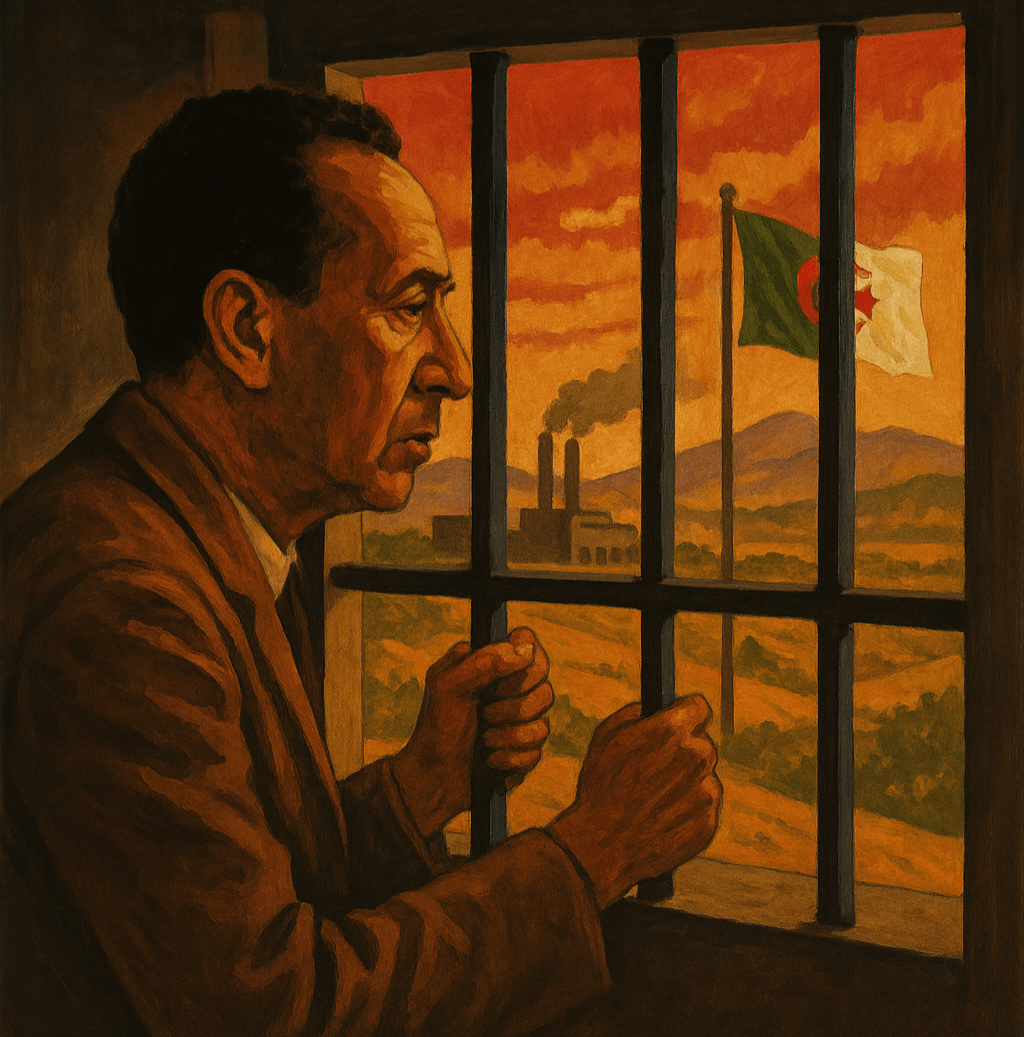
The Fighter Who Entered the Fire
Ahmed Ben Bella was not the chosen candidate of empire. He was not a functionary of the French, nor a placeholder for the West. He was a guerrilla, a revolutionary nationalist, and the face of Algeria’s storm-borne independence.
But unlike those who would take the flag of liberation and plant it inside a bourgeois state, Ben Bella tried to chart a different course. His presidency was brief, contested, and ultimately overthrown—but his attempt to pivot the Algerian revolution leftward, toward socialism and Third World internationalism, remains a defining moment in the history of postcolonial struggle.
This is not a hagiography. Ben Bella was not free of contradiction. But those contradictions must be judged within the brutal aftermath of colonial war, and the hostile context of a world split between imperialist blocs. He tried to build a new Algeria—land for the fellahin, dignity for the dispossessed, socialism for the people.
For that, he was overthrown. By the very forces who feared that his turn toward radical transformation would disrupt the postcolonial order.
Ben Bella was no puppet. He was a revolutionary caught in the storm between liberation and counterrevolution. And for a moment—before the guns turned inward—he tried to choose liberation.
Part I: Guerrilla Roots and the FLN Struggle
Ahmed Ben Bella was not born into revolution, but into resistance. Raised in a colonized Algeria where the French flag flew over every institution and the native majority was treated as subhuman, he came of political age in a crucible of racist violence, systemic poverty, and armed repression.
Ben Bella joined the French army during World War II—not as a collaborator, but as a means of training for future liberation. Like many colonial subjects, he understood that the skills of the colonizer could be repurposed for decolonization. After the war, disillusioned by France’s empty promises and brutal crackdown on Algerian uprisings, he became a founding member of the Organisation Spéciale, an underground militant network that later helped form the backbone of the FLN—the National Liberation Front.
He was arrested, imprisoned, hunted. But even in jail, he remained a symbol of militant resistance. When the FLN launched its war of liberation in 1954, it did so with Ben Bella’s name on the lips of the fighters. His strategic clarity, international reputation, and unwavering anti-colonial stance made him a natural leader.
He understood the stakes. Algeria wasn’t just fighting for political independence—it was fighting for social revolution. The colonial system had created a settler elite that owned the land, controlled the capital, and monopolized political power. The FLN had to do more than defeat France; it had to dismantle the structures France left behind.
By the time Algeria achieved formal independence in 1962, over a million Algerians had been killed. But the revolution had prevailed. And Ben Bella, released from prison, was catapulted into the presidency with mass popular support.
He didn’t inherit a functioning state. He inherited the ruins of war and a fractured revolutionary movement. But instead of securing power for its own sake, Ben Bella attempted to channel the FLN’s victory into a radical transformation of Algerian society.
And that, more than anything, would mark him for removal.
Part II: Radicalization, Internationalism, and the Internal Enemies of Revolution
Once in office, Ahmed Ben Bella made it clear he would not settle for a comprador postcolonial state. He saw independence not as a finish line, but as the beginning of a deeper social revolution. He moved quickly—too quickly for some.
He nationalized farmland and expropriated settler property, turning it over to Algerian peasants. He called for worker self-management in abandoned French factories. He pushed the FLN to embrace socialism not as an abstract idea, but as a material program for the poor, the landless, and the displaced. His rhetoric was fiery, but rooted in practice: “We are neither capitalist nor communist—we are Algerian socialists.” But make no mistake—his project was anti-imperialist, collectivist, and defiant of neocolonialism.
On the world stage, Ben Bella positioned Algeria as a hub of anti-imperialist solidarity. He welcomed Che Guevara, Mandela, and leaders of liberation movements from Angola, Mozambique, and Palestine. Algiers became known as the “Mecca of revolutionaries.” He called for a Third World front—not aligned with the USSR or the U.S., but grounded in the specific needs of formerly colonized peoples.
But revolution does not exist in a vacuum. And within the FLN and military leadership, contradictions were sharpening.
Many within the army, especially the officers who returned from exile in Tunisia and Morocco rather than fighting on the ground, viewed Ben Bella’s radical turn with suspicion. They feared the growing influence of the masses and the erosion of their own class interests. They saw in his reforms not renewal, but risk. The technocrats and military brass wanted order—not transformation.
And behind the scenes, France and the West watched nervously. A radical Algeria, sitting atop gas and oil reserves, rejecting Cold War allegiances and arming guerrilla movements, was a nightmare for imperial stability.
Ben Bella saw it coming. But he refused to compromise.
He radicalized when the moment demanded it. And for that, the state he led would soon move against him.
Part III: The Coup, the Class War, and the Tragedy of Algeria’s Future
On June 19, 1965, the revolution turned inward. Colonel Houari Boumédiène—Ben Bella’s Minister of Defense and former ally—led a bloodless coup that removed Ben Bella from power. It was framed as a correction. A stabilization. A necessary shift to prevent chaos. But it was, in substance, a counterrevolution from within.
There were no trials, no popular votes, no revolutionary congress. Just tanks on the streets and Ben Bella under house arrest. The mass organizations he had nurtured—the unions, the peasant cooperatives, the youth groups—were quietly sidelined. The workers’ councils were replaced by state technocrats. The radical foreign policy cooled. The state was restructured—not along socialist lines, but along statist ones.
The coup was not just a military maneuver. It was a class realignment.
The bureaucratic layer of the FLN, fearful of the mobilized masses and uncomfortable with self-management, consolidated its grip. The military hierarchy closed ranks. The technocrats steered the economy toward state capitalism. Western capital cautiously reengaged. Boumédiène nationalized oil and gas, but within a framework that restored order to the ruling apparatus—not revolutionary momentum.
Algeria remained formally independent. But the revolution had stalled.
Ben Bella, meanwhile, remained in detention for over a decade. When released, he reemerged as a critic of authoritarianism and a voice for Third World unity. But his moment had passed. The class forces that overthrew him had no interest in revisiting the rupture he tried to create.
And so Algeria—once the epicenter of radical dreams—slid into a post-revolutionary normalcy. The ghost of the revolution still haunted the Kasbahs and streets. But the fire was gone.
Ben Bella was no push over. He tried to turn a nationalist revolution into a socialist one. And for that, he was removed—not by imperialism from without, but by counterrevolution from within.
Part IV: Lessons of a Revolutionary Interrupted
The story of Ahmed Ben Bella is not one of triumphant success—but neither is it one of failure. It is the story of a revolution caught mid-breath. Of a militant who tried to turn the tide of independence toward deeper emancipation and was stopped by the undertow of reaction.
Ben Bella’s lesson is not in perfection, but in courage. In the willingness to make a decisive break with the colonial order—not just politically, but economically, socially, and ideologically. He knew that flag independence without land reform, worker power, and socialist development was a betrayal dressed in national colors.
He believed, like Fanon, that decolonization must be total. That the new man and new woman must be forged in struggle, not inherited from the ashes of empire. And he believed that Third World nations had the capacity—not just the right—to chart a sovereign path independent of both U.S. and Soviet influence.
But his downfall reminds us that revolution is not just about ideas—it is about class power.
The same forces that fight for liberation in one moment can defend privilege in the next. The same generals who speak of freedom can, under pressure, become the guardians of order. And if the people are not permanently mobilized—if the revolution does not deepen—it will be co-opted, redirected, or destroyed.
Today, Algeria remains formally free. But the revolutionary impulse of the 1960s lives on only in memory—and in movements that dare, once again, to raise the banner of total liberation.
Ahmed Ben Bella was no push over. He was a revolutionary who tried to take independence seriously. He didn’t fall because he was weak. He fell because he was strong enough to challenge the postcolonial order—and because that order, afraid of the people’s power, struck back.
 Weaponized Information
Leave a comment