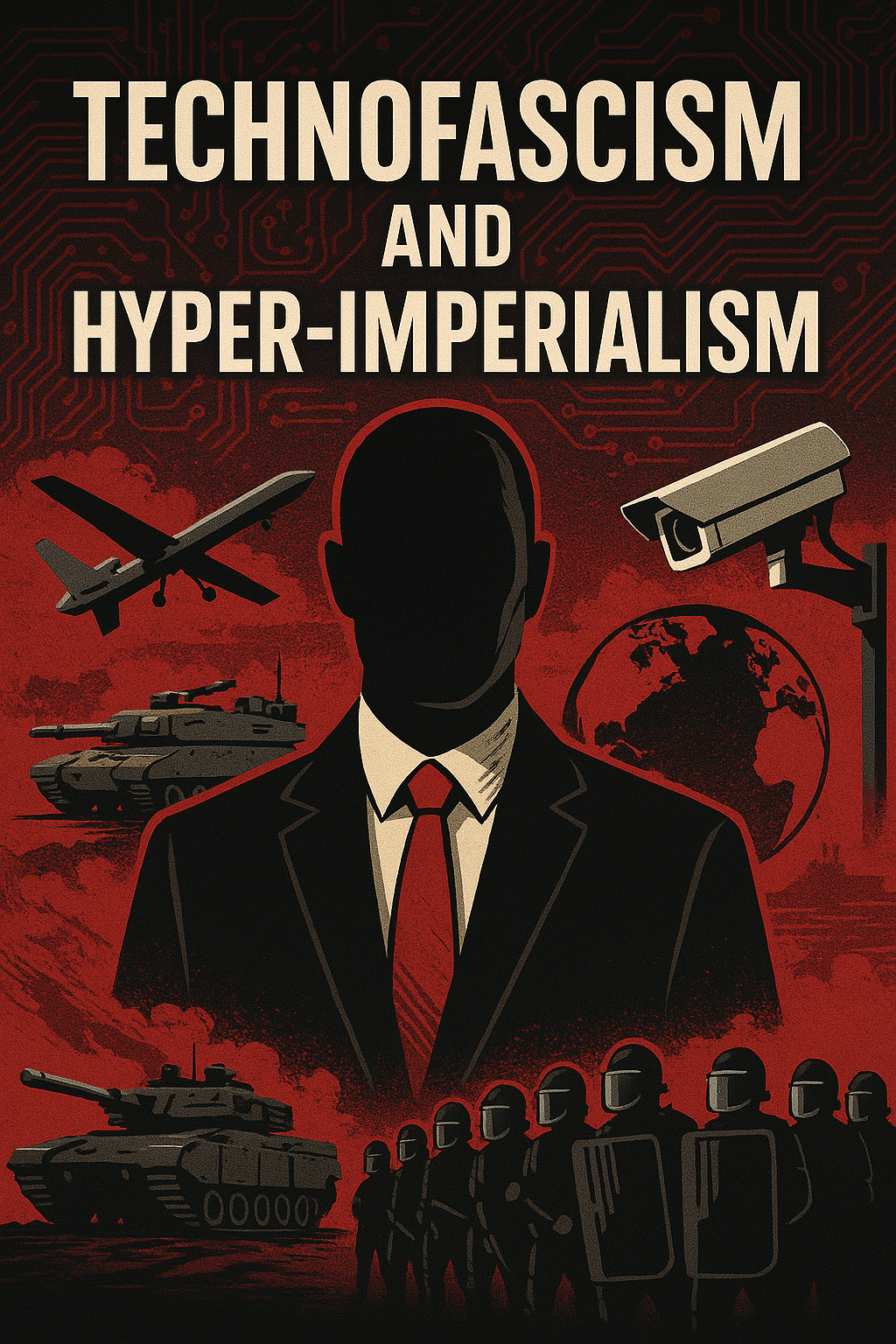
By Prince Kapone | Weaponized Information
Introduction: From the Cellblock to the Vanguard — A Personal Journey into the Heart of Technofascism
I became a revolutionary at eighteen, in a county jail cell awaiting transfer to prison. Like so many others in this empire, my political awakening came through the fire of incarceration—a system designed to break the body but that, paradoxically, forged my political clarity. Over three and a half years locked up, I read, studied, built with elder comrades, and came to consciousness not just about the world as it is, but the world as it could be. What began as raw anger and questioning matured into communist commitment, forged through study, struggle, and the wisdom of those who came before me.
Throughout the years that followed—inside and outside of prison—I worked with a range of political organizations and deepened my ideological line. It was through this evolving struggle that the concept of technofascism began to take shape in my mind. Initially, it was more of a question than an answer—a term that emerged to distinguish what we are living through today from the fascisms of the 20th century, which too many commentators invoke casually, without rigor, without historical depth. What is this thing we are facing—this fusion of digital surveillance, white nationalism, monopoly finance capital, predictive policing, mass data collection, and militarized repression? I came to understand it not as neo-fascism, not as techno-feudalism, but as something specific: a new formation arising from the crisis of late imperialist capitalism. Technofascism.
A key influence in sharpening this concept was Carl Oglesby’s The Yankee and Cowboy War, which helped me map the internal contradictions of the U.S. ruling class. It showed me how historical factions like the Yankees and Cowboys—those who built empires through finance and oil, respectively—are now giving way to the third head of the hydra: the Digerati. These are the lords of Big Tech and algorithmic power, the architects of digital domination, incubated in Cold War laboratories and brought to full maturation through the War on Terror.
The theory of hyper-imperialism, developed by the Tricontinental Institute, was another key anchor. Their analysis of the international dimension of U.S. imperialism in crisis was spot on—but what it lacked, in my view, was an analysis of the domestic base that enables it. Technofascism fills that gap. It is the internal configuration of power—the merger of monopoly capital, state repression, and digital governance—that allows hyper-imperialism to be projected onto the globe. Surveillance, sanctions, and smart bombs abroad all grow from predictive policing, algorithmic propaganda, and counterinsurgency at home.
None of this is accidental. Big Tech didn’t just emerge—it was designed. Its roots are deep in the U.S. military-academic complex. From ARPA to Google, from DARPA to Facebook, the so-called “innovation” of Silicon Valley was always about control—first over information, then over populations. Especially after 9/11, we watched the complete fusion of Big Tech, finance capital, and state power accelerate. It’s no longer a question of whether capitalism has become authoritarian. It’s about naming the form of that authoritarianism—technofascism—and preparing to destroy it.
I don’t believe technology is inherently oppressive. As Marx said, technology is an extension of the human body. It has revolutionary potential—if it is in the hands of the working class. But so long as it is owned and weaponized by capital, it will deepen exploitation, reinforce colonial hierarchies, and accelerate ecological collapse. That’s why this struggle can’t just be about algorithms or elections. It has to be about organizing from the ground up—community by community, neighborhood by neighborhood—while also building secure digital infrastructure for revolutionary struggle on the global terrain.
Some people ask me: what’s the alternative? I don’t have all the answers. But I believe the path forward won’t come from charismatic leaders or spontaneous moments. It will come from discipline, political education, and cadre formation. It will come from rebuilding the vanguard concept—not as a dogma, but as a living principle: to place yourself at the front lines of struggle, to lead by serving, to build collective power in a moment of mass disorientation.
This pamphlet is an invitation—not a prescription. It is a call for revolutionary recalibration. As the ruling class recalibrates its systems for imperial preservation, we must recalibrate for revolutionary transformation: toward dual power, ecological socialism, and internationalist solidarity with the workers, farmers, and colonized peoples of the world.
The world is on fire. The empire is collapsing. The only question is: will we be organized enough to shape what comes next?
Part I: The Technofascist System
Section 1: Foundations of Technofascism
Technofascism is not a departure from capitalism, nor a revival of historical fascism in its classic 20th-century form. It is the contemporary expression of capitalism in crisis, shaped by the contradictions of decaying imperialist monopoly capital and the digital revolution. It emerges as a fusion of the surveillance state, militarized capitalism, corporate power, and algorithmic governance, all functioning under the pretense of democratic order while advancing unprecedented authoritarian control.
To understand technofascism, we must begin not with Silicon Valley, but with the historical development of the capitalist state itself—specifically the settler-colonial and racial-capitalist roots of the United States. From its inception, U.S. capitalism relied on the dispossession of Indigenous peoples, the enslavement of Africans, and the creation of a “white republic” that fused private property, race hierarchy, and militarism. This foundational arrangement evolved into the global imperialist project following World War II, structured around U.S. hegemony, Bretton Woods financial institutions, and Cold War militarization.
But this system began to buckle in the 1970s. The postwar boom collapsed. Profit rates declined. The U.S. transitioned from an industrial powerhouse to a financialized and militarized empire, upheld increasingly through debt, domination, and digital manipulation rather than productive growth.
This period saw the rise of neoliberalism—a reactionary offensive by monopoly capital to restore class power through deregulation, privatization, austerity, and mass incarceration. Simultaneously, the counterinsurgency apparatus built during the Civil Rights and Black Power movements was updated and militarized for domestic repression. This laid the groundwork for technofascism.
Technofascism Emerges from Counterinsurgency and Crisis
Technofascism consolidates in the post-9/11 period, where digital surveillance, predictive policing, and homeland security form the ideological and technological basis for a new form of class rule. Crucially:
- Big Tech emerged from military research (e.g., ARPA, RAND, NSA) with deep roots in counterinsurgency doctrine. Google, Facebook, and Palantir are direct outgrowths of the U.S. military-intelligence nexus.
- Predictive algorithms and behavioral data have replaced old ideological coercion with real-time manipulation and preemptive control. Public opinion is no longer shaped—it is engineered.
- Mass data collection through phones, apps, smart cities, and social media constitutes the raw material of capitalist profit, state surveillance, and psychological warfare.
Unlike classical fascism, which relied on mass mobilization, technofascism functions through atomization, manipulation, and algorithmic repression. It is the fascism of the platform, the cloud, the drone—not the boot in the street (though that still comes when needed).
Yet the foundations of technofascism remain rooted in historical fascism’s purpose: to secure capitalist rule during periods of deep crisis, through repression of the proletariat, destruction of political opposition, and consolidation of corporate-state unity.
Technofascism and the Colonial Logic of Capitalism
Technofascism is not merely a system of control over the population in general. It is a racialized mode of control that carries forward the colonial division of humanity. In this sense, technofascism is not an aberration within the liberal West but its logical endpoint:
- Black, Indigenous, and colonized populations inside the U.S. are treated as internal enemies—surveilled, incarcerated, militarized.
- Migrants are categorized by algorithms, detained in privatized camps, and exploited for imperial profit.
- Workers in the Global South are disciplined through platforms, supply chains, and sanctions—what we call digital colonialism.
Technofascism is the domestic twin of hyper-imperialism, just as classical fascism was the domestic articulation of inter-imperialist rivalry. It functions to preserve racial capitalism within the imperial core, while projecting its crisis management onto the periphery through war, sanctions, and proxy regimes.
Section 2: The Consolidation of Technofascism in the 21st Century
Technofascism is not an accidental or temporary phase. It is the consolidated form of class rule under late-stage imperialist capitalism—emerging not simply from ideology or political choice, but from the material conditions of systemic crisis. It matured in the decades following 9/11, solidifying itself through overlapping political, economic, and technological developments.
These include the securitization of society, the expansion of digital platforms as infrastructure, and the bipartisan normalization of surveillance, censorship, and domestic militarization. In this sense, technofascism is not reducible to Trump or the far-right; it is a systemic formation that emerged within the very core of liberal democracy itself.
The Homeland Security State and Perpetual Emergency
After 9/11, the U.S. state entered a phase of permanent exception, justifying global wars, domestic surveillance, and mass policing under the banner of “national security.” The PATRIOT Act, the creation of the Department of Homeland Security, and the explosion of Fusion Centers created a full-spectrum domestic surveillance regime that merged local police with federal intelligence in a centralized counterinsurgency apparatus.
- This was not just aimed at “terrorists” abroad—it was a preemptive strategy to neutralize any future insurgency from below, especially among Black, Indigenous, migrant, and poor communities.
- Programs like Countering Violent Extremism (CVE) and “community policing” initiatives functioned as psychological warfare and intelligence collection on U.S. soil, rebranded for the digital age.
The Militarization of Policing: Counterinsurgency Comes Home
One of the most visible features of technofascism is the militarization of domestic police, transforming local law enforcement into a heavily armed, federally integrated counterinsurgency force. This process accelerated after 9/11 and intensified following uprisings like Ferguson and the George Floyd Rebellion.
- The 1033 Program facilitated the transfer of surplus military equipment—MRAPs, assault rifles, surveillance drones—to local police departments.
- Police began training with military units, adopting battlefield tactics, psychological operations, and urban warfare doctrines to contain civil unrest.
Police forces now function as occupying armies in Black and colonized communities. With predictive policing, facial recognition, and algorithmic surveillance, these areas are treated as pre-criminal zones. This is not a malfunction of democracy—it is its logical evolution within an empire confronting its own decay.
Platform Capitalism and the Digital Leviathan
As the security state expanded, so did a new layer of monopoly capital—the platform corporations. Google, Amazon, Facebook, Apple, and Microsoft (GAFAM) became the infrastructure of daily life, embedded into communication, commerce, education, and governance.
- These firms operate as private extensions of the surveillance state, collecting data, censoring speech, and coordinating with government agencies in real time.
- With smartphones, wearable tech, and smart cities, technofascism became ubiquitous, ambient, and intimate—reaching deep into the psyche and behavior of individuals, not just their economic activity.
This shift marks the total commodification of everyday life, where attention, behavior, and relationships are mined for capitalist profit and political control.
From Obama to Trump: Bipartisan Authoritarianism
Technofascism did not begin with Trump—it was normalized under Barack Obama, who expanded drone warfare, deportations, mass surveillance, and prosecuted whistleblowers. But Trump marked the qualitative leap: fusing white nationalism with digital authoritarianism and consolidating control through platform censorship, biometric tracking, and direct militarized governance.
- Algorithmic fascism: social media manipulation, censorship, and psychological warfare against dissidents.
- AI-driven policing and predictive analytics (e.g., Palantir) deployed by ICE, local police, and even school systems.
- Militarized borders and biometric apartheid targeting migrants as both surplus labor and domestic threat.
Crisis Governance Through Control, Not Consent
As liberal democracy collapses and ruling-class unity fractures, technofascism replaces consent with containment, coercion, and preemption.
- Elections are delegitimized, media is fragmented, and disinformation is weaponized—not only by adversaries, but by the state itself.
- Labor is fragmented and devalued, with mass precarity managed through surveillance and app-based dependency.
- Uprisings—from Ferguson to George Floyd—are met not with reform, but counterinsurgency: infiltration, predictive control, and militarized repression.
This system no longer governs through progress. It governs through fear, fragmentation, and permanent emergency. Technofascism is the ruling class’s answer to a world it can no longer control by older means.
Section 3: The Domestic Function of Technofascism
Technofascism does not merely serve as an abstract evolution of capitalist governance—it fulfills a clear domestic function within the imperial core: to preserve the declining power of the ruling class through surveillance, repression, and control of surplus populations. It is a crisis-management system, designed to prevent the internal contradictions of empire—class polarization, racial rebellion, and economic decay—from boiling over into revolutionary rupture.
At its core, technofascism functions as a counterinsurgency system turned inward. Its domestic purpose is to suppress insurgent consciousness and inhibit the self-organization of oppressed, colonized, and exploited people within the imperial core—especially within the United States.
Racialized Social Control and the Colonized Proletariat
In the U.S., technofascism operates atop an already-existing system of racial capitalism. Black, Indigenous, and migrant peoples have always existed as internal colonies, policed as threats to the settler order rather than protected as members of a democratic society. Under technofascism:
- These populations are hyper-surveilled, criminalized, and disciplined through a combination of carceral expansion, welfare retrenchment, and algorithmic governance.
- Tools like predictive policing, pretrial risk assessments, and social media monitoring treat oppressed communities as digital insurgent zones—subject to constant monitoring and preemptive neutralization.
This is not new—but it is automated, datafied, and corporatized. Where the old state relied on boots and bureaucrats, the new regime relies on biometrics, databases, and AI.
Surplus Population Management and the Carceral State
Technofascism emerges alongside the global decline of productive labor and the rise of mass surplus populations—workers who are no longer necessary for capital but must be controlled. In the imperial core, this manifests as:
- Mass incarceration and carceral subcontracting to private corporations.
- Digital probation, GPS monitoring, and algorithmic parole systems that extend punishment outside prison walls.
- Predictive child welfare, eviction tracking, and credit scoring—all used to preempt rebellion by suppressing autonomy and mobility.
Rather than provide for people, the technofascist state manages poverty as a security risk—a threat to be policed, not a contradiction to be resolved.
Labor Discipline, Gigification, and Economic Fragmentation
Technofascism is also a response to the disintegration of stable, waged labor. The rise of platform capitalism has created a new form of digital serfdom:
- Workers are atomized, monitored, and managed by algorithms—never employed, only contracted.
- Gig platforms extract surplus labor without responsibility, while using behavior data to train AI systems that will replace those workers altogether.
- Union-busting is automated: predictive analytics identify labor organizers, suppress solidarity, and micro-target dissenters.
Labor is not just exploited—it is digitally disciplined and disposable. Any attempt at collective resistance is flagged, tracked, and deplatformed.
Psychological Warfare and Manufactured Consent
Technofascism also functions on the terrain of consciousness. Through targeted disinformation, algorithmic echo chambers, and behavioral manipulation, it replaces ideology with real-time psychological warfare.
- Social media platforms function as both propaganda outlets and digital panopticons, shaping perception while collecting data.
- Dissent is neutralized not by censorship alone, but by informational overload, demoralization, and strategic confusion.
- Public attention is commodified and fractured, making revolutionary coherence increasingly difficult to maintain.
The result is a depoliticized population—overstimulated, overpoliced, and overwhelmed—trapped between despair and distraction.
The Preemptive Strike Against Revolution
Technofascism is not about law and order. It is about preemption. It assumes that rebellion is inevitable and seeks to stop it before it begins—through surveillance, fear, economic dependency, and digital control.
The uprisings of Ferguson and Minneapolis, the rise of youth radicalism, and the failures of liberal reformism have all accelerated this trajectory. What is emerging is a form of governance that no longer tolerates opposition, because it cannot survive it.
Section 4: Contradictions Within Technofascism
Technofascism presents itself as a totalizing system—unquestionable, predictive, and invincible. But beneath its digital surface lies a complex lattice of contradictions—economic, political, ecological, class-based, and colonial. These contradictions are not flaws in the system—they are the system’s essence. The more technofascism expands its control, the more visible and volatile these internal fault lines become.
1. The Colonial Contradiction Inside the U.S. Working Class
The U.S. working class is not a unified class—it is internally stratified along colonial lines, shaped by a settler-colonial history of genocide, enslavement, land theft, and labor segmentation.
- The Black proletariat, Indigenous nations, and migrant workers represent internally colonized labor forces who are hyper-exploited, hyper-policed, and largely excluded from the social contract promised to white workers.
- Large sections of the white working class—especially in service, administrative, and managerial sectors—function as agents of racialized surplus distribution, benefitting materially and psychologically from empire while lacking a productive class identity.
- This contradiction ensures that even within proletarian layers, solidarity is fractured, and class struggle is mediated through the racial state.
Technofascism does not resolve this—it manages it. It offers white workers algorithmic scapegoats (migrants, “woke culture,” China) while enforcing total discipline on colonized labor. The system’s racial logic is foundational, not incidental.
2. The Trumpist Contradiction: Lumpenized Settlers vs. Billionaire Technocrats
One of the sharpest contradictions of this period lies in the composition of the Trump base itself. It includes:
- A petty bourgeoisie in crisis—small business owners, disaffected professionals, and declining rural capitalists;
- A growing lumpen-proletariat of white workers, declassed and atomized by decades of neoliberalism, opioid crisis, and industrial collapse;
- And a consolidation of monopoly capital behind Trump: finance, fossil fuels, real estate, surveillance firms, and tech billionaires seeking deregulation and direct access to state power.
This contradiction is barely concealed. Trump gives his base the performance of rebellion—cultural grievance, anti-elitism, xenophobia—while openly delivering total ownership of the economy to the billionaire class.
Technofascism, in this formulation, becomes a class weapon deployed by the ruling elite through a mass base that will never benefit from it materially—but will be given enough enemies to believe they’re winning.
3. Economic Nationalism Without an Economic Engine
Trump’s economic program depends on an aggressive reassertion of national sovereignty—tariffs, sanctions, currency wars, reshoring, and coercive trade policy. But these strategies are haunted by a brutal contradiction: the U.S. has no industrial base capable of sustaining such a project.
- Deindustrialization has hollowed out the material economy. Outside of financialization, weapons manufacturing, and Big Tech, the U.S. produces very little.
- Trump’s tariffs and decoupling efforts cannot regenerate infrastructure or industry without massive public investment—which technofascists oppose on principle.
- The result is a strategy built on fantasy: economic coercion without capacity, and protectionism without production.
This contradiction intensifies the state’s dependency on military dominance, digital extraction, and financial manipulation—which only hastens the broader collapse.
4. Ecological Breakdown and the Crisis of Material Conditions
Technofascism is deeply entangled with the ecological crisis. Its infrastructures—data centers, global logistics, extraction zones—rely on intensified environmental destruction.
- Climate change destabilizes the very societies technofascism needs to control.
- Ecological migration, water wars, and energy shortages generate unmanageable surplus populations that must be controlled, not integrated.
- The techno-capitalist response—smart cities, geoengineering, carbon markets—is not a solution but a green-washed extension of elite control.
The contradiction is clear: technofascism destroys the conditions that make its own reproduction possible.
5. The Limits of Algorithmic Control
Technofascism’s core promise—total control through automation and AI—is brittle and unsustainable.
- Algorithmic systems reflect and intensify structural violence, further eroding trust and legitimacy.
- Public faith in media, elections, and digital platforms is disintegrating—producing a crisis of legitimacy that technology cannot solve.
- The more dissent is suppressed, the more resistance emerges—manipulation without legitimacy leads to collapse.
Control without legitimacy leads to backlash. At a certain point, preemptive repression becomes rebellion’s accelerant.
Toward Strategic Clarity and Revolutionary Breakthrough
Technofascism is not stable—it is a desperate configuration of power assembled to preserve a dying world-system. Its contradictions are sharpening rapidly: between classes, between nations, between ecology and economy, and between empire and its domestic base.
To fight this system, we must analyze it in its full complexity—understanding how the colonial, class, ecological, and technological contradictions interact and destabilize one another. These are not problems to be solved within technofascism. They are fault lines through which revolution must move.
Part II: Hyper-Imperialism – The Global Projection of Technofascism
Section 1: Hyper-Imperialism as Defined by Tricontinental
Hyper-imperialism is not merely an extension of past imperial systems—it is the globalized form of technofascism, adapted for the management of a collapsing world-system. Where technofascism secures capitalist rule within the imperial core through digital repression, racialized policing, and economic preemption, hyper-imperialism is its international counterpart: an imperial formation driven by monopoly finance, militarized global supply chains, elite comprador networks, and weaponized economic tools.
Drawing from the Hyperimperialism report by Tricontinental, we can define hyper-imperialism as:
“The consolidation of U.S.-led imperialism under conditions of structural crisis, expressed through a fusion of transnational finance capital, Big Tech, military force, and disciplinary global governance institutions.”
Hyper-imperialism is imperialism in crisis—but more vicious, more desperate, and more technologically advanced than ever before.
Finance Capital’s Domination of the Global Economy
At the core of hyper-imperialism is monopoly finance capital. This is not simply capital that circulates through banks or investments—it is capital that owns everything:
- BlackRock,
Vanguard, and
State Street collectively manage over
$20 trillion in global assets,
with major stakes in every major industry—from weapons and energy to tech and food. - These firms exert dictatorship without direct governance. They don’t need to run governments because they own the productive apparatus.
This form of power is invisible, unelected, and unaccountable. It defines who lives and who dies, which governments rise or fall, and where the next financial “crisis” will be engineered.
Dollar Dominance and Economic Coercion
Hyper-imperialism rests on the continuing dominance of the U.S. dollar, which functions as a global weapon. Through sanctions, dollar-denominated debt, and the SWIFT system:
- The U.S. can cut entire nations off from global markets—as seen in Iran, Venezuela, and China.
- The IMF and World Bank enforce debt dependency and neoliberal reforms across the Global South.
- Dollar-backed finance capital extracts wealth from periphery states and reinvests it into speculative bubbles and war industries.
This is not free trade—it is fiscal counterinsurgency, intensified by the structural aftershocks of COVID-19, climate collapse, and social unrest.
Big Tech as Global Infrastructure of Control
Just as technofascism integrates Big Tech into domestic repression, hyper-imperialism deploys digital platforms for international domination:
- Palantir, Amazon Web Services, and Microsoft Azure serve as the logistical, surveillance, and cloud infrastructure of U.S. empire.
- Social media platforms are tied to U.S. foreign policy objectives and host coordinated disinformation campaigns and psychological operations (source).
- Surveillance tech exports from firms like NSO Group build a global digital counterinsurgency grid.
These tools are tested on the periphery and perfected for the core, uniting global capitalism with cybernetic repression.
Militarized Global Supply Chains and Proxy Governance
Hyper-imperialism militarizes the global economy. Critical trade routes and supply chains are enforced by covert war and elite partnerships:
- The Panama Canal is now under the financial influence of BlackRock and other U.S. firms, ensuring capital flow through privatized chokepoints.
- The Red Sea, Strait of Hormuz, and South China Sea have become flashpoints for military escalation as shipping corridors become contested terrain.
- Across Latin America, West Africa, and Asia, economic governance is reinforced by proxy regimes, special forces, and intelligence-backed elites.
“Development” is a euphemism. The real goal is imperial lock-in: ensuring global capital flows through U.S.-approved arteries while the periphery remains fractured and dependent.
The Comprador Elite and Global Class Discipline
Hyper-imperialism depends on a global comprador class—local elites who serve imperial interests in exchange for wealth and protection:
- These actors are groomed via IMF internships, Ivy League universities, NGO networks, and elite financial institutions.
- They absorb cybernetic governance doctrine from RAND, Davos, and NATO-aligned think tanks.
- They suppress dissent not on behalf of their people, but on behalf of investors.
This is colonialism without flags. The comprador class is the human interface of global capital. Their role is to discipline their own people to uphold a collapsing order.
Section 2: Global Technofascism as Strategy of Crisis Management
Hyper-imperialism is not a stable or confident world order. It is a violent response to instability—a war strategy disguised as governance. A digital prison built atop collapsing economic, ecological, and political foundations. It is how the U.S.-led imperial bloc manages a world that is no longer governable by consent, only by containment, coercion, and continuous crisis.
Global technofascism is not a foreign policy. It is a global counterinsurgency doctrine that fuses economic war, psychological operations, predictive surveillance, and elite class coordination into a planetary system of control.
1. Economic Warfare as Global Siege
Sanctions, debt traps, and trade embargoes are not just tools of diplomacy—they are acts of war. Under hyper-imperialism, economic warfare becomes the default mode of engagement:
- U.S. sanctions now impact over one-third of the world’s population, targeting more than 40 countries including Iran, Venezuela, Syria, and China.
- Sanctions are enforced through the SWIFT banking system, OFAC listings, and secondary sanctions targeting third-party states and institutions.
- Blockades create engineered economic collapse and humanitarian catastrophe, then frame victims as failed states in need of Western “stabilization.”
This is siege warfare by financial means, enforced by U.S. allies and international institutions under the veil of humanitarian concern.
2. Military Force, Proxy War, and Drones
Where economic coercion fails, military force follows. Under global technofascism, the U.S. avoids large-scale occupations in favor of:
- Proxy wars such as those in Yemen, Ukraine, and Syria, designed to destabilize and drain adversaries.
- Drone warfare and special forces operations that conduct extrajudicial assassinations, including civilians, with impunity—The Bureau of Investigative Journalism has documented hundreds of such strikes.
- Private military contractors like Blackwater (now Academi) and CIA-trained militias who enforce U.S. objectives while shielding accountability.
This low-visibility warfare allows empire to maintain dominance while projecting the illusion of neutrality or non-involvement.
3. Surveillance, Preemption, and Predictive Control
Global technofascism is built on the assumption that rebellion is inevitable. It must therefore be neutralized before it emerges. Predictive surveillance is exported from the U.S. and Israel to Global South regimes for exactly this purpose:
- Israel’s Pegasus and similar spyware have been deployed in India, Mexico, Colombia, and beyond to surveil journalists, Indigenous leaders, and opposition parties.
- Platforms like Palantir offer pre-crime and counterinsurgency analytics to U.S. allies, police forces, and corporate clients worldwide.
- Biometric tracking, smart cities, and facial recognition systems exported from the West create a global panopticon under the guise of “security” and “efficiency.”
This is digital counterinsurgency—not designed to protect life, but to anticipate and suppress any spark of resistance.
4. Psychological Warfare and Ideological Occupation
Technofascism is not just enforced with guns and data—it also shapes the mind. The terrain of information is a primary battlefield, governed by algorithmic manipulation and narrative dominance:
- Social media platforms cooperate with U.S. agencies to remove “dangerous” content, promote state narratives, and throttle dissent.
- NGOs and PR firms conduct psychological operations in the Global South—rebranding coups as liberation and suppressing anti-imperialist thought.
- Behavioral targeting algorithms create curated information bubbles to isolate movements and disarm mass solidarity.
This is ideological occupation: the enforcement of capitalist realism through social media, influencer economies, and information war. Freedom of speech exists—but only within the parameters set by empire.
5. Crisis Multiplication and Shock Management
Technofascism thrives in chaos. It does not resolve crises—it manages them as a governance strategy:
- Pandemics justify biometric ID regimes and emergency surveillance powers (ACLU).
- Climate collapse enables “green” militarism and the securitization of migration routes (The Intercept).
- Refugees are framed not as victims of war and extraction, but as threats to be fenced, tagged, and detained using AI tools (TNI Report on Digital Border Walls).
Each disaster becomes a new opportunity for expanding the surveillance state, profiting from suffering, and deepening control. Under technofascism, crisis is not a breakdown—it is the business model.
Managing Decline, Not Securing the Future
Global technofascism cannot restore the strength of U.S. empire. It can only manage its decline through repression, fragmentation, and preemption. It is not a system designed for creation—but for damage control. It feeds off instability while accelerating the very crises it seeks to contain.
But no empire can forever suppress a world it has set on fire. Resistance is everywhere—from Gaza to Haiti, Niger to the French suburbs, Minneapolis to Chiapas.
The question is not whether technofascism will collapse. The question is what forces will be ready to shape what comes after.
Section 3: Global Contradictions and the Decline of Empire
Hyper-imperialism, like technofascism, appears total—omnipresent, overwhelming, and inescapable. But beneath this appearance lies a deeper truth: it is a system in crisis, held together not by stability, but by suppression. Its global dominance is crumbling under the pressure of internal and external contradictions—economic, geopolitical, ecological, and ideological.
This section maps the major fault lines destabilizing U.S.-led imperialism and outlines the ways in which they are increasingly expressed in global rupture and rebellion.
1. The End of Unipolarity and the Crisis of Hegemony
The unipolar moment following the Cold War—where the United States reigned as the sole global superpower—is rapidly collapsing:
- China’s economic rise and institutional counterweights like BRICS+ and the Shanghai Cooperation Organization challenge the West’s control over trade, currency, and development.
- Russia resists NATO expansion and uses military and energy leverage to assert multipolar sovereignty.
- Former allies in the Global South increasingly seek economic and diplomatic alternatives to U.S. dominance.
The result is not yet a new order, but the disintegration of U.S.-centered hegemony—a decline that Washington’s aggressive sanctions and military threats only deepen.
2. The Breakdown of the Dollar Order
Hyper-imperialism depends on the U.S. dollar’s role as the world reserve currency. But the very weaponization of the dollar is undermining its authority:
- Countries including China, Russia, Iran, and Brazil are conducting trade in non-dollar currencies.
- Central banks are diversifying away from U.S. treasury bonds and exploring central bank digital currencies (CBDCs).
- The growth of BRICS+ as a trading bloc and financial alternative weakens the monopoly power of institutions like the IMF and World Bank.
The contradiction: the more the U.S. uses the dollar as a weapon, the less trusted it becomes. Financial coercion accelerates monetary realignment.
3. Ecological Collapse and Resource Wars
The material foundation of empire—resource extraction, stable logistics, and industrial control—is being shaken by climate catastrophe:
- Climate shocks are destroying crops, flooding cities, and displacing millions across Africa, Asia, and the Americas.
- Critical minerals like lithium and cobalt are becoming sites of new colonial competition and militarized extraction (source).
- The U.S. military—one of the world’s largest polluters—now presents itself as a “climate protector,” a contradiction rooted in greenwashing imperialism.
Hyper-imperialism cannot stop ecological collapse—it can only militarize it and extract profit from the ruins.
4. The Collapse of Imperial Legitimacy
Perhaps the most profound contradiction is ideological: people no longer believe in the moral authority of the U.S. empire.
- After the wars in Afghanistan, Iraq, Libya, and now its support for Israel’s assault on Gaza, U.S. claims to defend democracy or human rights are widely discredited.
- Anti-imperialist consciousness is rising through movements for reparations, land back, Palestinian liberation, and Afro-Indigenous sovereignty.
- Global institutions of Western soft power—NGOs, universities, and corporate media—are increasingly seen as ideological instruments of elite control.
Imperialism has lost its narrative. This legitimacy crisis is not limited to the Global South—it is fracturing the U.S. settler population itself.
5. The Crisis of Control: Resistance and Revolt
Above all, hyper-imperialism faces resistance it cannot control:
- Popular uprisings in Chile, France, Haiti, Sudan, Iran, and South Africa continue despite brutal repression.
- Workers’ struggles and land occupations are escalating across Latin America, West Asia, and the Sahel region.
- New internationalist formations are emerging that reject both imperialism and its comprador managers, reviving the revolutionary traditions of Bandung, Tricontinentalism, and Zapatismo.
Empire cannot govern the world it helped destroy. The global rebellion has already begun.
A World-System on the Edge
Hyper-imperialism is not a stronger empire—it is an exhausted one, relying on violence, finance, and digital control to hold back a tidal wave of planetary change.
Its contradictions—between capital and labor, core and periphery, ecology and extraction, propaganda and reality—are sharpening. The ruling class cannot resolve them. But revolutionary forces can organize through them.
The task ahead is not simply critique—it is construction. To build the infrastructure, movements, and political formations capable of not only surviving the collapse, but forging the future beyond it.
Part III: Revolutionary Horizons
Section 1: The Failure of Reformism and the Crisis of the Liberal Left
Technofascism is not a glitch in the democratic system—it is the system working as designed. In the face of rising authoritarianism, ecological collapse, and intensifying inequality, the liberal order has not produced resistance. It has produced management: of dissent, of hope, of memory.
Every progressive upsurge of the last two decades has been absorbed, redirected, or crushed—leaving behind a trail of exhausted movements, disoriented organizers, and neutralized political energy. From Occupy Wall Street to Black Lives Matter, from Standing Rock to the George Floyd Rebellion, the cycle is the same: mass mobilization, rhetorical concession, institutional co-optation, algorithmic suppression.
Reformism is not simply inadequate—it is structurally incapable of addressing the contradictions driving technofascism. Capitalism in crisis cannot afford real concessions. And the liberal left, trapped within the logic of electoralism, nonprofit advocacy, and symbolic representation, can no longer pose a meaningful threat to ruling-class power.
The Liberal Left’s Capture by Technofascism
What passes for “resistance” in the liberal sphere is now largely mediated by corporate platforms, shaped by philanthropic dollars, and enforced by ideological gatekeeping. NGOs function as the soft edge of empire, managing dissent through grants and guidelines. Academic radicals police the boundaries of acceptable critique, ensuring the discourse remains within imperial limits. Social media creates the illusion of mass participation, while engineering fragmentation and surveillance.
The technofascist state doesn’t fear liberal outrage—it feeds on it. It welcomes protests that can be live-streamed, branded, and contained. It co-opts anti-racist slogans into corporate HR campaigns. It incorporates diversity as camouflage for empire. It platforms left voices so long as they pose no organizational threat, weaponizing representation against revolutionary transformation.
This is why “representation” without power is not liberation—it is counterinsurgency.
Bernie, AOC, and the Illusion of Left Electoralism
The electoral experiments of the 2010s—centered around figures like Bernie Sanders, Alexandria Ocasio-Cortez, and the so-called Squad—offered brief hope for a revival of left politics in the U.S. But these projects were never allowed to function as insurgencies. Their containment was swift and decisive.
Bernie’s campaigns energized millions but were crushed by the Democratic establishment, media blackout, and internal sabotage. Rather than break from the party or build independent power, his movement collapsed into electoral fatalism—delivering its base back into the arms of neoliberal technocrats. AOC and her cohort quickly became symbols of managed dissent: permitted to critique, never to resist.
Reformism cannot save us from technofascism. It cannot regulate the boot it refuses to remove. It cannot democratize the algorithm it cannot even explain. It cannot abolish the prison it helped build.
The Enemy Is Not Authoritarianism—It’s Capitalism
Liberals cling to the fantasy that fascism is an anomaly—a deviation from an otherwise noble trajectory of progress. But technofascism is not an interruption of democracy. It is the outcome of a system where democracy was always the performance, not the practice.
The real danger is not a singular “strongman,” but the systemic fusion of corporate, state, and digital power to enforce capitalist rule without popular consent. Liberals warn of Trump but ignore that Obama built the surveillance infrastructure he weaponized. They decry January 6 while supporting the police state that made it possible.
Technofascism emerges not in opposition to liberalism, but as its logical successor—the administrative form capitalism takes when it can no longer rule by consent.
The Crisis of Liberal Consciousness
The deeper crisis is one of consciousness. A liberal worldview cannot comprehend a world in which power no longer cares about legitimacy. In which elections, norms, and institutions no longer function as sites of struggle, but as instruments of managed decay. In which the ruling class would rather burn the planet than surrender profit.
This is why appeals to “civility,” “accountability,” or “saving democracy” ring hollow. They are symptoms of a class and ideological formation that has lost its historical function. Liberalism cannot tell us where we are. And it certainly cannot tell us how to get out.
The Revolutionary Task
If reform is no longer viable, then revolution is no longer optional. But revolution cannot emerge from nostalgia, moralism, or aesthetic posturing. It must emerge from clarity: about the nature of the enemy, the structure of the state, and the necessity of organization.
The task is not to salvage liberalism. It is to bury it—and build the forms of power that can survive the collapse and confront the system responsible for it.
Section 2: The Strategic Terrain of 21st Century Class Struggle
The age of technofascism is not just defined by surveillance and repression—it is defined by a new terrain of global class struggle. A terrain reshaped by crisis, digital enclosure, ecological collapse, and imperial contraction. It is a battlefield where the traditional categories of class are shattered, recomposed, and racialized under conditions of fragmentation and precarity. But this does not spell the end of class struggle. It marks its mutation—and its intensification.
The Recomposition of the Global Proletariat
The industrial working class of the 20th century—the factory proletariat of Marx’s vision—has not disappeared. It has been dispersed, recomposed, and made invisible by imperial outsourcing and platform domination. Today’s global proletariat lives in sprawling slums, works in subcontracted supply chains, rides motorbikes for app-based empires, and migrates across militarized borders to survive. This proletariat is not vanishing—it is exploding in number. But it is also fragmented, precarious, and largely excluded from the political imagination of the imperial core.
The engine of history is not dead. It is overworked, underpaid, and algorithmically managed.
Surplus Labor, Gigified Workforces, and Lumpenized Youth
Capital no longer needs full employment. It needs compliance. It needs control. And it needs just enough labor to sustain extraction while abandoning the rest. Across the world, we are witnessing the proliferation of surplus populations: youth with no future, workers with no stability, whole communities deemed economically unnecessary but politically dangerous. These workers are disciplined not through jobs and wages, but through debt, surveillance, and digital precarity.
The gig economy is not a solution to unemployment—it is its rebranding. A global system of digital serfdom where labor is atomized, datafied, and disposable.
The Revolutionary Core: Black, Indigenous, Migrant, and Global South Workers
Within this recomposed proletariat, one force remains consistently positioned at the vanguard: the colonized. Black workers, Indigenous nations, migrant laborers, and Global South peoples—those whose labor has always been violently extracted, whose communities have always been policed as insurgent zones, and whose very existence defies the settler order.
These forces are not marginal—they are central. They constitute the core of any viable revolutionary strategy. Because they already exist outside the boundaries of capitalist inclusion, and because they bear the brunt of technofascism’s machinery of control.
The Fragmentation of the White Working Class and the Colonial Contradiction
Any revolutionary strategy in the imperial core must confront the colonial contradiction: the historical alliance of the white working class with the settler state, and the material privileges derived from empire. While neoliberalism has hollowed out white labor, producing waves of disaffection, this discontent often veers toward reaction—not revolution.
The settler social contract is collapsing, but its ideology lingers. Many white workers remain committed to the illusion of national restoration—Trumpism, protectionism, racial nostalgia. But others are breaking ranks.
Settler Complicity vs. Settler Defection
The future will not be determined by whether white workers suffer—it already is. The question is whether they defect from the settler project and join the revolutionary struggle against empire. This requires more than sympathy. It requires material betrayal of whiteness as property, alignment with colonized liberation, and ideological transformation through collective discipline.
White radicals have a role to play—but not as leaders, saviors, or spokespersons. Their task is principled defection: to organize within the empire, sabotage its reproduction, and unite with the colonized to destroy it.
Rebuilding Revolutionary Capacity in an Age of Surveillance and Counterinsurgency
The strategic question is no longer whether rebellion will come. It is already here—in Ferguson, in Gaza, in the Sahel. The question is whether our movements can survive the digital counterinsurgency grid: infiltration, algorithmic demobilization, predictive suppression, and psychological warfare.
To meet this moment, we must rebuild revolutionary capacity: organization, discipline, education, and political infrastructure rooted in clarity—not charisma. This means:
- Training cadres who understand the terrain—both physical and digital.
- Grounding struggle in the lived realities of colonized and precarious peoples.
- Studying past revolutions not for nostalgia, but for strategic lessons.
- Developing security culture and psychological resilience in an era of surveillance saturation.
Technofascism is strong, but not invincible. Its strength is built on fragmentation, fear, and futility. Revolutionary power is built on clarity, solidarity, and strategic insurgency.
Section 3: Organizational Strategy in the Technofascist Era
Technofascism is not just a system of repression—it is a system of counterinsurgency. It is designed to destroy revolutionary potential before it materializes. In this context, disorganization is not neutral—it is defeat. To challenge this system, we must build organizations that can endure surveillance, withstand repression, and advance struggle with clarity and discipline. We must move beyond spontaneity and social media spectacle toward long-term strategic formation.
Principles of Underground and Aboveground Organizing
In the technofascist era, organizing requires duality: the visible and the invisible. Aboveground organizing must reach the masses—educating, mobilizing, and building public infrastructure. But it must be complemented by underground structures capable of surviving state repression. This is not paranoia—it is historical necessity. Every revolutionary movement has faced infiltration, surveillance, and sabotage. Today, those tactics are automated and predictive.
- Aboveground structures: mutual aid networks, mass political education, protest infrastructure, media arms.
- Underground structures: secure communications, decentralized cells, counter-intelligence, long-term logistical support.
The challenge is not to choose one over the other, but to synchronize both—creating an ecosystem of resistance that can adapt, retreat, and strike.
Digital Security, Infiltration Awareness, Counter-Psywar Consciousness
The battlefield is digital. Every click, message, and search is tracked. Every movement has been infiltrated—by feds, bots, and bad actors. Survival demands a new level of political maturity: digital security must be standard, not optional.
Encryption, anonymity, metadata hygiene, and secure device protocols are not technical luxuries—they are preconditions of struggle. But beyond technical security, we must also develop a culture of counter-psywar consciousness:
- Resisting demoralization campaigns and psychological manipulation.
- Training members to spot infiltration tactics: disruption, ego manipulation, identity fetishism, lateral violence.
- Building emotional discipline and ideological coherence in the face of engineered chaos.
The Return of Cadre-Based Political Formation
Mass movements without political formation are vulnerable to cooptation, collapse, or commodification. What’s needed is not mass alone—but cadres: trained, committed political organizers with ideological clarity and long-term vision. Cadre formation is not elitism—it is organization. It means creating a core of disciplined revolutionaries capable of navigating contradiction and leading struggle through waves of repression and confusion.
Technofascism thrives on confusion. Cadres bring clarity, cohesion, and continuity.
Why Charismatic Populism Cannot Defeat Technofascism
The enemy is not simply a corrupt state—it is a digital empire of global finance, predictive algorithms, and military surveillance. Charismatic populism—left or right—cannot defeat it. Why?
- It centralizes power in individuals, not in collective formations.
- It relies on spectacle, not strategy.
- It is easily coopted, surveilled, and dismantled through media manipulation and scandal warfare.
What’s needed is not a savior, but a movement of organizers. Not a viral campaign, but a revolutionary infrastructure. Political education, ideological unity, and cadre development are the real weapons in the age of digital authoritarianism.
Building Dual Power: Mutual Aid, Counter-Institutions, and Autonomous Infrastructure
We cannot wait for the empire to collapse—we must begin building the new world now. This means creating dual power: autonomous systems that meet people’s needs, train political consciousness, and erode dependency on capitalist institutions.
- Mutual aid networks rooted in revolutionary analysis—not charity, but solidarity with a strategy.
- Worker cooperatives, food systems, clinics, schools, and tech collectives that build counter-power.
- Digital infrastructure: secure apps, hosting alternatives, revolutionary media hubs.
Dual power is not a utopian escape—it is prefigurative resistance: creating material bases of revolutionary autonomy inside the decaying shell of technofascism.
The challenge is vast. The enemy is powerful. But history is made not by the inevitable, but by the organized. And our task is not simply to survive technofascism—but to destroy it and build beyond it.
Section 4: Digital Resistance and the Struggle for Narrative Control
In the age of technofascism, the battlefield is not only physical—it is informational. The ruling class no longer relies solely on censorship or brute force. Instead, it governs through algorithmic control, psychological warfare, and narrative domination. Digital resistance is not a supplement to revolutionary struggle—it is a front line.
Information War as Class War
Every revolutionary movement must now confront a new reality: information is a weapon. The digital terrain is saturated with disinformation, psyops, and controlled opposition. Algorithms prioritize pacification. Platforms throttle dissent. The system shapes consciousness before the first boot hits the ground.
- Google, Meta, and X (formerly Twitter) operate as ideological filters for capitalist empire.
- AI and content moderation regimes suppress radical narratives and amplify managed outrage.
- Public discourse is fragmented by design—engineered confusion replaces collective clarity.
The goal is not to inform the public—but to disorient, demobilize, and depoliticize them. This is why digital resistance must be strategic, intentional, and ideological.
Weaponized Memes, Psyops, and the Algorithmic Battlefield
Memes are not just jokes—they are weapons. On the algorithmic battlefield, narrative virality is a form of terrain control. Technofascism deploys its own arsenal: troll farms, botnets, think tanks, influencers, and narrative warfare units.
In response, revolutionaries must learn to weaponize culture—not for clout, but for consciousness. That means:
- Creating aesthetic coherence between revolutionary messages and popular culture.
- Understanding platform dynamics to maximize reach and dodge algorithmic suppression.
- Deploying psywar tactics that target ruling class legitimacy, not just their policies.
The goal is not just to react—but to shape the terms of perception. Our memes must tell truths the ruling class cannot hide, in formats the masses can absorb and amplify.
Counter-Propaganda Strategy: Theory, Aesthetics, and Viral Agitation
Counter-propaganda is not mere branding—it is ideological warfare. To cut through the fog of disinformation, we need media that educates, agitates, and builds revolutionary identity.
- Theory: concise, popular education that arms people with historical and analytical clarity.
- Aesthetics: compelling visuals, sounds, and formats that express revolutionary values.
- Agitation: short, viral bursts of truth that rupture dominant narratives and spark action.
This means training digital cadres—not content creators, but ideological operators who understand the battlefield. It means creating networks of revolutionary media production, cultural remix, and mass distribution across multiple platforms.
Seizing the Means of Communication: Open-Source Tools, Encrypted Platforms, and Revolutionary Media
We do not control the infrastructure—but we can build around and through it. While technofascist platforms surveil and censor, alternative digital ecosystems must be cultivated:
- Open-source tools for secure messaging, publishing, and organizing (e.g., Signal, Mastodon, Matrix).
- Decentralized media projects that bypass corporate hosting and create autonomous digital zones.
- Revolutionary media hubs that curate analysis, expose propaganda, and train digital agitators.
Seizing the means of communication does not mean waiting for Twitter to collapse. It means building our own channels, languages, and platforms—and preparing our forces to operate under constant ideological warfare.
In short: revolution needs its own propaganda machine. Not just to counter lies—but to build the consciousness necessary to destroy technofascism and reclaim the future.
Section 5: The Internationalist Path Forward
As the U.S.-led ruling class undergoes a process of imperialist recalibration—reorganizing global dominance through technofascist governance, monopoly finance, and digital counterinsurgency—the task for revolutionaries is to initiate a revolutionary recalibration. This is not about minor policy shifts or electoral detours. It is a fundamental rupture with the collapsing order of racial capitalism, digital authoritarianism, and imperialist war.
Our recalibration must be grounded in building dual and contending power, forging pathways toward socialist revolution, and aligning ourselves with a truly multipolar world—not one shaped by rival empires, but by the solidarity of the global working class, peasants, and oppressed nations.
Revolutionary Recalibration: Strategic Break from Empire
The age of protest is over. The imperial core has responded to every upsurge with repression, surveillance, and counterinsurgency. The time has come to shift from resistance to construction—from opposition to organization. Revolutionary recalibration demands:
- Disengaging from technofascist institutions and refusing legitimacy to electoral illusions;
- Rebuilding independent infrastructure: mutual aid, people’s assemblies, counter-economies, revolutionary media;
- Aligning with the global South not as charity or moral stance, but as the material center of world revolution.
Multipolarity as Proletarian Internationalism
Multipolarity is not about supporting rival capitalist states—it is about disrupting unipolar imperialism to create space for revolutionary development. It means standing in material solidarity with the workers, farmers, and national liberation movements of the Global South.
- From Gaza to Haiti, Chiapas to Niger, and Palestine to the Sahel, anti-imperialist struggle continues despite isolation and brutality.
- These struggles embody revolutionary potential—not symbolic resistance, but dual power in motion.
- We must learn from, support, and organize alongside these forces—not as allies, but as comrades in a global insurgency.
From Crisis Management to Revolutionary Construction
Imperialist recalibration governs through crisis: debt, climate chaos, migration, war. Revolutionary recalibration must be rooted in constructive power—the ability to build systems of care, governance, and defense beyond the reach of technofascism.
- Build dual institutions in housing, food, education, and security that answer to the people, not the state;
- Forge transnational coordination with movements confronting the same enemy in different forms;
- Center anti-colonial sovereignty, ecological restoration, and de-commodified life as the basis of the new world.
The U.S. empire cannot be reformed. It must be dismantled from within and without. Our recalibration is not a reaction—it is a rupture. A strategic pivot toward a future not built on imperial debris, but on revolutionary soil.
Advanced Bibliography
I. Foundational Theory and Political Economy
- Baran, Paul A., and Paul M. Sweezy. Monopoly Capital. Monthly Review Press, 1966.
- Foster, John Bellamy. The New Imperialism of Globalized Monopoly-Finance Capital. Monthly Review, 2010.
- Amin, Samir. Imperialism and Unequal Development. Monthly Review Press, 1977.
- Patnaik, Utsa and Prabhat. Capital and Imperialism. Monthly Review Press, 2021.
- Smith, John. Imperialism in the Twenty-First Century. Monthly Review Press, 2016.
- Rodney, Walter. How Europe Underdeveloped Africa. Verso, 2018.
- Nkrumah, Kwame. Neo-Colonialism: The Last Stage of Imperialism. Thomas Nelson, 1965.
- Luxemburg, Rosa. The Accumulation of Capital. Routledge, 2003.
II. Settler Colonialism and Racial Capitalism
- Du Bois, W.E.B. Black Reconstruction in America, 1860–1880. Free Press, 1998.
- Robinson, Cedric J. Black Marxism. University of North Carolina Press, 2000.
- Ture, Kwame, and Charles V. Hamilton. Black Power. Vintage Books, 1992.
- Burden-Stelly, Charisse. Black Scare / Red Scare. University of Chicago Press, 2024.
- Wolfe, Patrick. Traces of History. Verso, 2016.
- Veracini, Lorenzo. Settler Colonialism. Palgrave Macmillan, 2010.
III. Technofascism, Surveillance, and Counterinsurgency
- Levine, Yasha. Surveillance Valley. PublicAffairs, 2018.
- Simpson, Christopher. Science of Coercion. Oxford University Press, 1994.
- Cull, Nicholas. The Cold War and the USIA. Cambridge University Press, 2008.
- Burton, Orisanmi. Tip of the Spear. University of California Press, 2024.
- Hall, Stuart. Selected Writings on Race and Difference. Duke University Press, 2021.
- Bernays, Edward. Propaganda. Ig Publishing, 2005.
- U.S. Army. Field Manual 3-05.30: Psychological Operations, 2005.
- Kitson, Frank. Low Intensity Operations. Faber and Faber, 1971.
IV. Empire, Sanctions, and Economic Warfare
- Weisbrot, Mark, et al. Economic Sanctions as Collective Punishment. CEPR, 2019.
- Tricontinental Institute. Hyper-Imperialism: A Global Order in Crisis, 2023.
- Moyo, Dambisa. Dead Aid. Farrar, Straus and Giroux, 2009.
- Engler, Mark. How to Rule the World. Nation Books, 2008.
V. Digital Capitalism and the Platform Economy
- Srnicek, Nick. Platform Capitalism. Polity Press, 2017.
- Zuboff, Shoshana. The Age of Surveillance Capitalism. PublicAffairs, 2019.
- Pasquale, Frank. The Black Box Society. Harvard University Press, 2015.
- O’Neil, Cathy. Weapons of Math Destruction. Crown Publishing, 2016.
- Noble, Safiya Umoja. Algorithms of Oppression. NYU Press, 2018.
VI. Contemporary Struggle, Resistance, and Revolutionary Strategy
- Transnational Institute. Digital Colonialism. TNI, 2021.
- Prashad, Vijay. Washington Bullets. LeftWord Books, 2020.
- Ness, Immanuel. Southern Insurgency. Pluto Press, 2015.
- Towns, Armond R. On Black Media Philosophy. University of California Press, 2022.
- Haider, Asad. Mistaken Identity. Verso, 2018.
- Hansen, Bue Rübner et al. The Tragedy of the Worker. Verso, 2021.
- Zapatista Army of National Liberation (EZLN) Communiqués (1994–present).
- Palestine BDS National Committee. BDS Reports and Analysis.
VII. Weaponized Information Originals
- Globalization: Inequality in the Global Plantation. WI Editorial Board, 2023.
- Fall From Grace: The Euro-Amerikan Struggle to Make Amerika White Again. WI Editorial Board, 2023.
- Trilateral Imperialism. WI Editorial Board, 2023.
- The Dialectics of National Liberation. WI Editorial Board, 2024.
- Elon Musk and the Deep State. WI Editorial Board, 2025.
- The Silicon Matrix. Weaponized Information Research Collective, 2025.
 Weaponized Information