Tariffs, layoffs, and empire: when capital recalibrates, it’s the workers who bleed.
Weaponized Information | April 9, 2025
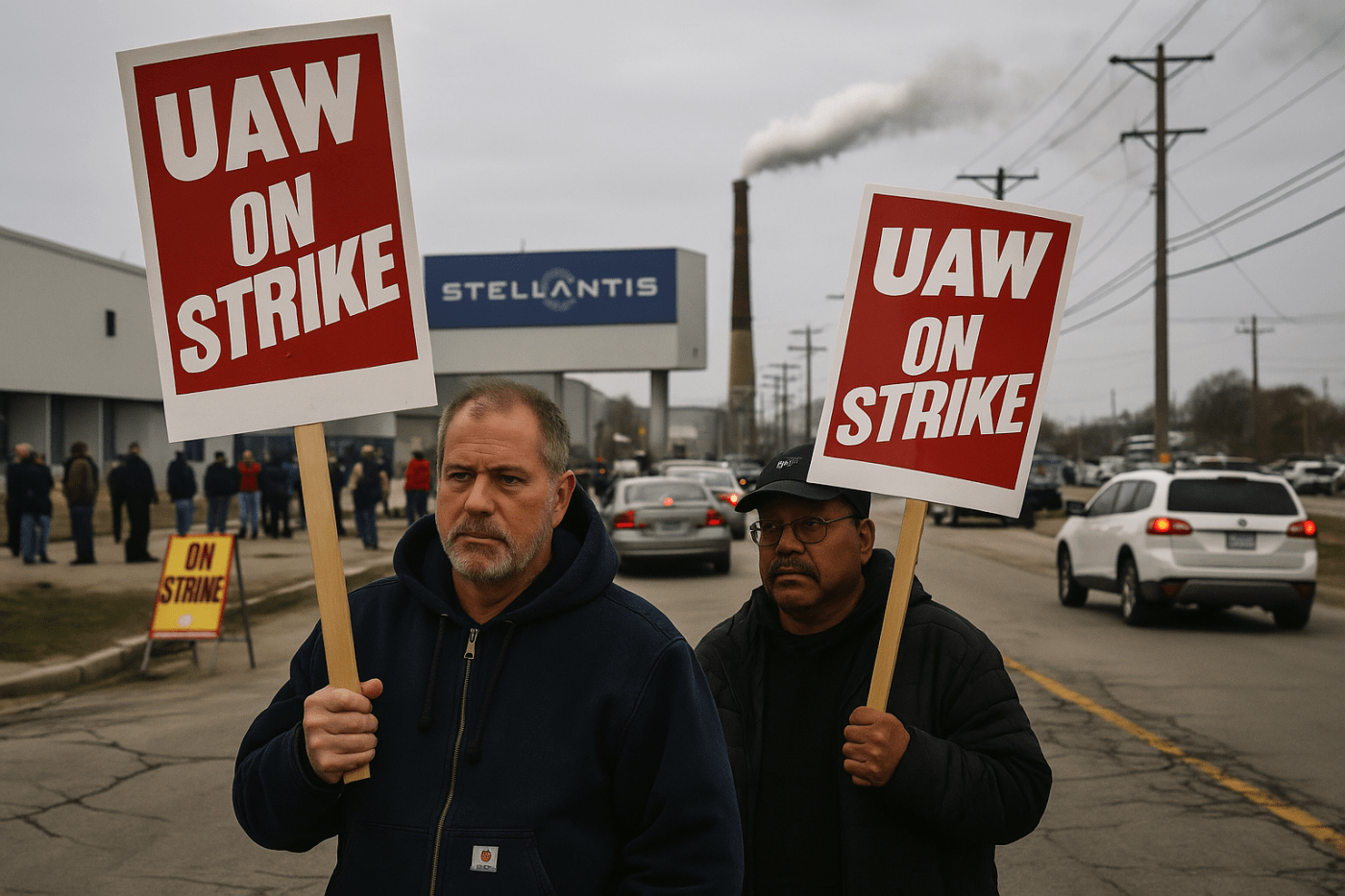
The multinational auto giant Stellantis—maker of Jeep, Chrysler, and Ram—is furloughing 900 workers in the U.S. and temporarily idling plants in Canada and Mexico. The corporate press is painting this as an unfortunate but temporary hiccup in response to President Trump’s new 25% tariff on foreign-made vehicles. But from where we stand—in the trenches of global class struggle—this isn’t some passing inconvenience. It’s a window into the logic of capital as it retools itself for the next phase of imperialist domination.
This is what we call hyper-imperialism in motion—a process of crisis-driven capitalist recalibration in which the ruling class reshapes global supply chains through protectionist tariffs, industrial policy, and chokepoint monopolization. The working class, particularly those in the Global South, is sacrificed on the altar of strategic profit consolidation.
Not “America First”—Empire First
Trump’s 25% tariff isn’t protecting workers—it’s protecting profits. The new policy, passed under the banner of “reindustrialization” and “bringing jobs home,” is part of the technofascist regime’s broader Monroe Doctrine 2.0: reasserting absolute hemispheric control not just militarily, but economically. The U.S. doesn’t just want supply chains closer to home—it wants them under its thumb.
And if workers in Mexico, Canada, or even Ohio suffer? That’s a feature, not a bug. The point of these recalibrations isn’t stability for labor—it’s leverage for capital.
Mexico: From NAFTA to Necropolitics
In Toluca, where Stellantis halted operations, thousands of Mexican workers are now without pay. Let’s not forget: Mexico was turned into a cheap-labor export platform through NAFTA and its successor, USMCA. U.S. and Canadian automakers flooded south to exploit hyper-flexible labor laws, depressed wages, and non-unionized workforces. Now that Washington wants to reshuffle the global deck, these workers are being discarded like worn-out machine parts.
This is not a one-off tragedy—it’s the predictable result of an imperialist system that treats the Global South as a disposable engine of surplus extraction. Stellantis’s move is a classic case of imperial recalibration: moving pieces around the board to maintain hegemony while offloading the costs onto colonized labor.
Canada: Caught Between Capital and Empire
In Windsor, Ontario, where Stellantis just halted vehicle production, Canadian autoworkers find themselves—once again—pawns in a war between U.S. capital and its own labor base. Canada, long the junior partner in the Anglo-American imperialist bloc, is now being reminded that proximity to empire does not mean protection. It means dependency.
Canadian workers are often perceived as peripheral to the colonial contradiction. But the fallout from this moment makes it clear: even workers in the settler core can and will be sacrificed when capital needs to shift gears. The difference? In the Global South, that sacrifice has always been the starting point—not the exception.
U.S. Workers: Strangled by the Same Machine
The 900 U.S. autoworkers being furloughed by Stellantis—primarily in Michigan and Indiana—are no less victims of this imperial machinery. But their exploitation, while real, is shaped by a different historical trajectory. U.S. workers operate from within the imperial core, with access to certain protections, wages, and political leverage—none of which are extended to their counterparts in Mexico.
The United Auto Workers (UAW) has criticized Stellantis for choosing “corporate greed over people.” But the deeper truth is this: Stellantis is doing what all capitalists do when crises hit—they preserve their profit margins by sacrificing labor, beginning with the most vulnerable. The layoffs in the U.S. may feel sudden—but they are part of a long chain of exploitation that runs through maquiladoras, supply chain slavery, and outsourced assembly lines across the Global South.
Our Position Is Clear
We at Weaponized Information reject all narratives that pit one set of workers against another—especially across national borders. Whether in Toluca, Windsor, or Toledo, the workers are not enemies. Their enemy is the imperialist class, which manipulates national boundaries and tariff regimes to maintain profit and suppress rebellion.
This is not about “free trade” versus “protectionism.” It’s about capital’s unrelenting war against labor—especially colonized labor. It’s about an imperialist economy rearranging itself in response to its own crises, offloading the wreckage onto the backs of those least able to bear it.
Final Word: Internationalism or Barbarism
There is only one way forward: internationalist working-class solidarity rooted in anti-imperialist revolution. The future must be forged not in corporate boardrooms or in the false promises of economic nationalism, but through revolutionary clarity, global class unity, and direct confrontation with the empire’s economic war machine.
The lines are drawn—not between nations, but between the exploited and the exploiters. Choose yours.
 Weaponized Information
Leave a comment