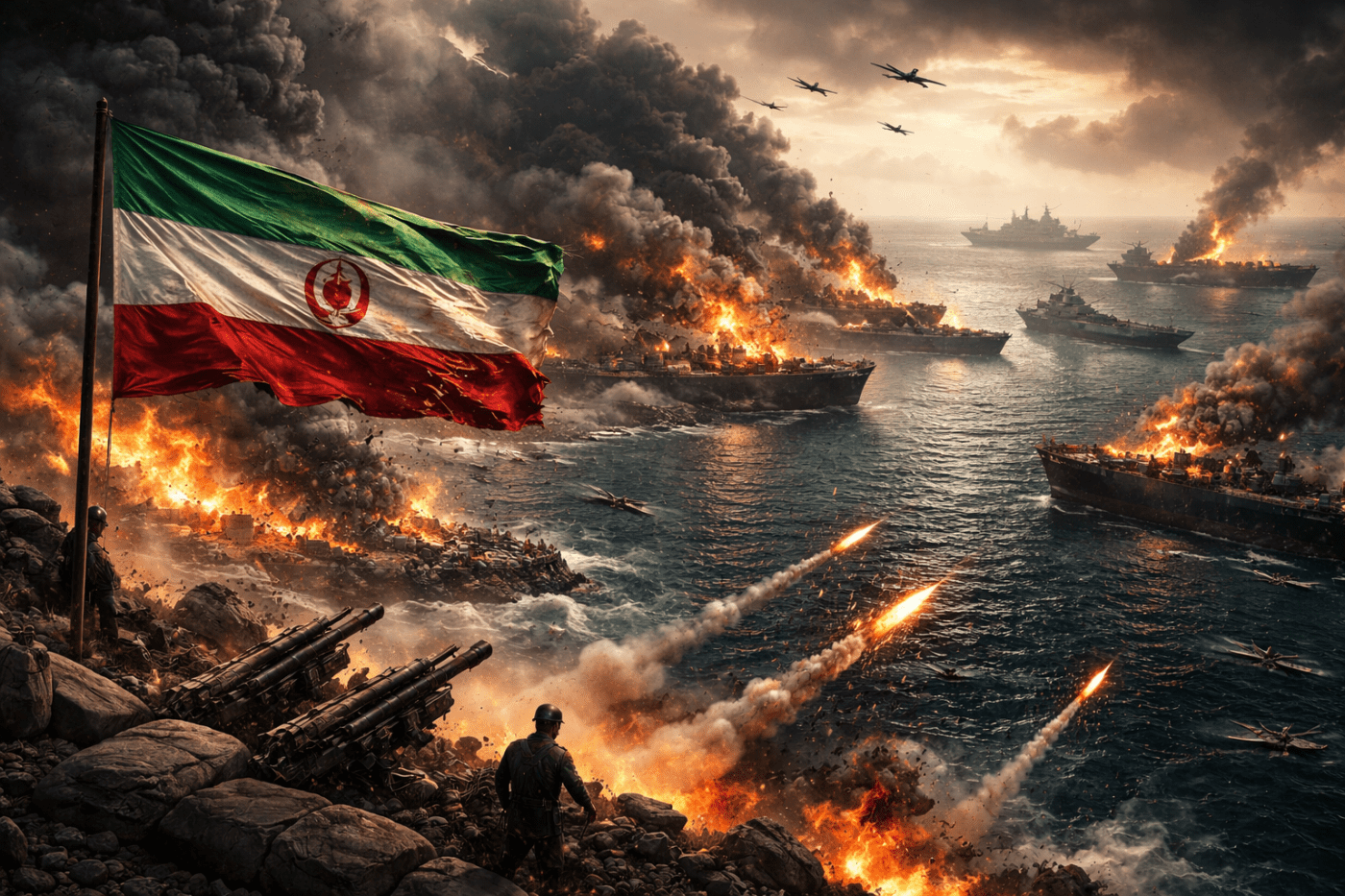
The headlines tell a story of escalation, but the facts reveal an ultimatum backed by mass death, where empire threatens to wipe out a civilization to reopen a chokepoint. Beneath that surface lies a structured reality of war crimes, sanctions, and selective control over Hormuz, exposing a coordinated system of coercion masked as crisis management. When these facts are synthesized, the real picture emerges: a colonial system in crisis, waging hyper-imperialist war to control global energy flows and contain a rising multipolar world. The task before us is not interpretation alone, but organization—turning exposure into resistance against a system that survives through destruction.
By Prince Kapone | Weaponized Information | April 7, 2026
Escalation Without a Beginning, Destruction Without a Name
The Associated Press article, “Trump warns a ‘whole civilization will die tonight’ if a deal with Iran isn’t reached”, published on April 7, 2026 by Bassem Mroue, Jon Gambrell, Mike Corder, and Samy Magdy, arrives wrapped in the familiar clothing of urgency and neutrality. It tells us that a war has reached its sixth week, that tensions are rising, that rhetoric is intensifying, and that the region stands on the edge of catastrophe. We are shown airstrikes hitting bridges and railways, missiles flying across borders, civilians seeking shelter, and global markets trembling at the disruption of oil flows. The article presents itself as a window into unfolding chaos. But like many such windows, it has been carefully framed—designed not only to show, but to limit what can be seen.
From the very first sentence, the war is presented as something already in motion, something that has simply “entered its sixth week.” This is not a trivial phrasing. It performs the quiet but essential labor of removing the question of origin. Wars do not begin themselves. They are initiated, structured, and directed. Yet here, the reader is dropped into the middle of events, as if stepping into a storm already underway, with no need to ask who set the winds in motion. The effect is to transform a concrete historical act into an abstract condition. The war becomes atmosphere rather than action, environment rather than decision.
Within this atmosphere, the article constructs a rhythm of escalation. Trump issues a threat of staggering magnitude—declaring that “a whole civilization will die tonight” if Iran does not comply with demands tied to reopening the Strait of Hormuz. Iranian officials respond with calls for mass mobilization, urging citizens to form human chains around power plants and reporting millions volunteering to defend the country. Airstrikes strike infrastructure. Iran fires missiles at regional targets. Each movement is paired with a counter-movement, each action mirrored by a reaction, producing the sense of a balanced and reciprocal struggle. The structure is almost mechanical: move, counter-move, escalation, response. What disappears within this choreography is any distinction between initiative and reply, between imposition and resistance.
The article reinforces this symmetry through its handling of suffering. We are shown the damage in Tehran, the fear in Israeli cities, the displacement in Lebanon, and the casualties spread across multiple countries. The images accumulate into a shared landscape of pain, one that appears to belong equally to all sides. This is not accidental. By distributing suffering across the region without differentiating its sources or trajectories, the narrative produces a moral flattening. Violence becomes universal, and therefore untraceable. The question of responsibility dissolves into a general condition of tragedy, where everyone suffers and no one is accountable.
Even the most extraordinary statements are absorbed into this equilibrium. Trump’s declaration that an entire civilization could be destroyed is not treated as a rupture in political language, not as a statement that demands categorical interpretation, but as part of a broader escalation of “rhetoric.” The word does heavy lifting here. It converts a threat of annihilation into a feature of discourse, something to be measured alongside diplomatic tensions and military developments. In this framing, language itself is neutralized. The difference between ordinary political speech and the invocation of total destruction is compressed into a single continuum of intensity.
The article does not entirely ignore the legal implications of what it describes. It briefly introduces warnings from international figures who note that attacks on civilian infrastructure are prohibited under international law and could constitute war crimes. Yet these warnings are positioned at the margins of the narrative, as concerns raised by observers rather than as defining characteristics of the actions being reported. The deeper legal question—whether the war itself is lawful, whether it constitutes aggression—remains unasked. Law appears only at the edges, never at the center.
Meanwhile, the material targets of the war are described in technical and operational terms. Bridges are struck because they may carry military equipment. Railways are hit as logistical pathways. Petrochemical facilities are attacked as strategic assets. The language remains within the vocabulary of military necessity, even as the objects themselves belong to the infrastructure that sustains civilian life. What is presented is a series of strikes against systems, not a sustained assault on the conditions of social existence. The transformation of infrastructure into battlefield disappears into the technical description of targeting.
The cumulative effect is not confusion, but containment. The reader is given enough information to recognize that something immense and dangerous is unfolding, but not enough to understand its structure or origin. Agency is diffused, legality is softened, and causation is obscured. What remains is a narrative of escalation without beginning, destruction without clear authorship, and crisis without a name. It is a story that moves quickly, speaks urgently, and reveals just enough to keep the deeper reality safely out of view.
What the Wire Reports, What the Record Reveals
The Associated Press gives us the official surface of the war, and even that surface is more revealing than it means to be. Trump tied his latest deadline to reopening the Strait of Hormuz and warned that “a whole civilization will die tonight” if Iran did not comply. There you have the empire speaking in its native tongue: extortion with a Bible-school smile and a gangster’s imagination. AP also reports that airstrikes hit two bridges and a train station in Iran, while the U.S. struck military targets on Kharg Island, described in the piece as an Iranian oil hub. It says that Iran fired on Israel and Saudi Arabia, and that Saudi Arabia said it intercepted seven ballistic missiles and four drones. It admits, though with the reluctance of a servant who does not wish to embarrass his master, that the war began after Israel and the U.S. attacked on February 28, and says Iran then choked off shipping through the strait. It adds that more than 1,900 people have been killed in Iran, more than 1,500 have been killed in Lebanon, and more than 1 million people have been displaced there. It reports, too, that Iran linked reopening the Strait of Hormuz to sanctions relief, while mediators from Pakistan, Egypt, and Turkey raced to broker a compromise before Trump’s deadline. Those are the bricks AP gives us. The trouble for AP is that when you stack those bricks honestly, the house it builds is not “escalation,” but aggression.
Once we step outside that wire-service cage, the world becomes clearer very quickly. AP wants the reader to imagine that Iran has simply slammed shut the Strait of Hormuz like an angry landlord changing the locks. But Iran’s Foreign Ministry states that the Strait of Hormuz is not closed, that maritime traffic has not been halted, and that Tehran is preventing transit by vessels belonging to or associated with the aggressor parties while continuing navigation under wartime conditions. That is not indiscriminate closure. That is selective wartime control. It is the difference between a barricade and a checkpoint, between chaos and policy. And Iran’s Foreign Minister Abbas Araghchi noted that ships are hesitating not because Iran has simply “closed” the strait, but because insurers fear the war initiated by the U.S. and Israel, adding that the Strait of Hormuz “is not closed”. So the problem in Hormuz is not some cartoon villainy by Tehran. The problem is war, insurance risk, and a sea lane passing through a battlefield created by U.S.-Israeli aggression. That is what the imperial press cannot say plainly, because once it says it plainly, the whole moral architecture of the story begins to collapse.
The same thing happens when we look at what is being hit. AP gives us fragments—bridges here, stations there, petrochemicals somewhere in the haze—always with the suggestion that these are technical targets in a technical war. But the U.S.-Israeli campaign has involved continued attacks and threats against civilian and service infrastructure, and threats against power plants and bridges are threats to commit war crimes. That is not diplomatic embroidery. That is a direct naming of the target set. And the details are concrete. Iran’s ambassador to the UN accused the U.S. and Israel of striking the Karaj-Tehran B1 Bridge, the Mahshahr Petrochemical Special Economic Zone, and a cement factory in Bandar Khamir, explicitly tying these attacks to prior U.S. public threats against infrastructure. This is not accidental rubble falling from the sky. This is a line from threat to deed, from speech to impact, from imperial mouth to civilian wreckage. The bombs do not lose their memory just because the headlines do.
There is another thing the AP frame buries under its shallow talk of standoffs and deadlines: Iran is not merely reacting blindly. It is governing a crisis. Iranian and Omani officials have already held technical talks on ensuring the smooth flow of transit through Hormuz. That means coordination, procedure, and regulated access under wartime conditions. It means Tehran is not flailing. It is setting terms. The same logic appears in the broader diplomatic proposals. Iranian officials have been discussing a protocol to monitor traffic and a differentiated access regime for “friendly” countries, while Al Jazeera reports that Iran’s 10-point proposal includes a protocol for safe passage through Hormuz, sanctions relief, and reconstruction. So the issue is not simply whether ships move. The issue is under whose authority they move, under what political terms, and inside which postwar order. That is why this narrow strip of water has become so charged. It is not just water. It is power in liquid form.
The war also did not unfold in the clean laboratory imagined by Washington and Tel Aviv. The U.S. and Israel expected a rapid domination or decapitation outcome, but that the war has instead produced state continuity and continued Iranian leverage, including over Hormuz. That matters enormously. Empire came to impose collapse and instead encountered endurance. It came to produce submission and instead produced bargaining power in the very chokepoint on which the world economy depends. This is why the language from Washington has become so wild, so swollen, so apocalyptic. When brute force fails to yield political victory, imperial speech begins to sound like a drunk landlord threatening to burn down the building because the tenants refused to kneel.
And none of this can be understood outside the machinery of coercion that already surrounded Iran before the missiles flew. OFAC announced new February 2026 sanctions targeting illicit traders of Iranian oil and the shadow fleet, followed by sanctions on networks supplying Iran’s missile and related programs. So this war is fought not only with aircraft and explosives, but with sanctions, shipping controls, blacklists, insurers, and financial siege. One hand tightens around the throat through the Treasury Department while the other drops bombs and calls it diplomacy. This is how modern empire works when it wears a necktie instead of a helmet.
Then there is the larger world into which this war explodes. Iran’s Foreign Ministry states that arrangements, initiatives, and mechanisms related to maritime safety and security in the Persian Gulf, Strait of Hormuz, and Sea of Oman must proceed with full respect for Iran’s rights and interests and in coordination with competent Iranian authorities. That is a jurisdictional claim. It says: you do not get to bomb us and then pretend the road through our neighborhood belongs to you by divine right. Iran’s proposal includes safe passage through Hormuz, sanctions relief, and reconstruction, while the root cause of the obstruction to navigation in Hormuz is the illegal military aggression of the United States and Israel against Iran, not an isolated Iranian decision detached from the war that preceded it. That is called causality, a thing corporate journalism treats the way Dracula treats sunlight.
The economic meaning of Hormuz is just as clear. The Strait of Hormuz is the primary export route for oil produced by several Gulf states, that around 20 million barrels per day normally transit it, and that the bulk of the oil leaving the strait heads to Asian countries, especially China, India, and Japan. This is not some local canal of interest only to mapmakers and admirals. It is one of the main arteries of the world economy. And now it is under severe disruption. Flows through Hormuz have plunged from about 20 mb/d to a trickle and Gulf producers have cut output by more than 10 mb/d, making this the largest supply disruption in the history of the global oil market. So when they tell you this is merely a regional crisis, understand that they are trying to describe an earthquake as an inconvenient vibration in the floorboards.
The legal meaning is no less plain. Civilians and civilian infrastructure, including nuclear installations, must be respected and protected, and freedom of navigation must be respected. It is prohibited to attack, destroy, remove, or render useless objects indispensable to the survival of the civilian population. These are not obscure footnotes buried in some monastery archive. They are the plain rules. And those rules sit directly on top of the public threats against power plants, bridges, and essential infrastructure. The law is not confused. The powerful are simply accustomed to treating the law the way a plantation master treated the Bible: useful when it disciplines others, disposable when it restrains them.
The alliance system surrounding this war is also under pressure. The only deal Iran will accept will give it a say over who goes in and out of the strait, a matter of concern for Europe and U.S. allies in East Asia because of their energy dependence. In other words, Washington’s partners want the benefits of imperial control without the bill that comes due when the controlled route becomes contested. They want the oil to flow, the markets to stay calm, and someone else’s children to absorb the blowback. That old imperial arithmetic is now breaking down in public.
And beneath all of this lies the long history that polite journalism handles the way a crooked banker handles ledgers—always losing the page where the theft began. U.S. official records on Mossadegh, oil nationalization, and Operation TPAJAX make plain that this confrontation is not some sudden crisis, but part of a continuous struggle over who controls Iranian state power and the strategic energy geography beneath it. And this trajectory was not hidden in some secret archive—it was openly theorized. The Brookings Institution laid out, as early as 2009, the potential pathways, contingencies, and pretexts for a U.S. war against Iran, mapping regime change not as speculation but as policy architecture. Oil, sovereignty, sanctions, regime change, sea lanes, infrastructure, war—these are not separate chapters scattered across time. They are one continuous book, written in advance and enforced in real time, and the same dirty fingerprints are on every page.
Taken together, the surface narrative collapses under the weight of the record. What the headlines call “escalation” is a structured war of aggression. What they call “shipping disruption” is a struggle over authority in one of the main chokepoints of global capitalism. What they call “rhetoric” includes open threats against the material basis of civilian life. And what they call “crisis” is a historical process decades in the making, now exploding through infrastructure, energy, law, finance, and blood. That is the war beneath the headlines. Not fog, not confusion, not symmetry—power, coercion, resistance, and a system showing its fangs.
When Empire Hits Its Limits: Oil, Chokepoints, and the Threat to Wipe Out a People
Strip away the polite language, the diplomatic choreography, the newsroom caution, and what stands before us is not a “conflict,” but the colonial contradiction exploding in real time. This is what it looks like when an imperial system—built on centuries of theft, domination, and enforced dependency—runs into a wall it cannot easily break through. The United States and its allies are not stumbling into war out of confusion or miscalculation. They are acting out the basic law of imperialism in crisis: control must be maintained, or the whole structure begins to crack. Iran, in this moment, is not simply a country under attack. It is a refusal. A refusal to be absorbed, disciplined, or reorganized according to the needs of empire. And for that refusal, it is being punished.
The Strait of Hormuz sits at the center of this struggle like a loaded gun on the table. This is not just a narrow stretch of water. It is one of the main arteries through which global capitalism circulates its lifeblood. Oil flows through it, and with that oil flows the energy that powers factories, transports goods, and sustains entire national economies—especially across Asia, where the future of global production is increasingly concentrated. Whoever shapes the conditions of movement through Hormuz holds a lever over the global system itself. Iran understands this. That is why it insists on regulating access, on asserting sovereignty over a space that runs along its own geopolitical front yard. But empire also understands this. And empire does not tolerate independent control over what it considers its infrastructure.
So what we are witnessing is not simply a dispute over shipping lanes. It is a struggle over who gets to command the material arteries of the world economy. And that struggle is inseparable from the New Cold War taking shape against China. The oil that passes through Hormuz does not vanish into the air—it moves east, toward the industrial centers that increasingly define global production. To disrupt, regulate, or militarize that flow is to apply pressure far beyond Iran. It is to reach into the economic bloodstream of China and its partners. In that sense, this war is not confined to West Asia. It is one front in a larger campaign to reassert imperial control over a world that is drifting, steadily and stubbornly, toward multipolarity.
And how does empire pursue that control? Not with a single weapon, but with an entire arsenal of domination. Bombs fall from the sky, yes—but they fall alongside sanctions that choke trade, financial restrictions that isolate economies, and diplomatic ultimatums that attempt to force submission without even the courtesy of negotiation. This is hyper-imperialist militarism: a system that wages war across every domain at once. It is not enough to defeat an opponent militarily. The objective is to suffocate them economically, isolate them politically, and break their capacity to function as an independent entity. War becomes not an event, but a condition—a permanent pressure applied to any state that steps outside the imperial line.
Within this structure, the threat that “a whole civilization will die tonight” is not some stray outburst that slipped past the filters of decorum. It is the system speaking plainly for once. When power reaches the point where it cannot secure obedience through markets, treaties, or proxies, it begins to speak in the language of annihilation. And when that language is paired with the systematic targeting of infrastructure—bridges, power systems, industrial facilities—the meaning becomes unmistakable. This is not simply about defeating a military. It is about degrading the material conditions that allow a society to exist. You destroy the bridges, you isolate the people. You destroy the energy systems, you darken their homes. You destroy the industrial base, you choke their future. This is how war begins to take on genocidal implications—not only in the number of bodies it produces, but in its assault on the very possibility of collective life.
But here the contradiction sharpens, and empire begins to stumble over its own assumptions. The script called for collapse. The script called for panic, fragmentation, and internal revolt. Instead, the Iranian state has endured. It has absorbed the shock, maintained coherence, and continued to act—militarily, politically, and strategically. This is not a minor inconvenience for imperial planners. It is a rupture in their expectations. Because the entire strategy rests on the belief that overwhelming force can produce predictable political outcomes. When that belief fails, the system is left with only one tool: escalation. More pressure. More threats. More destruction. The volume increases because the effectiveness does not.
This is what crisis looks like in an imperial system. Not weakness in the sense of immediate collapse, but a growing gap between what power can do and what it can achieve. The United States still possesses immense destructive capacity—it can bomb, sanction, and threaten on a global scale. But its ability to convert that destruction into stable, obedient political arrangements is eroding. The world it once dominated without serious challenge is changing. New centers of economic gravity are emerging. Old dependencies are loosening. And every attempt to reassert control produces new resistance, new instability, new contradictions.
That is why this war cannot be understood in isolation. It is part of a broader transformation of the world system. The colonial foundations of imperial power—the assumption that certain regions exist to be controlled, their resources extracted, their sovereignty conditional—are being contested more openly than before. Iran’s position, whatever its internal contradictions, represents one form of that contestation: a refusal to surrender control over its territory, its resources, and its strategic environment. And that refusal reverberates far beyond its borders, because it raises a dangerous question for empire: what happens if others do the same?
So the system responds the only way it knows how. It tightens the grip. It raises the stakes. It normalizes threats that once would have been unthinkable. And in doing so, it reveals itself more clearly than ever before. Not as a guardian of order, but as a structure of domination struggling to maintain itself in a world that is slipping beyond its command. The war, in all its brutality, is not an aberration. It is a message. A message about how power behaves when it is challenged, about what it is willing to destroy when it cannot control, and about the lengths to which it will go to preserve a system that is no longer as secure as it once believed.
From Exposure to Action: Turning Knowledge into Struggle
If this war reveals anything with clarity, it is that we are not dealing with isolated events, but with a system that organizes violence as a method of rule. That means the response cannot be limited to outrage, commentary, or passive recognition. To understand what is happening is to recognize that the terrain itself demands action—concrete, organized, and rooted in material struggle. The exposure of imperial violence is not an end in itself. It is a beginning, a point from which forces must be mobilized, alliances strengthened, and contradictions sharpened in favor of those who resist domination.
The first task is political clarity at the level of the masses. The narrative of “conflict,” “escalation,” and “both sides” must be actively dismantled wherever it appears—in workplaces, in communities, in classrooms, and across every platform where ideas circulate. This is not an abstract exercise. It means developing political education that connects this war to everyday life: to energy prices, to economic instability, to the diversion of resources toward militarism while social needs are neglected. It means making clear that what is being fought over abroad has direct consequences at home, and that the system responsible for war is the same system that imposes austerity, surveillance, and precarity domestically.
The second task is building active solidarity with those targeted by imperial violence. Solidarity is not a slogan. It is a practice. It takes the form of coordinated campaigns, material support, and public pressure that disrupts the ability of the state and its corporate partners to operate without opposition. This includes supporting anti-war coalitions, amplifying voices from affected regions, and creating networks that can respond quickly to escalations. It also means recognizing that struggles abroad and struggles at home are not separate. The same apparatus that wages war externally is deployed internally to manage dissent. Building solidarity therefore strengthens resistance on both fronts.
The third task is confronting the economic and institutional foundations of war. Military power does not operate in a vacuum. It is sustained by industries, financial systems, and political structures that profit from and reproduce conflict. Challenging war therefore requires identifying and targeting these nodes—whether through labor action, divestment campaigns, or organized disruption. When workers refuse to participate in the machinery of war, when institutions are forced to account for their role in sustaining it, the system begins to encounter limits that cannot be overcome through force alone. This is where the struggle moves from symbolic opposition to material intervention.
Finally, there is the task of building alternatives. Resistance cannot exist solely in opposition; it must also articulate a different vision of social and political organization. This means strengthening movements that challenge the underlying structures of imperialism—movements rooted in economic justice, democratic control, and international solidarity. It means developing forms of organization capable of sustaining long-term struggle, rather than reacting only to immediate crises. And it means understanding that the transformation of the global order will not be delivered from above, but constructed through the collective action of those who bear the cost of the system as it exists.
The moment we are in is one of danger, but also of possibility. The same contradictions that produce war also open space for resistance. The same system that reveals its violence also reveals its limits. The question is not whether these contradictions exist, but how they are engaged. If they are left unchallenged, they will deepen into greater destruction. If they are confronted with organization, clarity, and solidarity, they can become the basis for transformation. The task, then, is not simply to understand the world as it is, but to act within it in ways that push it toward what it could become.
 Weaponized Information
Leave a comment