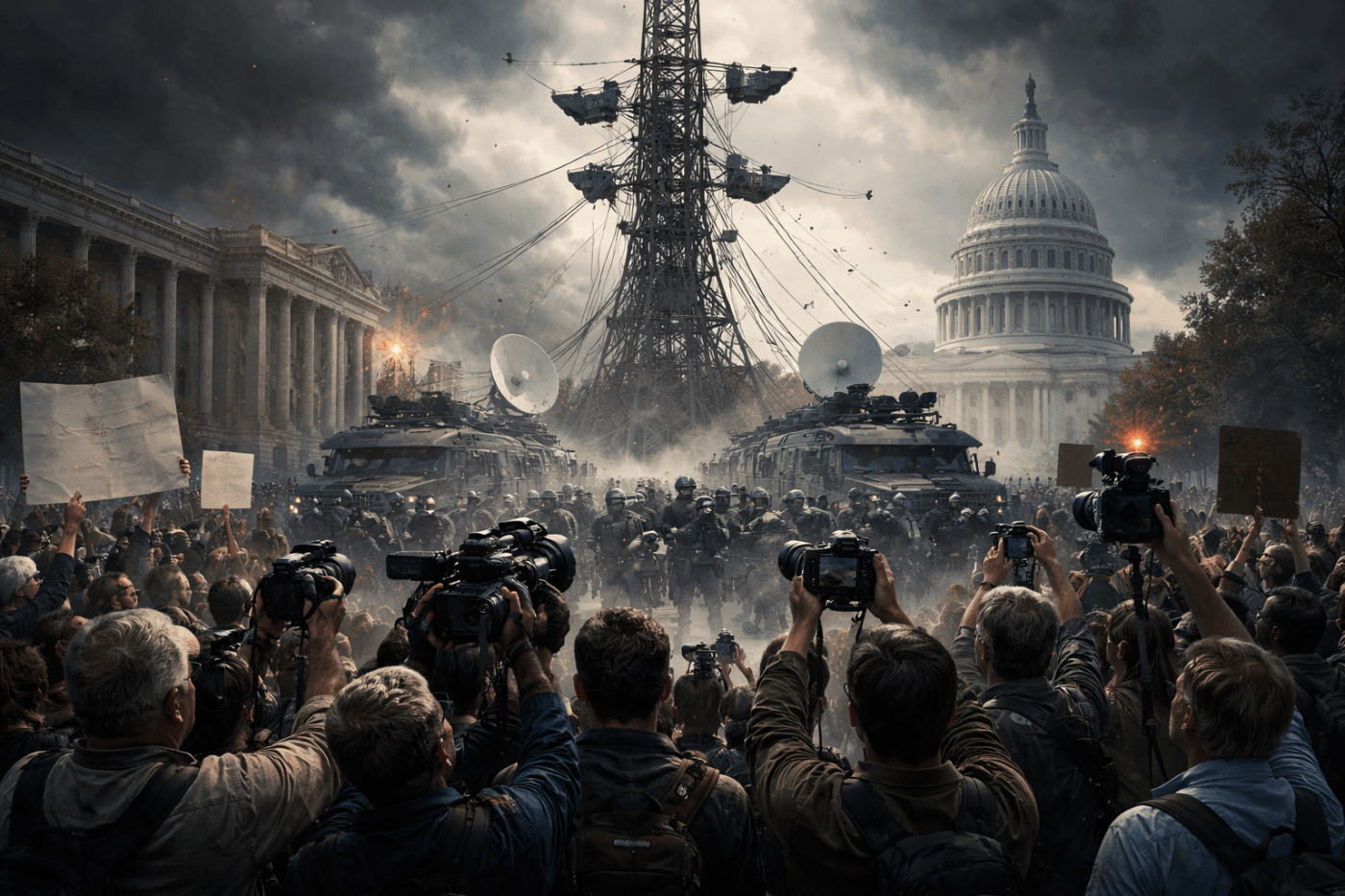
As the United States loses its monopoly over global storytelling, regulatory power, media concentration, and wartime pressure converge to manage a fractured information order—and reveal how narrative control adapts under imperial strain.
By Prince Kapone | Weaponized Information | March 17, 2026
When Power Clears Its Throat and Calls It a Debate
In Dominick Mastrangelo’s March 16, 2026 article in The Hill, we are presented with a moment that, on its face, appears straightforward: Federal Communications Commission Chair Brendan Carr raises the possibility that broadcast licenses could face consequences over wartime coverage, prompting concern from lawmakers, media figures, and regulatory officials. The article walks the reader through reactions—criticism from Democrats, unease among press advocates, and defenses or explanations from those aligned with the administration—framing the situation as a developing political controversy over the limits of government authority and press freedom. At the level of surface reporting, everything is in place: who said what, who objected, and how the debate is unfolding. But already, even in this basic telling, the terrain is being quietly shaped. What is introduced as a question of reaction is, in fact, a question of power.
The story does not begin with the act itself, but with the reaction to it. We are told there is “backlash,” that people are alarmed, that something controversial has entered the room. And just like that, the reader is positioned not as someone trying to understand what kind of power is being exercised, but as someone watching how respectable society is responding to it. This is how ruling-class storytelling works when it wants to keep things calm. It does not hide the problem outright. It surrounds it with commentary until the thing itself becomes secondary. By the time you arrive at the actual threat—licenses, regulation, pressure—the ground has already been prepared. You are no longer asking, “What is happening here?” You are asking, “How are people reacting to it?” That shift is not accidental. It is discipline in narrative form.
The article then moves the way these stories always move—through voices, not through investigation. Carr speaks. Trump complains. Senators object. Commissioners push back. Analysts weigh in. One quote after another, like bricks in a wall, until the reader is boxed into a very specific understanding of reality: politics is what these people say it is. There is no need to step outside that circle, no need to question the structure that gives these voices their authority. The journalist does not interrogate the event so much as arrange it. And arrangement, in this case, is everything. Because once the story is built out of official speech, the limits of that speech become the limits of the reader’s imagination. Even the criticism feels safe. Even the concern feels approved. The whole thing becomes a managed disagreement among people who already agree on the fundamentals.
And then there is the language itself—soft, careful, almost polite in the face of something that is not polite at all. The FCC chair “suggested” consequences. Broadcasters “could” face problems. The administration is merely “frustrated.” Notice how the weight is lifted off the action and placed onto emotion. What could be understood as pressure starts to look like irritation. What could be read as coercion begins to sound like a disagreement over tone. This is not sloppy writing. It is very precise. It turns a hard edge into a dull one. It teaches the reader to interpret power as mood. As if what we are dealing with here is not the possibility of discipline, but the temperament of men who are unhappy with how they are being portrayed.
Meanwhile, the war—the thing that gives this entire episode its urgency—sits in the background like a shadow no one is allowed to describe. It is mentioned, yes. It is everywhere, yes. But it is never opened up, never examined, never treated as something that might itself explain why this pressure is happening. The war is treated like the weather: always present, never questioned. And that silence does heavy lifting. Because once the war is removed from analysis, the struggle over how it is reported begins to look like a secondary issue, a media controversy, a dispute over coverage. The deeper question—who gets to define reality in a moment of conflict—is quietly pushed off the table.
What the article ultimately does is take something that should feel sharp and make it feel manageable. It wraps a potential act of discipline in the language of process. It balances reactions across parties to give the impression of democratic correction. It even slips in the idea that the public has lost trust in the media, as if that somehow explains why pressure might be justified. This is how power learns to speak when it does not want to alarm the room. It does not shout. It moderates. It presents itself as reasonable, procedural, even reluctant. And the story follows that tone. It does not need to defend the threat outright. It only needs to place it inside a familiar script, one where everything—no matter how serious—can be understood as just another episode in the normal functioning of American politics.
That is the craft of it. The threat is there. The warning is clear enough. But the way it is told ensures that it never quite lands with the force it carries. You are kept close to power, close enough to hear it speak, but not far enough to see the full shape of what is being said. And in that space—between hearing and understanding—is where this kind of journalism does its quiet work.
The Ground Beneath the Threat: Law, Ownership, and the Long History of Quiet Pressure
To understand what has surfaced in the present moment, we have to move away from the language of “controversy” and return to the material structure that makes such a threat possible in the first place. At the center of it all sits the Federal Communications Commission, whose authority over broadcast licensing is rooted in Section 309 of the Communications Act, which requires that licenses be granted and renewed according to “the public interest, convenience, and necessity.” This framework itself rests on a deeper legal rationale: the idea of spectrum scarcity, long used to justify federal oversight of broadcasting on the grounds that the airwaves are a limited public resource requiring regulation. The phrase “public interest” has always been elastic—wide enough to justify intervention, vague enough to avoid clear limits. But the crucial point, often left unstated, is that this authority has historically been used with restraint when it comes to direct editorial content. Even the FCC’s own policy on broadcast news distortion makes clear that action is only warranted in cases of deliberate falsification, not simply coverage that those in power find inconvenient or politically damaging.
This is why the current situation stands out. According to reporting by Reuters, the FCC has not revoked a television broadcast license in more than four decades. The power exists, but it has largely remained dormant, a kind of loaded instrument kept in reserve. That same reporting notes that FCC Chair Brendan Carr has suggested the possibility of accelerating license reviews tied to wartime coverage, signaling not routine enforcement, but a willingness to bring that dormant authority into active political use. Historically, outright revocation has been rare, but the licensing process itself has functioned as leverage, where the possibility of delay, scrutiny, or denial can shape broadcaster behavior without formal punishment.
The present framework also sits on top of an older transformation in U.S. media regulation. The FCC once enforced the Fairness Doctrine, a policy requiring broadcasters to present contrasting viewpoints on controversial issues of public importance. Its repeal in 1987, when the FCC formally voted to eliminate the doctrine, marked a decisive shift away from even limited obligations toward balance, opening the door to a more openly consolidated and ideologically segmented broadcast environment, where the absence of such requirements helped fuel the rise of partisan media ecosystems. What remains today is not a neutral system of public trusteeship, but a regulatory structure operating within a highly commercialized and concentrated media economy.
But law alone does not explain the terrain. The structure of the media system itself must be taken into account. What is often described as a free and pluralistic press is, in practice, a highly concentrated industry. Pew Research Center data on local television news shows that large station groups dominate the broadcast landscape, with a handful of corporations controlling vast networks of local affiliates. These stations rely heavily on advertising revenue, particularly political advertising, which ties them directly to cycles of electoral and state power. Meanwhile, organizations like Free Press have warned that the remaining ownership rules enforced by the FCC are among the last barriers preventing even deeper consolidation and local monopolization of the airwaves.
This concentration is not abstract. It has operational consequences. Large station groups such as Sinclair Broadcast Group have demonstrated the capacity to distribute centrally produced political segments across dozens of local affiliates, illustrating how ownership concentration can translate directly into narrative alignment at scale. The contradiction becomes clearer when we recognize that the same regulatory body now invoking the “public interest” has also been the arena through which this consolidation has been permitted, reviewed, and at times expanded. The FCC’s own quadrennial review processes continue to evaluate whether ownership limits should be loosened further. At the same time, broader analyses such as the Roosevelt Institute’s report on the political economy of the U.S. media system describe a sector marked by oligarchic ownership, the collapse of local journalism, and increasing vulnerability to both market and political pressure.
When we widen the lens beyond the present moment, a longer pattern begins to emerge. Over the past quarter century, pressure on journalism in the United States has rarely taken the form of outright censorship. Instead, it has operated through a layered set of mechanisms—access, surveillance, prosecution, and informal coordination. During the Iraq War, RAND Corporation analysis of embedded journalism showed how reporters were integrated into military units, making their ability to report dependent on the very institutions they were covering. This was not censorship in the classical sense, but it shaped the conditions under which truth could be produced.
In the years that followed, the pressure took on different forms. The Committee to Protect Journalists documented a chilling effect during the Obama administration driven by leak prosecutions, surveillance, and aggressive control over information. The Associated Press revealed that the U.S. Department of Justice secretly obtained two months of its phone records, an act described as a “massive and unprecedented intrusion” into newsgathering. These dynamics illustrate what legal scholars describe as a chilling effect, where the possibility of state scrutiny or retaliation discourages certain forms of reporting without the need for formal prohibition.
More recently, the terrain has extended into the digital sphere. The legal battle around Murthy v. Missouri brought attention to the ways in which government actors have sought to influence content moderation decisions on social media platforms. While the Supreme Court’s ruling turned on questions of standing, the case itself exposed a new layer of interaction between state power and the channels through which information circulates. At the same time, in the context of ongoing military operations, new restrictions have been placed on journalists’ access to information. U.S. Senator Ron Wyden warned that Pentagon policies were forcing reporters to accept conditions amounting to government approval boundaries on their work.
When placed alongside these developments, the present threat begins to look less like an isolated escalation and more like the visible edge of a longer process. And yet, there is another layer to this story—one that reveals a striking contradiction in how these issues are framed internationally. For decades, the United States has criticized other countries for actions remarkably similar to those now being suggested at home. In 2008, the U.S. State Department condemned Venezuela for the “forced closure” of the television station RCTV after the government refused to renew its broadcast license. Human Rights Watch likewise argued that the shutdown harmed freedom of expression, framing the licensing decision as a political act rather than a neutral regulatory process.
This position has not been limited to Venezuela. U.S. human rights reporting has also criticized other governments for similar actions, including the refusal to renew broadcast licenses in Hungary. While these cases differ in political context, the comparison highlights how similar regulatory tools can be framed differently depending on geopolitical alignment. What is described abroad as repression is domestically reframed as enforcement of standards, revealing the strategic flexibility of the principle itself.
Finally, it is important to situate all of this within the broader condition of press freedom in the United States itself. According to Reporters Without Borders, the U.S. ranked 57th in the world in its 2025 press freedom index, reflecting a broader downward trend over the past decade marked by arrests, harassment, and declining trust. The Freedom of the Press Foundation has documented numerous cases in which journalists were arrested, assaulted, or subjected to surveillance, while the U.S. Press Freedom Tracker continues to record incidents ranging from detentions to legal threats. Regional reporting has likewise noted that press freedom across the Americas has declined, including in the United States.
Taken together, these facts reconstruct a very different terrain from the one presented in the original article. What appears on the surface as a dispute over rhetoric and regulation is, in reality, unfolding within a system already marked by concentrated ownership, legal asymmetry, historical patterns of pressure, and a long-standing willingness to interpret similar actions differently depending on where they occur. The present moment does not emerge from nowhere. It emerges from this structure.
When the Empire Loses Its Grip on the Story
Now that the facts are on the table, we can say plainly what this episode is and what it is not. It is not a misunderstanding between government and media. It is not simply a rude outburst from an official who spoke too freely. And it is not just another episode in the endless soap opera of Washington personalities. What we are looking at is a structural response to a deeper problem: the imperial information order is no longer secure in its authority to narrate events without serious disruption. This is not the behavior of a system confident in its own story. It is the behavior of a system managing instability after losing the unquestioned narrative dominance it once enjoyed.
That is the wider historical setting that matters here. For a long period, the American empire did not need to lean too openly on the question of narrative discipline because it still possessed something better than brute censorship: broad agenda-setting power, interpretive authority, and a corporate media system already rooted in the same social world as the state, finance capital, and the national security apparatus. In that older arrangement, power could often rely on alignment without having to advertise enforcement. The story would be framed properly, the language would be softened, the assumptions would be shared, and the machinery could keep moving with a minimum of public roughness. But that arrangement has been weakened. Leaks, digital fragmentation, rival media systems, public distrust, and the visible contradictions of imperial war have all eroded the old monopoly over meaning. The empire can still speak, of course. What it can no longer do as easily is assume that everyone will simply accept its interpretation of events as the natural voice of reality.
That is why this moment should be understood as a threshold event. What we are observing here is narrative management beginning to move from soft control into the realm of openly signaled regulatory pressure. Not full repression in the old theatrical sense. Not tanks parked outside the newsroom. Empire is usually more sophisticated than that. It prefers to work through framing, access, class affinity, ownership structures, professional incentives, and the ordinary cowardice that bourgeois institutions call responsibility. But when those softer forms of control begin to lose their smoothness—when war coverage starts exposing too much contradiction, when audiences begin comparing official claims with visible cracks in the story—then power starts reaching for harder instruments. The polite mask remains on, but now the hand lifts slightly and you can see the knuckles.
This is also why it is important to avoid the liberal fairy tale that what we are seeing is the state attacking some wholly external and independent press. That is not the real structure before us. This is better understood as a moment of internal discipline within a shared system whose components—state power, corporate media, ownership blocs, and regulatory authority—are already deeply intertwined. The corporate press is not outside the imperial order looking in through the window. It lives in the same house. It may argue over furniture placement. It may complain about the noise in the next room. But it remains tied to the same property relations, the same access circuits, the same advertising logic, the same assumptions about what kinds of violence are regrettable and what kinds are necessary. That is why this moment has the character of tension within a structure, not a clean duel between freedom and oppression. One wing of the system is reminding another wing that its room for deviation has limits.
And war is what sharpens the contradiction. War always requires narration. It demands not only military operations but ideological management. The public must be made to feel that events are coherent, that objectives are rational, that power is advancing with purpose, that whatever blood is being spilled fits inside some larger grammar of necessity. But reality is a rude worker. It does not always follow the script handed down from above. Plans falter. Assets are hit. contradictions emerge. Civilian suffering becomes harder to bury. The enemy refuses to behave like a stage prop. And when those disruptions begin appearing in coverage, the problem for the ruling class is not simply that bad news exists. The problem is that a widening gap opens between the official story and the lived or visible evidence surrounding it.
Inside that gap, what spreads is not automatically rebellion. It is something quieter and, from the standpoint of power, more dangerous: doubt. Doubt is what begins when the public is no longer fully willing to let the empire serve as both actor and interpreter of its own conduct. Doubt makes people compare headlines to outcomes, rhetoric to evidence, moral language to material consequences. It slows the automatic reflex of belief. And once that process begins, the old information order starts to wobble. This is why the question of media discipline becomes urgent under conditions of imperial stress. Not because everyone has become revolutionary overnight, but because skepticism is contagious, and skepticism is the enemy of narrative monopoly.
That is also why the real power here lies less in execution than in signaling. The central point is not whether licenses will be revoked tomorrow morning. The point is that the visible reminder of regulatory force can itself produce discipline. You do not have to carry out the punishment in every case if institutions understand that the punishment-capable machinery remains available. A threat voiced publicly by the head of a regulatory body does political work even before it becomes policy. It tells broadcasters that the lines of tolerance may be narrowing. It tells owners and managers to weigh risk differently. It tells editors that war coverage is no longer merely editorial judgment but a possible point of state scrutiny. In that sense, the signal often accomplishes more than immediate enforcement. It creates a chilling effect without needing to declare one by name.
Seen in this light, the hypocrisy around press freedom is not incidental. It is built into the imperial use of principle itself. When states outside the Atlantic order refuse relicensing or discipline hostile outlets, Washington calls it repression, authoritarianism, the death of free expression. But when similar tools are floated at home, the language changes. Suddenly we hear about standards, obligations, the public interest, responsible broadcasting. The mechanism is similar enough to expose the contradiction, even when the political contexts differ. That is because the principle was never as universal as it claimed to be. It was always conditional, always strategic, always more comfortably applied against rivals than against the domestic infrastructure of empire itself.
From the standpoint of the global working class, the peasantry, the colonized nations, and those struggling inside the imperial core, the stakes are far larger than a media controversy among elites. When the narrative field tightens in the center of empire, it affects which wars can be named honestly, which peoples can be seen fully, which forms of resistance can appear as rational and just, and which atrocities will be washed clean in the language of necessity. The shrinking of narrative space in the core means the shrinking of political visibility for those on the receiving end of sanctions, bombardment, occupation, and information warfare. What disappears from the screen is often what is being destroyed in the real world.
So what the article presents as backlash is, in truth, a sign of transition. It shows us a system moving deeper into the post-monopoly phase of narrative management, where the old confidence of empire has given way to a more anxious and more openly disciplinary posture. The ruling class has not lost its instruments. It still has corporations, regulators, platforms, war ministries, think tanks, and the decaying authority of establishment media. But it is increasingly forced to show its hand because softer forms of narrative alignment no longer guarantee the same results they once did. That is the meaning of this moment. Not that censorship has fully arrived in some crude cartoon form, but that the empire is adjusting to a world in which its ability to define reality can no longer be taken for granted.
And that is the real story here. Not simply that power is angry. Not simply that officials are overreaching. But that the old imperial information order is under strain, and under that strain it is beginning to reveal how it actually works: through structural alignment when possible, through linguistic management as routine practice, and through the strategic signaling of regulatory force when the story starts slipping out of its hands.
From Fracture to Formation: Organizing in the Age of Narrative Instability
If what we are confronting is not simply media bias but a structural shift in how empire manages information under conditions of instability, then the response cannot be a nostalgic defense of arrangements that were never truly free to begin with. The old liberal appeal—“leave the press alone”—rests on the illusion that the press exists outside the system now attempting to discipline it. It does not. The corporate media order was always embedded within the same circuits of ownership, access, and class power that shape the state itself. What is changing now is not the discovery of control, but the visibility of it. The system is tightening because the conditions that once allowed it to appear loose are breaking down.
That means the task before us is not preservation, but construction. We are living in the afterlife of narrative monopoly—an environment where the old mechanisms of control no longer function smoothly, and new ones are being assembled in real time. In this terrain, the question is not whether information will be contested. It already is. The question is who will build the institutions capable of sustaining truth under pressure, of circulating evidence when it becomes inconvenient, of maintaining continuity when platforms, regulators, and corporate interests begin narrowing the field of visibility.
The beginnings of that work already exist. Across the imperial core, independent journalists, researchers, and small-scale media formations have carved out spaces that operate with reduced dependence on corporate advertising and official access. Subscription models, reader-funded investigations, decentralized publishing networks, and encrypted communication channels have created partial breaks in the old bottlenecks of distribution. These efforts remain uneven and often precarious, but they demonstrate something essential: the narrative field is no longer fully enclosed. There are openings. The task is to widen them and stabilize them.
At the same time, organizations engaged in the defense of journalists are already operating on the front lines of this struggle. The Freedom of the Press Foundation and the U.S. Press Freedom Tracker do not speak in the abstract language of principle alone—they document arrests, track surveillance, expose legal intimidation, and provide material support where repression becomes visible. Their work highlights an important reality: pressure on information workers is not theoretical. It is procedural, legal, and increasingly normalized. Defending those targeted by that pressure is not a side issue. It is part of maintaining the possibility of truth itself.
There is also a clear and growing convergence between the struggle over information and the struggle against war. Organizations such as ANSWER Coalition and CODEPINK have long recognized that war is sustained not only through military logistics, but through narrative discipline. Their campaigns—whether mass demonstrations, public education efforts, or direct disruption—challenge not only policy but the interpretive frameworks that make that policy appear necessary. In doing so, they expose a fundamental point: to oppose war materially is also to oppose the stories that justify it.
What is required now is a higher level of coordination across these fronts. The fragmentation of the information landscape has opened space, but space alone does not produce power. Power requires organization. It requires continuity. It requires the ability to sustain investigation, publication, and distribution over time, even as pressure intensifies. This means building media structures that are not dependent on the approval of the very system they seek to analyze. It means developing collective funding models, shared technical infrastructure, and legal defense networks capable of absorbing shocks that would otherwise isolate and neutralize individual actors.
It also means grounding information in lived experience. The most destabilizing evidence in any imperial system is not abstract critique but concrete reality—testimony from workers, documentation from conflict zones, accounts from communities directly subjected to policy. Building networks of local and international reporting that connect these realities to broader analysis is essential. Without that connection, information remains fragmented. With it, contradictions become visible in ways that cannot easily be absorbed back into the language of official explanation.
Political education must deepen alongside this work. The conversation cannot remain trapped at the level of “bias” or “misinformation,” terms that individualize what is fundamentally structural. People must come to understand how media systems are built, how ownership shapes narrative, how regulation operates as both constraint and leverage, and how moments like the one we are witnessing fit into a longer historical process. Without that understanding, each new escalation appears isolated. With it, patterns become visible—and once patterns are visible, they can be confronted more effectively.
Finally, this work must be internationalist in scope. The same mechanisms now becoming more visible within the United States—licensing pressure, narrative framing, digital moderation, regulatory signaling—have long been applied across the Global South, often with far greater intensity. Journalists, movements, and media collectives operating under those conditions have accumulated experience that is invaluable for understanding where the imperial information order is heading. Building connections with those forces is not charity. It is strategy. The battlefield of narrative is global, and any effective response must be as well.
What we are confronting, then, is not simply a dispute over media behavior. It is a struggle over who has the capacity to define reality under conditions where that capacity is increasingly contested. The old order is not gone, but it is no longer secure. The new one is not yet fully formed. That is the terrain of struggle.
And in such a moment, the task is clear. Not to plead for a softer hand from power, but to build the means by which truth can survive without it—and, where necessary, against it.
 Weaponized Information
Leave a comment