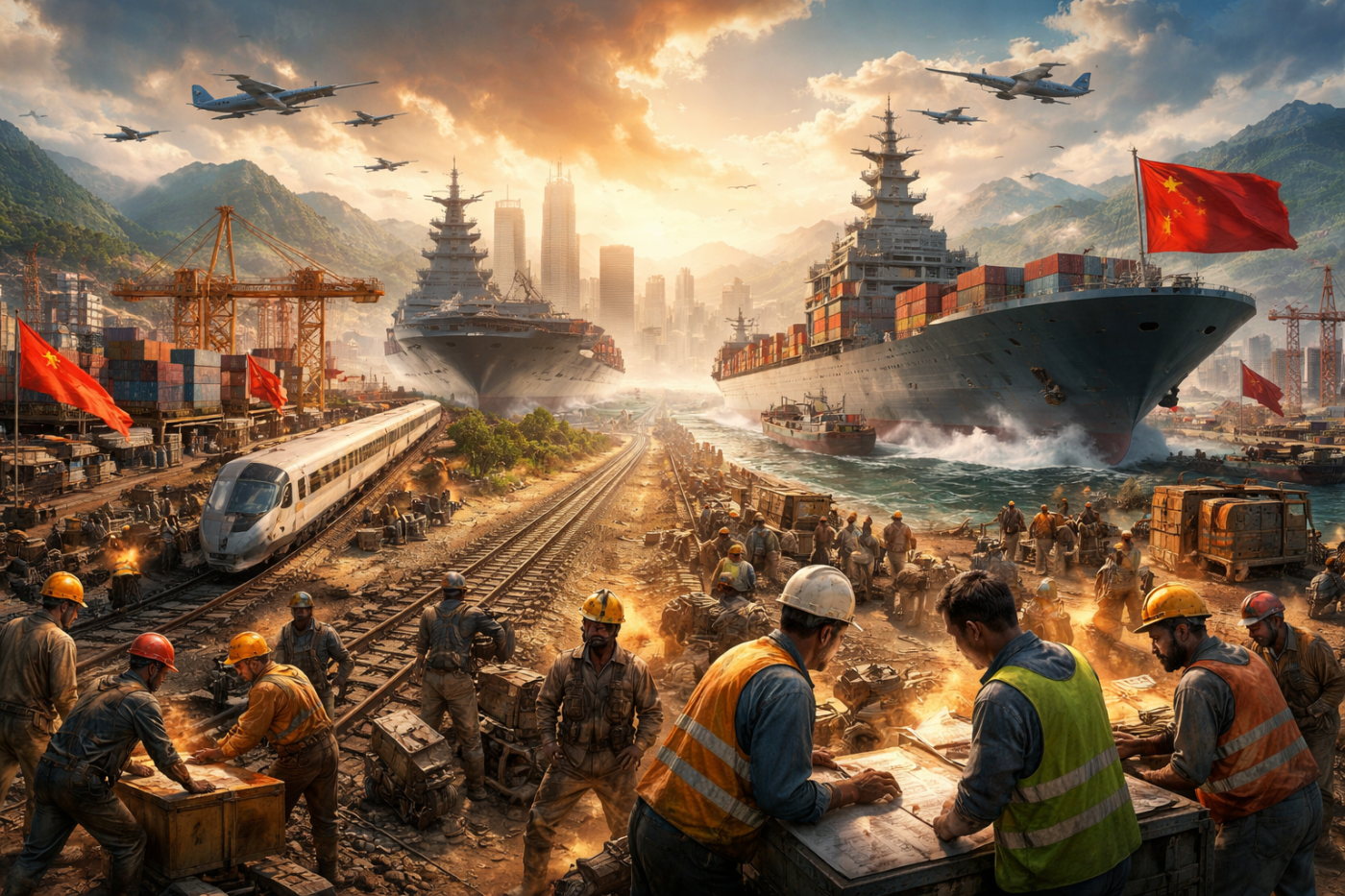
An op-ed declares that only the gun shapes history. We audit the numbers behind the metaphor. We situate debt, ports, sanctions, and sovereignty inside the wider architecture of global power. And we argue that multipolar bargaining space—not military nostalgia—is the terrain of our century.
By Prince Kapone | Weaponized Information | February 26, 2026
The Banker’s Sermon and the Gospel of the Gun
The piece under excavation is Matthew Lynn’s “China tried to buy the world. It failed.”, published in The Washington Post Opinions on February 23, 2026. It reads less like an investigation and more like a reassurance ritual. Its message is simple, almost tender in its certainty: do not worry about railways, ports, loans, or memoranda. None of that is real power. Real power is metal. Real power is force. Real power is the ability to send men and weapons anywhere at a moment’s notice.
But before we listen to the sermon, we must look at the pulpit. Lynn is not writing from a village council in the Sahel or a dockside in Lagos. His public biography situates him squarely inside the financial press of the City of London, writing for organs such as The Daily Telegraph and The Spectator. His own profile describes him plainly as a British financial journalist and publisher. This is the worldview of finance capital speaking to itself: markets as weather, empire as adulthood, coercion as maturity.
And the stage matters. The Washington Post, owned by Jeff Bezos, operates inside the architecture of American monopoly finance capital. Reporting from Politico has described how the Opinions section has been steered under that ownership toward a defined ideological horizon. The sermon is not delivered from a mountain. It is delivered from within the cathedral of Atlantic capital.
The first maneuver Lynn deploys is metaphor as weapon. China did not finance infrastructure. It “tried to buy the world.” In six words, a thousand differentiated projects become a single act of overreach. “Buy” carries the scent of illegitimacy. “The world” conjures delusion. “Empire” is implied without being defined. This is ideological compression. Complexity is flattened into accusation. A portfolio becomes a plot.
Then comes montage. Panama. Venezuela. Italy. Argentina. Each invoked as if history itself were presenting evidence. The sequencing creates inevitability: setback after setback, headline after headline. But montage is not causation. It is choreography. Distinct political events are woven into a single narrative arc of collapse. The reader is not asked to analyze; the reader is asked to feel the weight of accumulation.
There is also the gesture of polite debate. The text nods to the possibility that “we can all debate” the “debt-trap” allegation. The door opens an inch—then closes. The concession functions as inoculation. Debate is acknowledged, but not engaged. The verdict proceeds untouched.
Most decisive is the false dichotomy that anchors the entire argument. Finance is fragile. Contracts can be overturned. Governments change. Courts rule. Therefore, finance is soft. Force, by contrast, is final. The carrier strike group does not ask permission. The missile does not wait for a regulatory review. Only the state that can project violence, we are told, truly governs.
But this dichotomy erases the hybrid nature of imperial power. Western finance has never floated freely in the sky. It has historically moved under naval umbrellas, sanction regimes, and security alliances. Dollar clearing systems, insurance markets, and shipping lanes have operated within a military perimeter. The op-ed pretends that finance and force are opposites, when in practice they have long been braided together in the architecture of empire.
Sovereignty, in Lynn’s telling, becomes a nuisance variable. Courts annul concessions. States nationalize. Currencies devalue. The implied solution is clear: only the actor capable of overriding such processes can secure influence. Hard power is crowned as adulthood; everything else is adolescence. The world is reduced to a lesson in discipline.
What we are reading, then, is not simply an assessment of the Belt and Road. It is a reassurance to a center unsettled by erosion. It tells Atlantic power that history has not slipped from its grasp, that logistics corridors and development banks are secondary, that in the final instance the gun still writes the rules. The banker, confronted with multipolar turbulence, rediscovers the romance of force and calls it realism.
So here we have named the choreography: metaphor as compression, montage as inevitability, concession as inoculation, dichotomy as doctrine. The argument performs certainty. In the sections that follow, we will test whether that certainty survives contact with the record—and whether the world is governed only by steel, or by a far more layered struggle over development, sovereignty, and power.
Counting the Concrete, Tracing the Money, Naming the Guns
Having named the choreography, we must now name the numbers. The Belt and Road Initiative does not begin as metaphor. It begins in 2013 as policy, memoranda, contracts, and disbursements. How large is it? That depends on what one counts. The Green Finance & Development Center’s China Belt and Road Initiative (BRI) Investment Report 2025 tracks what it calls “BRI engagement” — construction contracts plus non-financial investment tied to participating countries. By its accounting, 2025 registered roughly $128 billion in construction contracts and $85 billion in investment, the highest annual combined figure on record, bringing cumulative engagement since 2013 to around $1.4 trillion. Those figures do not prove virtue or vice. They simply establish scale. The project has not evaporated. It has expanded, and in some regions — particularly Africa — it has intensified.
Scale alone does not answer the charge most frequently invoked against it: “debt trap diplomacy.” That phrase circulates easily. Evidence circulates more slowly. Scholarly analysis such as Chatham House’s examination of the “debt-trap” claim argues that the narrative of coordinated asset seizure lacks empirical foundation and that many high-profile cases were shaped as much by recipient-state decisions and global financial pressures as by Chinese lending strategy. Meanwhile, data on global debt servicing complicates the idea that one bilateral lender sits atop the system. Reuters reporting on Debt Justice research notes that lower-income countries have, in recent years, paid far more to private lenders than to China. The World Bank’s International Debt Report 2025 situates sovereign debt distress within a wider architecture of multilateral, bilateral, and private obligations. If debt is a trap, it is a crowded one.
Consider Italy, often cited as evidence of unraveling. Rome chose not to renew its 2019 memorandum framework with Beijing. Policy analysis from the Center for Strategic and International Studies outlines the procedural mechanics of that decision. The Istituto Affari Internazionali described the timing and political calculus behind the move. What these documents establish is not collapse but procedure: a memorandum not renewed. Trade flows, corporate deals, and diplomatic engagement are separate empirical questions. An MoU is a framework, not a guillotine.
Panama is invoked as proof that contracts evaporate under pressure. The 2026 court decision voiding CK Hutchison’s port concessions and the subsequent temporary licensing of operations to Maersk and MSC are matters of public record. Reuters documents the cancellation and transition process, including Hutchison’s objection and the explicit geopolitical context of U.S.–China rivalry. The event demonstrates that sovereign courts can intervene in concession agreements. It also demonstrates that such interventions unfold inside a field already saturated by great-power competition. Law, commerce, and geopolitics are not separate theaters.
Venezuela offers a different kind of turbulence. In January 2026, U.S. forces kidnapped President Nicolás Maduro and his wife in an operation whose legality and implications have been widely reported and debated. Reuters examined the legal questions surrounding the capture. The Associated Press and PBS NewsHour documented their arrival in New York to face charges. The Washington Post provided additional detail on the operation and its political framing. The U.S.–China Economic and Security Review Commission notes that Chinese banks have extended at least $10 billion in loans to Venezuela and that China remains a major purchaser of Venezuelan oil. In such an environment, “investment risk” is not a natural disaster. It is shaped by sanction regimes, regime-change efforts, and coercive interventions.
Finally, the doctrine that only “hard power” endures can itself be measured. The Stockholm International Peace Research Institute reports that global military expenditure reached record levels in 2024, with the United States accounting for roughly $997 billion of that total. Reuters coverage situates that figure within a global surge toward $2.7 trillion in military spending. If force is the final arbiter, it is also the most expensive line item in the ledger.
Taken together, the record establishes several facts without interpretation: the BRI continues at large scale; debt distress involves a diverse creditor class; Italy’s exit was procedural; Panama’s port dispute was adjudicated through court and executive action amid rivalry; Venezuela’s instability unfolded under overt coercive intervention; and military spending differentials are quantifiable. These are not metaphors. They are measurable events and balances. What they mean — and for whom — is the question to which we now turn.
When Steel Meets Credit: Empire in an Age of Fracture
Now we step out of the ledger and into history. The question is no longer how much was lent, how many ports were built, or which court voided which concession. The question is what kind of world-system produces these collisions. The op-ed we excavated insists that only force secures order. But that claim rests on a quiet assumption: that the Atlantic center still defines the terms of power, and that any deviation from its grammar must eventually bend back toward the gun. It assumes that the hierarchy born of colonial conquest, dollar supremacy, and military encirclement is natural law rather than historical construction.
Yet what Section II revealed is not the fragility of finance. It revealed the instability of a world already reorganizing itself. The Belt and Road did not arise in a vacuum. It emerged from a post-revolutionary state whose developmental model was forged in 1949, consolidated through centralized planning, and later restructured through controlled market reforms under party leadership. China’s global engagement does not originate in private monopoly capital seeking colonial superprofits backed by expeditionary fleets. It originates in a state-directed system that retains public control over the commanding heights of finance, energy, infrastructure, and strategic industry. This does not abolish capitalist contradiction inside China. It situates those contradictions inside a revolutionary legacy rather than a colonial one.
The BRI’s outward turn must therefore be read through that lens. It was launched after decades in which Global South states were disciplined through structural adjustment, austerity programs, and IMF–World Bank conditionality. The development gap estimated in the trillions annually is not an accident of geography. It is the residue of a world order structured around capital extraction and debt service. Into that vacuum stepped a state-backed infrastructure push offering loans, construction contracts, and trade corridors without military occupation, regime-change doctrine, or a global lattice of bases surrounding the borrower. China’s overseas military footprint consists of a single acknowledged support facility in Djibouti. The United States maintains hundreds of overseas sites across dozens of countries. These are not symmetrical postures.
The “debt trap” narrative, when placed in this longer arc, functions less as warning and more as ideological insulation. Sovereign debt distress is systemic. Private creditors and bond markets extract at scale. The World Bank and International Montary Fund (IMF) impose restructuring packages that reshape domestic policy and social spending. Yet the rhetorical spotlight narrows to one bilateral lender, the People’s Republic of China, and declares it uniquely predatory. This narrowing isolates China from the broader architecture of global finance and presents its lending as imperial ambition rather than counter-hegemonic disruption. It is easier to accuse Beijing of empire than to interrogate the decades of Western-enforced dependency and underdevelopment that preceded it.
Consider Panama. A sovereign court voids a concession linked to a Hong Kong–based operator and temporarily licenses Western shipping giants. This is not evidence that infrastructure diplomacy is illusion. It is evidence that infrastructure exists inside geopolitical struggle. The canal is not merely commercial throughput. It is a strategic artery in a world where trade routes and naval routes overlap. When legal rulings intersect with great-power rivalry, sovereignty becomes terrain. But it is crucial to note what is absent: there were no Chinese marines landing to seize the canal. There was no naval blockade enforcing repayment. The contest unfolded through law, executive decision, and diplomatic pressure — instruments common to inter-state competition, but not equivalent to military occupation.
Or Venezuela. When a sitting president is abducted by a foreign power and trafficked for prosecution, “market instability” ceases to be abstract. Investment does not retreat because spreadsheets tremble. It retreats because sanctions, blockades, and interventions reorder the political field. Chinese loans to Caracas did not evaporate in a vacuum. They entered a landscape shaped by U.S. coercive policy. To describe that turbulence as proof that infrastructure cannot secure influence is to erase the actual military violence actively reshaping the environment. Here again the contrast is stark: China did not send carrier groups to secure repayment. The United States deployed military force to alter political authority.
What the op-ed frames as proof of failure may instead be evidence of transition. The old unipolar grammar assumed that capital flowed from center to periphery under military umbrella and dollar-clearing dominance. That architecture remains powerful — as the near-trillion-dollar U.S. military budget demonstrates — but it is no longer uncontested. The BRI introduces alternative corridors of credit and trade that complicate that monopoly. Multipolarity does not abolish hierarchy. It fractures it. It weakens the automaticity of Western enforcement and multiplies bargaining points for states long confined to single-creditor, neocolonial dependency.
For countries in Africa, Latin America, and parts of Asia, this fragmentation widens negotiation space. A port financed through Chinese state banks can be renegotiated, delayed, or restructured without triggering naval escalation. A corridor mapped in Shenzhen does not arrive with a demand for regime compliance under threat of invasion. That does not mean Chinese projects are free of contradiction, corruption, or elite capture. It means they operate under a doctrine of non-interference rather than direct military domination. In a world still saturated with imperial memory, that distinction is not cosmetic.
From the standpoint of workers and peasants, the decisive contradiction is not whether Washington or Beijing commands more ships. It is whether development financing expands productive capacity, technological sovereignty, and regional integration — or whether it entrenches dependency under new management. China’s rise does not represent global socialism. It represents a state-led development model, rooted in revolutionary transformation, now operating within capitalist world markets. That is a contradictory formation — but it is structurally distinct from Western imperial finance capital whose accumulation was built on colonial conquest and military encirclement.
The deeper irony is this: the op-ed’s doctrine that only hard power endures rests on the very military expenditures that sustain the debt architecture it claims to judge. Nearly a trillion dollars annually in U.S. defense spending underwrites a security perimeter within which dollar-denominated trade and financial systems operate. Force and finance are not opposites. They have long been braided together in the architecture of Atlantic dominance. To crown the gun as sovereign while dismissing China’s credit diplomacy as naïve is to ignore how Western financial hegemony has always depended on overwhelming coercive capacity.
We are living not at the end of infrastructure politics, but at the fraying edge of unipolar certainty. Steel rails, shipping terminals, sanction regimes, and aircraft carriers are instruments in a larger contest over development pathways. The BRI’s turbulence signals neither imperial triumph nor imperial collapse. It signals a structural shift: a world in which Western monopoly over capital flows and enforcement mechanisms is contested by a post-revolutionary state whose global posture is built on sovereignty and negotiated development rather than military occupation. In that fracture lies danger — but also the material breathing room upon which the Global South can build new alignments.
Beyond Applause for Empire: Organizing in the Fractures of Multipolarity
If the banker’s sermon instructs us to salute the gun, our task is more disciplined. We do not collapse the world into two identical empires and declare neutrality. Nor do we romanticize any state as savior. We begin from the standpoint of the working class — global, fragmented, uneven — and ask what the fractures in unipolar power make possible. The turbulence we have traced is not a spectator sport. It is the terrain on which sovereignty, development, and class power are renegotiated.
The multipolar moment is not socialism. But it is not nothing. The weakening of a single imperial enforcement center widens the breathing room available to post-colonial states. China’s global posture — rooted in non-interference, infrastructure finance, and negotiated development rather than military occupation — has altered the bargaining field. It has not abolished dependency. It has complicated it. And in that complication lies leverage. Where the IMF once stood as near-monopoly gatekeeper, alternative credit corridors now exist. That structural shift matters.
For workers and peasants in the Global South, the immediate question is not whether Beijing is pure. It is whether new infrastructure financing can be wrestled toward national development strategies rather than captured by domestic elites or foreign contractors. That requires union organization on construction sites, oversight of loan agreements, technology-transfer demands, and public-sector stakes in strategic assets. It requires regional blocs coordinating rather than competing downward. China’s state-led model creates room for such negotiations because it is not backed by regime-change doctrine or a surrounding military base lattice. But room is not outcome. Organization is the bridge between the two.
For workers in the Global North, ideological clarity is equally essential. The narrative that only hard power guarantees prosperity feeds an endless spiral of military expansion. Nearly a trillion dollars in annual U.S. defense expenditure is justified as realism while public housing, healthcare, and infrastructure decay. To defend China against imperial aggression does not mean endorsing every policy of the Chinese state. It means recognizing that containment strategies, encirclement, sanctions, and destabilization campaigns are not progressive instruments. They are mechanisms of monopoly preservation. Anti-war coalitions, budget reallocation campaigns, and sanctions-resistance networks form part of the same struggle.
The capture of a head of state in Venezuela illustrates the stakes. When coercive intervention becomes normalized, every development project in the Global South sits under threat. In such conditions, defending sovereignty is not abstract diplomacy; it is material protection for working populations whose livelihoods are disrupted by sanctions, asset freezes, and regime-change operations. China’s willingness to trade and lend without attaching military enforcement clauses creates an alternative axis around which sanctioned states can maneuver. That axis is imperfect and contradictory — but it dilutes unilateral coercion.
It is therefore a mistake to frame the present as a choice between identical imperialisms. The United States maintains a global network of hundreds of overseas military installations and openly articulates containment doctrines. China maintains one acknowledged overseas support facility and publicly reiterates principles of non-interference and sovereignty. These are not symmetrical structures. They reflect different historical trajectories: one built through centuries of colonial projection, the other emerging from a twentieth-century anti-colonial revolution navigating global capitalism under siege. To erase that distinction is to reproduce imperial propaganda.
At the same time, revolutionaries cannot suspend critique. China’s integration into global markets produces internal inequalities, labor tensions, and private capital accumulation. These contradictions must be analyzed within the context of socialist transition, not through liberal moralism. Supporting China’s anti-imperialist function does not require abandoning the struggle for deeper class alignment globally. It requires dialectical clarity: defend sovereignty, oppose encirclement, push for expanded worker power everywhere.
Across Africa, Latin America, and Asia, movements already exist that engage this terrain: trade unions demanding local hiring and wage standards on infrastructure projects; regional integration initiatives seeking to align corridors with continental industrialization plans; peasant federations resisting extractive patterns regardless of the foreign partner involved; anti-sanctions coalitions linking diaspora communities with domestic labor movements. In Europe and North America, anti-war networks and budget-justice campaigns challenge the logic that prosperity flows from aircraft carriers. These are not abstract forces. They are living expressions of class struggle within a shifting global order.
Multipolarity opens the door. It does not walk through it. The weakening of unilateral imperial enforcement creates possibilities — but those possibilities must be seized by organized popular forces. Infrastructure can entrench dependency or anchor industrial transformation. Credit can reproduce extraction or finance development. The difference lies in political power.
The banker crowned the gun and called it realism. Our realism begins elsewhere. It begins with the recognition that imperial monopoly is neither eternal nor invincible; that China’s rise has disrupted that monopoly without replacing it with global occupation; and that the task of our century is not to cheer for one hegemon against another, but to organize across borders so that sovereignty, development, and production are bent toward human emancipation rather than domination.
 Weaponized Information
Leave a comment