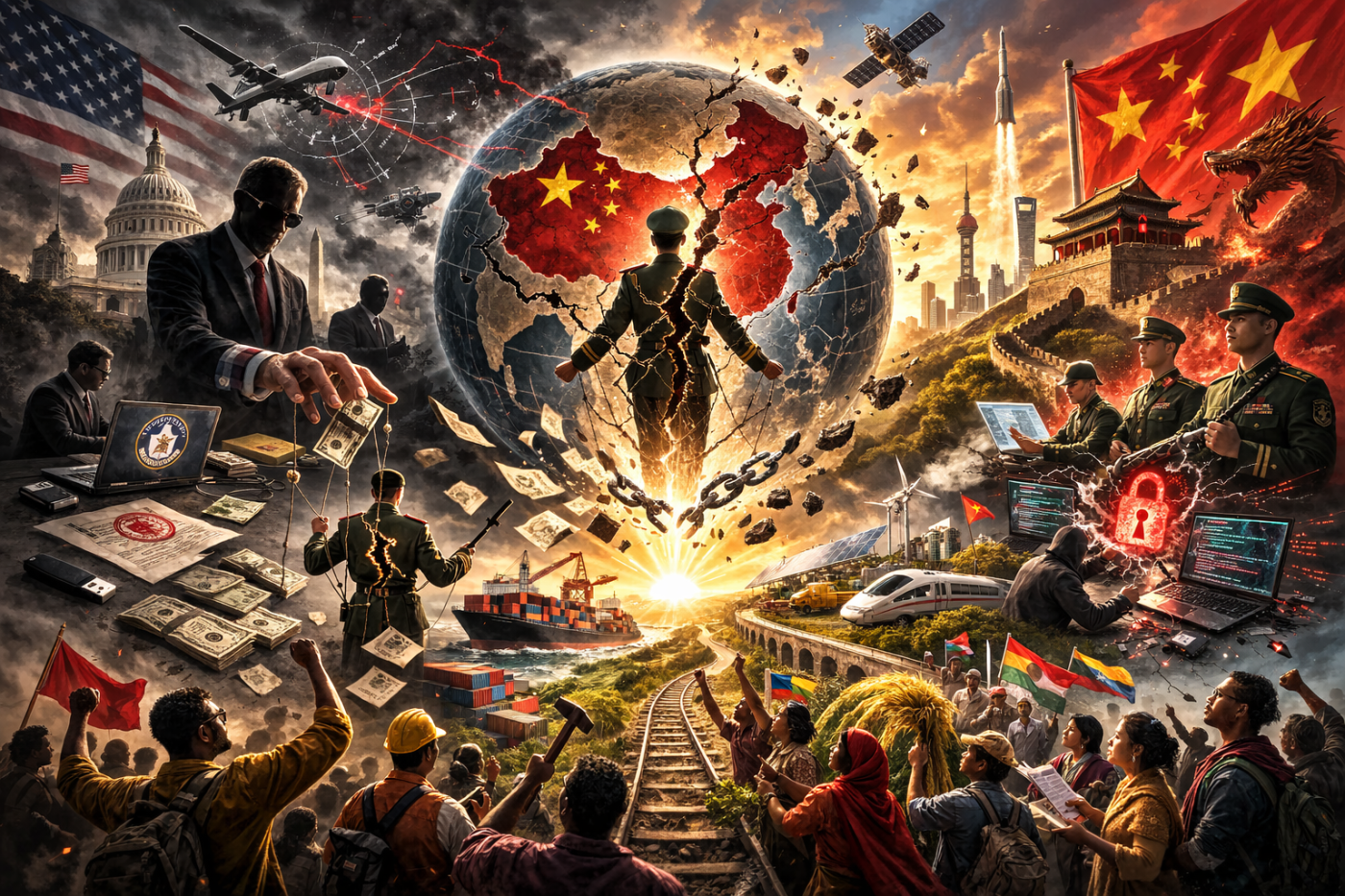
A CIA recruitment campaign is framed as opportunity while containment intensifies. Behind the video lies a shattered U.S. intelligence network and a decade of Chinese military reform. Export controls and Indo-Pacific encirclement reveal a deeper structural recalibration. As multipolarity widens the field, the real struggle is over who shapes the emerging order.
By: Prince Kapone | Weaponized Information | February 13, 2026
When Espionage Dresses Itself as Hope
Empire rarely announces itself in a loud voice when it is expanding its reach. It speaks softly. It uses the language of opportunity, reform, and personal growth. That is the atmosphere surrounding Dan De Luce’s NBC News report on the CIA’s new Mandarin-language recruitment video targeting members of China’s military. The headline calls it a “new push,” a phrase that sounds like a marketing campaign rather than a state operation. What is, in plain terms, an intelligence agency publicly inviting officers of another sovereign military to betray their chain of command is reframed as outreach. The sharp edges are sanded down. Espionage becomes encouragement. Penetration becomes possibility.
The article does not shout its defense of the CIA. It does something more subtle and more effective: it treats the act as normal. The recruitment campaign is explained as a response to “disillusionment” inside the People’s Liberation Army. We are introduced to a fictional mid-level officer, frustrated by corruption and internal removals, searching for meaning and stability. The structural conflict between Washington and Beijing recedes. What remains is a story about a man and his conscience. A vast geopolitical struggle is compressed into a tale of personal dissatisfaction. In that compression, the CIA no longer appears as an instrument of a global superpower navigating strategic rivalry. It appears as a sympathetic ear offering a way out.
This narrative move matters. Empire prefers individuals to institutions because individuals can be isolated, dramatized, and extracted from history. A disciplined military undergoing reform is a complex political subject. A single frustrated officer is a character. By centering ambition allegedly stifled by opaque leadership, the article recasts espionage as assistance. The recruitment effort is presented less as an attempt to fracture a foreign military and more as a form of professional mentorship. The logic is quiet but powerful: if talented people feel constrained, someone should help them. The CIA simply becomes that helper.
The repeated references to “purges” and “tumult” reinforce this framing. Leadership removals are described primarily as instability, as cracks in the structure. The suggestion is not explicit, but it hovers in the background: instability creates openings, and openings invite intervention. What disappears is any sustained exploration of institutional continuity or reform. The story does not linger on the broader arc of military restructuring. Instead, it foregrounds disruption. In that light, the recruitment campaign appears reactive, almost inevitable, rather than as part of a deliberate strategic posture.
The article also relies on unnamed U.S. officials who claim that earlier recruitment videos “reached millions” and “inspired new sources.” These assertions are presented without evidence, yet they function as confirmation of effectiveness. This is a familiar choreography in corporate media. The state speaks anonymously, its claims circulate as fact, and the press transmits them with minimal interrogation. The intelligence agency becomes both actor and evaluator of its own performance, while the reader is asked to accept the assessment as credible.
A noticeable asymmetry runs through the piece. The CIA’s actions are contextualized and rationalized. China’s response is summarized as predictable condemnation of “foreign infiltration.” The act of recruiting spies is treated as standard practice in international affairs; the objection to being targeted is framed as routine defensiveness. In this subtle way, the reader is guided to perceive U.S. penetration as normal and Chinese sovereignty as reactive. The moral burden shifts quietly but decisively.
Even the historical dimension is handled lightly. The article briefly notes past difficulties the CIA faced in maintaining human intelligence networks in China, but this reference remains peripheral. It does not reorganize the narrative. The emphasis stays on the present initiative, the video’s sophistication, and its digital reach. The deeper structure of rivalry, escalation, and strategic adjustment remains in the background, allowing the recruitment campaign to appear as a discrete episode rather than part of an unfolding systemic confrontation.
What emerges is not crude propaganda but a polished reframing. Espionage is translated into opportunity. Strategic rivalry becomes a personal drama. Intelligence recruitment is softened into mentorship. This is how ideological work operates in contemporary corporate media: not through loud denunciations, but through quiet normalization. The badge remains visible, but it is carefully polished until it reflects something that looks, from a distance, like hope.
The Structure Beneath the Performance
If Part I exposed the narrative polish surrounding the CIA’s recruitment video, Part II must step away from tone and examine the structure that made such a video necessary. The 2026 Mandarin-language appeal did not emerge from thin air. It sits inside nearly fifteen years of tightening confrontation between the United States and the People’s Republic of China. This confrontation is not confined to rhetoric. It spans intelligence failures, military restructuring, technological choke points, export controls, alliance expansion, and the reorganization of global finance. To understand the political meaning of the recruitment campaign, we must examine this larger terrain.
One of the early public markers of this arc was Washington’s strategic “Pivot” or “Rebalance” to Asia under Obama—sold as a policy of regional attention, but widely understood even in U.S. strategic literature as a long-range posture designed to manage and constrain China’s rising weight. The ideological packaging was polite; the material logic was not. In plain terms, the U.S. was repositioning diplomatic, military, and alliance resources toward the Asia-Pacific as China’s development began to rewrite the balance sheet of global power. You can see the posture stated openly in Hillary Clinton’s 2011 “America’s Pacific Century” essay and reinforced in the Pentagon’s 2012 defense guidance, “Sustaining U.S. Global Leadership: Priorities for 21st Century Defense”, which centers an increased focus on the Asia-Pacific.
The first major rupture came between 2010 and 2012, when Chinese counterintelligence dismantled large portions of the CIA’s human intelligence network inside China. Multiple U.S. sources were killed or imprisoned. American officials later described the episode as one of the most damaging intelligence setbacks in decades. This was not a routine embarrassment. It was a systemic breach. Years of clandestine infrastructure collapsed. For a superpower accustomed to penetrating rival states with relative confidence, the loss narrowed Washington’s internal visibility at precisely the moment when China’s economic and technological ascent was accelerating. The empire discovered limits.
That rupture is not background noise; it is the hidden foundation of the present recruitment effort. Intelligence agencies do not publicly advertise for sources unless deeper channels have been strained. When covert pipelines break, new methods are tested. The 2026 video is easier to understand when we recognize that earlier networks had been dismantled. What appears as bold outreach may also reflect strategic friction. Public recruitment becomes a compensatory tactic in a more contested environment.
On the Chinese side, 2013 marked the beginning of an extensive military reform and anti-corruption campaign under Xi Jinping. The People’s Liberation Army underwent structural reorganization. Theater commands were consolidated. Patronage networks were targeted. Commercial entanglements were curtailed. Party oversight tightened. Western commentary often compresses this decade-long process into the shorthand of “purges,” but the continuity is evident. The reform drive has sought modernization, professionalization, and centralization of command authority. The recent removal of senior officers is not an isolated convulsion but part of an ongoing restructuring project that has unfolded for more than ten years. A clear baseline framing of this reform arc—its goals, sequencing, and institutional logic—is laid out in MERICS’ overview of China’s military reforms.
While China consolidated internally, Washington escalated externally. Beginning in 2018 and intensifying after 2022, the United States imposed sweeping export controls on advanced semiconductors, chipmaking equipment, and artificial intelligence technologies bound for China. These measures were not subtle. They were explicitly designed to restrict China’s access to high-end components with potential military application. You can read the policy logic stated directly in the U.S. government’s own rulemaking on “Implementation of Additional Export Controls: Certain Advanced Computing and Semiconductor Manufacturing Items”, as well as BIS’s public explanation of the crackdown in its October 7, 2022 press release. Policymakers described the approach as a “small yard, high fence,” a phrase that politely disguises a strategic chokehold. This is not normal commercial rivalry; it is an effort to slow a competitor’s military-technological convergence by targeting critical nodes in global supply chains.
Military posture followed the same trajectory. The 2022 Indo-Pacific Strategy reaffirmed and expanded the U.S. forward presence across Asia and made “integrated deterrence” a centerpiece of the approach, explicitly tying force posture, alliances, and advanced capabilities into a coherent regional pressure architecture. That language is spelled out in the White House Indo-Pacific Strategy (February 2022). Alliance coordination deepened. Basing agreements broadened. Joint exercises multiplied. From AUKUS submarine coordination to reinforced deployments in Guam and the Philippines, the Pacific increasingly resembles a theater structured for sustained strategic pressure. Intelligence operations, export controls, and military alignment operate in parallel rather than isolation.
Under Trump 2.0, the posture did not reverse—it was folded into a harder, more openly coercive style of statecraft, where “national emergency,” “reciprocal tariffs,” and “economic security” are treated as default instruments of great-power management. This continuity is visible in the second Trump administration’s own strategic framing: Congress’s research service summarizes the 2025 National Security Strategy as prioritizing China in the overall orientation of U.S. power, and the strategy text itself is publicly accessible via an archived copy of the 2025 National Security Strategy PDF. In trade policy, Trump 2.0 formalized new tariff authorities through an April 2025 executive action targeting “low-value” imports from China, later adjusted tariff rates by executive order in November 2025, and simultaneously kept the overall architecture of pressure alive through rolling “suspensions” and extensions that preserve leverage as policy. Even where tactics shift, the strategic throughline remains: containment by layered instruments.
Beijing has framed these developments through the language of sovereignty and non-interference. In response to CIA recruitment videos, China’s Foreign Ministry warned of countermeasures against “infiltration and sabotage,” treating the outreach as hostile espionage rather than benign “opportunity.” Reuters reported China’s response directly, including the accusation that the videos amount to a confession of U.S. espionage intent, in its May 2025 coverage of Beijing’s official reaction. At the same time, China has accelerated efforts toward multipolar coordination, including the expansion of BRICS and deeper South-South cooperation. The narrative clash is clear. Washington describes its actions as deterrence and stability management. Beijing describes them as encirclement and intrusion.
Placed side by side, these developments reveal a pattern. First came a major intelligence rupture. Then came sustained Chinese military consolidation. Then came an escalating technological blockade. Then came reinforced military alignment in the Indo-Pacific. Finally, this unfolds against the backdrop of multipolar realignment that challenges the post–Cold War order. Within that structure, the CIA’s public appeal to PLA personnel reads less like a spontaneous media initiative and more like one instrument within a broader containment architecture operating simultaneously across psychological, technological, and military fronts.
The NBC report treats the recruitment campaign as a response to internal turbulence. The longer historical record suggests something more consequential: a dominant power recalibrating its instruments as the global balance shifts. The facts themselves do not prescribe ideology. They do, however, impose discipline. The recruitment video cannot be understood apart from the structural rivalry that surrounds it. What looks like outreach is embedded in a much larger struggle over power, autonomy, and the shape of the emerging world order.
When the Center Cannot Hold Forever
You cannot understand a recruitment video by staring only at the screen. You have to ask what kind of world makes such a video necessary. The sequence we traced in Part II is not accidental. An intelligence network shattered between 2010 and 2012. A decade of military consolidation beginning in 2013. A tightening technology blockade after 2018. A reinforced military perimeter after 2022. These are not scattered events. They are chapters in a single story: the slow grinding shift of global power.
For nearly thirty years after the Soviet collapse, Washington moved through the world as if history had signed a permanent contract in its favor. Intelligence agencies penetrated rivals with confidence. Wall Street wired the globe to the dollar. Supply chains bent toward U.S. corporations. Military alliances stretched across oceans without serious structural resistance. That was not destiny; it was a balance of forces. And balances change. The rise of China—rooted in revolution, shaped by state-led development, and powered by long-term planning—altered the material terrain. Not morally. Materially. Production capacity shifted. Technology advanced. Financial weight redistributed. What once seemed permanent began to look conditional.
The destruction of CIA human networks inside China a decade ago was one signal that the old ease was fading. Penetration could no longer be assumed. The empire that once whispered confidently into corridors of power found doors closing. When depth contracts, methods adjust. Public recruitment campaigns are not signs of effortless reach; they are signs of friction. They announce that the terrain is harder than it used to be. The quiet certainty of unchallenged access gives way to visible appeals.
At the same time, what Western headlines call “purges” inside the PLA read differently when placed in context. Since 2013, China’s leadership has tightened command structures, dismantled patronage networks, and pushed modernization through a centralized framework. One can debate the politics of that consolidation, but it is unserious to treat it as random instability. States under pressure do not loosen discipline; they reinforce it. When technological chokepoints tighten and military alliances encircle, consolidation is not chaos—it is strategy. What looks like turbulence from afar may be institutional hardening up close.
Now place alongside this the semiconductor restrictions and the Indo-Pacific force posture. Export controls aimed at advanced chips and artificial intelligence are openly designed to slow China’s military-technological convergence. Expanded basing agreements and alliance exercises narrow strategic breathing room in the Pacific. Intelligence recruitment seeks access from within. These are not isolated moves; they form a system. Economic pressure, military positioning, psychological operations—different instruments, same objective. This is what a hegemon does when it senses limits. It multiplies levers.
Through the lens we have been sharpening at Weaponized Information, this moment reflects a crisis not of morality but of imperial centrality. The United States is defending a global architecture assembled in the late twentieth century. China, despite its market contradictions and internal class tensions, remains a post-revolutionary state that retains centralized planning capacity and public command over strategic sectors. It does not project power through overseas military occupations or IMF-style conditionalities. Its central political claim is sovereignty. Containment, therefore, is less about abstract “values” and more about constraining autonomous development outside Western control.
The acceleration of multipolar realignment deepens this tension. As BRICS expands and alternative financial arrangements take shape, Western monopoly leverage erodes at the margins. And hegemony rarely erodes quietly. It responds. Intelligence efforts grow more visible. Export controls widen. Military exercises intensify. The CIA recruitment video is not a rogue flourish of creativity; it is one tile in a recalibrated strategy to maintain influence during systemic transition.
For the global working class and for nations long disciplined by sanctions and debt regimes, the real question is not which power tells the smoother story. It is which global configuration enlarges the room to breathe. A unipolar enforcement system narrows that room through chokepoints and encirclement. A multipolar shift, uneven and contradictory as it may be, widens it by weakening monopoly control. The recruitment campaign belongs to the former logic. It is an instrument of preservation, not liberation.
Empires rarely admit that they are defending hierarchy. They speak of opportunity and freedom. But when you align the intelligence rupture, the military consolidation, the technology blockade, and the alliance expansion, the pattern becomes unmistakable. What we are witnessing is not a morality tale about disappointed officers. It is a historical adjustment unfolding as unipolar power feels the ground shift beneath its feet.
Multipolarity Opens the Space — The People Must Decide What Fills It
If the CIA recruitment video is one tile in a larger containment design, then our response cannot be emotional or episodic. It has to be structural. The issue before us is not a single intelligence initiative. It is a world order in transition. The unipolar arrangement that defined the late twentieth century is loosening. The question is not whether that shift is happening, but who shapes its direction. For the global working class, for nations long disciplined by sanctions, debt traps, and military umbrellas, this is not an abstract geopolitical seminar. It is about material breathing room. It is about whether sovereign development expands or whether enforcement mechanisms tighten as monopoly power resists decline.
Clarity comes first. Recruitment campaigns do not operate alone. They sit beside semiconductor export controls, alliance militarization, financial coercion, and a steady stream of narrative framing in corporate media. These are not separate policy lanes. They reinforce one another. When technological chokepoints are sold as neutral “national security,” when expanded military basing is described as stabilization, and when intelligence outreach is packaged as humanitarian opportunity, a system of containment begins to look natural. Our task is to refuse that naturalization. Political education must connect these processes and show the architecture behind the performance.
At the same time, we do ourselves no favors by romanticizing multipolarity. A changing balance of power does not automatically deliver justice. China carries contradictions—market pressures, inequality, class tensions—like any society navigating development under siege. Recognizing those contradictions is not betrayal; it is seriousness. But the decisive issue is structural autonomy. When a post-revolutionary state that retains public command over strategic sectors becomes central to a multipolar shift, efforts to weaken it reverberate beyond one bilateral rivalry. Undermine that node, and the entire architecture tilts back toward consolidated Western leverage.
This has practical implications. Export controls framed as technical safeguards must be interrogated as instruments of competitive restriction. Indo-Pacific military expansion must be evaluated not only as deterrence but as escalation. Intelligence narratives should be examined rather than repeated. Independent research, anti-war organizing, tech worker dissent against militarized AI, and South-South institutional development are not symbolic gestures. They are pressure points. Fragmented outrage benefits entrenched power. Coordinated analysis strengthens collective leverage.
We must also refuse the sentimental bait embedded in recruitment storytelling. The language of opportunity and personal redemption invites us into a morality tale. The reality is structural. The global order is being reorganized as material balances shift. A hegemon rarely steps aside politely. It recalibrates through layered pressure—technological, financial, military, psychological. Multipolarity alone does not guarantee emancipation. But it fractures monopoly control and creates openings in which alternative arrangements can be built. Whether those openings produce deeper democratic development or simply hardened blocs depends on organized clarity, not wishful thinking.
Seen in isolation, the recruitment video looks like clever media craft. Seen within the broader architecture traced throughout this essay, it appears as one instrument among many designed to preserve leverage during systemic transition. Recognizing that scale difference changes the response. Multipolarity opens space. The question is whether that space will be filled by disciplined popular organization or surrendered to recalibrated hierarchy. History does not move on sentiment. It moves on power—and on whether ordinary people understand the terrain they are standing on.
 Weaponized Information
Leave a comment