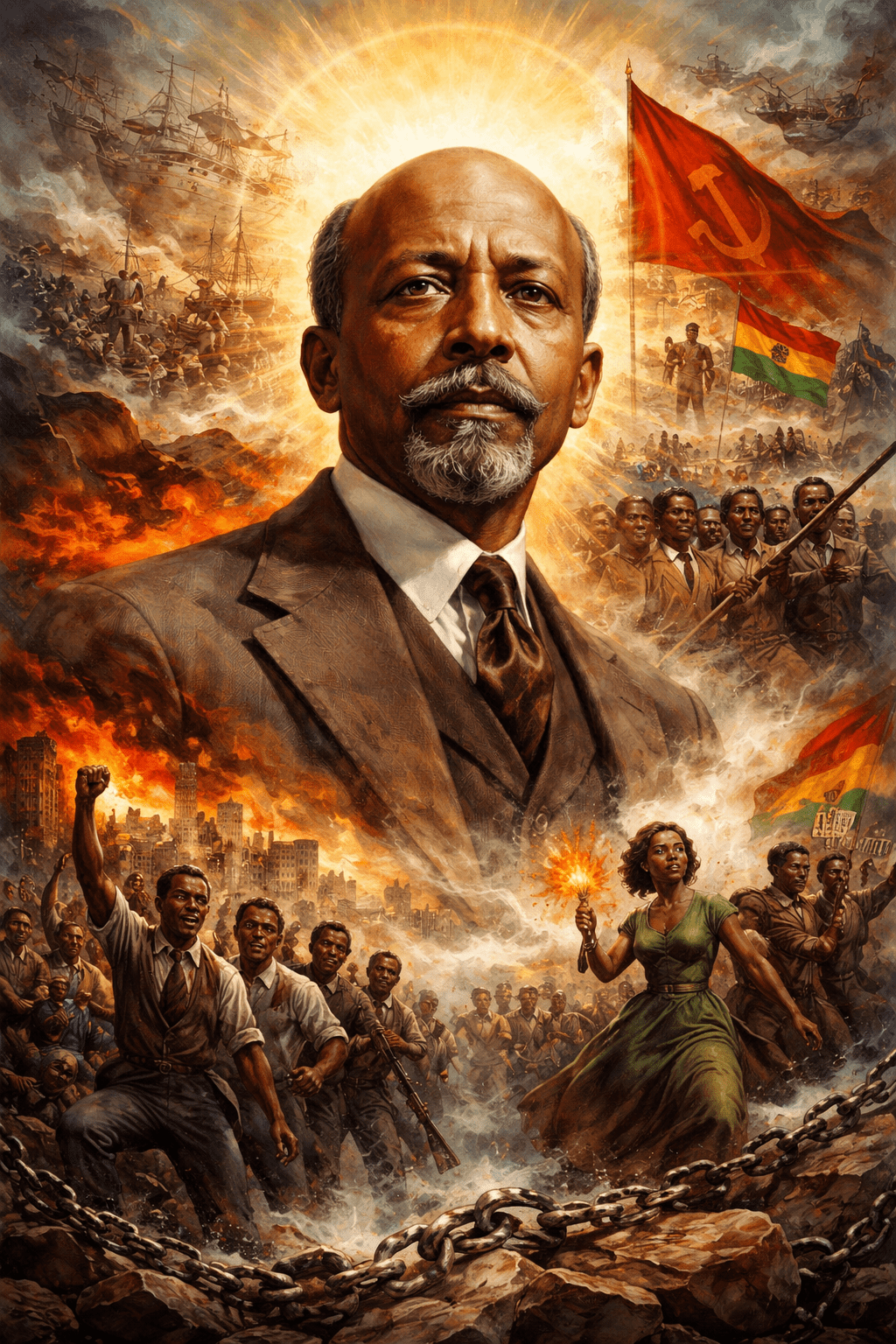
From Talented Tenth Idealism to Communist Internationalism, Du Bois’s Life Exposes the Color Line as a Global System, White Labor’s Imperial Bargain, Reconstruction as Crushed Revolution, and the Unfinished Struggle Against Colonial Capitalism.
By Prince Kapone | Weaponized Information | Black History Matters Series | February 11, 2026
I. A Child of Emancipation, Raised in the Shadow of Betrayal
W.E.B. Du Bois was born in 1868, just three years after slavery was formally abolished. That date is not trivia. It is a political location. He was born into the short breath between revolution and reaction — after the enslaved had broken the plantation order, before the empire finished rebuilding it in a new form. Reconstruction was not a charity project from benevolent whites; it was the unfinished revolution of formerly enslaved workers trying to reorganize society. And when Du Bois came of age, he watched that revolution get strangled.
He grew up in Great Barrington, Massachusetts — not in the Deep South, but in the North that congratulated itself on abolition while quietly profiting from cotton, railroads, and industrial finance. Even there, the lesson was clear: racism was not a regional accident; it was a national design. The problem was not simply prejudice. The problem was structure. A whole economy had been built on Black labor, and when the chains came off, capital found new ways to bind it — sharecropping, debt peonage, segregation, disenfranchisement, and terror.
Young Du Bois excelled in school. He was praised as exceptional. That word — exceptional — is often the first trap. It flatters while isolating. It says: you are different from the rest of your people. It invites you to believe that personal brilliance can outmaneuver systemic power. And for a time, Du Bois believed in that path. He would go on to become the first Black PhD from Harvard. The empire would later display this fact as proof of its fairness. But Du Bois learned something deeper: institutions that admit you can still refuse to share power with you.
What shaped him was not simply education, but contradiction. He was born into a republic that proclaimed liberty while reconstructing white rule through law and violence. The Supreme Court narrowed Black rights. The Ku Klux Klan enforced terror. Northern capital made peace with Southern reaction because profits matter more than principles. Reconstruction did not “collapse.” It was overthrown. That is a crucial distinction. And Du Bois would spend the rest of his life proving it.
There is something clarifying about being born at the edge of a betrayed revolution. You learn early that injustice is not a misunderstanding; it is policy. You learn that power does not surrender because it has been corrected by data. And Du Bois was nothing if not a man of data. He believed, at first, that scientific study — careful documentation of Black life — could puncture racist myth. He turned to sociology, to history, to empirical investigation. He trusted that truth, once presented, would compel justice. That faith would be tested.
Empire has a way of tolerating Black excellence as long as it remains ornamental. The moment it becomes political, the tolerance evaporates. Du Bois would discover that scholarship without organization is decoration. Intelligence without mass power is easily ignored. He would move — slowly, painfully, dialectically — from elite optimism to revolutionary realism.
And so this is where we begin: not with a statue, not with a sanitized civil rights icon, but with a young Black intellectual shaped by the defeat of Reconstruction and the consolidation of racial capitalism. Du Bois did not start as a Marxist. He started as a believer in American democracy. It was America that educated him otherwise.
The child of emancipation would grow into the historian of counterrevolution. And from that contradiction — between promise and plunder — emerged one of the sharpest minds the Black freedom struggle has ever produced.
II. The Talented Tenth and the Seduction of Respectability
Du Bois entered adulthood carrying both brilliance and belief. He believed that if Black people could produce scholars, artists, scientists, and statesmen at the highest levels, the lie of inferiority would collapse under its own stupidity. From this conviction came his early formulation of the “Talented Tenth” — the idea that a trained Black intellectual and professional class could lead the masses out of degradation. It was not a cynical idea. It was born from the material conditions of terror, disfranchisement, and exclusion. When mobs lynch you and the courts refuse protection, the instinct is to produce proof of humanity so overwhelming that it cannot be denied.
His early scholarship reflects this strategy. The Philadelphia Negro was not simply an academic exercise; it was a counter-attack. Du Bois meticulously documented housing, employment, family life, crime statistics, and economic patterns in Black Philadelphia to demonstrate that poverty was not biological but structural. He deployed data like a weapon. He was not begging for sympathy; he was dismantling pseudoscience. In The Souls of Black Folk, he named the central contradiction of the century: “the problem of the color line.” That line was not metaphorical. It was economic, political, and global.
But here is the tension: Du Bois still believed, at this stage, that white America could be reasoned with. He imagined that exposure of injustice would generate reform. He imagined that education would soften the ruling class. This was the residue of liberal faith — the belief that knowledge automatically produces justice. History would educate him differently.
The North applauded Booker T. Washington’s Atlanta Compromise precisely because it demanded little. Washington urged industrial training, economic patience, and quiet accommodation to segregation. White philanthropists funded his institutions because he posed no threat to property relations. Du Bois saw the danger. He understood that vocational uplift without political rights left Black labor at the mercy of white capital. But at this stage, Du Bois’s counter-vision still rested heavily on elite leadership — on cultivated excellence rising above degradation.
The contradiction sharpened. White foundations funded Washington while starving Du Bois’s work. Academic institutions praised his intelligence while sidelining his influence. The message was clear: brilliance is acceptable; independence is not. The “Talented Tenth” strategy collided with a reality that was not merely prejudiced but structured to preserve white rule. The empire had no intention of being persuaded into equality.
This is the dialectical moment. Du Bois began to see that representation without power is fragile. A handful of Black intellectuals could not neutralize a system organized around land theft, industrial exploitation, and racial division. Education could elevate individuals, but it could not dismantle the economic foundation of white supremacy. The problem was not ignorance alone. It was ownership. It was labor control. It was state power.
He did not abandon the importance of intellectual development — and we should not caricature him as naive. But his experience forced an evolution. The Talented Tenth would remain part of his thinking, yet increasingly subordinated to broader democratic and eventually proletarian struggle. The scholar was becoming an agitator. The sociologist was turning toward history. And history, once studied honestly, leads inevitably to class.
In these early decades, Du Bois was learning a lesson many Western Marxists failed to grasp: race in America was not a secondary “superstructural” distraction. It was constitutive. It was woven into the very organization of labor and capital. The color line was not an illusion masking class; it was a mechanism through which class was organized. This insight would mature, but its seeds were already present.
What we witness in this period is not failure, but development. The Talented Tenth was an attempt to negotiate space within empire. The next phase of Du Bois’s life would confront empire directly.
III. Against the Wizard: Democracy or Submission
The clash between W.E.B. Du Bois and Booker T. Washington was not a petty rivalry between two ambitious men. It was a struggle over strategy under terror. At the dawn of the twentieth century, the Southern regime of lynching, disfranchisement, and peonage had hardened into law. Into this nightmare stepped Washington with a program that soothed white anxieties: industrial education, economic self-help, silence on voting rights, and patience in the face of segregation. He assured white elites that Black advancement would not disturb the racial order. In return, they opened their purses.
Du Bois saw through the arrangement. In The Souls of Black Folk, he accused Washington of asking Black people to give up political power, civil rights, and higher education in exchange for the promise of economic opportunity. That was not uplift; it was managed subordination. Du Bois understood that without political rights, Black labor would remain trapped at the bottom of the industrial ladder, disciplined by violence and excluded from meaningful participation in governance. Economic training without citizenship is merely training for obedience.
Washington’s program aligned neatly with the interests of Northern capital. An industrializing South required a docile labor force. Philanthropy flowed not because white industrialists loved Black progress, but because Washington’s model posed no threat to property relations. It kept Black ambition safely within vocational boundaries. Du Bois, by contrast, demanded access to the liberal arts, to the professions, to the ballot, to full civic life. He demanded the right to think, not merely to toil.
This conflict reveals something deeper than personality. Washington represented what we might call the class-compromise line: negotiate survival within empire, secure incremental gains, avoid confrontation. Du Bois represented democratic insurgency within that same empire: insist on rights, expose hypocrisy, and cultivate independent Black leadership. At this stage he was not yet a Marxist, but he was already unwilling to trade dignity for funding.
He organized. The Niagara Movement of 1905 declared unequivocally that Black Americans demanded manhood suffrage, equal treatment under the law, and an end to segregation. It was a rupture with accommodation. When the NAACP formed in 1909, Du Bois became editor of The Crisis, transforming it into a vehicle for agitation. He wielded print like a hammer. Each issue exposed lynchings, documented discrimination, and argued that democracy without Black participation was a lie.
But even here, the terrain was treacherous. The NAACP was multiracial and included white liberals whose commitments were uneven. Du Bois navigated these contradictions carefully. He understood the need for alliances, yet he never allowed the organization to drift into quietism. His pen refused to bow.
The Washington-Du Bois conflict also foreshadowed later debates within Black politics: reform versus rupture, access versus autonomy, elite negotiation versus mass mobilization. The struggle was not resolved in 1903; it reappears in every generation. And if we examine it honestly, we see that Du Bois’s critique was prescient. Economic accommodation without structural change leaves the racial order intact. It simply produces a thin layer of intermediaries.
Here the dialectic sharpens. Du Bois was still operating within the framework of American democracy, still hoping that its principles could be made real. But he had abandoned the illusion that submission would produce respect. The fight against Washington forced him to articulate a more confrontational politics. It prepared him for the larger battles ahead — battles not just against Southern segregationists, but against the global architecture of empire itself.
IV. The Wages of Whiteness and the Betrayal of Labor
As Du Bois moved from the battle against Booker T. Washington into the broader terrain of American political economy, he confronted a harder truth: white supremacy was not only an ideology imposed from above; it was also a material arrangement sustained from below. The problem was not simply the Southern planter or the Northern industrialist. It was also the white worker who accepted racial privilege as part of his wage.
In the early twentieth century, Du Bois studied labor conditions with the rigor of a scientist and the clarity of a revolutionary in formation. He documented how trade unions excluded Black workers, how the American Federation of Labor tolerated segregation, and how white workers defended job monopolies through racial violence. This was not ignorance. It was interest. The white worker had been offered a bargain: share in the spoils of empire, and in return defend the color line at home.
Du Bois grasped this long before it became fashionable theory. He observed that imperialism created a system in which white labor could secure a psychological and sometimes material wage simply by being white. The plantation economy had disciplined Black labor through chains; the industrial economy disciplined it through exclusion and competition. Meanwhile, white workers were invited to see themselves not as exploited proletarians, but as junior partners in racial domination.
This did not mean Du Bois abandoned the hope of solidarity. He understood that the working class, divided by race, could not defeat capital. But he refused to romanticize unity where none existed. When white unions barred Black membership, when white mobs lynched Black men in the name of protecting “their” jobs and “their” women, Du Bois did not avert his eyes. He wrote plainly that Black people often saw the white working class as their fiercest enemy.
Here we must be precise. Du Bois was not arguing that white workers were inherently reactionary. He was analyzing a structure. Under imperialism, sections of the working class in the core countries are bribed — not necessarily with riches, but with status, access, and insulation from the worst forms of exploitation. This is not a moral condemnation; it is a material explanation. The white worker’s betrayal was not mystical; it was historically produced.
In this analysis Du Bois stood ahead of many European Marxists of his time, who centered factory exploitation but neglected the colonial foundation beneath it. Du Bois saw that the “color line” was global. The wealth extracted from Africa, Asia, and the Caribbean subsidized relative stability in Europe and the United States. Racism at home and plunder abroad were two faces of the same system.
This realization sharpened his politics. It forced him to think beyond appeals to abstract class unity. Unity would not fall from the sky; it would have to be built through struggle against white chauvinism itself. And until that struggle occurred, Black workers would have to organize autonomously, defend themselves, and speak with their own voice.
The lesson here is sobering. The working class is not automatically revolutionary. It is shaped by history, by empire, by privilege, and by fear. Du Bois refused both liberal faith in gradual integration and naive socialist faith in spontaneous unity. He chose instead the harder path: tell the truth about division, and fight to transform it.
This was not cynicism. It was clarity. And clarity, under empire, is a dangerous thing.
V. War, Empire, and the “Close Ranks” Contradiction
By 1914, Europe was in flames. Empires were tearing at each other over colonies, markets, and strategic corridors carved out of Africa and Asia. Du Bois saw clearly what many polite liberals refused to admit: this was not a war for democracy. It was a war for empire. He wrote bluntly that the conflict was rooted in the scramble for colonies and the exploitation of darker nations. The “color line,” he argued, was not only an American problem. It was the organizing principle of global capitalism.
And yet, in 1918, Du Bois made the most controversial decision of his political life. In the pages of The Crisis, he published the editorial “Close Ranks,” urging Black Americans to suspend protest and support the U.S. war effort while the conflict lasted. He called on Black people to “forget our special grievances” and stand shoulder to shoulder with white citizens. It was a tactical gamble — and a profound contradiction.
Why did he do it? We must resist caricature. Du Bois was not naive about American racism. He knew the military was segregated. He knew Black soldiers had historically been used and discarded. But he also believed that participation might force the nation to confront its hypocrisy. If Black men bled for democracy abroad, perhaps democracy at home could no longer be denied. He calculated that military service could produce trained Black officers, disciplined cadres, and leverage in the postwar order.
This was not capitulation to empire in spirit. It was pragmatism under pressure. But pragmatism in the belly of imperialism is a dangerous instrument. The U.S. state seized upon “Close Ranks” as proof of patriotic consensus. Meanwhile, the promised transformation never materialized. Returning Black soldiers faced lynching, race riots, and repression. The Red Summer of 1919 exposed the illusion: the empire would take Black blood, but it would not concede Black power.
Du Bois learned from this. He would later acknowledge that the decision had been an error — not because he suddenly discovered the brutality of empire, but because he recognized that imperial wars do not emancipate the oppressed. They reorganize exploitation. Lenin had called for transforming imperialist war into civil war; Du Bois had tried to extract racial advancement from imperial war. History delivered its verdict swiftly.
But we must be dialectical. This deviation did not define Du Bois. It sharpened him. The betrayal of Reconstruction had taught him about counterrevolution. The betrayal of Black soldiers taught him about empire. From this point forward, his internationalism deepened. His skepticism toward white leadership hardened. And his analysis of imperialism matured beyond moral critique into structural condemnation.
The lesson of “Close Ranks” is not that Du Bois was weak. It is that even the most brilliant revolutionary intellectual can misjudge the terrain when confronting imperial war. What matters is trajectory. After 1919, Du Bois never again trusted that empire could be pressured into justice through loyalty. He began instead to search for allies beyond its borders.
Contradiction produced clarity. And clarity moved him closer to Marxism.
VI. The Color Line Becomes a World System
After the catastrophe of World War I and the Red Summer of 1919, Du Bois’s analysis widened. The problem was no longer simply Southern lynch mobs or Northern labor chauvinism. The problem was empire. The “color line,” which he had named in 1903, revealed itself not as metaphor but as global architecture. Africa partitioned. Haiti occupied. India subjugated. The Congo plundered. The same hands that denied Black suffrage in Mississippi were carving up continents overseas.
Du Bois did not retreat into despair. He internationalized the struggle. Beginning with the Pan-African Congress of 1919 in Paris, he helped convene delegates from Africa, the Caribbean, and the diaspora to demand an end to colonial rule. These congresses — in 1919, 1921, 1923, 1927, and culminating in Manchester in 1945 — stitched together a new political imagination. Black liberation was not a minority question inside the United States; it was part of a world revolt against imperial capitalism.
He understood early what many European socialists failed to grasp: colonialism was not peripheral to capitalism — it was central. He warned in 1914 that even a Black capitalist class could not liberate Africa, because multinational finance would always dominate weaker nations. In other words, national liberation without economic transformation would become neocolonial dependency. That insight, forged decades before the term “neocolonialism” became fashionable, placed Du Bois ahead of much Western Marxism, which often treated colonial struggles as secondary theaters.
Through The Crisis and later writings, Du Bois linked the fate of Black Americans to the struggles of Irish rebels, Indian nationalists, Chinese revolutionaries, and African independence movements. When Japan defeated Russia in 1905, he interpreted it as a crack in white supremacy’s armor. When Ethiopia resisted Italian invasion, he saw it as a symbol of Black sovereignty under siege. The geography of his politics expanded with each imperial shock.
Importantly, this was not romantic nationalism. Du Bois was no simple cultural revivalist. His Pan-Africanism was political and material. He studied trade flows, labor migration, resource extraction. He recognized that colonial elites alone could not secure independence without confronting global capital. His critique of empire was increasingly systemic, not sentimental.
At home, this global vision sharpened his understanding of race. Jim Crow was not a Southern peculiarity; it was domestic colonialism. The police baton in Harlem and the whip in the Belgian Congo were instruments of the same order. The white worker’s “wage of whiteness” was subsidized by colonial plunder abroad and racial exclusion at home. The color line was an economic boundary as much as a social one.
This was Du Bois moving decisively beyond elite reformism. He no longer sought validation from white philanthropy or gradual integration into bourgeois respectability. He was tracing empire as a total system — racial, economic, geopolitical. The Black question, he insisted, could not be solved inside the narrow confines of American liberalism. It required global realignment.
In these years, Du Bois began to look less like a race reformer and more like an anti-imperialist strategist. The professor from Harvard was becoming a tribune of the colonized world. The color line had become a world system — and he intended to expose it.
VII. When the Slaves Stopped Working: Reconstruction as Proletarian Revolution
By 1935, Du Bois had reached a new intellectual altitude. With the publication of Black Reconstruction in America, he detonated a charge beneath the foundations of American historiography. For decades, white scholars of the Dunning School had portrayed Reconstruction as a tragic mistake — a carnival of Black incompetence and corruption imposed upon a noble South. Du Bois turned the telescope around. Reconstruction, he argued, was not a failure of democracy. It was democracy’s most radical experiment — and it was overthrown.
His most powerful intervention was deceptively simple: the enslaved had conducted a “general strike.” When the Civil War erupted, millions of Black workers withdrew their labor from the plantation regime. They fled, sabotaged, refused production, and aligned themselves with Union forces. Without that mass withdrawal of labor power, the Confederacy could not have collapsed. In Marxist terms, the slave system fell not simply to bayonets, but to the refusal of exploited labor to reproduce it.
This was not romantic flourish. It was historical materialism applied to American soil. Du Bois re-centered the enslaved as historical agents — not passive recipients of freedom, but active destroyers of slavery. He stripped away the paternalistic myth that Lincoln or white abolitionists “gave” emancipation. Freedom was seized in motion, not bestowed from above.
Yet the tragedy of Reconstruction lay in what followed. Du Bois demonstrated how white labor in the South and North chose racial solidarity over class solidarity. Rather than join with Black workers to build a democratic republic rooted in labor, white workers embraced the psychological wage of whiteness. The promise of racial status compensated for economic exploitation. This insight — the “wage of whiteness” — anticipated later theories of labor aristocracy and settler colonial class formation.
In Du Bois’s rendering, Reconstruction was a class struggle interrupted. For a brief historical moment, Black workers, poor whites, and radical Republicans attempted to build public education, expand suffrage, and democratize state power. It was a revolutionary opening. But counterrevolution came swiftly — through terror, paramilitary violence, federal retreat, and the consolidation of Jim Crow. “The slave went free; stood a brief moment in the sun; then moved back again toward slavery.” That sentence remains one of the most devastating summaries of American history ever written.
What made Black Reconstruction so explosive was not simply its archival depth, but its political clarity. Du Bois exposed how capital and white labor converged to crush Black political power. He refused to romanticize the white working class. He understood that class struggle in America was structured by colonial contradiction. This was not an abstract debate in European journals; it was the lived experience of a nation built on racial exploitation.
In doing so, Du Bois delivered a quiet indictment of Western Marxism. Where many European theorists focused on industrial proletariats in Manchester or Berlin, Du Bois centered plantation labor, racial caste, and colonial dispossession. He showed that the American working class could not be analyzed apart from slavery and settler expansion. Reconstruction was not a footnote to capitalism; it was its testing ground.
By the mid-1930s, Du Bois had completed his transition from elite race advocate to historical materialist. The professor had become a revolutionary historian. Reconstruction was no longer a morality tale about corruption. It was a suppressed revolution — and its defeat explained the shape of modern America.
VIII. Under Surveillance and Under Indictment: The State Discovers Its Enemy
If Black Reconstruction announced Du Bois as a historical materialist, the Cold War confirmed how the American state understood him: not as a reformer, but as a threat. By the late 1940s, Du Bois was no longer merely critiquing white supremacy at home; he was linking it openly to colonialism abroad, atomic warfare, and capitalist imperial expansion. In other words, he was naming the system. And systems do not tolerate exposure.
In 1951, at the age of eighty-three, Du Bois was indicted under the Foreign Agents Registration Act for his leadership in the Peace Information Center, which circulated the Stockholm Peace Appeal calling for nuclear disarmament. The charge was absurd on its face — that an elderly Black scholar advocating peace was secretly an agent of a foreign power — but the political message was clear. Black internationalism had crossed into criminal territory.
But the indictment did not emerge in isolation. Just months before, Du Bois had helped submit one of the most explosive political documents of the twentieth century to the United Nations: We Charge Genocide: The Crime of Government Against the Negro People. Drafted under the auspices of the Civil Rights Congress and presented to the UN in 1951, the petition argued that the United States was guilty of genocide under the Genocide Convention — not merely through lynching and police violence, but through systematic economic deprivation, terror, and premature death imposed upon Black communities.
The argument was devastating because it was precise. The petition meticulously documented killings, patterns of state neglect, and structural violence. It reframed what liberal America called “race relations” as a crime against humanity. Du Bois understood the stakes. If genocide was not only gas chambers but also a regime that knowingly allowed a people to die slowly under conditions of terror and deprivation, then the United States stood exposed before the world as a colonial power masquerading as a democracy.
This was not rhetorical excess. It was a legal and historical intervention. Du Bois and his comrades internationalized the Black freedom struggle, placing it before newly decolonizing nations and forcing the United States to defend itself not against protestors in Birmingham, but against the charge of criminality in the court of world opinion. In doing so, Du Bois crossed a line from domestic critic to global accuser.
The trial collapsed for lack of evidence. Even Judge Matthew McGuire dismissed the case. But the damage had been done. Du Bois’s passport was revoked. He was isolated from travel, cut off from global organizing, and placed under constant surveillance. The FBI compiled a file thousands of pages thick. His mail was monitored. His speeches were tracked. The machinery of domestic counterinsurgency — the same machinery that would later target Paul Robeson, Claudia Jones, and countless unnamed Black radicals — tightened around him.
Here we see the dialectic plainly. In his youth, Du Bois had believed that truth would persuade the republic. In his old age, the republic treated truth as sedition. The same nation that had once tolerated him as a liberal intellectual now understood the implications of his evolution. A Du Bois who wrote about the “color line” could be managed. A Du Bois who called the United States a colonial power, accused it of genocide, and aligned himself with anti-imperialist movements could not.
He did not retreat. Instead, he deepened his critique. In In Battle for Peace and later writings, Du Bois argued that the Cold War was a continuation of imperial rivalry — a struggle to dominate Africa, Asia, and Latin America under the guise of freedom. He insisted that peace could not exist without justice, and justice could not exist without dismantling colonial capitalism. These were not fashionable opinions in the era of McCarthyism; they were dangerous ones.
We must be clear: Du Bois was not persecuted because he was naïve. He was persecuted because he had become precise. He had moved beyond civil rights discourse and into systemic critique. He had connected domestic racial oppression to global empire. The state recognized what many liberals refused to see — that a Black intellectual armed with historical materialism is not simply a scholar; he is a strategist.
By the 1950s, Du Bois had lived long enough to see the American promise from every angle. He had tried integrationist liberalism. He had tried Pan-African diplomacy. He had petitioned the United Nations. Each avenue revealed the same structure: white supremacy and imperial capital were not aberrations but organizing principles. The repression he endured was not personal misfortune; it was confirmation.
Thus the octogenarian scholar, once the pride of Harvard, stood before the American court system as an accused subversive. In that moment, the contradiction was complete. The Talented Tenth theorist had become a dissident under surveillance. The reformer had become a revolutionary. And the empire had named him correctly.
IX. The Last Defection: Communism, Exile, and the Return to Africa
By the time Du Bois reached his nineties, there was no ambiguity left in his political position. The slow evolution from liberal reformer to Marxist critic had reached its conclusion. On October 1, 1961, at the age of ninety-three, W.E.B. Du Bois formally applied for membership in the Communist Party USA. This was not a symbolic gesture. It was a declaration of alignment — a public acknowledgment that capitalism, in its imperial form, could not be reformed into justice.
He wrote plainly that he had long studied socialism and had come to believe that communism offered “the only way of human life.” There is something profound in the fact that one of the most decorated intellectuals in American history — Harvard PhD, founder of the NAACP, architect of Pan-African Congresses — would, in the twilight of his life, cast his lot with a party vilified as treasonous. It was not desperation. It was clarity.
By then the United States had made its position equally clear. His passport battles, the indictment, the constant surveillance — all had signaled that his critique of empire would not be tolerated domestically. So when President Kwame Nkrumah of Ghana invited Du Bois to Accra to help direct the Encyclopedia Africana project, Du Bois accepted. In 1961 he left the United States permanently and became a citizen of Ghana. It was not exile in the tragic sense. It was a return.
The arc of his life had always bent toward Africa. From the 1900 Pan-African Conference in London to the 1945 Manchester Congress that helped catalyze postwar African independence movements, Du Bois had insisted that the struggle of Black Americans was inseparable from the liberation of the continent. Now, in his final years, he lived in an independent African nation — one that had broken formally from British colonial rule. The symbolism was unmistakable: the Black intellectual whom America surveilled and indicted found refuge in a decolonizing world.
He died in Accra on August 27, 1963 — one day before the March on Washington in the United States. As hundreds of thousands gathered in Washington, D.C., to demand civil rights reform, Du Bois’s body lay in state in Ghana. The juxtaposition is almost too perfect. While King would speak of a dream within the American republic, Du Bois had already stepped beyond that horizon. He had aligned himself not with integration into empire, but with its global undoing.
Internationally, his stature was clear. Leaders across Africa and Asia honored him as a pioneer of anti-colonial thought. Mao Zedong sent a message praising his “unbending will” and his spirit of “uninterrupted revolution.” In China, his birthday was commemorated. In Ghana, he was buried as a son of Africa. The empire that once celebrated him as a scholar now remembered him mainly as a dissenter.
From a historical materialist standpoint, this final chapter is not a romantic coda. It is the logical conclusion of a life spent interrogating the foundations of racial capitalism. Du Bois’s intellectual journey — from Talented Tenth elitism to Pan-African Marxism to Communist affiliation — was not erratic. It was dialectical. Each confrontation with the limits of liberalism pushed him further toward systemic critique.
In the end, he did not merely analyze empire. He defected from it. And in doing so, he left behind not a monument, but a roadmap — one that traces the path from academic idealism through organized struggle to internationalist alignment with the oppressed of the world.
X. The Long Arc of Radicalization
If we step back from the episodes and examine the totality, what emerges is not a saint’s biography, nor a liberal reformer’s résumé, but a trajectory — a long arc of radicalization forged under pressure. Du Bois did not begin where he ended. He was made, remade, and sharpened by the historical conditions he confronted. His evolution was not aesthetic. It was material.
He began in the faith of liberal meritocracy. The young Du Bois believed that excellence, discipline, and scientific truth could puncture the armor of white supremacy. He believed that if Black achievement were undeniable, the Republic would be forced to honor its own Constitution. The Talented Tenth was not yet a class theory — it was a wager that reason could shame power.
But empire does not blush. Academia marginalized him. Philanthropy financed Booker T. Washington. White labor shut Black workers out of unions. Lynching mobs did not consult footnotes. Under these blows, meritocratic idealism gave way to democratic insurgency. Du Bois moved from professor to agitator, from scholar to organizer, from observer to combatant. The Niagara Movement and the NAACP were not polite petitions; they were institutional counterweights to white supremacy.
Then the horizon widened. Through Pan-African congresses, colonial investigations, and relentless study, Du Bois grasped that the “color line” was not an American aberration but a global system. The Congo, Haiti, India, the Caribbean, the U.S. South — these were not separate crises. They were expressions of a single imperial order. Colonial capitalism was not accidental; it was structural. The extraction of Black and brown labor abroad subsidized white stability at home.
From this vantage point he identified what many Western Marxists preferred to avoid: white labor was not simply oppressed; it was also bribed. A “racial wage” — psychological, political, and material — tied large sectors of white workers to empire. The problem was not abstract prejudice alone. It was position within a world system. Du Bois saw this clearly during World War I, and later during Reconstruction studies. He concluded that class struggle in the United States could not be understood without the colonial contradiction at its core.
His masterwork, Black Reconstruction, marked the decisive theoretical turn. Reconstruction was no longer a tragic miscalculation. It was a crushed revolution. The formerly enslaved had launched a general strike; they had seized political power; they had attempted democratic transformation. And white labor, in alliance with capital, had helped bury it. Here Du Bois fused race and class into a historical materialist analysis that still unsettles American historiography.
From there, the final movement followed logically. If colonial capitalism structured the world; if white labor aristocracy stabilized empire; if Black freedom required global transformation — then the horizon could not remain liberal. It had to become socialist. By the time Du Bois joined the Communist Party in his nineties and departed for Ghana, this was not a sudden conversion. It was the culmination of decades of accumulated contradiction.
The path reads clearly in retrospect: liberal meritocracy; democratic insurgency; Pan-African nationalism; historical materialism; Communist internationalism. Each stage did not cancel the previous one — it deepened it. He did not abandon the demand for education; he placed it inside class struggle. He did not abandon democracy; he exposed its economic foundation. He did not abandon race; he globalized it.
Du Bois evolved because conditions forced evolution. Empire radicalized him. White supremacy clarified him. Colonial violence internationalized him. Repression hardened him. By the end of his life, the Black professor from Massachusetts had become a citizen of the anti-imperialist world. The arc was not mystical. It was dialectical.
And that is the lesson. Radicalization is not a personality trait. It is the product of confrontation with reality. Du Bois met that reality — and changed.
 Weaponized Information
Leave a comment