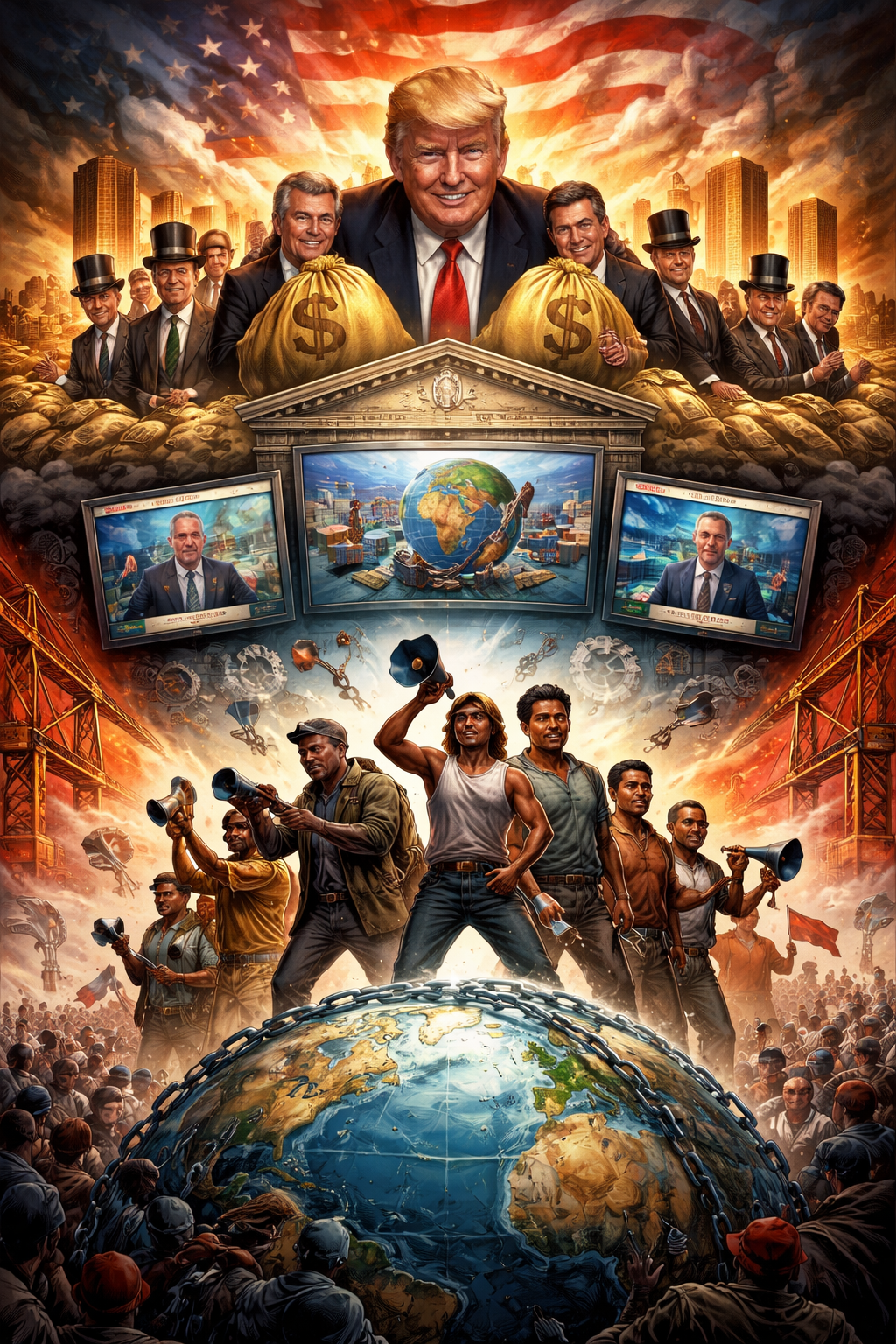
Corporate media frames tariffs as a consumer morality tale while shielding monopoly power. The data reveals regressive burdens, profit expansion, and geopolitical escalation beneath the headline numbers. Trade warfare emerges as imperial recalibration in a fading unipolar order. Labor, colonized nations, and multipolar movements must organize where the contradictions already burn.
By Prince Kapone | Weaponized Information | February 10, 2026
A Pocketbook Morality Play in the House of Disney
The target text is “Trump’s tariffs cost American households $1,000 last year: Research group”, written by Elizabeth Schulze and published by ABC News on February 9, 2026. The story’s core narrative is clean enough to fit on a receipt: Trump’s tariffs are framed as a hidden “tax” on ordinary Americans, supposedly costing the average household about $1,000 last year and rising further if the policy persists. The article positions this as a blunt economic self-harm, a policy that worsens the cost of living while undermining the gains of Trump’s own tax cuts. A White House spokesman is quoted to insist that inflation has cooled and investment is “pouring in,” but the piece treats that defense as a convenient talking point, not a serious explanation of who is paying, who is collecting, and who is being disciplined.
Schulze’s role in this machinery is not the cartoon villain of propaganda posters; it is the more common figure in imperial information systems: the professional translator of elite disputes into “common sense” for the masses. Her background signals the pipeline. She previously worked as a producer at CNBC, including as an associate producer on “The Kudlow Report,” a venue built to flatter markets and discipline politics into investor-friendly language. In that sense, the article reads like a familiar genre piece: a policy fight among ruling-class factions rendered as consumer arithmetic, with the worker recast as a shopper whose chief political identity is the grocery bill. That is not an accident of style; it is class orientation made into prose. It trains the reader to think of political economy as a debate over “household impact” rather than a conflict over power: who commands production, who sets prices, who captures rents, who can withstand austerity, and who cannot.
The outlet matters because it sets the guardrails. ABC News is a flagship network inside a corporate entertainment empire; it sits within a system of concentrated media ownership in which the same conglomerates that sell fantasies also launder legitimacy for the real. ABC is owned by the Walt Disney Company, and the relationship between political power and corporate media power is not theoretical—recent history shows it. When the Trump administration and allies applied pressure around broadcast licensing and political retaliation, Disney/ABC demonstrated the basic survival instinct of monopoly media: bend before the stick becomes a club. The public spectacle around the suspension of “Jimmy Kimmel Live!” after political threats is a reminder that “neutral news” in the imperial core is always written under the shadow of owners, regulators, advertisers, and the state. When a newsroom is downstream from corporate risk management, the questions it asks—and the questions it refuses to ask—are predetermined.
The article’s primary “expert” amplifier is the Tax Foundation’s tariff analysis, presented as nonpartisan research. But the ideological DNA of the Tax Foundation is not hidden if one bothers to look. Its own institutional history traces back to big-business formation: organized in 1937 by executives tied to General Motors and Standard Oil—capital’s planners, not labor’s tribunes—explicitly to “monitor” tax and spending policy. A think tank born from the boardroom naturally speaks the language of aggregate efficiency and national averages. In the ABC piece, this becomes the authoritative voice that converts tariff policy into “household cost,” which sounds populist while remaining safely managerial: the reader is invited to be upset as a consumer, not organized as a worker.
From there, the propaganda mechanics unfold with a practiced elegance. First comes the framing: tariffs are narrated as a “tax increase,” which quietly shifts the terrain from industrial strategy and geopolitical coercion into a moral tale about politicians picking your pocket. Next comes the omission pattern: the story flags that tariffs raise prices on goods “not manufactured domestically,” but it does not interrogate the power structure that decides where production goes, why deindustrialization happened, or which corporations profit regardless of where factories sit. Then comes the emotional lever: selective price shocks—coffee, beef, lettuce—are invoked as lived pain, making the reader feel the squeeze while discouraging them from asking who in the supply chain marked up what, and why. Finally comes the “balance” ritual: the White House spokesman’s reassurance that macro indicators look fine is included, not to clarify contradictions, but to stage the familiar duel of elites—think tank versus spokesperson—while the working class remains a silent object being measured, priced, and managed.
What this article accomplishes, in its smooth corporate tone, is not merely criticism of Trump. It performs something more useful to the system: it narrows the horizon of possible thought. The reader is trained to treat the struggle as a choice between “bad tariffs” and “good policy,” between one set of rulers and another, while the deeper architecture—monopoly pricing power, corporate capture of the state, media consolidation, and the imperial use of trade as coercion—sits outside the frame like an unmentioned landlord collecting rent. In that sense, the piece is less an exposé than a containment strategy: it lets anger circulate, but only within the safe channels of consumer grievance and partisan scorekeeping.
Tariffs, Tax Cuts, and the Arithmetic of Empire
The article’s central empirical claim rests on a study from the Tax Foundation, which estimates that Trump’s 2025 tariff regime imposed an average cost of roughly $1,000 per U.S. household last year, rising to approximately $1,300 if current rates remain in place. The same analysis reports that tariff collections reached into the hundreds of billions of dollars in 2025, while projecting trillions over the next decade if the structure holds. It characterizes the tariff escalation as the largest effective tax increase relative to GDP in decades, citing the sharp rise in the average U.S. tariff rate from low single digits to levels not seen since the mid-20th century. These are the numbers that anchor the narrative: the household burden, the historic comparison, the implied reversal of decades of low-tariff orthodoxy.
The article further situates these tariffs alongside Trump’s 2026 tax cuts, asserting that the economic drag from higher import duties will offset much of the growth stimulus promised by the new tax law. In this framing, the administration appears internally contradictory: cutting taxes with one hand while raising costs with the other. The White House response, as quoted, leans on macro indicators—cooling headline inflation, rising real wages, accelerating GDP growth, and renewed domestic investment—to argue that the broader economy remains resilient. On the surface, then, we are presented with two competing claims: one that emphasizes household cost pass-through, and one that highlights aggregate performance metrics.
To understand the material terrain beneath these claims, we must widen the lens. First, the distributional impact of tariffs is not uniform across class strata. Research from Yale’s Budget Lab indicates that lower-income households experience tariff-induced price increases as a significantly larger share of disposable income than wealthier households, even when the nominal dollar amounts appear similar. In other words, the burden is regressive: a $1,000 increase in annual expenses does not weigh equally on a family living paycheck to paycheck and on one with substantial accumulated wealth. The “average household” statistic, while technically accurate in arithmetic terms, conceals a structural inequality in impact.
Second, the tariff story cannot be separated from the trade war escalation that unfolded through 2025. Independent trade analysis from the Peterson Institute for International Economics documents how U.S.–China tariff rates surged dramatically during the year before partial adjustments lowered some headline figures. The average U.S. tariff rate climbed to levels not experienced since the postwar period, while China and other trading partners responded with retaliatory measures. These cross-border escalations reshaped supply chains, increased uncertainty, and influenced pricing decisions throughout import-dependent sectors. The ABC article mentions price increases for specific goods, but the broader geopolitical chessboard—the retaliations, the sectoral carve-outs, the shifting trade routes—is largely absent.
Third, corporate pricing behavior during the recent inflationary period complicates any simple tariff-to-price equation. Analysis by the Economic Policy Institute shows that a substantial portion of recent price increases in the nonfinancial corporate sector has been driven by expanded profit margins rather than labor cost growth. Even central banking officials in Europe have acknowledged that unit profits have contributed disproportionately to price pressures relative to historical norms. This does not negate tariff pass-through; rather, it raises a sharper question: when input costs rise, who absorbs them, and who leverages them? In highly concentrated industries, firms with pricing power can use tariff shocks as justification to increase prices beyond the strict cost increase, preserving or expanding margins in the process.
Fourth, employment dynamics offer another layer. Federal Reserve research examining prior tariff episodes found that sectors more exposed to import competition or input cost increases experienced slower job growth relative to less exposed sectors. The 2025 escalation appears to have coincided with a moderation in monthly job gains compared to the previous year. While causality in macroeconomics is never monocausal, the pattern suggests that tariffs, especially when deployed at scale, can function as a drag on hiring in trade-sensitive industries. The article’s reliance on aggregate GDP and wage indicators leaves this sectoral unevenness unexplored.
Finally, the broader fiscal architecture matters. Trump’s tax legislation, according to multiple distributional analyses, delivers disproportionate benefits to higher-income households and capital owners relative to working-class families. When tariff costs—regressive in structure—interact with tax cuts skewed upward, the combined effect can intensify inequality even if headline GDP growth appears stable. Thus, the contradiction between “tax relief” and “tariff burden” is not merely rhetorical; it is a structural reallocation across class lines.
In sum, the factual baseline reveals a complex terrain: tariff escalation raised average import duties to historically high levels; measurable price increases occurred in import-dependent goods; lower-income households bore a heavier proportional burden; corporate profit margins expanded significantly during the same period; and job growth moderated in trade-exposed sectors. At the same time, aggregate macro indicators did not collapse, allowing the administration to claim resilience. The tension between household strain and macro stability, between national strategy and class distribution, forms the empirical contradiction that must now be interpreted rather than merely reported.
Tariffs as Shock Doctrine in a Fading Hegemony
When we synthesize the factual terrain, a sharper pattern emerges. Tariffs were raised to levels not seen in generations; household costs increased in measurable ways; lower-income families absorbed a heavier proportional burden; corporate profit margins expanded during the same inflationary period; and employment growth in trade-exposed sectors slowed even as aggregate GDP indicators held steady. These are not random data points. They are the contours of a system recalibrating itself under pressure. What ABC News frames as a consumer problem is, in reality, a structural maneuver inside a deepening crisis of imperial political economy.
The tariff regime operates as a form of Economic Shock Therapy: a sudden and large-scale policy disruption justified as necessary correction. By rapidly increasing import duties to historic levels, the state introduces volatility into supply chains and pricing systems. In theory, the shock is meant to coerce capital into reshoring production and disciplining rival states. In practice, the shock is absorbed unevenly. Workers encounter higher consumer prices and uncertain employment conditions; small firms face rising input costs; while large, concentrated corporations—already possessing pricing power—translate the disruption into expanded margins. Shock, in this sense, does not dismantle monopoly power; it reorganizes it.
The regressive burden documented in distributional research makes this dynamic clear. When lower-income households lose a larger share of disposable income to tariff-induced price increases, the policy becomes a quiet transfer upward. Coupled with tax legislation that disproportionately benefits higher-income earners and capital owners, the tariff structure reinforces class stratification. The narrative of “America First” is thus reframed as a domestic redistribution that privileges capital accumulation while framing the costs as national sacrifice.
At the international level, the tariff escalation reflects what can be described as Imperialist Recalibration. The United States, confronting a multipolar environment and intensified competition with China, deploys trade policy as coercive leverage. The escalation documented by independent trade institutes demonstrates how tariff rates surged in a bid to reshape global value chains. Retaliatory measures from other states followed. This is not merely protectionism; it is economic confrontation within a system where supremacy is no longer guaranteed. The recalibration signals that the era of uncontested liberal globalization is over, replaced by overt strategic rivalry.
Yet recalibration does not equal renewal. The evidence of moderated job growth in trade-exposed sectors complicates the claim that tariffs automatically revive domestic employment. The contradiction lies in the structure of monopoly capitalism itself. Corporations that offshored production did so not from patriotic ignorance but from profit calculus. Raising tariffs does not automatically reverse that calculus when automation, financialization, and shareholder pressure remain dominant. Capital will absorb, redirect, or pass through costs so long as it preserves return on investment. The worker is left navigating instability, regardless of the nationalist rhetoric.
The pricing data and profit margin expansion point toward another concept: Monopoly Pricing Power. In concentrated industries, firms can exploit external shocks—tariffs, supply chain disruptions, geopolitical tensions—to justify price increases that exceed cost inputs. This is how inflation becomes partially detached from wages and tethered instead to markups. When profit-driven price expansion coincides with state-imposed tariffs, the consumer encounters a double squeeze. The propaganda frame isolates the tariff as culprit while leaving corporate leverage intact. The systemic view reveals a coordinated interaction between state policy and concentrated capital.
From the standpoint of the global proletariat and peasantry, the tariff saga is not a morality play about efficient taxation; it is a chapter in a long cycle of imperial competition. For workers in export-oriented sectors abroad, tariff escalation threatens livelihoods. For workers in the United States, it promises revival but often delivers instability. The common thread is that decisions are made at the level of ruling-class strategy, not democratic planning. Economic confrontation between states becomes a proxy for class discipline within states.
The deeper crisis, therefore, is not merely inflationary pressure or trade imbalance. It is a crisis of imperial sustainability. As hegemony wanes, coercive economic tools proliferate. Tariffs, sanctions, and emergency trade powers become instruments of control. But these instruments cannot resolve the underlying contradictions of overaccumulation, inequality, and global competition. They intensify them. What appears as nationalist correction is, in dialectical terms, the symptom of systemic strain.
Reframed in this light, the ABC narrative becomes a partial truth. Yes, tariffs raise prices. Yes, households feel the impact. But the essential question is not whether tariffs are good or bad in isolation. The question is who governs production and trade. So long as monopoly capital commands the supply chain and the state functions as its strategic arm, any trade regime—liberal or protectionist—will reproduce inequality. The solution lies not in toggling between tariff rates but in transforming the power structure that converts every policy shock into an opportunity for accumulation at the top.
From Contradiction to Organization: Where the Struggle Already Lives
If the analysis has shown anything, it is this: tariffs are not an isolated policy error but an expression of deeper contradictions—between monopoly capital and labor, between imperial recalibration and multipolar resistance, between nationalist rhetoric and class reality. The task now is not to invent struggle out of thin air. The struggle is already underway. Our responsibility is to recognize it, connect it, and deepen it.
Within the United States, organized labor has re-entered the historical stage with a confidence not seen in decades. The strike waves led by the United Auto Workers, the Teamsters, and logistics workers demonstrated that workers can extract concessions even under inflationary pressure and trade volatility. When auto workers forced wage increases exceeding 25% over the life of their contracts, they exposed a basic truth: corporate America has the money. It always did. The question is whether workers are organized enough to claim it. The tariff regime, combined with regressive price burdens, creates fertile terrain for renewed organizing around cost-of-living adjustments, price controls, and corporate transparency. The existing infrastructure—union locals, rank-and-file reform caucuses, labor councils—is where this fight must root itself. The contradiction between rising consumer prices and expanding corporate margins is not abstract; it is bargaining-table material.
At the community level, tenants’ unions and food justice networks have already begun confronting price escalation directly. Mutual aid formations that expanded during the pandemic—community food distribution projects, cooperative grocery initiatives, debt relief collectives—are practical responses to the same structural squeeze exposed in our analysis. These are not charity efforts; they are embryonic counter-institutions. In cities from Chicago to Los Angeles, tenant organizations have linked rising housing costs to financial speculation and corporate landlord consolidation. Their campaigns to cap rent increases and impose just-cause eviction laws intersect organically with the broader fight against monopoly pricing power. The contradictions revealed by tariffs and inflation are lived most sharply at the grocery store and the rent office. The organizations already confronting those sites of extraction are natural nodes for politicization.
Internationally, the contradictions have generated visible realignments. The BRICS+ expansion and experiments with alternative trade settlement mechanisms are not theoretical gestures; they are material attempts to reduce exposure to U.S.-centric economic coercion. Regional blocs in Latin America and Asia have intensified currency swap agreements and trade cooperation outside dollar-denominated systems. These initiatives are uneven and constrained, but they reflect a collective recognition that tariff and sanctions regimes are tools of geopolitical discipline. For colonized and formerly colonized nations, economic sovereignty is not an academic slogan—it is survival. Movements demanding control over natural resources, national development planning, and food sovereignty—whether in West Africa, Latin America, or South Asia—are part of the same historical current.
Revolutionary socialist parties and anti-imperialist coalitions across the Global South have consistently identified trade coercion as a component of broader domination. Organizations aligned with peasant movements like La Vía Campesina, labor federations in Brazil and South Africa, and anti-sanctions campaigns in the Middle East and the Caribbean have long argued that control over trade terms is inseparable from political sovereignty. The tariff escalation of 2025–2026 has only sharpened this awareness. The call now is not to romanticize multipolarity, but to recognize that every fracture in imperial economic unity creates space for popular movements to demand redistribution, public ownership, and democratic planning.
For the global working class, the path forward grows directly from these concrete struggles. In the United States and other core economies, this means strengthening labor militancy around price gouging, demanding windfall taxes on corporations that expand margins during crises, and linking contract fights explicitly to broader economic restructuring. It means connecting union campaigns with tenant unions and food justice networks so that wage struggles are tied to cost-of-living struggles. It means political education that clarifies how tariff costs, tax cuts skewed upward, and monopoly pricing are interwoven expressions of class power.
In the Global South, mobilization means defending and expanding initiatives that reduce dependency on imperial trade channels, while ensuring that alternative arrangements do not simply empower new domestic oligarchies. Popular movements must push multipolar realignment toward social ownership and public investment, rather than elite realignment under a different flag. The contradictions exposed by tariff warfare provide an opportunity to demand debt cancellation, technology transfer, and regional industrial planning that centers workers and peasants.
Across borders, coordination becomes decisive. Labor federations in the United States should build direct communication channels with unions in China, Mexico, Brazil, and beyond—not to defend any state apparatus, but to prevent workers from being weaponized against one another in trade conflicts. When tariffs are used to justify layoffs abroad or automation at home, workers must answer with solidarity statements, joint forums, and coordinated campaigns. Imperial rivalry thrives on division. Proletarian organization thrives on shared analysis and shared action.
The contradictions are clear: rising tariff rates, regressive price burdens, concentrated corporate power, and geopolitical recalibration. The movements are present: militant unions, tenant organizations, food sovereignty campaigns, anti-sanctions coalitions, multipolar development blocs. The call is simple and concrete: enter the organizations already fighting these battles. Strengthen them. Link them. Radicalize their demands where possible. The goal is not to toggle tariff percentages but to transform the structure that makes every crisis a moment of accumulation for capital.
History does not wait for perfect conditions. It moves through fractures. The tariff shock has opened one such fracture. The question before the global working classes, colonized nations, and revolutionary forces is whether we treat it as a partisan skirmish—or as an opening to reorganize economic life on principles of solidarity, sovereignty, and social ownership. The answer will not be written in policy briefs. It will be written in strikes, assemblies, and internationalist coordination.
 Weaponized Information
Leave a comment