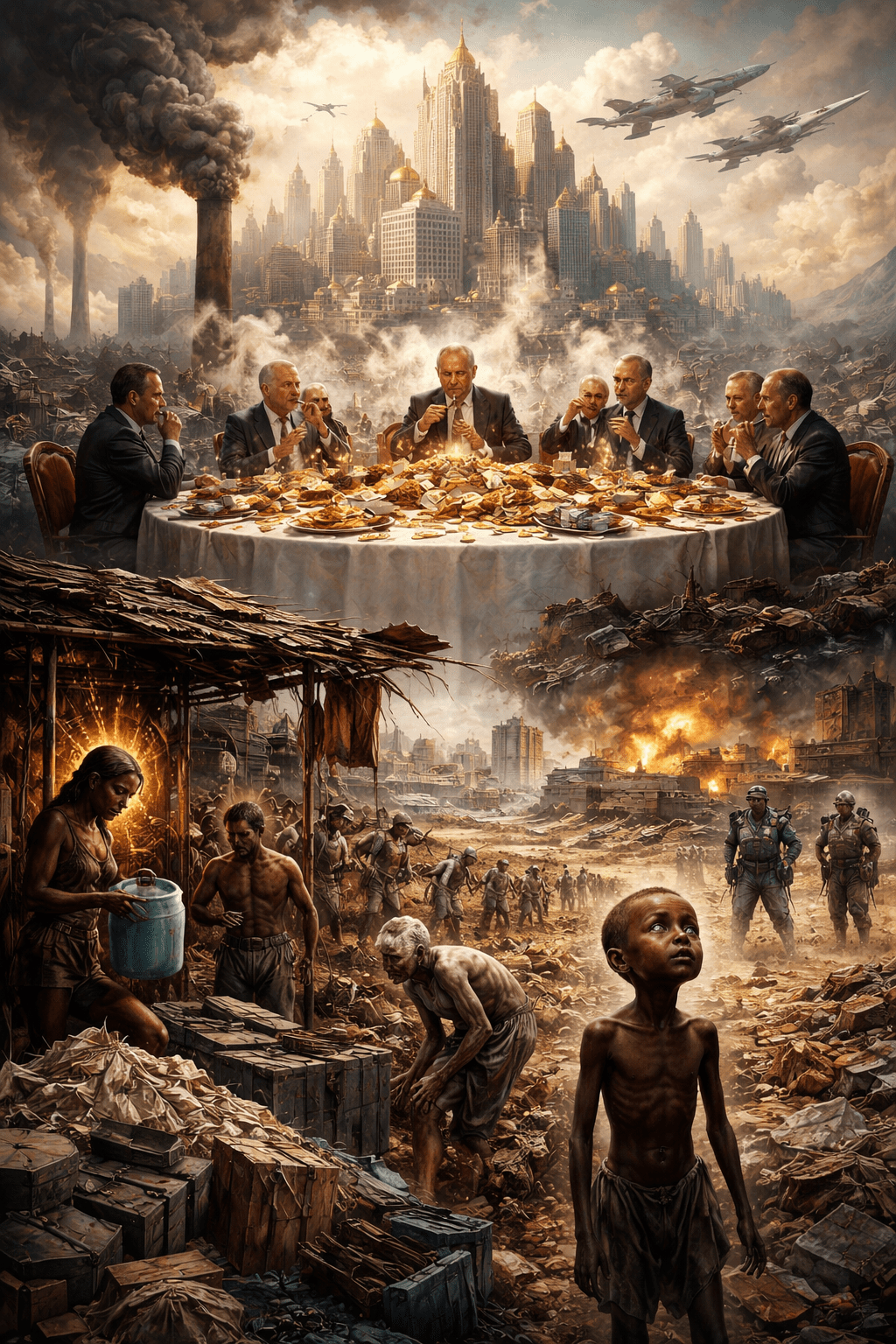
In The Political Economy of Growth, Paul A. Baran dismantles the myth that growth is neutral or benevolent, exposing it as a class project rooted in surplus extraction and imperial power. He shows how monopoly capitalism turns productivity into waste and development into stagnation, both at home and across the colonized world. Against liberal economics and reformist illusions, Baran restores political economy as a weapon for understanding why poverty persists amid abundance. What emerges is not a theory of growth, but an indictment of a system that can only survive by misusing its own potential.
By: Prince Kapone | Weaponized Information | Weaponized Intellects Book Review | February 7, 2026
Growth as Alibi, Surplus as the Crime Scene
Paul Baran opens The Political Economy of Growth with a quiet but devastating move: he strips “growth” of its innocence. What the bourgeois economist treats as a neutral, technical process—more output, higher income, expanding markets—Baran exposes as a political alibi. Growth, as it is conventionally understood, tells us nothing about who controls society’s resources, who benefits from production, or whose lives are being shortened so that others may enjoy abundance. From the very beginning, Baran insists that the real question is not how much an economy produces, but what happens to its surplus—who seizes it, how it is used, and to what social ends.
This move immediately ruptures the dominant economic common sense that treats poverty as a problem of scarcity, of insufficient production, of too many people chasing too few goods. Baran reverses the lens. Poverty, he argues, persists not because societies lack resources, but because the resources they do possess are systematically misused, wasted, or drained away. The scandal of capitalism is not low productivity, but the grotesque irrationality with which immense productive capacities are deployed—toward luxury consumption for the few, militarism, advertising, financial manipulation, and imperial expansion, while basic human needs remain unmet.
At the center of this irrationality stands the concept Baran places like a crowbar under the foundations of bourgeois theory: economic surplus. By distinguishing between actual surplus, potential surplus, and planned surplus, Baran transforms surplus from a bookkeeping residue into a social relation. Actual surplus reflects what capitalism manages to extract under existing relations of power. Potential surplus reveals what society could generate if its productive forces were organized rationally. Planned surplus gestures toward a future in which collective priorities, rather than private profit, govern economic life. The distance between these categories is not accidental; it is the measure of class power and imperial domination.
Baran is especially merciless toward the liberal doctrine of “consumer sovereignty,” that sacred cow of capitalist ideology which claims that markets merely reflect the free choices of individuals. In reality, he shows, consumer preferences are manufactured, distorted, and regimented by monopoly capital. Advertising does not serve human needs; it creates artificial ones. Production does not respond to social necessity; it responds to profitability. What appears as choice is, in fact, coercion administered through prices, wages, and the threat of deprivation. The result is a social order in which abundance coexists with poverty, and waste is celebrated as efficiency.
Crucially, Baran refuses to treat these pathologies as confined to the advanced capitalist countries. From the opening pages, he situates growth within a global system structured by imperialism. Underdevelopment, he argues, is not a backward stage waiting patiently for modernization. It is an active product of capitalist expansion itself. The same historical process that generated industrial wealth in a handful of imperial centers simultaneously distorted, drained, and arrested development across Asia, Africa, and Latin America. Surplus flows outward, while poverty is left behind—and then blamed on the victims as cultural deficiency, demographic excess, or lack of entrepreneurial spirit.
Baran’s intervention rests on a simple but dangerous proposition: economics is never neutral. By divorcing growth from power, bourgeois theory naturalizes imperial plunder and class exploitation. By restoring surplus to the center of analysis, Baran re-politicizes economic life and forces the reader to confront an uncomfortable truth. The problem is not that capitalism has failed to deliver development, but that it has succeeded all too well in organizing the world around accumulation rather than human need.
In this sense, Baran’s opening chapters do not read as a period piece, but as a diagnostic that refuses to age. What passes for growth appears increasingly detached from social well-being, while the mechanisms Baran identifies—waste, coercion, displacement, and surplus extraction—remain stubbornly intact. Growth is not progress. Surplus is not neutral. And any serious struggle for human emancipation begins by asking the question capitalism is designed to evade: growth for whom, and at whose expense?
When Economics Chooses Sides
Having torn the mask from “growth” as an innocent category, Baran widens the frame and turns his attention to political economy itself—how it came to be, who it serves, and why it now functions less as a science than as an ideological battalion. Economics, Baran reminds us, did not emerge in a vacuum. It developed alongside capitalism, responding not only to its productive expansion but to its crises, contradictions, and threats. What passes for economic theory at any given moment reflects the balance of social forces, not timeless laws of human behavior.
Classical political economy, for all its limitations, still grappled openly with production, class, and social conflict. It asked uncomfortable questions about value, labor, and accumulation because capitalism itself was still struggling into existence. But as capitalism consolidated power—especially in its monopoly form—economics retreated from critique into apology. The discipline narrowed its field of vision, abandoned historical analysis, and rebranded exploitation as efficiency, domination as equilibrium, and imperial expansion as development. Political economy gave way to technique, and technique to ideology.
Baran situates this degeneration of economic thought within a decisive historical shift: the collapse of Europe’s colonial empires and the emergence of socialist states as real competitors to capitalism. These developments shattered the myth that capitalism represented the natural endpoint of human progress. Suddenly, vast populations were demanding sovereignty, planning, and social transformation, while socialist economies demonstrated—however imperfectly—that alternatives to private accumulation were possible. Faced with this challenge, bourgeois economics responded not with self-criticism, but with tighter ideological discipline.
It is here that Baran delivers one of his most devastating indictments: economics increasingly operates in league with imperialism. Growth theory, development policy, and international finance are not neutral tools offered to newly independent nations; they are mechanisms designed to keep those nations safely within the orbit of capitalist accumulation. Measurements of growth are constructed to reward export dependency, punish social redistribution, and conceal the ongoing transfer of surplus from the periphery to the imperial core. What cannot be measured—human well-being, autonomy, collective capacity—is treated as irrelevant.
Baran’s critique lands with particular force on the question of measurement itself. By defining growth narrowly in terms of output, income, or investment flows, bourgeois economics renders invisible the social relations that determine how wealth is produced and used. An economy can grow while its population starves, its land is poisoned, and its future is foreclosed. Conversely, efforts to redirect surplus toward health, education, or social security appear inefficient or irrational within capitalist accounting frameworks. Measurement becomes not a mirror of reality, but a weapon wielded against any project that threatens existing power.
What emerges is a discipline that speaks fluently about markets while remaining silent about domination. Policies that immiserate entire populations are framed as technical necessities. Environmental destruction is absorbed into abstract models. Indebtedness is recoded as responsibility. Economics does not merely fail to challenge power; it trains its practitioners to translate violence into neutral language and to mistake management for understanding.
Against this backdrop, Baran insists that political economy must choose sides. Either it serves as a technical servant of monopoly capital and empire, or it becomes a tool for exposing how societies actually function and how they might be reorganized. There is no neutral ground. To speak of growth without speaking of imperialism is to lie by omission. To analyze production without confronting surplus is to accept the terms of domination. Baran’s demand is simple and uncompromising: economics must be dragged back into history, back into politics, and back into the struggle over who controls society’s material future.
The Surplus That Capitalism Cannot Admit
With the concept of economic surplus, Baran finally names what bourgeois economics works so hard to keep invisible. He does not treat surplus as a residual left over after production, nor as a technical accounting category to be shuffled between savings and investment. Surplus, for Baran, is a social fact rooted in power. It represents the portion of society’s productive capacity that could be directed toward collective development, but is instead captured, squandered, or exported under capitalism. By centering surplus, Baran shifts political economy away from abstract market equilibria and back onto the terrain of class struggle.
Baran’s first move is to distinguish between different forms of surplus, not to complicate the analysis but to expose the scale of capitalism’s irrationality. Actual surplus reflects what is currently extracted under prevailing social relations. Potential surplus points to what society could produce if its productive forces were organized rationally, freed from waste and parasitism. Planned surplus gestures toward the conscious direction of social resources according to human need rather than private profit. The gap between these categories is not a matter of inefficiency or poor management; it is the measure of how deeply capitalism distorts social priorities.
Against the bourgeois assumption that capitalism maximizes output and efficiency, Baran shows that monopoly capitalism systematically destroys potential surplus. Vast resources are absorbed by activities that add nothing to human well-being: bloated marketing industries, speculative finance, military production, and administrative superstructures whose sole function is to manage exploitation. These are not deviations from capitalism’s logic; they are expressions of it. When profit, rather than use, governs production, waste becomes rational and necessity becomes unprofitable.
Baran is particularly sharp in dismantling the myth that consumption under capitalism reflects genuine human desire. The so-called sovereignty of the consumer collapses once we recognize how wants are manufactured and regimented. Advertising does not inform; it disciplines. It channels surplus into socially pointless forms of consumption while crowding out needs that cannot be profitably satisfied. In this sense, capitalism produces not only commodities, but compliant subjects trained to mistake distortion for choice.
The importance of surplus becomes even clearer once Baran turns his attention to underdeveloped economies. Here, the problem is not simply how much surplus is produced, but how much is allowed to remain. Through unequal trade, profit repatriation, debt service, and direct extraction, surplus generated in the periphery is siphoned outward, leaving behind economies that appear stagnant or incapable of growth. Bourgeois economics then compounds the injury by diagnosing this condition as internal failure—blaming population growth, cultural backwardness, or lack of entrepreneurial spirit—while ignoring the structural drain at the heart of the system.
Planning enters Baran’s analysis not as an abstract ideal, but as a practical response to capitalism’s demonstrated inability to use surplus rationally. The question is not whether surplus will be planned, but by whom and for what purpose. Under capitalism, planning already exists—corporate planning, military planning, imperial planning—all directed toward preserving accumulation and power. Baran’s insistence on planned surplus simply makes explicit what capitalism conceals: that the allocation of social resources is always a political decision.
By restoring surplus to the center of political economy, Baran accomplishes something deceptively simple and profoundly subversive. He exposes the poverty of theories that obsess over growth rates while remaining silent on power. He reveals that stagnation, waste, and inequality are not accidental byproducts of capitalism but structural features of a system organized around private appropriation. And he arms the reader with a criterion by which any economic system can be judged: not by how much it produces, but by how fully it converts human potential into collective flourishing.
When Accumulation Becomes an Obstacle to Production
Having established surplus as the decisive category of political economy, Baran turns to the historical form of capitalism in which surplus reaches its most grotesque expression: monopoly capitalism. Against the comforting myth that capitalism naturally propels societies forward through innovation and investment, Baran argues that once accumulation becomes concentrated in the hands of monopolistic enterprises, the system’s internal motor begins to seize. What once appeared as dynamism hardens into rigidity. Capital no longer rushes toward productive expansion; it hesitates, hoards, and speculates.
In classical theory, investment is driven by opportunity. New markets, unmet needs, and technological breakthroughs supposedly invite capital forward, expanding production and employment. Baran shows that under monopoly conditions this logic collapses. Giant firms dominate markets, restrict output, and protect profit margins rather than risk disruptive expansion. Productive capacity outstrips profitable outlets, not because society has too much, but because monopoly capital refuses to organize production around social need. The result is chronic excess capacity alongside widespread deprivation.
Technological progress, far from resolving this contradiction, deepens it. Advances in productivity reduce the need for labor, but do not reduce the social demand for livelihoods. Instead of freeing humanity from unnecessary toil, technology under monopoly capitalism generates unemployment, underemployment, and insecurity. Innovation becomes a threat rather than a promise, not because technology is harmful, but because it is subordinated to profit. What could shorten the working day instead lengthens the shadow of precarity.
Baran rejects the familiar escape routes offered by bourgeois economists. Population growth is not the source of stagnation; the problem lies in the organization of production. Nor is insufficient saving the culprit, since surplus piles up faster than it can be absorbed. The crisis is not one of scarcity, but of distribution and control. Monopoly capitalism produces more than it can profitably use, while denying the majority access to what already exists.
This condition, Baran insists, is not cyclical but structural. It cannot be resolved by minor adjustments, policy tweaks, or renewed faith in markets. The stagnation tendency is woven into the fabric of monopoly capitalism itself. As accumulation becomes increasingly centralized, the system’s capacity to translate surplus into socially meaningful development erodes. Investment loses its social function and becomes a defensive maneuver, aimed at preserving dominance rather than expanding human possibility.
What emerges from Baran’s analysis is a picture of capitalism turning against its own historical justification. The system that once claimed to unleash productive forces now suppresses them. The promise of abundance gives way to managed scarcity. Growth continues in statistical form, but its content hollows out. Production serves accumulation, accumulation blocks production, and society is trapped inside a logic that mistakes stagnation for stability.
By the end of this section, Baran has decisively broken with any notion that capitalism’s problems can be solved by restoring competition or refining incentives. Monopoly capitalism does not malfunction; it functions exactly as designed. Its inability to absorb surplus productively is not a flaw to be repaired, but a contradiction to be confronted. The question is no longer how to revive capitalism’s momentum, but whether a social order organized around private accumulation can ever again claim to represent progress.
The State as Surplus Manager
Confronted with its own inability to absorb surplus through productive expansion, monopoly capitalism does not collapse under the weight of its contradictions. Instead, it recruits the state as its indispensable auxiliary. Baran makes clear that this is not a deviation from capitalism’s logic, but its continuation by other means. When private investment falters, public authority steps in—not to reorganize production rationally, but to stabilize accumulation and protect dominant interests.
The modern capitalist state, in Baran’s analysis, functions as a vast apparatus for surplus absorption. Public works, military expenditure, and bureaucratic expansion provide outlets for capital that cannot find profitable use elsewhere. Yet these expenditures rarely address genuine social needs. Roads are built where profit requires them, not where people need them. Armaments consume immense resources while adding nothing to human welfare. The state becomes a clearinghouse through which surplus is funneled into activities that preserve the system’s coherence while deepening its irrationality.
Militarism occupies a central place in this arrangement. Baran treats war and preparation for war not as unfortunate accidents, but as structurally functional responses to stagnation. Military spending absorbs surplus on a massive scale, disciplines labor, and legitimizes authoritarian controls, all while deflecting attention from internal contradictions. Destruction itself becomes a form of economic regulation. What cannot be sold profitably is blown up, replaced, and rebuilt, keeping accumulation in motion through negation.
Imperialism, in this framework, is no longer merely a policy choice or a relic of an earlier stage of capitalism. It becomes a necessity. External markets, investment outlets, and zones of extraction provide temporary relief from domestic stagnation. Surplus generated in the imperial core flows outward as capital, only to return augmented through profits, interest, and strategic advantage. The underdeveloped world is thus locked into a role not as a partner in development, but as a reservoir for surplus absorption and a dumping ground for contradictions.
Baran is particularly attentive to the social consequences of this arrangement within the imperial countries themselves. The benefits of surplus absorption are unevenly distributed, giving rise to privileged layers whose material position is tied to imperial expansion and state expenditure. These strata function as stabilizers of the system, buffering ruling-class power from popular challenge. Their relative security is purchased at the cost of intensified exploitation elsewhere, binding domestic social peace to global inequality.
Inflation, taxation, and public debt further integrate the state into the machinery of accumulation. These mechanisms redistribute surplus upward while appearing neutral or unavoidable. Fiscal policy becomes a means of disciplining labor and protecting capital, not of advancing collective welfare. The language of national interest masks a social reality in which the state acts as the executive committee of monopoly capital, administering crisis without resolving it.
What Baran ultimately exposes is a system that survives by displacing its contradictions rather than confronting them. Stagnation is managed through waste, violence, and expansion, not overcome. The state does not rescue society from capitalism’s failures; it organizes those failures more efficiently. By revealing this relationship, Baran strips away the illusion that capitalism’s reliance on state power represents a step toward rational planning. It is, instead, planning in the service of irrational ends.
How Capitalism Manufactures Backwardness
With the machinery of monopoly capitalism laid bare, Baran turns to one of the most tenacious lies of bourgeois thought: that underdevelopment is a condition inherited from the past, a residue of tradition waiting to be washed away by modernization. Against this comforting fiction, he insists that development and backwardness are not separate phenomena unfolding on parallel tracks, but two sides of the same historical process. Capitalism does not encounter an undeveloped world; it actively produces one.
Baran traces this process to the violent incorporation of vast regions into the capitalist world system. Colonial conquest shattered existing social structures, redirected production toward external markets, and reorganized economies around extraction rather than internal development. What mattered was not the growth of productive capacity within colonized societies, but the steady transfer of surplus outward. Industry was suppressed where it threatened imperial interests, agriculture was distorted to serve export demands, and local accumulation was systematically strangled.
This history, Baran emphasizes, leaves lasting structural scars. Underdevelopment is not simply a lack of capital or technology, but a deformation of social relations. The colonial economy creates classes whose survival depends on mediating imperial domination—landlords tied to export agriculture, merchants bound to foreign trade, officials trained to administer dependency. These classes do not represent a nascent national bourgeoisie capable of leading development; they are the internal agents of stagnation.
Baran’s discussion of India serves as a devastating case in point. British rule did not merely exploit Indian society; it actively dismantled indigenous industry, reorganized agriculture around imperial needs, and integrated the subcontinent into a global division of labor designed to benefit metropolitan capital. By the time formal independence arrived, the economic foundations necessary for autonomous development had already been systematically eroded. What bourgeois theory later describes as “initial conditions” were, in reality, the cumulative outcome of deliberate historical intervention.
The contrast Baran draws with Japan is instructive precisely because it exposes the exception rather than the rule. Japan’s ability to industrialize was not the result of cultural uniqueness or entrepreneurial spirit, but of a specific historical conjuncture: limited colonial penetration, strong state capacity, and the ability to control the use of surplus internally. Where imperialism failed to fully subordinate the social order, development became possible. Where it succeeded, backwardness hardened into structure.
By dismantling evolutionary theories of growth, Baran forces a reckoning with the ideological function they serve. To treat underdevelopment as a stage is to absolve capitalism of responsibility. To attribute poverty to population pressure or cultural inertia is to shift blame onto the oppressed. Baran shows that these explanations do not merely misunderstand reality; they actively conceal the historical violence embedded in global capitalism.
Underdevelopment, in Baran’s analysis, is neither accidental nor temporary. It is a stable condition reproduced through trade, finance, political control, and ideological domination. Capitalism does not fail to develop the periphery because it is inefficient; it succeeds in preventing development because underdevelopment is functional to the system as a whole. By restoring this historical perspective, Baran transforms backwardness from a technical problem into a political indictment.
The Internal Machinery of Dependency
Having established underdevelopment as a historical product of capitalist expansion, Baran turns inward to examine how this condition is sustained within the economies of the periphery themselves. He is careful not to reduce dependency to external domination alone. Imperialism reshapes internal class structures in ways that lock societies into stagnation long after formal colonial rule has ended. Underdevelopment persists not because nothing changes, but because change is carefully contained.
Agriculture occupies a central place in Baran’s analysis. Far from serving as a foundation for broad-based development, agrarian structures in underdeveloped economies are typically organized to extract surplus rather than to raise productivity or living standards. Land concentration, rent extraction, and primitive techniques coexist with chronic underemployment and poverty. Even reforms carried out in the name of modernization tend to reinforce existing hierarchies, channeling benefits upward while leaving the rural masses trapped in insecurity.
Outside agriculture, Baran finds little reason for optimism in the growth of non-agricultural sectors. Commerce and finance expand rapidly, but their function is largely distributive and speculative rather than productive. Merchants and moneylenders capture surplus without generating new social capacity. Industry, where it exists, is narrow, dependent, and often technologically subordinated to foreign firms. Instead of transforming the economy, these sectors become conduits through which surplus is drained or immobilized.
Foreign enterprise plays a decisive role in this configuration. Investment from the imperial centers is concentrated in enclaves—mining, plantations, extractive industries—designed to serve external markets. These enterprises integrate underdeveloped economies into global production chains while preventing the emergence of diversified domestic industry. Profits are repatriated, technology remains controlled from abroad, and linkages to the rest of the economy remain weak. What appears as development in accounting terms masks deepening dependency in social reality.
Baran rejects the notion that the failure of development can be explained by insufficient surplus. On the contrary, surplus exists and is extracted, but it is neither retained nor rationally used. Nor does he accept the claim that entrepreneurship or cultural initiative is lacking. The problem lies in the social structure that channels ambition toward mediation and rent-seeking rather than transformation. Where accumulation threatens established relations of power, it is blocked; where it reinforces them, it is encouraged.
The state in underdeveloped societies emerges as a contradictory institution within this framework. Formally sovereign, it remains economically dependent and politically constrained. Its policies reflect the interests of domestic elites aligned with foreign capital rather than the needs of the population. Attempts at reform are hemmed in by fiscal limitations, external pressure, and internal resistance from classes whose position depends on stagnation. The appearance of autonomy conceals a reality of structural subordination.
By the end of this section, Baran has dismantled the last refuge of bourgeois development theory. Underdevelopment is not the result of internal deficiencies awaiting correction through better policy or foreign assistance. It is a coherent system with its own logic, reproducing itself through class relations forged by imperialism. To imagine that this machinery can be retooled without confronting the power structures that sustain it is to mistake dependency for delay and domination for dysfunction.
Myths That Keep Poverty Profitable
After mapping the internal structure of underdevelopment, Baran turns to the ideas that sustain it. These doctrines do not merely misunderstand reality; they perform a political function by rendering exploitation natural and resistance futile. Chief among them is the belief that foreign capital constitutes a benevolent force, carrying development into stagnant economies from the outside. Baran dismantles this claim with precision, showing that foreign investment is guided not by social need but by profitability, and that its effects reinforce dependency rather than overcome it.
Investment from the imperial centers, Baran argues, does not integrate underdeveloped economies into a shared trajectory of growth. It reorganizes them as subordinate appendages. Capital flows into sectors that promise quick returns and secure control, not into those that would transform the social structure. Infrastructure is built to extract resources, not to unify national markets. Technology is imported in ways that deepen dependence, while local capacities are suppressed or rendered obsolete. What appears as assistance functions, in practice, as discipline.
Baran is equally unsparing toward the ideology of aid and reform. Programs designed to promote development rarely challenge the underlying distribution of power. Instead, they stabilize existing arrangements by relieving the most visible symptoms of poverty without altering its causes. Loans, technical assistance, and policy advice are accompanied by conditions that limit sovereignty and redirect surplus outward. Reform becomes a mechanism for preserving stagnation under a humanitarian banner.
Theories of trade are subjected to the same treatment. Baran rejects the claim that unfavorable terms of trade are merely temporary or self-correcting. They are structural features of a world economy organized around unequal exchange. Underdeveloped economies export raw materials and import finished goods, locking them into patterns of low value addition and volatile income. The promise that specialization will eventually lead to convergence dissolves once the political context of exchange is restored.
Population theory occupies a special place in Baran’s critique, not because it lacks empirical content, but because of how it is used. Malthusian explanations shift responsibility for poverty onto the poor themselves, portraying deprivation as the outcome of excessive reproduction rather than of social organization. By focusing attention on bodies rather than on surplus, these theories divert scrutiny from the structures that concentrate wealth and power. They function as moral alibis for inaction and repression alike.
Baran insists that these myths endure because they serve real interests. They justify the continued extraction of surplus, legitimize intervention, and delegitimize radical change. By framing underdevelopment as a technical problem requiring expert management, bourgeois ideology disarms political struggle in advance. The possibility that poverty might be abolished through structural transformation is excluded from consideration, replaced by endless tinkering at the margins.
With these illusions stripped away, Baran leaves little room for equivocation. If underdevelopment is produced by capitalism and maintained by imperialism, then no amount of reform within those parameters can resolve it. The myths of foreign investment, aid, and population pressure collapse under the weight of their own contradictions. What remains is a stark choice: accept stagnation as permanent, or confront the system that makes it profitable. The ground is now cleared for Baran’s final turn, from diagnosis to the problem of revolutionary transformation.
The Steep Ascent from a World Built to Keep You Down
With the ideological veils torn away, Baran turns to the question bourgeois economics never seriously entertains: what it would actually take to break out of underdevelopment. He does not approach socialism as an abstract moral ideal or a distant historical inevitability, but as a concrete response to a world economy structurally organized to prevent rational development. If capitalism produces surplus only to waste or export it, then emancipation begins with reclaiming that surplus and placing it under collective control.
Baran is unsentimental about the difficulty of this task. The transition out of backwardness is not smooth, gradual, or guaranteed. It is steep precisely because the global system is arranged to punish any serious attempt at autonomy. Economic isolation, political subversion, military pressure, and ideological warfare are not external obstacles but integral components of imperial rule. A society that attempts to plan its development confronts resistance not only from domestic elites, but from an international order invested in its failure.
Planning, in Baran’s formulation, is neither bureaucratic fetish nor technical shortcut. It is the conscious reorientation of production away from profit and toward social need. This requires decisions that capitalism systematically avoids: how to balance agriculture and industry, how to allocate resources between producer and consumer goods, how to choose technologies that maximize social benefit rather than immediate returns. These are political questions masquerading as economic ones, and they cannot be resolved without confronting entrenched interests.
Baran also rejects the notion that underdeveloped societies must retrace the historical path of advanced capitalism. The idea that socialism requires prior capitalist maturation is exposed as another ideological barrier. What matters is not the replication of past trajectories, but the ability to mobilize existing resources rationally. Backwardness, while real, does not preclude transformation; it intensifies the necessity of it. The very distortions produced by capitalism make planning indispensable rather than premature.
At the same time, Baran refuses to collapse socialism into economic administration alone. Planned surplus is not an end in itself, but a means of expanding human capacity. Development, in this sense, is measured not by output statistics but by the growth of collective possibilities: education, health, security, cultural life, and political participation. The point is not simply to produce more, but to produce differently, under relations that no longer treat the majority as expendable.
The ascent Baran describes is steep because it runs against the grain of the world system. There are no shortcuts, no guarantees, and no technocratic fixes. What exists instead is a stark alternative: a global order that perpetuates waste, inequality, and stagnation, or a break that reclaims surplus for social development at the cost of confrontation. Baran offers no consolation prizes, only clarity. The obstacles to development are not mysterious, and neither are the forces that sustain them.
By closing the book in this way, Baran refuses both despair and illusion. He does not promise easy victories, but he strips away the excuses that make defeat appear natural. The political economy of growth, once exposed, becomes the political economy of choice. Either surplus continues to serve accumulation and domination, or it is seized and redirected toward human emancipation. Everything else is commentary.
 Weaponized Information
Leave a comment