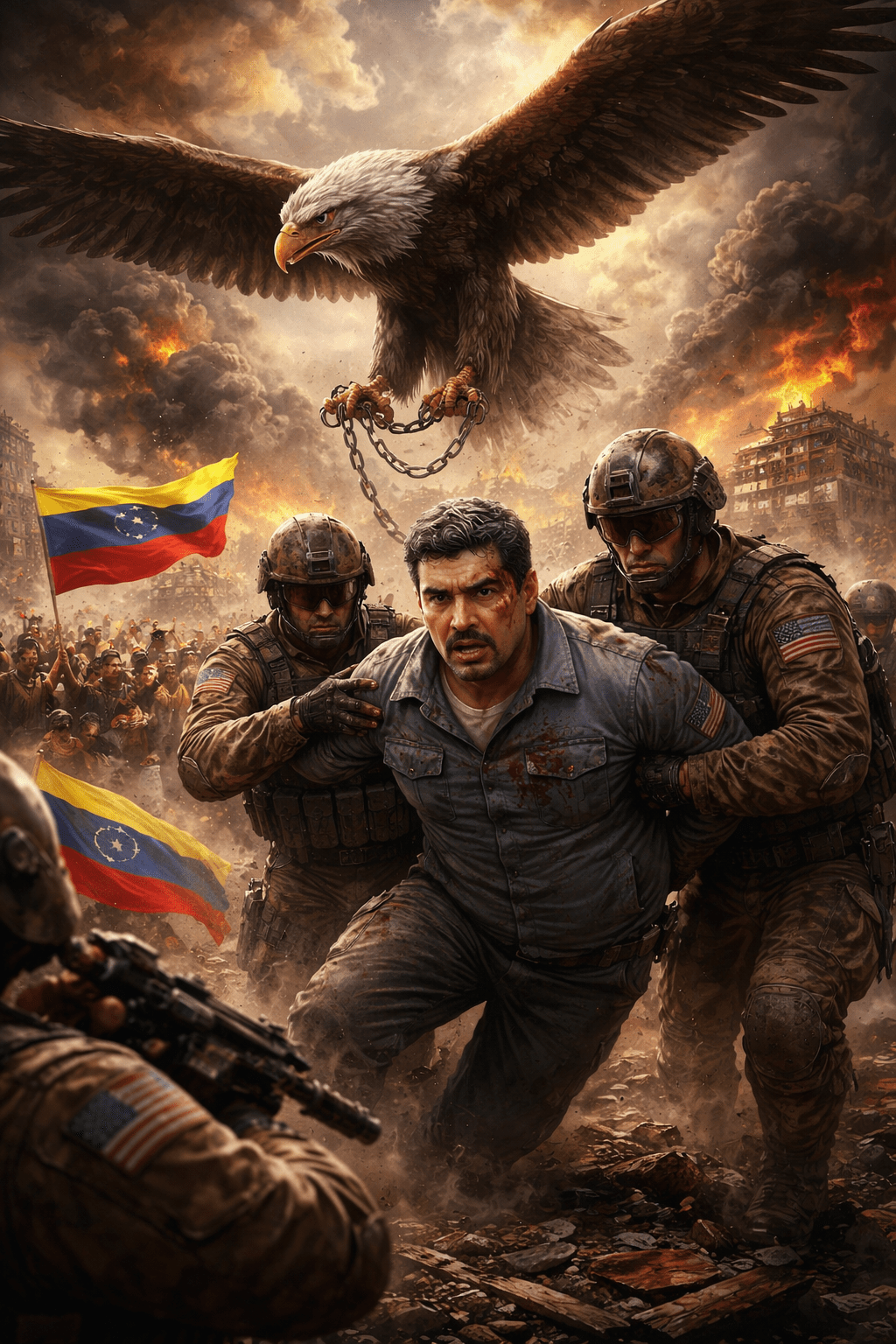
In his January 6, 2026 article in Socialist Worker, Alex Callinicos condemns the U.S. seizure of Venezuela’s president as a brutal assertion of hemispheric dominance, while simultaneously advancing a line that blames the Bolivarian process itself for its vulnerability. This essay takes Callinicos’ argument seriously—and then dismantles it—showing how a rhetoric of anti-imperialism can reproduce imperial logic when sovereignty, sanctions, and resistance are treated as conditional rather than fundamental.
The Pirate Raid and the Paper Shield
Call it what it is: a pirate raid dressed up in the language of “security” and “order.” The United States storms into a sovereign country, seizes its head of state, and then expects the world to nod like obedient clerks. The crime is not subtle. It is loud, spectacular, and meant to be seen. The point is not only Venezuela. The point is the lesson. Power is teaching again, with a baton in its hand, that sovereignty in the Western Hemisphere is conditional—licensed by Washington, revoked by Washington, and enforced by those who have mistaken aircraft carriers for moral arguments.
Alex Callinicos begins from the correct starting point—imperialism as coercion—but he cannot resist the old habit of turning the victim into the accused. He says “make no mistake,” and then proceeds to make the central mistake: he treats U.S. domination as the primary motor of events only long enough to establish credibility, and then pivots to the familiar prosecutorial tone that has become the Left’s most reliable contribution to empire. The raid is presented as monstrous, yes, but also as the predictable outcome of “Maduro’s lack of popular support,” of “little resistance,” of corruption, bureaucratisation, and internal decay. This is the rhetorical trick that lets you condemn the gangster while quietly repeating his alibi: “We didn’t want to do this, but look at the mess they made.”
The opening frame is designed to feel historical, even noble. Grenada and Panama are invoked as earlier U.S. invasions—small and large, island and canal—before Venezuela is introduced with Bolívar’s name attached like a medal. Yet the history is not here to deepen analysis. It is here to make the article sound like it is standing with Latin America’s long memory, while it does the opposite: it collapses the revolutionary process into a morality play about leadership errors. Bolívar becomes scenery, OPEC becomes a footnote, the “Seven Sisters” becomes a nostalgic reference, and the real question is quietly displaced. Not “how does imperialism operate?” but “why did Venezuela become vulnerable?” The answer, conveniently, is placed at the feet of the revolution itself.
This is how imperial ideology is reproduced inside radical language. Sanctions are acknowledged—“increasingly severe,” he says—yet treated as weather rather than warfare. This is the liberal move with a red scarf: admit external pressure exists, then insist it cannot “absolve” leaders of responsibility, as if imperial strangulation is merely an unfortunate constraint rather than the central battlefield. But sanctions are not a seminar topic. They are a policy instrument meant to break a population’s capacity to live and a state’s capacity to govern. When you minimize that reality, you are not being “balanced.” You are relocating causality from the empire that attacked to the society that was attacked, which is the intellectual version of blaming the bruised face for provoking the fist.
The most reactionary sentence in the entire piece is also the most casually delivered: the Venezuelan armed forces “seem to have put up very little resistance.” This “seems” is doing imperial work. It implies illegitimacy without proving it, and it invites the reader to infer that the raid succeeded because the people would not fight for the government. It turns a complex situation—where the calculus of resistance includes preventing slaughter, protecting civilians, and avoiding the kind of urban bloodbath the empire would happily film for its newsreels—into a cheap psychological verdict on “support.” A revolution, in this view, is not measured by what it built, endured, and defended under siege; it is measured by whether it produces the kind of cinematic resistance that satisfies spectators abroad.
Callinicos’ central thesis is smuggled in as if it were established fact: “Maduro buried Chavez’s Bolivarian Revolution.” This is not analysis. It is an ideological verdict. It reduces a years-long struggle—against coups, lockouts, sabotage, oil price collapse, financial strangulation, asset seizures, diplomatic isolation, and open threats of invasion—into a courtroom drama where the revolutionary process itself is on trial. The phrase “buried” does not describe. It sentences. And once you accept that sentence, the raid becomes not simply a crime but a consequence. You have shifted from defending a besieged people’s right to self-determination to adjudicating the merits of their leadership under imperial fire. That is the monastery dialectic: pure categories, immaculate critiques, and real bodies left outside the gate.
There is, of course, plenty of truth that could be said about bureaucratic deformation, corruption, internal contradictions, and the grinding difficulties of building popular power inside a petro-state inherited from colonial capitalism. A serious Marxist treatment would take these contradictions as material problems to be confronted by the masses, not as a rhetorical bridge to justify imperial outcomes. It would ask what options existed when the state was under economic siege, what forms of popular organisation survived, what new contradictions emerged, and how class forces moved under pressure. But that is not the project here. The project is to maintain two postures at once: to say “Hands off Venezuela” while insisting—loudly—that the Bolivarian process is already dead. It is the posture of a man who condemns the arsonist while insisting the house was already ashes.
This is why Vijay Prashad’s intervention matters. Not because he is an authority to be worshipped, but because he names the political responsibility that too many Left intellectuals avoid: under siege, you defend the besieged. You do not join the empire’s chorus of delegitimation and then pretend your conclusion is independent. You do not declare a revolution “buried” and then act shocked when the grave diggers arrive with helicopters. The first duty of internationalism is not to polish your critique. It is to refuse to help the enemy identify the target.
If Trump’s strategy is to make “US dominance in the Western hemisphere” unquestionable, then the role of the empire’s ideological auxiliaries is to make resistance appear pointless—either because it is doomed by brute power or because it is unworthy due to impurity. Callinicos performs both functions. He warns about imperial coercion and then drains the Bolivarian process of legitimacy. He condemns predation and then circulates rumor about “deals” with regime elements without evidence, as though the most pressing task is to interpret palace intrigues rather than mobilize solidarity against a kidnapping. The result is not revolutionary clarity. It is a refined confusion, useful to empire: the raid is wrong, but the victim is also guilty; the empire is predatory, but the revolution deserved its fate.
Weaponized Information does not deal in that confusion. We name the crime as a crime. We locate causality where it belongs—in the imperial system that cannot tolerate sovereignty in its backyard, that wants oil nationalisation reversed, that wants “access” and “strategic locations,” that treats Latin America as a supply depot and a laboratory. And we refuse the priestly habit of treating revolutionary processes in the Global South as dissertations to be graded by comfortable critics in the metropole. The people in Caracas do not need London’s permission to resist. They need international solidarity that does not come with a knife hidden behind the handshake.
When Sanctions Become Silence and Silence Becomes Guilt
There is a particular maneuver that recurs whenever empire tightens the noose: acknowledge the pressure, then drain it of causal force. Callinicos performs this move with practiced ease. Sanctions are mentioned, even described as “increasingly severe,” but they function in his argument like bad weather—unfortunate, disruptive, and ultimately secondary to the moral and political failings of leadership. This is not a neutral framing. It is an ideological displacement. It shifts the center of gravity away from the system that imposed collective punishment and toward the society struggling to survive it. In doing so, it quietly absolves imperial power of responsibility for the devastation it deliberately engineered.
Sanctions on Venezuela were not symbolic rebukes. They were not diplomatic frowns. They were a coordinated campaign to asphyxiate a country’s economy: freezing foreign reserves, blocking oil exports, criminalizing transactions, strangling shipping and insurance, and sabotaging access to food, medicine, spare parts, and credit. This was not pressure applied at the margins; it was warfare conducted through spreadsheets, banking systems, and legal codes. To discuss Venezuela’s internal contradictions without placing this economic siege at the center of analysis is like discussing a famine while treating the blockade as a footnote. You may sound “balanced,” but you have already chosen sides.
The liberal-Marxist trick is to concede the existence of these external constraints and then insist they cannot “absolve” political leaders of responsibility. The sentence sounds reasonable until you ask what it actually does. It collapses two radically different kinds of causality into one moral ledger. On one side stands a global imperial system with overwhelming structural power, enforcing compliance through economic violence. On the other stands a besieged state attempting to govern, redistribute, and defend itself under conditions of permanent attack. By treating these as symmetrical contributors to crisis, the analysis flattens reality. Responsibility becomes abstract and evenly distributed, which is precisely how empire prefers it.
This is where Callinicos’ argument slides from critique into prosecution. The question is no longer how imperialism functions, but why the Bolivarian process failed to withstand it in a manner deemed satisfactory by outside observers. The revolution is transformed into a defendant, sanctions into mitigating circumstances, and U.S. aggression into an unfortunate but understandable reaction to internal decay. This logic does not challenge imperial power. It normalizes it. It teaches readers to see coercion as a response to mismanagement rather than as a standing policy of domination in the Western Hemisphere.
The language of “bureaucratisation” and “centralisation” plays a crucial role here. These words are deployed as if they were self-explanatory indictments, floating free of historical context. But what does centralisation mean in a country facing repeated coup attempts, open calls for military intervention, parallel governments recognized by foreign powers, and the systematic seizure of national assets abroad? What does decentralisation look like when oil revenues are cut off, imports are blocked, and financial arteries are severed? These are not rhetorical questions. They are material ones. To ignore them is to substitute moral posture for political analysis.
The accusation that the Bolivarian process “depended” on a commodities boom is another way of emptying sanctions of their historical weight. It implies that the revolution was always fragile, always contingent, always one price drop away from collapse. What it erases is the deliberate decision by imperial power to weaponize that dependence once oil prices fell. The collapse was not merely cyclical; it was actively accelerated and exploited. To treat the outcome as evidence of internal failure rather than external assault is to mistake a strangulation for a natural death.
This is not an argument against criticism. Revolutionary processes generate contradictions, errors, and distortions, especially under siege. A serious Marxist approach would investigate how those contradictions were shaped by class struggle, international pressure, and inherited structures of dependency. It would ask how popular power was constrained, redirected, or transformed by the realities of blockade and threat. What it would not do is treat sanctions as background scenery while elevating leadership shortcomings into the primary explanatory framework. That move is not rigorous; it is convenient.
By minimizing the centrality of sanctions, Callinicos clears ideological space for the most dangerous inference of all: that the suffering of the Venezuelan people is ultimately the responsibility of their own government rather than the predictable outcome of imperial policy. This is the same inference that animates liberal editorials, State Department briefings, and humanitarian pretexts for intervention. When it appears in socialist language, it does not become more radical. It becomes more effective, because it reaches audiences that might otherwise resist imperial narratives.
Revolutionary Marxism insists on a different ordering of facts. Imperialism is not an external factor acting upon an otherwise autonomous crisis; it is the structuring force of the crisis itself. Sanctions are not a footnote; they are the text. Any analysis that reverses this order—placing internal flaws before external attack—ends up reproducing the very logic it claims to oppose. You cannot explain the wound while treating the knife as incidental. And you cannot claim solidarity with a besieged people while narrating their suffering as self-inflicted.
Measured in Blood or Measured in Survival
Every imperial narrative has its tell, and in this case it appears disguised as common sense: the claim that Venezuela’s armed forces “put up very little resistance.” The sentence is short, almost casual, but it carries the full ideological weight of empire. It invites the reader to draw a conclusion without evidence, to infer political illegitimacy from the absence of a spectacle. Resistance, in this framing, is not a strategic calculation or a social process; it is a performance. If it does not look like heroic last stands or televised carnage, it does not count. This is how imperial power trains spectators to confuse restraint with collapse and survival with surrender.
The assumption underneath the claim is never interrogated. What form of resistance would have satisfied this standard? Urban warfare in Caracas? Airstrikes answered with anti-aircraft fire over densely populated neighborhoods? Thousands of dead civilians offered up as proof of revolutionary authenticity? The empire understands this logic well. It has learned that spectacular resistance can be weaponized after the fact, replayed endlessly to justify even greater violence. A leadership that seeks to preserve life while maintaining the continuity of sovereignty does not fit neatly into this script, and so its choices are recoded as weakness.
By framing the absence of open military confrontation as evidence of “little resistance,” Callinicos collapses strategy into sentiment. He ignores the asymmetry of force, the history of U.S. interventions in the region, and the reality that resistance does not always announce itself with explosions. Endurance under siege, refusal to capitulate politically, maintenance of state functions, and the prevention of internal fragmentation are also forms of resistance. They are quieter, slower, and far less useful to the empire’s visual economy, but they are no less real. In fact, they are often the only forms that keep a society intact long enough for future struggle.
This is where the analysis drifts dangerously close to imperial psychology. The implication that the raid succeeded because of “Maduro’s lack of popular support” mirrors the language of interventionists who have long insisted that foreign domination merely reveals internal hollowness. It is the same argument used against Iraq, Libya, and countless other targets: the people did not rise, therefore the state had no legitimacy. What this logic erases is the terror produced by overwhelming force, the calculation of survival made by ordinary people, and the long memory of what U.S. intervention actually looks like once the cameras move on.
Resistance is not a referendum held under occupation. It is a process shaped by fear, hope, organization, and history. Venezuela’s recent past includes coups, lockouts, sabotage, paramilitary violence, and economic strangulation. To expect an immediate, unified, and militarized response to a U.S. raid is to pretend that societies behave like theory diagrams rather than living, wounded collectives. When Marx warned against abstracting social relations into tidy schemas, this is precisely the kind of analysis he had in mind.
The question that should be asked is not why resistance did not look the way distant commentators expected, but why imperial power assumed it could act with such confidence in the first place. The answer lies not in Venezuelan apathy, but in the accumulated effects of years of hybrid warfare designed to exhaust, divide, and isolate. Economic pressure weakens institutions; diplomatic isolation limits allies; media saturation distorts perception. When these tools are deployed successfully, the absence of spectacular resistance is not evidence of consent. It is evidence of a battlefield carefully prepared.
By failing to situate the moment of seizure within this longer arc of pressure, Callinicos turns a structural outcome into a moral verdict. The armed forces become a symbol of decay rather than an institution navigating impossible choices under threat of annihilation. The people become passive spectators rather than subjects whose options have been systematically constrained. This is not an analysis that empowers struggle. It is one that explains defeat in advance and then reads that explanation back into events as proof.
Weaponized Information rejects this logic outright. We do not measure revolutionary legitimacy by the quantity of blood spilled on command. We measure it by whether a people retain the capacity to decide their future without foreign rulers dictating the terms. Survival under siege is not betrayal. Strategic restraint is not capitulation. And the refusal to provide empire with the images it craves is not weakness—it is an understanding, learned the hard way, of how power feeds on spectacle.
The Convenient Rumor: Deals, Defections, and the Left’s Gossip Economy
When analysis thins out, rumor rushes in to fill the space. Callinicos reaches this point late in the article, where assertion replaces evidence and speculation is offered as insight. We are told there is “growing evidence” that a deal was cut, that elements of the regime “gave him up,” that power is quietly reorganizing itself to accommodate Trump’s demands. No documents are produced. No sources are named. No concrete facts are established. Instead, we are invited into the whisper network of regime psychology, where insinuation does the work that proof cannot.
This move is not accidental. It performs an ideological function. By floating the idea of internal betrayal, the article reframes the seizure of a head of state as something closer to a managed transition than an act of naked aggression. The empire appears less as a kidnapper and more as a broker. The violence of the act recedes into the background, replaced by intrigue about who talked to whom and which faction might be positioning itself for survival. This is how coups are laundered: first through inevitability, then through rumor, and finally through normalization.
The Left has seen this movie before. It was screened endlessly during the destruction of Libya, replayed during the dismemberment of Syria, and recycled during the long campaign against Venezuela itself. Each time, evidence-free claims of elite defection and secret agreements circulate just long enough to weaken solidarity. If the leaders are already cutting deals, why mobilize? If the regime is already fractured, why defend it? The rumor becomes a solvent, dissolving commitment while maintaining the appearance of critical engagement.
What is striking is how comfortably this speculation sits alongside calls for mass resistance. On the one hand, the article tells us the future lies “from below.” On the other, it invites us to fixate on palace maneuvering and elite calculations. These two perspectives are not complementary; they are antagonistic. One directs attention toward collective struggle and international solidarity. The other trains readers to watch elites like a political soap opera, as if history were decided in back rooms rather than through organized force and popular endurance.
The invocation of Iraq is particularly revealing. Callinicos warns that dissolving the existing state apparatus, as the U.S. did after toppling Saddam Hussein, could lead to implosion. This is a correct observation, but it is deployed to justify the idea that keeping parts of the existing regime intact might be sensible. In other words, imperial management is framed as pragmatic statecraft. The problem is not that Iraq was invaded, but that the invasion was administered poorly. Once again, the crime fades and technique takes center stage.
This line of reasoning leaves the reader with a deeply reactionary implication: that the central danger now lies not in the act of imperial seizure itself, but in how skillfully the empire manages the aftermath. Attention shifts from opposing domination to evaluating its competence. That is not anti-imperialism. It is consultancy. It imagines a world in which the task of radicals is to comment on the efficiency of conquest rather than to organize against conquest as such.
The fascination with “deals” also performs a subtler function. It erodes the idea of popular agency by suggesting that outcomes are decided entirely among elites. The masses appear only as a backdrop, passive recipients of decisions made elsewhere. This fits neatly with the earlier claim of “little resistance,” completing the picture of a society emptied of political life. Once that picture is accepted, solidarity becomes abstract and defensive at best, nostalgic at worst. The people are no longer subjects of history; they are scenery.
Weaponized Information refuses this drift into gossip and managerial thinking. We do not build analysis on whispers, nor do we substitute intrigue for structure. The decisive fact is not whether individuals inside a besieged state maneuver under extreme pressure, but that an imperial power asserted the right to seize a sovereign leader and dictate the political future of a nation. Everything else is secondary. To dwell on rumors at such a moment is not sophistication; it is evasion.
Anti-imperialism begins with clarity. Clarity requires evidence, not insinuation, and solidarity, not speculation. When the Left allows itself to become a relay station for unproven claims about internal betrayal, it does the empire’s work for free. It muddies the waters just enough to make decisive opposition harder, and it replaces the hard labor of organizing with the cheap thrill of inside knowledge. That is not revolutionary realism. It is ideological drift, and it always flows in the same direction.
Anti-Imperialism Without Conditions or Footnotes
The article closes with a familiar refuge: the hope that “the answer can come from below,” from mass movements and global resistance. On its face, this sounds like a return to first principles. But stripped of everything that came before, it rings hollow. You cannot spend an entire article hollowing out the legitimacy of a besieged process—questioning its leadership, hinting at elite betrayal, measuring its worth by the absence of spectacular resistance—and then invoke the masses as an abstract deus ex machina. That is not faith in popular power. It is a rhetorical escape hatch.
Mass movements do not emerge in a vacuum, and they do not grow stronger when imperial violence is explained away as the consequence of internal failure. They grow when lines are drawn clearly: when the aggressor is named, when the victim is defended without qualification, and when international solidarity refuses to participate in the delegitimation campaigns that precede and accompany intervention. To call for resistance “from below” while narrating the destruction of sovereignty as an almost natural outcome of bureaucratic decay is to demand courage from others while withholding it from oneself.
The repeated gestures toward Europe, Greenland, and the broader chaos of U.S. decline reveal the underlying contradiction. Callinicos understands, at a systemic level, that American power is becoming more openly predatory as its hegemony erodes. He sees the turn to brute force, the abandonment of pretense, the willingness to seize territory and leaders alike. Yet when that force is applied to an actually existing anti-imperialist state in Latin America, the clarity falters. The analysis retreats into conditional solidarity, as if resistance must first meet a set of ideological benchmarks before it deserves defense.
This conditionality is fatal to any serious anti-imperialist politics. It reproduces a hierarchy in which struggles in the Global South are perpetually on probation, evaluated by critics safely removed from the consequences of defeat. It treats sovereignty as a reward for good governance rather than as a non-negotiable right. And it trains activists to see imperial violence as a tragic but comprehensible response to imperfection, instead of as a structural necessity of a system that cannot tolerate independence in its “backyard.”
Weaponized Information insists on a harder, clearer position. Anti-imperialism is not a seminar where we distribute grades. It is a line in the sand. When an empire kidnaps a head of state, seizes assets, and announces its intention to rule, the task is not to speculate about internal flaws or future deals. The task is to oppose the act, defend the principle of self-determination, and refuse to assist—directly or indirectly—in the ideological preparation of conquest. Critique has its place, but it does not come at the point of a gun.
The history of Latin America is littered with movements that were isolated, demonized, and ultimately crushed not only by U.S. power, but by the hesitation and equivocation of those who claimed to stand against empire while quietly accepting its premises. Each time, the lesson is relearned too late: you cannot build a mass anti-imperialist movement on narratives that blame the victim. You cannot mobilize “from below” while repeating the arguments used to justify intervention from above.
The future will indeed be decided by mass struggle, but that struggle begins with intellectual discipline. It requires saying no—clearly, publicly, and without hedging—to imperial seizure, sanctions, and domination. It requires defending sovereignty as the terrain on which people can fight their own battles, make their own mistakes, and chart their own paths. Anything less is not realism. It is accommodation, dressed up in radical language.
The brutal lesson exposed by the raid is not simply that power is naked. It is that even on the Left, too many are still tempted to avert their eyes at the decisive moment, to soften their stance with caveats and conditions. Weaponized Information rejects that temptation. When empire moves, we do not ask whether the target was pure enough. We ask how to stop the crime, how to break the siege, and how to stand with those whose right to decide their future is under attack. That is not sentimentality. It is the minimum requirement of internationalism.
Choosing Sides When Theory Runs Out
At a certain point, analysis stops being an exercise in interpretation and becomes a test of political alignment. This is that point. The line advanced by Callinicos—however much it wraps itself in anti-imperialist language—fails that test. It fails not because it names U.S. domination incorrectly, but because it ultimately refuses to confront the full implications of that domination. It condemns the raid while internalizing its logic. It decries coercion while reproducing the narrative that makes coercion appear reasonable, inevitable, or even deserved. This is not a minor error of emphasis. It is a strategic failure.
The erroneous line rests on a simple inversion: imperialism is treated as a response to crisis rather than as the author of it. Leadership flaws are elevated into primary causes, while sanctions, blockades, asset seizures, and open threats of force are relegated to background conditions. Resistance is judged by spectacle rather than by survival. Sovereignty is treated as conditional rather than absolute. And solidarity is offered only after a revolution has been found wanting by external critics. This inversion is not accidental. It is the ideological footprint of a Left that has grown accustomed to commenting on power rather than confronting it.
To repudiate this line is not to claim that the Bolivarian process is without contradictions or that the Venezuelan state is beyond criticism. It is to insist on sequence and priority. Critique belongs to the people engaged in struggle, not to distant observers at the precise moment when an empire is attempting to impose its will through force. Internal debates cannot be conducted under the shadow of foreign kidnapping and occupation. When they are, they cease to be emancipatory and become tools of domination, whether intended or not.
History offers no comfort to those who hedge at decisive moments. From Guatemala to Chile, from the Congo to Iraq, the pattern is consistent: imperial intervention is always accompanied by a chorus explaining why the victim was already compromised, already decaying, already unworthy of unconditional defense. Each time, those explanations survive the wreckage intact, while the societies subjected to them are left to bury their dead. The lesson is not abstract. It is written into the political memory of the Global South.
Weaponized Information takes a different position, grounded not in moral purity but in material reality. In a world system defined by imperial hierarchy, sovereignty is the minimum terrain on which popular struggle can occur. Defend that terrain, and contradictions can be fought through by the masses themselves. Abandon it, and no amount of theoretical clarity will compensate for the loss. This is why anti-imperialism cannot be conditional, and why any line that softens or complicates opposition at the moment of attack must be rejected outright.
The seizure of a head of state, the open declaration of hemispheric domination, and the normalization of economic warfare are not thought experiments. They are acts of power that demand a response. That response cannot be calibrated to preserve intellectual respectability or factional consistency. It must be clear, collective, and uncompromising. Empire does not care how nuanced our critiques are. It cares whether we stand in its way.
This analysis therefore ends where it must: with a refusal. A refusal to accept the victim-blaming logic that seeps into parts of the Left. A refusal to measure revolutionary legitimacy by imperial expectations. A refusal to trade solidarity for speculation. The line advanced by Callinicos is not merely mistaken; it is politically disabling. It disarms opposition at the very moment when clarity and commitment are required.
Anti-imperialism is not an identity. It is a practice. And in moments like this, practice begins with choosing sides. Not rhetorically, not conditionally, but materially. Against seizure. Against sanctions. Against domination. For sovereignty. For self-determination. For the right of peoples to struggle, err, adapt, and endure without empire holding the knife to their throat. Anything less is not realism. It is retreat.
 Weaponized Information
Leave a comment