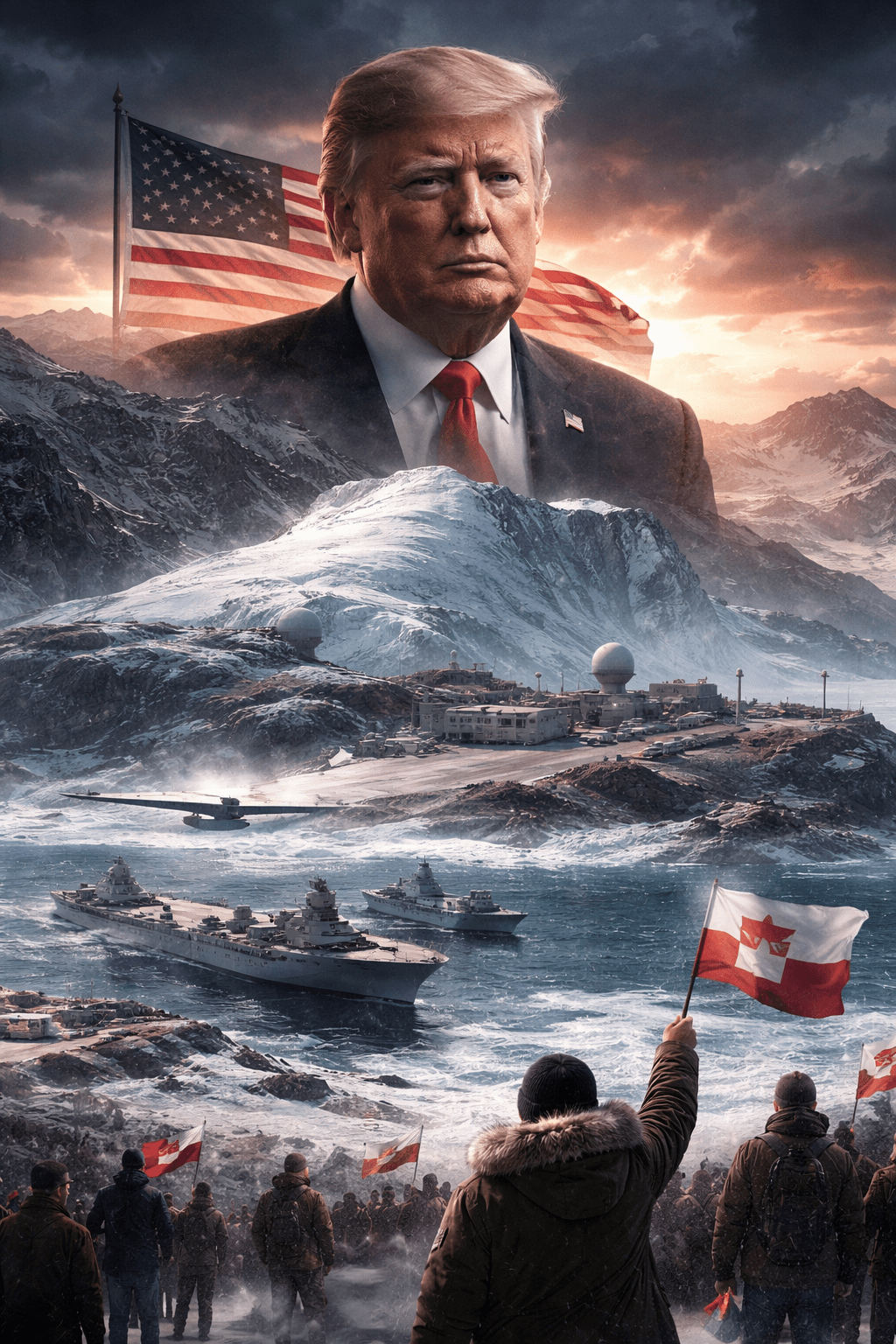
An empire tries to blame one man for what its strategy requires. The Arctic is revealed as a military node, an extractive frontier, and a colonial question. Beneath alliance etiquette, imperial authority demands control, not cooperation. From Greenland to the Global South, resistance exposes the system speaking plainly.
Blaming the Man So the Machine Can Keep Running
The article—“Trump says his Greenland fixation is about national security. Europeans are skeptical”, written by Eli Stokols for Politico—wants to sound like a calm report from the grown-ups’ table. It speaks in the language of concern, diplomacy, and alliance management. But read closely, and you can see the real work it is doing. It is not explaining power. It is managing how power is felt. The goal is not to help the reader understand what is happening, but to make what is happening feel less dangerous than it actually is.
The central trick of the piece is simple: turn empire into a personality problem. Greenland is not presented as something the United States wants or needs as part of a long-running strategy. It is presented as something Donald Trump is “fixated” on. That word does the ideological labor of a thousand footnotes. A fixation is personal, irrational, fleeting. Systems do not have fixations; people do. And once the story is framed this way, the reader is gently steered away from asking structural questions. If this is just Trump being Trump, then history, institutions, and class interests can all be left offstage.
This personalization is softened further through tone. Trump’s comments float through the article wrapped in jokes, laughter, and anecdotes. He jokes about dogsleds. He laughs aboard Air Force One. These details are not neutral color. They function like comic relief in a tense play. The threat is still there, but it is coated in absurdity. The reader is encouraged to smirk rather than to think. Empire appears clownish, not calculated.
At the same time, the article reassures us that the machinery of power is still humming along. Anonymous officials speak calmly. Meetings are held. Committees function. Frameworks “work perfectly.” The repeated appearance of these faceless voices creates the sense that whatever noise is coming from the White House, responsible hands remain on the wheel. This is access journalism doing what it does best: translating domination into process, and violence into policy discussion.
Notice how carefully the language avoids saying too much. Greenland is never something that might be seized; it is something that might be pressured over. U.S. actions are not threats; they are signals. Even when force is hinted at, it is wrapped in speculation and worry rather than named plainly. The article keeps the reader suspended in a fog where nothing quite takes shape. You feel unease, but you are never allowed the satisfaction of clarity.
European leaders, meanwhile, are cast as anxious custodians of order. They are skeptical, alarmed, uneasy—but never defiant. Their role in the story is not to challenge power, but to plead for restraint. This framing preserves the moral symmetry of the alliance. The United States may be disruptive, but it is never described as illegitimate. The problem is tone, not domination. Procedure, not plunder.
The article also keeps time on a very short leash. Everything happens in the last few weeks, the last few months, the current term. History appears only as a background prop, useful for calming nerves but never for drawing lines. By shrinking the timeline, the text discourages the reader from seeing patterns. What looks like a momentary crisis might start to look like a trajectory if time were allowed to stretch.
The end result is a familiar ideological service. The article does not deny that the United States is powerful. It simply asks the reader not to dwell on what that power means. By blaming Trump’s personality, by leaning on jokes and process, by narrowing time and softening language, it transforms a question of empire into a matter of manners. The reader is left worried about alliances and decorum, but not about the deeper reality that gives those worries their shape: a system that treats land, resources, and people as pieces on a strategic board, and expects the world to accept that as normal.
The Strategic Reality the Article Will Not Name
To understand what is actually at stake in the Greenland question, we have to step outside the narrow frame imposed by the article and reconstruct the material reality it carefully avoids. The issue is not rhetorical excess, diplomatic misunderstanding, or one leader’s eccentricity. Greenland has occupied a central place in U.S. military, economic, and geopolitical planning for decades, and its renewed prominence reflects long-term strategic calculations that predate Donald Trump and will outlast him.
Greenland is one of the most strategically significant landmasses in the North Atlantic–Arctic corridor. Its geographic position places it directly along key routes linking North America, Europe, and the Arctic. For the United States, this location has never been abstract. Since the early Cold War, Greenland has functioned as a forward platform for missile detection and early-warning systems and strategic surveillance aimed at the Eurasian landmass. The U.S. military installation now known as Pituffik Space Base has long been integrated into the architecture of U.S. homeland defense, missile warning, missile defense, and space surveillance, as well as the wider command-and-control systems that feed U.S. strategic decision-making. This is not a peripheral outpost; it is a node in the nervous system of U.S. military power.
This strategic role did not emerge recently, nor was it improvised. The United States has repeatedly identified the Arctic as a central theater in great-power competition, particularly as climate-driven ice loss opens Arctic sea routes and lengthens navigable seasons and accelerates access to resources previously locked beneath ice. U.S. defense planning documents over multiple administrations have treated the Arctic as a domain requiring persistent presence, enhanced domain awareness, and rapid force projection. Greenland sits at the heart of this theater. Any claim that U.S. interest in Greenland is sudden or impulsive collapses under even minimal historical scrutiny.
Alongside its military significance, Greenland occupies an increasingly important position in the political economy of extraction. The island contains substantial deposits of critical minerals essential to modern industrial production, including rare earth elements and other strategic raw materials, as well as documented critical-mineral potential identified by Greenland’s geological authorities and large estimated reserves of oil and natural gas (U.S. Geological Survey assessment). These resources are not incidental. They are central to contemporary struggles over supply chains, industrial sovereignty, and military-industrial production. In an era defined by competition over energy-transition inputs, advanced weapons systems, and strategic manufacturing, control over such reserves carries enormous long-term value.
These material realities intersect with Greenland’s political status in ways the article does not seriously confront. Greenland is not an empty space awaiting management. It is an inhabited land whose people live under a political arrangement with Denmark that grants autonomy while reserving foreign affairs and defense to the Danish state. Greenlandic self-government exists within strict constraints established by the 2009 Self-Government Act, and any discussion of Greenland’s future necessarily raises unresolved questions of self-determination, consent, and sovereignty. U.S. pressure on Denmark therefore does not occur in a vacuum; it operates through and against an already unequal colonial relationship.
The article also avoids situating Trump’s Greenland posture within the broader evolution of U.S. hemispheric and territorial doctrine. In recent years, the U.S. state has increasingly asserted expansive claims over what it defines as its strategic perimeter — not only within the Western Hemisphere, but across adjacent gateways deemed essential to homeland security. This logic is stated openly in the administration’s own language about reviving and extending the Monroe Doctrine and codified in its National Security Strategy’s emphasis on hemispheric control and strategic chokepoints. Greenland, positioned at the northern edge of this perimeter, fits cleanly within that strategic imagination.
From this vantage point, the reported refusal of the Trump administration to accept Denmark’s offer of expanded U.S. military presence takes on a different meaning. If basing and access were the primary objectives, the offer would have resolved the issue. The rejection suggests that the dispute is not about presence alone, but about authority — about who ultimately decides Greenland’s orientation, development, and future. Control, not cooperation, is the unresolved question highlighted by the article’s own sourcing.
The article briefly gestures at European anxiety following recent U.S. actions in Venezuela, but it does not explore what that anxiety reveals. European leaders are responding not simply to rhetoric, but to a pattern in which economic pressure, political coercion, and the threat of force are used interchangeably to discipline states within the U.S. strategic orbit, a concern sharpened by contemporaneous reporting linking Greenland to recent U.S. coercive operations. Greenland enters this picture not as an isolated case, but as part of a broader reassertion of unilateral power in a moment of global realignment.
When these omitted facts are assembled, a coherent picture emerges. Greenland is strategically indispensable, resource-rich, politically constrained, and historically embedded in U.S. military planning. Trump’s statements do not create this reality; they expose it. What the article treats as an unsettling departure is better understood as a moment where long-standing imperial assumptions are being stated more openly, as the global balance of power shifts and the tools of informal dominance are tested.
By failing to present this larger context, the article leaves readers with fragments instead of structure. It records tension without explaining its source, and it describes alarm without clarifying what is being threatened. The task of analysis, therefore, is not to speculate about motives, but to recognize how military strategy, resource extraction, colonial governance, and geopolitical recalibration converge in Greenland — and why that convergence matters far beyond the Arctic.
When Empire Speaks Plainly: Greenland and the Logic of Imperial Recalibration
Once the scattered facts are assembled and the missing context restored, the Greenland episode stops looking strange and starts looking familiar. What appears, in the Politico narrative, as an unsettling deviation driven by one man’s temperament instead reveals a deeper pattern: a dominant power confronting the limits of its old methods and reaching for more direct forms of control. The question is no longer why Donald Trump talks this way, but why such talk now appears both possible and necessary from the standpoint of the U.S. ruling class.
For much of the postwar period, U.S. power operated through a mixture of consent, dependency, and institutional mediation. Military bases, trade arrangements, and alliance structures allowed Washington to secure strategic advantage without constantly naming domination as such. Greenland fit comfortably into this arrangement: a critical military node quietly embedded in a friendly colonial framework, its strategic value secured without disturbing the appearance of partnership. What has changed is not Greenland’s importance, but the global environment in which that importance is asserted.
The Arctic is no longer a frozen margin of world politics. It is opening physically, economically, and strategically, just as the broader world system is shifting away from unchallenged U.S. primacy. New transport routes, intensified competition over resources, and the growing capacity of rival powers to operate in previously U.S.-dominated spaces have altered the calculus. In this context, informal influence begins to look insufficient. What once could be managed through quiet basing agreements and diplomatic routines now appears, from Washington’s perspective, as a vulnerability.
Trump’s language strips away the decorum that once concealed this logic. When he says the United States “needs” Greenland, he is articulating an assumption that has long underpinned imperial strategy: that strategic spaces near the core of empire are not subject to genuine choice. The refusal to accept Denmark’s offer of expanded military access exposes this clearly. Access was never the real issue. Authority was. The underlying demand is not merely to operate in Greenland, but to remove uncertainty about who ultimately decides how that land, its resources, and its position in the world are used.
This is where the Greenland question intersects with a broader transformation in imperial practice. As economic and political leverage lose some of their former effectiveness, coercion moves closer to the surface. Pressure campaigns, legal ambiguity, and the calculated use of threat become tools for disciplining allies as well as adversaries. The aim is not chaos, but hierarchy—an attempt to reassert a clear chain of command within an international order that is increasingly resistant to it.
From the standpoint of Greenland’s people, this dynamic is especially revealing. Their land is discussed as territory, platform, reserve, and asset, but rarely as a lived space shaped by history and struggle. The colonial relationship with Denmark already limits the scope of Greenlandic self-determination, placing key decisions about defense and foreign policy beyond local control. U.S. pressure exploits this condition, treating Greenland not as a political subject but as a strategic object whose fate can be negotiated over its head. What is presented as a dispute between allies is, at a deeper level, a contest over who gets to speak for a colonized land.
Seen from the perspective of the global working class and peasantry, the pattern is unmistakable. Strategic regions rich in resources or positional advantage are increasingly governed through force, threat, or exceptional measures, even when they lie within nominally friendly or allied states. The language of security masks a more basic reality: control over space and resources is being tightened as the room for imperial maneuver narrows. Greenland’s minerals, energy potential, and geographic position make it part of this tightening grip.
What the Politico article treats as a crisis of norms is better understood as a crisis of imperial management. The old balance between persuasion and domination is breaking down. Trump’s bluntness is not an aberration; it is a symptom. He says aloud what the system increasingly requires but can no longer easily justify. In doing so, he exposes the contradiction at the heart of contemporary imperial power: the need to project strength more openly in a world less willing to accept it.
For revolutionary and multipolar forces, this moment is clarifying. It shows that appeals to alliance, legality, or shared values offer little protection when strategic interests are at stake. It also reveals that struggles over land, sovereignty, and resources in places like Greenland are not peripheral to global politics. They are central fronts in a wider confrontation between an aging imperial order and a world in motion. To understand Greenland in this way is to move beyond the spectacle of personality and see, instead, the system speaking in its own increasingly unvarnished voice.
From Exposure to Alignment: Organizing Against Imperial Reassertion
The Greenland episode does more than reveal the mechanics of U.S. power; it clarifies the terrain on which resistance must now be organized. What is being asserted is not merely a claim over land, but a claim over the right to decide whose interests matter when strategic resources and geography are involved. For working people in the Global North, for colonized nations, and for revolutionary forces confronting imperial decline, this moment demands more than commentary. It demands alignment.
Across Greenland itself, questions of self-determination and control over land and resources have long animated political life. Indigenous and Greenlandic movements pressing for greater autonomy, environmental protection, and democratic control over development are already resisting the treatment of their homeland as a strategic asset to be managed from afar. These struggles are not symbolic. They are material fights over who decides the future of a land increasingly targeted by military planners and extractive interests.
Beyond Greenland, similar lines of struggle are visible across the world system. Communities resisting military base expansion, surveillance infrastructure, and resource extraction—from the Arctic to the Pacific, from the Sahel to the Caribbean—are confronting the same logic of control. These movements often appear isolated, framed as local disputes or environmental concerns, but they are bound together by a shared condition: imperial power seeking to secure strategic advantage by narrowing the space for popular choice.
For workers in the imperial core, this confrontation carries a specific responsibility. Militarization, resource seizure, and coercive diplomacy are not abstract foreign policy choices; they are paid for through austerity, repression, and the redirection of social wealth into security apparatuses. Organizing against imperial expansion is therefore inseparable from organizing against the hollowing out of social life at home. The same system that treats Greenland as a possession treats working-class communities as expendable.
Concrete action begins with connection. This means building ties with Indigenous and Greenlandic organizations asserting control over land and development. It means supporting campaigns that challenge the expansion of military infrastructure and the normalization of permanent war readiness. It means amplifying voices from colonized and peripheral regions that are routinely excluded from strategic debates conducted in their name.
Political education is central to this task. Greenland must be understood not as an exotic outpost or a curiosity of Arctic geopolitics, but as a warning sign. When empire feels its position slipping, it moves closer to open assertion. Helping people see this pattern—across regions, across cases, across struggles—builds the foundation for solidarity that is rooted in material reality rather than moral appeal.
For revolutionary and multipolar forces, the goal is not to appeal to imperial restraint, but to accelerate the unraveling of imperial legitimacy. Each exposure of coercion, each act of resistance to base expansion or resource seizure, weakens the claim that domination is benign or necessary. Greenland shows that even allies are subject to discipline when strategic interests demand it. That lesson should sharpen, not paralyze, opposition.
The task ahead is therefore twofold: to defend the right of peoples like those of Greenland to determine their own future, and to link that defense to broader struggles against militarization, extraction, and imperial hierarchy. In doing so, working classes and oppressed peoples can transform isolated confrontations into a shared front—one capable of meeting an empire that is increasingly forced to speak plainly with an organized refusal to listen.
 Weaponized Information
Leave a comment