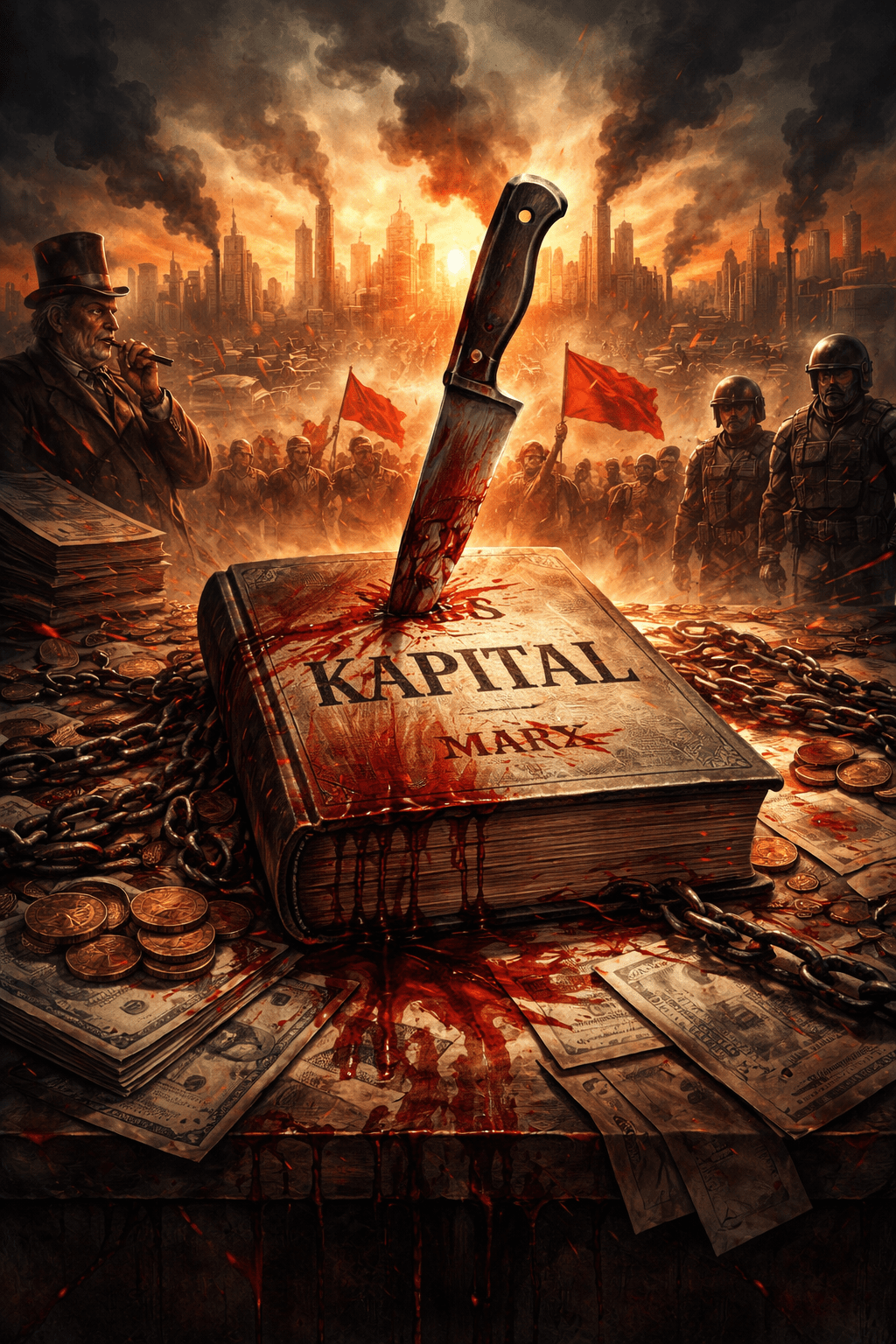
A Weaponized Intellects reconstruction of Capital that follows Marx’s dialectical knife from the commodity to the state, exposing capitalism not as a flawed system in need of reform, but as a coherent social order built on abstraction, dispossession, and organized domination—and reclaiming Marx’s method as a weapon for the global working class and colonized nations.
Preface to Part I: Reading Capital Against Its Enemies
This review of Volume I of Capital is written against two dominant failures that have neutralized Marx’s critique for generations. The first is liberal economics, which treats capitalism as a technical system occasionally distorted by greed or poor policy. The second is Western Marxism, which treats Capital as a philosophical text to be interpreted rather than a scientific weapon to be used. Both approaches sever Marx’s analysis from the material reality it was designed to expose.
Volume I is not a meditation on inequality, nor a moral argument against injustice. It is an anatomy of exploitation at its point of origin. Marx’s central task is to demonstrate how domination operates legally, routinely, and invisibly within the normal functioning of capitalist society. This requires abandoning the surface language of markets and exchange and descending into the hidden structure of production itself. Any reading that remains at the level of circulation, policy, or distribution never reaches the crime scene.
This review therefore follows Marx’s method rather than summarizing his conclusions. Each section reconstructs the conceptual problem Marx confronts and the category he is forced to develop in order to resolve it. The movement is deliberate. When one explanation fails, Marx advances to the next. When equality appears real, he uncovers its conditions. When freedom seems voluntary, he reveals the compulsion beneath it. The analysis progresses not by assertion, but by necessity.
Volume I is where Marx establishes the most dangerous insight of the entire work: that capitalism does not depend on cheating, corruption, or the suspension of its own rules. Exploitation occurs precisely because those rules are followed. Labor-power is bought at its value. Contracts are honored. Exchange is equal. And yet surplus value is extracted systematically. This is why reformist critiques that focus on fairness, transparency, or regulation leave the structure intact. They target symptoms, not the relation.
This Preface must also be explicit about what is not being done here. This is not a neutral exegesis, an academic literature review, or a contribution to interpretive debate. It does not aim to reconcile Marx with contemporary liberal economics, nor to rescue capitalism through ethical adjustment. The purpose of this review is to sharpen Marx’s critique against the present conditions of imperial decline, technocratic domination, and global dispossession.
Volume I is foundational because it reveals how abstraction becomes real domination. Value is not a mental category. It is a social force imposed through survival. Time becomes measurable, comparable, and exploitable. Human activity is reduced to labor-power. The commodity becomes the primary way power is encountered. These are not ideas in people’s heads; they are structures people live inside. This review treats them accordingly.
The analysis here also insists on the historical and colonial dimension that bourgeois readings suppress. “Free” wage labor did not emerge peacefully. It was produced through dispossession, enclosure, enslavement, and state violence. Capital’s abstraction was built on blood, and its universality was forged through empire. Any reading of Volume I that ignores this history turns Marx into a European theorist of markets rather than a global analyst of domination.
Finally, this Preface clarifies the political horizon of the review. Capital is not a prophecy and not a blueprint. It is a weapon of clarity. Its value lies in what it makes visible and therefore contestable. To understand exploitation structurally is to strip capitalism of its moral alibis and technocratic disguises. What follows is an attempt to restore that clarity, not for academic satisfaction, but for struggle.
Part I proceeds from the commodity to primitive accumulation not as a march through topics, but as a forced descent through appearances. Each category survives only until it fails. When it fails, Marx moves. This review moves with him. The goal is not to admire the knife, but to learn how to use it.
Why Marx Writes Capital Like an Autopsy
Volume I of Capital is where Marx proves his case rather than announcing it. Before crisis, finance, or the state can be meaningfully analyzed, he descends into the labor process to demonstrate how exploitation arises within the normal, legal operation of capitalism. This volume is concerned not with outcomes but with origins: how value is produced, how surplus is extracted, and how domination takes root in everyday work. Any serious engagement with Capital must begin here, because everything that follows presupposes what is established in this descent.
The Preface establishes the book’s central wager: that social relations can be analyzed with the same rigor as natural processes, provided one abandons ideology and follows the movement of the object itself. Marx rejects the bourgeois habit of explaining exploitation through individual behavior, bad policy, or moral failure. Instead, he commits to tracing the objective forms through which domination operates, even when those forms appear neutral, voluntary, or beneficial. Capitalism must be grasped on its own terms before it can be overcome.
Marx is explicit about the difficulty of this task. The Preface warns that there is no royal road to science. What he offers is not a simplified critique or a digestible set of conclusions, but a method that demands effort, patience, and discipline. The categories of political economy are not intuitive. They are designed to obscure the relations they express. To penetrate them requires sustained confrontation with abstraction—not as a mental exercise, but as a real social process imposed on living labor.
This insistence on difficulty is itself political. Marx refuses to flatter the reader. He understands that capitalism survives not only through coercion, but through confusion. To truly grasp exploitation is to break with the everyday appearance of freedom and equality that structures bourgeois life. The Preface therefore functions as a warning: whoever enters this analysis must be prepared to leave behind comforting illusions, including those offered by liberal reformism and superficial radicalism alike.
The Introduction and later Afterword deepen this methodological clarity. Marx situates his work against both vulgar economists who naturalize capitalism and idealist critics who mistake surface phenomena for essence. His method is dialectical not because it juggles abstractions, but because it follows contradiction as a real force. Each category is introduced not as a definition, but as a solution to a problem generated by the previous one. When circulation fails to explain profit, Marx moves to production. When exchange appears equal, he exposes exploitation. When freedom appears real, he uncovers compulsion.
Crucially, Marx insists that theory does not float above history. Capitalism is not a universal system that has always existed in embryonic form. It is the outcome of concrete historical processes: dispossession, enclosure, colonial conquest, and state violence. The categories of Capital therefore have a birth, a trajectory, and limits. They are not eternal truths, but weapons forged for a specific terrain of struggle.
This is why Marx refuses to begin with the state, morality, or politics in the narrow sense. He begins with the commodity because capitalism presents itself to ordinary people not as domination, but as everyday exchange. Power is encountered first as things. Marx’s opening move is therefore epistemological warfare: he starts where capitalism feels most normal and peels back the layers until normality itself becomes suspect.
A Weaponized Intellects reading of Capital must take Marx at his word here. This is not a book to be admired, summarized, or ritualistically cited. It is a method designed to be used. Its purpose is not to explain exploitation in the abstract, but to make it visible where it hides best: in wages, prices, productivity, and law. To read Capital properly is to allow its analysis to reorganize how the world is seen—and therefore how it can be changed.
What follows in this review does not aim to restate Marx’s conclusions, but to re-enact his movement. Each section traces a problem capitalism poses for its own self-understanding, and the concept Marx is forced to develop in order to resolve it. This is not a neutral tour through a classic text. It is an attempt to sharpen Capital back into what it was meant to be: a weapon for those whose labor sustains a system that denies them control over their own lives.
The Commodity Is Where the Lie Begins
Marx does not begin Capital with exploitation, poverty, or the factory floor. He begins with the commodity because capitalism does not present itself as domination. It presents itself as exchange. It does not announce power; it offers goods. The commodity is the first appearance of capitalist society, the surface form through which everything else is concealed. To begin anywhere else would be to grant capitalism the very mystification Marx is trying to destroy.
At first glance, the commodity looks innocent. It is simply a useful thing produced for exchange. But Marx immediately splits this apparent simplicity open. Every commodity, he tells us, contains a contradiction: it is simultaneously a use-value and a value. Use-value refers to the concrete usefulness of the thing—bread feeds, coats warm, tools cut. Value, however, has nothing to do with usefulness. It expresses something social, something invisible: the amount of socially necessary labor time objectified in the commodity.
This distinction is not semantic. It is the fault line of capitalist society. Use-values are qualitative and diverse; values are quantitative and comparable. Bread and steel share nothing in their material form, yet on the market they confront one another as equivalents. The question Marx forces us to ask is not moral but scientific: how can qualitatively different things be made commensurable at all?
The answer is labor—but not labor as we experience it. Not the concrete labor of the baker, the miner, or the machinist. What the market equates is abstract labor: labor stripped of its specific form, reduced to human labor-power expended in the abstract. This abstraction does not occur in the worker’s mind. It occurs behind their back, through the act of exchange itself. When commodities are exchanged as equivalents, the different labors that produced them are treated as equal. Abstraction is not a philosophical operation; it is a social one.
This is Marx’s first devastating move. Capitalist society produces abstraction as a material fact. People do not first think abstractly and then build markets; markets force abstraction upon them as a condition of survival. The worker who cannot sell their labor-power starves. The producer whose commodity cannot realize its value disappears. Abstract labor is enforced by necessity, not belief.
Once this is understood, the commodity ceases to be a thing and reveals itself as a social relation. It is frozen labor, congealed time, carrying within it a history of human expenditure that is invisible on its surface. The price tag does not show the conditions under which it was produced, the discipline imposed on the worker, or the coercion that made wage labor unavoidable in the first place. The commodity erases its own origin.
This erasure is not accidental. It is functional. If exploitation were visible at the point of exchange, capitalism could not reproduce itself peacefully. The commodity must appear as a neutral object so that the social relation embedded in it can operate without resistance. Marx is not accusing anyone of lying here; he is showing how the form itself lies.
This is why Marx insists that political economy cannot begin with production as it really is. Bourgeois society does not experience itself there. It experiences itself in the marketplace, where buyers and sellers meet as legal equals. By beginning with the commodity, Marx accepts capitalism’s own starting point—only to turn it against itself. He enters the system through its front door, not to admire the architecture, but to map the hidden corridors that lead downward.
Already, in this opening move, the stakes are clear. Capitalism is not first a moral problem; it is a problem of appearance. It rules not only by force, but by organizing how reality is encountered. The commodity is the basic unit of this organization. To understand it is to begin dismantling the spell.
Marx’s method here is surgical. He does not shout. He dissects. And once the commodity is understood as a contradictory unity—useful yet abstract, concrete yet social—the entire edifice of capitalist common sense begins to crack. What looked like a world of things starts to reveal itself as a world of relations. And once relations come into view, struggle becomes possible.
When Labor Loses Its Name and Becomes Value
Once Marx has cracked the commodity open, he does not rush forward. He slows the analysis deliberately, because something profoundly unnatural has already occurred. Bread and iron, linen and coats, utterly different products of human activity, now confront one another as quantities that can be equated. This equivalence is not obvious. It demands explanation. Marx’s task in this section is not to repeat that labor creates value, but to show how labor itself must be transformed for value to exist at all.
In everyday life, labor appears only in its concrete forms. A baker bakes, a weaver weaves, a miner digs. These activities are irreducibly different. They use different skills, tools, rhythms, and bodies. Yet the market treats their products as commensurable, exchangeable according to definite proportions. Marx insists that this commensurability cannot arise from usefulness. Use-values are incommensurable by nature. Their equality must come from elsewhere.
What the act of exchange performs—silently, compulsively—is the reduction of concrete labors to abstract labor. The moment commodities are exchanged as equivalents, the specific character of the labor that produced them is stripped away. What remains is not the baker’s craft or the miner’s endurance, but labor-time as such. Labor is no longer recognized by what it does, but by how long it takes under average social conditions. Labor loses its name and becomes a quantity.
This is the point where Marx’s critique becomes genuinely unsettling. Abstraction here is not a mistake, an illusion, or a mental shortcut. It is a real social process enforced by the market. Producers do not choose to abstract their labor; abstraction is imposed on them through exchange. If their labor does not conform to the socially necessary average—if it is too slow, too inefficient, too costly—it does not count. The product may be useful, but it will not realize value.
Socially necessary labor time is therefore not a technical measure but a disciplinary one. It is how society, behind the backs of producers, decides whose labor matters and whose does not. The market operates as a silent tribunal, rewarding conformity and punishing deviation. Those who cannot meet its standards are not corrected; they are eliminated. Marx shows us here that value is inseparable from coercion, even before the factory or the boss enters the scene.
This is why Marx refuses to treat value as a mere accounting device. Value is the social form labor takes under capitalism. It is labor reorganized to serve exchange rather than need. The worker’s activity is no longer oriented toward producing something useful for someone else; it is oriented toward producing something exchangeable. Production bends itself toward the market’s abstractions, and human activity is reshaped accordingly.
At this stage, Marx has not yet mentioned exploitation, wages, or profit. But the ground is already prepared. Once labor is reduced to abstract labor, once time becomes the universal measure, the conditions are set for labor itself to be bought and sold as a commodity. Value does not merely describe capitalism; it prepares the terrain on which capital will later dominate.
The rhythm of Marx’s analysis here mirrors the violence of the process he describes. He moves slowly, insistently, returning again and again to the same point from different angles, because abstraction is not intuitive. Capitalist society trains us to accept it as natural. Marx forces us to see it as historical, imposed, and fragile.
By the end of this section, the reader is no longer dealing with things, but with a social world reorganized around time, equivalence, and discipline. Labor has been stripped of its particularity and made commensurable. Human activity has been flattened into value. The commodity’s secret deepens, and the logic of capital begins to take shape—not as ideology, but as a real movement that reshapes life itself.
How Value Learns to Speak
Once labor has been reduced to an abstract quantity, Marx confronts a new problem. Value now exists, but it remains mute. It has no visible form of its own. You cannot touch value, smell it, or hold it in your hand. And yet, in a society governed by exchange, value must appear. It must become readable, comparable, and socially valid. Marx’s task in this section is to explain how something invisible acquires a body.
He begins with a relation that seems trivial: one commodity expressing its value in another. A certain quantity of linen equals a certain quantity of coats. At first, this looks like a simple comparison. But Marx insists that something more is happening. The linen is not just being compared to the coat; it is using the coat as a mirror. The value of the linen is being expressed in the physical form of another commodity.
This expression is asymmetric. The linen is active; it seeks expression. The coat is passive; it serves as the material in which value appears. In this relation, the coat’s own value is temporarily irrelevant. What matters is that its bodily form becomes the language through which value speaks. Marx slows the reader down here because this inversion is easy to miss. Value does not appear directly. It appears only by inhabiting something else.
As exchange multiplies, this simple expression proves insufficient. One commodity cannot reliably express its value in just one other. The linen must now relate itself to many commodities: coats, tea, iron, wheat. Value begins to scatter itself across a series of equivalences. Marx calls this the expanded form, but the name matters less than the tension it reveals. Value is becoming more visible, but also more unstable. Its expression is fragmented.
The instability forces a resolution. Instead of one commodity expressing its value in many others, many commodities begin expressing their value in one. A single commodity is set apart as the general equivalent. Its physical form becomes the universal body of value. This is not a convention agreed upon in advance. It is the practical outcome of repeated exchange, a solution imposed by necessity.
When this role stabilizes, money emerges. Marx is careful here. Money is not introduced as a clever invention or a state decree. It crystallizes out of social practice. Value, unable to appear directly, finally finds a fixed form in a particular commodity. Gold and silver do not become money because they are shiny or rare. They become money because social relations force value to anchor itself somewhere.
With money, value achieves independence. It no longer needs to constantly borrow the bodies of other commodities. It has a body of its own. This is a decisive transformation. What began as a relation between producers now confronts them as an external power. Money stands opposite all other commodities as their universal equivalent, the measure of their worth, and the condition of their exchange.
Marx does not celebrate this development. He treats it as a loss. Once value takes the money-form, social relations harden. The equivalence between different labors, once fluid and implicit, now appears as an objective fact stamped into prices. Money presents itself as the natural measure of wealth, hiding the labor relations that gave rise to it. Value has learned to speak, but it speaks in a language that conceals its origin.
The rhythm of Marx’s analysis here follows value’s own movement: from hesitant expression, to proliferation, to concentration. Each step solves a practical problem while creating a deeper mystification. By the end of this section, the groundwork is laid for a society in which human activity is mediated everywhere by an abstract power that appears independent of those who produced it.
Money does not yet dominate in full. It has not become capital. But it has already altered the terrain. Social labor now confronts itself in alien form. Value has found a voice, and it will soon begin to command.
The World Turned Upside Down: When Relations Wear the Mask of Things
Marx does not introduce fetishism as an afterthought or a cultural aside. He arrives at it because the analysis now demands it. By the time value has secured a body in money, social relations have undergone a quiet inversion. People relate to one another through things, and those things appear to possess a life of their own. What must be explained is not why people hold mistaken beliefs, but why the world itself appears in this distorted way.
Commodity fetishism names this inversion. In a society organized around commodity exchange, the social character of labor does not appear directly as a relation between producers. Instead, it takes the form of relations between products. The coat and the linen seem to enter into relation with one another, while the workers who produced them vanish from view. This disappearance is not a trick of perception. It is the real effect of how production and exchange are organized.
Marx is careful to distinguish fetishism from simple illusion. People are not duped because they are ignorant or irrational. They experience the world accurately as it presents itself to them. Prices really do fluctuate. Money really does command access to life’s necessities. Commodities really do confront people as independent powers. Fetishism is therefore not false consciousness imposed from above; it is consciousness that corresponds faithfully to a mystified reality.
The source of the mystification lies in the separation between producers and the social coordination of their labor. Under capitalism, production is private while social validation occurs only after the fact, through exchange. No one plans society’s labor directly. Instead, the market sorts, disciplines, and reallocates labor through price movements and competition. Social order is achieved without appearing as social order. It emerges as the movement of things.
This is why commodities appear to have value “in themselves,” why money seems to generate wealth, and why the market is spoken of as if it were a natural force. The social relations that actually govern production retreat into the background, while their material expressions take center stage. Power is exercised impersonally, anonymously, and therefore irresistibly. One cannot argue with a price.
Marx’s intervention here is devastating because it targets the deepest layer of bourgeois common sense. Capitalism does not rely primarily on lies told by elites, though it has plenty of those. It relies on a form of social life in which domination is exercised without a visible dominator. Responsibility dissolves into “the economy,” “the market,” or “economic necessity.” Violence is administered without anyone appearing to wield it.
Fetishism also explains capitalism’s peculiar moral atmosphere. Exploitation appears as opportunity. Inequality appears as difference in merit. Crisis appears as misfortune rather than consequence. Because relations between people are mediated by things, suffering is experienced as bad luck instead of social design. The system reproduces itself not only materially, but emotionally and cognitively.
Marx insists that this inversion is historically specific. It is not a permanent feature of human societies. Other forms of production organize social labor directly, through custom, planning, or communal decision. Only where commodity exchange dominates does social power take the alienated form of things ruling over people. Fetishism is therefore not an eternal flaw in human thinking; it is a symptom of a particular mode of production.
The rhythm of Marx’s argument slows here because recognition itself is a political act. To see fetishism is to realize that what appears objective and natural is in fact social and changeable. This realization does not dissolve the power of commodities overnight, but it breaks their spell. Once relations are seen as relations, the authority of things begins to weaken.
By ending this section on fetishism, Marx closes the circle he opened with the commodity. What began as a simple object is revealed as a dense knot of social relations that present themselves in inverted form. The stage is now set for the decisive question: how does this inverted world, governed by things and money, become a system in which money itself moves, accumulates, and commands labor? With fetishism exposed, Marx is ready to follow value as it begins to act.
When Money Refuses to Sit Still
Up to this point, Marx has remained on terrain capitalism itself recognizes. Commodities exchange. Money mediates. Values appear, circulate, and vanish. Nothing here yet violates bourgeois common sense. Money enters and exits circulation, facilitating exchange between equals. But Marx now introduces a disturbance that cannot be explained within this framework. Money, he observes, does not always disappear once exchange is complete. Sometimes it returns—larger than before.
This simple observation forces a rupture. The familiar circuit of exchange—selling in order to buy—follows the pattern C–M–C. A commodity is sold for money, which is then used to acquire another commodity. The purpose of the process lies outside circulation itself, in consumption. Once the need is met, the movement ends. There is no reason for the money to linger. But capital follows a different logic altogether.
In the circuit M–C–M′, money does not serve as a means. It becomes the point. The movement begins with money and ends with more money. The commodity enters the process only as a momentary vehicle, a necessary detour through which money must pass in order to expand itself. The prime mark—M′—is not decorative. It names the surplus that cannot be accounted for by exchange alone.
Marx is ruthless here. If equivalents exchange for equivalents, if buying and selling obey the rules of the market, then no surplus can arise within circulation. Profit cannot come from cheating without collapsing the system into fraud. Yet surplus is everywhere. It is not an exception; it is the organizing principle of capitalist production. Marx insists that this contradiction must be resolved scientifically, not morally.
The transformation of money into capital therefore marks a qualitative shift. Money ceases to be a neutral intermediary and becomes a self-expanding value. It acquires an autonomous motion that appears to generate growth from within itself. Interest-bearing capital, speculation, and finance will later amplify this illusion, but its foundation is already present here. Value now appears as a subject.
This is where bourgeois political economy falters. It can describe circulation endlessly, but it cannot explain why money returns with a surplus. By remaining at the level of exchange, it mistakes movement for source. Marx’s method is to stop the motion and ask where the surplus actually originates. The answer cannot be found in buying cheap and selling dear without reducing the entire system to deception.
Marx therefore announces a decisive methodological turn. If surplus cannot arise in circulation, yet cannot arise without circulation, then the secret must lie elsewhere. The analysis must descend beneath the sphere of exchange into the sphere of production, where labor is expended and time is consumed. Capital cannot be understood by watching money move. It must be understood by watching people work.
The rhythm of the argument tightens here. Marx does not yet reveal the source of surplus; he only clears the ground. He shows what surplus is not, eliminating every comforting explanation that leaves the system intact. What remains is a puzzle that cannot be solved without confronting labor directly. The market has reached its explanatory limit.
With this move, Marx crosses a threshold. The critique of appearances gives way to an investigation of mechanisms. Money’s restless motion demands an answer, and the answer will not be found among things. It will be found in a peculiar commodity whose use-value consists precisely in producing value itself. To uncover it, Marx must now bring labor onto the stage—not as activity, but as something bought and sold.
The Commodity That Produces Value
Marx does not rush to labor as a moral category or a heroic abstraction. He arrives there because the analysis has cornered him. If money becomes capital without cheating in exchange, then somewhere within the process a commodity must exist whose use does not vanish in consumption but expands value itself. This requirement is not ideological; it is logical. Capital’s movement demands a very specific kind of commodity, one whose use-value consists in creating value.
That commodity is labor-power. Marx pauses here, because the distinction he introduces will do more damage to bourgeois economics than any denunciation ever could. Labor is an activity; labor-power is a capacity. Capital does not buy work already done. It buys the worker’s ability to work for a given period of time. This distinction is the key that unlocks the entire structure of exploitation.
Like every other commodity, labor-power has a value. That value is determined not by what the worker produces, but by what the worker requires to live and reproduce as a worker. Food, shelter, clothing, training, and the maintenance of a laboring population set the socially necessary labor time embodied in labor-power itself. Wages, in their ideal form, correspond to this value. Nothing here violates the rules of exchange.
The contradiction emerges only once labor-power is put to use. Its use-value—the very thing capital purchases—consists in living labor, the active expenditure of human energy. And living labor has a peculiar property no other commodity possesses: it can produce more value than it costs. During part of the working day, the worker produces value equivalent to their wage. Beyond that point, the worker continues to labor, producing surplus value for the capitalist.
Exploitation therefore does not arise because the worker is cheated at the point of sale. It arises because the use of labor-power is not exhausted by the reproduction of its own value. Capital purchases the capacity to work for a day, but it owns the product of that work for the entire duration. The difference between what labor-power costs and what labor produces is the source of surplus value.
Marx insists on this point with almost obsessive clarity because it destroys the moral myths capitalism depends on. Exploitation does not require dishonesty. It does not require bad intentions. It functions perfectly within a system of equal exchange and legal contracts. The violence is structural, embedded in the form of wage labor itself.
This is also where the historical dimension, long held in reserve, begins to press forward. Labor-power can appear on the market as a commodity only under specific conditions. Workers must be “free” in a double sense: free to sell their labor-power, and free of any independent access to the means of subsistence. This freedom is not natural. It is produced through dispossession, enclosure, colonial conquest, and law.
Marx does not yet fully unfold this history, but its shadow is already present. Wage labor presupposes a world in which survival has been made conditional on selling oneself. The labor market is not a neutral arena; it is the afterimage of prior violence, carried forward into daily life as economic necessity.
With labor-power identified, the secret of capital is finally exposed, though not yet fully elaborated. Capital is not a thing. It is not money. It is not machinery. It is a social relation in which living labor is subordinated to value in motion. Everything that follows—the struggle over the working day, machinery, accumulation, empire—will unfold from this relation.
Marx’s rhythm here is deliberate and unforgiving. He closes every escape route before advancing. Once labor-power is understood, the capitalist system can no longer hide behind exchange, morality, or ignorance. The source of surplus has been located, and it lies not in circulation, but in the organized consumption of human life-time.
The Theft That Obeys the Law
Once labor-power is identified, Marx does not celebrate a revelation; he tightens the vise. The question is no longer where surplus comes from, but how it is organized, normalized, and made to appear legitimate. Surplus value, Marx insists, is not an anomaly within capitalism. It is its rule. The system does not malfunction when surplus is extracted; it functions exactly as designed.
Marx begins by splitting the working day itself. Part of the day is devoted to producing value equivalent to the worker’s wage. This is necessary labor, the time required to reproduce labor-power. Beyond that point, the worker continues to labor, producing value for which no equivalent is returned. This is surplus labor. The distinction is not visible on the shop floor. The clock keeps ticking. The motions continue. Yet the social meaning of labor has already changed.
What makes this arrangement so difficult to grasp is its apparent normality. The wage conceals the division of the working day by presenting all labor as paid labor. Marx lingers here because this concealment is the cornerstone of capitalist legitimacy. If surplus labor appeared openly as unpaid, the system would require constant naked coercion. Instead, it presents exploitation as employment and theft as compensation.
Surplus value, in Marx’s formulation, is therefore not a moral accusation. It is a measurable relation. It is the quantitative expression of surplus labor crystallized in commodities. Capital does not steal sporadically; it extracts systematically, hour by hour, day by day, through a legal relation that treats time itself as purchasable.
Marx now introduces a decisive clarification. The rate of surplus value does not measure how hard workers labor, but how much of their labor time is appropriated without equivalent. Intensity and exhaustion matter, but the core relation is temporal. Capital’s fundamental interest is not effort as such, but duration. The longer labor-power is put to use beyond the point of its own reproduction, the greater the surplus extracted.
This is why Marx refuses to ground his critique in sympathy or outrage alone. Capitalism does not require cruelty to exploit. It requires only time, discipline, and control over the conditions of work. A polite workplace can be just as exploitative as a brutal one. What matters is not the atmosphere of labor, but its structure.
At this stage, Marx has not yet examined how capital increases surplus value. He has only established that surplus value exists, that it arises from surplus labor, and that it is concealed by the wage-form. This restraint is methodological. Before explaining the techniques of exploitation, Marx must first demonstrate its inevitability under wage labor.
The rhythm of the argument here is almost juridical. Marx builds his case as if anticipating every possible objection. No cheating. No unequal exchange. No violation of contract. And yet, exploitation persists. By the end of this section, the reader is forced to confront a disturbing conclusion: capitalism does not exploit workers by breaking its own rules. It exploits them by following them.
Surplus value is thus revealed as capitalism’s quiet engine. It does not roar. It accumulates. And once this engine is recognized, the next question becomes unavoidable: if surplus labor is the source of profit, how does capital expand it? The struggle over time is about to become explicit.
Where Time Becomes a Battlefield
With surplus value established as the extraction of unpaid labor-time, Marx now turns to the most immediate and brutal method capital uses to increase it: extending the working day itself. There is nothing subtle about this move. If surplus labor begins only after necessary labor is complete, then the simplest way to enlarge surplus is to lengthen the portion of the day during which the worker labors for capital for free.
Marx insists that capital recognizes no natural limit to this process. Left to itself, it would absorb the entire waking life of the worker, and then press beyond it. Sleep, rest, family, and health appear only as obstacles. The only limit capital acknowledges is physical collapse. Time, here, is not a neutral measure; it is the raw material of exploitation.
The working day therefore becomes a site of open conflict. On one side stands capital, driven by the imperative to expand surplus value. On the other stands labor, seeking to preserve life itself. Marx frames this struggle not as a misunderstanding or a moral dispute, but as a clash between irreconcilable interests. One side demands labor-time without limit; the other demands limits as a condition of survival.
What gives this section its distinctive rhythm is Marx’s turn to history. Abstract reasoning is no longer sufficient. He fills the analysis with factory reports, parliamentary inquiries, medical testimony, and workers’ struggles. These are not illustrative anecdotes; they are evidence. Capitalism’s tendency toward overwork is not theoretical—it is documented in broken bodies and shortened lives.
Marx shows that the so-called “normal” working day is not the result of natural balance or enlightened policy. It is the outcome of struggle. Every legal limit imposed on capital is wrested from it through resistance. Laws regulating labor time do not humanize capitalism; they testify to its inhumanity. Capital yields nothing voluntarily. It concedes only when forced.
This historical grounding also exposes a deeper truth. The law, often presented as a neutral arbiter, appears here as a terrain of class conflict. The state intervenes not to abolish exploitation, but to stabilize it. By preventing capital from destroying its own labor force, regulation preserves the system’s long-term viability. Protection of workers functions simultaneously as protection of capital.
Marx is careful not to romanticize resistance. Limiting the working day does not end exploitation; it reorganizes it. Once absolute extension meets resistance, capital will seek other methods. The struggle over time therefore inaugurates a new phase of conflict rather than resolving it. Capital adapts, rationalizes, and intensifies.
The significance of this section lies in its concreteness. Exploitation is no longer an abstract relation; it is measured in hours, exhaustion, and mortality. Surplus value is revealed as a matter of life-time appropriated. The factory clock becomes an instrument of domination.
By the end of this analysis, Marx has shown that capitalism’s respect for life extends only as far as necessity compels it. The working day is shortened not because capital becomes humane, but because unrestrained exploitation threatens its own reproduction. This prepares the ground for the next transformation: if time cannot be extended indefinitely, capital will turn to reorganizing labor itself, extracting more value from the same hours.
Productivity as a Weapon
Once the extension of the working day encounters resistance, Marx shows capital changing tactics rather than retreating. If surplus value can no longer be expanded by stretching time, it will be expanded by reorganizing labor itself. This shift marks the transition from absolute surplus value to relative surplus value, and with it a decisive deepening of capitalist domination. Exploitation becomes less visible, more technical, and far more efficient.
Relative surplus value does not depend on making the worker labor longer, but on making labor produce more within the same span of time. Capital achieves this by reducing the value of labor-power itself. If the commodities required to reproduce the worker—food, clothing, shelter—can be produced more cheaply, then the portion of the working day devoted to necessary labor shrinks. Surplus labor expands without a single minute being added to the clock.
This maneuver reveals the full violence of capitalist “progress.” Improvements in productivity appear as social advances, yet under capitalism they function primarily as instruments of extraction. The gains of technical development do not accrue to labor as free time or security. They accrue to capital as surplus. What looks like efficiency is, in fact, a recalibration of exploitation.
Marx emphasizes that this process reshapes the entire social landscape. Capital does not merely introduce new tools; it reorganizes production to discipline labor. Cooperation, division of labor, and technological innovation are deployed not to satisfy human need, but to cheapen labor-power and intensify control. The worker confronts a production process designed around capital’s imperatives, not their own capacities.
Unlike the crude extension of the working day, relative surplus value operates quietly. It does not provoke immediate outrage because it presents itself as improvement. Wages may remain stable or even rise slightly, yet the share of unpaid labor grows. Exploitation deepens under the appearance of modernization. Capital learns to extract more without seeming to demand more.
This is why Marx treats relative surplus value as a qualitative transformation. The factory becomes a laboratory in which human activity is measured, optimized, and subordinated to value production. The labor process itself is redesigned to serve accumulation. The worker is no longer merely exploited through time, but through technique.
At this stage, Marx’s critique anticipates later forms of domination without naming them. The logic he uncovers—continuous rationalization, constant innovation, relentless pressure to increase productivity—does not end with nineteenth-century industry. It is the structural motor of capitalism itself. Every technological advance becomes a new means of control.
Relative surplus value therefore marks a turning point in the analysis. Capital no longer appears simply as a thief of time, but as an organizer of society’s productive forces against those who generate them. Exploitation becomes systemic, embedded in machinery, workflow, and planning. Resistance, too, must change its form, because the terrain has shifted.
By revealing productivity as a weapon, Marx dismantles the myth that capitalism’s technological dynamism is inherently emancipatory. Under capital, progress does not free labor from toil; it perfects labor’s subordination. The system advances not by overcoming exploitation, but by making it more efficient, more abstract, and harder to see.
When Workers Become a Social Force—and Capital Claims It
Having shown how capital extracts relative surplus value by reorganizing production, Marx now pauses over a phenomenon that seems, at first, almost emancipatory. Workers are brought together. Labor is coordinated. Tasks are synchronized. Productivity rises not because individuals work harder, but because they work together. Cooperation appears as a collective power that transcends the limits of isolated labor. Marx’s task here is to show why this apparent advance deepens domination rather than dissolving it.
Cooperation under capitalism does not arise from solidarity or conscious planning by workers themselves. It is imposed by capital as a condition of employment. The capitalist assembles workers in a single space, assigns them tasks, and directs their collective activity toward a unified goal. What emerges is a new productive force: the collective worker. This force is real. It multiplies output and transforms the labor process. But it does not belong to those who generate it.
Marx is precise about the source of this new power. Cooperation does not spring from capital’s ingenuity. It arises from workers acting together. The combined labor of many produces effects no individual could achieve alone. Capital contributes only one thing: command. Yet this command allows capital to present itself as the source of productivity, as if cooperation were its gift rather than labor’s creation.
This misattribution is not merely ideological; it is material. Because capital owns the means of production and controls the labor process, the social power generated by cooperation confronts workers as an alien force. The rhythm of work, the scale of production, and the organization of tasks all appear as external necessities. Workers experience their own collective capacity as something imposed upon them.
Marx’s analysis here cuts against liberal fantasies of teamwork and collaboration. Under capitalism, cooperation is not the free association of producers; it is a technique of exploitation. By coordinating labor, capital reduces costs, intensifies output, and tightens discipline. The individual worker becomes more dependent on the collective process, yet has less control over it.
At the same time, Marx refuses to dismiss cooperation as merely oppressive. The contradiction is sharper than that. Capitalism, in organizing labor collectively, inadvertently demonstrates the material possibility of a different mode of production. Workers already labor socially. Production is already cooperative. What remains private is control and appropriation. The social character of labor clashes with the private form of ownership.
This tension gives the section its distinctive rhythm. Marx moves back and forth between exposure and anticipation. Cooperation under capital deepens exploitation, yet it also reveals the latent power of collective labor. Capital assembles the very force that could eventually overthrow it. The same process that disciplines workers also binds them together materially.
By the end of this section, cooperation stands revealed as a double-edged phenomenon. It is a weapon in capital’s hands and a potential weapon against it. Capital claims collective power as its own, masking the fact that it arises from workers themselves. Once this mask slips, cooperation can cease to function as domination and begin to function as liberation.
Marx does not resolve this contradiction here. He exposes it. The analysis now moves toward forms of production that further reorganize labor—first by breaking it down, then by mechanizing it entirely. Cooperation is only the opening act. The deeper transformation of the labor process is still to come.
When Skill Is Broken into Pieces
After cooperation reveals the collective power of labor, Marx shifts direction again. Capital does not stop at bringing workers together; it begins to break them apart. Manufacture marks this turn. Here, the unity of the labor process is preserved, but the worker’s relation to it is shattered. What cooperation gathers, manufacture dissects.
Manufacture reorganizes production by dividing tasks into discrete operations, each assigned to a different worker. What was once a craft, requiring a range of skills and judgments, is split into partial functions. The worker no longer produces a commodity; they perform a fragment of its production repeatedly. Skill is no longer embodied in the worker as a whole person. It is redistributed across the workshop and concentrated in the process itself.
Marx emphasizes that this is not simply a technical improvement. It is a social transformation. By narrowing tasks, manufacture cheapens labor-power. The worker becomes easier to train, easier to replace, and easier to discipline. What capital loses in individual versatility, it gains in control. Labor is reduced to a series of gestures calibrated to the needs of accumulation.
This reorganization also reshapes consciousness. The worker confronts production as something external, something designed elsewhere and imposed from above. Judgment, planning, and knowledge migrate away from the shop floor and into management. The worker executes; capital decides. The separation between mental and manual labor begins to harden.
Marx is attentive to the historical specificity of this moment. Manufacture does not yet rely on machines. It still depends on human dexterity. But by fragmenting skill, it prepares the ground for mechanization. Once tasks are simplified and standardized, they can be transferred from human hands to mechanical systems. Manufacture is the bridge between cooperation and modern industry.
The rhythm of Marx’s analysis here is deliberately unsettling. Manufacture increases productivity while degrading the worker. It creates order in the workshop by imposing disorder on human development. The worker’s capacities are not expanded; they are truncated. What capital presents as efficiency appears, from the standpoint of labor, as mutilation.
At the same time, Marx refuses to romanticize the past. Craft labor was not free or egalitarian. But manufacture represents a decisive step toward the domination of living labor by an alien process. The worker becomes an appendage of a system they did not design and do not control.
By the end of this section, the logic is clear. Capital’s advance does not simply harness labor; it reshapes the worker to fit its needs. Cooperation created a collective force. Manufacture disciplines that force by breaking it into controllable units. The stage is now set for a final transformation in which the labor process itself is transferred from human hands to machinery.
When Dead Labor Rises to Command the Living
Manufacture prepares the ground, but machinery completes the transformation. Marx treats modern industry not as a quantitative improvement on earlier forms of production, but as a qualitative rupture. With machinery, the tool no longer serves the worker. The worker serves the machine. What had been dispersed across the workshop is now unified in a system whose rhythm, speed, and logic confront labor as an external authority.
Marx’s conceptual move here is precise and ruthless. Machinery is not simply equipment. It is congealed past labor—dead labor—that now stands over living labor as command. Knowledge, skill, and coordination migrate decisively out of the worker and into the machine. What remains for the worker is supervision, repetition, and endurance. The labor process is no longer shaped by human capacity; human capacity is reshaped to fit the machine.
This inversion allows capital to deepen relative surplus value dramatically. Productivity surges, not because workers are more skilled, but because machinery reorganizes the entire labor process. At the same time, the value of labor-power is driven downward. Skilled workers are displaced, wages are pressured, and the reserve army of labor expands. Machinery does not eliminate labor; it cheapens it.
Marx is adamant that this development intensifies exploitation rather than mitigating it. Shorter labor time per unit does not translate into more free time for workers. It translates into more commodities, more surplus value, and more domination. The machine becomes an instrument for extracting greater quantities of unpaid labor from fewer hands, while threatening the employed with replacement by those rendered superfluous.
The social consequences are profound. Families are pulled into the factory. Women and children are absorbed into production, not as a sign of emancipation, but as a means of lowering wages and extending exploitation across households. Life outside work contracts as work expands its reach. Capital colonizes time, space, and reproduction itself.
Marx does not deny the technical potential embedded in machinery. He recognizes that modern industry creates the material conditions for abundance and the reduction of necessary labor. But under capitalist relations, this potential is inverted. What could shorten the working day instead intensifies labor. What could free human time instead renders human beings increasingly disposable.
The rhythm of this section oscillates between exposure and contradiction. Machinery reveals capitalism’s capacity to organize production at an unprecedented scale, while simultaneously revealing its inability to deploy that capacity for human ends. Dead labor dominates living labor precisely because living labor has been stripped of control over the means of production.
By the end of this analysis, capital no longer appears merely as money in motion or command over time. It appears as an entire automated system that subordinates human life to the expansion of value. The machine stands as both achievement and indictment. It embodies the collective intelligence of humanity, yet confronts humanity as an alien power.
Marx’s critique here leaves no room for technological mysticism. Machinery does not determine social outcomes on its own. The question is who controls it, and for what purpose. Under capital, machines are weapons. Only when the social relation is broken can the productive forces they embody cease to dominate and begin to serve.
Accumulation: Why Capital Must Expand or Die
Once surplus value has been extracted, Marx poses a question that bourgeois economics never seriously asks: what happens next? Surplus value is not an end point. It cannot remain idle without ceasing to be capital. The very definition of capital as self-expanding value means that surplus must be thrown back into circulation, converted into additional means of production and additional command over labor. Accumulation is not a choice capital makes. It is the condition of its existence.
Marx strips accumulation of its moral camouflage immediately. It is not abstinence, thrift, or foresight. It is the reinvestment of unpaid labor for the purpose of extracting more unpaid labor. Yesterday’s surplus becomes today’s machinery, raw materials, and expanded workplaces. What confronts the worker as capital is therefore nothing other than their own past labor, alienated and returned as power.
This process has a clear direction. As capital accumulates, it does not merely reproduce the original relation between worker and capitalist; it reproduces it on an expanded scale. More workers are drawn into wage labor, more means of production are concentrated under capitalist control, and the dependence of labor on capital deepens. Accumulation is the reproduction of exploitation, enlarged.
Marx insists that this expansion is internally driven. Capital cannot stabilize itself at a given level. Competition compels each individual capital to accumulate or be eliminated. To survive, capital must cheapen commodities, increase productivity, and expand output. Each of these requires further accumulation. What appears as voluntary growth is in fact coercion imposed by the system itself.
Accumulation therefore reshapes the entire social landscape. Production becomes increasingly social, interconnected, and large-scale, while ownership becomes more concentrated. Workers are bound together materially in vast cooperative processes, yet remain separated from the means of production that organize their labor. The contradiction between socialized labor and private appropriation sharpens with every cycle.
Marx is explicit about the human cost of this movement. Accumulation produces wealth at one pole and insecurity at the other. Even when living standards rise in absolute terms, relative dependence intensifies. The worker’s existence becomes more precarious as capital’s command over the conditions of life expands. Growth does not dissolve antagonism; it reorganizes it on a larger scale.
At this point, accumulation can no longer be understood as a neutral economic process. It is a social relation in motion, driven by the imperative to dominate labor more completely. Capital grows not by satisfying human needs, but by extending its control over time, activity, and survival itself. The expansion of capital is simultaneously the expansion of its power.
By framing accumulation this way, Marx closes off reformist escape routes before they can open. There is no stable, humane equilibrium waiting to be reached through better policy or fairer distribution. As long as surplus value exists, it must accumulate. And as long as accumulation proceeds, the antagonism between capital and labor will deepen rather than fade.
Accumulation thus appears not as prosperity, but as pressure. It is the engine that drives capitalism forward while reproducing the very conditions that make the system increasingly unstable. Capital expands by pushing against its own limits, setting the stage for further concentration, crisis, and conflict.
Why Competition Ends in Monopoly
Marx now follows accumulation to its unavoidable conclusion. If capital must expand or die, and if each individual capital confronts all others as rivals, then accumulation cannot remain evenly distributed. Competition does not preserve equality among capitals; it destroys it. The very struggle that bourgeois theory celebrates as a guarantor of balance becomes the mechanism through which imbalance is produced and intensified.
Marx distinguishes carefully between concentration and centralization. Concentration refers to the growth of individual capitals through accumulation itself. As surplus value is reinvested, capital grows larger, production expands, and command over labor deepens. Centralization, by contrast, refers to the absorption of existing capitals by others. Through mergers, bankruptcies, takeovers, and credit, many capitals are reduced to fewer, larger ones. Both processes operate simultaneously, reinforcing one another.
Competition drives this movement relentlessly. Larger capitals can produce more cheaply, withstand downturns longer, and deploy new technologies more rapidly. Smaller capitals are forced to match these advances or perish. What appears as a neutral contest of efficiency is, in reality, a process of elimination. The market does not reward effort; it concentrates power.
Credit accelerates this transformation. By pooling social capital and placing it under the command of a few, the credit system allows expansion far beyond the limits of individual accumulation. Capital leaps over barriers that would otherwise slow it down. But this leap comes at a price. Decision-making power becomes increasingly centralized, while risk is dispersed downward onto workers, communities, and entire societies.
Marx is unequivocal here: monopoly is not a corruption of capitalism introduced from the outside. It is capitalism’s matured form. The same laws that generate competition generate its negation. As capitals grow larger and fewer, the freedom promised by the market gives way to domination by vast economic powers that shape production, employment, and even political life.
This concentration sharpens the system’s contradictions. On one side stands an increasingly socialized labor process involving thousands, even millions, of workers. On the other side stands a shrinking class of owners whose control over production becomes ever more absolute. The gap between collective labor and private command widens beyond any ideological repair.
Bourgeois reformism repeatedly stumbles here. It treats monopoly as an aberration caused by bad policy, corruption, or insufficient regulation. Marx’s analysis leaves no such refuge. Even if monopolies are broken up, the competitive pressures of accumulation will reproduce them. The problem is not size; it is the social relation that makes accumulation compulsory.
The political implications are unavoidable. As economic power concentrates, so too does influence over the state. Law, policy, and enforcement increasingly serve the interests of dominant capitals. The separation between economic and political power erodes. What appears as market rule shades into open class rule.
By the end of this section, competition has been stripped of its mythology. It no longer appears as a path to efficiency or fairness, but as the engine that forges monopoly out of accumulation. Capital does not transcend its contradictions through competition; it sharpens them. The stage is now set for examining how this concentrated power masks exploitation even more effectively—most immediately through the wage form itself.
How Exploitation Disappears in the Pay Envelope
After tracing capital’s movement toward concentration and monopoly, Marx turns to a form so familiar that it rarely provokes suspicion. Wages appear as payment for work. The worker labors, receives money, and survives. Nothing in this transaction seems hidden. Yet Marx insists that this apparent transparency is precisely the problem. The wage form is the final and most effective disguise of exploitation.
The key inversion occurs quietly. What the worker sells is labor-power, a capacity expended over time. What the wage appears to pay for is labor itself, as if the entire working day were compensated. Necessary labor and surplus labor are collapsed into a single figure. The division that structures exploitation disappears from view. All labor now seems paid, even though part of it is not.
Marx stresses that this concealment is not achieved through deception at the point of exchange. The wage corresponds, in its ideal form, to the value of labor-power. The mystification arises afterward, in how the relation is experienced. Because payment comes after labor is performed, it appears as compensation for the whole. Time itself is flattened. The distinction between reproducing the worker and enriching the capitalist is erased.
This erasure has enormous ideological force. Exploitation no longer appears as appropriation, but as opportunity. The worker does not experience unpaid labor as theft, but as employment. The antagonism between capital and labor is translated into a technical question of wages, hours, and productivity. Class struggle is reframed as negotiation within a shared system rather than conflict over the system itself.
Marx shows that the wage form also fragments the working class internally. Differences in pay appear as differences in individual worth. Skill, effort, and merit are elevated as explanations for inequality, obscuring the underlying relation that binds all wage workers together. Exploitation becomes personalized, competitive, and moralized.
At this stage, capital no longer needs to justify itself overtly. The wage does the work. By presenting exploitation as fair exchange, it recruits workers into the daily reproduction of the system. The compulsion to sell labor-power appears as choice. Dependence appears as freedom. Domination hides behind routine.
Marx’s insistence on analyzing the wage form is therefore strategic. Without dismantling this appearance, resistance remains trapped at the level of distribution. Higher wages, better contracts, and fairer compensation can mitigate suffering, but they do not touch the source. As long as labor-power remains a commodity, exploitation persists regardless of its rate.
By the end of this section, the circle is nearly complete. What began with the commodity now returns in the wage, the commodity that capital requires above all others. The system that appeared to rest on equality reveals itself as a structure of domination precisely because it never violates its own rules. Exploitation disappears not because it is absent, but because it is perfectly normalized.
With the wage form exposed, Marx prepares the final historical descent. If exploitation appears natural today, it is because the conditions that produced wage labor have been buried beneath centuries of repetition. To unearth them, Marx must now turn backward—to the violent processes that created “free” labor in the first place.
The So-Called Primitive Accumulation
Marx now breaks decisively with every comforting origin story capitalism tells about itself. If wage labor appears today as natural and eternal, it is only because its birth has been buried. Primitive accumulation is Marx’s name for the historical process that produced the conditions wage labor requires: a mass of people separated from the means of subsistence and forced to sell their labor-power to survive. He calls it “so-called” because there is nothing primitive about it, and nothing accidental.
Bourgeois mythology presents this origin as peaceful: industrious individuals accumulate, others fall behind, and the market sorts the difference. Marx tears this narrative apart. Capital did not arise from saving and thrift. It arose from expropriation. The producers were separated from the land, the tools, and the communal arrangements that once sustained them. What appears as freedom in the labor market presupposes a prior unfreedom enforced by violence.
The enclosures of common land in Europe stand at the center of this process. Peasants were expelled from land they had cultivated for generations, their means of life transformed into private property. Dispossession was then legalized, moralized, and enforced. Those driven from the land were declared vagrants, criminals, or idlers if they refused wage labor. The state did not stand above this process; it organized it.
Marx is unambiguous about the role of law and terror. Bloody legislation against the dispossessed disciplined newly created workers into submission. Punishment, imprisonment, and execution were deployed to compel people to accept wage labor as necessity. The labor market did not emerge from consent; it was beaten into existence.
Crucially, Marx refuses to confine primitive accumulation to Europe alone. Colonial conquest, plunder, and enslavement are not external episodes that accompany capitalism’s rise; they are constitutive moments. The plantation, the mine, and the slave ship were not archaic leftovers. They were integral to the accumulation of capital in the metropole. The wealth that financed industry was wrung from colonized land and enslaved bodies.
This global dimension exposes the lie at the heart of capitalist universalism. The freedom of wage labor in the core was inseparable from unfreedom in the periphery. Capitalism did not civilize the world; it reorganized violence on a world scale. What appeared as progress in one region was built on devastation in another.
Marx insists that primitive accumulation is not a closed chapter. Its methods persist wherever capital confronts limits. Privatization, land grabs, debt peonage, forced migration, and mass incarceration are not deviations from capitalism’s logic; they are its recurring strategies. Whenever labor must be made available cheaply and dependently, expropriation returns.
The rhythm of this section is deliberately historical and accusatory. Marx abandons abstraction to show that capitalism’s foundations are soaked in blood. This is not a moral flourish. It is a structural claim. A system born through dispossession cannot reproduce itself without reproducing dispossession in new forms.
By ending Volume I’s historical descent here, Marx closes the circle opened at the beginning. The commodity, the wage, and the market appear natural only because their violent origins have been erased. Primitive accumulation restores that erased history and, in doing so, strips capitalism of its last moral alibi. What was created by force will not be undone by reform. It can only be undone by struggle.
The State Appears as Neutral Only Because It Is Victorious
By the time Marx arrives at the state, he does not introduce it as a new subject. The state has been present throughout the analysis, moving silently through law, enforcement, punishment, and administration. What changes here is not its function, but its visibility. Once the violent birth of capitalism has been exposed, the state can no longer be treated as an external referee. It emerges as the institutional form through which capitalist relations are created, stabilized, and defended.
Marx’s argument cuts directly against liberal mythology. The state does not arise to protect universal rights and later become corrupted by class interests. It is forged in the same historical process that creates wage labor and private property. From the earliest enclosures to the regulation of the working day, the state acts as capital’s organizer and enforcer, translating economic necessity into legal obligation.
Law plays a central role in this process. Property relations, contracts, and labor discipline appear as neutral rules governing free individuals. Marx shows that these rules presuppose a prior act of force: the separation of producers from the means of subsistence. Once that separation is achieved, the law can present itself as impartial. Its violence recedes into the background, replaced by routine administration.
This is why coercion under capitalism so often appears indirect. The worker is not typically forced to labor at gunpoint. Hunger, debt, and legal exclusion do the work instead. The state enforces the conditions under which wage labor becomes unavoidable, then withdraws, allowing compulsion to operate through “economic necessity.” Power becomes invisible precisely because it is effective.
Marx also makes clear that the state’s role evolves alongside capital. As accumulation proceeds and social antagonisms sharpen, the state expands its regulatory and repressive functions. Policing, prisons, welfare systems, and border regimes emerge as tools for managing populations produced by capital’s own dynamics. Surplus humanity must be governed, contained, or expelled.
Crucially, Marx does not reduce the state to a simple instrument manipulated at will by individual capitalists. The state has its own institutional logic and relative autonomy, but this autonomy operates within strict limits. Its fundamental task remains the reproduction of capitalist social relations. When conflicts arise between capital and labor, the state intervenes not to abolish exploitation, but to preserve the conditions under which exploitation can continue.
This helps explain the dual character of state intervention. Protective legislation, social reforms, and labor regulations appear as concessions to working-class struggle. And they are. But they also function to stabilize the system, prevent collapse, and secure capital’s long-term interests. The state mediates class conflict without resolving it.
By situating the state within the logic of capital rather than above it, Marx closes off another reformist illusion. There is no neutral apparatus waiting to be captured and repurposed without struggle. The state is structured by the same relations it enforces. Any attempt to use it against capital must confront this reality rather than deny it.
The analysis therefore returns us to the core insight of the entire work. Capitalism is not sustained by markets alone, nor by ideology alone, but by a complex ensemble of economic compulsion, legal form, and organized force. The state appears neutral only because it has already won. To challenge capital is to challenge the social order it governs, and that confrontation cannot be confined to the economic sphere alone.
Why This Book Is a Weapon
Marx does not conclude Capital with consolation, prophecy, or instruction manuals for reform. He concludes by stripping the system of its innocence. After following capitalism from the commodity to the state, from the wage to colonial violence, what remains is not a technical problem to be managed but a social relation to be confronted. Capital does not tell us what to believe. It teaches us how to see.
The power of the book lies precisely in its refusal to moralize. Marx does not condemn capitalism because it is cruel, though it is. He condemns it because it functions. Exploitation persists not through corruption or error, but through legality, contract, and everyday necessity. Once this is understood, the liberal hope that injustice can be corrected without altering the system collapses.
Marx’s method is itself part of the intervention. By beginning with appearances and descending into mechanisms, he dismantles the ideological order step by step. Each category—commodity, value, money, wage—appears first as common sense, then as mystification, and finally as a moment in a larger structure of domination. The reader is not invited to agree with Marx, but forced to follow his reasoning until agreement or rejection becomes impossible to avoid.
This is why Capital has always been dangerous. It does not rely on outrage to mobilize. It relies on clarity. Once exploitation is grasped as structural, charity becomes irrelevant. Once accumulation is seen as compulsion, policy tinkering loses its aura. Once the state is understood as embedded in capitalist relations, neutrality is exposed as fiction.
For revolutionaries, this clarity has strategic consequences. It shifts struggle away from symptoms and toward structures. It exposes why battles over wages, hours, and conditions are necessary but insufficient. It explains why victories won within capitalism are always provisional, reversible, and limited. The enemy is not greed, bad actors, or distorted markets. It is a social relation that organizes life around the expansion of value.
Marx also makes clear what capitalism inadvertently produces alongside its own domination. It socializes labor, concentrates production, and binds humanity together materially while keeping control private. The very processes that intensify exploitation also create the conditions for collective resistance. Capital organizes the forces that can overthrow it, even as it struggles to discipline them.
In this sense, Capital is not pessimistic. It is unsentimental. It offers no guarantees, only insight. It does not promise that capitalism will fall on its own. It shows that capitalism can be understood, and that understanding is a precondition for conscious action. Blind revolt dissipates. Informed struggle accumulates.
To read Capital as a neutral work of economics is to miss its purpose entirely. It is a forensic report on a crime that calls itself normal life. It documents how domination hides in contracts, how violence hides in law, and how exploitation hides in wages. Its audience is not the academy, but those who live under the relations it exposes.
This is why the book endures. Not because it predicts the future, but because it clarifies the present. As long as human life is subordinated to the expansion of value, the categories Marx dissects will continue to structure experience. And as long as they do, Capital remains what it was from the beginning: not a doctrine to memorize, but a weapon to be wielded.
 Weaponized Information
The review salvages Marx’s Capital from the vast heap of theoretical interpretations to firmly place it back in the revolutionary tradition of Lenin and the early Bolsheviks who used it in clandestine marxist reading circles in tsarist Russia as what it is supposed to be – an anti-bourgeois educational weapon
LikeLiked by 1 person