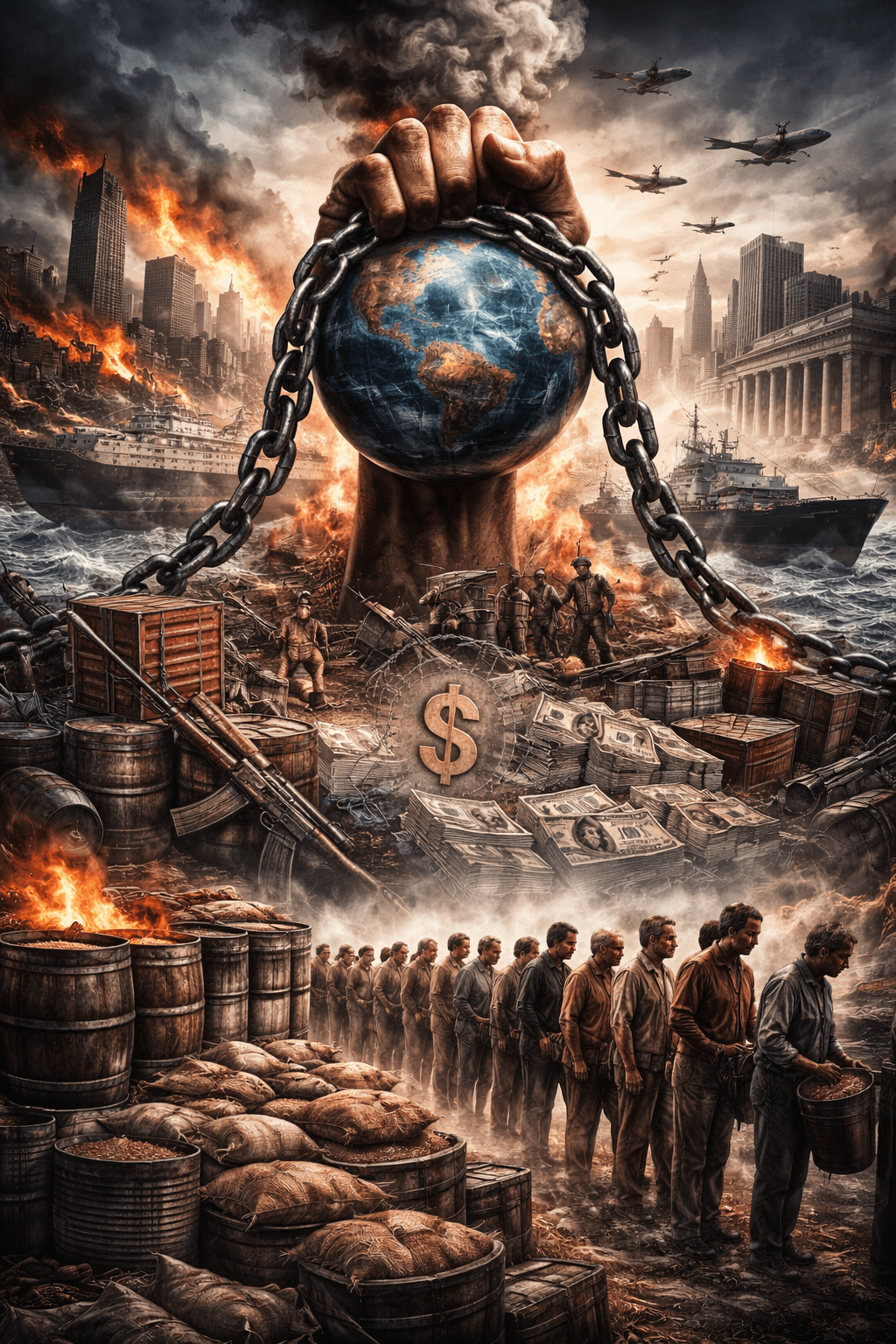
How imperialism strangled socialist revolutions through sanctions, blockades, and economic warfare—and why socialism was never judged on its own terms, but only under siege.
The Alibi They Hand You When They Don’t Want You to Ask Who’s Holding the Knife
“Socialism never worked anywhere.” You’ve heard it like you’ve heard “pull yourself up by your bootstraps,” like you’ve heard “the market is neutral,” like you’ve heard every sermon capitalism preaches to the hungry to keep them from looking up at the mansion on the hill. It’s not an argument. It’s an alibi. It’s the kind of sentence a system repeats when it wants to close the case before the evidence is even allowed into the courtroom.
Because what does that line actually mean? It means: judge every socialist project as if it grew under sunlight and rain like a garden, while capitalism is not a garden at all but an armed camp. It means: pretend the socialist experiment was carried out in a laboratory, when in reality it was carried out under siege—under blockade, sabotage, embargo, sanctions, asset seizures, credit strangulation, technology denial, covert destabilization, proxy warfare, and the constant threat of invasion. It means: compare a baby placed in an incubator to a baby thrown into a frozen river—and then announce, with the smugness of a landlord, that one “simply isn’t viable.”
If we want to talk scientifically—really scientifically, not like the economists who treat hunger as “incentive”—then we have to identify the missing variable that is erased from almost every mainstream verdict on socialism: imperial power. Not “international pressures” in the polite language of policy journals, but the concrete machinery of empire—banks, shipping insurance, payment systems, trade chokepoints, intelligence services, comprador elites, and armed force—mobilized to make sure that any society attempting to break with capitalist rule does so while being choked.
This is why the most common anti-socialist claim is also the laziest. It never asks what the imperial system did to make socialist development difficult, then impossible, then bloody. It never asks why the richest states on earth behaved, again and again, not like confident competitors but like anxious jailers. If socialism is “doomed by nature,” why did capital spend so much time and money manufacturing that doom? If socialist planning is “inefficient,” why did imperial planners repeatedly choose the most efficient method of political warfare: cut off oxygen, then blame the lungs?
Here is the basic pattern, stripped of propaganda and dressed in plain clothes: a people break the chain of capitalism in their country; the imperial system responds by strangling trade and finance; shortages and inflation are produced, not merely suffered; internal contradictions sharpen under pressure; the media chorus declares this the “failure of socialism”; and the same powers that engineered collapse announce themselves as neutral referees calling the match. This is not history as accident. It is history as strategy.
And there is a second trick hidden inside the first. Capitalism’s own record is never judged with the same standard. Capitalism is allowed to fail for centuries—through slavery, famine, conquest, depressions, coups, and wars—without anyone declaring the system “doesn’t work.” Its disasters are treated as temporary setbacks, its crimes as unfortunate side effects, its mass graves as “complexity.” But socialism is expected to deliver paradise while under fire. It must heal the sick, educate the poor, industrialize an underdeveloped economy, defend itself from sabotage, and keep morale high—while the world’s most powerful states try to starve it. Then, when it struggles, the empire that tightened the noose points to the bruises and says: look what you did to yourself.
In Weaponized Information, we refuse that rigged trial. We do not measure socialist projects by the fantasies of liberal commentators who have never stood in a ration line and never lost a child to a preventable disease. We measure them by historical materialism: by starting conditions, by class forces, by the structure of the world system, and by the fact that imperialism is not a “context” but an active antagonist. The question is not “did socialism deliver utopia under siege?” The question is: what did these revolutions accomplish despite siege—and what might have been possible if the empire’s boot had been removed from their necks?
That is why this essay begins where the propaganda ends. We will not take “socialism never worked” as a conclusion. We will treat it as a claim that must account for the deliberate, documented history of economic warfare waged against every serious attempt to build a post-capitalist society. Before we argue about models, we must name the method: strangulation. Before we lecture the besieged about “governance,” we must identify the siege-makers. And before socialists in the imperial core posture as judges, we must confront our own responsibility—because these sanctions, blockades, and financial weapons do not float in the air. They are built, maintained, and enforced by the institutions of our ruling class, in our names, with our taxes, through our banks, ports, and corporations.
So no: the story of socialism is not simply the story of internal contradictions. It is the story of a fight—an uneven fight—between oppressed peoples trying to build a new world and an imperial system determined to prevent that world from ever becoming visible. And once you see that, the old slogan stops sounding like common sense. It starts sounding like what it has always been: the empire’s excuse for why the child it strangled did not grow up.
Before the Cold War Had a Name, the Siege Had Already Begun
The first great lie about economic warfare against socialism is that it began with the Cold War, as if sanctions were some unfortunate excess of postwar rivalry. In reality, the siege begins the moment socialism first breaks the capitalist chain in 1917. The Bolshevik Revolution does not just overthrow a ruling class inside one country; it detonates a shockwave through the entire world system. For the first time, a state openly declares that capital will no longer rule, that land, industry, and labor will be organized for social need rather than private profit. And the response from the imperial powers is immediate, coordinated, and unmistakably hostile.
Long before phrases like “containment” or “iron curtain” enter the political vocabulary, the capitalist powers are already practicing what we now call sanctions. Trade routes are cut. Credit is denied. Diplomatic recognition is withheld. Western banks refuse to deal with the new Soviet state. Shipping and insurance networks—quiet but decisive arteries of global commerce—are closed off. Even gold, the universal lubricant of international trade, is rejected when it bears Soviet origin. This is not a moral protest. It is an attempt to make economic survival itself impossible.
What matters here is not simply that the young Soviet state faced hardship—every post-revolutionary society does—but that these hardships were actively engineered from outside. The imperial powers understood something very clearly: socialism could not be allowed to stabilize. If it consolidated, if it demonstrated that a workers’ state could survive and develop, the example would spread. So the strategy was not to wait and see whether socialism “worked,” but to ensure that it was forced to function under conditions no capitalist state would ever accept for itself.
The result was a brutal paradox. The Soviet economy was condemned for being underdeveloped and inefficient at the very moment when it was being deliberately excluded from the world economy. It was criticized for shortages while being denied access to machinery, spare parts, and industrial inputs. It was accused of authoritarian emergency measures while facing an external environment that made normal economic life impossible. This contradiction is not incidental. It is the logic of siege: provoke crisis, then blame the victim for how they survive it.
And here we see the birth of a pattern that will repeat for the next century. Economic isolation is paired with ideological narration. Every difficulty inside the besieged society is attributed to socialism itself, never to the blockade surrounding it. Meanwhile, the architects of the blockade present themselves as neutral observers, or even reluctant participants, merely “responding” to events rather than actively shaping them. In this way, imperial power hides its hand while tightening its grip.
The significance of the early Soviet siege goes far beyond Russia. It establishes the rulebook. Any society that attempts to exit the capitalist world system will be treated as an enemy combatant, not a sovereign equal. Access to trade, finance, and technology will be weaponized. Development will be obstructed, then mocked for failing to meet standards set by the very powers obstructing it. What later generations will call “sanctions” is, from the beginning, a form of class war waged at the level of nations.
This is why it is historically illiterate to treat sanctions as a policy choice that could have gone another way. From the moment socialism appears as a real, material alternative, economic warfare becomes automatic. It is not a response to Soviet behavior; it is a response to Soviet existence. And once this is understood, the entire debate shifts. We are no longer asking why the first socialist state struggled under impossible conditions. We are asking why the imperial system was so afraid of letting it breathe.
The siege of the early Soviet Union is not a footnote. It is the opening chapter. Everything that follows—China, Vietnam, Cuba, Chile, Nicaragua, Libya, Venezuela—will be variations on this original act. Different continents, different cultures, different historical moments, but the same underlying strategy: isolate, starve, destabilize, and then declare socialism a failure. The Cold War did not invent this method. It merely gave a name to a war that had already begun.
When Isolation Becomes Policy and Recognition Becomes a Weapon
By the middle of the twentieth century, economic siege was no longer improvised. It had become doctrine. The lesson imperialism drew from the early Soviet experience was not that isolation failed, but that it had to be systematized, internationalized, and normalized. The postwar order did not abandon economic warfare; it refined it. Institutions were built, rules were written, and legitimacy itself was weaponized so that exclusion could be made to look like common sense rather than coercion.
Nowhere is this clearer than in the treatment of revolutionary China. After 1949, the People’s Republic was not merely opposed; it was rendered invisible. Denied diplomatic recognition by the dominant powers for decades, excluded from international institutions, locked out of trade and finance, and treated as a kind of global outlaw, China was forced to develop as if the rest of the world barely existed. This was not an accident of ideology. Non-recognition functioned as economic punishment. If you are not recognized, you cannot borrow, insure, trade, or plan development on normal terms. Sovereignty itself becomes conditional.
The absurdity of later judgments becomes obvious once this is acknowledged. China is often criticized for the harshness and austerity of its early revolutionary decades, as if these emerged from doctrinal stubbornness rather than material necessity. But a society of hundreds of millions, emerging from colonial devastation and civil war, was deliberately denied access to the very world economy that had enriched its critics. The choice was never between a gentle socialism and a harsh one. The choice was between self-reliance under siege or dependency under subordination.
Vietnam’s case exposes the punitive logic even more starkly. After decades of war, after cities were bombed and farmland poisoned, the Vietnamese people achieved what imperial planners had sworn to prevent: victory. And then the punishment continued. Trade embargoes, financial exclusion, and denial of reconstruction aid followed the guns into silence. The message was unmistakable. Military defeat would be followed by economic strangulation. Peace would not mean relief; it would mean discipline.
This is a crucial point that imperial apologetics work hard to obscure. Sanctions are not defensive measures taken in moments of crisis. They are often imposed after the crisis has ended, after the revolution has survived, precisely to prevent recovery. They are not about stopping violence. They are about preventing success. A socialist society that rebuilds, educates its population, and improves living standards is far more dangerous to imperial ideology than one reduced to rubble.
Cuba completes this picture and stretches it across generations. From the early 1960s onward, the blockade is no longer a temporary measure or a bargaining chip. It becomes permanent. Laws are passed to ensure its longevity, to punish third parties, to make sure that even shifts in global politics cannot easily loosen the grip. The goal is no longer simply to pressure a government, but to exhaust a people. Shortages are engineered. Costs are inflated. Normal economic life is distorted year after year, and then these distortions are cited as proof that socialism is inherently unworkable.
What unites these cases is not geography or culture, but method. Recognition, trade, finance, and legality are fused into a single apparatus of control. To be socialist is to be placed outside the circle of acceptable humanity, where hunger becomes a policy tool and development is treated as a privilege to be revoked. This is the moment when sanctions stop being episodic and become structural. They are baked into the world order as a standing threat against any society that dares to reorganize its economy in the interests of the many.
And yet, despite this, something remarkable happens—something that imperial narratives cannot easily explain away. Even under isolation, even under embargo, even under permanent pressure, these societies do not simply collapse. They feed their people. They eradicate illiteracy. They extend life expectancy. They build systems of care where none existed before. These achievements are not miracles, and they are not accidents. They are the product of collective organization under conditions of siege. And it is precisely because they occur under such conditions that imperialism works so hard to ensure they are never discussed honestly.
By this stage, the pattern is fully formed. Socialism is never allowed to appear in the world as it actually is. It is presented only through the distortions imposed by economic warfare. To understand the twentieth century without understanding this is to mistake the bruise for the disease and the chokehold for a natural weakness. The siege is no longer an exception. It is the rule.
When the Empire Said the Quiet Part Out Loud
If earlier sieges were wrapped in diplomatic euphemism, Chile tore the veil away. In the early 1970s, the world was given a rare thing: an unguarded confession. The socialist project led by Salvador Allende was not crushed because it “mismanaged” the economy or failed to win elections. It was targeted precisely because it threatened to demonstrate that socialism could emerge through democratic means, redistribute wealth, and still function. That possibility terrified the imperial system far more than any armed insurgency ever could.
What followed was not improvisation but execution. Credit was cut. International lending institutions were leaned on. Multinational corporations coordinated capital flight and production sabotage. Domestic elites withheld goods, organized strikes, and engineered shortages. And behind it all stood imperial planners who described the strategy with chilling clarity: the goal was to make the economy scream. This was not metaphor. It was policy. The suffering of ordinary people was not an unfortunate side effect; it was the mechanism.
Chile matters because it removes any remaining ambiguity about intent. No one can claim that sanctions and economic destabilization are merely neutral responses to bad behavior when the architects themselves openly described them as tools to collapse a government by collapsing daily life. Inflation, scarcity, and social tension were cultivated conditions, designed to fracture popular support and create the atmosphere in which military intervention could be justified as “restoring order.”
This is why Chile occupies such a central place in the anatomy of imperial counterrevolution. It shows that economic warfare is not simply about isolating socialist states from the world market. It is about manipulating internal class relations, weaponizing scarcity against the poor, and turning the pain of everyday survival into a political bludgeon. The market is not allowed to function freely; it is deliberately broken, then blamed on socialism.
In Chile, the sequence is unmistakable. First comes economic strangulation. Then comes social chaos. Then comes the claim that democracy has “failed” and that only force can restore stability. The coup does not arrive as an interruption of the siege; it arrives as its culmination. Economic warfare prepares the ground so that tanks can roll in as saviors rather than invaders.
The significance of this episode extends far beyond Chile itself. It clarifies the logic that had been operating quietly elsewhere and would continue to operate long after. Sanctions are not meant to force policy concessions. They are meant to produce political collapse. When collapse does not arrive on schedule, violence is waiting in the wings. The economy is softened first; the society is fractured next; and the final blow is delivered in the name of “rescue.”
After Chile, no serious analyst can honestly claim ignorance. The empire told us what it was doing and why. Economic warfare was revealed as a deliberate strategy to destroy socialism before it could mature, to strangle it before it could prove that another world was not only imaginable but livable. Everything that follows—Central America, the Middle East, the Caribbean, South America again—will repeat this lesson with variations in scale and brutality.
And yet, in the imperial narrative, Chile is often treated as a tragic exception rather than a structural example. The confession is acknowledged, then buried. But once you recognize it for what it is, the entire historical record snaps into focus. The question is no longer whether socialism “failed” in Chile. The question is why an empire felt compelled to crush it so violently, so openly, and so unapologetically. The answer is simple and devastating: because it was working just enough to be dangerous.
When Starvation Wasn’t Enough, the Guns Came Out
By the 1980s, imperial strategy had absorbed its own lessons. Economic warfare alone could cripple a society, but when combined with armed destabilization, it could break one. This was the era when sanctions and proxy war fused into a single counterrevolutionary instrument—one hand tightening the economic noose, the other pulling the trigger through intermediaries. What unfolded in places like Nicaragua was not an escalation from economic pressure to violence. It was a coordinated campaign in which both were always meant to work together.
Nicaragua’s revolution emerged from decades of dictatorship, poverty, and foreign domination, carrying with it the basic demands of land, literacy, healthcare, and dignity. The response from the imperial system was swift and brutal. A trade embargo cut off export earnings and access to imports. Financial isolation strangled credit. At the same time, an armed counterrevolution was funded, trained, and unleashed to destroy infrastructure, terrorize civilians, and drain the young state’s resources. Schools, clinics, and cooperatives became military targets. Economic pain and physical violence reinforced each other in a vicious feedback loop.
This dual assault produced exactly what it was designed to produce: inflation, shortages, exhaustion, and fear. The economy buckled under pressures that had little to do with internal planning and everything to do with external attack. Daily life became a struggle not only against scarcity but against death. And then, as always, the imperial narrative arrived right on schedule to explain that socialism had “failed” to deliver prosperity and stability.
The cruelty of this strategy lies in its circular logic. Economic warfare weakens a society; violence magnifies the damage; the resulting suffering is then attributed to the political project under attack. The fact that international courts ruled these actions illegal did not matter. Law, in the imperial system, is not a constraint on power but a language power uses when convenient and ignores when it is not.
Libya, though different in history and political structure, reveals the same underlying method. For years, sanctions hollowed out the economy, restricted access to technology, froze assets, and degraded infrastructure. Long before bombs fell, economic isolation had already done its work, eroding social capacity and normalizing hardship. Sanctions did not replace war; they prepared it. By the time overt military destruction arrived, the target had already been softened, its resilience weakened by years of enforced scarcity.
What these cases demonstrate is that sanctions are rarely meant to stand alone. They are part of a broader choreography of domination in which economic strangulation creates the conditions for political destabilization, and political destabilization invites military intervention. The empire does not choose between starving a population or shooting it. It does both, in sequence or simultaneously, depending on what proves most effective.
This phase of imperial practice strips away the last remaining illusions about sanctions as “peaceful” tools. There is nothing peaceful about deliberately collapsing an economy while funding armed groups to exploit the chaos that follows. There is nothing humanitarian about manufacturing scarcity and then using the desperation it creates as evidence of moral failure. This is not diplomacy by other means. It is war conducted through markets, militias, and misery.
By the end of the twentieth century, the lesson for any aspiring socialist project was brutally clear. Breaking with capitalism would not only invite isolation; it would invite a full-spectrum assault. Economic warfare would come first, but it would not come alone. And if the society under attack bent under the pressure, the empire would claim vindication. If it resisted, the empire would escalate. Either way, the siege would continue until submission, collapse, or destruction.
This is the world in which socialism has been forced to exist—not as an abstract idea, but as a lived struggle against a system that refuses to tolerate alternatives. To judge these revolutions without accounting for this reality is not analysis. It is complicity.
When War Put on a Suit and Moved Into the Bank
By the turn of the twenty-first century, imperial warfare had learned to clean its hands. Tanks and bombers never disappeared, but the most effective weapons were now issued to bankers, regulators, insurers, and compliance officers. Sanctions evolved from blunt trade embargoes into a permanent, finely tuned system of financial warfare—quiet, technical, and devastating. This is the moment when economic siege stops looking like punishment and starts looking like infrastructure.
The modern sanctions regime does not simply block goods at ports. It strangles entire economies upstream. Payment systems are severed. Correspondent banking relationships are cut. Insurance for shipping and energy infrastructure is withdrawn. Assets and foreign reserves are frozen or seized outright. Third parties are threatened with secondary sanctions if they dare to trade. In this system, a country can technically be “allowed” to buy food or medicine while being systematically denied the ability to pay for, transport, or insure it. Starvation is achieved administratively.
Nowhere is this clearer than in the contemporary assault on the Bolivarian Revolution. Venezuela was not merely sanctioned; it was financialized out of existence. Restrictions on oil exports were paired with bans on refinancing debt and maintaining infrastructure. Refineries were cut off from spare parts. Tankers were denied insurance. Billions in state assets were frozen abroad. Gold reserves were immobilized. What could not be produced domestically could not be imported, not because markets failed, but because imperial gatekeepers closed the gates.
The result followed with mechanical precision. Import capacity collapsed. Medicine shortages appeared. Food distribution became strained. Inflation spiraled as access to hard currency evaporated. Migration increased—not as a spontaneous rejection of socialism, but as a rational response to a deliberately manufactured economic emergency. And then, with breathtaking cynicism, the very consequences of sanctions were held up as proof that the sanctions were necessary.
What distinguishes this phase from earlier ones is not cruelty but sophistication. Modern sanctions are designed to be plausibly deniable. The suffering they cause is distributed through complex systems rather than dramatic blockades. Responsibility is diffused across institutions that claim to be merely following regulations. The violence is slower, quieter, and therefore easier to normalize. A child denied insulin because a payment could not clear is not counted as a casualty of war, but the result is the same.
This is also the moment when sanctions become truly globalized. A single imperial power can enforce compliance far beyond its borders because the financial system itself has been centralized. Banks, shipping firms, insurers, and technology companies become unwilling conscripts in economic warfare. Sovereignty is no longer violated by invasion alone; it is overridden by spreadsheets and threat letters.
And yet, even under this intensified siege, the same contradiction persists. Socialist and anti-imperialist states are condemned for emergency measures taken to survive financial strangulation—capital controls, state management of trade, alternative currency arrangements—while the coercive system that makes those measures necessary is treated as invisible. The abnormal is normalized for the aggressor and pathologized for the target.
The modern sanctions regime reveals the imperial system at its most honest. It no longer pretends to compete with socialism on the terrain of human development. It seeks instead to prevent comparison altogether by ensuring that socialist societies are forced to operate in permanent crisis. This is not the market at work. It is power at work, disciplining those who refuse to submit.
To understand socialism in the contemporary world without understanding this financial siege is to miss the battlefield entirely. The war did not end. It simply learned how to dress itself in legal language, humanitarian rhetoric, and balance sheets. And for those on the receiving end, the effect is as real as ever: an economy gasping for air while the empire insists it is merely enforcing the rules.
How You Govern When the World Is Trying to Kill You
One of the laziest accusations leveled against socialist revolutions is that they resort to “extraordinary measures,” as if any society under sustained attack could afford the luxury of normalcy. This critique pretends that governance occurs in a vacuum, that policy choices emerge from ideology alone rather than from material pressure. In reality, what is called authoritarianism by distant commentators is often nothing more than emergency administration in a state of permanent siege.
When an economy is cut off from credit, trade, and currency, the question is no longer whether the state should intervene, but how quickly it can do so to prevent collapse. Rationing is not a moral preference; it is a mechanism to distribute scarcity in a way that prevents starvation from becoming a market commodity. Price controls are not doctrinal stubbornness; they are an attempt to stop speculation from turning hunger into profit. State control over foreign exchange is not ideological dogma; it is the only way to prevent capital flight from bleeding a besieged society dry.
These measures appear again and again across socialist and anti-imperialist experiences not because of some shared authoritarian gene, but because siege produces similar constraints. When shipping insurance is denied, the state steps in. When banks refuse to process payments, alternative systems are built. When hoarding and black markets emerge under pressure, enforcement becomes a matter of survival. The choice is not between freedom and control, but between organized survival and chaotic collapse.
Imperial narratives invert this reality with remarkable consistency. The sanctions that force emergency measures into existence are treated as background noise, while the measures themselves are placed in the foreground as proof of failure. The hand that tightens the chokehold is rendered invisible; the gasp for air is scrutinized for ideological impurity. This inversion allows imperial power to present itself as an external judge rather than an active participant in the crisis it created.
There is a deeper hypocrisy at work here. When capitalist states face crisis—war, depression, pandemic—they too suspend norms, nationalize industries, impose controls, ration goods, and mobilize society by decree. These actions are praised as pragmatism or necessity. When socialist states do the same under far harsher conditions, the very same actions are condemned as tyranny. The difference is not in the measures themselves, but in who is allowed to exercise them without moral indictment.
Governing under siege also reshapes political culture. Security becomes a constant concern, not because dissent is inherently dangerous, but because destabilization is actively funded and organized from abroad. Sabotage is not hypothetical; it is documented. Infiltration is not paranoia; it is policy. Under such conditions, the boundary between political pluralism and counterrevolution is not drawn in theory, but in practice, under pressure, with lives at stake.
None of this is offered as romanticism. Emergency governance carries real costs. It can harden institutions, narrow political space, and generate internal contradictions of its own. But to discuss these outcomes honestly, one must begin where reality begins: with the siege. You cannot evaluate the internal dynamics of a besieged society as if it were at peace. You cannot abstract governance from the conditions under which it is exercised.
The crucial point is this: the extraordinary measures of socialist revolutions are not evidence of their moral failure, but evidence of the extraordinary violence directed against them. They are scars, not pathologies. To blame the wounded for bleeding while ignoring the knife is not analysis. It is ideological cover for the attacker.
Once this is understood, the conversation shifts. The question is no longer why socialist states look the way they do under siege. The question is why the imperial system insists on creating sieges in the first place—and why so many observers accept the resulting distortions as natural features of socialism rather than as the predictable outcomes of sustained economic war.
What They Built Anyway, With the Boot Still on Their Neck
There is a moment in every honest assessment of socialism under siege when the narrative is supposed to collapse. After sanctions, blockades, sabotage, proxy wars, and financial strangulation, we are told that nothing meaningful could possibly have been achieved. And yet, when we actually look at the historical record, something stubborn refuses to disappear: material gains in human life. Not miracles, not perfection, but measurable advances in survival, dignity, and social capacity—won under conditions that would have broken most societies outright.
This is the part of the story imperial ideology would prefer you never examine closely. Under blockade and isolation, socialist societies expanded literacy on a mass scale, often eradicating it entirely within a generation. They built public health systems where none had existed, trained doctors and nurses at rates unmatched by comparably poor capitalist countries, and dramatically reduced infant mortality. Life expectancy rose not because sanctions were gentle, but because collective organization prioritized human need over market return.
These outcomes were not abstract achievements. They were embodied in bodies that lived longer, children who survived infancy, and communities that gained access to clean water, electricity, and education for the first time. In Cuba, a country denied normal trade for decades, healthcare outcomes rivaled those of the richest capitalist states. In China, life expectancy doubled within a generation despite international isolation. In Vietnam, recovery from total war occurred without the influx of capital that every orthodox development model insists is indispensable.
The usual response to these facts is deflection. Critics will say that these gains came “at a cost,” as if capitalist development did not also exact costs measured in famines, slums, sweatshops, and mass graves. What they rarely say is that these socialist gains were achieved while resources were deliberately withheld, while imports were obstructed, and while financial lifelines were severed. Development was not assisted by the world system; it was wrestled from it.
This is where the counterfactual becomes unavoidable. If these societies were able to make such advances under siege, what might have been possible without it? What levels of prosperity, innovation, and social flourishing were foreclosed not by socialist planning, but by imperial intervention? The answer is unknowable in detail, but its direction is clear. The ceiling imposed on socialist development was external, not inherent.
It is precisely because these gains existed that sanctions were intensified rather than relaxed. A socialism that merely survives can be tolerated for a time. A socialism that educates, heals, and stabilizes threatens to expose capitalism’s own failures. It invites comparison. And comparison is the one thing imperial ideology cannot survive.
None of this is to deny contradiction. Socialist societies under siege faced shortages, inefficiencies, and political tensions. But to isolate those problems from the context of economic warfare is to commit intellectual malpractice. No development project in history has been judged while being actively strangled—except socialism. And yet, even within that rigged test, the results confound the verdict handed down in advance.
The persistence of these achievements under such conditions forces a reconsideration of what “worked” actually means. If the measure is human survival, expanded capacity, and the reduction of preventable suffering, then socialism did not merely stumble forward. It delivered—unevenly, imperfectly, and under fire. The tragedy is not that these projects failed to meet some imagined ideal. The tragedy is how much more they might have done if allowed to live without the empire’s hand around their throat.
At this point, the story of socialism under siege stops being a story about economics alone. It becomes a moral indictment of a world system that would rather starve an alternative than risk learning from it. And once that indictment is clear, the final question can no longer be avoided: what responsibility does this place on those who live at the center of the system that enforces the siege?
The Verdict Was Rigged — and the Responsibility Is Ours
By the time we reach the end of this historical record, the old refrain that “socialism never worked” no longer sounds like a conclusion at all. It sounds like a sentence handed down in advance. Every serious attempt to break with capitalism was met not with observation but with intervention, not with comparison but with coercion. The verdict was never meant to be discovered. It was meant to be enforced.
Across continents and generations, the pattern holds. Socialism emerges from conditions of underdevelopment, colonial plunder, and class violence. Almost immediately, it is encircled. Trade is cut. Credit is denied. Assets are frozen. Technology is withheld. Internal elites are mobilized. Armed proxies are funded. When these pressures produce crisis—as they are designed to do—the crisis is then attributed to socialism itself. Failure is manufactured and then presented as proof.
This is why debates about whether socialism “works” so often feel dishonest. They abstract socialism from the world system that attacks it. They treat sanctions as footnotes rather than as central variables. They speak as if socialist societies collapsed under the weight of their own contradictions, rather than under the sustained pressure of the most powerful states and institutions ever assembled. It is a method of analysis that would excuse any crime so long as it is committed quietly and through paperwork rather than bombs.
Once sanctions are recognized for what they are—economic warfare aimed at civilians—the moral landscape changes. These are not neutral policies. They are acts of collective punishment. They target hospitals, food systems, energy infrastructure, and currency access. They shorten lives without ever declaring war. They allow imperial states to kill invisibly while insisting on their own innocence.
And this brings us to the uncomfortable truth for those of us who live in the imperial core. These sieges are not abstractions carried out somewhere else by faceless forces. They are enforced through our banks, our ports, our insurance firms, our technology companies, our governments. They are maintained by laws passed in our name and normalized by media we consume. The suffering they cause is distant enough to ignore, but not distant enough to deny responsibility.
For socialists in the imperial core, this reality imposes a primary duty. Before lecturing besieged societies about policy choices or democratic form, we must confront the machinery of siege itself. Opposing sanctions is not charity. It is not a secondary humanitarian concern. It is internationalist class struggle. To break the economic war against socialist and anti-imperialist societies is to remove one of the central weapons capitalism uses to preserve its global dominance.
This means naming sanctions as violence, not “pressure.” It means refusing the language that sanitizes starvation into policy. It means organizing against the institutions that enforce economic warfare, from banks and shipping firms to political parties and regulatory agencies. And it means rejecting the posture of neutral analyst in favor of partisan clarity: there is no fair evaluation of socialism while the noose remains in place.
The history traced here does not ask for romanticism. It asks for honesty. Socialism did not fail in a vacuum. It was fought, sabotaged, strangled, and, in many cases, drowned in blood. That it achieved as much as it did under such conditions is not evidence of its weakness, but of its resilience. The real question is not whether socialism was perfect under siege. The real question is why capitalism was so terrified of letting it live without one.
Until that question is answered in practice—until the sanctions regimes are dismantled and economic warfare is confronted head-on—the debate about socialism’s “failure” will remain what it has always been: an empire arguing with the shadow it cast over the very experiments it set out to destroy.
Socialism Was Never Judged in Peace — Only Under Fire
When the record is taken as a whole, stripped of Cold War mythology and liberal evasions, one conclusion becomes unavoidable: socialism has never been allowed to exist as a normal participant in the world system. It has existed only as a target. From the moment workers and peasants seized power in 1917, socialism was not tested against capitalism in open competition but subjected to a century-long campaign of economic warfare designed to ensure that no fair test could ever take place.
This is why the familiar verdict—“it never worked”—rings hollow. What does it mean for a system to “work” when it is encircled from birth, denied access to trade and credit, sabotaged internally, attacked militarily, and strangled financially? No society in history has been evaluated under such conditions except those that dared to break with capital. Capitalism itself emerged through centuries of colonial plunder, slave labor, enclosure, genocide, and state violence—yet it is never asked to account for those origins when its performance is judged.
Socialism, by contrast, is expected to deliver abundance instantly, under blockade, while defending itself from annihilation. When it stumbles, the empire that engineered the stumbling declares victory. This is not analysis. It is a rigged experiment whose outcome was decided in advance.
And yet, even within this rigged experiment, the historical record refuses to cooperate with imperial ideology. Under siege, socialist societies fed their people, educated the illiterate, extended life expectancy, built systems of public health, and asserted a degree of sovereignty over social life that capitalism reserves for the wealthy few. These achievements were not accidents, and they were not gifts from the world market. They were wrested from history by collective struggle under conditions of permanent attack.
The real scandal, then, is not that socialism faced contradictions. Every social system does. The scandal is how much human potential was deliberately foreclosed by sanctions, blockades, and financial strangulation—how many lives were shortened, how many possibilities were crushed, not because socialism failed, but because it was never permitted to succeed on its own terms.
For those of us living in the imperial core, this history leaves no room for comfortable distance. The sieges described here are not abstract geopolitical maneuvers. They are enforced daily through institutions that structure our own lives: banks that freeze assets, corporations that comply with blacklists, governments that legislate collective punishment, media that normalize it all as “foreign policy.” To oppose capitalism while remaining silent about sanctions is to criticize the symptoms while defending the weapon.
Internationalism begins here. Not with romantic declarations of solidarity, but with material opposition to the economic wars waged in our name. To fight sanctions is to fight the empire at one of its most vulnerable points. It is to insist that socialism, and any society that seeks to place human need above profit, has the right to exist without a knife at its throat.
Until that siege is broken, every debate about whether socialism “works” is dishonest. The only honest question left is whether humanity will continue to tolerate a world order so afraid of alternatives that it must starve them into submission—or whether we will finally dismantle the machinery of strangulation and allow history to unfold without imperial hands on the scales.
 Weaponized Information
Leave a comment