By Prince Kapone | Weaponized Information — Weaponized Intellects Book Review |
Before the First Shot — Why This Book Matters
This book arrives not a moment too soon.
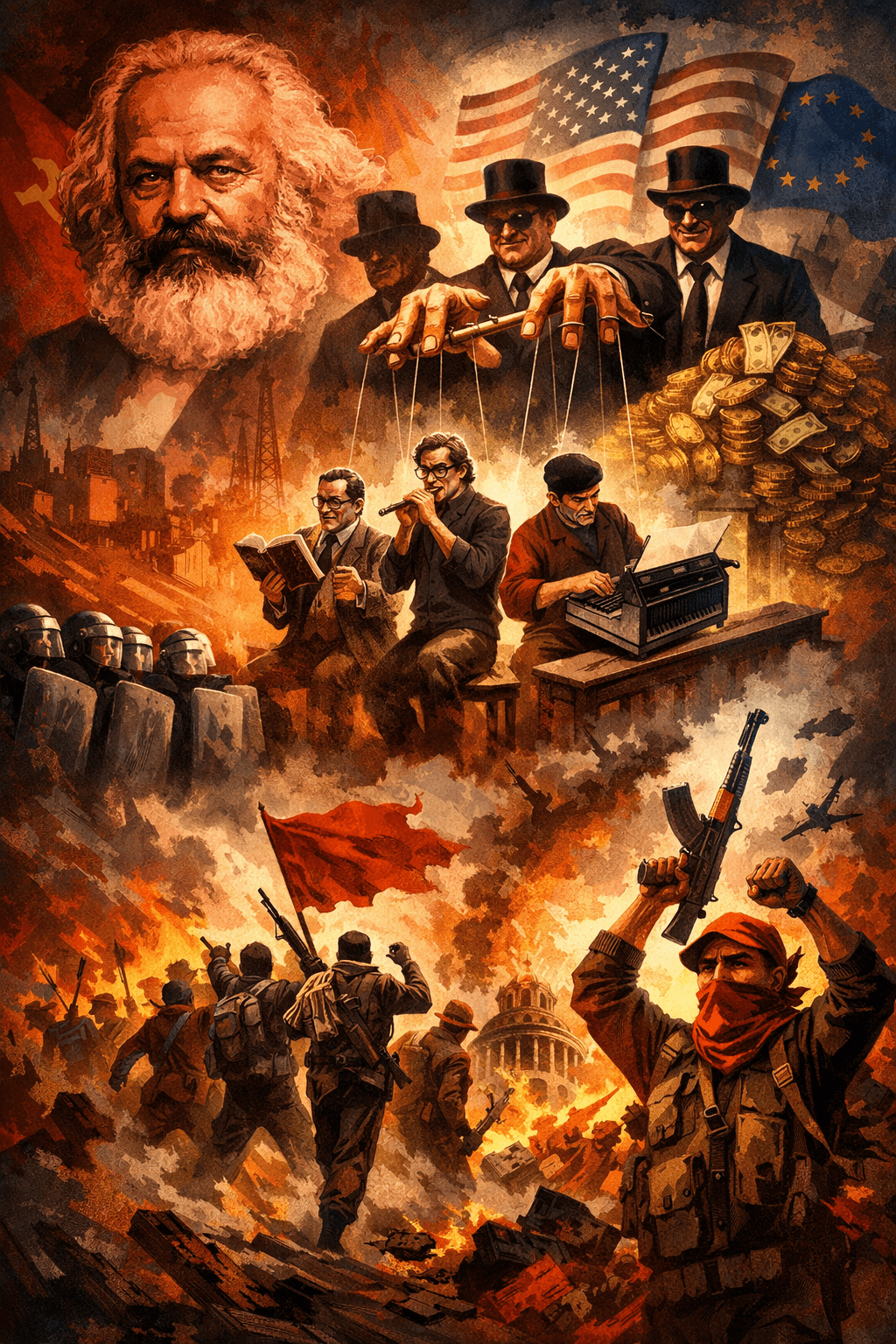
Who Paid the Pipers of Western Marxism? is not a contribution to academic debate. It is an intervention into a global struggle over consciousness, one that determines whether the working classes of the world will recognize their enemies—or continue to fight shadows while empire tightens its grip. Gabriel Rockhill’s work speaks directly to the material reality facing billions of people today: escalating imperial violence, permanent war, economic strangulation, ecological collapse, and an ideological environment carefully engineered to make all of this appear inevitable.
For the global working class and the colonized nations of the world, the stakes could not be higher. Imperialism does not survive by force alone. It survives by shaping how people understand history, power, revolution, and even the meaning of socialism itself. Before sanctions starve populations, before coups destroy governments, before drones and blockades do their work, an intellectual operation has already prepared the ground. Resistance is delegitimized. Alternatives are ridiculed or demonized. Socialism is recoded as tyranny, failure, or naïveté. This is not collateral damage. It is strategy.
Rockhill’s book exposes one of the most effective weapons in this strategy: a form of Marxism that speaks critically while functioning safely inside empire. Western Marxism, he argues, did not merely drift away from revolution by accident or disappointment. It was cultivated, rewarded, and institutionalized precisely because it neutralized Marxism’s most dangerous capacities—its alignment with anti-imperialist struggle, its commitment to organization, and its insistence on the seizure and transformation of power.
For socialist states under siege and for emerging multipolar forces challenging U.S.-led imperial dominance, this analysis is not abstract. It explains why Western intellectuals so often rush to condemn actually existing socialism while remaining conspicuously silent about sanctions, coups, and proxy wars. It explains why revolutions in the Global South are endlessly scrutinized for their imperfections while imperial violence is treated as background noise. It explains why so much “radical” theory in the imperial core seems allergic to questions of state power, discipline, and victory.
This book therefore belongs not only on the shelves of theorists, but in the hands of organizers, militants, and revolutionaries trying to make sense of why the left in the imperial core so often fails to rise to the level of history. It names the problem without euphemism: a left whose dominant theories are structurally aligned with the system they claim to oppose is not merely ineffective—it is dangerous.
It is precisely for this reason that Weaponized Information exists. This platform was created from within the Global North, inside the imperial core, with no illusions about neutrality or safety. We are not observers of the intellectual world war Rockhill describes. We are participants. The battle of ideas is not a metaphor here. It is the terrain on which imperialism defends itself and on which revolutionary movements must learn to fight.
This review is written in that spirit. Not to evaluate Rockhill’s book as an object of scholarship, but to deploy it as part of an ideological offensive against imperial common sense, anti-communism dressed as nuance, and radicalism stripped of consequence. The task is not to admire this work, but to put it to use.
Because in a world where empire is fighting for survival, ideas are never innocent. And Marxism, stripped of its revolutionary content, becomes one more instrument of domination. Rockhill’s book helps tear that mask away. What follows is a reading of Who Paid the Pipers of Western Marxism? as a weapon—aimed not at the oppressed, but at the ideas that keep them disarmed.
I. Opening Salvo — The Intellectual World War
Gabriel Rockhill opens Who Paid the Pipers of Western Marxism? by tearing apart a comfortable lie that sits at the center of liberal thought and much of the academic left as well: the idea that ideas live in one world and violence in another. According to this fantasy, bombs fall in foreign lands while theories circulate harmlessly in classrooms and journals. Rockhill makes it clear from the outset that this separation is itself an imperial invention. Long before the first shot is fired, the real work has already been done in people’s heads.
Empire does not wait for resistance to appear and then respond. It works constantly to shape what people can imagine, what they can recognize as legitimate, and what they will dismiss as impossible or dangerous. This is what Rockhill calls an intellectual world war. It is not fought in isolated debates between scholars, but through permanent, organized efforts to manage consciousness. Its terrain is the mind, and its weapons are education systems, cultural institutions, foundations, media, and theory itself.
This is why Che Guevara enters the book not as a symbol of youthful rebellion or aesthetic radicalism, but as a problem for empire. Che was dangerous because he did not treat Marxism as commentary. He treated it as a guide to action. He showed that theory could move into practice, that practice could harden into organization, and that organization could seize power. For U.S. imperial strategy, this kind of Marxism was not something to be debated. It had to be destroyed.
But Rockhill refuses to let that destruction be understood narrowly. Killing Che’s body was only the first step. The grotesque display of his severed hands was not just proof of death; it was a declaration of ownership. Empire wanted the revolutionary body as evidence, but it wanted the revolutionary idea as property. The real danger was not that Che had lived, but that others might learn how and why he lived the way he did.
This is where Rockhill’s argument cuts deeper. The true objective was never simply to eliminate Che, but to neutralize his meaning. To turn a revolutionary example into a cultural object. To preserve the image while draining the politics. To let Che’s face circulate everywhere while ensuring his strategy went nowhere. A revolutionary frozen in time, stripped of context and method, is no longer a threat. He becomes decoration.
Rockhill insists that this logic applies far beyond Che. The same process has been applied to communism itself. The imperial wager is simple and ruthless: if communism can be killed as an idea—rendered synonymous with tyranny, failure, or historical embarrassment—then the mass violence inflicted on real people can proceed without resistance. Sanctions that starve populations, wars that flatten countries, and coups that drown movements in blood all rely on this prior ideological victory. You must first convince people that no alternative is possible, or that any alternative is worse.
At the same time, Rockhill refuses the defeatism that often follows this recognition. If ideas were powerless, empire would not spend so much time trying to bury them. The endless effort to discredit, distort, and erase revolutionary traditions is proof that they still matter. Ideas outlive bodies. They cross borders. They resurface in new conditions. This is why empire fears them.
Steve Biko’s insight anchors this section with clarity and force: the most effective weapon in the hands of the oppressor is the mind of the oppressed. This is not a metaphor. Control how people understand the world, and you reduce the need for constant physical repression. Break that control, and even overwhelming force begins to wobble. Rockhill treats this as a strategic principle, not a slogan.
From here, the book names the United States plainly for what it is: an empire built on genocide, slavery, and colonial plunder, sustained not only by force but by denial. Its greatest ideological achievement is convincing people—especially its own population—that it is not an empire at all. It presents itself as accidental, defensive, and benevolent, even as it wages permanent war. This denial is not a mistake. It is the condition of imperial rule.
Edward Bernays’ notion of an “invisible government” gives this condition its modern form. Consent is not forced openly; it is manufactured quietly. People are guided without being told they are ruled. Intellectuals play a crucial role in this process, supplying explanations, critiques, and theories that make the system appear natural and inevitable. This is the world Rockhill is dissecting.
The opening salvo closes with Thomas Sankara’s insistence that ideas cannot be killed. This is not optimism for its own sake. It is a line drawn in struggle. If ideas survive repression, then intellectual work is not optional. There is no neutral space outside the fight over meaning. Everyone is already positioned, whether they admit it or not.
From its first pages, Who Paid the Pipers of Western Marxism? declares itself on one side of this divide. It is not a reflection on theory, but an intervention into how theory is produced and used. It does not ask whether ideas matter; it shows how they are weaponized. And it makes clear that anyone engaging Marxism today must decide whether they are helping empire manage dissent—or helping revolution reclaim its future.
II. Introduction — Class Struggle in Theory
Having established that empire wages war in the realm of ideas long before it does so with bombs and soldiers, Rockhill turns in the introduction to a more uncomfortable target: the way theory itself is produced, circulated, and sanctified on the left. The question is no longer whether ideas matter, but how they function. And here Rockhill insists on a hard truth that cuts against the grain of liberal moralism and academic self-flattery alike: theory is not a passive reflection of class struggle. It is one of its primary arenas.
Marxism, Rockhill reminds us, does not exist in the abstract. It does not descend from the sky fully formed, nor does it survive simply because it is correct. It is made by people working inside institutions, under specific material pressures, with concrete rewards and punishments shaping what they can say and how far they can go. What circulates as “Marxism” in any given society is therefore not just an intellectual tradition; it is a social product, stamped by the class forces that govern its production.
This is where Rockhill introduces a distinction that many on the left instinctively resist, because it strips away comforting illusions. The political value of a theory cannot be measured by the sincerity, radical language, or personal commitments of the person producing it. What matters is objective function. A thinker may feel oppositional, speak critically, and genuinely despise capitalism in the abstract, yet still produce work that stabilizes imperial power. Good intentions do not neutralize political effects. History is full of well-meaning people whose ideas served forces they believed they were opposing.
Rockhill’s insistence on this point is not moralistic; it is scientific. Ideology cannot be analyzed at the level of character or belief. It must be analyzed structurally. The left’s fixation on intentions—who meant well, who was sincere, who had the right feelings—functions as a shield against serious analysis. It allows entire traditions to escape critique so long as their authors can be portrayed as personally progressive. Rockhill tears that shield away.
Returning to Marx’s formulation that the ruling ideas are the ideas of the ruling class, Rockhill pushes the insight beyond slogan and into material reality. The ruling class does not simply promote its worldview through persuasion. It owns and manages the infrastructure through which ideas are produced and circulated. Universities, foundations, publishing houses, journals, and media platforms are not neutral arenas of debate. They are sites of production, governed by funding streams, institutional priorities, and professional incentives. They decide which questions are worth asking, which methods are respectable, and which conclusions are career-ending.
Seen from this angle, the dominance of certain forms of Marxism in the imperial core begins to look less mysterious. Why is it that the Marxism most celebrated in these spaces is relentlessly hostile to socialist states, dismissive of political economy, suspicious of organization, and deeply uncomfortable with revolution? Why does it so often retreat into cultural critique, discourse analysis, or personal ethics, while treating questions of power, state formation, and imperialism as crude or dangerous?
Rockhill is clear: this is not an accident of intellectual history, nor the result of unfortunate misunderstandings. It is the predictable outcome of theory being produced inside imperial institutions. A Marxism that challenges capitalism in general but refuses to confront imperialism in practice, that criticizes domination everywhere except where it is organized, and that treats revolution as inherently suspect is not a failure of the system. It is one of its achievements.
At this point, Rockhill introduces the concept of the imperial superstructure to clarify how such outcomes are generated without the need for crude conspiracy. Ideological coherence does not require a single command center issuing orders. It emerges from shared class interests operating across a decentralized but tightly aligned set of institutions. Foundations fund certain kinds of work. Universities reward certain forms of critique. Publishers and journals amplify certain voices. Together, they produce a field in which some ideas flourish effortlessly while others struggle to exist at all.
The crucial point is that this system works primarily through incentives, not repression. Intellectuals learn the limits of acceptable critique long before they encounter them explicitly. They adjust their language, their focus, and their conclusions in ways that feel like individual choice but reflect structural pressure. Over time, this produces a Marxism that is fluent, sophisticated, and safely disarmed.
The task Rockhill sets for the rest of the book is therefore sharply defined. Western Marxism cannot be understood by parsing texts alone or reconstructing intellectual lineages in isolation. It must be explained materially, as a product of the imperial superstructure that shapes what kind of Marxism can survive and thrive in the heart of empire. The introduction does not merely frame this task; it makes it unavoidable. Anyone serious about revolutionary politics must confront not only the ideas they oppose, but the conditions under which their own ideas are formed.
III. Part I — Imperial Knowledge
Rockhill begins Part I by dismantling a stubborn fantasy shared by liberals and much of the left alike: the belief that bad ideas dominate because they are more persuasive, better marketed, or simply not yet confronted by superior arguments. Chapter 1 is a direct assault on this illusion. Imperial knowledge does not prevail because it convinces people through debate. It prevails because it is produced, reproduced, and enforced through material systems that shape intellectual life from the ground up.
Knowledge, Rockhill insists, is a force of production. Like any force of production under capitalism, it is organized to serve the interests of those who control it. Education under empire is not a neutral process of enlightenment; it is a form of counterrevolutionary conditioning. The “chains” that bind intellectual life are not primarily cognitive errors or gaps in understanding. They are institutional constraints, methodological norms, and career structures that determine what kinds of thinking are viable in the first place.
This is why critique alone is inadequate. One can expose falsehoods endlessly and still leave the machinery that produces them untouched. Imperial ideology does not survive because it has not been challenged; it survives because it is systemically reproduced. Rockhill’s point here is devastating for academic Marxism. If ideology functions as an organized system rather than a collection of mistaken beliefs, then no amount of better theory will defeat it unless the systems that sustain it are disrupted. Education becomes part of the problem when it remains confined within imperial institutions.
Rockhill sharpens this argument by situating intellectual labor itself within the imperial division of labor. Universities do not stand outside power; they are production sites within it. Intellectuals are workers whose labor is shaped by funding, prestige, and professional survival. Dissent is tolerated—often celebrated—so long as it remains stylized, individualized, and detached from organization or power. The system does not fear critique that goes nowhere. It fears theory that converges with practice.
This dynamic takes on a colonial character when the Global South enters the picture. Rockhill shows how imperial knowledge feeds on anti-imperialist struggle while neutralizing it at the same time. The lived experiences of colonized peoples are extracted as examples, metaphors, and case studies, then abstracted from their political content. Revolution becomes a concept to analyze rather than a process to join. The result is an epistemic colonialism that allows imperial institutions to profit intellectually from struggles they materially suppress.
The myth of academic freedom collapses under this analysis. Freedom exists, but only within carefully enforced boundaries. Anti-communism operates not as an explicit rule but as a silent condition of legitimacy. One may criticize capitalism endlessly, but one may not affirm socialist states, defend revolutionary organization, or treat anti-imperialist struggle as anything other than tragedy or failure. These limits are rarely announced because they are enforced structurally. To “break the chains” of imperial knowledge, Rockhill argues, is not to refine critique, but to confront the institutions that make critique safe.
Chapter 2 advances the analysis by naming the machinery that produces these outcomes. If Chapter 1 exposes why imperial knowledge cannot be defeated through ideas alone, Chapter 2 explains how it is administered. Rockhill introduces the imperial intellectual apparatus not as a conspiracy, but as a coordinated system of institutions aligned by shared class interests. Foundations, universities, state agencies, publishing houses, and media outlets form a circuit that governs intellectual production without requiring centralized command.
Philanthropic foundations emerge as key strategic nodes in this apparatus. They do not dictate conclusions; they shape entire fields. By funding certain questions, methods, and areas of inquiry, they define the boundaries of intellectual possibility. What is unfundable becomes unthinkable. This is power exercised through curation rather than censorship, reward rather than repression. It is far more effective precisely because it feels voluntary.
Universities function as imperial organs within this system. They train cadres, produce expertise, and legitimate dominant narratives under the banner of neutrality. Their proximity to state power is not accidental. The circulation of personnel between academia, foundations, intelligence agencies, and government normalizes collaboration and aligns intellectual labor with imperial needs. Ideological warfare becomes professionalized, routinized, and respectable.
Prestige completes the apparatus. Journals, presses, and media outlets act as filters that determine what counts as serious thought. Canonization becomes a disciplinary mechanism. Once a framework is established as authoritative, it reproduces itself automatically through citation, syllabi, and conferences. Exclusion rarely needs to be explicit; invisibility is usually sufficient. Scholars learn the limits not through punishment, but through anticipation.
The most important insight of this chapter is that the apparatus operates primarily through incentives. Intellectuals internalize constraints because their livelihoods depend on it. Over time, this produces a body of theory that appears critical, even radical, while remaining structurally incapable of threatening power. The absence of overt repression is not evidence of freedom. It is evidence of successful conditioning.
Chapter 3 completes the movement by showing what this apparatus produces: an imperial theory industry. Here, Rockhill demonstrates how critique itself is commodified. Marxism becomes content, brand, and intellectual capital. Its exchange-value replaces its revolutionary use-value. The question is no longer whether theory can help change the world, but whether it can secure grants, publications, and professional advancement.
Radicalism becomes a career path. Obscurity becomes a marker of sophistication. Complexity functions as a class barrier, protecting theory from mass uptake. Interpretation replaces transformation. Organization is dismissed as crude, dangerous, or naïve. The more a theory distances itself from practice, the safer it becomes within imperial institutions.
This is not a failure of Western Marxism. It is its success. Empire does not need to suppress Marxism when it can reshape it into something politically inert. Managed dissent is more effective than outright repression. A Marxism that critiques capitalism abstractly while rejecting revolution concretely performs an essential counterinsurgency function. It absorbs discontent without allowing it to coalesce into power.
By the end of Part I, the central insight is unavoidable. Western Marxism did not arise despite imperial conditions; it arose because of them. Its dominance in the imperial core reflects not intellectual superiority, but institutional compatibility. Rockhill’s intervention forces a reckoning: Marxism is either a weapon rooted in anti-imperial struggle, organization, and power, or it is a product circulating safely within empire’s intellectual marketplace. There is no third option.
IV. Intermezzo — Western Marxism as an Imperial Product
At this point in the book, Rockhill makes a strategic pause—not to soften the argument, but to sharpen it. Before moving deeper into historical case studies, he clears away one of the most persistent myths that shields Western Marxism from serious scrutiny: the story that it emerged as a tragic but understandable response to defeat. According to this narrative, Western Marxism is what remained after revolution failed in Europe. It is Marxism in mourning—philosophical, introspective, and skeptical because history itself had disappointed it.
Rockhill rejects this story outright. Not because defeats did not occur, but because the narrative centers Europe as the primary site of Marxist history while erasing the revolutionary victories that reshaped most of the twentieth century. Socialism did not fail globally. It triumphed across large parts of the world, especially in colonized and semi-colonized societies. The problem, Rockhill insists, is that Western Marxism was forged inside imperial states whose populations benefited materially from those victories being ignored, delegitimized, or destroyed.
This shift in perspective is crucial. Western Marxism cannot be explained as a reaction to global defeat because there was no such defeat. It must be explained as a formation shaped by imperial privilege. The theorists who populate the Western Marxist canon lived and worked inside societies that sat at the top of the imperial food chain. Their distance from revolutionary practice was not imposed by repression alone; it was enabled by relative security, institutional access, and insulation from colonial violence.
Rockhill draws here on the Lenin–Losurdo line to reframe the East–West split in Marxism as a product of imperialism itself. Marxism did not fracture because theory went astray; it fractured because class struggle unfolded differently in imperial cores and colonized peripheries. In the Global South, Marxism developed as a science of liberation, inseparable from anti-imperial struggle, state power, and mass organization. In the imperial core, Marxism increasingly detached itself from these questions, treating them as authoritarian, crude, or historically obsolete.
This divergence was not accidental. It reflected the material interests of imperial populations and the institutions that served them. A Marxism that aligned openly with anti-imperialist states, defended revolutionary violence, or prioritized organization would have threatened the geopolitical and class position of the imperial core. A Marxism that criticized capitalism abstractly while rejecting actually existing socialism, however, posed no such danger.
Rockhill therefore proposes a corrective that is as blunt as it is necessary. “Western Marxism,” as a descriptive label, obscures more than it reveals. What matters is not geography, but function. The tradition in question does not merely arise in the West; it operates in the service of empire. It polices the boundaries of acceptable critique, delegitimizes revolutionary power, and provides sophisticated ideological cover for imperial domination. In this sense, it is more accurate to speak of imperial Marxism.
This reframing is not a moral condemnation of individual thinkers. Rockhill is careful to avoid that trap. The issue is not whether particular intellectuals were sincere, courageous, or personally progressive. The issue is objective political effect. A theory that consistently undermines revolutionary struggle, discredits socialist states, and treats imperial violence as an unfortunate backdrop rather than a central contradiction performs counterrevolutionary labor regardless of its author’s intentions.
The intermezzo thus performs a necessary cleansing function. It strips Western Marxism of its tragic aura and forces it to be judged by what it does in the world. Once this veil is lifted, the tradition can no longer hide behind claims of nuance, complexity, or historical sensitivity. It must be evaluated like any other political force: by the side it ultimately serves.
With this clarification in place, the path forward is clear. If Western Marxism is an imperial product, then its most influential figures must be examined not as misunderstood critics on the margins of power, but as intellectuals whose work was shaped, enabled, and often rewarded by imperial institutions. The next section takes up that task directly, beginning with the Frankfurt School—not as abstract theorists of modernity, but as concrete actors situated inside the machinery of empire.
V. Part II — The Frankfurt School
Chapter 4: Adorno and Horkheimer
Rockhill approaches the Frankfurt School without reverence and without caricature. He does not deny the intelligence of its leading figures, nor does he reduce their work to crude bad faith. What he refuses is the comforting story that presents the School as a group of radical thinkers tragically exiled from Europe, forced into pessimism by fascism and defeat. For Rockhill, this narrative is not only incomplete; it is politically misleading. The trajectory of the Frankfurt School, particularly that of Theodor W. Adorno and Max Horkheimer, is not best understood through loss alone, but through adaptation.
The move from Europe to the United States did not simply displace these thinkers; it re-situated them within the heart of imperial power. Their exile coincided with incorporation into elite institutions that offered funding, safety, and prestige. This material relocation mattered. It shaped what kinds of questions could be asked, which political commitments could be sustained, and how Marxism itself would be reworked. The Frankfurt School did not exist outside power while criticizing it. It operated within structures that conditioned its theoretical horizons.
At the center of Rockhill’s critique is anti-communism, not as an incidental prejudice, but as a core orientation. Adorno and Horkheimer’s work repeatedly treats socialist revolution and state power as threats rather than solutions. The Soviet Union appears less as a historical experiment under siege than as proof of Marxism’s alleged authoritarian destiny. Revolution is preemptively delegitimized, not through crude denunciation, but through philosophical framing that renders it irrational, totalizing, or doomed.
This move has far-reaching consequences. Political economy recedes from view, replaced by an all-encompassing critique of “instrumental reason” and mass society. Capitalism becomes a total system with no outside, no weak points, and no agents capable of transforming it. Domination appears everywhere, resistance nowhere. In this framework, revolutionary practice does not fail because it is suppressed; it fails because it is conceptually foreclosed.
Rockhill insists that this pessimism is not simply a personal response to historical trauma. It is structurally reinforced by institutional compatibility. A Marxism that abandons questions of state power, organization, and class struggle in favor of cultural critique poses little threat to empire. It can circulate freely, attract funding, and earn prestige precisely because it offers no roadmap for liberation. Its radicalism is expressive, not strategic.
The relationship between critique and paralysis is central here. Adorno and Horkheimer’s insistence that mass culture and rationality themselves are forms of domination leads to a politics of withdrawal. The masses appear not as historical subjects, but as victims or accomplices. Organization becomes suspect. Leadership becomes manipulation. The very tools required for revolutionary struggle are redefined as instruments of domination, ensuring that resistance remains abstract and individualized.
Rockhill does not argue that this outcome was consciously engineered. Rather, he shows how the Frankfurt School’s theoretical choices align seamlessly with the needs of imperial order. A Marxism that treats revolution as inherently violent and states as inherently oppressive leaves empire as the only imaginable arbiter of stability. Critique becomes a posture, not a threat.
By situating Adorno and Horkheimer within their material and institutional context, Rockhill strips away the myth of tragic radicalism and replaces it with a sober assessment of political function. Their work helped shape a tradition of Marxism that could thrive in imperial institutions precisely because it renounced the practical tasks of revolution. In doing so, it set the template for much of what would later be celebrated as Western Marxism.
This chapter does not ask whether Adorno and Horkheimer were brilliant. It asks a more dangerous question: what did their brilliance do? And in answering it, Rockhill forces a reckoning that cannot be resolved through nuance or citation. A theory that leaves empire intact, no matter how sophisticated, has chosen its side.
Chapter 5: The Frankfurt School in the U.S. Government
If the previous chapter dismantles the myth that the Frankfurt School stood tragically outside power, this one removes the last refuge: the claim that their relationship to the U.S. state was merely circumstantial or defensive. Rockhill’s intervention here is devastating precisely because it is sober. He does not accuse; he documents. The question is no longer whether Frankfurt School theory aligned with imperial needs, but whether its leading figures materially participated in the ideological machinery of empire. The answer, laid out without melodrama, is yes.
Rockhill shows that the transition from academic critique to state service was neither abrupt nor contradictory. It was smooth, logical, and professionally coherent. Members and associates of the Frankfurt School did not simply find temporary refuge in the United States during wartime. They were absorbed into the expanding ideological infrastructure of the U.S. state, contributing their expertise to institutions tasked with propaganda, psychological warfare, and information management.
Agencies like the Office of War Information, the Office of Strategic Services, the State Department, and Voice of America were not peripheral to the war effort. They were central to it. Their purpose was not merely to inform, but to shape perception—at home and abroad. This was ideological labor in its most explicit form, and Frankfurt School intellectuals participated in it directly.
What matters here is not the wartime context alone. Rockhill is careful to avoid the cheap argument that “everyone did what they had to do” under extraordinary circumstances. The deeper issue is continuity. Wartime service did not represent a rupture in these intellectuals’ careers; it became a bridge. Participation in state propaganda and intelligence work translated into postwar legitimacy, institutional standing, and academic prestige. There was no return from contamination because there was no contamination to begin with. The work was already compatible.
Rockhill emphasizes the asymmetry that liberal narratives work hard to obscure. When Western intellectuals collaborate with U.S. intelligence and propaganda agencies, this is framed as pragmatic, reluctant, or morally complex. When intellectuals in socialist states work with their governments, it is labeled totalitarian control. One is treated as unfortunate necessity, the other as proof of ideological corruption. This double standard is not accidental; it is ideological discipline at work.
More importantly, Rockhill refuses the comforting fiction that these collaborations were merely technical or apolitical. The labor performed by Frankfurt School figures helped manage the ideological battlefield against communism. Marxism itself became an object of governance—something to be studied, categorized, neutralized, and redirected. This is where the earlier theoretical moves around anti-communism take on their full material weight. A Marxism already suspicious of revolution and hostile to socialist states was uniquely suited for this task.
The sophistication of the Frankfurt School mattered here. Blunt anti-communism could be dismissed as crude. Critical, philosophical anti-communism—especially when wrapped in the language of Marxism—was far more effective. It could reach audiences that overt state propaganda could not. It could disarm without appearing to coerce. In this sense, Frankfurt School theory functioned as an internal ideological refinement of empire’s external messaging.
Rockhill does not argue that these intellectuals consciously set out to betray Marxism. That framing would miss the point. The issue is not intent but function. Their theoretical orientation, institutional position, and professional incentives converged in a way that made collaboration with imperial institutions both possible and natural. The boundary between critique and service did not collapse under pressure; it had already been dissolved by alignment.
By the end of this chapter, the romantic image of the Frankfurt School as marginal critics surviving on the edges of power is no longer tenable. They were not silenced. They were listened to. They were not excluded. They were employed. And their ideas circulated not despite empire, but through it.
This realization forces a recalibration of how Western Marxism itself must be understood. When a tradition’s leading figures move seamlessly from critical theory to state propaganda, the problem is not hypocrisy. It is coherence. The next chapter pushes this clarity further by dismantling the false equivalence often drawn between Frankfurt School collaboration with U.S. institutions and alleged ties between Western Marxists and Soviet intelligence—an equivalence that collapses under even minimal scrutiny.
At this stage of the argument, Rockhill anticipates the reflexive response of liberal defenders and embarrassed admirers alike. If members of the Frankfurt School collaborated with U.S. intelligence and propaganda institutions, the story goes, then surely similar ties existed on the other side. Everyone was compromised. Everyone was dirty. The Cold War, after all, was a two-sided game. Chapter 6 exists to demolish this false equivalence with precision and evidence.
Rockhill’s approach here is surgical. He does not deny that socialist states engaged in intelligence operations, nor does he romanticize the geopolitical pressures they faced. What he refuses is the lazy symmetry that collapses radically unequal positions into a moral wash. The United States emerged from the Second World War as the dominant imperial power, surrounded by military bases, commanding global finance, and actively organizing counterrevolution on a planetary scale. The Soviet Union, by contrast, was a besieged socialist state encircled by hostile forces, struggling to survive in a world structured against it. To treat their intelligence activities as equivalent is to erase history.
This erasure becomes especially blatant when examining the actual evidence. Rockhill shows that while collaboration between Frankfurt School intellectuals and U.S. state institutions is systemic, documented, and professionally normalized, allegations of Soviet intelligence ties among Western Marxists are speculative, inflated, or outright fabricated. Where U.S. collaboration produced resumes, appointments, and career continuity, Soviet “links” produce suspicion, rumor, and smear. One side’s integration is treated as pragmatism; the other’s imagined association is treated as proof of moral corruption.
The asymmetry is not incidental. It is ideological work. Western liberal discourse treats collaboration with imperial institutions as neutral or even virtuous, while portraying any relationship to socialist states as inherently illegitimate. This double standard ensures that Marxism aligned with empire appears reasonable, while Marxism aligned with revolution appears dangerous. The result is not balanced analysis, but ideological policing.
Rockhill is especially attentive to how the very concept of “intellectual independence” is weaponized here. Frankfurt School figures could work openly with U.S. intelligence agencies and still be celebrated as critical thinkers. Their autonomy was never seriously questioned. By contrast, even the suggestion that an intellectual might sympathize with or cooperate with a socialist state is enough to strip them of credibility. Independence, it turns out, means independence from socialism—not from empire.
This chapter also exposes how Cold War historiography functions retroactively. Accusations of Soviet influence are used to launder imperial collaboration after the fact. By insisting that “both sides did it,” defenders of Western Marxism convert structural alignment into unfortunate necessity. What disappears in this maneuver is scale, power, and context. A global hegemon managing ideology is not the same as a socialist state defending itself against annihilation.
Rockhill’s refusal of false equivalence is not an exercise in apologetics. It is a demand for material analysis. Political relationships must be evaluated according to the positions they occupy within the world system, not according to abstract moral symmetry. To ignore this is to reproduce imperial ideology under the guise of balance.
By dismantling this alibi, Rockhill closes off one of the last remaining defenses of Western Marxism. If collaboration with U.S. intelligence is normalized, while even hypothetical ties to socialist states are criminalized, then the tradition’s anti-communism cannot be dismissed as incidental. It is structural. It is the price of admission into imperial legitimacy.
With this clarification in place, the path is cleared for the next escalation. The analysis now turns to the figure who most clearly embodies the synthesis of radical language and imperial safety: Herbert Marcuse. In him, Rockhill shows how Western Marxism did not merely retreat into pessimism or abstraction, but actively retooled itself to manage dissent—especially among youth—at the height of global rebellion.
V. Chapter : Herbert Marcuse — The Radical Piper
If Adorno and Horkheimer represent Western Marxism’s philosophical retreat from revolutionary politics, Herbert Marcuse represents its tactical adaptation. Rockhill treats Herbert Marcuse not as an anomaly within the Frankfurt tradition, but as its most effective mutation. Where pessimism and abstraction could demobilize quietly, Marcuse would do something more dangerous and more useful to empire: speak the language of revolt while quietly disarming its revolutionary potential.
Marcuse’s appeal was never accidental. He arrived at a moment when youth rebellion, anti-colonial struggle, and anti–Vietnam War militancy were converging into a global challenge to imperial order. Unlike his Frankfurt predecessors, Marcuse did not recoil from this energy. He translated it. He gave it philosophical legitimacy while redirecting its trajectory away from organization, state power, and disciplined revolutionary struggle.
Rockhill insists that Marcuse’s role cannot be understood apart from his material and institutional history. Long before he became a patron saint of the New Left, Marcuse worked for the Office of Strategic Services, producing analyses of fascism, ideology, and political movements for the U.S. state. This was not incidental employment. It trained Marcuse in the art of ideological management—how movements rise, how they fracture, and how their energies can be redirected. That knowledge did not disappear when he returned to academic life. It reappeared, refined, in his theory.
Marcuse’s so-called Marxism-Leninism project exemplifies this refinement. While claiming fidelity to Marx and even Lenin, Marcuse systematically hollowed out the core elements that made Marxism a revolutionary science. Class struggle receded. Political economy thinned. The state became an object of suspicion rather than conquest. Revolution was reframed as a cultural and psychological event rather than a material seizure of power. The proletariat itself faded from view, replaced by students, intellectuals, and diffuse outsiders.
What remained was radical language without revolutionary strategy. Marcuse spoke of liberation, negation, and refusal, but stripped these concepts of organizational form. Power was critiqued everywhere and grasped nowhere. This was not accidental confusion. It was a theoretical architecture perfectly suited to a moment when mass dissent needed to be vented without being allowed to consolidate.
Rockhill is especially sharp in his analysis of Marcuse’s relationship to the New Left. The uprisings of the 1960s represented a genuine threat—not because they were fully formed revolutions, but because they disrupted imperial legitimacy and exposed contradictions at the heart of the system. Marcuse did not suppress this energy; he shepherded it. He gave it a language that celebrated transgression while discouraging discipline. Spectacle replaced strategy. Expression replaced organization. Militancy became a lifestyle rather than a political program.
This is why Marcuse could be simultaneously celebrated by radicals and tolerated by the state. He functioned as what Rockhill calls a radical piper, drawing rebellious forces toward a theoretical horizon that never crossed into real power. Empire does not fear dissent that lacks direction. It fears disciplined movements capable of seizing institutions. Marcuse’s Marxism ensured that the former flourished while the latter remained suspect.
Crucially, Rockhill does not frame Marcuse as a conscious counterrevolutionary operative. That would be too simple, and too flattering. The issue is not betrayal, but function. Marcuse’s work performed an objective role in managing dissent at a moment of imperial crisis. His popularity was not a failure of empire’s ideological apparatus, but evidence of its flexibility. When repression alone was insufficient, refinement stepped in.
By closing the Frankfurt School section with Marcuse, Rockhill brings the argument full circle. Western Marxism is not merely a philosophy of defeat or resignation. At its most effective, it is an active technology of containment. It absorbs radical energies, translates them into safe forms, and returns them to the system as critique without consequence.
This chapter forces a final reckoning. A Marxism that speaks in the name of liberation while rejecting organization, state power, and anti-imperialist struggle does not merely misunderstand revolution. It obstructs it. And in doing so, it performs one of empire’s most delicate tasks: ensuring that even rebellion reproduces the conditions of its own defeat.
VI. Reclaiming Marxism as a Weapon
By the time Rockhill reaches the end of Who Paid the Pipers of Western Marxism?, the question is no longer whether Western Marxism has shortcomings. That would be too small a frame. The question is what function it has served, and continues to serve, in a world defined by imperial domination and counterrevolutionary violence. Rockhill’s answer is unambiguous: Western Marxism is not a failed attempt at revolution. It is a successful ideological formation within empire.
This conclusion follows directly from the analysis developed throughout the book. Imperial knowledge is not a mistake to be corrected but a system to be confronted. Intellectual labor under empire is organized, administered, and rewarded in ways that reliably produce certain outcomes. Theories that challenge capitalism in the abstract while rejecting revolution in practice flourish. Theories that align openly with anti-imperialist struggle, socialist state power, and organized class struggle are marginalized, distorted, or erased. This is not accidental. It is how the system works.
Western Marxism, viewed through this lens, appears not as a tradition tragically cut off from power, but as one structurally shaped to avoid it. Its hostility to socialist states, its retreat from political economy, its suspicion of organization, and its fixation on culture, discourse, and subjectivity are not intellectual quirks. They are adaptations. They allow Marxism to circulate safely within imperial institutions while remaining politically harmless.
Rockhill insists that this must be understood without moralism. The problem is not that individual thinkers were insincere or cowardly. The problem is that their work performed a counterrevolutionary function regardless of intent. Objective ideology critique demands that theories be judged by what they do in the world, not by how they feel or how radical they sound. By that standard, Western Marxism has repeatedly worked to disarm revolutionary struggle, delegitimize socialist power, and redirect dissent into safe channels.
The stakes of this diagnosis are not academic. At a moment when imperialism is intensifying—through sanctions, proxy wars, genocidal blockades, and ecological devastation—the need for a Marxism capable of confronting power is existential. A theory that cannot name imperialism as a system, defend revolutionary states under siege, or commit to organization and struggle is worse than useless. It actively obstructs liberation.
Reclaiming Marxism as a weapon therefore requires a decisive break. It means breaking with anti-communism in all its refined and sophisticated forms. It means rejecting the idea that revolution is inherently authoritarian, that states are only instruments of domination, and that organization is a betrayal of freedom. It means returning Marxism to its material foundations: class struggle, political economy, anti-imperialism, and the seizure and transformation of power.
This is the line that Weaponized Information draws explicitly. Marxism is not a brand, a lifestyle, or a professional identity. It is a science of liberation forged in struggle and refined through practice. When it is detached from that purpose, it does not become more nuanced or humane. It becomes an accessory to empire.
Rockhill’s book does not offer comfort to those invested in maintaining the prestige of Western Marxism. It offers clarity to those willing to break with it. The choice it poses is unavoidable. Marxism can function as an ideological containment strategy, managing dissent while leaving imperial power intact. Or it can function as a weapon, aligned with the struggles of the colonized, the exploited, and the revolutionary movements fighting to bring this system to an end.
There is no neutral ground between these positions. The intellectual world war that Rockhill names is already underway, and every theory takes a side. The task now is not to invent a new Marxism, but to reclaim the one that empire has worked so hard to bury: a Marxism rooted in anti-imperial struggle, collective organization, and the uncompromising pursuit of human emancipation.
 Weaponized Information
Leave a comment