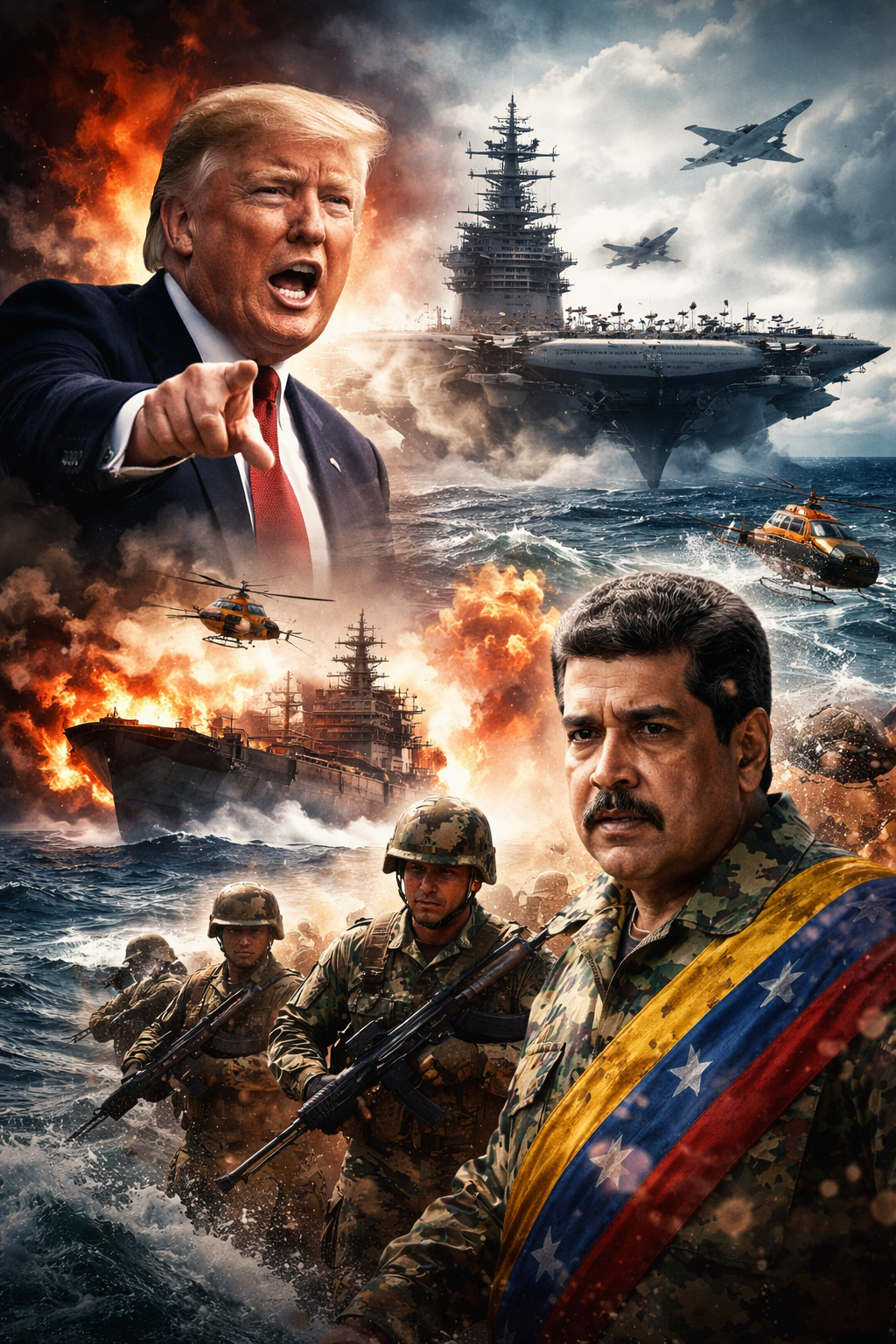
How “Narco-Terrorism” Became the Alibi for Blockade, Sanctions, and the Collision Between U.S. Maritime Power and Venezuelan Sovereignty
When Criminality Explains Everything and War Explains Nothing
Our target is the BBC News report, “Venezuela denounces Trump’s order for ship blockade as ‘warmongering threats’” The article opens with a posture of balance—Washington declares, Caracas denounces—but the balance is performative. From the first paragraph onward, the story is organized so that U.S. power appears as reaction, administration, and necessity, while Venezuelan resistance is rendered as complaint. The reader is invited to move quickly past the meaning of a naval blockade and to dwell instead on the vocabulary that makes it seem reasonable: sanctions, terrorism, drugs, trafficking. War enters the text dressed as paperwork.
The dominant narrative move is substitution. Geopolitics is replaced with criminality. A confrontation between states over sovereignty, resources, and control of sea lanes is re-described as a law-enforcement problem involving “drug smuggling” and “human trafficking.” This substitution is crucial because it relocates the scene of judgment. Once the problem is defined as crime, force no longer needs to be justified as aggression; it presents itself as remedy. The article does not argue this directly. It does something more effective: it assumes it, letting the accusations do the explanatory work that history and political economy would otherwise demand.
Trump’s statements function as the narrative engine. His claims—of a “total and complete” blockade, of the “largest armada ever assembled,” of oil being “stolen” to fund terror—are reproduced with minimal friction. Even when the article acknowledges that evidence has not been publicly provided, that caveat arrives too late and too softly to interrupt the forward motion of the story. The allegation has already done its job. As Marx might put it, the claim circulates like capital: once in motion, it does not require proof to generate value. It only requires repetition.
Authority in the article flows almost entirely from official U.S. voices. Presidential declarations, sanctions data, and military posture are treated as the structural anchors of reality. Venezuelan statements, by contrast, appear as denunciations—emotionally charged, reactive, and largely unexamined. When Caracas calls the blockade theft or piracy, the words are presented as rhetoric rather than as claims rooted in law or history. This asymmetry matters. One side is granted intention and coherence; the other is granted voice but denied standing. The result is a quiet hierarchy of credibility that mirrors the hierarchy of power at sea.
The article also practices a careful amplification of crisis. The language of escalation—deadly strikes, armadas, surrounding forces—creates a sense of urgency and danger, yet the causes of that escalation are left unmapped. There is no timeline of pressure, no accounting of prior actions, no tracing of how we arrived at the brink. Crisis is presented as atmosphere rather than process. By severing effect from cause, the text invites the reader to experience the present as inevitable, as though the blockade emerged fully formed from Venezuelan deviance rather than from a long chain of deliberate decisions.
Perhaps the most consequential maneuver is what can be called criminal compression. The article collapses state authority, economic activity, and alleged crime into a single object: “the regime.” Oil exports, government policy, and transnational trafficking are folded together until distinction disappears. Once this compression is complete, anything associated with Venezuela can be treated as suspect by definition. The political question—how a country trades, governs, and survives under pressure—vanishes, replaced by a moral portrait of contamination. This is not sloppy journalism; it is a disciplined narrative technique that turns complexity into pathology.
Throughout, legality is handled as ambient background rather than contested terrain. Sanctions are assumed to be legitimate instruments, blockades are implied to be enforceable extensions of them, and the leap from economic restriction to naval interdiction is never interrogated as a transformation in kind. The reader is not asked to consider what it means, historically or legally, for one state to announce control over another’s maritime lifeline. The absence is telling. When law becomes atmosphere, power operates most freely.
The BBC’s institutional voice plays a decisive role here. Speaking in the calm tones of professional neutrality, the article metabolizes state language into common sense. There is no need for overt cheerleading; the structure does the work. By arranging voices, sequencing claims, and privileging certain forms of speech over others, the report produces a world in which coercion feels managerial and resistance feels unruly. As Walter Rodney taught us, this is how domination maintains its innocence: not by shouting, but by narrating.
What emerges from this excavation is not a single lie, but a system of sense-making. The blockade is not defended so much as normalized. The accusations are not proven so much as circulated. And the central question—who has the right to move ships, sell oil, and command the sea—is quietly displaced by a more comfortable one: how do we stop bad actors from doing bad things? Once that displacement succeeds, the gunboat no longer looks like a weapon. It looks like policy.
What Happened, What Was Done, and How We Got Here
Once we step outside the narrative fog, a clearer sequence of events comes into view. Donald Trump publicly announced what he described as a “total and complete” naval blockade targeting oil tankers sanctioned by the United States that enter or leave Venezuelan waters. This declaration was not framed as a future contingency but as an active policy posture, backed by existing military deployments in the Caribbean and by recent enforcement actions already carried out at sea. In the same statement, Trump expanded long-standing accusations against the Venezuelan state, describing the Maduro government as a criminal enterprise involved in drug smuggling, human trafficking, and terrorism, language used to justify extraordinary coercive measures.
The blockade announcement did not emerge in a vacuum. Days earlier, U.S. authorities seized the oil tanker Skipper off the Venezuelan coast and were reported to have brought the vessel to the U.S. (Texas) to unload its oil cargo. Washington characterized the seizure as enforcement against an “illicit oil shipping network”, while Caracas denounced it as piracy and the kidnapping of civilian crew members. At the same time, U.S. officials acknowledged that they had conducted multiple lethal strikes on vessels they claimed were involved in drug trafficking operations near Venezuela, actions that reportedly resulted in at least 90 deaths since September. These operations were presented as counter-narcotics missions, though no public evidence was provided to substantiate the specific claims made about the vessels targeted.
In response, the Venezuelan government moved quickly to reframe the confrontation in legal and political terms. Caracas formally denounced the blockade and tanker seizure as violations of international law, freedom of navigation, and national sovereignty, raising the issue before international bodies including the United Nations. Venezuelan officials characterized the U.S. actions as an attempt to seize national resources under the cover of sanctions enforcement, arguing that Washington was unilaterally arrogating to itself the authority to police Venezuelan trade beyond its territorial jurisdiction.
Crucially, developments at sea signaled that both sides understood the situation as materially dangerous rather than rhetorical. Reports emerged that the Venezuelan navy had begun escorting oil and fuel tankers departing its ports, following Trump’s blockade threat. Those departures reportedly included ships carrying petroleum products / oil byproducts.These escorts were intended to deter seizure or interference and marked a significant escalation by increasing the risk of a direct naval confrontation. Whether or not shots were fired, the deployment of armed escorts elevated sanctions enforcement into an overt contest over maritime control.
The economic context underlying these moves is essential. Since 2017, U.S. sanctions have progressively targeted Venezuela’s state oil company PDVSA, senior officials, and entire segments of the country’s energy sector. These measures restricted access to international finance, insurance, shipping services, and conventional trade channels. As a result, Venezuela increasingly relied on improvised and opaque arrangements to move its oil, not as a criminal preference but as a condition of survival under financial siege. The emergence of “shadow fleets” and alternative routing mechanisms was a predictable outcome of exclusion from formal markets.
At the same time, the sanctions regime has never been airtight. Reporting shows that oil exports have continued through narrow, U.S.-licensed channels, most notably via Chevron, which has operated under specific exemptions granted by Washington. This reality complicates the claim that Venezuelan oil exports are inherently illicit or uniformly criminal. Instead, it reveals a system in which legality is selectively conferred, allowing U.S.-approved actors to trade while criminalizing the same activity when conducted outside Washington’s control.
Regionally and internationally, reactions to the blockade have been fractured rather than unified. Mexico publicly called on the United Nations to prevent escalation and urged peaceful negotiation, reflecting broader concerns in Latin America about the return of unilateral military pressure in the hemisphere. Russia and other states expressed diplomatic support for Venezuela’s sovereignty, while many governments avoided explicit endorsement of Washington’s actions. The absence of multilateral authorization underscored that the blockade was not the product of international consensus but of unilateral decision-making backed by force.
The historical dimension deepens the picture. Venezuela has faced naval coercion before. During the 1902–1903 crisis, European powers imposed a blockade to enforce debt repayment, an episode that reverberated across Latin America and helped give rise to doctrines opposing the use of force for economic extraction. That debate left a durable legal and political legacy in the region, shaping contemporary skepticism toward gunboat diplomacy dressed in legal language.
Taken together, these facts establish a clear sequence. Economic sanctions narrowed Venezuela’s legal trade options. Enforcement actions escalated from financial pressure to physical seizure. A declared blockade extended that logic to maritime space itself. Venezuelan escorts emerged as a defensive response to a perceived existential threat. What the BBC article presents as a sudden security crisis is, in fact, the latest phase of a long and deliberate escalation, one that converts economic warfare into a contest over who commands the sea.
From Sanctions to Seizure: How Economic Warfare Becomes Maritime Control
When the facts are placed in sequence, the story told by the BBC begins to unravel. What appears as an emergency response to Venezuelan “criminality” is better understood as the maturation of a long-running strategy: the conversion of economic pressure into direct physical control. Sanctions, seizures, and blockades are not separate instruments pulled at random; they are stages in a single process through which power asserts itself when compliance is not forthcoming. The language of security obscures this continuity, but the pattern is unmistakable.
The central contradiction lies in the way legality is invoked and suspended at the same time. Sanctions are presented as lawful and rules-based, yet their enforcement increasingly depends on actions that stretch, bypass, or openly disregard the legal frameworks they claim to uphold. Financial restrictions morph into ship seizures; trade prohibitions spill into naval interdiction. What begins as economic regulation ends as coercive control of movement. This is not an accident or an overreach—it is the point at which economic warfare reveals its reliance on force.
The repeated invocation of drugs and trafficking functions here as a moral solvent. By framing the Venezuelan state as inherently criminal, the political content of the conflict is dissolved. Once criminality becomes the primary lens, negotiation appears futile, sovereignty becomes conditional, and escalation is recoded as necessity. This move is familiar to anyone who has watched the evolution of imperial doctrine over the last half-century. Political adversaries are not confronted as such; they are reclassified as lawless actors to whom ordinary constraints no longer apply.
Yet the material realities contradict the narrative. Venezuela’s turn toward informal trade routes did not precede sanctions—it followed them. The same system that restricts access to finance, insurance, and shipping then condemns the alternatives it forces into existence. Illegality is produced by exclusion, and exclusion is later justified by the illegality it generates. This circular logic allows economic strangulation to masquerade as crime control, while the underlying objective—discipline through deprivation—remains unspoken.
The blockade threat marks a qualitative shift because it moves the struggle from markets into space. Control over maritime corridors has always been a cornerstone of imperial power, and its reassertion signals a waning confidence in softer forms of dominance. When influence fails, chokepoints become decisive. Ports, sea lanes, insurance markets, and shipping registries are transformed into instruments of command. The sea, once governed by negotiated norms, is reimagined as a zone of unilateral authority.
Venezuela’s deployment of naval escorts must be read within this framework. It is not a gesture of aggression, nor a theatrical challenge, but an attempt to defend the minimal conditions of economic life under siege. For a country whose oil exports underwrite food imports, public services, and currency stability, the ability to move tankers is a matter of social survival. Escorting ships is therefore an assertion of sovereign continuity, a refusal to accept that external powers may unilaterally decide when a nation may trade.
The regional response further exposes the imbalance at work. Calls from Mexico and others for UN engagement and restraint reflect a recognition that unilateral coercion destabilizes the hemisphere as a whole. Yet such appeals are easily sidelined when power is concentrated in naval fleets rather than multilateral institutions. The contrast between diplomatic language and military posture reveals the hierarchy of tools now being prioritized.
Historically, this moment fits within a broader arc of imperial adjustment. As global power diffuses and alternative trade and financial arrangements emerge, coercive enforcement becomes more attractive than persuasion. The criminalization of adversaries, the expansion of extraterritorial sanctions, and the militarization of economic policy are symptoms of an order struggling to reproduce itself. Venezuela’s case is not exceptional; it is illustrative.
From the standpoint of the global working class and peasantry, the stakes are not abstract. Sanctions and blockades do not fall on presidents or ministers; they fall on people whose wages shrink, whose medicines vanish, and whose food systems fracture under pressure. The promise that coercion targets only elites has been disproven repeatedly by lived experience. What is defended as “order” abroad is paid for with austerity and repression at home.
Reframed this way, the BBC’s story no longer reads as a report on security threats. It reads as a snapshot of an imperial system shifting from economic management to overt control, from rules to force, from persuasion to encirclement. The blockade is not an anomaly; it is a warning. It signals the point at which economic warfare, having failed to secure submission, reaches for the gunboat once again.
From Exposure to Organization: Turning Coercion into Collective Resistance
The purpose of laying bare the mechanics of blockade and criminalization is not simply to sharpen critique, but to clarify where struggle already exists and where it must be joined. What is unfolding against Venezuela is not an isolated injustice; it is a rehearsal and a warning. The normalization of sanctions, seizures, and maritime coercion establishes precedents that can be redeployed wherever a society resists subordination. For working people and oppressed nations, the question is not whether this logic will spread, but whether it will be confronted in time.
Resistance to this escalation is already unevenly present. In Latin America, governments and popular sectors shaped by long memories of gunboat diplomacy have called for restraint and multilateral engagement, insisting that disputes be addressed through international forums rather than force. Within Venezuela itself, workers, communal organizations, and public institutions continue to operate under conditions designed to make ordinary life impossible. The decision to escort tankers is part of this broader effort to defend social reproduction against external strangulation, an assertion that survival itself is a political act under siege.
Beyond Venezuela, the confrontation resonates with societies subjected to similar forms of pressure. Countries facing sanctions and blockades have sought alternative trade routes, non-dollar settlements, and regional cooperation to blunt the impact of exclusion from Western-controlled systems. These initiatives are limited and contested, but they demonstrate that coercive architectures depend on compliance to function. Each successful workaround exposes the fragility of an order that relies on denial rather than consent.
For working-class and socialist forces in the Global North, the task is to break the illusion that sanctions and blockades are foreign policy abstractions disconnected from everyday life. Economic warfare abroad feeds militarization, surveillance, and austerity at home. It trains populations to accept collective punishment as legitimate and to view deprivation as a tool of governance. Opposing these measures is therefore not an act of charity toward distant others, but a defense of working-class interests against a system that disciplines through scarcity.
Concretely, this means strengthening and connecting existing anti-sanctions, anti-war, and labor movements that challenge economic coercion as a weapon. Trade unions, tenant organizations, and community groups can expose how sanctions inflate prices, disrupt supply chains, and erode social protections. Independent media and popular educators play a critical role in translating distant conflicts into legible class questions, breaking the isolation that propaganda depends on to survive.
It also requires reclaiming the terrain of international law as a site of struggle rather than a rhetorical ornament. When blockades are imposed without multilateral authorization and seizures occur without due process, these acts must be named and contested as violations, not normalized as administrative tools. Supporting legal challenges, amplifying voices from sanctioned countries in international forums, and pressuring governments to oppose unilateral coercive measures all contribute to weakening the moral immunity claimed by imperial power.
Finally, organization demands historical clarity. The blockade of Venezuela belongs to a long lineage of coercion deployed against societies that attempt to chart independent paths. That lineage has also produced resistance—sometimes defeated, sometimes victorious, always instructive. To mobilize today is to situate this moment within that longer struggle, to reject the lie that there is no alternative, and to insist that dignity under siege is not a crime.
The choice presented by the current escalation is not between order and chaos, as propaganda suggests. It is between a world in which power enforces obedience through hunger and fear, and one in which peoples assert the right to live, trade, and develop without the shadow of the gunboat. Organization, solidarity, and disciplined clarity are how that choice is made real.
 Weaponized Information
Leave a comment