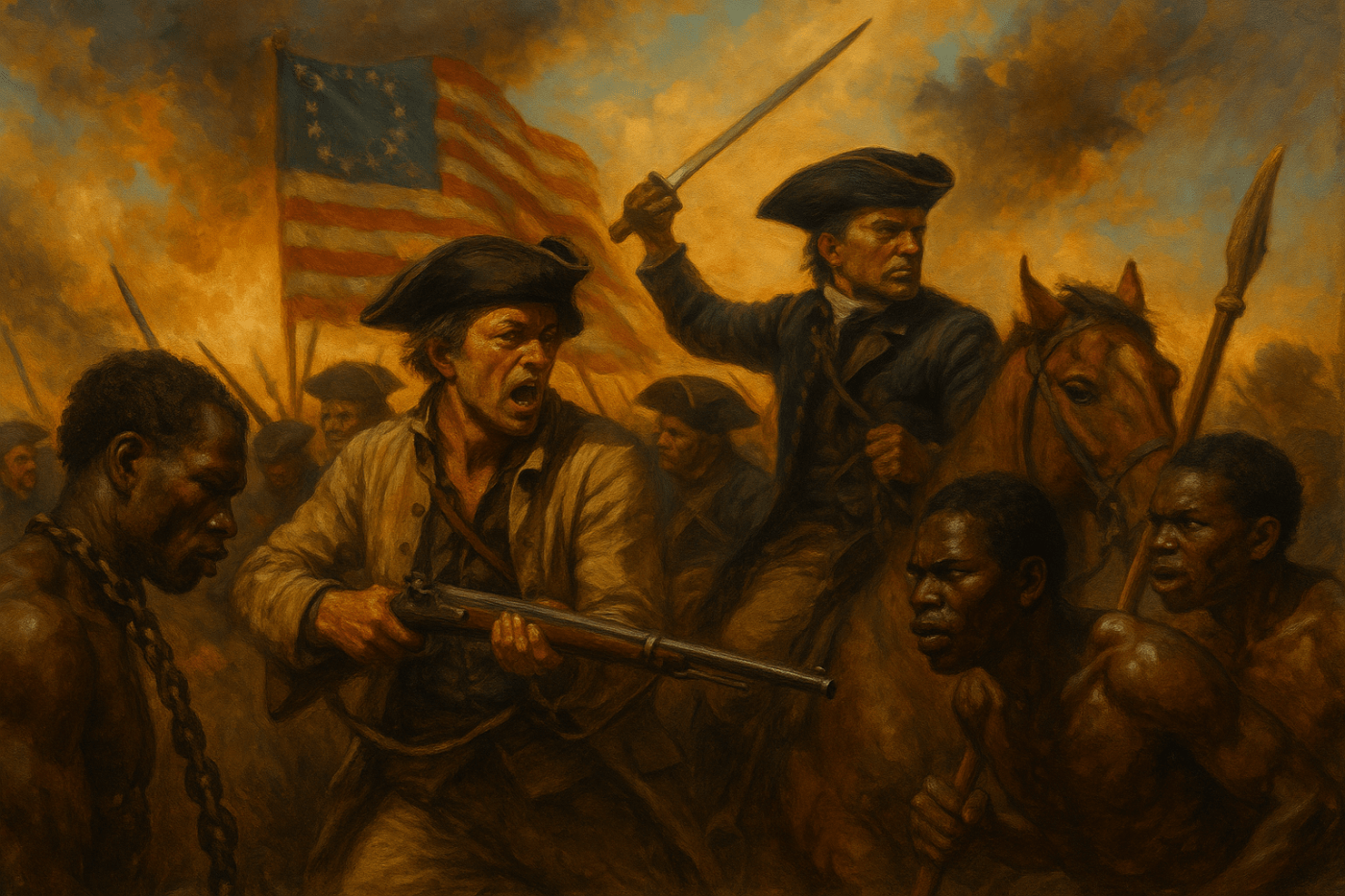
Gerald Horne’s definitive indictment of the American founding — revealing 1776 not as a revolution for liberty, but as a pro-slavery uprising by a settler elite terrified of Black emancipation, Indigenous sovereignty, and the global currents of abolition reshaping the Atlantic world.
By Prince Kapone | Weaponized Information | December 7, 2025
America Was Born to Stop Black Freedom
By the time we get to The Counter-Revolution of 1776, Gerald Horne has done us the courtesy of tearing up the script already. The long sixteenth century showed us how Europe learned to fuse racial violence and capitalism into a single operating system. The seventeenth century laid out how England perfected that system through settler colonialism, plantation slavery, and the invention of the “white republic.” This volume – written before both The Dawning of the Apocalypse and The Apocalypse of Settler Colonialism – doesn’t offer a new fairy tale; it delivers the verdict. The thing that calls itself the United States of America was not born as a break from that world, but as its armed rescue mission. 1776 was not a revolt for liberty. It was a counterrevolution against Black freedom.
Horne’s first move in this book is simple and ruthless: he drags the American Revolution back into the world it actually happened in. Not the sanitized classroom world of powdered wigs and quill pens, but a world already on fire from centuries of Indigenous dispossession and African revolt. The Atlantic in the mid-1700s is not a quiet backdrop. It is a battlefield. Enslaved Africans are mutinying on ships, setting plantations ablaze, building maroon communities in Jamaica’s mountains and South Carolina’s swamps, and cutting into the profits of the very merchants who will later pose as “Founding Fathers.” Imperial officials in London are nervously debating what to do about this social volcano. And every slaveholder from Boston to Barbados knows one thing: if this continues, the world they live off of cannot last.
That is the starting point Horne insists on. Before we talk about “taxation without representation” or tea thrown in harbors, we have to look at the terrified faces of colonial elites watching the ground shift under their feet. For them, the danger is not the British Crown; it is the possibility that the Crown, under pressure from slave resistance, war debt, and shifting moral winds, might start to concede something to Black freedom. Once you read the files, the letters, the speeches Horne pulls from the archives, the pattern is unmistakable: the men who lead the break with Britain speak obsessively about one thing—slavery. They talk about it more than taxes, more than tariffs, more than any high-minded phrase in the Declaration.
From a Weaponized Information standpoint, the book’s introduction is doing surgical work. Horne is not just correcting a few dates or adding “the Black perspective” to an otherwise decent story. He is flipping the whole frame. In the official mythology, enslaved Africans are a backdrop to the revolution at best—anonymous bodies in the fields while white men debate abstract ideals in Philadelphia. In Horne’s telling, enslaved Africans are the main destabilizing force in the system. Their resistance is one of the central reasons the British Empire begins to consider reforms, and those reforms are one of the central reasons the colonists decide to bolt. The enslaved are not extras in this play; they are the people whose threat of freedom forces everyone else to show their hand.
This is why he calls 1776 a counterrevolution. What is being “countered”? Not the tyranny of a king in a powdered wig, but the rising possibility that the empire might move, however slowly and unevenly, toward limiting or even ending slavery in key zones. Jamaica is boiling with revolt; Saint-Domingue is simmering toward what will soon become the Haitian Revolution; enslaved people across the Caribbean and mainland are running, plotting, burning, and negotiating their way toward survival. British elites, eyeing both the balance sheet and the balance of forces, start to talk about curbing the slave trade, tightening regulation, restraining settler expansion, and integrating free Black people and Indigenous allies into imperial structures. For the colonial ruling class, this is not “progress.” It is apocalypse.
Horne piles up example after example where colonial elites say the quiet part loud. They complain that London is tying their hands when it comes to seizing Native land. They rage that the Crown is limiting access to fresh African captives. They obsess over rumors that the British might arm enslaved Africans or offer them freedom in exchange for loyalty. They accuse imperial officials of “inciting” Black and Indigenous people against them. In other words, they are not worried that Britain is too harsh—they are worried that Britain is not harsh enough to sustain the settler order they want.
This is the move that matters for us in 2025. Horne is telling us: if you strip away the patriotic costumes, the American Revolution looks less like a struggle for human emancipation and more like a massive labor and race-control operation. The colonists are not declaring independence from oppression—they are declaring independence for oppression, independence for an economy based on stolen land and stolen labor, independence for a ruling class that fears its own workforce more than any king. 1776 is the moment when a settler elite decides it would rather fight a war against the world than risk living in a reformed empire where Black people might have leverage.
Of course, none of this works unless you can convince ordinary whites—the small farmers, artisans, and land-hungry settlers—that their fate is tied to the fate of the slaveholders. This is where the long arc from Horne’s earlier books comes back in. The seventeenth century had already produced a white republic in embryo, a political community defined not so much by class as by race. Bacon’s Rebellion, Barbados’s slave codes, Carolina’s rice empire: all of that laid the groundwork for poor and middling Europeans to see themselves as “white” first and exploited second. By 1776, the system just has to cash in on that investment.
Horne’s introduction makes clear that this is exactly what happens. The promise of the revolution offered to poor whites is not an end to exploitation; it is a larger share in the spoils of empire. Land in the west once reserved or contested? Now it can be opened up once you get Britain out of the way and Indigenous nations off the map. Political participation? Sure, as long as you are inside the racial boundary. Access to arms and militias? Absolutely—because the new republic needs you as a domestic army to police the enslaved and push the frontier line. What 1776 offers white colonists is not freedom from domination but promotion within the chain of command.
For enslaved Africans, the calculations look very different. Horne shows that many of them rightly perceive the British as the lesser enemy—not because the empire is humane but because it is divided. Governors, judges, naval officers, and imperial reformers occasionally use Black resistance as leverage against rebellious colonists, offering manumission, military rank, or land in exchange for service. It is a cynical game, but it opens cracks in the system. Those cracks are precisely what the colonial elite wants to seal by breaking with Britain. The new republic’s real “self-determination” is the ability to crush Black and Indigenous resistance without imperial interference.
Seen from below, the map looks upside down. The people fighting for something like liberation are not in Independence Hall; they are on the plantations, in the maroon camps, in the regiments of enslaved people who take up arms when told that British law might set them free. The “rebels” in powdered wigs are, in class terms, the conservative force: slaveholders, merchants, land speculators, and their hangers-on, all determined to freeze history at the point most favorable to white supremacy. Horne’s archive work simply brings the receipts.
This is why this third Weaponized Intellects review can’t just repeat the line that “the U.S. is a settler-colonial, white supremacist state.” We’ve already established that in the first two pieces. What The Counter-Revolution of 1776 adds is sharper: the U.S. is a state born in direct response to the threat of Black liberation. It is a political machine designed from day one to lock in slavery against both imperial reform from above and slave revolt from below. The founding trauma of the United States is not that it failed to live up to universal ideals; it is that it rose up in arms to prevent those ideals from reaching Black people at all.
Horne’s introduction closes with a challenge that lands right in the gut of anyone raised on red-white-and-blue mythology: if the country you live in was founded as a counterrevolution against Black freedom, what exactly are you trying to “restore” when you talk about getting America back to its roots? There is no pure democratic core hiding under layers of corruption. The core is the corruption. The roots are slave ships, auction blocks, stolen land, and a settler class so committed to that order that it was willing to shoot at the world’s biggest empire to keep it.
For Weaponized Information, that’s the point of departure. Part I of this review is the opening argument in a political indictment. We are not here to add a “diverse perspective” to the founding myths; we are here to treat Horne’s work as a weapon against those myths. If the long sixteenth and seventeenth centuries built the architecture of racial capitalism, then 1776 is when that architecture gets a new nameplate and a fresh coat of patriotic paint. The chapters that follow will walk through the specifics—Somerset, Dunmore, Jamaica, maroon wars, Indigenous alliances, Spanish maneuvers—to show, step by step, how the United States came into being not as a revolution, but as the most successful counterrevolution the slaveholding world could imagine.
A World Already in Revolt: How Black Resistance Set the Stage for 1776
Once Horne leaves the introduction and steps into Chapter 1, the floor drops out from under the usual origin story. The “road to 1776” doesn’t begin with pamphlets in Boston or debates in taverns; it begins in the cane fields and mountain strongholds of the Caribbean, where Africans had already been fighting a long, dirty war against slavery for generations. If you read the imperial records the way Horne does, the eighteenth century doesn’t look like a gentleman’s disagreement over taxes. It looks like a system cracking under the pressure of people who refuse to stay in chains.
Jamaica sits at the center of this storm. For London, it is a jewel and a nightmare rolled into one island. The profits from sugar and slavery are enormous, but so is the fear. African fighters rooted in Kongo, Ndongo, Akan, and other military traditions turn the interior into a zone of permanent insurgency. Maroons negotiate treaties, raid plantations, and force the Crown to treat them as a political reality instead of a problem that can be whipped away. Horne walks us through the dispatches of governors begging for troops, the memoranda of nervous officials calculating rebel numbers, the desperate measures taken just to keep the colony from going up in smoke. These are not side stories. They are the tremors that shake the whole imperial edifice.
The mainland colonists are watching. Planters in South Carolina and Virginia follow Jamaican revolts almost the way modern markets follow oil prices. They know that what happens in the Caribbean today can happen in Charleston tomorrow. Horne shows them reading of conspiracies in Antigua, uprisings in Suriname, shipboard mutinies in the mid-Atlantic—and then turning to their own plantations, where Africans often outnumber Europeans by terrifying ratios. The question gnawing at them is not “Are we British enough?” but “How long can this system hold before the Africans here try the same thing?”
This is where Horne quietly shifts the center of gravity. The crisis of empire is not primarily about “constitutional rights”; it is about whether the sheer level of African resistance can be managed. Every rebellion forces London to rethink policy: how to regulate the trade, how many soldiers to send, whether to limit settler encroachment on Indigenous land that might push Native nations into alliance with the enslaved. For the colonial elite, each of those questions has the same answer: anything that weakens white control is a threat.
Horne doesn’t romanticize the British here. The Crown isn’t suddenly woke; it’s scared and calculating. But the fact that imperial officials have to calculate at all is what matters. Africans in Jamaica, Antigua, and elsewhere make themselves un-ignorable. They force reconsideration in the metropole. They insert uncertainty where the planters want certainty. By the time we approach the 1770s, the Atlantic is not a stable highway for commerce but a contested zone where African struggle shapes the decisions of kings, merchants, and ministers.
From a Weaponized Information standpoint, Chapter 1 gives us the material foundation for everything that follows: enslaved Africans are not the backdrop to the drama; they are the ones pushing the story forward. The colonists will later shout about “liberty,” but what they are really trying to do is regain control over a situation Africans have already destabilized. When we say that 1776 was born out of fear of Black freedom, this is the fear we mean—a fear sharpened year after year by news of uprisings that make the whole plantation order look like it might be living on borrowed time.
When the Empire Blinked and the Settlers Panicked: Somerset, Abolition Currents, and the Colonial Fear of Freedom
If Chapter 1 is about the fire in the cane fields, Chapter 2 is about the spark that lands in the legal heart of the empire. In 1772, a case that should have been a narrow dispute between a man named James Somerset and the master who tried to drag him back into bondage explodes into something much larger. The ruling of Lord Mansfield—that slavery has no basis in English common law and cannot be enforced on English soil—doesn’t abolish slavery across the empire. But it sends a signal, and signals travel fast.
Horne’s method here is almost clinical. He traces how news of Somerset v. Stewart ripples outward: through London drawing rooms, into colonial newspapers, across plantation dinner tables. On paper, nothing changes in Virginia or South Carolina. In the minds of the planter class, everything changes. If stepping onto English soil can make an enslaved person unenslaveable, what happens if that idea metastasizes? What happens if Parliament, under pressure from abolitionist agitation and imperial crisis, begins to talk seriously about restricting the trade or constraining slavery where it is most profitable?
The sources Horne brings forward are full of this anxiety. You see colonial commentators brooding over the case, clergy warning that God’s ordained order is under legal attack, lawyers speculating grimly about imperial precedents. The ruling frees one man but unleashes a far more dangerous force: the thought that the law might, under certain conditions, recognize the enslaved as human beings with claims the master must respect. In a system that depends on the opposite assumption, that thought is dynamite.
Horne places this legal tremor alongside other unsettling signs: growing abolitionist talk in the metropole; more petitions against the trade; occasional court decisions that side with the enslaved or free Black people in contested cases. None of this amounts to a straight line toward emancipation, but that is not how the colonists read it. From their vantage point in a slave society, the line only needs to tilt a little to look like a coming avalanche.
The fear is sharpened by demographics and geography. In plantation regions, Africans make up massive segments of the population. Indigenous nations still control huge stretches of the interior. British policy after the Seven Years’ War—especially the Proclamation of 1763 limiting westward expansion—already feels like an insult to settler entitlement. Add the possibility that London might cool on slavery, and the whole colonial project starts to look exposed. Somerset becomes shorthand for an empire that may no longer be a safe umbrella for racial capitalism in its most naked form.
Through the WI lens, this chapter isn’t just a story about a court case; it’s about how the colonists think politically. When they talk about “slavery,” they are not only talking about labor; they are talking about a whole structure of power that keeps Africans at the bottom, Indigenous nations off the land, and Europeans on top. Somerset threatens to introduce ambiguity into a system that relies on brutality presented as common sense. That ambiguity—however remote, however contested—is intolerable to a class that wants guarantees, not debates.
By the end of Chapter 2, the road to open revolt is clearer. It’s not that Somerset alone “causes” 1776. It’s that the decision crystallizes a deeper realization among the colonial elite: the British Empire, under pressure from the very people it has enslaved and dispossessed, might no longer be willing to underwrite their project on the old terms. Once you see that, talk of separation stops being a distant fantasy and starts sounding like a plan.
Running Toward the Redcoats: Why the Enslaved Chose the Crown Over the Colonists
After laying out how African revolt shakes the empire and how Somerset rattles the planter class, Horne turns to the people everyone pretends were silent: the enslaved themselves. Chapter 3 follows their footsteps—quite literally—as they make the most important political choice of the entire conflict. When war breaks out between Britain and the colonists, tens of thousands of enslaved Africans do not wait to see who wins. They start moving.
The movement has a date and a voice. In November 1775, Lord Dunmore, the royal governor of Virginia, issues a proclamation promising freedom to any enslaved person belonging to rebel masters who will bear arms for the king. In Patriot memory, Dunmore becomes a villain for “inciting slave insurrection.” In Black memory—and in Horne’s account—he becomes something else: proof that the British split with the colonies can be turned into a crack in the walls of bondage.
Horne traces the aftermath with care. As word of the proclamation spreads, enslaved people flee plantations in waves, sometimes alone, sometimes in family groups, sometimes in improvised columns heading for British lines, ships, and garrisons. Many are intercepted and killed. Many die of exposure or disease. But the movement doesn’t stop. The enslaved understand the stakes. They are not deserting a neutral ground; they are escaping from a class of men whose entire lives are built on their unfreedom, toward an imperial force that, for its own reasons, has just announced that Black bodies can have a different status if they switch sides.
The colonists’ reaction gives the game away. Horne brings in their letters, legislative resolutions, and newspaper editorials, and the tone is panic. The danger they describe is not primarily redcoat regiments; it is what they call “domestic insurrection.” They accuse the British of weaponizing the enslaved against them, of tearing at the “bonds” between masters and “servants,” of unleashing chaos. Long before modern counterinsurgency manuals, they understand exactly what happens when the people at the bottom of a system see a route out: the whole structure wobbles.
What Horne refuses to do is reduce this to British benevolence. He is blunt: the empire arms Black people because it needs soldiers, laborers, guides, and intelligence. Many of the promises made to the enslaved are broken, especially once the war is lost. But from the perspective of the people running toward British lines, the calculus is rational. On one side, a rebel camp led by men who openly defend slavery and reserve citizenship for whites. On the other, a conflicted empire that sometimes manumits those who fight for it, relocates Black Loyalists, or at least complicates the planter’s claim to absolute ownership.
In WI terms, this chapter is the clearest rebuttal to the mythology of “our revolution.” If the American cause is truly the cause of liberty, why do the people with the least liberty overwhelmingly reject it? Why do those with the most to gain from real emancipation gravitate toward the king, not the Congress? Horne doesn’t answer with moral abstractions; he answers with the movement of bodies across contested territory. The enslaved vote with their feet, and they do not vote for America.
By centering those choices, Horne flips the moral map. The colonists’ “freedom struggle” looks, from below, like a project to keep Black people in place. The British, for all their crimes, become a temporary lever in the hands of the enslaved. And the enslaved themselves emerge as the most lucid strategists in the story: they read the balance of forces, identify the fracture line that favors them, and move toward it with a clarity that makes the rhetoric of Philadelphia look like theater.
When Freedom Became a Crime: Why the Colonists Rebelled Against Emancipation
By the time we reach Chapter 4, Horne doesn’t need to argue in the abstract that the American revolt is a counterrevolution. The colonists have already said it, again and again, in their own words. What he does here is gather those words, line them up, and let them testify. When you strip away the ceremonial language about “rights” and “liberty,” what remains is a hard core of complaints about Britain’s refusal to guarantee the future of slavery and unrestrained land theft.
Horne digs into colonial pamphlets and resolutions from the 1760s and 1770s. You see how many of them circle the same themes: anger at imperial attempts to regulate the slave trade; fury at any suggestion that westward expansion might be limited; outrage at proclamations that recognize even the most minimal Indigenous rights. We are used to hearing about the Sugar Act, the Stamp Act, and the Townshend Acts as if economic policy alone drove the break. Horne reminds us that these were layered onto a deeper struggle over who controls the basic social order in the colonies—especially the relationship between white settlers and Black labor.
It’s not just Dunmore’s Proclamation that spooks the elite, though that is a tipping point. They are equally alarmed by smaller signals: imperial officers who talk to enslaved people as potential allies, judges who sometimes rule against cruel masters, debates in London that connect the trade to moral disgrace. Each of these is read not as an isolated annoyance but as part of a trend: a center of empire that may, over time, be pushed by Africans, abolitionists, and rival powers into limiting the most extreme demands of the colonial ruling class.
In this context, “freedom” in Patriot discourse begins to look very specific. Freedom means the ability to buy, sell, and discipline Africans without anyone in London meddling. Freedom means the right to convert Indigenous land into private property at a pace dictated only by settler appetite. Freedom means that no royal governor will ever again dangle emancipation as a weapon in a political dispute. Horne doesn’t have to editorialize much; the colonial record is full of men who explicitly describe British policy as dangerous because it emboldens the people they want to keep beneath them.
What emerges is not a contradiction between “good ideas” and “bad practice,” but a unity: the colonists’ lofty language provides cover for a very concrete program of racial and class domination. They are not hypocrites who accidentally fall short of universal principles. They are politicians who chose their principles to fit their interests. The moment the empire looks like it might tilt, even slightly, toward the enslaved and the dispossessed, those principles shift from talk of loyalty to talk of independence.
From a WI standpoint, Chapter 4 is where we stop treating the founding as a tragedy of unrealized ideals and start seeing it as a success from the point of view of the men who made it. They wanted a state in which no metropolitan power could ever again interfere with their ability to own other human beings and seize land. They got it. The cost was war, but the reward was a political order better suited to their needs than the old imperial arrangement could ever be.
The Cartography of Counterrevolution: How White Settler Unity Was Invented to Defend Slavery
One of Horne’s sharpest moves in Chapter 5 is to show that this project could not succeed on planter will alone. There were never enough rich slaveholders to make a revolution by themselves. They needed a broader base—a class of Europeans prepared to see their own future bound up with that of men who owned far more than they ever would. That broader base didn’t appear spontaneously. It had to be built.
Horne walks us through how that building happens. In the early colonial period, “Englishman,” “Scot,” “Irish,” “German,” and “French” are real and often antagonistic identities. There are riots between different European groups, deep religious divides, bitter memories carried from the old country. At the same time, poor whites—indentured servants, landless laborers, small tenants—have more in common economically with enslaved Africans than with the great planters. There are moments of shared rebellion. There are conspiracies that cross the color line. The ruling class reads these as warnings.
The solution they develop is what we now call whiteness. Horne shows the term slowly appearing and hardening in law and policy. Statutes distinguish “white persons” from “Negroes and Indians.” Militia obligations and privileges are assigned on racial lines. Voting and property rules are written so that more Europeans, even poor ones, can participate politically—as long as they are not Black or Indigenous. Punishments for Europeans and Africans who join in rebellion together are sometimes explicitly differentiated, with harsher penalties for the African conspirators. The point is clear: the elite is drawing a thick line between “us” and “them” and inviting struggling Europeans to join the “us.”
What makes this more than cultural prejudice is the role of violence. Horne emphasizes that whiteness is institutionalized through arms. To be “white” in this emerging American sense is to be eligible for the militia, for the right to bear weapons in defense of the colony, for authority over those defined as non-white. In a slave society on stolen land, that is a powerful offer. You might be poor, but you are a member of the policing class. You might be exploited, but you are also enlisted in maintaining someone else’s property relations.
When imperial reforms and cases like Somerset hit, the planter class leans hard on this identity. They present the Crown’s hesitations as an attack on “white rights.” They frame any protection for Indigenous land or tentative constraints on slavery as an insult to “white liberty.” A wide swath of European settlers internalizes this framing, not because it serves their long-term material interests, but because it offers them status, land on the frontier, and the psychic wage of belonging to the ruling race.
Through WI eyes, Chapter 5 is a primer on how to build a reactionary bloc. You take real grievances—poverty, insecurity, resentment toward a distant elite—and you weld them to a project of domination over someone even more oppressed. Then you call that welding “freedom.” Horne isn’t content to say the United States was a white republic; he shows us the construction process. Revolution here doesn’t mean a people rising as one. It means a planter class forging “the people” itself as a racial instrument.
How London Lit the Fuse: British Abolition, African Revolt, and the Colonists’ Descent Into Treason
By Chapter 6, Horne brings the strands together: Caribbean rebellions that won’t stop, legal decisions like Somerset that unsettle the ground, Dunmore’s experiment in Black military emancipation, and the forging of a white settler identity. What he adds now is the pace—a sense of how quickly things move once both sides realize the old arrangement can’t hold.
In London, debates over the slave trade sharpen. Business interests divided between different regions of the empire push competing strategies. Abolitionists start to find their voice. The Crown, facing war debts and global rivalry, looks for ways to rationalize and stabilize the imperial system. That may mean tamping down the most explosive forms of colonial racism—not out of love for Africans or Indigenous people, but out of a desire to keep the machine from flying apart.
In the colonies, the same developments look like betrayal. Horne samples colonial commentary that turns every minor imperial adjustment into evidence of a grand conspiracy against “American liberty.” The Stamp Act and Townshend duties become intolerable not simply because they cost money, but because they symbolize a metropole that no longer treats the colonies as fully trusted partners in domination. When colonists complain that Britain is “enslaving” them, the word is doing double work: it dramatizes their fiscal complaints while denying the reality of actual slavery all around them.
Horne refuses to let that rhetorical trick pass. He sets the colonists’ language against their practice. The same men who invoke “slavery” to describe paying taxes own human beings who can be bought, sold, whipped, and killed for running away. When imperial officials flirt with using those enslaved people as soldiers, the hypocrisy is exposed. The colonists scream about “inciting insurrection” because they know that the people the British are courting are not metaphors. They are the ones whose labor keeps the colonial economy afloat and whose revolt could bring it down.
On the British side, the choice is ugly. Does the Crown hold the line with the colonists and risk more rebellions like Jamaica by continuing to prioritize planter interests? Or does it experiment with leveraging African discontent to discipline those same colonists, at the risk of making a more radical break inevitable? Dunmore’s proclamation is one answer to that question, and it helps close off any route back to the old equilibrium. Once Black freedom is on the table, even in a limited, conditional form, the settler elite sees reconciliation as more dangerous than rupture.
From a WI perspective, this chapter is less about “who was right” in a quarrel between Britain and its colonies, and more about what both sides were trying to preserve. Britain wanted an empire that could survive in a changing world, even if that meant modest reforms and tactical use of the enslaved. The colonists wanted an empire of their own where slavery and land theft would never again be subjected to that kind of higher calculation. When push came to shove, they chose treason against the Crown in order to remain loyal to slavery.
When the World Closed In: Black Rebels, Native Nations, and Rival Empires Against the Colonists
In the later chapters, Horne pulls the camera back one more time. The revolt in North America is no longer just a quarrel between London and the colonies, or even a triangle between Britain, settlers, and the enslaved. It becomes a crowded board with multiple players—Indigenous nations, Spain, France, maroon communities—each trying to turn the crisis to their advantage. The settlers are not fighting a clean, two-sided war. They are trying to claw out independence while surrounded.
Indigenous diplomacy is a major part of this picture. Horne shows leaders from the Haudenosaunee, Shawnee, Creek, Cherokee, and other nations weighing their options in a world where no side has clean hands. Britain has broken treaties and spilled blood, but it has also sometimes tried to regulate settler expansion and drawn lines—like the 1763 Proclamation—that at least acknowledge Native presence. The colonists, by contrast, speak openly of pushing west, dividing land, and clearing out anyone in the way. Faced with these choices, many Native nations decide that an imperial power with global worries is easier to bargain with than a young settler republic drunk on Manifest Destiny before the phrase exists.
Spain and, to a lesser extent, France enter as opportunists but end up creating openings the colonists dread. Spanish Florida and Louisiana become places where fugitives might find shaky refuge or bargain for survival. Spanish authorities sometimes arm Black and Native forces, not out of solidarity, but out of cold imperial calculus: a slave revolt that weakens the British or the upstart Americans is useful. To the settlers looking south and west, these territories look like dangerous edges where the people they’re trying to control can slip away into other jurisdictions, other alliances, other futures.
Through all of this move Africans—still enslaved, newly escaped, organized in maroon camps, enlisted in imperial armies. Horne traces stories of Black Loyalists shipped out with the British, of communities in swamp and mountain regions using imperial rivalries as shields, of people who refuse to let the lines on European maps dictate where they can run or fight. If you follow their paths, the war stops being about flags and becomes about corridors: where can you move that a settler’s writ does not yet run?
The colonists feel this pressure as encirclement. Their letters are full of complaints about “savages” armed by rival powers, about Spain “harboring Negroes,” about Britain “turning our slaves against us.” They are not just afraid of redcoats; they are afraid of a world in which Black and Indigenous resistance is backed, even temporarily, by other empires. For a project that dreams of exclusive, unbroken control over a continent, the very existence of alternative power centers is intolerable.
From the WI angle, these chapters read like an early lesson in internationalism from below. The enslaved and the colonized are not naive about Britain or Spain. They don’t confuse imperial tactics with liberation. But they understand that cracks between ruling classes are opportunities. A multi-polar imperial order, for all its horrors, allows more room to maneuver than a single consolidated settler state built on whiteness. The colonists’ victory will be to reduce those options, to collapse the messy map of overlapping sovereignties into a simpler one where, from Georgia to the Great Lakes, the only power that ultimately counts is theirs.
How a Counterrevolution Became a Country: The Birth of the Slaveholders’ Republic
In the final movement of the book, Horne asks us to look at the thing the colonists build once the smoke clears. If this was a counterrevolution, what does its victory look like in institutional form? The answer is not mysterious. It is written into the founding documents, stamped onto the land, and encoded in the first decades of U.S. policy. The new republic is not a flawed democracy slowly working toward equality; it is a successful attempt to lock in the gains of a pro-slavery revolt.
Horne reads the Constitution the way a prosecutor reads a contract drafted by a criminal syndicate. The clauses about representation and taxation give extra weight to slave states without calling enslaved people citizens. The fugitive slave clause turns the entire union into a hunting ground for masters. Federal power is strong enough to put down rebellions but weak enough, by design, not to interfere with property in human beings. There is no mystery here. The men in that room in Philadelphia knew exactly what kind of society they were codifying, because they had gone to war to preserve it.
On the ground, the new state makes its priorities even clearer. Freed from the minimal restraints Britain sometimes placed on westward expansion, the United States moves immediately and relentlessly against Indigenous nations. Wars, broken treaties, forced removals, and land grabs become the normal rhythm of national life. The same militias and officers who had policed enslaved Africans turn westward to clear Native people off territory slated for white settlement and, often, for new slave plantations. The “liberty” proclaimed in 1776 translates directly into more land for settlers and more space for slavery to grow.
Beyond its borders, the republic chooses its friends and enemies along the same lines. Nowhere is this more obvious than in its response to Haiti. When enslaved Africans in Saint-Domingue overthrow French rule and declare a Black republic, they accomplish what the American Revolution never attempted: the destruction of slavery as a system. For Horne, the U.S. refusal to recognize Haiti, its participation in isolating and punishing the new nation, is not an accidental lapse. It is the logical behavior of a state whose very existence is bound up with the fear that such an example might spread.
Taken together, these threads reveal a simple pattern. The United States carries forward the seventeenth- and eighteenth-century project Horne charted in the earlier books: a world built on racial slavery and settler colonialism. The difference is that the old imperial middleman is gone. There is no longer a metropole that can be pressured, even slightly, by revolts elsewhere. The former periphery becomes its own center, and it organizes itself—constitutionally, militarily, ideologically—to be a more reliable guardian of the slaveholders’ interests than Britain ever was.
For Weaponized Information, the conclusion is not just that the founding myths are lies. It’s that they are functional lies, designed to make a counterrevolution look like a revolution so that generations of people—especially in the white working class—will identify with a project that was never built for their liberation either. Horne’s book gives us the archive and the narrative we need to tear that mask off. It shows that the real revolutionary tradition in this story runs through Black resistance, Indigenous survival, and all those moments when the oppressed turned imperial contradictions to their advantage.
If 1776 gave that counterrevolution a flag, a constitution, and a place in school textbooks, then our task in 2025 is the opposite: to strip it back down to what it really was and to choose sides accordingly. Not with the men in powdered wigs who declared independence for slavery, but with those who, in every generation since, have struggled to finish the work that terrified them.
 Weaponized Information
Leave a comment