How AP News Turns Class Warfare Into Geometry — and What the Numbers Reveal About Imperial Decay, Worker Immiseration, and the Fight Being Waged From the U.S. Streets to the Global South.
By Prince Kapone | Weaponized Information | December 1, 2025
How to Turn a Class Fracture into a Friendly Letter of the Alphabet
The Associated Press piece by Christopher Rugaber, “Here’s why everyone’s talking about a ‘K-shaped’ economy”, dated December 1, 2025, sets out to explain why so many people are suddenly invoking this new letter to describe the U.S. economy. In simple terms, the article tells us that the upper arm of the “K” represents people whose incomes and wealth are rising, while the lower arm represents those who are struggling with weaker income gains and high prices. Around this simple graphic, the piece builds a guided tour through muddled economic signals: solid growth alongside slowing hiring, record stock markets next to fragile household budgets, booming AI-related construction next to weak factory jobs and home sales.
From the first paragraph, the voice of the story is clear. It is written in the calm, measured tone of someone speaking on behalf of “the economy” rather than on behalf of anyone who is being crushed by it. Rugaber’s narrating “we” is the familiar composite figure of corporate media: central bankers, Wall Street analysts, corporate executives, and the political class peering down at the landscape with concern. When he quotes people, they are almost always perched in that same altitude: an economics professor, an executive at a household-name corporation, the CEO of a major airline, the head of a big-box electronics chain. They are the ones who get to describe what is happening and what it means. Those who live on the bottom arm of the K appear mainly as an object of study—“lower-income consumers,” “those living paycheck to paycheck”—rather than as subjects with their own voices.
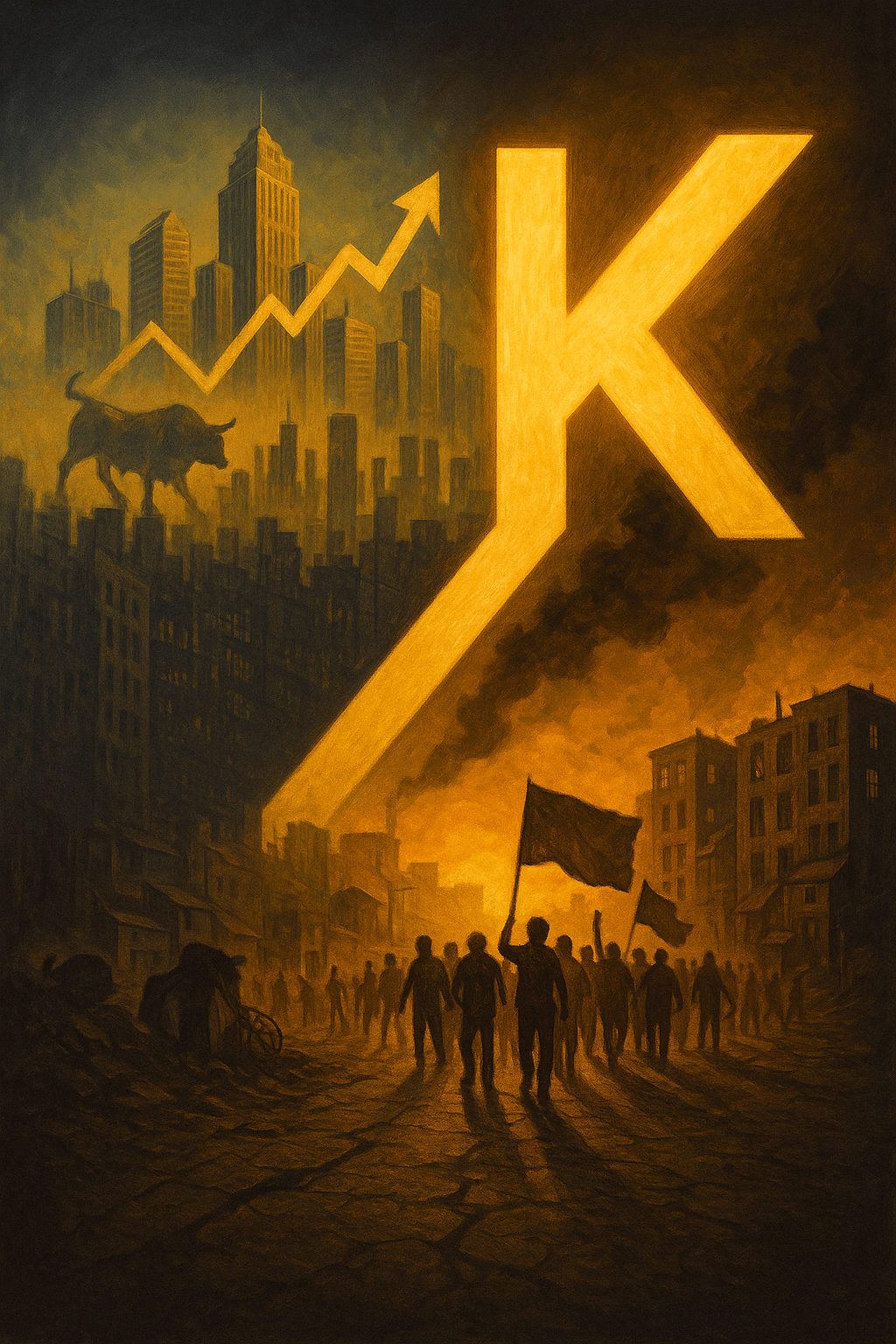
One of the central devices in the article is the metaphor of the “K” itself. Instead of speaking about conflict, exploitation, or even basic unfairness, the piece asks the reader to imagine a letter: two lines moving in opposite directions, simple and symmetrical. The metaphor works like a soft-focus filter. Sharp edges become smooth curves. A deep social fracture gets translated into a geometric pattern. Once everything is moved into that visual frame, the role of the reader is not to question why one line is rising and the other is falling, but to nod along as experts debate how this peculiar pattern might affect consumer spending, earnings calls, and interest rate decisions.
The article’s language gently distances the forces at work from any sense of responsibility. Wage growth doesn’t slow because of decisions; it just “slows.” Inflation doesn’t result from anyone’s actions; it simply “remains elevated” or “pressures households.” AI investment “soars,” stock prices “hover near record highs,” data centers “boom” – all described as if they were acts of nature rather than concrete choices made by specific groups of people. In the same way, the pressure on people at the bottom of the K is acknowledged, but wrapped in soft terms: they “feel less able to spend,” “struggle with affordability,” “live with the cumulative impacts of price inflation.” Their condition is real enough to be noticed, but never sharp enough to feel like an indictment.
Another key narrative move is the way the article organizes time and emotion. It briefly recalls an earlier moment, in the immediate aftermath of the pandemic, when lower-paid workers saw faster pay increases and commentators stopped talking about a K-shaped economy. That episode is presented as a kind of hopeful interruption, a short season when “the bottom was catching up.” Now, we are told, things have cooled down again. The symmetry is neat: a brief period of convergence, then a return to divergence. The effect is to present the current divide as part of an ebb and flow, something that comes and goes like the tide, not a pattern with a direction and a cause.
The voices chosen to interpret this moment are just as important as the ones left out. Executives from global brands step in to explain how they see consumer behavior: the demand for “premium” products alongside hunger for cheaper, smaller packages; first-class airline tickets selling briskly while budget travelers “clearly struggle.” Their comments are framed as practical observations, even a bit of savvy customer insight, rather than as windows into how companies are repositioning themselves toward the top arm of the K while squeezing what they can from the bottom. There is no worker in this story explaining what it means to watch prices rise while paychecks stall, or to rely on credit cards for basic survival. The article doesn’t need those voices; it lets managers speak about them instead.
The emotional arc of the piece is also carefully managed. Early on, we are invited to feel a kind of puzzled concern: the economy is “muddy,” the signals are “convoluted,” growth is solid but people are uneasy. Midway through, the tone shifts toward quiet worry: economists “worry” about sustainability, companies are “watching closely,” some households are “living paycheck to paycheck.” And at the end, the story offers a soft landing. We are told that tax refunds might provide relief, that a new central bank leader may cut interest rates, that there is a “different path” more likely than a hard crash. The reader is left with the impression that, yes, there is a split, yes, some people are hurting, but responsible adults in suits are on the case and there are plausible adjustments on the horizon.
All of this—the choice of who speaks, the metaphors used, the way causes are blurred into trends, the absence of certain voices, the reassuring final note—works together to produce a very specific effect. The reader is encouraged to see the divide between those on the top and those on the bottom not as something anybody actively constructed, but as a strange pattern that emerged on the chart of a complex system. The problem is rendered legible only through the eyes of those who profit from that system or manage it. The people living on the lower arm of the K are visible only at a distance, as silhouettes in the background of someone else’s story.
The Long Road to the K: Policy, Paychecks, and the Making of a Split Economy
If you only read the AP story, you’d walk away thinking the K-shaped economy is some quirky new plot twist—an odd moment when the folks at the top float higher while everyone else sinks. But anyone who has lived through the last half-century knows better. Once you start stitching together the public data scattered across decades, the pattern is unmistakable. This divide wasn’t a surprise; it was engineered. It came from policy decisions made in well-lit rooms: tax cuts for the wealthy, trade deals that gutted industrial cores, deregulation that turned finance loose, and an all-out assault on unions. It came wrapped in the language of “reform,” but its meaning for the working class was the same: tighten your belt, keep your head down, wait your turn—while the rich were told to loosen theirs and grab everything they could carry.
The AP mentions that the richest households own most of the stocks. True. But it doesn’t bother to explain how this mountain of concentration was built. The Federal Reserve’s Distributional Financial Accounts show the top 10% now holding roughly two-thirds of all household wealth, while the bottom half together hold barely anything. When you isolate stocks and mutual funds, the picture sharpens: the top owns almost all of it; the bottom scraps by with crumbs. That outcome didn’t fall from the sky. Starting in the early 1980s, Washington slashed the top marginal income tax rate from about 70% to 50%, and then down to 28%—the kind of generosity toward the rich that would’ve made the robber barons blush. Historical series from the Tax Foundation and the Bradford Tax Institute confirm the timeline: the Tax Reform Act of 1986 made sure the wealthy kept even more. Meanwhile, capital gains and dividends—the income of people who don’t work with their hands—were given preferential treatment, documented in Congressional Research Service work on capital income taxation and historical capital gains rate series. Estate taxes were hollowed out next: exemptions lifted from under $1 million to nearly $14 million per person, as outlined by the Congressional Research Service, estate-tax archives, and the IRS. Layer after layer, policy hardened into a fortress for the wealthy. Research from the Institute for Policy Studies and investigative work like the Center for Public Integrity’s report on four decades of tax-cut-driven inequality fill in the rest. And the World Inequality Report situates the U.S. squarely inside a global pyramid where the top 10% capture more than half of income and over three-quarters of wealth. America’s K-shape sits inside a worldwide hierarchy carved by the same logic.
The AP mentions that wages for low-income workers briefly outran those at the top after the pandemic—before cooling off again. Minneapolis Fed researchers confirm it: by 2025, bottom-quarter wage growth slowed to around 1.5% while the top kept closer to 2.4%. But these short-term fluctuations ride on top of a much longer betrayal. Since the late 1970s, productivity soared while wages flatlined. Workers created mountains of value they never saw. During that same period, union density collapsed—from one-third of workers in the 1950s to about one in ten today, documented by the U.S. Treasury and by research like the CRS report on private-sector unionization. The state made its position clear in 1981 when Reagan fired 11,000 striking air-traffic controllers—the moment captured by the Association of Flight Attendants. After that came right-to-work laws (NBER), offshoring (ILO), and the normalization of union-busting (EPI). Every blow weakened workers’ power to claim the wealth they produce. Add deindustrialization—millions of manufacturing jobs gone since 2000 (EPI) and regional devastation documented by Pierce & Schott. The bottom half of the K didn’t emerge naturally. It was carved into the landscape by decisions that funneled people from union jobs into gig work, temp work, and permanent precarity—exactly the world described in UNCTAD’s 2024 report.
The AP says low-income households are squeezed and spending less. True again. But look at the banks’ own figures and the story sharpens. The Bank of America Institute shows widening spending gaps; its “Gains and Gaps” brief adds detail. The Boston Fed and Fed in Print show the same: almost all consumption growth since 2022 came from the top. Meanwhile, the New York Fed’s 2025 Q3 Household Debt Report reveals total household debt smashing through $18.5 trillion, with details confirmed in their data tables and Reuters. Credit cards and student loans lead delinquency transitions. And if you want to know what that looks like on the ground, ask the people surveyed in the Clever Real Estate polling cited by InvestorsObserver, or the households described in KBTX’s reporting, or the Urban Institute’s data on families going into debt just to buy groceries. The bottom half isn’t surviving on wage growth. They’re surviving on plastic—and paying interest for the privilege.
The AP mentions the stock market but skips the political architecture that made Wall Street the sun around which the modern economy orbits. In 1999, the Gramm–Leach–Bliley Act tore down the Glass–Steagall wall separating commercial and investment banking—a demolition affirmed by the Congressional Research Service. In 2000, the Commodity Futures Modernization Act opened the floodgates on unregulated derivatives, as Better Markets details. After the 2008 crash, the Fed expanded its balance sheet from $870 billion to $2 trillion almost overnight—eventually reaching $9 trillion during the pandemic. These interventions inflated asset prices and fortified the top of the K. Corporate behavior followed suit. IMF research in Finance & Development shows markups rising from 20% to 60% since 1980, echoed by broader IMF analysis on global corporate markups. Instead of investing productively, firms shoveled profits into shareholder pockets: documented in IMF reports on buybacks and dividends, and in critical work like the Roosevelt Institute and Lazonick on “profits without prosperity”. Oxfam’s recent findings add the final indictment: $1.5 trillion in payouts in 2024 alone. No wonder IMF stability reports find asset prices repeatedly stretched to the edge while paychecks stagnate. The rich rode a rocket built from policy; workers were told to admire the view.
The AP frames AI as background scenery—servers humming, stock charts rising. But the research behind the headlines shows a different kind of story. A Brookings study estimates that over 30% of workers face automation of half their tasks, and UNCTAD warns that AI will eliminate or reshape far more jobs than it creates. The OECD’s digitalization study shows the same: rising productivity, rising profits, but very few new jobs. The gains flow to a tiny elite of firms. A Brookings analysis shows a small cluster capturing most AI-driven profits. The “Magnificent 7” have dominated market gains since 2023, built on AI and cloud empires. And because the top 10% own almost all the stocks, the boom rains upward.
None of this is happening in a vacuum. The same global bodies tracking domestic inequality see the international storm brewing. UNCTAD’s Trade and Development Report 2024 warns that global growth has slowed to around 2.7%, too weak to tame inequality or climate chaos. The ILO’s Global Wage Report shows that global real wages went negative in 2022 for the first time this century. The World Inequality Report shows the rich capturing the bulk of global growth for decades, with the top 1% pulling away. And the dollar? UNCTAD’s World of Debt is clear: U.S. rate hikes hammer the global South, driving up borrowing costs in countries chained to dollar-denominated debt. When fear rises and capital stampsede into U.S. assets, Treasury and equity prices jump, enriching the asset-owning class in the core. The upper arm of the American K has a global supply chain: cheap labor abroad, punitive debt regimes, capital flight that props up Wall Street. AP doesn’t mention it—but the world economy is written in the silhouette of that K.
Put it all together and the story becomes painfully clear. The K-shaped economy didn’t materialize overnight. It was built over decades by concrete policy choices: tax cuts for the rich, weakening unions, trade deals that hollowed out industry, financial globalization, and technology that concentrates power. The AP gives a snapshot. The data show the machine behind it—one that has been running for fifty years, churning out inequality with the precision of an assembly line. The K is not an accident. It’s the architecture of an era.
The Monster We Built: Reframing the K Through Stagnation, Monopoly, and Imperial Power
When you look at the mountain of evidence in Part II, a pattern emerges that can’t be captured by the polite geometry of a “K-shaped economy.” The figures point to something far more structural: a capitalism that has outgrown the old promises of shared prosperity and settled into its mature form—stagnant, financialized, and dependent on widening inequality both at home and across the world. In the language of the Monthly Review tradition, what we’re seeing is the political economy of monopoly-finance capital playing out in real time. Once this framework is applied, the K stops looking like a curiosity and starts looking like the inevitable outcome of a system that can no longer reproduce itself through production, and thus must reproduce itself through extraction.
Consider the first major contradiction: wealth accumulation at the top is no longer tied to rising production but to the inflation of financial assets. This is the classic tendency of a system stuck in stagnation. When productive investment no longer delivers the returns capitalists expect, the surplus generated in society does not disappear — it must go somewhere. It flows into the easiest outlets available: speculation, asset inflation, share buybacks, and monopoly rents. This is the Monthly Review understanding of surplus absorption. The numbers in Part II show it clearly: profits rise even when wages stagnate, stocks surge even when production stalls, and asset values explode even as household incomes barely move. The top half of the K rises not because the economy is “healthy,” but because the ruling class has developed ever more sophisticated mechanisms to absorb surplus in ways that do not require raising wages or expanding productive employment.
Now look at the bottom half of the K. Workers’ wages stagnate for decades, labor’s share of national income remains depressed, debt balloons as a substitute for income, and basic consumption is increasingly financed on credit. This is not an accidental imbalance. It is the domestic consequence of a global structure. For half a century, U.S. firms turned toward global labor arbitrage—seeking cheaper workforces abroad in order to maintain profit rates at home. What looks like “deindustrialization” from a domestic view is, from a global perspective, the movement of capital to regions where labor is cheaper, protections are weaker, and resistance is more easily disciplined. The K inside the United States is therefore inseparable from the K that spans the world system: the rise of a narrow elite feeds on the immiseration of the many.
This is where the concept of imperialist rent becomes unavoidable. The wealth gains at the top are not simply the outcome of domestic policy choices (though those choices mattered, as Part II shows). They also reflect the ability of U.S. capital to extract value from the Global South through unequal exchange, dollar dominance, intellectual property regimes, and the political-military architecture built to enforce compliance. The top of the K floats upward because it is buoyed by rents drawn from global production networks that keep billions in low-wage positions. Meanwhile, the bottom half of the U.S. working class—Black, brown, white, Indigenous, immigrant—finds itself increasingly treated like the periphery within the core: precarious, indebted, and disposable.
Technology intensifies these contradictions. The AP article frames AI as an economic curiosity or a sectoral boom. But from a political economy standpoint, AI is the latest frontier of monopoly power—a new method of organizing production not to spread prosperity, but to concentrate control. The handful of firms dominating this space do not rely on expanding mass employment; they rely on owning the digital infrastructure through which everyone else must operate. This is the twenty-first century version of what Monthly Review thinkers called the “monopoly stage of capitalism”: a world where power is held by those who can wall off whole sectors of life and charge rent for entry. The AI and platform economy doesn’t contradict the K-shaped split; it fortifies it, turning technology into an engine for deepening inequality rather than overcoming it.
Once you map all this together—stagnation at the core, financial speculation as surplus absorption, the external drain of imperialist rent, the internal collapse of labor power, the rise of digital monopolies—you begin to see the K as something more than a stylized graph. It is a political, social, and global structure. It is the visible form of a system that can no longer expand outward in ways that lift the population as a whole, and so turns instead to squeezing both its internal working class and the external populations it has always exploited. The result is what can only be described as internalized uneven development: the periphery reproduced inside the core, the colonial relation reborn within the boundaries of the colonial power itself.
This is why the AP narrative feels so hollow. It misses the totality. It sees the lines but can’t recognize the structure. It points out gaps without naming the system that produces them. The K-shaped economy is not new. It is not temporary. It is not the product of technological disruption or post-pandemic quirks. It is the latest, sharpest expression of the long-term logic of monopoly-finance capital and the imperial world system it built. The top rises because it absorbs surplus globally; the bottom falls because it has been stripped of the capacity to claim the value of its own labor. The K is not a new letter in the alphabet of crisis. It is the signature of an empire aging into its final form.
Turning the Split Into a Signal: Mobilizing the Many Against the Few
If the K-shaped economy shows us anything, it is that the people on the bottom half of that broken letter are not alone. Their position rhymes with the struggles of workers, peasants, and poor communities across the Global South, whose backs have carried the weight of someone else’s prosperity for generations. The divide inside the United States has finally caught up with the divide outside it, revealing a single world of labor standing against a single world of concentrated wealth. And if there is a lesson to draw from that, it is that the future belongs to those who organize—across neighborhoods, across borders, and across the fractures that ruling classes have relied on for centuries.
All around us, movements are already fighting in ways that speak directly to the contradictions exposed by the K. Tenant unions from Kansas City to Los Angeles have formed networks of rent strikers, eviction defenders, and neighborhood mutual aid circles built to survive in an economy that treats housing as a commodity instead of a human right. Workers in logistics, food service, education, and health care have created strike committees that refuse to accept a world where corporations soar while their own lives are squeezed to the bone. Across the Global South, farmers’ movements, anti-austerity coalitions, and community cooperatives continue to challenge the structures that siphon value upward—from Indian farmers blocking highways to African community unions pushing back against price shocks and economic diktats. These are not isolated eruptions. They are the front lines of the same fight.
For those of us in the heart of the empire, the task is to connect these fronts in a way that builds power from the ground up. One path is to focus directly on the corporate giants whose profits depend on widening the divide. Organizing campaigns against these firms—whether through boycotts, worker committees, pressure coalitions, or solidarity strikes—gives people a concrete target rather than an abstract enemy. Another path is to strengthen the community infrastructures that already hold people together: neighborhood food programs, childcare circles, local transit cooperatives, and grassroots protection networks. These are not charity projects. They are the beginnings of institutions that meet human needs without relying on the same forces that created the crisis in the first place.
The digital battlefield is another arena where ordinary people can shift the balance. Building public mapping projects that expose corporate ownership webs, tracking the concentration of economic power, documenting rent hikes and price gouging, and sharing this information freely helps people see the system for what it is and where to push. When communities can trace the lines of power—who owns what, who profits from which decision—they gain the clarity needed to strike effectively, whether through coordinated campaigns, legal challenges, or direct action.
And then there is political education—the slow, patient work that turns scattered frustrations into organized consciousness. Study groups rooted in working-class experience, grounded in the voices of those most affected by the K-shaped split, and connected to the struggles of the Global South help people see that their suffering is not a personal failure but a structural reality. This kind of education builds unity across lines that elites have spent decades dividing: race, nationality, immigration status, neighborhood, job sector. When people understand the forces arrayed against them, they stop fighting each other and start fighting back.
The horizon we face is not predetermined. The top of the K will not collapse out of moral exhaustion; the bottom will not rise simply because the numbers become too grotesque to ignore. Change will come when people refuse to accept the terms of their immiseration and link their struggles to the millions worldwide fighting the same battle. The task is simple, even if the work is not: turn isolation into solidarity, turn precarity into organization, turn the fracture of the K into the fault line that shakes the whole structure loose. The future belongs to those who build it together.
 Weaponized Information
Leave a comment