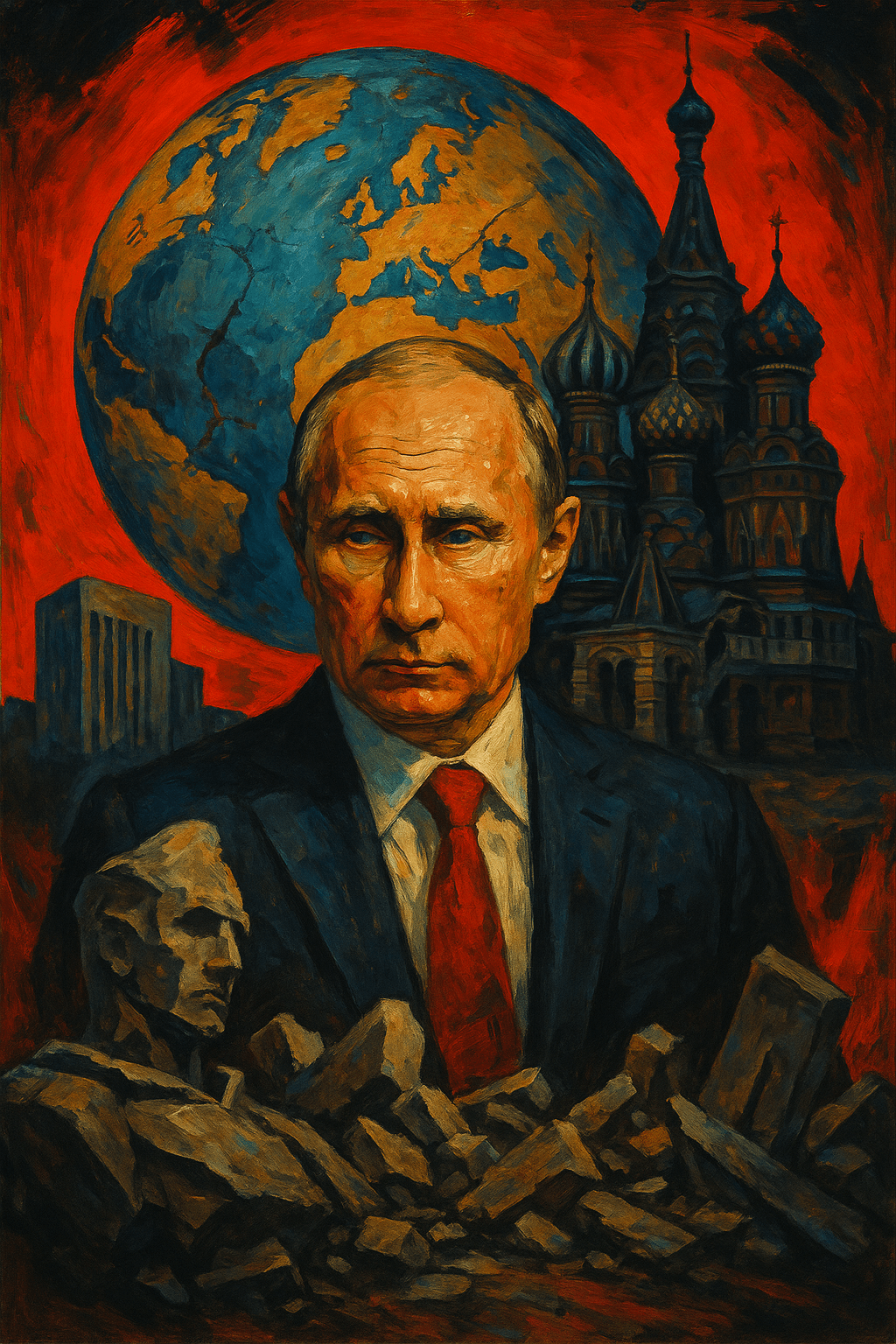
How Tony Wood’s corrective to Western liberal delusion stops short of anti-imperialist clarity — and what it reveals about the NATO Left’s crisis of thought.
Weaponized Intellects Book Review Series | By Prince Kapone | Weaponized Information | November 19, 2025
“Too much attention has been paid to the man, and not enough to the system over which he presides.” — Tony Wood
The Mirror of Western Marxism
Tony Wood’s Russia Without Putin is a sober and necessary antidote to the hallucinations that pass for analysis in the Western press. Against the endless spectacle of Putin-as-omnipotent, Wood insists that the Russian system has a logic of its own—one not reducible to a single man’s whims or a cartoon villain’s desires. This is an important correction. But it is still a correction written from within the West’s ideological mirror, where Russia exists mostly as a problem for Europe to interpret, not as a living society besieged by empire.
Wood dismantles the cult of personality only to leave the cult of Western moral authority standing. His pages breathe with a restrained decency: careful, documented, and critical. Yet what he ultimately asks us to do is see Russia “more clearly” through Western eyes. This clarity, however, remains bound by the limits of Western Marxism—a school that can describe capital in its Russian manifestation but cannot recognize imperialism when it wears a NATO flag. The book is an invitation to think beyond personalities, but not beyond the empire’s epistemological border.
In the capitalist core, “Putin” has become a moral placeholder—a single name onto which every anxiety of the liberal world is projected. The NATO Left, ever eager to prove its moral hygiene, chants the same script: Putin is the reason for everything wrong with Russia, the world, and their own irrelevant politics. They perform radicalism by condemning an Other safely external to their own privilege. It’s the oldest colonial reflex in Marxist clothing. Wood challenges this reductionism, yet he never fully escapes its gravitational pull. He dismantles the cult of the czar only to leave the catechism of the West unbroken.
Still, his starting point is valuable. By tracing Russia’s political economy from the ashes of the Soviet Union, Wood reminds us that Putin did not fall from the sky; he rose from the ruins of a neoliberal massacre administered by Harvard boys, IMF clerks, and local comprador oligarchs. The state he inherited was a wounded survivor of capitalist restoration. To stabilize it, he fused private plunder with public command—what Wood calls a system of “money and power.” In other words: state capitalism. Yet even here, the author stops short of calling the thing by its global name. He sees Russian capitalism but not the world capitalist system that encircled and disciplined it. He sees internal contradictions but not siege warfare.
For us, reading through the lens of Weaponized Information, this is the decisive omission. Russia today is not neoliberal in the Washington Consensus sense, nor imperialist in the Leninist sense. It is a state-capitalist formation born of defensive necessity. Its partial public ownership, military-industrial backbone, and surviving social guarantees are not relics of Soviet nostalgia—they are the minimum conditions for survival under economic blockade. When Wood calls this system “authoritarian,” he unconsciously repeats the vocabulary of those same Western institutions that created the conditions for its existence. Every time he invokes democracy, we can hear the faint echo of the IMF’s applause for Yeltsin as he shelled his own parliament in 1993.
The question that Wood poses—“Can Russia change without Putin?”—is already contaminated by Western premises. It assumes that Russia’s problem is leadership, not siege. It measures Russian politics against the moral geometry of liberal democracy rather than the geopolitical reality of encirclement. In doing so, it turns history into therapy: the West asks Russia to “heal” from its authoritarian trauma while NATO fortifies every border it can reach. This is what passes for solidarity among the imperial Left: criticism without context, empathy without analysis, and always, always the assumption that the cure must come from the doctor with the drone.
But history has its own sense of irony. Every liberal who decries Putin’s “aggression” forgets that Russia’s current militarization is the arithmetic consequence of three decades of Western expansion. Each “color revolution” celebrated in the pages of the Guardian or Le Monde arrived like a Trojan horse—carrying NGO technicians by day and CIA contractors by night. What Wood calls “reactive geopolitics” is, in fact, structural defense. There is no Russian Monroe Doctrine, no global network of 800 military bases, no sanctions regime choking half the planet. There is only a state that remembers what happens when it forgets the lesson of 1991.
To read Russia Without Putin through a revolutionary lens is to extract its useful insight—the distinction between man and system—and arm it with materialist clarity. Putin is a function, not a cause. The system he embodies is one stage in the long historical counteroffensive of a people who refused to die when neoliberalism demanded their extinction. Wood’s book tells part of that story; our task is to tell the rest. Russia is not the villain of history—it is the living proof that empire’s victory was never total. And that is why the empire cannot stop talking about it.
The System That Survived the Collapse
The first act of Wood’s book dissects the man; the second unearths the machinery that produced him. What he calls “the system” is not a metaphor—it is the architecture of post-Soviet survival. After the shock therapy of the 1990s, Russia was left in an economic wasteland: its factories gutted, its workers unpaid, its resources auctioned to gangsters baptized as businessmen. The Western press called this “transition.” Russians called it hunger. Out of that wreckage, a new formation emerged—not democratic, not neoliberal, not socialist, but something in between: a state struggling to discipline capital while defending what remained of national life. Wood captures the shape of that formation but misses its global function. This was not the birth of tyranny; it was the defensive consolidation of sovereignty under siege.
In the pages of Russia Without Putin, the reader meets a cast of familiar villains—the oligarchs who bought the republic for pennies, the technocrats who managed the loot, the generals who guarded what was left. But Wood refuses the Western fairy tale that paints Putin as their singular puppeteer. Instead, he shows a more intricate dance: a balance between oligarchic capital and bureaucratic control, where neither fully dominates the other. “Money and power,” he writes, “became inseparable.” The state did not destroy the market; it nationalized its chaos. What emerged was a hybrid order—an economy of mixed ownership, sovereign finance, and strategic industries, guided less by ideology than by the instinct for survival. To the imperial eye this looks authoritarian; to the besieged it looks like breathing.
Yet Wood’s analysis, for all its precision, never quite crosses the frontier from sociology to strategy. He describes how the Kremlin manages contradictions but not why it must. He sees the choreography but not the encirclement. By reducing the state’s militarization and centralization to domestic necessity, he obscures the global war being waged against it. The system’s “stability” is not a cultural artifact—it is a political response to thirty years of external pressure, sanctions, color revolutions, and ideological assault. In the imperial core, the same commentators who once cheered the privatization of Russia’s wealth now condemn the reassertion of state control as autocracy. It is the hypocrisy of empire dressed in human rights.
The truth is that every Russian policy the West denounces as “illiberal” can be traced to a Western provocation. When NATO moved east, Russia rearmed. When Washington sabotaged pipelines and imposed sanctions, Russia built self-sufficiency in agriculture and energy. When Western capital froze its assets, Russia developed alternative payment systems and deepened ties with China, India, and the Global South. This is not moral equivalence; it is historical cause and effect. The “system” Wood describes is not an aberration of capitalism—it is capitalism under siege, forced to build walls just to feed itself. Its nationalism is a mirror held up to imperial aggression. If the West wants to understand Putinism, it should start by looking at Brussels and Washington.
But here, too, the book’s limitations reveal themselves. Wood sees the Russian state as a conservative manager of capitalism, which is true enough, but he cannot imagine its potential as a counter-imperial node in a reconfiguring world order. His Marxism remains chained to Europe’s coordinates; his internationalism, to the very structures of power he critiques. For him, the “system” is an obstacle to liberal democracy. For us, it is a symptom of empire’s decline. It is the rough draft of a multipolar world where no single power can dictate the terms of civilization. That does not make it socialist or pure. It makes it real.
To dismiss this formation as reactionary is to forget what reaction it is reacting to. The West’s own ruling class exported neoliberalism with tanks and treaties; Russia internalized it and then partially rolled it back. That partial rollback—the reassertion of public ownership, capital controls, and strategic planning—may look modest from London or New York. From Caracas or Damascus, it looks like the possibility of breathing space. This is why the empire rages. It cannot forgive a state that refuses to die. It cannot tolerate a world where capital does not flow unchallenged. And it cannot comprehend a left that takes the side of sovereignty against finance.
The NATO Left clings to its fantasy of “democratic capitalism,” convinced that political virtue can survive economic plunder. In this fantasy, Russia’s sin is not corruption or aggression but disobedience. Wood’s analytic restraint stops short of indicting that fantasy. Yet his own evidence points to a deeper truth: the so-called “authoritarian consolidation” of the Russian state was the inevitable outcome of neoliberal disintegration. The strong state was not born of ideology; it was born of collapse. In the dialectic of imperialism, weakness invites domination, and domination breeds resistance. The Russian system, for all its contradictions, is that resistance made institutional.
What Russia Without Putin ultimately reveals—perhaps in spite of itself—is that history did not end in 1991. The system that survived the collapse is the same one now confronting the empire that built it. And as the old unipolar order crumbles under its own arrogance, the question is no longer whether Russia can change without Putin, but whether the West can change without war. The former is a national question; the latter is planetary. Tony Wood hints at the first. We live inside the second.
Red Bequests and the Ghosts of a Future Unfinished
Every empire dies twice—once in the streets, and once in the memory of its subjects. Wood’s third chapter, “Red Bequests,” circles this uneasy inheritance: what remains of the Soviet experiment after its economic heart was ripped out and sold to the highest bidder? He traces how the past lingers not as ideology but as infrastructure—industrial towns, railways, housing blocks, habits of collective life that the new order could not fully erase. These remnants, Wood argues, make Russia incomprehensible to the neoliberal mind, which sees history as a spreadsheet that can be “reset.” But beneath his patient sociology lies something far more explosive: the truth that socialism, even defeated, continues to structure the living conditions of its gravediggers.
In Russia’s case, those “red bequests” are not simply nostalgic symbols; they are material facts. Millions of workers still depend on industries built by Soviet planning. Entire regions survive on state subsidies and social programs inherited from the old order. The welfare guarantees—pensions, public health care, subsidized energy—are fragments of a broken promise that the ruling class dares not abolish entirely. To do so would be to ignite rebellion. Wood registers this contradiction but keeps it safely academic, as if history were a residue rather than a weapon. For the imperial Left, Soviet legacies are curiosities; for ordinary Russians, they are lifelines.
This is where the book’s cautious empiricism falters. Wood recognizes that the Soviet past haunts the present, yet he treats that haunting as a psychological echo rather than a material force. He writes of “continuities” and “legacies,” but stops short of acknowledging that the Russian state still operates within the gravitational pull of socialist memory. Even as it defends capitalism, it must perform a parody of socialism to remain legitimate. The paradox is not unique to Russia—it is common to all post-revolutionary societies that have retreated under imperial siege. Cuba, China, Vietnam, even the surviving fragments of Yugoslavia wrestle with the same duality: the ghost of socialism as moral authority, the skeleton of capitalism as survival mechanism.
What Wood calls “red bequests” are, in fact, the material conditions that prevent Russia from becoming a neoliberal vassal. Public ownership of energy, heavy industry, and defense is not a vestige of authoritarianism—it is a bulwark against recolonization. The very institutions that Western economists deride as “inefficient” are the ones that kept Russia from total economic collapse after 2014. When sanctions hit, it was these semi-socialist structures that absorbed the shock. Yet, to the NATO Left, this resilience is interpreted as state oppression rather than economic sovereignty. Their Marxism is allergic to victory when it occurs outside the imperial metropole.
Wood, to his credit, does not indulge the liberal fantasy that Russia’s salvation lies in dismantling these structures. He understands that the “transition” to capitalism was not a transition at all but a demolition. However, his analysis remains trapped in the language of “development” and “modernization,” as if history were a neutral process rather than a global class war. The problem is not that he misreads Russia—it is that he reads it through Europe. In his framework, socialism belongs to the past, and capitalism, even in crisis, defines the horizon. This is where Weaponized Information breaks ranks: for us, the “red bequests” are not the debris of failure but the scaffolding of the next rupture.
The endurance of Soviet forms inside a capitalist shell exposes a truth that terrifies the Western mind: socialism may lose battles, but it leaves behind infrastructures of possibility. Roads, hospitals, universities, and collective memory—all built not for profit but for life—continue to testify against the neoliberal gospel. This is why the empire cannot stop rewriting Soviet history. To admit that the USSR industrialized a vast peasant territory, eradicated illiteracy, and defeated fascism is to admit that capitalism is not history’s endpoint. So the empire rewrites the story as tragedy, and the NATO Left, ever obedient, recites it as scripture.
Wood’s “red bequests” chapter, despite its limitations, opens a window onto this deeper dialectic. The Russian system he describes exists because the Soviet system existed. Its contradictions are the fossils of a revolution forced into retreat. To understand this is not to romanticize the past, but to grasp how the future re-enters history through its ruins. Where Wood sees residue, we see resistance. Where he sees inertia, we see potential energy. The Soviet ghost is not a specter to be exorcised—it is a comrade waiting for a signal.
And that signal will not come from think tanks or NGOs; it will rise from the same working-class towns that capitalism tried to erase. In those forgotten places—Magnitogorsk, Norilsk, the Donbas—people still live amid the infrastructure of socialism and the wreckage of neoliberalism. Their memories are not ideological; they are practical. They remember free education, stable work, and collective dignity. These are not abstractions. They are the living archive of a world that proved, however briefly, that human life could be organized around need rather than profit. That memory, not Putin’s power, is what keeps the Russian state awake at night—and what keeps the empire dreaming of regime change.
The Fractured Opposition and the Myth of Liberal Salvation
Every empire needs a loyal opposition to prove that its enemies are free. Wood’s fourth chapter, “An Opposition Divided,” examines the bewildering variety of Russian dissent—the liberals who dream of Western capitalism with a conscience, the nationalists who mourn lost empire, the leftists stranded between nostalgia and nihilism. His portraits are sharp: Navalny, the digital populist who flirts with fascism while preaching transparency; Kasyanov, the technocrat who promises reform without redistribution; the small Marxist and socialist groups surviving on the margins, scattered and surveilled. What emerges is not a resistance movement but a mirror maze. Each faction claims to oppose the Kremlin while reproducing some fragment of its logic. The result, as Wood admits, is not revolution but stalemate.
This fragmentation is not uniquely Russian—it is the global condition of opposition under neoliberalism. The left is split between moralism and opportunism, between those who mistake hashtags for history and those who mistake cynicism for clarity. In the Russian context, this divide is sharpened by imperial pressure: the closer one leans toward the West, the louder the applause. Western media anoints dissidents not for their politics but for their usefulness. To oppose Putin is enough; no program required. A liberal economist calling for privatization becomes a “freedom fighter.” A far-right nationalist who denounces corruption becomes a “pro-democracy activist.” In this circus, the empire plays ringmaster, rewarding obedience with visibility. Wood, to his credit, exposes some of this charade—but he still writes as if Western approval were an external distortion rather than the organizing principle of Russia’s opposition.
The book’s sober realism about the opposition’s weakness is its strength, but also its limitation. Wood observes that most anti-Kremlin movements lack any vision of social transformation; they seek to replace the ruling clique without dismantling the system that produced it. Yet he frames this as a crisis of political imagination rather than a class contradiction. He notes their dependence on foreign funding, their aesthetic Westernism, their elite composition—but stops short of identifying these traits as symptoms of comprador politics. The problem is not merely that the Russian opposition is divided. It is that it is aligned—aligned with the geopolitical interests of the very empire that dismembered the Soviet Union and now encircles its successor.
Within Weaponized Information’s framework, the diagnosis sharpens: the Russian liberal opposition is the domestic wing of the global counterrevolution. Its task is not to liberate Russia but to re-open it for looting. Its slogans—“freedom,” “democracy,” “integration”—are the same passwords that unlocked Iraq, Libya, and Ukraine for capital’s return. The NATO Left cheers these words because it cannot imagine socialism outside the West’s vocabulary. It applauds Navalny’s slick videos and technocratic rhetoric because they sound like TED Talks, not manifestos. It ignores the fact that his economic platform is indistinguishable from the IMF’s. In short, it confuses modernity with subordination.
Wood’s refusal to romanticize these figures is refreshing, but his tone of detached empiricism softens the blow. He writes that Russia’s “civic opposition” has been unable to mobilize the working class—a factual statement, but also a euphemism. The working class remembers who starved them in the 1990s, and it wasn’t the Kremlin; it was the liberals now preaching free markets in the name of freedom. The masses have learned, through brutal experience, that the West’s democracy comes with famine clauses. That is why liberal opposition movements, no matter how artfully branded, remain confined to the professional-managerial enclaves of Moscow and St. Petersburg. The factory towns and rural heartlands do not march for Navalny; they bury their dead from the last “reform.”
The Western left, from London to Los Angeles, consumes this opposition like fair-trade coffee—ethically branded dissent imported from afar. It grants moral indulgence to the empire while claiming solidarity with the oppressed. Yet the solidarity never runs both ways. When Russia supports anti-colonial governments in Africa or shields Syria from NATO’s annihilation, the same leftists who demand “self-determination” elsewhere suddenly discover the limits of their principle. For them, resistance is noble only when it kneels before the West. This is not internationalism; it is imperial narcissism with socialist adjectives.
The tragedy, as Wood notes but never resolves, is that Russia’s genuine left—the small but persistent socialist and communist organizations—remains trapped between repression from the state and hostility from the liberal opposition. They are doubly besieged: punished for their critique of capitalism, ignored for their rejection of imperialism. Yet within those margins lies the embryo of a real alternative. These organizations—rooted in workplaces, neighborhoods, and anti-war networks—carry forward the memory of a collective project buried but not extinguished. They are the heirs not of Yeltsin or Navalny but of the mutinous workers who once turned a world war into a revolution.
In this light, Wood’s account of the opposition reads as a symptom of a broader crisis in Western thought. The inability to recognize class struggle outside the imperial core has reduced “democracy” to a marketing slogan. By refusing to name imperialism as the main contradiction, even critical observers like Wood risk confusing the shadow for the substance. Russia’s problem is not a deficit of liberalism; it is an excess of capitalism. Until that truth becomes the organizing principle of opposition, the struggle will remain trapped in circles—endless, eloquent, and harmless.
The fractured opposition thus reveals the real unity of the moment: the alignment of neoliberal elites East and West in defense of the same property regime. Against this alignment, the task of revolutionaries is clear. We must reject imported models of dissent, build alliances that cross the artificial walls of nation and race, and defend the right of any people—Russian or otherwise—to choose sovereignty over servitude. The empire can tolerate every form of rebellion except that one. That is why its media celebrates every “activist” who dreams of privatization but silences every worker who demands bread. Wood sketches the map of this contradiction. Our job is to arm it.
After Maidan: The Empire’s Mirror and the Siege of Sovereignty
By the time Wood reaches the chapter on Ukraine and the Maidan revolt, his tone turns geopolitical, and the stakes of his analysis widen beyond Moscow. Here, he traces the unraveling of post–Cold War illusions—the moment when the polite fiction of cooperation between Russia and the West dissolved into open hostility. Maidan, in Wood’s account, marks the end of the “post-Soviet” era and the rebirth of empire in the language of democracy. He avoids the cartoonish binaries of Western journalism: Russia as eternal aggressor, Ukraine as innocent victim. Instead, he treats the 2014 rupture as a collision of forces long in motion—NATO expansion, IMF austerity, and the unfinished business of capitalist restoration. Yet even as he restores complexity, he cannot fully escape the gravity of his own milieu. His analysis stops where it should begin: at the doorstep of imperial strategy.
From the standpoint of Weaponized Information, the Maidan crisis was not a spontaneous eruption of democratic yearning; it was the culmination of a decade-long campaign of encirclement. The Orange Revolution of 2004 had already rehearsed the script: NGOs funded by Western intelligence fronts, media saturation by Euro-Atlantic networks, and an army of consultants whose loyalty was never to Kiev but to Washington and Brussels. By 2014, this infrastructure of regime change had matured into an art form. The same journalists who decried “foreign interference” in Western elections applauded it in Ukraine. The same leftists who once opposed NATO expansion now called it solidarity. The same academics who lamented the death of socialism found themselves cheering for austerity under a blue-and-yellow flag.
Wood acknowledges NATO’s eastward march, but he treats it as context rather than cause. He speaks of “security dilemmas” and “mutual mistrust,” as though history were an accidental misunderstanding between equals. There is no mention of the Wolfowitz Doctrine, of RAND’s simulations for breaking Russia into regional blocs, or of Zbigniew Brzezinski’s blueprint for seizing Ukraine as the key to Eurasian dominance. These are not footnotes—they are the architecture of modern imperialism. To ignore them is to repeat the liberal fiction that Russia’s militarization is self-generated rather than imposed. The so-called “annexation” of Crimea, which Wood correctly notes enjoyed popular support, was not an act of expansion but of containment. It prevented NATO from seizing the most strategic naval base on the Black Sea. To call that aggression is to call breathing an act of violence.
In the imperial metropole, the Maidan narrative became catechism: freedom versus tyranny, Europe versus barbarism. But behind the moral theater stood the same class logic that governs every neoliberal counterrevolution. The new Ukrainian government, installed with Western blessing, moved swiftly to privatize, deregulate, and militarize. Western banks descended like locusts; agribusiness conglomerates carved up the fertile black soil; U.S. defense contractors retooled the economy for war. The people were promised democracy and delivered debt. The same journalists who once wept over Russian corruption now turned a blind eye to fascist militias marching under SS insignia. The empire had found its proxies, and the NATO Left its alibi.
Wood’s even-handedness, while admirable in tone, becomes evasive in substance. He warns against reductionism, yet his caution curdles into neutrality. He calls for “understanding both sides,” as if one side were not waging a global campaign of economic and military domination. He is right that the Russian state uses nationalism as glue; he is wrong to treat that nationalism as an original sin rather than a defensive adaptation. When a country is surrounded by missile bases, sanctioned into recession, and accused of crimes it did not commit, patriotism ceases to be ideology—it becomes survival instinct. The same Western liberals who sanctify U.S. nationalism every Fourth of July condemn Russian nationalism as pathology. Such is the morality of empire: the right to self-defense belongs only to those who don’t need it.
The NATO Left’s moral outrage over Ukraine reveals the full decomposition of Western Marxism. It replaced analysis with emotion, solidarity with sentiment, and historical materialism with moral melodrama. The same voices that once critiqued the Iraq invasion now justify arms shipments to a government that banned communist parties and outlawed Russian language instruction. They have learned to love imperialism so long as it speaks with an anti-authoritarian accent. This is what happens when the left decouples anti-imperialism from socialism: it becomes the cultural wing of empire, a department of moral justification for the Pentagon.
Wood, though not guilty of such hypocrisy, nevertheless reflects its intellectual gravity. His careful prose, balanced and moderate, reflects the pathology of an academic world that fears clarity as dogma. To say plainly that the U.S. and NATO engineered a coup is to risk excommunication from polite society; to say it diplomatically is to be cited approvingly in Foreign Affairs. Wood chooses the latter. But history, unlike academia, demands sides. To describe the Maidan as a tragedy without naming the perpetrator is like describing slavery without mentioning the master.
The Russian intervention in Syria a year later proved the same point on a global stage. When Moscow entered the war at Damascus’s invitation, it did not “expand its empire”; it stopped the Western demolition of another sovereign state. For the first time since 1991, the empire was forced to retreat militarily. This was not Putin’s genius—it was the inevitable recoil of multipolarity asserting itself. Wood touches on these events but treats them as case studies in Russia’s search for relevance. We see them differently: as acts of defensive internationalism that opened cracks in the unipolar wall. Every time Russia defends a sovereign nation from NATO, it buys time for the rest of the world to breathe. Every time Western leftists call that “aggression,” they trade solidarity for self-righteousness.
The lesson of Maidan, then, is not about Russia’s sins but the West’s. The empire has mastered the art of turning its victims into villains and its aggressions into virtues. It wages war in the name of peace, and its intellectuals write books explaining why resistance is irrational. Wood’s Russia Without Putin gives us valuable tools for dismantling the cult of personality—but it leaves intact the cult of empire. To finish his project, we must invert his perspective: stop asking why Russia resists and start asking why the West cannot live without enemies. For behind every “defense of democracy” lies a defense of profit, and behind every humanitarian intervention, the cold arithmetic of capital. Until that truth is spoken, Maidan will remain less a revolution than a mirror—reflecting the face of empire back at itself.
Russia in the World: The Counterweight of a Collapsing Order
In his final chapters, Wood turns outward—to the geopolitical stage where Russia, diminished yet defiant, maneuvers among giants. He argues that Moscow’s reach is limited, that it remains a regional power clinging to the remnants of Soviet influence. There is truth in this; Russia does not command the world’s financial arteries nor control its trade chokepoints. But to stop there is to miss the historical transformation underway. What Wood calls “limited power” is, in material terms, the rebirth of balance—the re-emergence of counterweight in a world long tilted toward the Atlantic. In his measured prose, he charts Russia’s place in the system. In our frame, we chart the system’s unraveling around Russia.
The heart of the matter is this: Russia is not an empire, but an obstacle to empire. Its GDP may be smaller than California’s, yet its sovereignty is vast—and in the age of financial colonization, sovereignty is the rarest wealth of all. Against the global monopoly of U.S. capital, Russia has revived what even Lenin could not have foreseen: a defensive state-capitalist formation that refuses absorption. Its banks are domestically controlled; its energy sector publicly anchored; its military-industrial complex vertically integrated and not beholden to foreign shareholders. These structures are not relics of totalitarianism—they are weapons of autonomy. In a world run by the IMF’s spreadsheets and Silicon Valley’s algorithms, such autonomy is heresy.
Wood describes how Russia’s economy has adapted under sanctions—pivoting toward Asia, deepening ties with China, India, and the Global South. He notes the rise of BRICS as an alternative bloc, but hesitates to call it transformative. His caution is understandable; the multipolar world is not yet born, and its midwives are many and contradictory. Yet he overlooks the most subversive dimension of this reconfiguration: Russia’s insistence on the principle that no single nation, no matter how wealthy or righteous, has the right to rule the planet. This principle—simple, defensive, and profound—is the political essence of multipolarity. It is not revolution, but it is the condition under which revolution once again becomes possible.
From Syria to Venezuela, from Mali to Myanmar, Russia’s foreign policy has followed a single logic: defend sovereignty where empire seeks chaos. To the NATO Left, this is “authoritarian solidarity.” To us, it is anti-imperialist realpolitik—an imperfect but necessary shield for nations too small to fight alone. When Russian aircraft prevented the fall of Damascus, they did more than save a government; they preserved the idea that the West does not own the right to intervene. When Moscow sent grain to Africa despite sanctions, it demonstrated that internationalism need not wear a neoliberal smile. These are not gestures of altruism, but they are acts that materially weaken the imperial monopoly on violence and trade. In a world suffocating under Western “order,” even limited defiance carries revolutionary weight.
Still, Wood hesitates. His Western Marxism cannot quite digest the notion that a capitalist state might play a progressive role. He treats multipolarity as a “constraint” on U.S. power rather than a battlefield of global class struggle. To him, Russia’s actions are pragmatic maneuvers within the same imperial chessboard; to us, they are the cracks spreading through the board itself. The contradiction of our era is not between democracy and autocracy, but between sovereignty and empire—between nations struggling to control their own destinies and a global capitalist core that demands obedience in the name of “freedom.” Russia stands, not as the vanguard of socialism, but as the brake on fascism’s globalization.
Yet this role is not guaranteed. The Russian state, for all its defiance, remains burdened by internal contradictions: an oligarchy fused to bureaucratic nationalism, an economy tied to fossil exports, a political culture suspicious of mass mobilization. These are not minor defects; they are structural legacies of survival under siege. But history is dialectical. The very pressures that entrench authoritarianism also generate the material conditions for transformation. Sanctions have forced industrial retooling, trade diversification, and partial de-dollarization. Isolation from the West has driven Russia closer to the Global South, reviving a discourse of solidarity long buried under neoliberal rubble. The contradictions of state capitalism, under imperial pressure, can evolve into something radically new—if the working class reclaims its role as historical subject rather than patriotic audience.
For that to happen, the international left must abandon its obsession with moral purity and embrace strategic complexity. It must learn to see Russia not as a savior or a sinner but as a terrain of struggle—a living contradiction within a decaying world order. The question is not whether Russia meets some textbook definition of socialism, but whether its existence weakens imperial domination. It does. And in the long arc of history, that is no small achievement. Every day that empire is forced to negotiate rather than dictate, every nation that can trade without IMF supervision, every people who can resist without U.S. permission—these are victories, however partial. Wood’s sober realism would call them “limitations.” We call them openings.
The multipolar horizon is not utopia; it is breathing room. It is the difference between a world governed by one Wall Street and a world of contested sovereignties. To confuse it with socialism is a mistake, but to dismiss it is a betrayal. For revolutionaries, the task is to defend every crack in empire’s armor while organizing for the day we can shatter it completely. Russia Without Putin stops at the description of cracks; Weaponized Information begins at the hammer.
As the unipolar century collapses under the weight of its own arrogance, Russia’s endurance reveals the empire’s deepest fear: that history has not ended, that the colonized world still remembers how to resist, and that even the defeated can rise again as counterweights to the machine. In that sense, Russia is not a model to be copied but a signal to be heard—a rough, imperfect reminder that sovereignty, once reclaimed, can tilt the balance of the planet. Whether that balance tips toward socialism or barbarism depends not on the Kremlin, but on us.
Epilogue: Beyond the Man, Beyond the Mirror
Tony Wood closes Russia Without Putin by reminding readers that removing a single man cannot redeem a system—that the structures of power in Russia will persist beyond Putin’s lifetime. It is an honest conclusion, but an incomplete one. For while Wood successfully dissects the pathology of personalism, he leaves untouched the deeper question: what sustains that pathology inside the imperial core itself? The West’s obsession with Putin is not simply projection—it is therapy. It allows a decaying empire to imagine that its own decline is someone else’s fault. The mirror reflects the tyrant abroad to hide the one at home.
In this sense, Wood’s argument is a mirror image of the Western conscience: it condemns fetishism without interrogating faith. His book deconstructs the myth of Putin’s omnipotence but still treats the liberal world order as a neutral terrain, not a combat zone. This is the ideological trap of Western Marxism—it can critique capitalism abstractly but hesitates to name imperialism concretely. It analyzes the structure of domination while living comfortably within it. Wood’s Russia is a problem to be explained; our West is an assumption to be preserved. Yet if his own logic were followed to its end, it would point toward the real heresy: the system he describes in Russia is not exceptional. It is the global norm under late capitalism, merely stripped of its democratic costume.
What, then, remains of his project? A diagnosis of the patient, yes, but no treatment for the disease. Wood concludes that Russia’s stability rests on a fragile balance of coercion and consent—a conclusion that could just as easily describe the United States, the European Union, or any capitalist state in crisis. His realism edges toward revelation, but he never crosses the threshold. To say that Putin is not the system is to admit that the problem is capitalism itself. To say that the system endures because the alternatives have been crushed is to confess the bankruptcy of liberal democracy. But instead of facing this truth, Wood withdraws into the academic comfort of “nuance.” In the age of empire, nuance without courage becomes complicity.
For Weaponized Information, the lesson of Russia Without Putin is both tactical and moral. Tactically, the book arms us with facts to dismantle the empire’s propaganda: Russia’s political economy is neither neoliberal nor imperialist; its militarization is defensive; its opposition largely comprador; its social base a product of survival, not conspiracy. Morally, however, the book reveals the paralysis of a Western left that cannot imagine a world outside its own moral geography. When Wood writes that Russia’s system must eventually “open up” or “modernize,” he repeats the same logic that justified every imperial intervention since 1492. The assumption that history flows from West to East, from capital to the periphery, from democracy to dictatorship, remains intact. Even the most critical Western thinkers still believe the river of progress runs through London and Washington.
Our task is to reverse the current. We read Wood not to emulate him but to outgrow him—to move from critique to insurgency, from sociology to strategy. The Russian state will not collapse into democracy nor ascend into socialism by Western decree. Its future, like ours, will be decided in struggle: by workers reclaiming the factories privatized in the 1990s, by the poor defending the social remnants of the Soviet era, by the Global South forging alliances that make U.S. sanctions obsolete. These are not fantasies. They are the embryonic realities already reshaping the twenty-first century. The empire feels it too; that’s why it calls every assertion of sovereignty “authoritarianism.” It cannot conceive of freedom that does not wear its flag.
In this emerging world, Russia’s contradictions are the world’s contradictions. Its oligarchs mirror our billionaires; its censorship mirrors our corporate algorithms; its nationalism mirrors our patriotism. The difference is positional, not moral. The Western capitalist class rules from the core; the Russian capitalist class survives on the periphery. That asymmetry explains why the empire calls its own violence “order” and the periphery’s resistance “aggression.” It also explains why every Western critic who condemns Russia’s flaws without condemning the empire’s crimes ends up reinforcing the very system they claim to oppose.
What Russia Without Putin cannot yet articulate—and what Weaponized Information insists upon—is that the struggle for sovereignty is the precondition for the struggle for socialism. Multipolarity is not utopia, but it opens the terrain on which utopia can be fought for. When the U.S. dollar no longer rules trade, when NATO no longer dictates security, when Western NGOs no longer define “civil society,” then the people of the world will breathe enough to argue about the next horizon. Russia’s resistance to imperial domination, however imperfect, contributes to that opening. Its contradictions are the cracks through which history returns.
So, yes—Russia without Putin is possible. But a world without empire is necessary. The first may come by accident; the second only through struggle. Wood’s book invites us to see the limits of personality; we invite him to see the limits of his own civilization. The empire’s problem was never one man in the Kremlin—it was the class in control of Wall Street, Brussels, and Washington. Until that truth becomes the common sense of the left, the shadow of empire will continue to walk in daylight, wearing the mask of freedom.
In the end, Russia Without Putin offers us a mirror. What we see in it depends on which side of the world we stand. For the imperial left, it reflects confusion—a desperate attempt to square their anti-capitalism with their loyalty to empire. For the internationalist, it reflects a warning: that socialism cannot be born inside the metropole that lives off the world’s veins. And for those of us committed to the struggle for a new world, the mirror offers something else—a glimpse of the horizon beyond personalities, beyond propaganda, beyond the decaying theater of Western power. The task is clear: break the mirror, not the reflection.
 Weaponized Information
Leave a comment