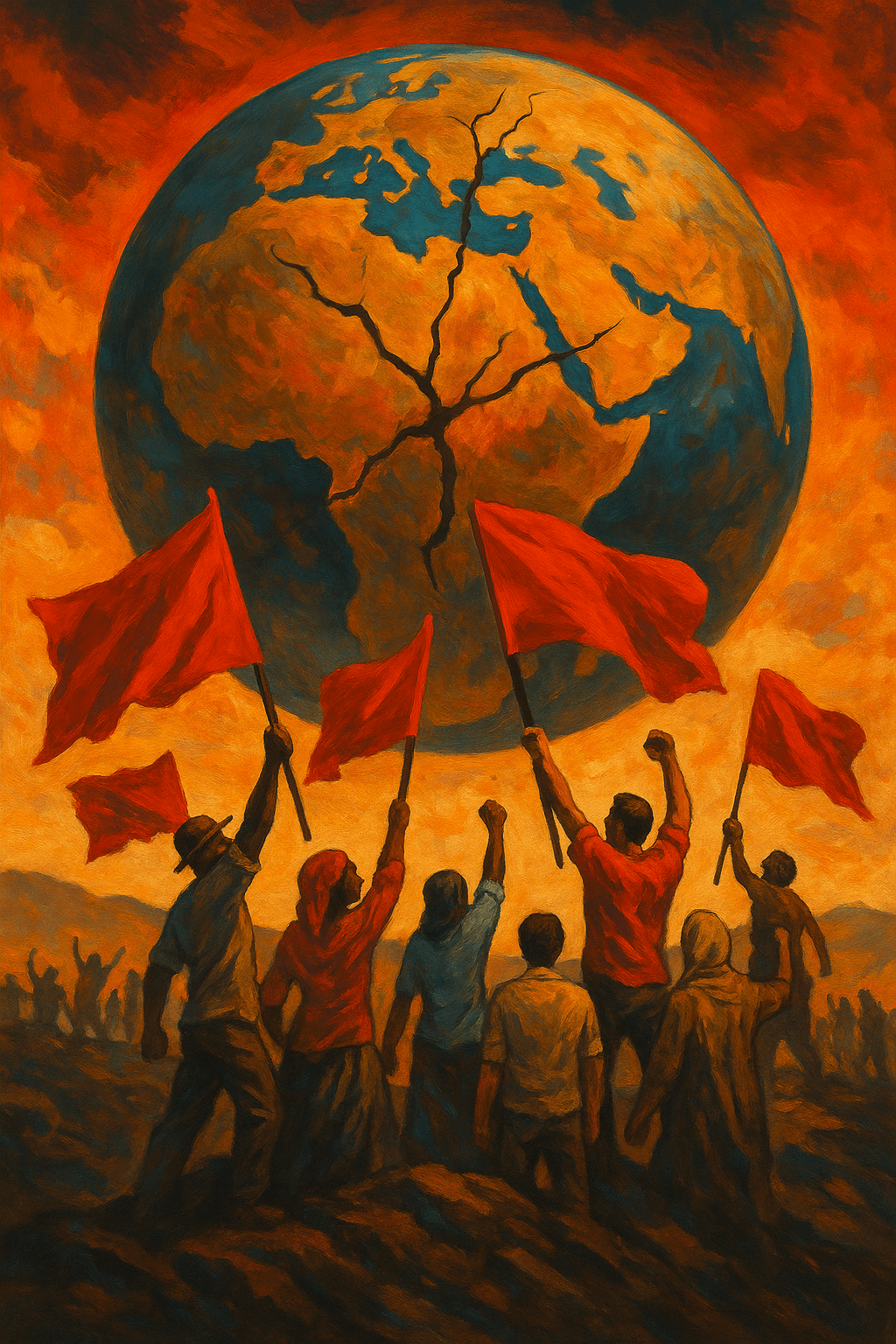
A Weaponized Propaganda Excavation of The Economist’s Fantasy of 2026—and the Real Global Forces Reshaping the Future
By Prince Kapone | Weaponized Information | November 17, 2025
The Story They Tell When the World Is Burning
Before we break open the machinery of this narrative, we have to name the text we are excavating. The Economist’s piece, “The contours of 21st-century geopolitics will become clearer in 2026”, presents itself as a sober guide to the year ahead. It tells readers that 2025 marked the end of an old order, and that Donald Trump—through tariffs, threats, diplomatic stunts, and constitutional brinkmanship—has redrawn the global landscape. It sketches a world where alliances, economies, and entire regions bend around Washington’s gravitational pull. But as with all imperial storytelling, what is presented as analysis is really an ideological map, and what is presented as the world is only the world as seen from above. It is this map we now set out to dismantle.
The Economist’s latest dispatch on the coming year, “The contours of 21st-century geopolitics will become clearer in 2026”, presents itself as foresight—a calm assessment from the command tower of global capitalism. Written by Zanny Minton Beddoes, the outlet’s editor-in-chief and longtime interpreter of imperial reason, the article announces that the old world ended in 2025. It wasn’t the world of hunger, sanctions, occupation, or debt that collapsed. No—what ended, we are told, were the “norms” that governed the imperial center: the tariff codes, the diplomatic rituals, the polite agreements between powerful men in closed rooms. A presidency bent on smashing rivals both foreign and domestic is described as if it were the weather: volatile, unpredictable, but something one must simply endure. And behind every line sits the quiet confidence of a class that believes the world is its property, and that what matters most is how the turbulence feels from atop the skyscraper, not from the ground where lives are buried.
Beddoes herself stands precisely where empire narrates itself best: IMF pedigree, Davos fluency, and the cool managerial posture of someone entrusted with explaining the world to those who own most of it. Her task is familiar—to turn crises into policy puzzles, to turn structural domination into “geopolitics,” to turn the convulsions of a declining empire into the natural evolution of a system that still imagines itself eternal. The Economist, long funded and steered by the dynasties of finance capital and sustained by the ideological infrastructure of NATO’s Atlanticist worldview, operates as a kind of imperial switchboard, translating the anxieties of ruling-class strategy into analytic prose. Its audience is the investor who wants reassurance, the policymaker who wants a script, and the Western professional who wants to believe that decline is simply another stage of progress.
The propaganda, here, flows not from bombast or crude lies but from the gentle tone of someone steadying the hand of a nervous elite. The article deploys a series of narrative maneuvers that transform the chaos of 2025 into an acceptable—and even admirable—expression of American power. When it describes soldiers deployed into Democrat-run cities, government machinery used against political opponents, and the intimidation of universities and independent institutions, these are not acts of authoritarian escalation. They are, instead, “assertions of executive power,” a kind of colorful leadership style that merits debate rather than alarm. By pairing descriptions of authoritarian overreach with language borrowed from management consulting, the article reframes a constitutional crisis as a performance review.
At the same time, the article deploys a strategic ambiguity that allows Trump to be both unhinged and clever, reckless and effective. The same actions that provoke “unease” are presented as having brought “real successes,” from a Gaza ceasefire to the disciplining of NATO allies. This duality functions as an alibi. If Trump appears dangerous, it is only because strong men must sometimes break a few diplomatic eggs to make a geopolitical omelet. If he destabilizes alliances, it is only because he is creatively renegotiating global order. In this narrative, imperial violence is not condemned; it is repackaged as bold disruption.
The Global South—Latin America in particular—exists in the text only as a landscape, not a subject. Countries like Brazil, India, Venezuela, and Colombia are neither actors nor societies but chess pieces whose value is determined by how Trump might move them. Their elections are not democratic expressions, but “opportunities” for the United States to shape outcomes. Their governments are not sovereign, but either “ideological fellow-travellers” to be supported or “foes” to be bullied. This rhetorical flattening reduces hundreds of millions of people to background noise in a drama staged for Atlantic capital.
Even where the article gestures at crisis—protectionism, politicized institutions, declining Western democracy—it wraps each danger inside a soft cushion of reassurance. Tariffs did not crash the global economy, we are told; the stock market soared; investors cheered; business leaders kept quiet. The world beyond the U.S. border may be shifting, but American wealth still hums, and that melody is enough to soothe the restless nerves of empire. This is the heart of the propaganda: the idea that the chaos is manageable, the world is still governable, and the future remains an American property deed waiting to be updated.
Yet beneath the polished prose, one can hear the fear. The Economist writes as an empire watching its own shadow on the wall, trying to convince itself it still controls the fire. And so it tells a story where Trump’s improvisations are strategic, where U.S. coercion is diplomacy, where Western crises are temporary noise, and where the rest of the world remains frozen in a supporting role. It is a story written for a ruling class that senses the ground shifting under its feet—and whose greatest comfort is the illusion that it can still predict the future.
Reconstructing the World Behind the Economist’s Window
After excavating the story The Economist wants the powerful to believe, we will now drag that story out of the boardroom and place it on solid ground. We start with what the article actually says—its facts, stripped of the perfume. These are the claims the magazine is confident enough to print: that Trump’s post–“Liberation Day” tariff machine settled at an effective rate just above 10% and did not unleash the global trade apocalypse Wall Street once feared; that the specter of a 1930s-style trade war dissolved as retaliation stayed muted; that NATO, bullied and threatened, reached into its pockets and spent more on weapons; that Washington is sharpening its claws for Latin America, signaling pressure on Venezuela and a political squeeze on Colombia; that U.S. support for Taiwan might soften as Trump angles for a grand bargain with Beijing; that MAGA’s cultural cousins are rising across Europe—in Britain, France, Germany; that the stock market’s sugar-high comes from deregulation, crypto madness, and a corporate sprint toward AI dominance; that by late 2026, the economy may finally feel the cost of this joyride; and that in the Middle East, the White House wants to be seen as a peacemaker. These are the givens, the bricks of the imperial story.
But to understand what is really happening, we have to place these facts next to everything The Economist quietly sweeps under the rug. Start with Latin America, a region the article treats like Washington’s backyard, as if whole nations were just lawn furniture waiting to be rearranged. Yet reporting from NACLA shows a very different reality—one where anti-imperialist governments, peasant unions, Indigenous movements, and working-class organizations are reshaping politics on their own terms. Gustavo Petro’s push for peace in Colombia, the surge of mass movements in Chile, and the proliferation of communes in Venezuela all reveal a hemisphere that is not a passive stage for U.S. pressure but an active battleground of its own making.
Then there is the matter of sanctions—America’s favorite weapon when bombs are too messy or too visible. While The Economist mentions Trump’s “pressure” on Venezuela, research from the Center for Economic and Policy Research (CEPR) shows the brutal, measurable reality of U.S. sanctions: hospital shortages, restricted food imports, rising mortality, whole sectors collapsing. This isn’t “pressure.” It is economic strangulation. And to omit this context is to pretend that Latin America’s crises appear spontaneously, untouched by the empire that has shaped the region for over a century.
Asia is likewise flattened into a cartoon duel between Washington and Beijing. But the region is not simply choosing sides; it is building structures of its own. Reporting from Global Times tracks the growing weight of BRICS+, the Shanghai Cooperation Organization, and ASEAN’s quiet but deliberate integration. These institutions—none of which exist in The Economist’s imagination—coordinate energy deals, trade mechanisms, and development strategies that increasingly bypass the United States. You would not know it from the article, but Asia is becoming one of the most important laboratories for post-Western global cooperation.
The Middle East is reduced to a diplomatic stage where Trump supposedly conjured a ceasefire in Gaza. But on-the-ground reporting from Middle East Eye tells a different story: one shaped by Palestinian resistance, shifting alliances across West Asia, and political negotiations that began long before Washington decided to step in for a photo-op. The Economist’s version erases people again—as if only one country, and one man, had any role in shaping the region’s fate.
Even on economic matters—its supposed area of expertise—the magazine keeps one eye shut. Yes, the stock market is roaring. Yes, investors are buzzing. But analysts at Brookings describe an economy built on creaking foundations: household debt ballooning, corporate leverage stretching into the red, speculative bubbles swelling under deregulation, and almost no investment in the productive sectors that actually sustain a society. The Economist waves vaguely toward a possible “slowdown” in late 2026, but avoids naming the structural rot that guarantees it.
And then there is the most important omission of all: the reorganization of the Global South into a force that refuses to kneel. Outlets like The Hindu document India, Brazil, South Africa, Indonesia, and others deepening ties with BRICS+, the Shanghai Cooperation Organization, and ASEAN’s quiet but deliberate integration. These institutions coordinate energy deals, trade mechanisms, and development strategies that increasingly bypass the United States — for example, BRICS countries agreed to broaden energy cooperation. S&P Global reported on such plans. You would not know it from the article, but Asia is becoming one of the most important laboratories for post-Western global cooperation.
When we pull all these threads together, a clearer picture emerges—one the article cannot acknowledge without undermining its own worldview. Its facts describe a world in motion, but its silences reveal the deeper truth: that power is slipping from the hands of the very class for whom The Economist writes. And so it narrows the world to fit the frame of empire. Our task here is simply to lay the facts bare, free of illusions, so that we can proceed to confront the meaning behind them with the clarity and courage history demands.
Seeing the Empire’s Reflection in the Cracks of Its Own Story
When we gather the fragments of fact and omission laid out in the previous section and hold them together in the light of history, the picture that forms is not the clean, forward-looking panorama that The Economist promises. It is something far more jagged: the outline of an empire that can no longer narrate the world without tripping over the limits of its own power. The article tried to describe 2025 as the end of one order and the birth of another, but once we assemble its claims alongside the realities it refuses to speak, we see that the “new world” emerging is not the invention of an American president’s style, nor the product of Western decisions alone. It is the result of a long, global struggle against a system that has exhausted its ability to command obedience. In this section, we do not add new facts. We take only what Section II gave us—the tariffs, the sanctions, the rising movements in Latin America, the regional architectures in Asia, the manufactured ceasefire narrative, the hollow financial boom, and the multipolar refusal of the Global South—and we read them together, as a dialectical whole. From this synthesis, the meaning of the moment begins to take shape.
Start with the contradiction that sits at the heart of the article: the United States is portrayed as both wounded and supreme, both a faltering democracy and the central architect of the world’s future. This tension is not an accident. It reflects the political reality of a ruling class trapped between its fantasies of universal authority and the material decline eroding the foundations of its power. The Economist wants the reader to believe that the stock market boom is proof of resilience, but the structural weaknesses beneath it—debt, speculation, and a lack of productive investment—tell us instead that the U.S. economy is running on fumes. When an empire’s strength rests on financial fireworks rather than the labor and material production of its people, the crisis is not merely cyclical. It is systemic. The article cannot confront this truth, so it hides it behind the glow of an index number.
The same pattern appears in its geopolitical outlook. The Economist frames Trump’s pressure on NATO, Latin America, and Asia as evidence of an imperial center still capable of shaping global affairs. But the movements and institutions we identified in Section II reveal that the world is no longer arranged around Washington’s whims. In Latin America, workers, Indigenous communities, and left-wing governments are not waiting for permission to chart their path; they are resisting U.S. pressure in real time. In Asia, the rise of BRICS+, the SCO, and ASEAN coordination is not a footnote—it is the backbone of a new regional architecture. These developments are not isolated. They are connected by a growing refusal among the Global South to live under a system where their resources, markets, and sovereignty are subordinate to the United States. It is precisely because this refusal is rising that The Economist must present the hemisphere as a site of American “influence,” as though the people of the region exist only when Washington acknowledges them.
Consider too the article’s treatment of Gaza. By presenting the ceasefire as Trump’s personal accomplishment, The Economist restores the imperial fantasy that the U.S. is the indispensable stabilizer of the world. But Section II shows this narrative collapsing under the weight of real events: Palestinian resistance, shifting West Asian alliances, and regional negotiations shaped the conditions for any pause in the violence. The attempt to re-center the U.S. as peacemaker is a statement not of American strength, but of its desperation to claim relevance in a region reshaping itself without it. When an empire must take credit for outcomes it did not produce, it is no longer narrating history—it is clinging to it.
When we step back, the pieces align: the U.S. is exerting more pressure with fewer results, wielding more threats with less leverage, and projecting more certainty with less control. That is the dialectic of a declining empire. It lashes outward because it feels the world slipping away. It doubles down on coercion in Latin America because grassroots power is rising. It leans into trade and military deals in Asia because regional blocs are maturing. It invokes “peacemaking” in the Middle East because its model of dominance has lost legitimacy. It celebrates stock market highs because it cannot confront the emptiness beneath them. If The Economist feels the need to reassure its readers that 2026 will clarify the contours of a new world, it is because its writers already sense that the old world is dissolving.
But from the standpoint of the global working class, the peasantry, and the colonized nations—those who have always lived in the shadows of empire—the picture is dramatically different. What The Economist calls chaos, they recognize as possibility. What the article calls uncertainty, they understand as movement. The rising forces in Latin America, the independent architecture forming in Asia, the strength of resistance in the Middle East, the multipolar coordination across the Global South—these are not fragments. They are the early expressions of a world that no longer wishes to be ruled. And the fact that they appear as “omissions” in elite discourse is not an oversight. It is evidence of what truly terrifies the empire: not an unpredictable president, not tariff disputes, not populist elections in Europe, but the steady, disciplined, collective refusal of billions to accept the world as The Economist depicts it.
In that sense, the cracks in the article are more revealing than its conclusions. They show a ruling class struggling to interpret a world that no longer aligns with its desires. They show an imperial center mistaking its own unraveling for a shift in the weather. And they show us, if we look closely, the outlines of a future not written in Washington or Brussels, but in the fields, factories, streets, and movements of the people who are making it. The Economist calls this a “new world starting to emerge.” It is mistaken. The world is not emerging. It is rising.
From Knowing to Moving: The World Is Rising, and So Must We
If the first three sections stripped away the illusions and exposed the workings of an empire in decline, then this final section must answer the only question that matters: what are we going to do about it? Knowledge without movement is a museum exhibit—something to be admired, not lived. But the world we have just reconstructed is not an exhibit. It is alive, full of struggle, full of contradictions that call out for participation. And the most important truth revealed through this excavation is that the world’s people are already moving. Across continents, workers, peasants, Indigenous nations, and anti-imperialist forces are refusing the script that The Economist tries to write for them. Our task is not to invent movements out of thin air or impose campaigns from above. Our task is to recognize the living struggles unfolding across the planet, understand the conditions that shape them, and join them where we stand.
Begin in Latin America, where the article’s fantasies of U.S. “pressure” collide with a region already in motion. In Colombia, the grassroots support behind Gustavo Petro’s peace process includes peasant organizations, Indigenous communities, and social movements that have been resisting state violence for decades. In Venezuela, despite sanctions meant to crush it, the communal councils continue to build local governance and economic autonomy from below. In Brazil, the Landless Workers Movement (MST)—one of the largest social movements on earth—fights not only for land reform but for food sovereignty, political education, and collective production. These are not hypothetical forces. They are active, disciplined, and rooted. To stand with Latin America today is not to romanticize resistance—it is to join hands with movements that are already confronting the very contradictions The Economist tries to disguise.
Turn to Asia, where the article’s narrow frame hides the truth of a continent building its own future. Indian farmers, who mounted the largest protest in human history, continue to resist neoliberal agriculture and the corporate monopolies driving rural dispossession. In Korea and the Philippines, anti-base movements persist in their long struggle against the militarization of their lands and communities. These struggles expose the real meaning behind Washington’s waning influence: it is not simply that the U.S. is losing ground—it is that people are reclaiming it. Any project of internationalist solidarity must recognize that Asia’s political awakening is not a footnote. It is a central pillar of the new world being born.
Across West Asia, the myth of American peacemaking dissolves under the weight of movements fighting for their own dignity. Palestinian resistance—political, cultural, and armed—continues despite blockade, occupation, and relentless propaganda. Regional alliances that The Economist refuses to name are negotiating ceasefires, development projects, and security arrangements that bypass the United States entirely. To stand with these forces means refusing the imperial narrative that reduces the region to a chessboard. It means supporting the organizations—grassroots media outlets, prisoner-support networks, diaspora coalitions—keeping the struggle alive.
And in the Global South more broadly, BRICS+ cooperation is beginning to take institutional form. Energy deals outside the dollar system, credit arrangements independent of the IMF, and South–South development projects represent more than diplomacy. They form the early architecture of a world seeking to escape the economic chokehold that fuels the crises described in the previous sections. Supporting these processes does not mean cheerleading governments uncritically. It means recognizing that when nations build alternatives to U.S. control, the space for popular power expands.
But solidarity must not stop at the borders of the South. In the belly of the empire itself, the contradictions exposed by The Economist are producing their own openings. Anti-war coalitions are rebuilding after years of demobilization. Tech workers—from Google to Amazon—are organizing against the militarization of artificial intelligence and the surveillance regimes constructed in its shadow. Labor unions are reawakening in logistics, education, and manufacturing. Palestine solidarity movements have become one of the largest mass mobilizations in the U.S. and Europe in a generation. These are not side notes. They are the beginnings of a realignment of political life inside the imperial core.
So what is to be done? First, connect the struggles. Build lines of communication between Latin American movements and Global North anti-war campaigns. Link tech workers resisting AI militarization with activists challenging U.S. foreign policy. Support the grassroots media of the Global South—Venezuelanalysis, Brasil de Fato, New Frame, Middle East Eye—because information is a battleground as decisive as any street. Join unions, tenant organizations, student movements, and anti-surveillance networks. Support Indigenous sovereignty movements fighting extractive capitalism. Every one of these fronts touches the contradictions exposed in the article. None of them are abstract.
Second, build the political education necessary for long-lasting struggle. Study circles grounded in anti-imperialism, multipolar analysis, and class struggle are not luxuries—they are weapons. The world The Economist describes is collapsing, but collapse alone does not guarantee liberation. Only organized consciousness can turn crisis into opportunity.
Finally, understand that internationalism is not a slogan. It is a practice. When a farmer in Punjab resists corporate agriculture, when a Brazilian worker occupies unused land, when a Palestinian child survives another night under occupation, when a Korean villager fights a military base, their victories weaken the same system that exploits workers in Detroit, Chicago, and New York. The cracks in empire are openings for all of us. The world is rising. The only question now is whether we rise with it.
 Weaponized Information
Leave a comment