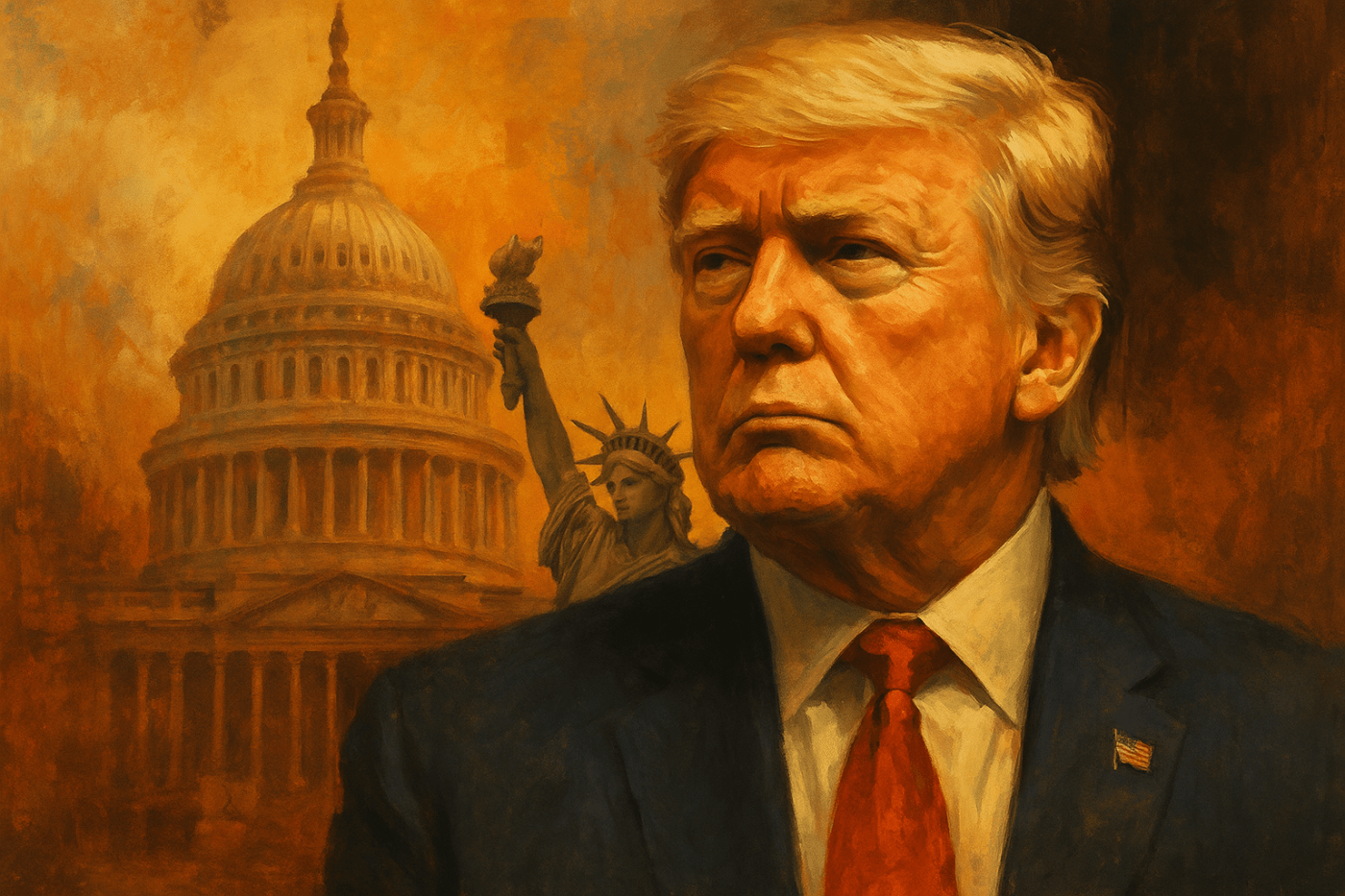
Beneath the polite chatter about “skills gaps” and “foreign talent” lies a deeper confession: the U.S. empire has exhausted its capacity to reproduce itself. What CNN calls competitiveness is the final stage of imperial dependency—a system that must now import the very labor it once destroyed.
By Prince Kapone | Weaponized Information | November 12, 2025
The Empire’s Talent Problem
DJ Judd’s CNN report on Trump’s Fox News interview reads like a polite stenography of empire—an official dispatch from the boardroom of a civilization that no longer knows how to work, only how to manage. The headline tells us that the United States “doesn’t have people with certain talents” to fill jobs domestically, as if that were an accident of history rather than the outcome of a deliberate class project. Trump appears in the piece not as a demagogue or a tyrant, but as a weary CEO explaining the limits of his workforce. CNN, ever the mediator between capital and confusion, serves the exchange straight, no irony added.
“You don’t have certain talents,” Trump tells Laura Ingraham, brushing off her protest that America is brimming with capable workers. CNN quotes the line as if it were a revelation, not a confession. It’s an admission that the ruling class has spent forty years dismantling the very foundations of working-class skill—gutting public education, deindustrializing entire regions, and replacing apprenticeships with algorithmic management. The result is a labor force deliberately disarmed, a proletariat stripped of its tools and told to blame itself for the wounds. Yet CNN repeats the lie with the same faith it once reported stock prices, treating “talent” as a natural resource America somehow misplaced rather than something systematically stolen.
The article performs the usual ritual of journalistic obedience: Trump is framed as pragmatic, the economy as neutral, the question of labor as technical. The ideological trick is subtle but devastating. What should be a debate about exploitation becomes a conversation about efficiency; what should indict capital becomes a plea to train workers faster. CNN’s house style is the soothing hum of managed decline—polished sentences masking the tremors of a collapsing order. Beneath the corporate calm lies the sound of an empire admitting it can no longer reproduce itself.
In Judd’s account, Trump defends the H-1B visa program as a necessary import pipeline for specialized skills. The story omits that this pipeline was built by U.S. corporations themselves, designed to replace expensive domestic labor with cheaper foreign engineers whose residency depends on obedience. CNN calls this competitiveness. Marx would call it what it is: the reserve army of intellectual labor. The “talent shortage” is merely the polite term for wage suppression by design—a managerial euphemism for global labor arbitrage dressed up as national necessity.
Then there’s the Georgia ICE raid—a raid that tore through a Hyundai facility and deported hundreds of South Korean contractors. Trump cites it as proof that America “needs skilled workers,” while CNN quotes him without pause. What neither the president nor the network will name is the deeper truth: this was a spectacle of discipline, a public relations campaign for the border-industrial complex. It was not a question of legality but of loyalty—reminding both citizen and migrant alike that labor exists here by permission, not by right. CNN’s silence is not ignorance; it is complicity. To report power’s performance as fact is to join the act.
By the end of the article, the narrative folds into farce. Trump jokes about Chinese and French students, turning a conversation about imperial dependence into reality television. The reader is left with the impression of a country debating which foreigners it prefers to exploit. CNN dutifully records the banter and calls it journalism. The moral of the story is clear enough: imperial decay must be made entertaining, lest it become understood. What is called a “skills gap” is, in truth, a social chasm between those who live by labor and those who live off it. The empire’s real shortage is not of talent, but of honesty.
Behind the Curtain of Competence
Strip away CNN’s stage lighting, and what remains is a set of hard, verifiable facts and a mountain of omissions large enough to bury them. Trump did say the U.S. lacks “certain talents.” He did defend the H-1B visa program even after imposing a $100,000 application fee. He did reference the Georgia ICE raid that deported hundreds of South Korean battery workers. These are the article’s bones. But CNN never bothers to tell us whose skeleton they belong to—whose interests those policies serve, whose lives they destroy, whose profits they protect. The report treats each event as an isolated data point rather than as symptoms of a single, coherent disease: an empire that no longer knows how to produce value except by managing scarcity.
The factual record shows that the H-1B program, created in 1990, was sold as a way to “fill gaps” in a booming tech economy. In reality it was a mechanism to import cheaper labor and export class struggle. Economic Policy Institute studies demonstrate that companies using H-1B visas routinely pay less than the prevailing wage, undermining collective bargaining and depressing industry standards. UNCTAD data confirms that much of the “innovation” driving this policy is parasitic—wealth extracted from the Global South through patent monopolies and intellectual property rents, not genuine productivity. Yet CNN’s coverage avoids the word exploitation, preferring “competitiveness,” a term that erases both the victims and the system that produces them.
The Georgia raid reveals another truth that corporate media refuses to touch: immigration enforcement is not about borders—it is about labor discipline. The Tricontinental Institute’s research on hyper-imperialism details how deportations function as economic shock therapy, producing fear that stabilizes precarious industries. The deported worker becomes a warning, the detention center a classroom in obedience. By reducing the migrant to an expendable unit of productivity, the state enforces compliance among those who remain. CNN’s sanitized retelling turns a counterinsurgency tactic into a procedural misunderstanding, a bureaucratic glitch in an otherwise “fair” system.
Even the “battery” example hides a deeper supply-chain dependence. Lithium from Bolivia, cobalt from Congo, nickel from Indonesia—each extracted through neocolonial arrangements brokered by Western corporations and their local comprador allies. The “skilled” South Korean contractors Trump praises are themselves embedded in this chain, their expertise built on raw materials mined by workers who will never be invited to apply for an H-1B. International Labour Organization reports describe this as the global hierarchy of work: a vertical conveyor belt where value climbs and bodies fall. CNN’s failure to mention this is not oversight; it’s editorial policy. To reveal the world-system behind “talent” would be to expose capitalism’s scaffolding.
Historically, the myth of a “skills gap” emerges every time capital needs to justify disinvestment in labor. After World War II, industrial barons blamed “worker laziness” for automation layoffs; in the 1980s, Reaganite economists blamed “regulation” for deindustrialization. Today, Trump and CNN blame the workers themselves for a problem manufactured by neoliberalism. Since the 1970s, U.S. elites have offshored industry, gutted public education, and privatized training infrastructure. The result is an economy of managed incompetence—where the ruling class breaks the worker’s tools and then charges tuition to replace them. CNN’s report takes this destruction as fact, refusing to ask how the wound was made.
Seen through historical materialism, these facts outline a familiar pattern: the crisis of imperial accumulation has come home. The empire can no longer extract enough surplus from abroad to feed its rentier class, so it begins to internalize colonial conditions within its own borders. This is the context the article omits—the wider landscape in which Trump’s sound bites make sense. His invocation of “foreign talent” and “skilled workers” is not a contradiction of nationalism but its evolution: the technocratic nationalism of a decaying empire that must now import what it once stole. CNN’s silence is not just cowardice; it is the journalism of empire in crisis, smoothing over the cracks in a system that survives only by convincing its subjects that the collapse is a technical malfunction, not the consequence of class rule.
The Talent Shortage of Empire
What CNN calls a “skills gap” is in truth the ideological name for imperial decay. The United States is not suffering from a shortage of talent—it is suffering from the exhaustion of parasitism. After decades of exporting production, looting the periphery, and treating education as a private investment rather than a social good, the empire looks around its hollow factories and discovers that it has stripped its own soil of fertility. Trump’s remarks to Fox News are less a policy position than a confession of guilt. When he says America lacks “certain talents,” he means that capital has consumed the very capacities that once sustained it. What remains is a managerial class that knows how to speculate, surveil, and subcontract, but not how to build, repair, or grow. The crisis is not intellectual—it is civilizational.
The CNN article turns this confession into comfort food for the professional classes. Its function is to naturalize imperial dependency—to make exploitation sound like prudence. We are told that importing skilled labor keeps America “competitive.” But competitive with whom? The answer is revealing: with the very nations whose development the U.S. has systematically obstructed through sanctions, debt traps, and corporate capture. The Global South trains engineers with public funds only to see them siphoned off by the North; their knowledge becomes the new raw material of imperial accumulation. This is global cognitive expropriation—the mining of intellect rather than minerals, the extraction of capacity rather than copper, enforced through visa regimes, patent monopolies, and education markets that convert public training abroad into private rents at the core.
Yet this phase differs in one crucial respect: the colonial order has begun to fold back on itself. As multipolar alliances assert sovereignty over resources and development paths, U.S. capital finds its external frontiers shrinking. The flows of cheap labor and tribute that once sustained domestic privilege are no longer guaranteed. In response, the ruling class seeks to reproduce those relations internally, importing select skilled migrants while criminalizing the unskilled, automating workplaces while expanding carceral infrastructure. This is the logic of domestic labor recalibration—the conversion of imperial extraction into internal colonization. The sweatshop moves from Dhaka to Detroit, the colonial hierarchy from Jakarta to Georgia. Trump’s rhetoric and CNN’s narration merely give this process a patriotic accent.
The ideological glue holding it all together is what can only be called technofascism: the merger of monopoly capital, state power, and digital surveillance to manage both production and perception. The H-1B visa regime is a microcosm of that fusion—a data-driven apparatus that sorts human beings by algorithmic value, coding entire populations as “useful,” “temporary,” or “deportable.” It is a technology of obedience disguised as an opportunity. Every worker’s fate becomes a data point in the empire’s dashboard. And CNN’s role is to keep the interface clean, the illusion seamless, the contradictions invisible. The headline about “certain talents” is not news—it’s software. It programs consent.
Beneath that surface lies the same contradiction Marx diagnosed in the nineteenth century: capital’s tendency to destroy the very labor upon which it depends. In its imperial form, this contradiction takes geographic shape—siphoning vitality from abroad until there is none left to steal. When Trump admits that America no longer has the workers it needs, he is not identifying a workforce problem; he is acknowledging the end of a world-system. The parasite has devoured its host and now gnaws on its own limbs. The empire that once colonized others must now colonize itself to survive. That is why deportations, tariffs, and H-1B visas coexist so comfortably: they are not opposing policies but complementary instruments of imperial self-cannibalization.
The CNN article’s silence on this process is not merely editorial convenience—it is ideological necessity. To admit that imperialism is collapsing is to admit that its beneficiaries must either revolt or perish. And so, the media turns crisis into gossip, domination into debate. It asks whether America should “bring in talent” while ignoring the real question: why has the richest country on earth become incapable of reproducing its own working class? The answer, as The Empire That Eats Itself argued, lies in the internalization of colonial logic. Having run out of worlds to conquer, the United States has begun to colonize its own people—turning citizens into precarious laborers, consumers into debtors, and journalists into apologists. CNN’s polite reporting is not peripheral to that process; it is part of the machine.
This is the true meaning of Trump’s “certain talents.” He is not wrong that the empire lacks them—only wrong about what they are. The missing talent is not in coding or chemistry; it is in solidarity, in organization, in the creative intelligence of a class that refuses to be ruled. The empire’s schools cannot teach it, its visas cannot import it, and its prisons cannot contain it. That talent belongs to the oppressed, to the colonized, to the working class awakening to the realization that the crisis of empire is their opportunity. The question is not whether America has enough skilled workers—it is whether the workers have finally learned what their skill is for.
From Exposure to Organization
Every empire hides its collapse behind a slogan. “Talent shortage” is the latest mask for a system that has run out of worlds to exploit. But the contradictions it conceals—between worker and boss, colonizer and colonized, consumer and producer—are already tearing through the surface. The task now is not to merely expose these contradictions, but to organize around them. This is the terrain of struggle: the global working class and peasantry, the colonized nations reclaiming their sovereignty, the socialist and multipolar forces rising in defiance, and the defectors from empire inside the imperial core who refuse to keep feeding the machine.
The first step toward liberation is ideological. We must demolish the myth that the foreign worker threatens the domestic worker, that one laborer’s survival must come at the expense of another’s. The truth, as our class has always known, is that the bosses built that division to keep us at war with ourselves. The so-called “skills gap” is not a labor problem—it is a capitalist design. It exists to justify wage theft, privatized education, and a global labor hierarchy that makes exploitation appear as meritocracy. The migrant deported from Georgia and the machinist laid off in Michigan are not adversaries—they are casualties of the same empire.
Fortunately, the resistance is not starting from scratch. Across the world, militant organizations and people’s movements are already building the scaffolding of the next order. In the imperial core, unions like United Voices of the World are organizing precarious and migrant workers on their own terms, refusing the compromise politics of corporate unionism. They strike not only for wages, but for dignity—proving that solidarity can cross borders long before capital collapses them. In the United States, the Black Alliance for Peace has become a vital node linking domestic struggles against police militarization, austerity, and mass incarceration to the global fight against imperialism and NATO aggression. They remind us that peace abroad begins with justice at home—and that both require dismantling empire itself.
In the Global South, formations like the Philippines’ Kilusang Mayo Uno carry forward the tradition of militant, anti-imperialist trade unionism, uniting peasants and workers against the foreign domination of their economies. Their struggle against transnational capital is the mirror image of the one unfolding in the U.S.—two fronts of the same war, separated only by geography. And on the international scale, networks like the International Labor Rights Forum continue to expose corporate supply chains that feed on exploited migrant labor, offering practical tools for worker-to-worker campaigns and accountability drives against global capital.
These are not NGOs courting grants or government favor; they are the laboratories of proletarian internationalism in motion. The revolutionary task now is to weave these threads together—to connect the migrant unionist in London with the dockworker in Manila, the grassroots anti-war coalition in Washington with the debt-resistance committee in Lagos. Material solidarity means more than statements; it means shared logistics, shared strike funds, shared defense. The enemy already coordinates globally—through capital markets, sanctions, and surveillance. We must do the same, but from below.
The path forward is clear enough:
support the movements already defying the empire’s labor order; fund the independent media that tell their stories; build dual and contending power through neighborhood assemblies, worker councils, and peasant cooperatives; and educate our class in the political economy of our own enslavement. Every picket line, every debt strike, every occupied factory is a crack in the illusion of imperial permanence. What we call solidarity today will become self-defense tomorrow.
They say America needs “talent.” They are right—but not the kind they mean. The true talent is in the hands of the worker who builds, the farmer who feeds, the coder who resists the algorithm that exploits them, and the teacher who keeps history alive against amnesia. The empire cannot import that talent because it already belongs to the people. The task now is to organize it—to turn scattered skill into collective power, and collective power into the final art: the overthrow of the system that calls our genius a shortage.
 Weaponized Information
Leave a comment