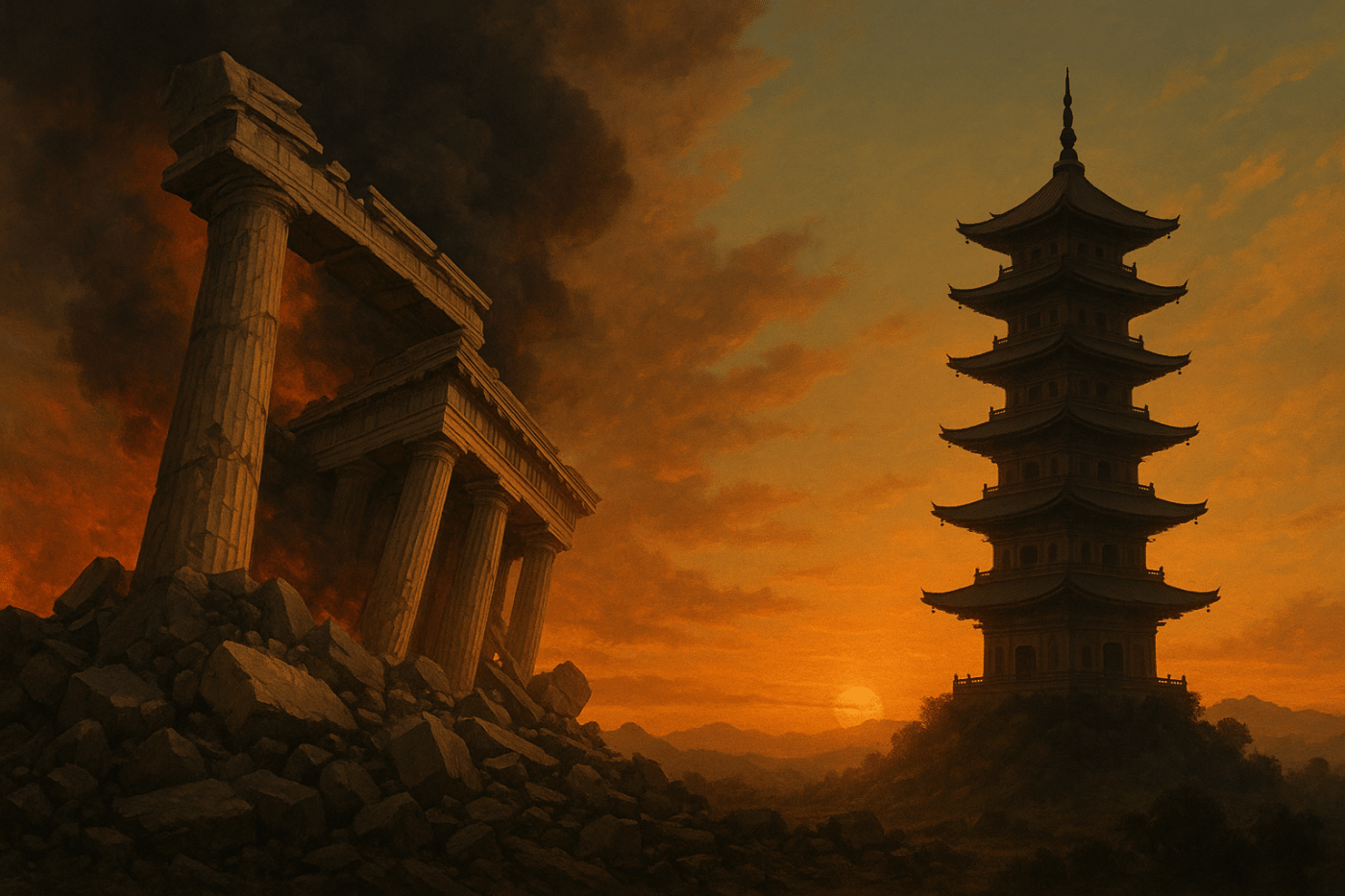
This was not a reset. It was not a détente. It was the empire asking for time, and a rising world civilization choosing not to rush. The United States performs strength to hide its decline. China exercises restraint because history is moving in its direction.
By Prince Kapone | Weaponized Information | November 1, 2025
The Stage and the Spectacle
The world was told that something grand had happened in Busan. The American press, ever anxious to reassure its audience that the empire still has steady hands on the wheel, greeted the meeting between Donald Trump and Xi Jinping with the usual bloated chorus: “Amazing.” “Historic.” “Very important decisions.” They said the two leaders had reached a turning point, that tempers were cooling, that new cooperation was emerging. And in their telling, America had once again sat at the head of the table, issuing terms, compelling outcomes, bending reality back toward its image of itself. This is the theater of a declining empire—loud, sentimental, and hungry for applause. It is a performance of confidence meant to hide the lack of it.
Look closely at the American media’s diction and you will see the insecurity dripping through every sentence. The United States must announce its victories now. It must declare its relevance. It must proclaim its strength. A power that knows itself does not need to constantly remind the world of what it is. But a power that senses its historical moment slipping—its economic foundations cracking, its military logistics stretched thin, its moral legitimacy rotted to the bone—must cultivate the image of victory even when the battlefield suggests otherwise. And so the American news cycle becomes less a system of information and more a therapeutic ritual. The headlines do not tell you what is happening. They tell you what the American ruling class needs its population to believe.
Meanwhile, on the other side of the Pacific, Chinese state media spoke in a different register entirely. No theatrics. No triumphalism. No grand gestures about the future of humanity hanging on handshakes and photo-ops. The language was procedural, calm, almost understated: deepen communication, maintain regular dialogue, complete follow-up work, ensure stability, expand cooperation where possible. Not a hint of desperation. No need to inflate outcomes. No internal legitimacy crisis to soothe. A state that is confident in its long-term horizon does not need spectacle. It needs continuity.
This difference is not cultural. It is structural. It is the difference between a nation still rising—its productive forces deepening, its internal cohesion largely intact, its strategic orientation long-term and disciplined—and a nation in imperial decline, clinging to narratives of exceptional destiny to mask the basic truth that it can no longer command the world as it once did. The United States must perform strength because its strength is increasingly symbolic. China does not perform because its power is increasingly material.
So let us be clear from the beginning: Busan was not a “historic breakthrough” nor a “reset” of relations. It was not a moment of reconciliation, nor was it a diplomatic victory for the United States. What happened in Busan was something far more ordinary—and far more revealing. Two world powers, locked in a long-term structural conflict over the very shape and meaning of the world order, agreed to keep talking. They agreed to manage their rivalry rather than let it ignite. They agreed, in effect, to maintain the conflict on a schedule. And the way each side talked about this meeting tells us everything about the different paths they are walking and the different worlds they are trying to build.
The American ruling class needs spectacle to maintain its authority. China does not. The United States is terrified of a world it cannot dominate. China is building a world in which domination itself is obsolete. The United States must convince its people that the empire is still sacred. China does not need to convince anyone of anything—it is too busy constructing the material foundations of the century to come.
This essay begins here, not with the agreements made, but with the tone. For tone is not superficial posture—it is the ideological smoke that rises from deeper political fires. And if you know how to read it, you can see the shape of the future flickering in the haze.
What Was Actually Agreed
If you strip away the noise, the posturing, and the patriotic choreography of the American news cycle, the Busan meeting was not a triumphant realignment of world affairs. It was, in material terms, a set of limited, technical, and reversible adjustments—the kind of things states do when they are not ready for confrontation, but are also not prepared to concede anything of strategic value. In other words: not a peace treaty, not a surrender, not a turning point—just the management of a contradiction that will endure for decades to come.
Let us begin with the headline that the American press most desperately wanted to sell to the public: the so-called tariff rollback. Trump told audiences that he had slashed tariffs on Chinese goods, as though he had single-handedly pried open the gates of the Chinese market. Yet what actually happened was far smaller: a single category of tariffs, tied to chemical precursors associated with fentanyl, was reduced from 20% to 10%. The overall tariff regime remains firmly in place. The United States is still imposing historically high tariffs across Chinese goods, and China, for its part, made no reciprocal tariff concessions at all. This was not a reset. It was a pressure valve release—an attempt to calm inflationary forces inside the United States, not a structural shift in the relationship between the two economies.
The same applies to the much-advertised rare earths development. Trump claimed victory: that China had agreed to keep supplying the minerals and processing materials without which the U.S. military machine cannot function. The truth is both simpler and sharper. China agreed to delay the implementation of new export controls for one year. Not cancel. Not reverse. Not abandon. Delay. Which is to say: Beijing reminded Washington that it still holds the knife, and that the Pentagon, Wall Street, and Silicon Valley all know exactly where the blade is pointed. The pause is not weakness. It is confidence—the calm of a country that knows time is working in its favor.
Beyond these headline items, the rest of the Busan agreements fall into the category of diplomatic maintenance. Technical working groups on anti-money laundering, telecom fraud, fentanyl precursor flows, artificial intelligence risk discussions, and health cooperation will resume. These are not acts of friendship. They are mechanisms designed to prevent spirals—pressure gauges wired into the machinery of competition. When two nuclear-armed economies are locked in a global struggle for historical direction, they require channels to slow escalation, even when antagonism remains fundamental. Dialogue is not peace; it is conflict management.
Now we come to the part of the story the American public was not meant to think about. The real long-term outcomes of Busan were not economic or technological. They were temporal. Both countries reaffirmed a schedule of upcoming diplomatic engagements—APEC hosted by China in 2026, and the G20 hosted by the United States the following year. This creates a structured diplomatic calendar extending nearly two years into the future. In international politics, that is not a courtesy. That is a decision not to accelerate history. It means the United States has accepted—for now—that it cannot force a showdown. And China has accepted—for now—that it does not need to.
Meanwhile, the claims Trump made about massive Chinese purchases of soybeans, sorghum, chips, and Alaskan energy resources were just that—claims. China issued no commitments, no quantities, no purchase windows, no contractual mechanisms. Beijing acknowledged none of this as binding. And so, once again, the American people were given a story in place of a fact, a spectacle in place of a material gain, a posture in place of policy. Farmers back home may cheer, but the market will not move until Beijing moves, and Beijing did not move.
So what was Busan? A moment of strategic pacing. The United States needed to cool inflationary pressure, calm investor anxiety, and stabilize defense procurement timelines. China needed to maintain a steady external environment to continue deepening its industrial upgrading, global trade partnerships, and multipolar institution-building. Both sides acted according to their long-term structural needs, not according to the fantasies being narrated in American living rooms.
In the end, nothing fundamental changed. And that is what makes this moment important. Because empires in decline crave turning points, but rising powers prefer continuity. We are not watching reconciliation. We are watching a conflict that is being scheduled. The war for the future is not avoided—it is paced.
The Doctrine Gap: One World to Command, One World to Share
To understand what is truly at stake in the U.S.–China relationship, one must look past the negotiations, the tariffs, the diplomatic photo lines, and the manufactured storylines of competition. The core of this conflict is not cultural misunderstanding, nor is it the result of personal antagonism between leaders. It is foundational, structural, civilizational. It is a clash between two projects for organizing the world.
On one side stands the United States, whose foreign policy establishment has, in its own documents, declared preserving American primacy—the ability to shape the rules, institutions, currency regimes, trade routes, security guarantees, and ideological reference points of the world system—as its supreme objective. The Pentagon calls China the “pacing challenge” because China is the first power since 1945 with both the industrial base and the geopolitical coherence to build a world that does not revolve around Washington. In the National Security Strategy, China is accused of seeking to “reshape the international order.” Think tanks from RAND to the Atlantic Council warn that China’s economic development model may prove more appealing to the Global South than IMF austerity and American gunboat diplomacy. They say this out loud—not as propaganda for the masses, but as instructions for capital and the state.
The American corporate media, of course, translates this strategic anxiety into something far more cartoonish: China is trying to take over the world. But this is not what the U.S. state fears. Washington does not fear Chinese tanks rolling into California. It fears a world in which African nations no longer have to borrow from the IMF to build railroads, in which Latin America can sell its lithium without surrendering its sovereignty, in which Asia trades in its own currencies rather than the dollar, in which Europe must negotiate with Beijing rather than dictate to it, and in which the Global South can refuse the demands of empire because it finally has another option. The real terror in Washington is that China offers the world the possibility of saying no.
And so, the United States casts China as an existential threat—not because China threatens the American people, but because China threatens the American ruling class’s ability to rule the world. The so-called “China threat” is not military. It is historical. It is the threat that the age of imperial management may be coming to an end—not through war, but through obsolescence.
And on the other side, there is China’s political orientation. Not a doctrine of universalization, not a civilizing mission, not a plan to remake humanity in its own image, but a remarkably consistent commitment to sovereignty, non-interference, and development first. China does not demand that others adopt its political system. It does not insist that its values are universal. Its foreign policy white papers speak instead of “win–win cooperation,” of “plurality of development paths,” of a “community of shared future for mankind.” And while critics in the West roll their eyes at this language, unable to imagine a world order not organized around domination, the rest of the world hears something different: the possibility of breathing room.
China does not sanction countries for trading with Washington. China does not overthrow governments for nationalizing their resources. China does not deploy aircraft carriers to force compliance. In Latin America, Africa, the Middle East, and Southeast Asia, China builds ports, fiber-optic cables, power plants, universities, mines, bridges, and special economic zones—not military bases. It lends instead of dictates. It negotiates instead of commands. It listens instead of lectures. China’s project is not to become the new empire; it is to make empire structurally impossible.
This is the doctrine gap. On one side, the United States must dominate the world to continue being what it is. On the other, China can rise without forcing the world to kneel. The conflict is not symmetrical, because the goals are not symmetrical. One side is trying to preserve a dying system; the other is building a world that outlives it.
To fail to understand this is to misunderstand everything that will follow.
The Real China Threat: Breaking the Cycle of Violence and Extraction
To understand why the United States sees China as an existential threat, one must be honest about how the American empire was actually built. It was not built by virtue, or innovation alone, or by the supposed genius of “free markets.” It was built, as all empires are built, through violence. The United States became the center of the world system because it destroyed or subordinated every project that attempted to develop outside its command. It overthrew governments in Iran, Guatemala, Congo, Indonesia, Chile, and the Caribbean. It invaded Korea, Vietnam, Afghanistan, Iraq, and Panama. It funded death squads from Central America to Southern Africa. It enforced sanctions that starved children in Iraq and dismembered entire economies in Latin America. It did not persuade the world. It forced the world into position.
And only after this architecture of domination was secured through blood and steel did the United States build the institutional and technological scaffolding that came to be mistaken for the source of its power. The dollar became the universal currency because Washington ensured that there was no viable competitor. The IMF became the global lender because nationalist development projects were crushed. Silicon Valley became the digital nervous system of the world because every alternative was either purchased, absorbed, sanctioned, or buried. The problem is not merely that the U.S. controls the operating system of global life. The problem is how it obtained that control.
Which brings us to the real “China threat.” China is not attempting to replace the United States as the global empire. It is doing something far more dangerous to the existing order: it is demonstrating that large-scale economic development, industrialization, and technological modernization do not require conquest. That sovereignty can be preserved. That the Global South can rise without bowing. That the highway to modernity does not have to be paved with stolen labor, recolonized resources, and foreign garrisons.
China threatens the United States not because it seeks domination, but because it undermines the ideological and material justification of domination itself. The entire moral narrative of American empire — that “there is no alternative” — collapses if one nation develops successfully outside its system. And China has not only developed outside of it. It is now offering the tools for others to do the same: development loans without structural adjustment, industrial projects without privatization, railways without occupation, digital infrastructure without regime change.
This is why Washington cannot tolerate Chinese influence in Africa, Latin America, West Asia, Southeast Asia, or even Europe. Not because China is “spreading authoritarianism,” but because China is reducing American leverage. When countries have options, empire loses its hostage.
So the United States responds in the only way empires know how to respond when their foundation cracks: it militarizes oceans, expands bases, escalates sanctions, revives Monroe Doctrine fantasies, threatens to invade Venezuela, arms colonial massacres in Gaza, surrounds China with military alliances, and tries to cut off China from advanced technology. It returns to the open violence that built the empire in the first place, because the mask of “rules-based order” falls apart when the ruled stop obeying.
And this is the precise meaning of our moment: China did not end the age of empire by defeating the empire militarily. It ended it by making empire obsolete. By showing that the world can industrialize without being plundered. By making the costs of domination exceed the benefits. By making sovereignty materially viable again.
That is the real China threat. Not domination — the end of domination.
The Global Battlefield Beneath Diplomacy
If Busan appeared calm, it is only because the fire is somewhere else. The real struggle between the United States and China is not occurring in press releases, tariff schedules, or APEC summit halls. It is unfolding across the world in the places where empire has always fought to secure its lifeline: the lands of the Global South. To understand the meaning of diplomacy, one must examine what is happening outside the room where the diplomats shake hands. Because every handshake has a frontline.
Even as Trump sat with Xi for polite discussion, his administration’s foreign policy apparatus was threatening the government of Venezuela with regime change—explicitly. Not for “democracy,” not for “human rights,” but because Venezuela controls the largest proven oil reserves on Earth and because China has become one of its primary creditors, developers, and energy partners. The United States does not fear Caracas. It fears the precedent of a Latin American state developing outside U.S. command. It fears a hemisphere no longer sealed by the Monroe Doctrine. In Venezuela, the U.S. is not fighting a government. It is fighting a future in which Latin America is no longer a captive market for U.S. capital.
The same pattern is visible in Gaza. The U.S. did not simply “stand by Israel.” It armed, funded, defended, and rationalized a massacre, because the settler colony in Palestine is a pillar of U.S. control over the trade arteries, energy routes, and political alignments of West Asia. The genocide is not a policy error or moral failure. It is a strategic requirement. Israel is the imperial outpost that blocks the rise of a sovereign Middle East—a region where China is now brokering energy contracts, infrastructure projects, and diplomatic normalization processes without the permission of Washington. Gaza is burning because empire needs the region to remain fragmented, dependent, and haunted by catastrophe.
And then there is Iran. For the United States, Iran is not an isolated adversary—it is the geopolitical hinge that connects West Asia to Central Asia, Russia, and China. It is the core of the emerging Eurasian energy and logistics corridor. It is a founding member of BRICS+. It is proof that a sanctioned nation can survive and even reindustrialize without capitulating. When the United States demands Iran’s isolation, it is not punishing Iran for nuclear ambitions. It is attempting to strangle the belt of multipolar development that stretches from the Persian Gulf to the South China Sea. The “Iran threat” is nothing more than the fear of a region choosing cooperation rather than servitude.
Situate these conflicts together—Venezuela, Gaza, Iran—and a clear pattern emerges. The strategic terrain of U.S.-China rivalry is not primarily East Asia. It is the Global South. It is the band of nations long treated as extractive zones and proxy battlegrounds. It is the part of the world that has been prevented from breathing for five hundred years. It is there, not in Washington or Beijing, that the future of world order is being decided.
China enters these regions not as liberator or savior—romantic fantasies are for empires—but as a developer, a financier, a long-term partner willing to build rather than seize. It offers credit without shock therapy, trade without vassalage, technology without ownership of sovereignty. The United States responds not with better offers, but with sanctions, weapons shipments, coups, naval blockades, and economic sieges. One side builds; the other disciplines. One expands capacity; the other enforces obedience. One offers time; the other demands submission.
This is why the Busan meeting matters precisely because it did not change any of this. The diplomacy was real, but the struggle continues. The world is not moving toward peace. It is moving toward a long contest over the terms of development itself. The United States can no longer maintain global power by consent. It must now maintain it by force. China does not need to defeat the United States militarily. It needs only to continue building the conditions under which force no longer organizes the world.
What is happening is not a Cold War. It is the slow collapse of the era in which the Global South existed as someone else’s resource. And the Busan handshake is only the surface of the earth shifting as the tectonic plates below it finally begin to move.
Time as Strategy
One of the most remarkable misunderstandings in U.S. commentary on China is the belief that restraint equals weakness. American analysts look at China’s refusal to exploit its full leverage—its dominance over rare earth refining, its command of global shipping infrastructure, its ability to reroute capital flows and supply chains—and they interpret patience as hesitation, caution as fear, and gradualism as lack of capacity. They do not understand that China is not trying to win the moment. It is trying to win the century.
This is why Beijing did not use the Busan meeting to escalate the rare earths crisis. It could have. The U.S. military machine cannot build fighter jet engines, smart missile guidance systems, sonar arrays, drone propulsion units, electric combat vehicles, or shipboard power electronics without rare earth permanent magnets—and nearly all global refining capacity for those minerals is in China. If China shut off the tap, the U.S. Department of Defense would not grind to a symbolic slowdown. It would experience a material collapse in production continuity. War planners know this. Defense contractors know this. Congress knows this. Beijing knows they know.
But to use your strongest leverage too early is to consolidate your opponent’s resolve. If China cut off rare earth flows today, the United States would respond with emergency industrial mobilization, wartime economic reorganization, extraordinary financing authority, and a national security manufacturing regime unlike anything seen since the 1940s. It would become the crisis through which U.S. elites restore unity. It would be the thing that finally convinces Wall Street, Silicon Valley, the Pentagon, and both political parties that their survival is tied to permanent confrontation. It would generate not collapse, but cohesion.
China understands that empires do not fall when they are attacked. They fall when they exhaust themselves trying to prevent the inevitable. Rome did not collapse because Carthage was strong. It collapsed because it tried to rule too much for too long. The British Empire did not fall because India stormed London. It fell because the cost of maintaining supremacy exceeded the benefit. Hegemony dies not in battles, but in balance sheets.
So China is letting time do the work. It is allowing the United States to burn through its strategic reserves, to stretch its logistics chains thin across three oceans, to hemorrhage political legitimacy at home, to finance its military machine with debt it can no longer service without cannibalizing living standards. It is allowing the contradictions to rip through the seams of American society—where infant mortality now rises while billionaires multiply, where infrastructure collapses while aircraft carriers circle the globe, where student debtors drown while private equity devours the housing market.
In this context, the one-year pause on rare earth controls is not appeasement. It is tempo management. It is the deliberate choice to let the United States continue hollowing itself out. It is the choice to keep the empire marching forward in exactly the direction that is killing it. It is the strategy of historical judo: let the opponent’s momentum become the cause of their undoing.
Meanwhile, China is not waiting passively. It continues to move:
— expanding BRICS+ settlement in local currencies,
— building industrial corridors across Eurasia, Africa, and Latin America,
— replacing Western-controlled infrastructure with South–South logistics,
— accelerating semiconductor autonomy and energy transition capacity,
— and deepening the internal cohesion of its economic system.
None of this requires a dramatic showdown. None of this requires a single aircraft carrier to fire a shot. It requires patience, stability, and direction—three things empire has lost the capacity to maintain.
If Washington’s timeline is the election cycle, Beijing’s is the lifespan of civilizations. The U.S. seeks advantage in news cycles, approval ratings, quarterly profits, and strategic compulsions. China seeks advantage in structure, tempo, supply chains, and irreversible shifts in global development pathways. One plays to the crowd. The other plays to history.
Time is not neutral. Time is a battlefield. And China is winning by refusing to rush.
The Long Arc of Multipolarity
There is a tendency, especially in the imperial core, to imagine world history as something that changes all at once—through wars, treaties, grand declarations, and dramatic collapses. Empires encourage this belief because they want their subjects to think power is a matter of spectacle. But the actual shape of history is quieter. It turns not when the empire falls in a single moment, but when the conditions that made empire possible no longer exist. And today, those conditions are eroding—not in Washington or Beijing, but across the Global South, across the very regions that were once treated as the empire’s mineral fields, oil wells, labor reservoirs, debt markets, and strategic chessboards.
Multipolarity does not arrive as a flag or a slogan. It arrives when nations that were once coerced into choosing between obedience and annihilation discover that they have options. When a country can borrow without surrendering its state-owned industries. When it can build infrastructure without privatizing its water. When it can trade without restructuring its economy to serve foreign capital. When it can choose partners based on mutual development rather than military intimidation. When it can build a dignified life for its people without asking permission from Washington.
This is the transformation now underway. China is not creating multipolarity. It is making it materially possible. It is building the conditions under which sovereignty is not a slogan, but a practice. And the United States, seeing this shift unfold, is reacting not with adaptation, but with desperation. It sanctions, it threatens, it encircles, it destabilizes, because the logic of empire leaves it no alternative. An empire cannot “share” the world. It can only dominate or collapse. There is no middle position. A hierarchy cannot coexist with equality.
And so the United States responds to multipolarity as though it were an invasion. It treats the electrification of Africa, the industrialization of Latin America, the re-emergence of West Asia, and the sovereignty of the Pacific as strategic emergencies. It treats the development of others as a threat to itself. This is not because the U.S. fears being attacked. It fears becoming unnecessary. It fears a world in which it cannot command the terms of energy, finance, trade, communication, and security. The fear is not of China rising. The fear is of the world no longer kneeling.
This is why Busan mattered. Not because of the agreements made, but because of what both sides were trying to protect. The United States was trying to preserve the appearance of control—to reassure its public, its military planners, and its corporate sponsors that the empire can still bargain from a position of strength. China was protecting something else entirely: the stability required to continue building a world that does not depend on empire at all. If the U.S. needs spectacle to breathe, China needs continuity to grow.
We are living in a moment when the ground beneath the world system is shifting. But the shift is not loud. It does not appear as breaking news. It appears in slow, irreversible realignments: regional development banks, currency swap lines, joint industrial ventures, food security agreements, cross-border energy corridors, multinational research institutes, cultural exchange zones, and the quiet rejection of American conditionality. The world is not rebelling. It is simply walking away.
This is the long arc of multipolarity. It does not destroy the empire in one blow. It renders it structurally redundant. And once the world discovers that it can live without empire, empire has only two choices left: adapt or break. Washington has made its decision. Beijing has already made its own. The rest of the world will decide for itself.
History is no longer waiting for permission.
Calm Is Not Surrender
The lesson of Busan is not that tensions have cooled, nor that cooperation has triumphed, nor that the world is returning to some imagined era of stable great-power management. The lesson is that China understands something the United States has forgotten: history is not decided by dramatic confrontations, but by the quiet, continuous development of the material conditions that make a different future possible. Empires fall not when they are defeated on the battlefield, but when they can no longer reproduce the system that sustains them. And the American empire, for all its noise and spectacle, is struggling to reproduce itself.
The United States came to Busan seeking reassurance. Reassurance that its grip on global production networks could still hold. Reassurance that its alliances still had meaning. Reassurance that its currency could still command obedience. Reassurance that the world still feared it in the way it once did. The performance of triumph was not confidence—it was a plea. A plea for time. A plea for narrative coherence. A plea for the permission to still believe that the world must be arranged around it.
China did not come seeking reassurance. It came seeking time. Time to continue its industrial upgrading. Time to deepen South–South cooperation. Time to extend logistical corridors, build energy networks, secure raw material partnerships, expand offshore manufacturing ecosystems, and refine the institutional architecture of multipolarity. China did not win anything in Busan because it did not need to. It merely ensured that the conditions of its long trajectory remain intact.
This is the difference. The United States is fighting to preserve a world it has already lost. China is building a world that has not yet fully arrived. The United States speaks in the frantic, theatrical tempo of decline. China speaks in the patient, infrastructural tempo of emergence. The United States negotiates in headlines. China negotiates in railroads, ports, semiconductors, currency swaps, and supply chains. One plays for today. The other plays for the century.
When future historians look back on this era, they will not remember Busan for its communiqués or talking points. They will remember it as a moment when one empire tried to pretend it still ruled the world, and another civilization allowed the performance to play out—not out of fear, and not out of compromise, but because there was no strategic need to interrupt. A tiger who knows its power does not need to roar.
Calm is not surrender. Restraint is not concession. Dialogue is not retreat. China is not negotiating to become part of the empire. It is negotiating to outlive the empire. To ensure that when the world system shifts—and it is shifting—it does so in a direction where sovereignty is real, where development is cooperative, where the Global South is not a resource pit for someone else’s wealth, and where the future is not determined by who can kill most efficiently.
The empire wants urgency. China wants duration. And in the long game of history, it is duration that decides everything.
Empires fall quickly. Civilizations endure.
 Weaponized Information
Leave a comment