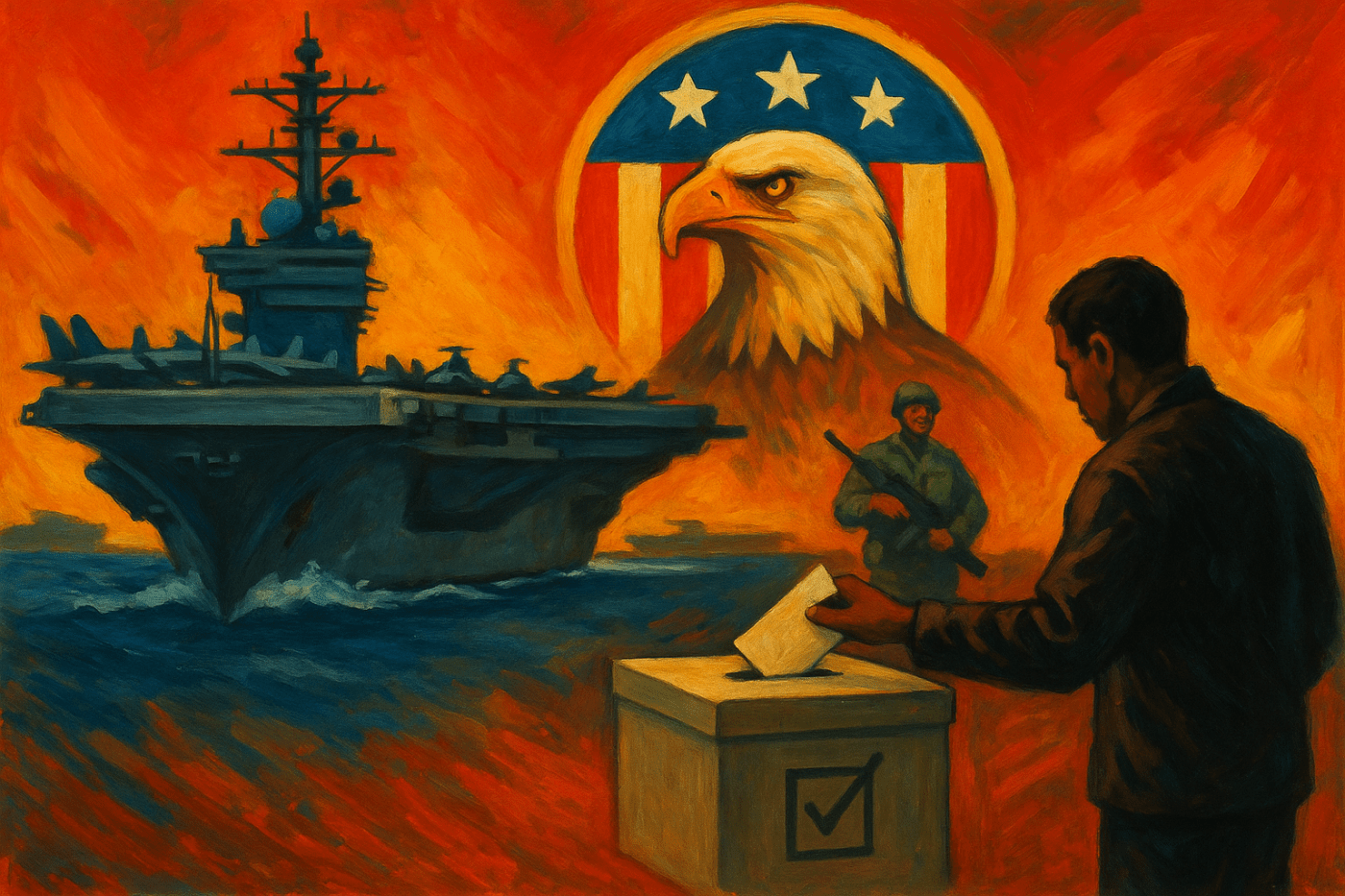
From a U.S.-backed mid-term victory in Buenos Aires to naval deployments in the Caribbean, the hemisphere is being reordered in plain sight.
By Prince Kapone | Weaponized Information | October 29, 2025
When Empire Sells You a Victory: Reading the Fine Print of CNN’s “MAGA Hero” Narrative
It begins with the calm confidence of imperial journalism. The headline—“MAGA hero hands big win to Trump’s Latin America strategy”—does not report; it announces. Stephen Collinson of CNN writes as if history itself were a press release from Washington, celebrating an empire that still believes it can dictate the fates of nations like stock movements on Wall Street. The tone is polite, deliberate, and smug. The subject—Javier Milei’s midterm triumph in Argentina—is framed as proof that Donald Trump’s new foreign policy has taken root across the hemisphere. There is no doubt, no hesitation, no room for dissent. It is the voice of power speaking to itself.
The article stitches together two threads that, on their own, have no organic relation: an Argentine election and a U.S. aircraft carrier steaming toward the Caribbean. The USS Gerald R. Ford, bristling with F/A-18 jets and Tomahawk missiles, becomes a floating metaphor for Trump’s supposed strength. The carrier’s voyage is presented as a “signal” to Venezuelan President Nicolás Maduro—proof that the hemisphere now bends once again toward Washington’s will. Collinson never asks why the most powerful navy on earth needs to posture against a nation besieged by sanctions, sabotage, and hunger. Instead, he narrates the movement of warships as though they were moral gestures, weapons as punctuation marks in a paragraph about “stability.”
Each paragraph moves like a military parade—precision without substance. We are told that Trump is “considering strikes on Venezuelan drug facilities” and that his advisers “portray Maduro as head of a cartel network.” We are told that “fentanyl” flows through the region, that the president “might be in Asia but his gaze is on Latin America,” and that “the game has changed.” What we are not told is that Venezuela produces no fentanyl, that these allegations have never been proven, and that such narratives have always served as the opening act to invasion. The journalist’s task, it seems, is not to interrogate power but to rehearse it.
Collinson’s prose bathes militarism in the glow of inevitability. When he writes of U.S. senators predicting “a real possibility” of land strikes, the danger is dressed as foresight; when Trump boasts, “We’re going to kill them,” the violence becomes bravado, not criminality. The text constructs what every empire needs most: moral permission. It frames aggression as order, coercion as policy, and obedience as progress. Through repetition and rhythm, it invites the reader to accept these absurdities as common sense.
The narrative relies on familiar sleights of hand. First comes the conflation of foreign policy with domestic salvation—“stopping drugs,” “reducing migration,” “making Americans safer.” Then the sanctification of strength: Trump’s willingness to “ignore Congress” becomes a virtue, not a violation. Finally, the ritual invocation of democracy: Washington, we are told, seeks only to free Venezuela from tyranny, even as it bankrolls coups, sanctions food, and threatens invasion. The contradictions are never confronted because imperial logic requires no consistency—only repetition.
Nowhere in the article do Latin Americans speak for themselves. The continent appears only as a stage on which U.S. actors perform morality plays about freedom and fear. Argentina’s electorate, Venezuela’s workers, Colombia’s dissenters—all reduced to scenery. Trump, in this script, is the protagonist of everyone’s history. The writer’s craft—careful, credentialed, and complicit—transforms empire into entertainment, converting the machinery of domination into a story of heroes and villains. It is the journalism of imperial nostalgia: the yearning to feel that the world still turns at America’s command.
What CNN sells here is not information but reassurance. It tells a weary empire that its muscle still matters, that its commands still echo, that the hemisphere is still “ours.” It is propaganda with manners—civilized, fact-checked, and ideologically sanitized. The language of neutrality disguises the violence it normalizes. Beneath the headlines and talking points lies the same old catechism: that the United States has a moral right to punish those who refuse its authority, and that every foreign election, every naval deployment, every threat of war can be read as another “win” for freedom. Freedom, of course, defined in Washington and broadcast by CNN.
What the Story Doesn’t Say: The Material Architecture of Coercion Beneath the “MAGA Victory”
Beneath CNN’s glossy narrative of triumph lies a map of coercion and crisis that the article never names. To understand why the network could present Argentina’s midterm elections and a U.S. carrier group’s movement as a single strategic “win,” we have to recover the material terrain it erases: the financial blackmail behind the ballots, the sanctions that starve nations into submission, the regime-change apparatus still operating in the shadows, and the open militarization of the Caribbean that accompanies it all. These are not stray facts; they are the infrastructure of what Collinson calls “Trump’s Latin America strategy.”
Start with Argentina. In the weeks leading to the election, Washington extended a $20 billion emergency loan to Buenos Aires— subsequently increased to $40 billion if Javier Milei’s party consolidated power. Trump, with his trademark bravado, said the quiet part out loud: he would “not be generous” if Milei lost. A lifeline became a leash. Argentine labor federations and left opposition economists denounced the bailout as electoral interference dressed as generosity, warning that austerity and privatization would be the true price of the loan. CNN mentioned none of this, preferring the fairy tale of a “MAGA hero” whose victory somehow proved the wisdom of U.S. policy. The reality is simpler: a government in crisis was bribed and bullied into compliance.
The story’s other axis—Venezuela—has been trapped under a siege economy since 2017, when U.S. sanctions were expanded into a full-spectrum blockade and approximately $30 billion in Venezuelan state assets were frozen abroad, cutting the country off from the global financial system and international banking channels. This chokehold rippled through daily life: oil and industrial imports were throttled, and medical supplies stalled in warehouses and ports until they expired. The sanctions were never a policy disagreement—they were, as documented by international observers, a coordinated economic warfare strategy designed to break the Bolivarian project from within and return control of the country’s resources to foreign corporate interests. Trump did not originate this system; he merely escalated it– publicly confirming in 2025 that “we have people in Venezuela right now,” a casual admission of ongoing CIA involvement. Meanwhile, the U.S. branding of Maduro as a “narco-terrorist” functions not as evidence, but as justification for the siege itself—yet Collinson repeats the accusation as narrative truth, scrubbing the machinery of coercion entirely from view.
The militarization that followed makes the economic pressure visible in steel and wake. Under the banner of “counter-narcotics,” the United States expanded naval and air operations across the southern Caribbean, even though independent monitoring organizations have shown these missions operate with little transparency and no public evidence of trafficking. One of the vessels destroyed in these interdictions was reportedly Colombian, prompting officials in Bogotá to question the legality of the strike, while Venezuelan authorities issued a formal statement condemning the attacks as extrajudicial aggression. These operations coincided with the United States increasing its military footprint at strategic island positions, including forward access from Curaçao and Aruba for surveillance and interdiction flights, alongside ongoing joint operational frameworks with Colombian security forces. Taken together, analysts have described the pattern as a hemispheric containment perimeter designed to enforce U.S. dominance in the region. None of this appears in CNN’s framing, which reduces the deployment of a carrier strike group to a symbolic gesture. In practice, it is a logistical architecture for coercion: predictable, sustained, and already underway.
Even within Washington’s claimed coalition, cracks have opened. Colombia’s President Gustavo Petro condemned the U.S. boat strikes as violations of international law and refused to join Trump’s “interdiction” initiative, pressing Washington to halt the attacks. Brazil signaled non-alignment and concern over U.S. warships in the Caribbean, aware that siding with Washington would threaten strategic ties with China and regional stability. Meanwhile, Caribbean states, through CARICOM, warned against a security build-up turning their waters into a military chessboard, endangering the very populations Washington claims to protect. None of this made CNN’s cut; dissent is the one form of “instability” the network never reports. To admit that Latin America is not united behind Washington’s threats would collapse the illusion of consensus that legitimizes them.
Argentina’s internal landscape also disappears behind the flag-waving headlines. The so-called “win” for Milei is less a surge of faith in Trumpian economics than the exhaustion of Peronism after decades of debt crises, repeated IMF restructurings (Argentina is the Fund’s largest debtor, with a long program history) and collapsing purchasing power under triple-digit inflation. The Peronist promise of social justice long ago curdled into crisis management, with the model repeatedly patched through IMF deals rather than renewed from below following the 2018 mega-loan that set records.In that vacuum, Washington’s dollar diplomacy finds fertile ground: a fresh, U.S.-backed IMF bailout was advanced in 2025 with Executive Board approval. It is easier to buy obedience when hope is on sale.
The “drug war” justification fares no better under scrutiny. The DEA’s 2024 National Drug Threat Assessment identifies the Sinaloa and Jalisco New Generation cartels in Mexico as the primary producers and traffickers of illicit fentanyl destined for the United States, using precursor chemicals sourced from China—a supply chain detailed in Brookings’ analysis of China’s role in the fentanyl crisis and reflected in erroneous U.S. enforcement actions indicting China-based precursor suppliers. Meanwhile, the United Nations’ World Drug Report does not list Venezuela as a fentanyl production or trafficking hub. Even U.S. border data show the vast majority of fentanyl is seized at official ports of entry, not on Caribbean sea lanes, as summarized by CBP’s portal Frontline Against Fentanyl. Yet the fiction of a Venezuelan “cartel state” persists because it performs a political function: it reframes economic siege and military encirclement as a benevolent act of “public safety.” CNN reproduces this premise without interrogation, converting accusation into atmosphere, and atmosphere into common sense.
When these omissions are restored, the pattern becomes impossible to miss. Financial leverage props up friendly regimes; sanctions and covert action punish disobedient ones; the navy enforces policy when markets and media fail. Behind every “MAGA victory” is a human cost measured in hunger, unemployment, and the steady erosion of national sovereignty. The corporate media’s role is to flatten this complexity into spectacle—to convert coercion into confidence, and domination into democracy. The facts are not hidden; they are simply ignored, buried beneath the noise of self-congratulation. It is the silence between CNN’s sentences that tells the real story.
The Hemispheric Hedge: How the White Ruling Class Plans to Save the Empire by Recolonizing the Americas
Strip away the patriotic varnish of CNN’s “MAGA victory” and what remains is not renewal but desperation. The Trump regime’s posture toward Latin America is the white ruling class’s latest attempt to rescue a collapsing empire by rebuilding a smaller one—an American Pole, carved from what Washington still calls its “backyard.” Having lost uncontested command of Eurasia to China’s infrastructure diplomacy and of Africa to a rising South–South solidarity, the United States now turns homeward in search of a colony it already owns.
The logic is simple and brutal. If the empire can no longer dominate the world, it will consolidate the hemisphere. The sanctions on Venezuela, the bailout blackmail in Argentina, the pressure on Colombia and Brazil, and the shadow operations across the Caribbean all belong to a single strategy of imperialist recalibration. The ruling class knows its unipolar moment has passed; what it seeks now is a regional fortress of capital and resources from which to negotiate the terms of decline. The new Monroe Doctrine wears a MAGA hat.
This recalibration is not just geopolitical—it is racial and classed to its core. The same white-supremacist bourgeoisie that built its wealth on genocide and slavery now faces the prospect of losing global privilege. Trumpism’s rallying cry of “America First” is the ideological mask for a deeper material project: to reassert control over the hemisphere’s land, labor, and markets, ensuring that the extraction zones of the South remain chained to the consumption zones of the North. In this design, sovereignty is treason, and socialism is a security threat.
The hemisphere’s recent history terrifies them. When Hugo Chávez won the Venezuelan presidency in 1999 and declared the Bolivarian Revolution, he ignited a continental current that swept through Bolivia, Ecuador, Nicaragua, Argentina, Brazil, and beyond. That progressive wave, however uneven, proved that the Americas could think and govern for themselves. It was this experiment in independence that Washington vowed never to let happen again. Every coup, sanction, and “drug operation” since has been an act of counter-revolution, aimed at reversing the gains of the twenty-first-century pink tide.
Trump’s revival of gunboat diplomacy, dressed up as counter-narcotics enforcement, is the armed wing of that reversal. The carriers in the Caribbean are not hunting smugglers; they are rehearsing subjugation. The “bailouts” to Argentina are not generosity; they are chains forged in the language of credit. The endless vilification of Venezuela is not about democracy; it is about reminding the hemisphere who is boss. And the media chorus that applauds these moves—CNN included—functions as the ideological artillery of this reconquest.
The contradiction is staggering: to save “freedom,” the empire must rebuild dependency; to preserve “democracy,” it must destroy sovereignty. But contradictions do not deter a class fighting for its life. The U.S. ruling bloc—its bankers, its oil barons, its Silicon Valley monopolists—understands that the only way to compete with a multipolar world is to re-colonize its own hemisphere. Control the mines of Bolivia, the lithium of Argentina, the oil of Venezuela, the ports of Panama, and the grain of Brazil, and the empire might yet buy time. Lose them, and it faces extinction.
This is why the Trump regime, and the bipartisan consensus that shadows it, is so ferocious toward Latin America. It is not hatred of socialism alone but fear of irrelevance. The West’s economic heart is hollowing; its political legitimacy is in tatters. What remains is the military cudgel and the racial arrogance that built the first empire on these continents. The white ruling class is circling the wagons, trying to turn the Western Hemisphere into one vast plantation with high-tech fences and privatized overseers. The struggle for Latin America’s sovereignty is, in truth, the struggle for humanity’s future.
From the viewpoint of the global working class, this “hemispheric hedge” is not merely a foreign-policy realignment—it is an act of class war on a planetary scale. It seeks to keep the South subservient and the North complacent, to turn crisis into opportunity for capital and catastrophe for everyone else. Yet the very forces driving this recalibration—multipolar integration, socialist resurgence, and people’s resistance—are the same forces that will ultimately undo it. The empire’s attempt to wall off a hemisphere will only reveal how small its world has become.
From Exposure to Action: Building the Front Against Hemispheric Empire
Once the mask is lifted, the question becomes what to do with the face beneath it. CNN’s story, like so many others, is not just a lie to be corrected—it is a weapon to be neutralized. It manufactures consent for a regional war economy and trains the public to see domination as destiny. The counter-weapon must therefore be organization, solidarity, and the steady construction of people’s power from below. Every strike of the imperial pen must meet the hammer of collective resistance.
The struggle already lives in the streets and ports of the Americas. In Venezuela, communal councils keep neighborhoods alive under blockade, turning scarcity into self-management. Across Argentina, trade-union federations march against austerity while popular assemblies resist the privatization blitz unleashed after Milei’s “victory.” In Colombia, movements that once fought for land now march for peace, defying U.S. military bases planted in their soil. The ALBA alliance continues to defy the sanctions architecture, and CELAC presses for integration independent of Washington’s command. These are not abstractions—they are living laboratories of sovereignty.
For those of us in the imperial core, solidarity must be more than sympathy; it must become sabotage of the machinery that feeds on others. The same banks that underwrite Argentina’s debt issue our credit cards. The same arms companies that build the carrier groups invest in our pension funds. Breaking those links—through divestment campaigns, worker pressure, and public exposure—is the first act of internationalism. The empire’s wars depend on the quiet cooperation of its citizens; our refusal is the only form of veto it cannot override.
On the information front, the task is to puncture the monopoly of narrative. Independent journalists from the Global South, exiled reporters, and grassroots media collectives already document the cost of sanctions and the realities of resistance. They need allies who can translate, amplify, and defend them against digital censorship. Every repost, every translation, every shared archive of truth is a crack in the corporate wall that shields empire from accountability. To speak clearly about what is happening is not charity—it is insurgent pedagogy.
Organization must follow clarity. Labor unions in the North can link directly with port, energy, and transport workers in the South to expose how sanctions and blockades flow through the same global supply chains that exploit them both. Migrant communities—those who have lived the empire’s border from the wrong side—must be recognized as the vanguard of this new internationalism, carrying the memory of dispossession and the skill of survival. The path forward is not a single march but a thousand coordinated refusals: to move the cargo, to code the software, to produce the weapons, to believe the lies.
The world that CNN depicts—an empire triumphant, commanding its hemisphere—is a ghost story told to frighten us into obedience. The living world looks different. It is a landscape of insurgent dignity: teachers in Caracas teaching under candlelight, dockworkers in Rosario striking against IMF dictates, Caribbean youth filming police violence on their phones, tenants in New York connecting their rent struggle to the sanctions that drive migration. The threads are already there; the loom is ours to build.
To read imperial propaganda critically is not enough. We must answer it with movement. The fight against sanctions, debt, and militarization is the fight for our own humanity—an act of collective self-defense. The hemisphere belongs not to Washington, nor to Wall Street, but to its peoples: to the farmer in the Andes, the nurse in Caracas, the longshore worker in Los Angeles, and the reader who has seen through the lie. Their unity is the empire’s end. Our task is to make that unity material.
 Weaponized Information
Leave a comment