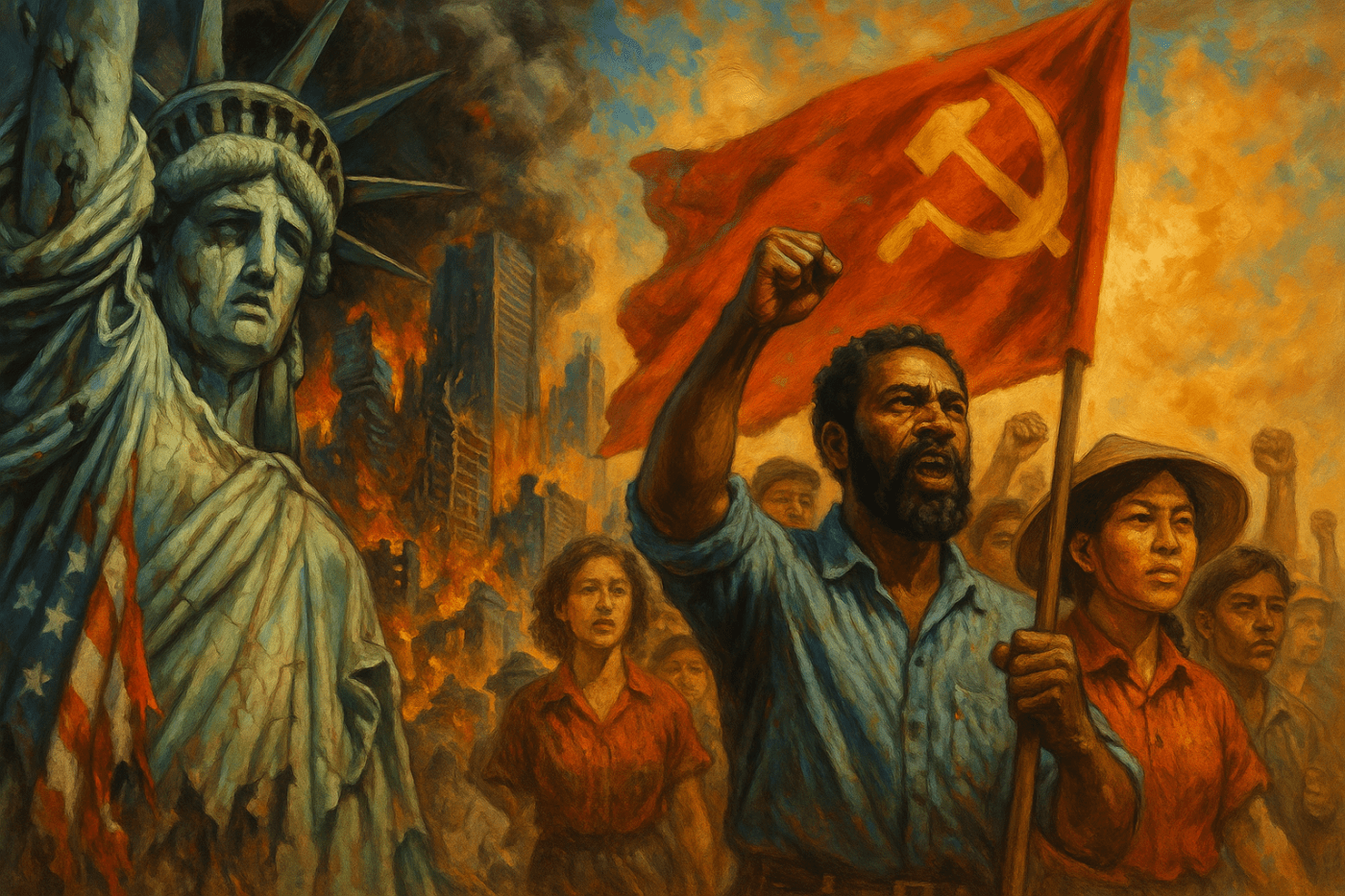
A Weaponized Propaganda Excavation of Kaiser Kuo’s modernity sermon—through the eyes of the people who build the world
Prince Kapone | Weaponized Information | October 22, 2025
The Rhetoric of a “Reckoning”
Kaiser Kuo’s essay walks onto the stage like a priest at a confessional, telling the West it’s time to face the mirror. He opens with thunder: history is no longer behind us, it’s “rushing toward us.” That’s not just a poetic flourish—it’s a setup. He wants the reader to feel swept up, to sense that resistance is futile. When you start a story that big, you make dissent look small. The reader’s already on their knees before the argument even arrives.
Then comes the credential drop: Adam Tooze, the economic historian with a cathedral voice, calling China “the master key to understanding modernity.” It’s a clever move—borrow the authority of a Western scholar to bless a non-Western rise. This isn’t analysis; it’s stage lighting. Kuo isn’t explaining how China became what it is; he’s massaging the Western ego so it can tolerate the shock. The audience can say, “See, even our intellectuals see it now,” and still feel cosmopolitan about it.
But beneath the performance of humility is a sleight of hand. He lists China’s accomplishments like a record of miracles—poverty eradicated, renewables built, life expectancy matched with the U.S.—and then he draws the moral: legitimacy doesn’t come from ballots but from results. That’s the essay’s pivot point, its soft revolution. No need to chant for democracy if the trains run on time and the lights stay on. The whole vocabulary of legitimacy gets flipped from freedom to function, from process to performance. He doesn’t shout it; he just changes the measurement.
To grease that transition, he brings in the “climate mirror.” You know the trick: if you deny climate science, you’re a crank. Now, if you doubt China’s rise, you’re another kind of denier. The analogy works like a trapdoor—you fall through it and land in moral discredit. The argument’s no longer about history or economics; it’s about your psychological fitness to face reality. That’s not logic; that’s cognitive warfare dressed in calm prose.
When Kuo says America’s problem is “cope” and “denial,” he’s not describing an empire in decay; he’s diagnosing a patient on the therapist’s couch. Dissent becomes pathology, critique becomes neurosis. It’s a neat trick—turn structural contradictions into emotional weakness. Then he quotes Levenson to intellectualize the mood: America, like late-Qing China, has lost the harmony between what it believes and what it sees. The comparison feels sophisticated, but it’s moral theater. A fallen empire gets to imagine itself as a tragic philosopher instead of a violent debtor.
Midway through, Kuo starts soft-selling the new gospel: state capitalism with Chinese characteristics, American-style. The United States, he says, is now borrowing the playbook it once scorned—industrial policy, subsidies, national planning. But instead of calling it what it is—panic management—he packages it as evolution. It’s the same trick imperial ideologues always play when the center starts cracking: rename retreat as innovation.
The racial and civilizational anxiety hums underneath the prose like bass. Kuo brushes against it without dwelling: the West’s problem, he says, is psychological—its inability to see a nonwhite civilization as equal or superior. True enough, but notice the containment. He turns racial panic into a kind of identity crisis, not the material logic of empire. The essay lets the white ruling class off easy by calling its imperial habits “reflexes” rather than structural necessities.
The ending lands with a monk’s calm. No blueprints, no manifestos—just the call for “intellectual honesty.” That’s the rhetorical coup. By renouncing ideology, Kuo makes his argument sound like realism itself. “The world has changed,” he says. “The only sin is lying to yourself.” That’s how propaganda works when it graduates from slogans to self-help. The reader walks away thinking they’ve been enlightened, not persuaded. It’s empire therapy for a bourgeois audience: face your decline gracefully, don’t rage against the dying of your dominance—just call it maturity.
The essay calls itself a reckoning, but what it offers is resignation. Beneath the velvet tone lies a quiet command: accept the new order as natural, inevitable, and above all—beyond politics. The poetry of humility masks the prose of surrender. And that, comrades, is how ideology wears a scholar’s smile.
Facts Behind the Curtain
Strip away the ceremony, and Kaiser Kuo’s essay rests on a solid handful of verifiable facts—each dazzling in scale, but each carrying a context he leaves untouched. The core of his argument is simple: China has done what the West said could not be done. It lifted hundreds of millions out of poverty, built the world’s largest renewable grid, and proved that planning, not chaos, delivers results. Those facts are real. The World Bank itself confirms that since 1981, nearly 800 million Chinese people rose above the poverty line—roughly three-quarters of all poverty reduction on Earth during that period. Life expectancy climbed from 33 years in 1960 to 78 in 2023, a figure almost identical to the United States. Nearly every home in China has had electricity for a decade, and secondary school enrollment has reached levels that rival Western Europe.
The numbers Kuo cites on energy are also verifiable—and staggering. China now accounts for more than half of all solar and wind power installed worldwide, according to Our World in Data and the Global Energy Monitor. Roughly three-quarters of renewable energy projects under construction today are Chinese-built or Chinese-financed. Even the European Commission’s own climate report concedes that while China is the largest single emitter of carbon, it is simultaneously leading in renewable deployment. These are not propaganda numbers; they are the hard arithmetic of development.
Kuo speaks of poverty eradication as a miracle, but leaves out the machinery that made it possible— massive state planning, socialist land reforms, public housing, and decades of Party-led rural development that resisted IMF and World Bank dictates. The same China that the West condemned for “state control” was the one that refused to privatize everything and let capital decide who lived or died. What’s called “performance legitimacy” in Kuo’s polite academic language is, in reality, the legacy of a revolution that broke the landlord class and reorganized production for social use. Without that, the miracle never happens.
Kuo also frames China’s emissions as a moral contradiction—how can the biggest polluter also be the biggest decarbonizer? China is indeed the world’s largest annual greenhouse gas emitter, yet at the same time, it has become the global leader in renewable energy deployment. But that paradox dissolves when you remember who outsourced their carbon footprints. The West offshored its factories to Asia decades ago, then blamed Asia for producing the goods they still consume. China emits because it manufactures the world’s necessities. To measure carbon without measuring consumption is a sleight of hand that keeps the imperial ledger clean.
The article notes, accurately, that the United States has tiptoed into its own version of industrial policy. With the CHIPS and Science Act and the Inflation Reduction Act, Washington quietly reintroduced state direction into its economy—the very practice it condemned in others. But here, too, Kuo skips the deeper contradiction: America’s return to planning is driven not by social need but by fear of losing hegemony. The CHIPS Act isn’t about building public prosperity; it’s about choking China’s access to advanced semiconductors. The IRA isn’t a green revolution; it’s a corporate feeding frenzy wrapped in green branding. It’s not socialism in embryo—it’s monopoly capitalism in panic.
In climate policy, Kuo’s essay contrasts China’s action with America’s paralysis—and he’s right. The second Trump administration has once again abandoned the Paris Agreement and even used the United Nations stage to ridicule renewable energy. Meanwhile, China continues wiring the planet with clean power, exporting solar panels and turbines to Africa, Latin America, and Southeast Asia at prices the West can’t match. Every new grid it builds chips away at the West’s monopoly on energy technology and finance. The contradiction is clear: the so-called “free world” is free to fail, while the “authoritarian” world keeps the lights on.
Even Kuo’s polling data— the Pew Research survey showing younger Americans softening toward China—fits into this material pattern. People under forty are far less likely than older generations to view China as an enemy, and they’ve never known a world where the United States builds anything monumental. They scroll through videos of Chinese maglev trains, megacities, and solar farms while potholes eat their own streets. They see the future and it doesn’t have an American accent. The essay cites this shift but misses its cause: it isn’t ideological admiration; it’s exhaustion with decline.
What’s missing from Kuo’s polished narrative is class. The people who actually built that new world—the Chinese workers who laid the solar panels, tunneled the metros, assembled the high-speed trains—are invisible. The essay marvels at the machine but ignores the hands that made it. And that’s where the story of modernity always gets rewritten: not in the think tanks or the pressrooms, but on the factory floor.
These are the facts that must stand before theory: China’s achievements are real; its contradictions are real; and so are the omissions that disguise the human labor and socialist planning behind them. Only when we place those facts side by side—what’s said and what’s unsaid—can we begin to see how this so-called reckoning is less about understanding China, and more about the West coming to terms with its own decay.
The World Turning Inside Out
Every empire imagines itself eternal until the lights start flickering. Kaiser Kuo’s “Great Reckoning” frames China’s rise as a mirror to the West’s moral confusion—as though the story were psychological, not structural. But what we’re seeing is not a civilization losing confidence. It’s a system losing viability. The crisis is not about perception; it’s about production. The United States and its junior partners built their supremacy on a world they no longer control—one where labor, minerals, and markets have slipped beyond the leash of dollar supremacy. China is not the cause of this decay; it is the proof that the neoliberal order has run its course.
The very data Kuo cites—poverty eradication, universal electrification, the renewable energy surge—mark something deeper than technocratic competence. They show what happens when a state refuses to surrender planning to the market. In the language of empire, this is called “performance legitimacy.” In the language of the people, it’s called feeding, housing, and empowering human beings. These are not gifts from authoritarian benevolence but the accumulated dividends of a revolution that reorganized society around social need. Long before it became fashionable to speak of “industrial policy,” Chinese planners were building collective infrastructure that no corporation could or would provide.
For forty years, Western orthodoxy preached that history was settled: deregulate, privatize, and the invisible hand would deliver abundance. What it delivered was collapse. When China built railways, ports, and solar fields, the U.S. built speculative bubbles and data monopolies. The “reckoning” Kuo writes about is not moral—it’s material. The empire that once financed the world now lives off financial extractions. It no longer produces; it manages. And when an empire stops producing, it starts policing.
That’s why the new “industrial policy” in Washington looks more like triage than transformation. The CHIPS Act and Inflation Reduction Act aren’t efforts to democratize production; they’re emergency fences around monopoly capital. They try to imitate China’s planning without its social purpose—to mobilize the state not for public welfare but for corporate defense. When Kuo calls this convergence, he mistakes imitation for equivalence. One side plans to build; the other plans to hoard. The difference isn’t geography—it’s class.
Meanwhile, the essay’s climate analogy—its “mirror”—accidentally exposes the true reckoning. Climate change and capitalist decay are twin crises of the same logic: accumulation without responsibility. China’s rise, however contradictory, reveals that survival in the twenty-first century will depend on coordinated planning at scale. The question is not whether the world needs planning; it’s who the planning will serve. When Beijing wires half the planet with renewable energy, it demonstrates that organization and speed are not authoritarian vices—they’re conditions of survival.
The West’s problem is not that it has too much freedom; it’s that it has too little direction. Its political class can no longer imagine public purpose beyond GDP and shareholder value. So it reaches for nostalgia, for Cold War clarity, for enemies to explain away its rot. The obsession with “China’s contradictions” is projection. It’s the empire looking in a cracked mirror and blaming the reflection. The United States offshored its pollution, debt, and production, then calls the countries that carried its burden “threats.”
What Kuo’s narrative misses is that modernity has already broken free from the West’s custody. Development is no longer a franchise of liberal capitalism. The center of gravity has shifted from the Atlantic to the Pacific, from the imperial core to the Global South. The world’s infrastructure, its supply chains, and even its scientific momentum are being rebuilt by the very nations once written off as dependent. Modernity has become plural, not because of ideology but because of material necessity. You can’t build the future on a dying empire’s script.
And yet, for all the celebration of progress, there remains the silence of the workshop—the workers who made it happen. The millions who built the roads, wired the grids, assembled the turbines. Their absence from Kuo’s essay is not oversight; it’s ideology. Modernization is presented as a state accomplishment, not a labor victory. But history doesn’t move by policy; it moves by production. The Chinese worker who lays fiber in a desert province and the African technician installing solar panels with Chinese hardware are part of the same global proletarian process: building the physical foundation of a post-imperial world.
What Kuo calls “reckoning” is actually recognition—the moment when empire must face its own obsolescence. The West’s story of modernity was always a colonial one: that progress required subjugation elsewhere. But the facts now say otherwise. The very instruments of progress—industry, science, and planning—have been reclaimed by those once denied them. The bourgeoisie reads this as humiliation. The working class reads it as vindication.
The real reckoning, then, is not whether China is “rising,” but whether humanity can escape the death grip of capital before the planet itself burns. China’s achievements, however uneven, reveal a principle the West forgot: that production can serve life instead of profit. The task for revolutionaries everywhere is not to idealize Beijing or Washington, but to generalize the lesson—planning over chaos, cooperation over extraction, sovereignty over subordination. The age of imperial modernity is ending. The question is whether the next one will belong to the people who build it.
Building the Reckoning From Below
If Part III showed that the world’s old order is cracking from within, Part IV is about what to do with the rubble. The “Great Reckoning” that Kaiser Kuo frames as an intellectual awakening can only become real when it is taken up as a project of organized labor, peasantry, and popular power. Because history doesn’t move by polite recognition—it moves when the people who make the world decide to take it back.
Around the planet, the new world is already being built by hands calloused from work, not from typing reports. In Africa, Chinese-made turbines and African technicians are bringing cheap electricity to towns that colonial companies ignored. In Latin America, the regional energy integration projects tied to ALBA and CELAC are reasserting sovereignty over natural resources, using Chinese capital but Latin leadership. In the United States, transmission-grid alliances like Transmission Possible and the Rewiring America campaign fight the bottlenecks that private utilities maintain for profit. These are not side stories; they are the early laboratories of multipolar survival.
The anti-war and anti-imperialist front is also stirring again. Campaigns such as Codepink’s “China Is Not Our Enemy” and the Tricontinental Institute’s dossiers challenge the manufactured hatred that feeds sanctions and proxy wars. They connect the price of bread at home with the bombs abroad. Every base closed, every sanction lifted, every war budget cut is a transfer of power back to the people who actually need power—electrical, political, and social.
These struggles must converge. The climate fight, the labor fight, and the anti-war fight are one and the same: a struggle over who plans the future. Will planning remain a monopoly of billionaires and generals, or become a public good? The answer will not come from think tanks or party conferences; it will come from organizing at the base—utility workers taking grids public, tenants forming unions, students defending the right to learn without debt, farmers refusing to poison their soil for export markets. The point is not to copy China’s model but to learn its lesson: the state must once again become an instrument of collective survival, held accountable from below.
For comrades in the Global North, this means confronting our own complicity. The empire survives through us—our banks, our taxes, our silence. The first act of solidarity is refusal: refuse the new Cold War, refuse to let climate denial and anti-China hysteria be used to justify militarization. The second act is reconstruction: build alternatives. Join the local energy-democracy campaigns, support public-bank initiatives, back the union drives that connect labor rights with ecological transition. Every kilowatt wrested from private monopoly, every wage won from a transnational firm, is a small breach in the fortress of technofascism.
For comrades in the Global South, the task is defense and coordination. Protect the sovereignty that has been so hard won—through BRICS+, through South-South cooperation, through new trade and finance architectures that break the IMF’s chains. Demand technology transfer, not tutelage. The multipolar world must not become a new marketplace for old masters; it must become a workshop for shared survival.
The “reckoning” that Kuo imagines as a quiet Western self-realization will only happen when the working classes of the world make it happen. When we link our movements across borders—when the U.S. electrician sees the same struggle in the Bolivian lithium miner, and both see their fight reflected in the Chinese factory hand—then the reckoning becomes revolution. Because the empire’s collapse isn’t the end of history; it’s the beginning of responsibility.
So, comrades, the task is clear: organize the new world before the old one drags us down with it. The ruling class has had its centuries; now it’s our turn to plan. Not to manage decline, but to build life. The Great Reckoning is not a headline—it’s a job for the living.
 Weaponized Information
Leave a comment