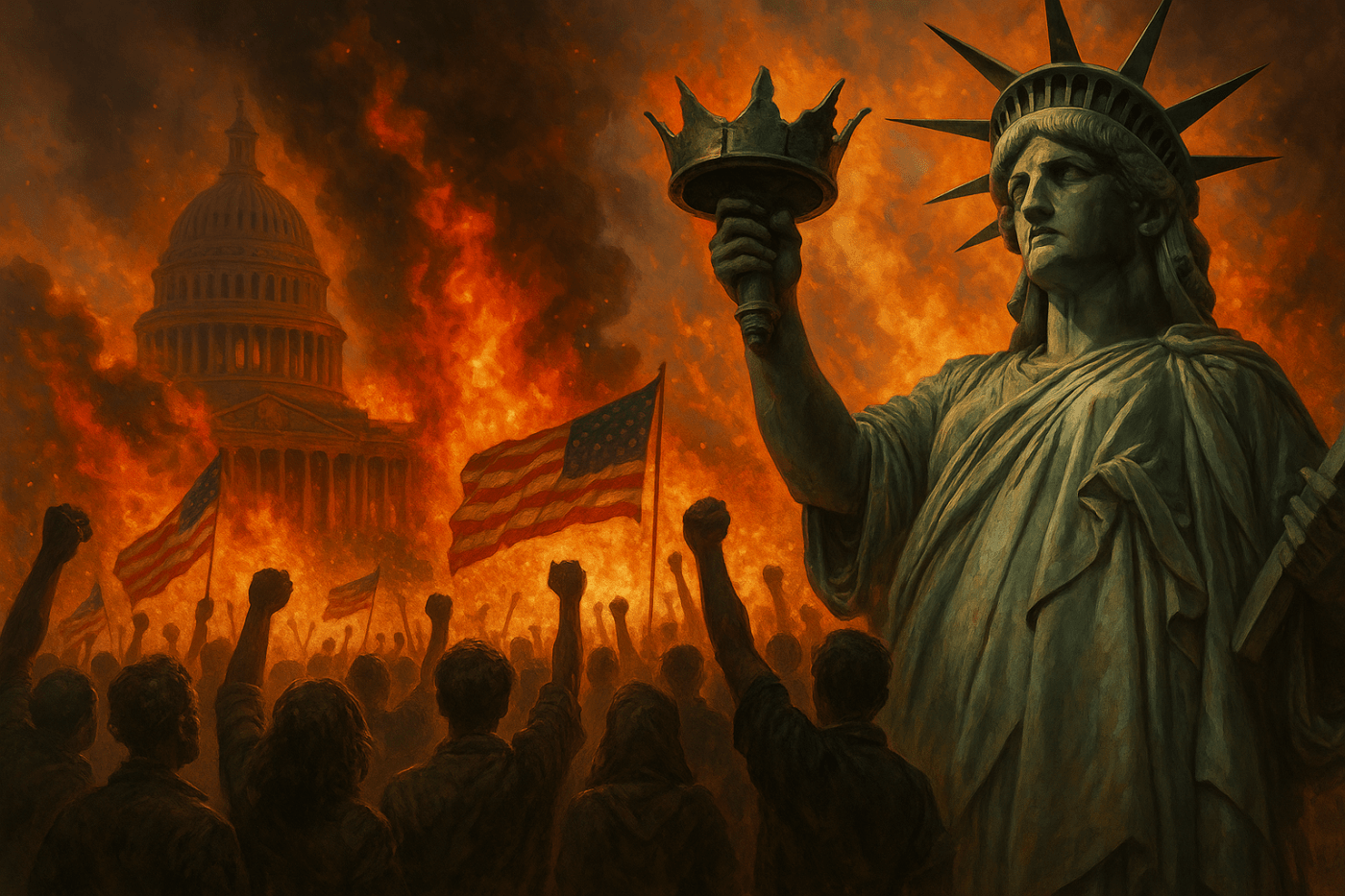
How the ruling class staged a mass protest to save the presidency—not dismantle it—and why a real “No Kings” movement must break the throne, not defend it.
By Prince Kapone | Weaponized Information | October 22, 2025
Rituals for a Throne: How “No Kings” Became a Crown-Saving Ceremony
They told the country a stirring tale: on October 18, millions took the streets to stop a tyrant and save the Republic from a new American king. It sounds heroic. It also isn’t true. Those marches weren’t a revolt against kingship; they were a ritual designed to protect it—a carefully managed spectacle that released steam without touching the boiler.
In this country we don’t have mass movements so much as mass mobilizations. Movements grow from hunger, debt, eviction courts, picket lines, and the long patience of organizing. Mobilizations get emailed into being when elites need the crowd to march in circles and go home on time. October 18 was exactly that: a pressure valve in protest form, a way to express anger while leaving power intact.
If the goal were to stop executive dictatorship, the target would have been the presidency itself—the war machine each administration inherits; the surveillance architecture that expands no matter who wins; the bipartisan dictatorship of capital that governs through the Oval Office. Instead, the demand was modest: a nicer king. A technocrat who bombs with etiquette, surveils with a smile, and restores “norms” so the empire can breathe easier.
Peel back the posters and the class character is obvious. This wasn’t built by the evicted or the colonized. It was staged by nonprofit directors, foundation-favored strategists, digital turnout contractors, and party-adjacent influencers—professionals whose careers exist to manage dissent, not weaponize it. Their politics cannot imagine a world beyond the throne because their livelihoods orbit it. For decades, the nonprofit industry has performed this role: converting insurgent energy into safe deliverables and respectable campaigns that protect the state’s legitimacy while claiming to hold it accountable.
The chant said “No Kings.” The mission said: guard the crown. What unfolded was a Yankee–Digerati rescue operation to keep the throne in competent hands and out of the Cowboy faction’s open-air barbarism. This wasn’t about smashing the instrument of rule; it was about choosing which faction wields it—technocrats over arsonists, logistics over lynch mobs, drones with punctuation instead of drones with sneers.
That is the quiet cruelty of liberal protest culture: it convinces the oppressed to march for the institutions that oppress them. Workers, tenants, students, debtors, and migrants were told that saving the imperial presidency was resistance, not obedience. The spectacle did not challenge executive authority; it sanctified it. It did not defend democracy; it defended belief—the myth that the presidency rules by consent rather than coercion.
Every empire lives on ceremony. When the faith begins to wobble, it throws a pageant to steady the hand. October 18 was one such pageant. It warned of a looming monarch to conceal the one already seated. And like every imperial con, it rests on a simple lie: that the problem is the person wearing the crown, not the crown itself.
Professional Protest Managers and the Politics of Containment
There was nothing spontaneous about the October 18 spectacle. Once you strip away the cardboard slogans and stage-managed anger, you don’t find a people’s uprising—you find an administrative flowchart. You find executive directors, list managers, turnout vendors, and foundation-linked coalitions that operate like subcontractors of the Democratic Party. The “No Kings” chorus did not arise from the barrios, the prisons, or the shop floors. It was conducted from the boardrooms of the professional activist class.
At the center of this apparatus sit groups like Indivisible, MoveOn, Public Citizen, ACLU, and a rotating cast of respectable NGO brands that have mastered the art of protest without consequence. They write the scripts, craft the talking points, train volunteers in the etiquette of outrage, and hand out chants that never name capitalism, never name empire, and never name the presidency as the weapon it truly is. This is not movement-building. It is narrative management with a marching permit.
Even the digital infrastructure gave away the game. The entire operation ran through Mobilize and NGP-VAN—the same turnout software used for Democratic electoral campaigns. That is not revolutionary energy. That is voter-prep cosplay. It exists to funnel unrest back into the ballot box, back into NGO pipelines, and back under the supervision of the very institutions that helped build the imperial presidency they now pretend to fear.
Look at these organizations outside the spotlight and their loyalties are unmistakable. Indivisible waves NATO flags over proxy wars. MoveOn begs for “restraint” while backing every foreign-policy consensus that keeps the empire’s arteries open. AFT and SEIU lend the symbolic weight of labor without risking a single strike. ACLU, for all its necessary work, refuses to confront the imperial architecture that manufactures the abuses it litigates. These are not engines of liberation. They are the liberal wing of imperial governance.
Their purpose is not to mobilize the oppressed into a force that can seize power. Their purpose is to manage discontent—to keep people marching, voting, donating, and believing, but never organizing beyond the boundaries of elite supervision. They are the soft police of the ruling order: not the baton that breaks the bone, but the velvet glove that guides rebellion back onto the sidewalk, promising justice if we just behave a little longer.
So let us speak clearly: October 18 was not the voice of the people. It was the voice of a faction of the ruling class speaking through the people. It did not challenge the throne. It defended it from instability, from disillusionment, and from the possibility that millions might finally conclude that the presidency itself—not merely its current occupant—is the greatest weapon the ruling class has ever forged.
The Billionaires’ Benevolence: How Philanthropy Buys Obedience and Manufactures “Democracy”
If you want to know who a protest really serves, follow the money. October 18 did not run on volunteer enthusiasm and printer paper. It ran on the quiet bankroll of the same philanthropic empires that have spent half a century converting rebellion into paperwork, defiance into “deliverables,” and liberation into grant cycles. These funders do not fear executive dictatorship—they fear executive delegitimization. Their concern was never that the throne was too powerful. Their concern was that the people might stop bowing to it.
Behind the slogans about “saving democracy” stood the usual constellation: the Open Society network, the Ford Foundation, the Democracy Fund, Arabella outfits, Tides intermediaries, and donor-advised pipelines that exist to stabilize the imperial order with a humanitarian smile. This is not philanthropy in the moral sense. It is ideological counterinsurgency—a form of social management designed to contain movements before they grow teeth. As Ferguson showed in her study of the Ford Foundation, philanthropy perfected this technique in the 1960s and 70s, hijacking Black insurgency by funding a harmless substitute: representation instead of revolution, “community participation” instead of power, reform as a tranquilizer, not a weapon.
The same playbook governs the nonprofit complex today. As INCITE! meticulously documented, the nonprofit sector functions as a political firewall—absorbing insurgent energy, professionalizing struggle, and disciplining movements through the logic of grant dependency and foundation oversight. The result is predictable: uprisings become campaigns, campaigns become projects, projects become staff positions, and staff positions must never threaten the hand that funds them.
This is why October 18 posed no danger to the imperial presidency. The funders behind it require a strong executive. They depend on the presidency to enforce sanctions, guard trade routes, protect financial flows, discipline the Global South, and maintain domestic order through surveillance and police militarization. Their objection to Trumpism is not that it is imperial, but that it is messy imperialism—reckless, uncoordinated, and bad for markets. What they want is executive power that is stable, predictable, and globally legitimate. Drone strikes with footnotes. Coups with press releases. Technocratic domination wrapped in the language of civil liberties.
Philanthropy fears only one thing: disillusionment. A public that loses faith in the presidency becomes ungovernable. A population that stops believing in “democracy” might start believing in itself. It might form organizations the ruling class cannot fund, cannot steer, cannot veto. It might learn that freedom is not granted by presidents, courts, or parties—but seized through struggle. That is why they poured money into October 18: not to fight despotism, but to preserve the myth of consent on which the imperial system depends.
So the marching orders were clear. Fund the pageantry. Choreograph the outrage. Protect the legitimacy of the office. Keep the masses protesting within acceptable boundaries—loud enough to feel free, but never organized enough to become dangerous. October 18 was not a cry of rebellion. It was a retainer fee paid by the ruling class to its nonprofit intermediaries to stabilize belief in a collapsing political religion.
The money behind the march was not “movement money.” It was imperial insurance. And its investment paid off. Millions marched—yet the presidency emerged stronger, its authority reaffirmed, its mythology refurbished. The crown did not tremble. It gleamed.
The Family Feud of Empire: Yankees, Cowboys, and the Digital Nobility
What unfolded on October 18 was never a morality play about democracy versus dictatorship. It was a custody battle inside the imperial household—a fight over who gets to control the throne, not whether the throne should exist. Three factions of the white ruling class dominate U.S. political life today: the Yankees, the Cowboys, and the Digerati. All three agree on empire, on private property, on endless war, on the right of the United States to police the planet. Their only disagreement is over how the empire should be managed, and which faction gets to administer the violence.
The Yankees are the old imperial managers—Wall Street financiers, Ivy League mandarins, State Department lifers, and think-tank priesthoods who worship at the altar of “rules-based order.” They prefer treaties, sanctions, NATO coalitions, and speeches in polished English before the drone strikes begin. They are the stewards of respectable empire: buttoned-up, credentialed, and convinced that the world can be governed by spreadsheets, markets, and forward-operating bases.
The Cowboys, by contrast, are the blunt instrument of white power—oil barons, settler revanchists, war profiteers, Christian nationalists, and extraction capitalists who dream of a frontier that never closed. They don’t want global order. They want global obedience. They distrust institutions, despise multilateralism, and see brute force—not diplomacy—as America’s birthright. Their slogan, spoken or not, is simple: The strong take. The weak kneel.
Then there are the Digerati—the new aristocracy of Silicon Valley and the security state. These are the platform oligarchs, AI monopolists, and behavioral engineers who believe empire can be automated. They don’t want a king with charisma or a technocrat with charm. They want dashboards, machine learning, predictive policing, and frictionless obedience. Their dream is an empire that runs like a cloud server—self-correcting, self-updating, and self-policing, where rebellion is not crushed in the streets but filtered, throttled, and quietly deleted.
On October 18, the Yankees and the Digerati joined hands in public, not because they oppose authoritarianism, but because they fear the Cowboys’ lack of discipline. Trumpism represents sloppy empire, chaotic empire, empire that threatens markets, alliances, and legitimacy. For the Yankee–Digerati bloc, this is the greatest danger—not injustice, not poverty, not endless war, but a crisis of belief in the imperial center. Their nightmare is not tyranny. Their nightmare is instability.
So they mobilized their foot soldiers, hired their turnout machines, and staged a ritual meant to “defend democracy” while actually defending the executive throne from being captured by the wrong faction of the ruling class. The NGOs provided the volunteers. The funders provided the scripts. The media provided the soundtrack. And the people—most of them sincere, many of them terrified—were led into the streets to protect the crown from one faction by marching under the banner of another.
This is why the slogans were vague. This is why the demands were hollow. This is why the target was theatrical and the enemy abstract. The spectacle was never about dismantling executive power. It was about preserving the throne by choosing which hand should grip the scepter. It was factional maintenance disguised as mass resistance.
The people deserve the truth: under all three factions—Yankee, Cowboy, or Digerati—the presidency remains a weapon of capital, and we remain its subjects. There is no “lesser evil” when all three roads lead to empire. What October 18 revealed is that the ruling class will mobilize millions to protect the throne, but will unleash hell on anyone who tries to break it. Their quarrel was never with kingship. Only with who gets to wear the crown.
Manufactured Dissent: When Protest Becomes a Pressure Valve for Empire
In a healthy society, protest is a weapon of the oppressed. In the United States, it has been turned into a pressure valve for the oppressor. The October 18 spectacle was not organized to unleash popular power—it was engineered to contain it. Instead of sharpening rage into strategy, it converted rebellion into ritual. Instead of building organization, it produced catharsis without consequences. Instead of threatening the system, it taught people to scream on schedule and disperse on time.
This is not accidental. It is the perfected craft of the nonprofit-industrial complex. As INCITE! has shown, the nonprofit sector functions as a management layer between the people and the state—absorbing insurgent energy, professionalizing dissent, and steering rebellion into grant-friendly activities that pose no material threat to capital or empire. The result is a politics of spectacle, not struggle—activism reduced to performance metrics, healing circles, email blasts, and photo ops about “raising awareness,” all while the boot stays firmly on the neck.
That is exactly what October 18 was: a controlled burn. A release of frustration that preserved the architecture of domination. There were no strike calls. No shutdowns. No refusal of logistics. No disruption of capital flows or imperial operations. Instead, participants were shepherded through a pre-scripted choreography: gather, chant, post, disperse, vote. The organizers didn’t want escalation—they wanted emotional release without structural rupture. They offered people the feeling of resistance without the power of it.
The ruling class is not afraid of protest. It is afraid of organization. It fears tenants who can halt evictions, workers who can halt production, debtors who can sabotage finance, and communities who can feed and defend themselves beyond the reach of the state. It fears institutions of popular power that cannot be bought, steered, or dissolved by foundation grants. So long as protest remains a ritual—loud, symbolic, obedient—the empire smiles. It knows the difference between a march and a movement, between managed dissent and insurgent power.
And so the nonprofits did their job. They translated rebellion into branding. They turned fury into hashtags. They converted righteous anger into a harmless procession that left property untouched, capital unhindered, and empire uninterrupted. People walked away feeling lighter, not stronger—relieved, not organized. That is how manufactured dissent works: it drains the insurgent impulse and calls the result “civic engagement.”
October 18, then, was not a protest against kingship. It was a vaccination against revolt. A dose of symbolic resistance administered to prevent the spread of the real thing. By marching the people in circles, the organizers protected the presidency from its only true threat: the possibility that millions might stop pleading with power and start seizing it.
The Empire’s Soft Police: How Media and NGOs Pacify the Left
Empires do not rule by force alone. Police, prisons, and armies can break bodies, but they cannot secure belief. For that, the ruling class requires something gentler—institutions that can disarm rebellion before it matures. This is the true function of the U.S. nonprofit sector, prestige media, and the respectable wing of the American “left”: they are the soft police of the empire, tasked not with cracking skulls, but with narrowing imagination, pacifying insurgency, and converting revolt into loyalty.
Philanthropy pioneered this architecture in the late twentieth century. When Black, Brown, and Indigenous movements threatened the foundations of U.S. power, the Ford Foundation stepped in—not to liberate, but to domesticate. It funded “community engagement” in place of self-determination, representation in place of revolution, and professional activists in place of mass organizers. In doing so, it transformed liberation movements into manageable reforms, regulated by grant conditions and overseen by foundation staff. Ferguson’s analysis laid it bare: philanthropy became a method of counterinsurgency from above, stabilizing the state by absorbing its most dangerous critics.
This model matured into the nonprofit-industrial complex that INCITE! later exposed—a vast machinery that turns rebellion into programming, and freedom dreams into deliverables. Through grant dependence, reporting requirements, and “respectability metrics,” nonprofits learn to police movements on behalf of the state, disciplining the very communities they claim to serve. Their job is not to challenge capitalism or empire; it is to manage dissent, administer suffering, and maintain faith in a system built on dispossession.
October 18 showed this system in full operation. The NGOs took the lead, not because they wanted to dismantle power, but because they feared a crisis of legitimacy. They guided marchers down safe routes, fed them patriotic scripts about “our democracy,” and framed obedience as resistance. Meanwhile, the corporate media amplified the spectacle, lavishing attention on a protest that defended the state, while mocking, silencing, or criminalizing uprisings that target the system itself. The media’s job is not to inform, but to dictate the boundaries of acceptable dissent—protest is allowed, so long as it ends with a vote.
Even the official “left”—from progressive influencers to academic celebrities—played its role. They warned against being “too radical,” scolded the angry for being “divisive,” and begged the oppressed to be patient with the very institutions that cage and surveil them. They speak the language of change, but insist that change remain harmless. They treat the Democratic Party as the horizon of possibility, activism as therapy, and solidarity as content. In moments of real rupture, they side with order over liberation, stability over struggle, and symbolism over strategy.
This is how empire survives its crises. Not only by crushing revolts, but by preventing them—by exhausting people with spectacles, soothing them with representation, and trapping them in rituals that never threaten capital or the presidency. Protest becomes a performance. Voting becomes a sacrament. Democracy becomes a ritual of obedience dressed up as choice. The NGOs provide the script, the media provides the soundtrack, and the official left provides the moral cover. Together, they ensure that resistance never becomes revolutionary.
October 18 was their masterpiece. Millions marched, yet nothing was disrupted. Anger was expressed, but not organized. The presidency—the centerpiece of U.S. imperial authority—emerged not weakened, but renewed. That is not liberation. That is domestication. And until the people break from the soft police of empire—until they reject foundation-approved activism and media-approved dissent—they will remain loyal opposition inside a system that cannot be reformed, only overthrown.
A Democracy for Empire: Legitimacy as the Last Line of Defense
The greatest illusion in American political life is the belief that “democracy” exists to empower the people. It does not. U.S. democracy is a management system for empire—a mechanism for manufacturing consent, institutionalizing obedience, and renewing the legitimacy of a ruling class that the vast majority of people will never meet, vote for, or control. This is why October 18 must be understood not as a fight for freedom, but as a fight for belief. The purpose of the spectacle was not to weaken executive authority—it was to protect the myth that the presidency rules by consent, not coercion.
The empire is in crisis. Its currency is challenged, its military exhausted, its alliances unstable, and its domestic order fraying at the edges. More dangerous than any rival superpower is a population that no longer believes. Millions of people—workers, tenants, students, the indebted, the policed, the unemployed—are slipping out of the psychological contract that once held the system together. They no longer trust the courts, the parties, the media, or the presidency itself. And that terrifies the ruling class far more than any cowboy demagogue ever could.
October 18 was a defensive maneuver against this unraveling. That is why the slogans obsessed over “norms,” “institutions,” and “saving our democracy.” They were not defending liberty—they were defending legitimacy, the ideological oxygen of empire. Without the belief that America is free, that elections are sacred, and that presidents govern on behalf of the people, the entire imperial structure begins to crack. You cannot run a global war machine, a domestic surveillance apparatus, or a financial empire on brute force alone. At some level, the people must believe.
And so the marchers were told that they were protecting democracy from kingship, when in fact they were protecting kingship from democracy. They were led into the streets to shield the imperial presidency from its only real threat: the possibility that ordinary people might stop kneeling before the institutions that dominate their lives. A population that stops believing in the presidency might stop obeying its laws, stop respecting its authority, and stop accepting its violence at home and abroad. That is the nightmare scenario for capital and empire—not chaos, but clarity.
This is why NGOs, media, and official left figures all coordinated their message. They know that once the myth collapses, the people will seek power outside the institutions that exist to contain them. They will build unions that strike, tenant councils that seize housing, neighborhood formations that feed and defend themselves, and political organizations that refuse foundation money and ballot-box obedience. They will discover that democracy does not mean choosing which ruler will preside over their exploitation—it means organizing to abolish the power of rulers altogether.
The ruling class understands this better than many progressives. They know the presidency cannot survive without the theater of consent. They know that legitimacy, not liberty, is the true prize. And they know that if the people ever stop mistaking participation for power, the empire loses its spell. October 18 was therefore not a rebellion against authoritarianism, but a ritual designed to restore faith in the throne. A ceremony for a dying political religion. A chant to keep the crown shining.
The Only “No Kings” Worth Marching For
If there is to be a future without kings, it will not be delivered by nonprofits, political parties, or philanthropic caretakers of empire. It will not come from ballot lines that swap one manager for another, nor from patriotic sermons about restoring the soul of a settler republic that never had one. A genuine “No Kings” politics must come from below—from the people who have never known power in this country except as a boot on their neck—and it must aim not to regulate the throne, but to abolish it entirely.
That means rejecting the oldest lie of American liberalism: that salvation descends from above. No president will liberate the poor. No administrator of empire will dismantle the empire. No ruling class will vote away its own dominance. The presidency is not a malfunctioning institution; it is a weapon of class rule, forged in genocide, slavery, war, and accumulation. It cannot be reformed into something humane. You cannot democratize a throne. You can only knock it down.
A real “No Kings” movement begins with the slow, disciplined work of building counterpower—tenant unions that can shut down evictions, worker councils that can halt production, neighborhood assemblies that can control resources and defend communities, and political organizations rooted in mass participation rather than donor approval. It requires a culture that values solidarity more than branding, organization more than outrage, and struggle more than symbolism. It means forming institutions that do not ask permission from the state, because they are being built to replace it.
This movement will need its own media, its own schools, its own infrastructure of survival. It must learn from the great liberators of the world—from Haiti to Vietnam, from the Panthers to the Sandinistas—that the oppressed do not win by begging for inclusion in the master’s institutions. They win by constructing their own. They win by turning the cracks of empire into openings for power. They win by making the old world ungovernable.
What the ruling class fears most is not a demagogue in the White House. It fears a population that no longer believes in the myth of authority at all. It fears workers who recognize their own power. It fears the colonized when they reclaim their history. It fears the masses when they stop mistaking representation for liberation and begin building a world without bosses, landlords, generals, or presidents. That is the nightmare that October 18 was designed to prevent—not dictatorship, but awakening.
The only “No Kings” worth marching for is one that ends the reign of the imperial presidency altogether, dismantles the machinery of empire, and replaces it with a democracy rooted in the self-governance of the oppressed. Not a change in personality, but a change in system. Not a gentler king, but no king at all. No masters. No managers. No overseers. Just power in the hands of the many, organized to build a world where freedom is not a slogan, a ceremony, or a myth—but a material fact.
Conclusion: Break the Spell, Build the Power, Burn the Throne
The great danger of this moment is not that the United States is sliding toward monarchy. It is that millions have been coached to mistake ritual for rebellion, symbolism for struggle, and management for democracy. October 18 was not an uprising against executive domination—it was a loyalty ceremony for a dying system, a mass pledge of allegiance disguised as dissent. The liberals who organized it do not fear dictatorship. They fear the loss of faith in the institutions that make dictatorship possible.
But legitimacy is cracking. Millions feel the system collapsing on top of them—rent rising, wages shrinking, wars multiplying, rights evaporating, police militarizing, and the future closing in. People are not losing hope because they are irrational. They are losing hope because they are perceptive. They can see that the presidency is not a shield but a sword, not a guardian but a racket—an instrument of capital that consumes lives at home and abroad to preserve the profits of the few.
The ruling class has only two tools left: force and theater. The hard police break bodies; the soft police break imagination. But their spell is weakening. Every crisis exposes the truth. Every contradiction tears another seam in the fabric of belief. When the spell breaks fully—and it will—the question will not be whether the empire falls, but whether the people are organized enough to build what comes after.
That is our task. Not to rescue the throne or to mourn the republic, but to bury both. To build power where we live and work. To construct institutions that do not serve capital. To create movements that cannot be steered by foundations or defanged by parties. To refuse the counterfeit choices of empire and assert the only freedom worthy of the name: collective power over the conditions of our own lives.
There is no savior coming from the ballot box. No president can liberate the people. The only force capable of ending kingship in America is the one that empire fears most: a conscious, organized, multinational working class aligned with the colonized of the world. That is the force that can break the spell, dismantle the machinery of technofascism, and build a democracy rooted not in ceremony, but in shared power and shared fate.
The time for managed dissent is over. The time for revolutionary clarity has arrived. No more crowns. No more overseers. No more rituals to uphold a system that devours the earth and its people. Let the old order crumble, and let the people—not presidents—inherit the world.
 Weaponized Information
Leave a comment