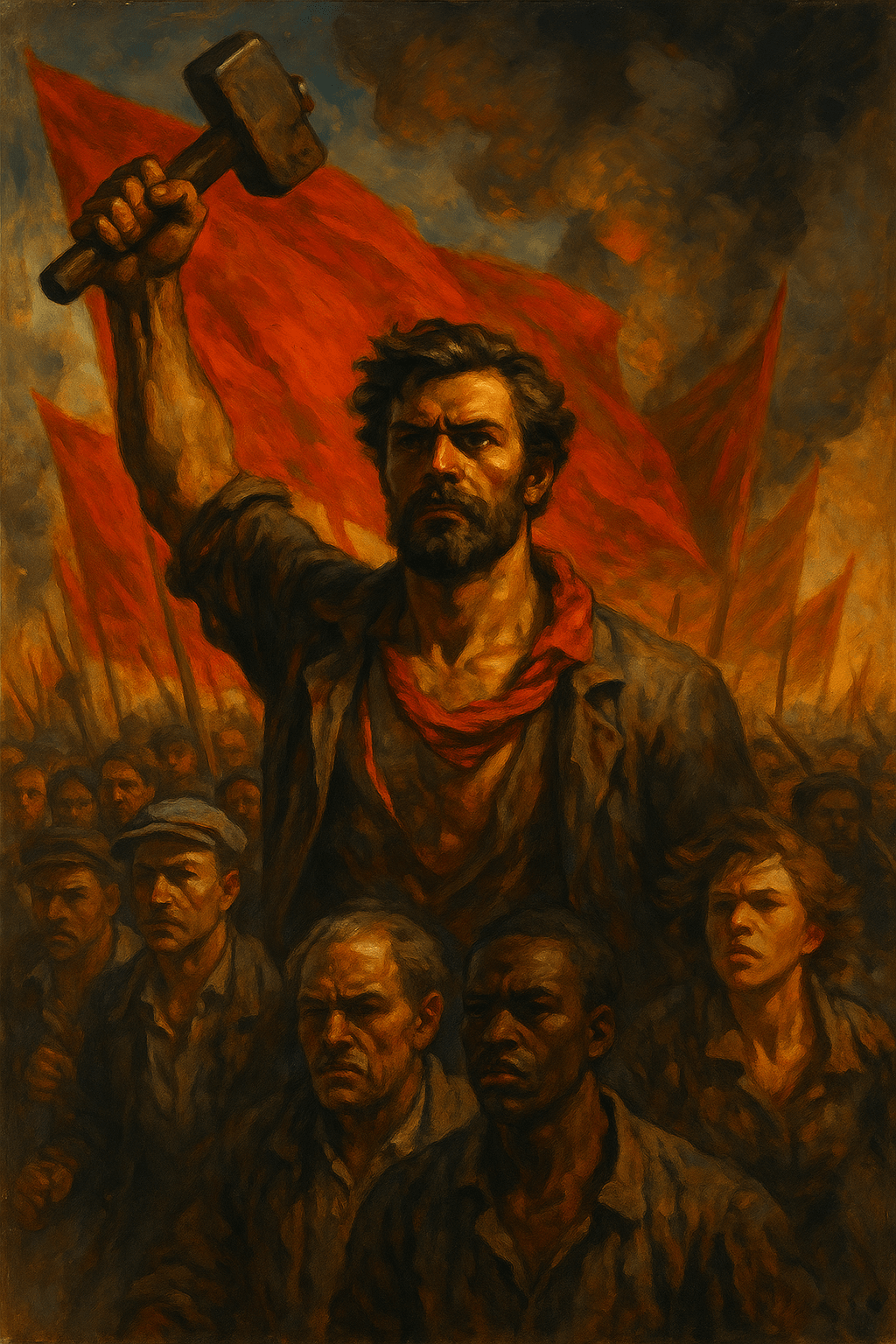
A review of Nietzsche: The Aristocratic Rebel by Domenico Losurdo — a ruthless excavation of Europe’s most reactionary philosopher. Losurdo drags Nietzsche out of myth and into history, exposing his war on equality as the moral software of empire. Our review reads Losurdo as a weapon: a guide for revolutionaries to unmask how Nietzsche’s aristocratic creed still powers the ideologies of capital, empire, and Silicon Valley.
By Prince Kapone | Weaponized Information | October 10, 2025
The Mask of Style, the Machinery of Power
Strip away the incense and the aphorisms and what stands up in Nietzsche is not a misunderstood poet of freedom but the house philosopher of hierarchy. That’s the core provocation of Domenico Losurdo’s reconstruction, and it lands with the weight of history: Nietzsche’s writings on art, science, truth, and “culture” aren’t neutral meditations later hijacked by reaction—they are political from the root, a sustained counterrevolution against the rising workers’ movement, abolition, women’s emancipation, and any universal claim the oppressed might make upon the world. Losurdo names the spine of the project plainly: the coherence of Nietzsche’s thought lies in “his constant eye on social conflict and the threat of socialism.” Politics is not a side effect of Nietzsche—it is the organ that pumps blood through the whole system.
Read this way, the “style” becomes evidence. The celebrated mask—perspectivism, the aristocratic sneer at pity, the fetish for “rank”—stops floating above history and snaps back to the battlefield where it was forged: the Second Reich’s long panic over democracy and labor. Losurdo refuses the academic domestication that turns Nietzsche into a toolbox for seminar games. He drags the fragments into daylight and shows the mechanism: a philosopher waging class war with a pen, elevating domination into a virtue and recoding solidarity as sickness. If the university cured Nietzsche of his politics, Losurdo readmits the patient into real time and takes his vitals.
The origin scene matters. Nietzsche isn’t writing from a mountaintop; he is writing through war drums and barricades. In letters from the era of the Franco-Prussian War and the massacre of the Paris Commune, we watch a young philologist celebrate “our German mission” against what he calls “Franco-Jewish leveling”—the workers’ republic already coded as decadence and disease. The fear is not abstract; it has a name: socialism. From that fear he builds a philosophy where the plebeian is the problem and hierarchy the cure. The later glamor of the “free spirit” was born in this mud.
This is why the book belongs on a worker’s shelf, not just a scholar’s. Losurdo’s Nietzsche is a manual for reading ruling-class ideology in high language. “Perspectivism”? In practice, a permission slip for power to declare its values sovereign. “Will to power”? A hymn to the right of the few to stand on the many. Even metaphysics gets drafted: the “eternal return” becomes, in Losurdo’s cutting formula, the counter-revenge of the ruling classes—a cosmic taunt meant to mock our hunger for progress and tell the rabble there is no “better world,” only circles. That is not philosophy above politics; that is politics pretending to be eternity.
So we begin here, with the mask off. Not to moralize, but to weaponize. The point of this review series is not to win a debate about a nineteenth-century sage; it is to arm a twenty-first-century struggle. When today’s platform oligarchs and policy “realists” sneer at equality, when they dress austerity as “discipline” and automation as “merit,” they are speaking the old language with new hardware. Losurdo gives us the grammar. Our task is to hear the class sentence beneath the style—and answer it in the only tongue the oppressed have ever trusted: organization, solidarity, and the stubborn refusal to bow before a master class, however poetic its apologia.
The Birth of Reaction: From the Commune to the Kulturkampf
Every philosophy has a birthplace. Nietzsche’s was a battlefield. Losurdo opens the case in 1871, with the cannons of the Franco-Prussian War still echoing and the corpses of the Paris Commune barely cold. The young philologist, once enamored with Schopenhauer’s gloom and Wagner’s nationalism, watched the first socialist government in history rise and fall—and learned the lesson the bourgeoisie drew from it: never again allow the workers to rule. In Nietzsche’s letters, Losurdo finds the embryo of aristocratic radicalism—cheers for the “German mission” against the “Franco-Jewish leveling,” disgust at the specter of equality, fear that the rabble might write the next chapter of history. The philosopher of the future begins as the ideologue of defeat, a pen enlisted in the counterrevolution.
Losurdo dismantles the postwar myth that Nietzsche floated above his time. He grounds him in the politics of restoration—the Second Reich’s Kulturkampf against Catholics, Jews, and socialists; Bismarck’s repression paired with social “reforms.” The young Nietzsche sided with hierarchy every time, condemning the “herd” that dared to claim rights. His early manuscripts, Losurdo shows, read like dispatches from the ruling class: fear of mass education, contempt for universal suffrage, anxiety over women’s emancipation. He railed against “socialism of the chair” as much as against the socialists in the street. When he spoke of culture’s decline, he meant the crisis of aristocratic order under the pressure of democracy.
Losurdo’s point is merciless and obvious once said aloud: Nietzsche’s rebellion is not against power but on behalf of it. He is the rebel of the castle, not the barricade. “The aristocratic radical,” Losurdo writes, is the intellectual counterpart to the soldier who suppresses revolutions and the bureaucrat who manages colonies—a thinker of restoration cloaked in the rhetoric of transgression. His aphorisms about the “free spirit” are sermons for the landlord terrified of losing his tenants. His call to “become what you are” is the whisper of the master class to itself: stay on top. When Nietzsche mocks the Enlightenment’s “mania for equality,” he is doing ideological maintenance work for empire.
And yet, Losurdo refuses the easy caricature. He doesn’t paint Nietzsche as a proto-fascist cartoon but as a complex node in the bourgeois nervous system—part Voltairean skeptic, part Prussian nationalist, part social Darwinist flâneur wandering through Europe’s colonial triumphalism. What makes Nietzsche dangerous, Losurdo insists, is not his extremity but his elegance. He re-enchants hierarchy. He makes domination sound like destiny and slavery like style. He takes the terror of the age—the collapse of aristocratic certainties under the weight of socialist and colonial revolt—and turns it into a new gospel of strength. The old theology had God; the new one has “the will to power.”
This is why Losurdo’s Nietzsche matters for us, not as a relic but as a mirror. Every time a billionaire tells workers that inequality is “natural,” every time a tech mogul preaches disruption as creative destruction, every time the ruling class repackages exploitation as meritocracy, Nietzsche’s ghost is speaking through their PR departments. The Commune was drowned in blood, but its murderers needed a philosophy to justify the massacre. That philosophy is what Losurdo uncovers in Nietzsche’s prose: the poetry of reaction, the moral grammar of a class determined to stay divine. To understand it is not to forgive it—it is to learn the enemy’s scripture, so we can write its final chapter.
The Enlightenment Reversed: Voltaire with a Whip
In Losurdo’s hands, Nietzsche’s so-called “Enlightenment” phase becomes an x-ray of Europe’s split conscience. After the Commune’s smoke cleared, the bourgeois world tried to rehabilitate reason without equality—to salvage the prestige of intellect while rejecting its revolutionary implications. Nietzsche rose to the task. In Human, All Too Human, he traded Wagner’s mythic nationalism for the cosmopolitan irony of Voltaire. But Losurdo points out that this was not progress; it was an update of reaction. Nietzsche took Voltaire’s skepticism and stripped it of its humanism. Where Rousseau saw dignity in the common man, Nietzsche saw contagion. He admired the Voltairian wit but directed it downward, toward the “herd” that dared to demand rights. Enlightenment, retooled as elitism, became a weapon against the people who had first made its ideas dangerous.
Losurdo names this moment what it is: a counter-Enlightenment dressed in rationalist clothes. Nietzsche recasts reason as a privilege of birth, a private estate from which the vulgar are excluded. His free thinker is a landlord of intellect, wandering through ideas like conquered territory. The philosopher who called himself “dynamite” was, Losurdo shows, defusing the real explosives of his time—the democratic and socialist detonations threatening the foundations of European class rule. Against the equality of the guillotine he posed the hierarchy of taste; against fraternity, the discipline of the superior; against liberty, the law of strength. He performed what the bourgeoisie could not admit aloud: the Enlightenment’s great words—reason, progress, civilization—must be preserved, but only for the ruling class.
It is here that Losurdo draws one of his sharpest parallels. Nietzsche’s “free spirit” is the intellectual cousin of the imperial administrator. Both despise the mob, both praise order, both see themselves as custodians of culture in a decaying world. The colonial project and the philosophical project rhyme: bring light to the dark places, whip the natives—or the masses—into shape. When Nietzsche mocked compassion as decadence and called pity “the practice of nihilism,” he was not speaking metaphorically. He was crafting a moral alibi for domination. Pity is weakness because it blurs the border between master and slave, colonizer and colonized. The true philosopher must harden himself against that infection. That’s not courage—it’s counterinsurgency.
Losurdo threads this analysis through the entire fabric of European thought. The names change—Voltaire, Tocqueville, Mill—but the anxiety is constant: democracy will dissolve excellence, equality will ruin civilization. Nietzsche radicalizes their tremor into metaphysics. He doesn’t just defend hierarchy; he divinizes it. “Every elevation of man,” he writes, “requires the sacrifice of countless others.” In Losurdo’s translation, that is not a metaphor for effort—it’s a charter for exploitation. The suffering of the many is recoded as the condition of greatness, the misery of the worker as the price of culture. What began as philosophy ends as bookkeeping for empire.
And yet the language is seductive. That is Nietzsche’s enduring power and danger. He offers elites a way to feel rebellious while staying on top—a revolutionary aesthetic for reactionary politics. Losurdo’s demolition job is to tear that mask off without underestimating its charm. Nietzsche flatters domination by calling it honesty; he makes cruelty sound like clarity. In doing so, he gives every boss, every colonizer, every self-styled “visionary” a spiritual vocabulary. Losurdo reads him not to moralize but to inoculate. For every worker and every colonized people, the lesson is simple: beware of philosophies that speak of “excellence” while your hands are bleeding. They aren’t describing humanity’s ascent; they’re just describing you carrying the weight.
The Science of Hierarchy: Knowledge as the Weapon of the Strong
Nietzsche’s next maneuver, Losurdo shows, was to make science itself aristocratic. When positivism and socialism began speaking in the same language—statistics, progress, reason—he fled from “truth” and built a philosophy of perspectives. But this wasn’t epistemological humility; it was class strategy. Every claim to knowledge, he argued, comes from a particular point of view—and the only legitimate one belongs to the strong. Losurdo calls this the “science of hierarchy.” Where Marx saw knowledge as a collective tool forged in labor, Nietzsche saw it as a weapon wielded by genius. He didn’t want to democratize truth; he wanted to privatize it.
In Losurdo’s reading, Nietzsche’s perspectivism becomes the ideological twin of monopoly capital’s worldview: every vantage point is partial, but some are born to dominate the field. The philosopher who mocked science’s “will to truth” wasn’t rejecting domination—he was rebranding it. Knowledge, stripped of universality, turns into an aristocrat’s art of self-affirmation. What the working class had begun to build as a science of liberation—Darwin, Marx, the materialist critique of history—Nietzsche answered with a metaphysics of contempt. He replaced materialism’s solidarity with the metaphysical sneer of the “free spirit,” the one who creates values precisely by denying the herd any right to share them.
Losurdo calls this the moment when Nietzsche’s rebellion against positivism folds completely into the rebellion against socialism. The same bourgeois class that built railroads and telegraphs needed a philosopher to bless the spiritual spoils of empire. Nietzsche obliged. “There are no facts, only interpretations,” he wrote—convenient words for any ruler caught in the act. For Losurdo, perspectivism is not a revolution in thought but a moral loophole: it licenses the strong to define reality and the weak to endure it. The philosopher becomes the sovereign of meaning, the world his colony of perceptions. Truth is not discovered; it is conquered.
Here Losurdo’s dialectical scalpel cuts deepest. Nietzsche’s “genealogy of morals,” often praised as critique, is revealed as class counterattack. By turning history into a battlefield of instincts rather than a record of exploitation, he vaporizes the material struggle that birthed morality in the first place. The master’s cruelty becomes creativity; the slave’s demand for justice becomes ressentiment. The bourgeoisie, under siege from organized labor and the colonized world, suddenly acquires a new self-image: not exploiters, but artists of civilization misunderstood by the envious. It is the perfect psychological armor for a ruling class losing faith in God but not in its right to rule.
Losurdo’s clarity here is a gift to revolutionaries. He shows that Nietzsche’s rejection of “truth” anticipates the modern information order, where lies are branded as perspectives and domination hides behind relativism. When Big Tech billionaires claim to “disrupt” reality or politicians dismiss facts as narratives, they are performing a Nietzschean trick: the transfiguration of power into interpretation. The will to power becomes the algorithm of empire. Perspectivism, reborn in code, tells the poor they cannot know the world they labor to sustain. Against this, Losurdo reminds us that truth is not a viewpoint—it is a weapon sharpened in struggle. The oppressed don’t need perspectives; they need power.
The War on Compassion: Misogyny, Morality, and the Fear of Weakness
For Losurdo, Nietzsche’s most poisonous contribution to bourgeois ideology wasn’t his metaphysics—it was his morality. Or rather, his demolition of it. In his crusade against what he called “slave values,” Nietzsche declared war on pity, mercy, and solidarity—the very sentiments that had underwritten every emancipatory struggle from the abolitionists to the communards. Losurdo unearths the class logic hiding in that moral rhetoric. When Nietzsche spits on compassion, he’s not merely venting personal cruelty; he’s defending a system. The ruling class can only keep its boot on the neck of the world if it learns to feel nothing underfoot.
Losurdo places this in its historical theater. The late nineteenth century was an age of reform and revolt—abolition still fresh, feminism on the march, social democracy gathering steam. Everywhere, compassion had become political: the slave’s suffering, the worker’s hunger, the woman’s confinement were not private misfortunes but public crimes. The moral universe was tilting toward equality. Nietzsche’s project was to tilt it back. His aphorisms sneer at Harriet Beecher Stowe’s sentimentalism, ridicule women’s movements as herd hysteria, and brand every appeal to justice as a symptom of sickness. Pity, he insists, multiplies misery; mercy breeds mediocrity. For Losurdo, this is not philosophy—it is triage for a nervous ruling class.
Behind the mockery of pity lies a deeper panic: the fear of feminization. Nietzsche’s “higher type” is defined by his capacity to suppress the maternal, the nurturing, the soft. To feel empathy is to risk contamination. Losurdo calls this the gendered anatomy of class power: a bourgeois masculinity terrified that its empire might dissolve in tears. Nietzsche converts that terror into virtue, recasting hardness as health, cruelty as courage, domination as discipline. The ethic of care that powered abolition, unionism, and socialist internationalism becomes, in his hands, the pathology of the weak. It’s the moral counterinsurgency of empire—a way of training the conscience to stop flinching at the sound of the lash.
And yet the rhetoric dazzles. Nietzsche’s moral inversion comes wrapped in lyrical fire, his venom sweetened with poetry. That’s how ideology works best. It doesn’t march in uniform; it seduces in verse. Losurdo refuses to let that charm pass unexamined. He reads each glittering phrase back into its material function, showing how the philosopher’s disdain for compassion became a philosophical dress code for exploitation. When Nietzsche writes that “suffering is not an argument against life,” Losurdo replies: no, but it’s an argument against those who inflict it. The worker bleeding in the factory doesn’t need to hear that his pain ennobles him; he needs a union. The colonized don’t need the lesson that cruelty refines the soul; they need the means to make cruelty impossible.
In this light, Nietzsche’s “transvaluation of values” looks less like a philosophical revolution than a moral counterrevolution—the ideological twin of the state’s repression of labor and empire’s war on its colonies. His philosophy, Losurdo writes, is a “spiritualized form of colonial violence,” an effort to purge civilization of its conscience. To read him today is to hear echoes in every austerity sermon, every lecture on toughness, every pundit who calls empathy weakness. The same logic still rules: if you suffer, it’s your fault; if you care, you’re naive; if you rebel, you’re sick. Losurdo’s Nietzsche reveals the genealogy of that poison—and offers the antidote of clarity. Compassion isn’t decadence; it’s class consciousness with a heartbeat.
Masters, Slaves, and the Civilization of Chains
Losurdo’s excavation reaches its most damning depth when he drags Nietzsche’s master–slave dialectic out of abstraction and into history. What liberal interpreters treat as metaphor, Losurdo restores to its literal, material ground. Nietzsche’s praise for hierarchy, his talk of breeding and rank, his call for a “new slavery” in the modern world—these aren’t rhetorical flourishes; they are blueprints for a social order built on bondage. The philosopher of the “free spirit” turns out to be an apologist for the oldest unfreedom known to humankind. “Every culture needs its slaves,” Nietzsche wrote. Losurdo replies: that isn’t philosophy, it’s policy.
Against the grain of those who sanitized Nietzsche into an existential rebel, Losurdo shows him writing like a reactionary economist of empire. His model of civilization depends on the labor of an underclass that must never become conscious of itself. In his notebooks, Nietzsche even sketches a European “worker-Chinoiserie”—a disciplined, de-spiritualized labor force within the metropole to serve as a domestic colony. He wanted a Europe where the masters could cultivate genius because the workers had been spiritually lobotomized. This wasn’t ancient nostalgia; it was a program for modern capitalism, one that naturalized exploitation and global color hierarchy as the biological order of things.
Losurdo’s archival reading hits with the precision of a hammer. Nietzsche draws his heroes not from reason or justice but from conquest: the Franks over the Gallo-Romans, the Aryan aristocracy over the Semitic rabble, the blond beast trampling the herd. These aren’t allegories for personal self-overcoming—they’re mythic justifications for domination. The vocabulary of “nobility” and “degeneracy” carries the same DNA as the pseudosciences of race and empire that metastasized across Europe at the time. When Nietzsche scorns the “slave revolt in morals,” he is indicting the very idea that the enslaved might demand equality. In the century of abolition, he preaches re-enslavement—not necessarily of Africans, but of everyone whom capital deems surplus to the march of progress.
For Losurdo, this is where Nietzsche’s aristocratic radicalism fuses completely with the political economy of monopoly capitalism. His cult of strength baptizes the class structure as a fact of nature; his contempt for compassion legitimizes the brutality required to keep it intact. The plantation, the sweatshop, the colony—all reappear in his pages as aesthetic necessities, the “sacrifice” through which culture achieves its height. This is not poetry of rebellion but the prayer book of the bourgeois order. In celebrating the master’s cruelty as creativity, Nietzsche provides what every system of exploitation needs most: moral permission.
And that’s why Losurdo’s critique cuts beyond nineteenth-century Europe. He shows how Nietzsche’s logic survives in every regime that justifies wealth with genius and poverty with failure. The “new slavery” he dreamed of is here, digitized and global: warehouse workers tracked by algorithms, migrant laborers building smart cities they will never live in, gig workers chained to apps instead of overseers. The master–slave morality hasn’t vanished; it has been networked. Nietzsche would have called it progress. Losurdo calls it what it is—the civilization of chains, polished by philosophy, powered by blood. To recognize it is the first step toward breaking it.
Colonialism as Civilization: The Empire of the Overman
From here, Losurdo turns his lens outward—toward the colonies, where Europe’s moral schizophrenia was written in whips and ledgers. Nietzsche, he shows, looked upon this expanding empire not with shame but fascination. He mocked the missionaries who preached equality while enslaving whole continents, but not because he opposed conquest. His disgust was aimed at their hypocrisy, not their violence. For Nietzsche, the problem wasn’t that the West enslaved and exterminated—it was that it felt bad about it. Compassion, repentance, “guilt”: these were the sentimental diseases of a civilization that had forgotten how to be cruel with pride. In that sense, Nietzsche was the perfect philosopher for imperial exhaustion—he gave the colonizer permission to sin without remorse.
Losurdo documents this with surgical calm. Nietzsche calls slavery “the tribute humanity pays to human dignity.” He describes the subjugation of the weak as the “natural tribute” owed to greatness. In the same pages where he praises the ancient Greeks for their art, he praises them for their chains. For him, there is no contradiction between beauty and brutality—only continuity. “The temple of civilization,” he writes, “rests upon the slave’s back.” Losurdo refuses to let this stay a metaphor. The temple, he reminds us, was not symbolic: it was the British Raj, the Belgian Congo, the forced labor that paved Europe’s modernity. When Nietzsche speaks of “slavery,” he is describing the global order that fed his own age, an order that still feeds ours.
The colonial archive becomes the missing context of Nietzsche’s philosophy. His exaltation of conquest resonates with the European project of “civilizing missions,” the racial science of hierarchy, the propaganda of progress. Losurdo threads him into the company of Tocqueville, Mill, and Kipling—not as anomaly but as intellectual sibling. All of them, in their own idioms, defended the same logic: some lives exist to serve others. Nietzsche’s originality was to elevate that logic into metaphysics, to baptize imperial arrogance as a cosmic principle. The Overman, Losurdo insists, is the colonial administrator purified of doubt—the embodiment of power that no longer pretends to moral legitimacy.
And yet Nietzsche’s contempt for missionary hypocrisy made him sound, to the inattentive reader, like a critic of empire. Losurdo catches the trick. When Nietzsche lashes out at the “false humanitarians” who weep for the oppressed, he is not denouncing conquest; he is demanding that it drop its mask. “If one wants slaves,” Nietzsche writes, “one must not preach equality.” That is not anti-imperialism. It is a call for imperial honesty—a demand that the master stop pretending to love his victim. Losurdo recognizes this as the moral DNA of fascism: the moment when domination stops apologizing and calls itself destiny.
For the colonized and their descendants, this reading lands like a flare in the dark. It exposes the continuity between the old empire’s whips and the new empire’s drones, between the colonial overseer and the technocrat who calls exploitation “development.” Nietzsche’s disdain for guilt echoes today in the rhetoric of “realism” used to justify sanctions, coups, and occupations. The Overman no longer rides on horseback; he manages a hedge fund, commands a data firm, or drafts austerity from a boardroom. The “slaves of civilization” are still paying tribute to “human dignity,” only now it’s denominated in GDP and carbon credits. Losurdo’s excavation makes the connection unavoidable: Nietzsche’s Overman is alive and well, armed with satellites instead of swords, and still calling his domination culture.
This is why Losurdo’s Nietzsche must be read not in seminar rooms but in the factories, prisons, and colonies of the modern world. The task isn’t to debate whether Nietzsche “meant it metaphorically.” The task is to understand how his metaphors became material—how the poetry of mastery turned into the prose of empire. Philosophy doesn’t stay on the page; it travels in cargo holds, policy briefs, and algorithms. The empire of the Overman is no myth. It’s the system we live in. And to end it, we must strip its morality bare until domination stands naked, as Nietzsche wanted—then do what he feared most: organize to abolish it.
The Liberal Genealogy of Fascism: From Selection to Extermination
Losurdo’s boldest stroke is to rip Nietzsche out of the mythic isolation where liberal academia has entombed him and reinsert him into the bloodstream of Western modernity. Nietzsche was not the mad prophet who suddenly broke from civilization—he was its fever dream. His contempt for equality, his fetish for hierarchy, his language of “selection” and “breeding,” all grew from the soil of liberal Europe. Losurdo maps the lineage clearly: from Mill’s “civilizing despotism” to Tocqueville’s terror of the masses, from Darwin’s social misreadings to the colonial laboratories where “fitness” was measured in whips and land deeds. Nietzsche radicalized what was already there. He stripped the liberal conscience of its hypocrisy and gave its racism and elitism a philosophical halo. The result was not a break with liberalism but its revelation.
He becomes, in Losurdo’s words, the “theorist of the liberal unconscious.” Where the liberals spoke of progress, Nietzsche spoke of breeding; where they justified empire as tutelage, he called it destiny; where they cloaked domination in pity, he exalted cruelty as truth. The continuity is chilling and precise. The logic that ran plantations and colonies simply changed its uniform—from missionary robe to philosopher’s cloak. In Nietzsche’s prose, Losurdo hears the murmur of the entire bourgeois century: the fear of the many, the worship of the few, the hunger to turn class rule into natural law.
Losurdo traces how this ideological bloodstream flowed forward into fascism, not as accident but as culmination. The vocabulary of vitality, degeneration, and selection—these weren’t stolen from Nietzsche by the Nazis; they were his proud bequest. The German bourgeoisie found in his aphorisms a permission structure for its own panic. In a world where the old aristocracy was collapsing and the proletariat rising, Nietzsche offered a metaphysics of hierarchy immune to economics. Fascism simply operationalized it. The “will to power” became the will to empire; the Übermensch descended from the clouds and put on a uniform.
But Losurdo refuses the comfort of moral distance. He reminds us that Nietzsche’s fascist inheritance was not confined to Germany. Its spirit animated the Anglo-American cult of eugenics, the sterilization boards, the immigration quotas, and the racial science that justified lynch law and colonial apartheid. These were not the crimes of irrational barbarians—they were the policies of “civilized democracies” whose philosophers had long preached merit, fitness, and order. Nietzsche’s radical honesty merely dropped the veil. The road to Auschwitz and Hiroshima did not detour around the salons of Europe; it passed straight through them, paved with epigrams about greatness and decay.
Losurdo’s confrontation with this genealogy is not academic hygiene—it’s a political necessity. In a world once again drunk on talk of “excellence,” “meritocracy,” and “civilizational values,” the same logic is resurfacing in corporate manifestos and culture wars. When Silicon Valley CEOs praise “disruption” as natural selection, when technocrats speak of “weeding out inefficiency,” when think-tank intellectuals defend inequality as innovation, they are channeling Nietzsche’s liberal heirs. The philosopher of rank has become the ghost in the algorithm. Fascism today no longer needs uniforms; it needs spreadsheets and venture capital. Losurdo’s warning lands like a slap: ideas don’t die—they mutate. And every ruling class, when cornered, reaches again for Nietzsche’s vocabulary of vitality to sanctify its violence.
For revolutionaries, the lesson is brutally clear. Fascism is not an alien eruption into Western civilization; it is Western civilization without anesthesia. The same liberal order that quotes Nietzsche for style still practices his creed in substance. Its wars are fought for “order,” its markets run on “selection,” its morality demands that the weak disappear. Losurdo gives us the historical map of this continuity so that we can finally stop pretending surprise when barbarism returns. The philosopher of the master class was never buried; he was simply rebranded. To defeat fascism, we must dismantle its liberal cradle.
From the Will to Power to the Will to Profit: Nietzsche in the Age of Technofascism
Every era remakes Nietzsche in its own image, and ours has given him Wi-Fi. Losurdo ends his anatomy of aristocratic radicalism by showing how the philosopher of hierarchy has been reborn in the circuits of monopoly capital. The Übermensch has traded his cape for a hoodie; his battlefield is the boardroom, his will to power an IPO. What Nietzsche once theorized as “rank,” Silicon Valley now calls “merit.” The same contempt for the herd, the same exaltation of strength, the same aesthetic hatred of equality—it all lives on, digitized and automated. Losurdo’s work becomes prophetic here: the aristocratic rebel’s dream has been realized not in the Third Reich but in the cloud.
The pattern is grotesquely familiar. Nietzsche’s master morality exalted the right of the few to create values and the duty of the many to serve. The modern technocrat simply translated that ethic into code. “Move fast and break things” is just the will to power with venture funding. When Elon Musk sneers at regulators, when Peter Thiel praises monopoly as virtue, when AI evangelists preach that automation will liberate the exceptional while discarding the redundant, they are reenacting Nietzsche’s drama in real time. The herd must obey the algorithm; the higher type must innovate without conscience. It’s not philosophy—it’s policy. Losurdo saw it coming a century away: the new masters no longer need divine right or blue blood. They have data.
Technofascism, in the dialect Losurdo arms us to speak, is the fusion of Nietzsche’s ethics with finance capital’s machinery. It is domination without guilt, hierarchy without apology, exploitation disguised as efficiency. The “slave morality” of compassion becomes the “sentimental politics” mocked by pundits; the call for justice becomes “cancel culture.” Nietzsche’s aristocratic values have migrated from the salons of Europe to the platforms of Silicon Valley, from the whip hand of the colonizer to the invisible hand of the market. Where he dreamed of a world purged of weakness, today’s ruling class builds predictive systems to preempt it. The will to power runs on lithium.
Losurdo gives us the lens to see through this digital fog. The point is not that the billionaires read Nietzsche—it’s that their world runs on his logic. The algorithm decides worth; empathy is a bug; suffering is data. The philosopher who laughed at socialism as the revolt of the herd is alive in every boardroom that calls unionization “disruption.” He’s there in every austerity plan that calls hunger “motivation,” in every immigration law that calls exclusion “sovereignty.” Nietzsche’s aristocratic rebellion has gone global, monetized and mechanized, a ruling ideology for a class that believes itself post-human precisely because it has forgotten what human means.
But Losurdo’s final lesson is not despair—it’s clarity. To understand Nietzsche is to see the moral software of empire laid bare. His “transvaluation of values” was never about liberation; it was about laundering domination through aesthetics. The cure is not to out-philosophize him but to abolish the world that still makes him necessary. Against his hierarchy, we oppose solidarity. Against his cruelty, organization. Against his “will to power,” the will to emancipation. Losurdo ends not with lamentation but with a call to arms: the aristocratic rebel has become the technocratic ruler, and only a revolutionary class can finish the argument he started. The future, if it is to belong to anyone, must belong to those Nietzsche despised—the slaves who refuse to stay slaves.
In this light, Nietzsche: The Aristocratic Rebel isn’t just a book—it’s a field manual. Losurdo disarms one of the most seductive weapons of bourgeois ideology and hands it back to the oppressed, blade turned outward. He reminds us that every empire, from Rome to Palo Alto, writes its philosophy before it draws its sword. And he insists that the counter-philosophy—the dialectic of emancipation—must be written by those who bleed. The task is ours now: to wrestle Nietzsche’s ghost out of the machine and build a world that no longer needs his gospel of strength. The only “will to power” worth the name is the collective one that smashes the chains he called civilization.
Weaponizing Losurdo: A Manual for the New Proletarian Humanism
Losurdo leaves us with no illusions about the battle we face. The cult of strength has become the ideology of the weak who rule; the contempt for equality has been coded into the architecture of everyday life. Nietzsche’s heirs sit not in monasteries or philosophy departments but in ministries, boardrooms, and server farms. They speak the same language he perfected—efficiency, selection, excellence, innovation—but their meaning has never changed: hierarchy as nature, domination as destiny. The more their machines advance, the more primitive their morality becomes. Against this regression masquerading as progress, Losurdo offers something precious: not nostalgia, but a framework to fight.
That framework is a materialist humanism, stripped of sentimentality and armed with history. Losurdo refuses to romanticize the “human” as an abstraction; he reconstructs it as the living capacity of the oppressed to struggle, to organize, to build new institutions of solidarity. Against Nietzsche’s individual genius, he raises the collective intelligence of the masses; against the philosopher’s aesthetic cruelty, the creative labor of a class that makes the world and can remake it. This is not a debate between ideas—it is a war of worlds. Nietzsche’s “higher types” produce monuments; the proletariat produces humanity. His greatness feeds on corpses; ours feeds on cooperation.
To weaponize Losurdo, then, is to reclaim philosophy itself as a tool of struggle. Every ruling class has its Nietzsche: a poet to dignify its violence, a prophet to baptize its greed. Every revolution must therefore have its Losurdo: a historian to unmask their idols, a dialectician to track the counterrevolution in thought. Losurdo teaches us how to read the enemy’s scriptures—to trace the moral codes of empire back to the plantations, the colonies, the killing fields. He shows that the “beautiful words” of culture—excellence, vitality, freedom—are written in a script of blood. The task is to rewrite them in the language of liberation.
And that language is not speculative; it is forged in action. The antidote to Nietzsche’s aristocratic rebellion is not another treatise—it is a movement. It is the solidarity of the colonized and the proletarian, the worker and the prisoner, the student and the peasant, organizing across the color line and across the borders drawn by capital. Losurdo’s Marxism, disciplined and militant, reminds us that emancipation is not the promise of history but its project. The new humanism will not be born in libraries but in strikes, communes, and insurgencies. The “free spirit” of the twenty-first century is the one who fights for collective freedom.
Losurdo’s study of Nietzsche is therefore more than critique—it is inoculation. He arms us against the seductions of aristocratic despair, against the cynical politics of hopelessness that dress up cruelty as realism. He reminds us that every age of reaction has declared compassion dead, and every age of revolution has resurrected it in struggle. The slaves Nietzsche mocked as decadent built the revolutions that remade the world—from Haiti to Petrograd, from Nanjing to Havana. The “herd” he despised still marches, scarred but undefeated, toward the only transcendence that matters: a society without masters.
That is where this review—and Losurdo’s intervention—leads us. Beyond Nietzsche’s labyrinth of mirrors, beyond the cult of the exceptional, lies the living majority of humanity, those whose hands keep the world turning and whose names history forgets. Their suffering is not the proof of inferiority but the indictment of the order Nietzsche sanctified. Their compassion is not weakness but the muscle of survival. Their solidarity is not ressentiment but revolution. If Nietzsche taught the rulers to glorify themselves as gods, Losurdo teaches the ruled to recognize themselves as creators. The question is no longer “Who will rise above humanity?” but “What will humanity rise above?”
So we close where Losurdo begins—with the struggle between aristocratic radicalism and democratic emancipation, between the will to dominate and the will to live together. Nietzsche’s philosophy ends in the abyss of the master’s imagination; Losurdo’s begins in the workshop of the oppressed. One seeks to perfect the world that exists; the other to abolish it. And in that abolition lies the only true “transvaluation of values.” Against the philosopher of the master race, we raise the science of the human race—the revolutionary humanism of those who, having carried the world on their backs, now prepare to throw it off.
Losurdo’s message to the twenty-first century could not be clearer: philosophy is not neutral, culture is not innocent, and history is not finished. Every aphorism that glorifies power is a call to arms for the oppressed to seize their own. The question is not whether Nietzsche will outlive us. It is whether we will outfight him.
 Weaponized Information
The missing link between Nietzsche’s deeply anti-human philosophy of supremacy powering societies and western bourgeois liberalism is the endorsement and praise of individuality as the reigning principle of civilization and thus enacting the law of the jungle permanently having societies drifting towards a liberal-fasccist order
LikeLike