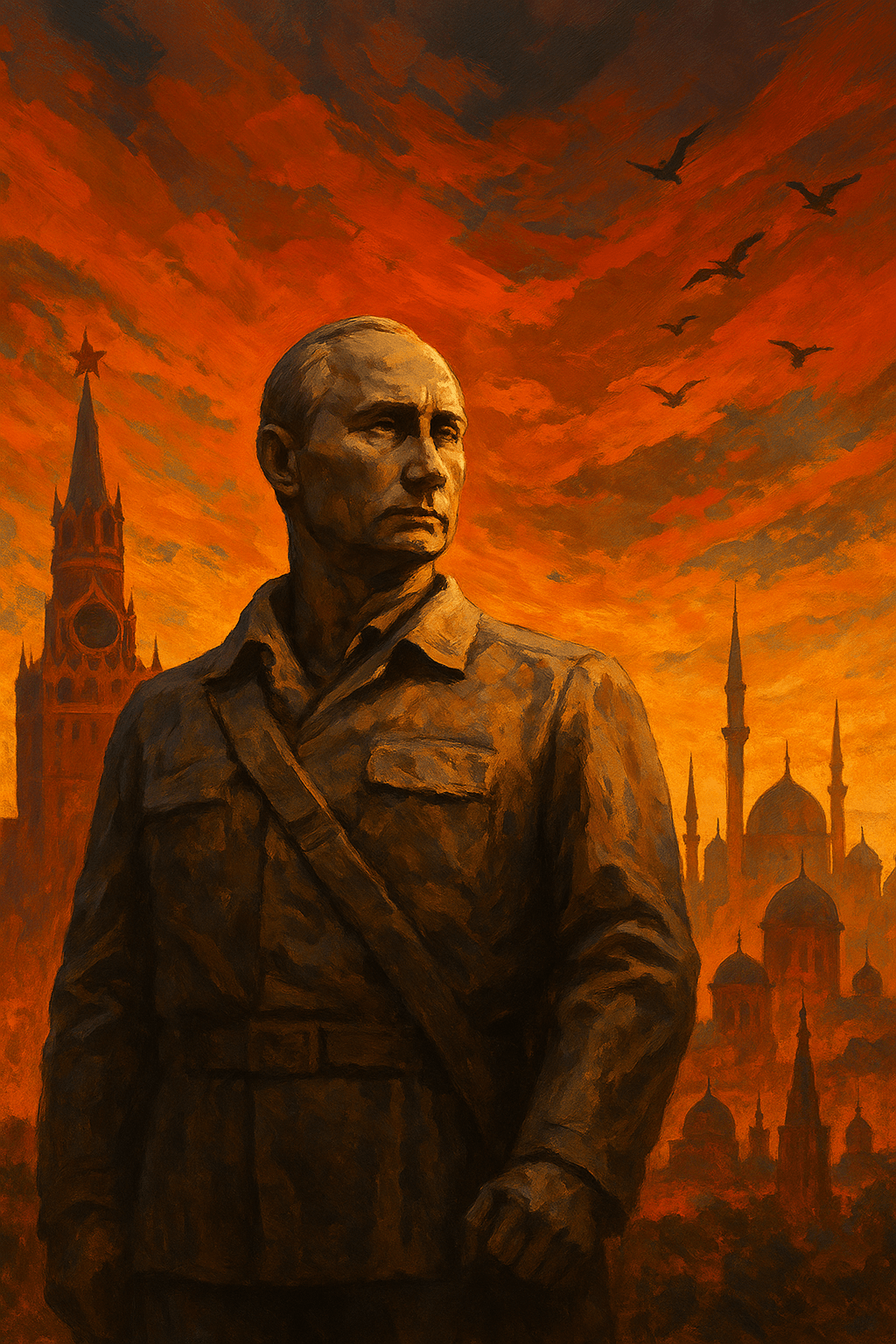
From reactive sovereignty to proactive world-making — how Russia’s Valdai doctrine signals the consolidation of the multipolar epoch
By Prince Kapone | Weaponized Information | October 8, 2025
The End of Empire’s Script
The stage was set in Sochi, under the heavy October air that always seems to carry more than the weather — it carries history. President Vladimir Putin stepped to the podium at the Valdai Discussion Club not to give a speech, but to issue a declaration: that the age of empire, of Western monopoly over meaning, morality, and money, is finished. You could sense it in his tone — not defiant, not triumphant, but final. The empire’s language had run out of breath. The rest of the world, long treated as background noise in history’s script, was now writing its own dialogue.
Putin did not speak like a man seeking inclusion in the “rules-based order.” He spoke like one reading the last rites over it. The rules had been written by empires who stole half the world, enslaved the other half, and then built moral doctrines to justify both. Now those same empires, exhausted by overreach and internal decay, are collapsing under the weight of their own contradictions. From the wars they can’t win to the currencies they can’t stabilize, their power has turned inward — consuming itself in moral hysteria and cultural fragmentation. Putin simply named what everyone else already knows: the unipolar world is not dying; it is already dead.
The moment was not just symbolic. This year’s Valdai address came in the wake of cascading crises — the genocidal siege of Gaza, the rebellions of the Sahel against French neocolonialism, and the expansion of BRICS+ that formally welcomed Africa, the Arab world, and Latin America into the emerging multipolar orbit. The world order that Washington built through debt, drones, and disinformation is cracking open. Putin’s words served as a mirror for the epoch itself: what once called itself globalization has revealed itself as global occupation.
“Russia,” he said, “will never accept the idea of one civilization pretending to be universal.” In those words, the tone was not just Russian but human — a voice for all those nations that have been mutilated by empire’s arrogance and yet refused to disappear. The West calls this defiance “revisionism.” But what it calls revision is merely the world revising its relationship to domination. It is not Russia that rewrites history; it is history that rewrites empire.
There was no hint of isolationism in his tone, only of historical maturity — a kind of sober clarity that empire cannot understand. For centuries, Russia has oscillated between trying to join the West and trying to survive it. Now, for the first time in modern history, it no longer needs either posture. The speech was not about Russia as a single state, but about Russia as a civilization — a term that Western analysts, trained in the vocabulary of domination, struggle to comprehend. Civilization in Putin’s sense is not about hierarchy or conquest; it is about rootedness — a people’s ability to exist on their own terms, to make sense of the world through their own moral, cultural, and historical coordinates.
Empire, by contrast, has no coordinates. It floats above history, declaring itself “universal” while parasitically feeding off the lifeblood of others. Its universality is the mask of its decay. What Putin signaled at Valdai is that the world no longer needs that mask. The multipolar epoch is not a theory; it is a lived reality, the inevitable result of empire’s exhaustion. As the United States expands its military budgets and moralizes its own decline, the rest of the world quietly builds: pipelines, payment systems, ports, and alliances — infrastructure as sovereignty, cooperation as resistance.
The Sochi address must therefore be read not as a nationalist speech but as a civilizational manifesto. Putin’s words belong to the lineage of Bandung, Havana, and Caracas more than to the diplomatic tradition of Geneva or Brussels. He was not speaking to the G7; he was speaking to the Global Majority — the billions of people whose lives are the collateral damage of imperial stability. His message to them was simple: history no longer belongs to those who hoard it. It belongs to those who endure it and remake it.
To the liberal ears of Western analysts, this sounded like blasphemy. To the oppressed and decolonized, it sounded like prophecy. The end of empire will not come with an explosion but with a silence — the silence of those who stop listening to it. That silence began in Sochi. And when the empire finally realizes it has been talking to itself all along, it will already be too late. The script has been flipped. The world no longer waits for permission to exist.
From Unipolar Delirium to Multipolar Clarity
History is not a circle but a spiral, twisting through familiar shapes until the old contradictions collapse under the weight of new realities. The Soviet Union’s disintegration in 1991 was celebrated as the “end of history,” a capitalist sermon written by men who mistook imperial victory for human progress. For three decades the West mistook plunder for order, replacing colonial conquest with the financial equivalent: the dollar as whip, the IMF as overseer, and NATO as global plantation police. It was the unipolar delirium of a civilization convinced it had conquered time itself.
But history is not an empire’s hallucination—it is a process. And processes, as Marx reminded us, produce their own gravediggers. Every weapon the West forged to dominate others has turned inward. Its wars bankrupted it, its propaganda stupefied it, and its technology enslaved it. Meanwhile, the periphery—the so-called “developing world”—has begun to shed its dependency, to remember its own weight. Putin’s Valdai address must be heard within that larger tremor: the sound of the periphery becoming center, of nations once strangled by Western finance now designing new arteries of survival.
He did not invent multipolarity; he merely named what had already begun to materialize. As Lenin once wrote in Imperialism: The Highest Stage of Capitalism, monopoly capital cannot help but carve the world into spheres of control—until those spheres collide. Samir Amin deepened the point: imperialism survives by enforcing a global hierarchy of wages and technology, a structure so fragile it collapses the moment its victims organize across borders. Multipolarity, then, is not a diplomatic dream but a material necessity, born from the exhaustion of that global hierarchy. It is empire’s unintended child.
Putin’s earlier Valdai speeches—2014, 2020, 2023—carried the cadence of resistance: defensive, skeptical, wary of provocation. The 2025 address shed that caution. Its tone was neither oppositional nor apologetic; it was declarative. Russia was no longer pleading to be understood but offering its own framework for understanding. The unipolar world, he implied, is no longer something to resist; it is something to bury.
This is not a Cold War redux. The multipolar transition is not a redivision of spoils among great powers but a restructuring of history itself. When Putin spoke of “civilizational sovereignty,” he was describing the world’s new grammar—one in which each nation defines progress on its own terms, not under imperial tutelage. It is the return of political oxygen after decades of suffocation. And it terrifies the West precisely because it cannot be bombed or sanctioned away.
To the empire’s think tanks, multipolarity looks like chaos. To the rest of us, it looks like equilibrium. It is the dialectical rebalancing of the world after centuries of theft. Every BRICS summit, every yuan-settled oil trade, every transcontinental rail link is a crack in the architecture of Western domination. These are not signs of fragmentation but of coherence—an alternative order crystallizing in real time. When Putin invoked “a world of many centers,” he was translating the material logic of history into political language. Multipolarity is not an ideology; it is gravity asserting itself after five centuries of distortion.
In the West, they still preach the gospel of liberal democracy while drowning in oligarchy, censorship, and decline. Their sermons sound hollow not because Putin refutes them, but because their own citizens no longer believe them. Empire’s priests have lost their faith. Meanwhile, across Eurasia, Africa, and Latin America, new congregations of sovereignty are rising—each one refusing to kneel to the altar of the dollar.
If the twentieth century was the empire’s feast, the twenty-first is its hangover. Putin’s Valdai address is the morning after: the sobering recognition that the world cannot live on debt, delusion, and domination forever. The hallucination of the unipolar moment has cleared, and the outlines of a multipolar reality are coming into focus. The West calls it disorder. History calls it recovery.
Civilizational Sovereignty and the Rebirth of History
Every empire believes it is eternal—until the first time someone names the world without it. At Valdai, Putin did precisely that. He did not present Russia as a state defending its borders; he described it as a civilization defending its right to interpret existence. This was not the language of nationalism. It was the language of historical recovery, of a society that remembers itself after a century of external definition. For the first time in decades, Russia’s leadership spoke not of catching up to the West, not of joining the “international community,” but of transcending the very framework that those terms were built to enforce.
What does it mean to call Russia a civilization? In the Western lexicon, “civilization” has always been a weapon—a word wielded to justify conquest, slavery, and erasure. To Putin, and to the world he was addressing, the term was being repossessed. It no longer meant hierarchy or evangelism; it meant rootedness. A civilization, in his framing, is not an empire of expansion but a community of continuity: a society whose people are bound by a shared sense of time, culture, and moral responsibility. This conception transforms politics from management into meaning. It places sovereignty not only in institutions but in consciousness itself.
This civilizational turn did not emerge in a vacuum. Its genealogy runs from the Russian philosopher Nikolai Danilevsky’s idea of distinct cultural-historical types, through the Eurasianists who envisioned Russia as a bridge between continents, to the post-Soviet thinkers struggling to articulate sovereignty in an age of financial colonization. Each iteration arose in moments of imperial crisis, when Western modernity’s promises were revealed as instruments of domination. In Sochi, Putin distilled that entire lineage into a single political axiom: no civilization has the right to impose its template upon another. Against the moral absolutism of empire, he counterposed the ethics of coexistence.
He described Russia’s identity as a long continuum rather than a sequence of ruptures—the Tsardom, the Soviet Union, and the modern Federation as successive expressions of the same civilizational core. This was not nostalgia for monarchy or communism, but a statement of historical resilience. Where the West sees discontinuity and reinvention as virtues, Russia now sees endurance as its philosophy. Its national survival, after invasions, sanctions, and ideological siege, is treated not as accident but as evidence of a deeper organizing principle: that a society anchored in history cannot be colonized by fashion.
For Western liberals, this is incomprehensible. They read “civilization” and hear dogma; they hear “sovereignty” and think isolation. But what terrifies them is that this idea has resonance far beyond Russia’s borders. Across Africa, Latin America, and West Asia, nations emerging from centuries of subjugation are beginning to speak the same political language—the language of plural modernities. They recognize themselves in the Russian proposition that a world of civilizations is not a threat to peace but its precondition. What empire calls fragmentation, humanity calls differentiation.
In this sense, Putin’s civilizational doctrine is less about Russia than about the architecture of the future. It refuses to accept that the only alternative to Western liberalism is chaos. Instead, it posits a world of parallel orders: multiple centers of culture, faith, and political life coexisting within a shared commitment to sovereignty. This is what he called “civilizational democracy”—a phrase that Western commentators dismissed as contradiction, because they cannot imagine democracy without capitalism, or freedom without empire. But in the emerging world system, democracy will mean something older and more concrete: the collective right of nations to govern themselves without interference.
Weaponized Information reads this as the ideological articulation of multipolarity’s next stage. It is the moment when geopolitics becomes philosophy, when infrastructure and identity fuse into a single historical project. Civilizational sovereignty transforms pipelines into arteries of autonomy, currencies into instruments of dignity, and borders into membranes of cultural protection. It marks the shift from resistance to creation—from the defensive posture of the besieged to the proactive world-making of the liberated. If the twentieth century was about states competing for dominance, the twenty-first will be about civilizations asserting their right to exist.
In the end, Putin’s civilizational thesis was not merely about Russia’s survival. It was a warning and an invitation: the warning that a civilization without roots is a corpse in motion, and the invitation to other nations to rediscover the sources of their own vitality. The empire that once claimed universality now finds itself provincial, trapped in its own fading myth of progress. The rest of the world is learning to breathe again, to build again, to define again. History, long held hostage by empire’s grammar, has escaped captivity. At Valdai, its new language began to take form.
Weaponized Language and the Battle for Meaning
Empires do not rule only with armies and banks—they rule with words. They dictate the grammar of legitimacy, the syntax of virtue, the vocabulary of truth. That is why every anti-imperialist struggle eventually becomes a linguistic one. At Valdai, Putin wielded language like a weapon, stripping empire of its semantic armor. He spoke not in the sterile dialect of international diplomacy but in the living idiom of resistance, reshaping the moral coordinates of global discourse. It was less a speech than a linguistic jailbreak.
Words like democracy, freedom, and order have been occupied territories for decades. The West turned them into managerial slogans, drained of all content except obedience. Putin’s address repossessed those words, reclaiming them for the multipolar age. When he said “civilizational democracy,” he wasn’t coining a slogan—he was detonating one. He was telling the world that democracy does not belong to Washington’s vocabulary any more than freedom belongs to its military bases. The West hears this and cries “propaganda,” but propaganda is simply what power calls any language it does not own.
This act of linguistic liberation is not cosmetic. It is structural. Every empire colonizes not only land but meaning. It dictates what is thinkable, what is publishable, what is fundable. To challenge that regime is to fight the cognitive war at its source. That is why Western journalists reacted to the Valdai address with the nervous laughter of men who sense the ground beneath them shifting. They mocked the phrase “civilizational democracy” because it made them confront their own intellectual bankruptcy. A world where each civilization defines its own destiny leaves no room for an ideological priesthood in London or New York.
Weaponized Information calls this process ideological deterrence—the use of truth to neutralize the empire’s monopoly on moral legitimacy. When Putin speaks of “spiritual sovereignty,” it is not theological rhetoric; it is epistemic defense. He is describing a world tired of being told what to believe. The empire that once monopolized philosophy now finds itself in an existential identity crisis. Its media cannot explain, its universities cannot inspire, its think tanks cannot think. The more it shouts about “disinformation,” the more obvious it becomes that it fears competition on the battlefield of reality.
For centuries, the West has deployed language as an occupying force—branding colonization as civilization, theft as aid, coups as democratization. It built an empire of euphemism to conceal its crimes. The Valdai speech tore through that camouflage. By naming the West’s ideology as what it is—a weaponized mythology of virtue—Putin performed the most dangerous act a political leader can commit: he described the truth plainly. In doing so, he did not invite war; he declared the information war already underway.
You could hear it in the rhythm of his speech, deliberate and stripped of ornamentation. It was a rhetorical style designed to invert imperial semiotics. Where the empire speaks in abstractions—“human rights,” “shared values,” “rules-based order”—Russia now speaks in material terms: sovereignty, infrastructure, production, cooperation. The empire produces slogans; the multipolar world builds railways. One speaks of ethics while orchestrating famine; the other speaks of survival and calls it justice. This inversion of language mirrors the inversion of power itself.
Critics in Western capitals like to imagine they are fighting an “information war.” They are mistaken. The true battle is ontological: it concerns what counts as real. The empire’s media-industrial complex is not just misinforming—it is manufacturing perception to sustain an economic order that is crumbling. That is why the speech at Valdai terrified them. It suggested that the periphery no longer accepts imperial reality as reality. Once that consensus breaks, the empire’s psychological empire—its greatest weapon—disintegrates.
Marx once said that the ruling ideas of any epoch are the ideas of its ruling class. The Valdai address marked the beginning of a new epoch: the ideas of the ruled are beginning to rule. “Civilizational democracy” may sound like rhetoric to those who still live inside the empire’s linguistic borders. But to the rest of the world, it is a declaration of emancipation—the right of every people to name their own world, to speak their own truth, to define freedom in their own tongue. When the empire loses control of meaning, it loses control of everything.
The Dialectics of Multipolarity
There is a strange arrogance in the way the West mourns its fading order. It calls multipolarity a “challenge” to stability—as if stability ever meant anything but the preservation of imperial privilege. But history is not a museum, and empire is not an exhibit worth preserving. The Valdai address made clear that multipolarity is not chaos; it is the natural outcome of empire’s own contradictions, the dialectical recoil of centuries of exploitation. Every sanction, every invasion, every IMF austerity plan has created the very world now rising to bury its authors.
Putin’s speech did not merely describe this process; it framed it as a historical law. The unipolar world was never a structure—it was a symptom, a temporary distortion in the global balance of forces. Its collapse was not caused by Russian ambition or Chinese cunning but by the logic of capital itself. When accumulation depends on permanent warfare and permanent debt, the system will eventually consume the core that sustains it. Multipolarity is thus not an alternative to imperialism; it is imperialism’s decomposition in real time. What Putin articulated in Sochi was less a vision than a diagnosis: empire has entered its terminal stage, and the world is organizing the hospice.
From a Marxist standpoint, this transition bears the unmistakable signature of dialectics. The West’s pursuit of total dominance generated its negation—states, movements, and cultures forced to unite by the very aggression meant to divide them. The sanctions designed to isolate Russia instead bound it closer to China, India, Iran, and the Global South. The wars launched to secure energy routes only accelerated the search for alternative corridors. Each attempt to freeze history has melted another layer of imperial authority. What began as an effort to contain sovereignty has become the global proliferation of it. That is what the empire cannot compute: that its enemies are not copying its model but abolishing it.
The material architecture of multipolarity is already visible. BRICS+ has become a gravitational field for the global majority. The Shanghai Cooperation Organization coordinates regional security without U.S. oversight. The Eurasian Economic Union links resource bases, production chains, and financial systems in ways that bypass the dollar. Africa’s new wave of anti-colonial governments—Burkina Faso, Mali, Niger—looks east, not to Paris or Washington, for partnership. Each of these developments is a brick in the new edifice that Putin described: a world of autonomous yet interlinked civilizations, trading on equal terms and protecting their sovereignty with collective deterrence.
Yet multipolarity is not utopia. It is struggle, movement, and contradiction—a battlefield more than a blueprint. Putin’s speech was careful to present it not as an ideology but as a terrain of contestation. In a world defined by multiple centers, contradictions will not disappear; they will proliferate, but on equal footing. The imperial system’s claim to universality was always the denial of dialectics—it wanted history to stop at the point of its own supremacy. Multipolarity restores motion. It reintroduces the dialectic of difference into the world-system. It means that progress, once again, will emerge from tension rather than decree.
For the West, this sounds like anarchy; for the rest of humanity, it sounds like breathing. The empire’s fear of disorder is the fear of equality. Because equality requires change, and change threatens those who built their fortunes on stasis. The Valdai address inverted that logic: it declared that the new order will be stable precisely because it refuses to be static. Its equilibrium will come not from domination but from diversity. The world of one center is a graveyard; the world of many centers is a living ecosystem.
In the vocabulary of Weaponized Information, this is the dialectical stage of negation. The old order has exhausted its productive function and now survives through coercion. The new one is emerging through cooperation, exchange, and interdependence—what we call “strategic sovereignty.” Putin’s words distilled this shift into historical clarity. Multipolarity is not a geopolitical wish list; it is the inevitable consequence of the empire’s inability to sustain the global conditions of its own survival. It is the return of balance after the overdose of hegemony.
If empire was the violent concentration of power into one hand, multipolarity is that hand opening, releasing what it can no longer hold. The empire calls it decline; the world calls it justice. At Valdai, justice finally spoke in its own voice.
The West’s Crisis: Ideological Exhaustion and Structural Decay
When a system collapses, it first loses the ability to tell the truth about itself. The West has reached that stage. Its elites know their empire is disintegrating, but instead of reckoning with it, they dress decay in the robes of virtue. Every imperial crisis—whether in Gaza, Ukraine, or the Sahel—is recast as a moral crusade. Every revolt against exploitation becomes “authoritarianism.” Every assertion of sovereignty becomes “aggression.” The Valdai address cut through that theater with surgical precision. Putin didn’t just indict Western hypocrisy; he diagnosed it as a symptom of civilizational burnout. He described a culture that once colonized continents now unable to colonize its own despair.
The ideological crisis of the West is not a matter of policy; it is a matter of faith. For five centuries, the West has believed that it represented history’s direction—that its economic model was destiny, its values universal, its violence redemptive. That illusion required constant expansion to sustain itself. When the frontier ran out, it turned inward. Capital replaced conquest; the algorithm replaced the missionary. The result is a society that produces immense wealth but no meaning, perpetual connectivity but no community, freedom without purpose. The Valdai doctrine did not need to invent an alternative—it only needed to name the void that Western civilization can no longer fill.
What Putin articulated—whether deliberately or instinctively—is the exhaustion of liberalism’s historical mission. The liberal project once promised emancipation through progress; now it offers surveillance through convenience, consumer choice as citizenship, and permanent war as “defense of democracy.” The same societies that lecture the world on human rights are building digital prisons for their own populations. Their politicians sound like broken algorithms reciting talking points generated by lobbyists. Their intellectuals, long the empire’s priests, now shuffle papers in think tanks funded by defense contractors. When truth becomes a liability, ideology becomes bureaucracy.
In this sense, the Valdai address was not simply anti-Western—it was post-Western. It acknowledged that the civilization which once defined modernity is now devouring itself. The crises of Europe and America are not random—they are the visible consequences of a system built on extraction. The U.S. dollar, once the empire’s golden chain, has become its millstone. The wars it can no longer win are the only way it can sustain demand for its own weapons. The information system built to shape global opinion now functions primarily to narcotize domestic populations. Empire’s greatest achievement has been to colonize its own citizens.
This is what Weaponized Information calls technofascism—the merger of monopoly finance capital, digital surveillance, and military coercion under the illusion of democracy. It is the final stage of Western capitalism, where freedom is rebranded as data privacy and tyranny is delivered through software updates. Putin’s critique of Western decay, though framed in civilizational terms, strikes at this material core. He understands that moral disintegration is not the cause but the symptom of economic rot. The West preaches diversity while concentrating ownership; it promotes equality while engineering dependency. Beneath its humanitarian masks lies the oldest face in history: capital defending itself with moral terror.
The empire’s ideologues respond with predictable hysteria. They accuse Russia of nihilism, China of expansionism, Iran of fanaticism—any label that preserves their fantasy of moral supremacy. Yet their outrage reveals anxiety, not conviction. The empire senses that its categories no longer command belief. Even within its own populations, the consensus is crumbling. Workers are disillusioned, youth are radicalizing, faith in institutions is evaporating. Liberal democracy, once the West’s proudest export, now survives only as a trademark. The product itself has expired.
At Valdai, Putin didn’t need to announce the West’s defeat; he only needed to observe its decomposition. His tone was that of a pathologist, not a conqueror. “They do not create,” he said, “they only consume.” It was an observation both economic and moral. Empires die not when they are defeated militarily but when they exhaust the world’s patience—and their own imagination. The U.S. and Europe have reached that threshold. Their factories of consent are breaking down. Their myths of progress no longer sell. What remains is spectacle without substance, power without direction, wealth without purpose.
The tragedy is that the empire cannot reform; its survival depends on denying its condition. It cannot live without enemies because it cannot live without expansion. And so, it manufactures new crusades to justify its decay. But history is indifferent to denial. The Valdai speech was not a prophecy of collapse—it was a eulogy for an empire that has already buried itself beneath its own illusions. The world is simply walking away from the grave.
From Defense to Design: The Proactive Sovereignty of the Multipolar Epoch
For most of the last century, Russia’s strategic posture has been defensive—fortress walls against invasion, sanctions, and subversion. The 2025 Valdai address revealed a historic shift: defense has matured into design. The nation that once fended off encirclement is now drawing the blueprint for a world beyond encirclement itself. Multipolarity, Putin implied, is no longer a counterweight; it is a construction project. Sovereignty is not just protection—it is production.
The architecture of this new epoch is not imagined in think tanks or decreed by elites; it is being built through material systems that bypass imperial chokepoints. The BRICS currency mechanism, the MIR and CIPS payment networks, the Power of Siberia pipeline, and the digital sovereignty of the Runet all form the infrastructural skeleton of a post-dollar, post-hegemonic world. Each corridor, pipeline, and data line redefines geography as autonomy. In the Western vocabulary, “globalization” meant dependence; in the multipolar lexicon, it means mutual development. The difference is moral, economic, and existential.
Putin’s tone at Valdai was striking for its absence of complaint. Gone was the defensive rhetoric of a besieged state demanding fairness. Instead, he spoke like an engineer describing a project already underway. Russia, he said, seeks cooperation with those “who value equality, not domination.” The statement was deceptively simple. Equality, in this context, is not the liberal fantasy of procedural fairness; it is the structural equality of nations liberated from monopoly finance. In a world where the West manufactures scarcity to preserve control, Russia and its partners are manufacturing capacity to preserve life.
What makes this moment dialectically significant is that the multipolar project has moved from rhetoric to reproduction. It generates its own economic circuits, cultural institutions, and security frameworks. China’s Belt and Road Initiative, the Eurasian Economic Union, and the African renaissance of sovereign governments—Mali, Niger, Burkina Faso—are not isolated phenomena. They are coordinated expressions of an underlying shift: the means of production are being wrested from the global core and redistributed among civilizations. The unipolar world extracted; the multipolar world constructs.
Empire responds, as always, with hysteria. It calls cooperation “collusion,” integration “subversion,” and sovereignty “aggression.” But beneath the propaganda lies fear—fear of redundancy. The empire’s economic weapons no longer bite; its diplomatic ultimatums no longer compel. Even the sanctions meant to strangle Russia have become lessons in self-reliance, forcing technological substitution and industrial reinvention. The siege has become a school. Putin’s calm confidence at Valdai reflected this paradox: isolation has been inverted into autonomy. In a world addicted to dependency, Russia has remembered how to stand alone—and therefore how to stand with others.
The Valdai address’s deeper significance, however, lies not in its policies but in its philosophy. It defined sovereignty as a creative force rather than a defensive posture. This is the principle of constructive sovereignty—the capacity of a civilization to design systems that embody its own values. In this sense, Russia’s new role is not to lead a bloc but to model a process: the conversion of resistance into innovation, of exclusion into initiative. The global South, long forced into the margins of production, is watching closely. The lesson is clear: the path to freedom runs not through protest but through creation.
In the tradition of Marx and Lenin, Weaponized Information reads this as the material maturation of contradiction. The imperial center can no longer generate legitimacy; the peripheries can no longer tolerate dependency. Out of that tension emerges a new global synthesis—cooperation without colonization, exchange without subordination. The Valdai doctrine gives this synthesis a political vocabulary, but the builders are already at work: engineers in Kazakhstan laying rails, coders in India developing local AI, miners in Bolivia negotiating with China instead of Wall Street. This is multipolarity in motion—the world’s working class reconfiguring the geography of production.
Empire still dreams of control through conflict, but history has moved on. The age of sanctions is giving way to the age of systems, where survival is built rather than begged. The West’s tools of coercion—dollar, drone, and disinformation—are losing their potency against nations that produce their own circuits of power. This is what terrifies Washington: not that Russia fights, but that it builds. The empire understands war; it does not understand peace that produces.
At Valdai, Putin made no threats, issued no ultimatums. His message was quieter and far more revolutionary: that the world’s future belongs to those who construct, not those who command. The battle lines of the twenty-first century are not between armies but between architectures—between those who weaponize scarcity and those who engineer abundance. In that sense, Russia’s civilizational project is not the resurrection of empire but the dismantling of imperialism’s material foundations. The blueprints are already on the table; the world is learning to read them.
The Global Class War in Civilizational Form
Strip away the diplomatic language, and the Valdai address reveals the oldest story in the world: the struggle between those who live from labor and those who live from its theft. The setting has changed—from factories to algorithms, from colonies to credit markets—but the antagonism remains. What Putin named as “civilizational sovereignty” is, in Marxist terms, the return of class struggle at the planetary level, now expressed through nations rather than individual workers. The empire still exploits, only now through sanctions, data monopolies, and debt traps instead of chains. The resistance still labors, only now in factories from São Paulo to Shenzhen, in oil fields from Siberia to Basra, and in the digital trenches of the information war.
Weaponized Information reads this moment as the globalization of contradiction. The Cold War divided the world ideologically; the multipolar transition divides it materially. On one side stand the states that hoard surplus value through finance, control of logistics, and information dominance—the imperial core. On the other stand the states that produce the world’s raw materials, labor, and future—and who are no longer content to sell it cheap. What the West calls “authoritarianism” is often nothing more than the reassertion of sovereignty by nations tired of exporting wealth and importing lectures. In this sense, multipolarity is not a rebellion against order but against exploitation.
Putin’s civilizational thesis articulates this class realignment through the language of culture and history, but its engine is economic. Russia’s partnerships with China, India, and Africa are not sentimental gestures; they are material alliances among productive systems breaking free of imperial accumulation. Each BRICS project—currency integration, infrastructure corridors, industrial co-development—transfers the means of production from global finance to sovereign states. It is the world’s first collective strike against neoliberalism. That is why Washington sees cooperation as threat: because it knows that if sovereignty spreads, profit margins shrink.
This civilizational struggle is not a revival of nationalism but its transcendence. It is the moment when nations realize that survival depends on solidarity, not subservience. The Valdai doctrine’s insistence on mutual respect and equality is not diplomatic etiquette—it is revolutionary necessity. The capitalist world system was built on hierarchy: core over periphery, creditor over debtor, settler over colonized. Multipolarity overturns that logic by multiplying the centers of power until the hierarchy collapses under its own weight. Empire can dominate one enemy, even a dozen, but it cannot dominate a hundred civilizations that refuse to die.
The working classes of the imperial core are trapped in contradiction. Their comforts are subsidized by the exploitation of others, yet their futures are being destroyed by the same monopolies that exploit abroad. The empire that once offered them security now offers surveillance, debt, and despair. They are discovering—slowly, painfully—that their liberation, too, lies in the defeat of empire. When Russia, China, or the global South dismantle the architecture of imperial extraction, they are not stealing Western prosperity; they are revealing that it was never prosperity at all, only the privilege of complicity.
This is why Putin’s words resonate beyond geopolitics. When he declared that “our world is moving toward freedom, not under one flag but under many,” he was speaking to the collective worker of the twenty-first century: the farmer in Mali, the coder in Moscow, the nurse in Havana, the dockworker in Karachi. They inhabit different realities but share one condition—they live in a system that treats them as expendable. Multipolarity, in its most material sense, is their rebellion against expendability. It is the demand that labor, culture, and life itself no longer be organized around imperial profit.
To call this a new Cold War is to misunderstand the stakes. The old Cold War was about ideology; the new one is about existence. The empire fights to preserve control over value chains; the rest of the world fights to survive their collapse. In this confrontation, Russia plays a catalytic role, not as savior or hegemon but as breaker of monopolies. Its defiance opens political space for others to move. The true danger to empire is not Russia’s military strength but its refusal to obey. Disobedience, when practiced by billions, is revolution.
In this sense, the Valdai address did more than articulate Russia’s vision—it gave shape to a new class consciousness at the civilizational scale. The world’s producers are beginning to act in concert, not under one banner but under a shared necessity. The form is international; the content is universal: the right of peoples to own what they create. Empire calls it fragmentation. History calls it the reorganization of humanity.
The Battlefield of Consciousness: Information as the New Front of Liberation
No revolution survives without its own language. No empire collapses until its lies are no longer believed. This is why the struggle over consciousness has become the central battlefield of the twenty-first century. The Valdai address was not only a geopolitical manifesto; it was an act of psychological warfare against the empire’s monopoly on perception. Putin was not merely speaking to governments—he was speaking to minds, to the billions who have been taught that empire is inevitable and resistance is impossible. His words, stripped of diplomatic varnish, said the unspeakable truth: the world does not need permission to be free.
For centuries, empire has ruled through narrative control. It has convinced the oppressed that their misery was destiny, their inferiority natural, their rebellion futile. The printing press, the radio, the cinema, and now the algorithm—all have been conscripted into its service. But the digital age, meant to perfect control, has instead democratized revelation. The same networks designed to surveil are being used to expose. Every drone strike, every corporate coup, every televised lie now ricochets through the circuits of the global South, accumulating as memory, then as anger, then as movement. The truth, long buried under imperial noise, has gone viral.
Weaponized Information calls this the epistemic insurgency—the uprising of truth against monopoly. The Valdai speech was one of its fronts. By speaking plainly of Western hypocrisy, Putin dismantled the empire’s most powerful illusion: that it represents reason itself. Once the West is no longer seen as the measure of civilization, its cultural artillery—Hollywood, Harvard, and the human-rights industry—loses its range. What follows is not chaos but clarity. The world begins to interpret itself without translation.
The empire understands this danger instinctively. Its censors call it “disinformation,” its think tanks call it “hybrid warfare,” its journalists call it “propaganda.” But what they fear is not falsehood—it is competition. The West’s information supremacy was never about accuracy; it was about monopoly. The purpose of its narratives was to ensure that every rebellion looked criminal, every sovereign nation looked corrupt, and every act of self-defense looked like aggression. The Valdai address ruptured that narrative by declaring a simple principle: meaning belongs to those who live it, not those who market it.
From a material standpoint, this is the ideological dimension of multipolarity—the decolonization of truth. The empire’s dominance depended not only on the extraction of labor but on the extraction of perception. It colonized the imagination, replacing history with advertising and reality with simulation. The task now is to repossess the imagination itself. To teach the world to see again, to think in its own idioms, to measure value by the needs of life rather than the profits of empire. That is the mission of every revolutionary intellectual, every artist, every worker who refuses to be anesthetized by imperial entertainment. As Walter Rodney wrote, “the weapon of theory is sharper than any blade.” The Valdai speech was a demonstration of that weapon’s reach.
This is why the information war is not peripheral—it is primary. Armies fight for territory; narratives fight for time. Whoever defines the future owns the present. The empire’s last defense is its control over imagination—its ability to convince even its victims that there is no alternative. But multipolarity is the living proof that there is. When Putin stood before the Valdai audience and declared that “the West’s hegemony has ended,” he was not forecasting an event; he was narrating a reality that millions already feel. The point was not to persuade the West but to remind the world that the empire’s era of epistemic domination is over.
Weaponized Information identifies this as the heart of twenty-first-century revolution: the synchronization of material resistance and ideological liberation. The internet may still be surveilled, but it cannot be censored fast enough to suppress the emergence of global consciousness. Each new multipolar institution, each sovereign media network, each classroom that teaches decolonized history, chips away at the empire’s control of the narrative. The goal is not to mimic Western media but to annihilate its premise—that truth requires Western validation.
At Valdai, Putin did what no Western leader dares: he spoke to humanity as if it were still capable of thought. He assumed intelligence in his audience, not obedience. That, in itself, was revolutionary. The West treats the global population as data; the multipolar world treats it as destiny. One reduces human beings to consumers and voters; the other restores them as agents of history. This is the true divide between empire and sovereignty, between propaganda and truth, between sleep and awakening.
In the empire’s lexicon, freedom means forgetting. In the language of liberation, freedom means remembering—who we are, where we come from, and what has been stolen. The Valdai address was a reminder in this deeper sense: that memory is itself a weapon. The West erases; Russia recalls. The empire distracts; the multipolar world rebuilds attention. And as the attention of the world shifts, the walls of empire crack. The first revolution of the multipolar age will not be televised. It will be remembered.
The Civilizational Epoch Begins
Empires die slowly, like old gods, their temples still standing long after belief has vanished. The unipolar order will leave behind monuments of decay—think tanks still publishing, currencies still traded, armies still mobilized—but its spirit is already gone. The 2025 Valdai address marked the threshold of that passage: the world’s pivot from the mythology of empire to the material reality of civilizations. It was not a prophecy but an obituary—a statement that history has changed hands.
What Putin articulated in Sochi was not a plan for domination but a philosophy of survival: sovereignty as the universal condition of peace. In the West’s language, peace means submission; in the language of multipolarity, it means equilibrium. Russia’s project, as presented at Valdai, is not to rule the world but to unlearn its hierarchies—to convert the memory of suffering into the architecture of balance. “We are not seeking hegemony,” he said, “we are seeking justice.” In the ears of empire, those words sound like rebellion. To the rest of the world, they sound like reason.
Civilizations are the earth’s long memories. They survive wars, ideologies, and collapses because they are not regimes but organisms—living systems that metabolize catastrophe into continuity. The West, in its arrogance, mistook its own civilizational decay for the end of all history. The Valdai doctrine shatters that illusion. It asserts that there is no single path, no universal template, no superior culture to which all must assimilate. Humanity, finally, is allowed to diversify again. The world is returning to its natural polyphony.
But this return is not regression—it is transformation. Multipolarity does not resurrect the past; it reconstitutes it under new conditions. The struggle for sovereignty is no longer fought with muskets or manifestos but through infrastructure, communication, and coordination. The modern battlefield is economic integration, cultural production, and digital autonomy. Putin’s civilizational declaration, in this sense, is less about Russia itself than about the historical function Russia now performs: to safeguard the possibility of alternatives in a world where empire demands uniformity.
In the lexicon of Weaponized Information, this is the dialectical turn of history—the point where negation becomes affirmation. For decades, anti-imperialism was a reactive posture, a politics of survival. Today, it is becoming a politics of creation. Nations once defined by resistance are defining their own future. The periphery is constructing its own center. Each project—from BRICS+ to the African Alliance, from the SCO to ALBA—adds another gear to the engine of post-imperial history. The unipolar system collapses not through confrontation but through obsolescence. Its machinery no longer fits the world it built to exploit.
Weaponized Information recognizes this moment not as an end but as a beginning. The Valdai address signals the emergence of a new civilizational epoch, one in which the very metrics of progress—growth, power, modernity—are being rewritten. Sovereignty is now measured in capacity, not compliance; strength in autonomy, not aggression. The future will belong not to those who dominate markets but to those who build systems of survival—systems that feed rather than drain, that connect rather than command. Multipolarity is the materialization of that future: the return of the human to history.
To those still clinging to empire’s wreckage, this transition looks like chaos. But the chaos they fear is merely the sound of the world breathing again after centuries of suffocation. The empire’s order was silence—the silence of exploitation, the silence of conformity, the silence of consent. The new order will be noisy, contested, alive. It will speak in many tongues, not one. It will be slow, imperfect, contradictory—because it will be human.
Putin’s Valdai address, then, was not a Russian speech but a civilizational one. It gave voice to a truth that can no longer be suppressed: that no empire, however armed or technologized, can own the future. The future belongs to those who endure, who remember, who rebuild. As the empire collapses beneath the weight of its own machinery, the builders of the new epoch are already at work—in factories and farms, in classrooms and laboratories, in the hearts of those who have stopped waiting for permission to exist.
Multipolarity is not peace—it is preparation. The world is not yet free, but it is no longer ruled. The empire retreats, and in the spaces it leaves behind, civilizations awaken. That is the meaning of Valdai 2025: the beginning of history’s next movement. The old script has burned. The new one is being written, line by line, by the very peoples once condemned to silence. And when the smoke clears, what remains will not be the ashes of empire, but the blueprints of the world to come.
 Weaponized Information
Leave a comment