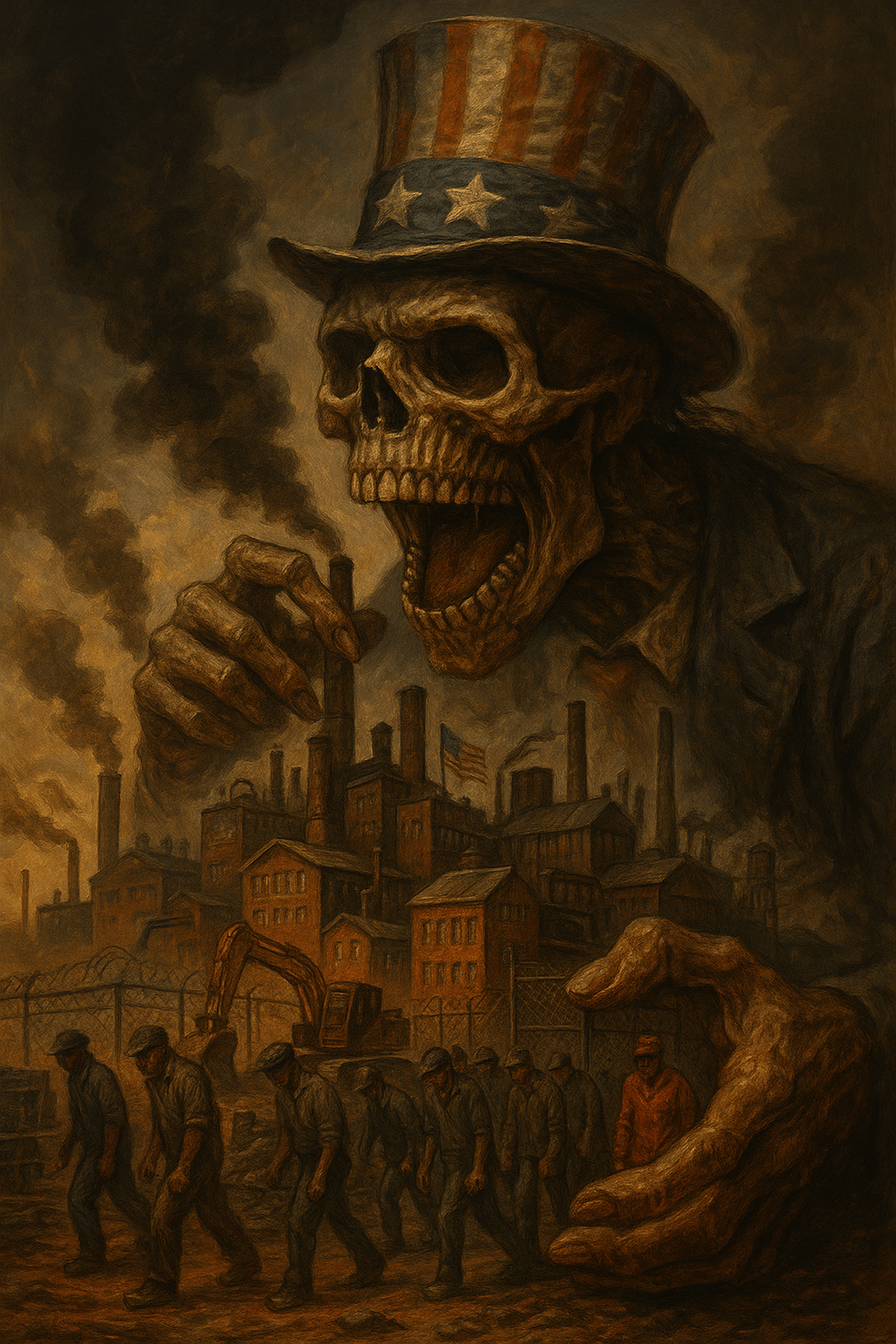
How the U.S. ruling class seeks to preserve global dominance by turning the colonial order inward — through tariffs, deportations, and the domestic replication of global-South conditions.
By Prince Kapone | Weaponized Information | 2025
Consumption as the Mirror of Empire
They say the American economy runs on the consumer—that the heartbeat of its strength is the checkout line, the credit card swipe, the dopamine hit of the next purchase. For decades, economists and politicians alike have repeated the mantra: “consumer spending makes up 70 to 80 percent of U.S. GDP.” They utter it with pride, as if consumption were proof of dynamism rather than dependency. But that number, stripped of its patriotic varnish, is the mirror image of empire itself. It exposes the parasitic structure of an economy that survives not by producing value, but by absorbing the value produced elsewhere.
When we peel back the surface, we find that this “consumer economy” is less a triumph of capitalism than its terminal stage—imperialism feeding on its colonies and its class relations feeding on themselves. The United States does not produce enough to sustain its own consumption. It extracts that capacity from the rest of the world through unequal exchange, financial domination, and military coercion. The iPhone assembled in China, the avocado picked in Mexico, the cobalt mined in the Congo, the garment sewn in Bangladesh—each enters the bloodstream of U.S. consumption at a fraction of its real cost because the labor that made it has been super-exploited. Every Walmart shelf is a ledger of colonial tribute.
Even the official statistics that claim only 11 percent of U.S. personal consumption comes from imported goods tell a deceptive story. They capture only the last stop on a planetary assembly line. The deeper truth is that the entire U.S. economy is built on imported value—the raw materials, intermediate inputs, and human labor extracted from the periphery. The empire doesn’t need to import finished goods when it owns the companies, patents, and finance systems that control production abroad. That’s the genius of imperial design: to make exploitation invisible by outsourcing it.
What appears as self-sufficiency is, in reality, ownership of dependence. The United States consumes the world because it has forced the world into its service. Dollar hegemony ensures that every country must earn, borrow, or buy its currency to participate in global trade, making U.S. deficits a form of tribute collection. Wall Street’s financial networks drain surplus from global production and recycle it into domestic liquidity, allowing Americans to live beyond their productive means. This is not national strength—it is global parasitism dressed up as prosperity.
The fetish of consumption hides the decay beneath. A society that celebrates buying over building has reached the point where its accumulation depends less on producing commodities than on manipulating money, data, and debt. Manufacturing jobs have been replaced with logistics, marketing, and financial speculation. The working class has been transformed from producers of value into managers and consumers of value produced elsewhere. In Marxist terms, the U.S. has shifted from a system of productive accumulation to one of rentier extraction. The economy no longer lives off profit derived from its own labor, but from interest, intellectual property, and control of global trade circuits.
This is why the “consumer economy” functions as both mask and mirror: it disguises stagnation while reflecting the empire’s true face. Behind every credit-fueled purchase lies a chain of exploitation that stretches across continents. The supermarket is the plantation updated for the digital age—an ecosystem of cheap goods subsidized by foreign misery and domestic debt. When workers in the Global South sweat for fourteen hours a day to produce a shirt that sells for fifteen dollars, and U.S. consumers buy it on credit, what’s being exchanged isn’t value—it’s domination.
The politicians who boast that America’s economy “runs on the consumer” are, in fact, describing an empire that runs on consumption of the world itself. Every trade deficit is a receipt for the labor stolen from abroad; every budget deficit is an IOU on the backs of the next generation; every stimulus check is a redistribution of imperial spoils. The consumer isn’t the hero of capitalism—he’s the vessel through which imperial plunder is metabolized. The empire doesn’t just export products; it exports poverty, and imports the means to live above its own contradictions.
What we call the “American consumer” is not merely an economic actor but a geopolitical construct—the final station in a global assembly line of expropriation. Every click of the credit card transmits command from the imperial core to the planetary periphery. But that circuitry is fraying. The very flows of cheap labor and materials that kept the empire’s appetite fed are now rerouting toward multipolar centers of gravity beyond Washington’s control. As the supply of tribute weakens, the empire begins to turn inward, searching for new ways to sustain itself. That is how the story of consumption bleeds into the story of Trump 2.0.
Trump 2.0 and the Illusion of Productive Revival
Trump enters this landscape of exhaustion not as a reformer but as a salesman of nostalgia. He promises to make America “produce again,” to reverse the hollowing out of the working class with tariffs, deportations, and a flag-wrapped rhetoric of national renewal. But what he truly offers is not a new economy—it’s a new alibi for an old addiction. The same empire that once consumed the labor of the Global South now vows to consume its own. Tariffs, reshoring, and economic nationalism become the instruments of that internal re-colonization, a way to feed the dying body of capital with the flesh of its domestic proletariat.
Trump 2.0’s economic nationalism begins with tariffs—an executive decree establishing a “reciprocal tariff” system that effectively raises duties on a broad array of imported goods, with higher rates for strategic sectors. The rhetoric is simple: punish foreign cheaters, protect American workers, rebuild industry. But in practice, these tariffs are not shields for labor; they are tollgates for capital. They raise prices for consumers, fuel inflation, and fill the Treasury with revenue skimmed off the working class. The real beneficiaries are not the workers sweating in the factories but the corporations collecting subsidies, the financiers speculating on price shifts, and the politicians who sell nationalism as policy while delivering austerity as reality.
Manufacturing construction is indeed rising, with real spending having doubled since 2021 under a policy push via CHIPS, IRA, and IIJA. Trump inherits this momentum and rebrands it as his industrial miracle. However, microdata show that even in a higher interest rate environment, the investment surge is tied to incentives under the CHIPS and Inflation Reduction Acts. Meanwhile, automation looms large: around 30 % of workers are exposed to new automation tech, especially in manufacturing, and rigorous analysis finds automation tends to reduce employment in manufacturing sectors. The working class, once the muscle of industrial America, is now the unpaid audience of its simulation.
Even the supply chains that supposedly return home do not return home. They merely shift their coordinates—from China to Vietnam, from Shenzhen to Monterrey, from the Pearl River Delta to the U.S.-Mexico border. It’s not de-globalization; it’s re-globalization under U.S. corporate control. This is what the White House calls “friend-shoring”: relocating production to compliant allies who guarantee low wages and political obedience. The goal isn’t sovereignty—it’s leverage. The empire is rearranging its dependencies, not abolishing them.
Meanwhile, the dollar remains the whip hand of this system. Every tariff skirmish and every trade realignment still unfolds under the shadow of dollar hegemony—the quiet weapon that lets the U.S. import the world’s goods in exchange for paper. Tariffs, in this context, are less about protecting domestic producers than about disciplining foreign ones: a show of economic violence meant to remind the world who controls the rules of the global market. The American worker becomes a pawn in this geopolitical theater, sacrificed in the name of “national strength” while the rentier class fattens its margins.
Trump’s “America First” economics therefore do not signal a return to productive capitalism; they mark the consolidation of imperial rentier capitalism under a nationalist banner. Tariffs act as selective protection for monopolies, reshoring serves as an excuse for corporate subsidies, and “decoupling from China” functions as psychological warfare to rally a fractured domestic base. The working class is promised dignity but delivered debt, promised sovereignty but delivered surveillance, promised jobs but delivered poverty wages in hyper-automated facilities built on public money.
For all its populist bluster, Trump 2.0’s program does not dismantle the global system of exploitation—it relocalizes it. The empire can no longer rely on unchallenged extraction abroad, so it begins to internalize those same colonial logics at home. The sweatshop moves from Dhaka to Detroit, the surveillance infrastructure of the border becomes the time-clock of the warehouse, and the language of “economic security” becomes the moral veil for state capitalism fused with corporate monopoly.
This is the true meaning of Trump’s “productive revival”: a desperate attempt to breathe new life into a decaying imperial economy by fusing nationalism, protectionism, and rentier extraction into one coherent technofascist project. The goal is not to restore labor’s power but to restore capital’s legitimacy. It’s a patriotic theater staged to disguise the fact that America’s industrial heart now beats on imported capital, foreign raw materials, and the invisible labor of the Global South. The empire is not coming home; it’s bringing the colony with it.
Tariffs and reshoring do not end parasitism—they refine its machinery. The empire no longer needs to sail outward to exploit the world; it can reconstruct the world’s conditions of exploitation right here at home. What began as a promise to “revive American industry” is fast becoming a plan to domesticate the very logics of the Global South—cheap labor, weak unions, and technological discipline—within U.S. borders. The same system that once outsourced exploitation now prepares to replicate it domestically, dressed in the language of national renewal.
Domestic Labor Recalibration: Importing the Global South Into America
This is the silent pivot of Trump 2.0’s so-called “economic nationalism.” Beneath the patriotic slogans and tariff walls lies a deeper project: to re-engineer the U.S. working class along colonial lines. As global extraction becomes more difficult and resistance abroad strengthens, capital must reproduce those same relations of domination internally. Domestic labor recalibration is the name of that process—the strategic adaptation of imperial exploitation to the terrain of the metropole itself, ensuring that what can no longer be taken abroad will now be taken from within. The colonial logic of accumulation, as Monthly Review’s analysis of colonialism and migration demonstrates, persists even within the imperial core, where capital replicates external domination in internal form.
The logic is simple. For decades, U.S. capital exported production to the periphery, extracting surplus from the cheap labor of Asia, Africa, and Latin America. But as multipolarity strengthens, as BRICS+ coordination expands, and as more nations seek sovereignty over their resources and supply chains, that easy plunder faces new limits. So the empire turns homeward. It seeks to recreate, within its own territory, the same regime of dispossession it once exported abroad. The goal is not to restore America’s productive capacity but to recolonize its domestic working class.
This project fuses three elements: economic coercion, technological discipline, and racialized social control. Together they form the architecture of a homegrown maquiladora economy. Wages stagnate while prices rise—real average hourly earnings fell by 0.1 percent in August 2025 as inflation eroded worker purchasing power. Union membership has fallen to just 9.9 percent of wage and salary workers, and union density continues to decline, while nationalist rhetoric substitutes for real labor power. Social welfare is dismantled and replaced by debt and digital surveillance. Factories built with public subsidies run on private profit and algorithmic management, where every movement of the worker is tracked, timed, and quantified. The laborer is reduced to data—a digitized serf under the watchful eye of capital’s new overseers.
In this environment, mass deportations serve as both purge and warning. They clear out millions of low-wage workers to shock the labor market into compliance, and to teach the citizen workforce what happens to those who resist. The spectacle of repression functions as an economic policy—a reminder that survival depends on submission. The migrant, hunted and humiliated, becomes the mirror through which the American worker learns their future. The empire no longer imports cheap labor from abroad; it manufactures cheap labor at home through fear, debt, and despair.
We are witnessing the birth of an internal colony within the imperial core itself. In the postwar era, the U.S. could afford a middle class because it drained wealth from the Global South. Now, as that external surplus narrows, it must extract from its own population. Deindustrialized towns become sacrifice zones. Homelessness swells. Entire generations live one paycheck from collapse. Prisons and detention centers merge into a single carceral infrastructure feeding the same private corporations that build the new factories. This is not “reindustrialization”—it is the neoliberal counterrevolution in nationalist clothing, designed to turn domestic crisis into labor discipline.
Technological innovation, far from liberating workers, intensifies their subjugation. Artificial intelligence and automation promise “efficiency,” but in the hands of monopoly capital they become instruments of enclosure. Algorithms assign shifts, monitor fatigue, and flag “underperformance.” The worker’s body becomes a data point, their exhaustion a metric, their obedience a score—documented in systematic reviews of workplace surveillance technologies and in new research on AI-based fatigue monitoring. This is not progress—it’s digital plantation management. The old whip has been replaced by predictive analytics, the overseer by the algorithm. What Trump calls “freedom” is in fact the freedom of capital to extract without limit.
Domestic labor recalibration is therefore not an economic correction—it’s a political counterinsurgency. It takes the colonial relationship that once defined U.S. domination abroad and re-imposes it on the home front. The working poor, immigrants, and surplus populations become the new colonized subjects of a technofascist empire fighting for survival. Patriotism becomes the mask for plunder; law and order become the euphemisms for class warfare. The carceral infrastructure of debt and policing is fused with predictive surveillance systems to manage dissent and preempt rebellion. Meanwhile, austerity policies described by the United Nations Conference on Trade and Development extend this counterinsurgency into the economic sphere, disciplining labor through scarcity and debt. The empire that once subjugated others to sustain itself must now subjugate its own.
In the final analysis, the U.S. ruling class is not restoring sovereignty—it is redistributing servitude. The same capital that extracted value from the sweatshops of Asia and the mines of Africa now seeks to extract it from the warehouses of Kentucky and the prisons of Louisiana. The difference is only geographic. The logic is identical: super-exploitation, surveillance, and suppression. America is becoming its own colony.
And yet, in this inversion lies a contradiction too deep to ignore. As the empire turns its weapons inward, the lines separating colonizer and colonized begin to blur. The white working class, long shielded by imperial privilege, now feels the tightening grip of the system it once benefited from. The myths of American exceptionalism crumble as the material reality of exploitation becomes universal. What was once outsourced to the Third World now comes home as everyday life. The empire, having devoured the planet, begins to feed on its own flesh.
That is the true meaning of “America First.” It is not the revival of national strength—it is the implosion of imperial privilege. The colony has finally come home.
Epilogue: The Dialectic of Resistance
Every system that lives by exploitation eventually turns its contradictions inward. When the empire runs out of colonies to drain, it colonizes its own. When capital can no longer plunder the periphery freely, it redefines the metropolis itself as the new frontier of extraction. Yet in this desperate inversion lies the seed of the empire’s undoing. The same process that deepens oppression also universalizes the struggle against it. The colonial contradiction, once global, now courses through the veins of the United States itself.
The working class in the imperial core is waking to a grim realization: the empire never protected them—it merely rented them privilege at the expense of others. Now that privilege is being repossessed. The deportations they cheered are coming for them in the form of evictions, layoffs, and digital surveillance. The austerity imposed on the Global South now stalks the streets of the metropole. The border wall, once built to keep others out, has become the architecture of their own confinement. The imperial boomerang has come full circle.
But from that recognition can emerge a new consciousness. The fight for living wages, housing, health care, and dignity inside the empire is inseparable from the fight against imperialism abroad. The same system that exploits migrant labor here exploits entire nations elsewhere. The same corporations that automate and impoverish U.S. workers fund coups, sanctions, and debt traps across the Global South. Solidarity is no longer an act of charity—it is an act of survival. To resist technofascism at home is to join the struggle against hyper-imperialism abroad.
That is the dialectic of resistance: as the empire collapses inward, the potential for revolutionary unity expands outward. The internal colonies of America—Black, Indigenous, and migrant—have long carried the memory of this struggle. Their liberation movements, from the cotton fields to the factories, have always contained the DNA of global revolution. Today, as white workers lose their imperial cushion, the possibility emerges for a new kind of solidarity: not based on privilege or pity, but on shared material oppression.
The task, then, is not to mourn the death of American prosperity, but to organize its funeral properly. The empire that eats itself cannot be saved—but it can be overthrown. Its decay offers the raw material for a new world, one built not on the extraction of others’ labor but on the liberation of human potential. The colonized of the world have shown that empires can fall; now it is time for the colonized within the empire to finish the job.
History does not move in straight lines—it turns in spirals. The contradictions that once divided the world into center and periphery are now collapsing into one another. The struggle of the worker in Detroit and the peasant in Chiapas are not parallel—they are the same. The same system that shackles both can be broken only through unity forged in resistance. When the oppressed of the world recognize that the borders dividing them are artificial, the empire will find that its walls are made of glass.
And when that day comes—when the people refuse to be consumers of empire and become its gravediggers instead—the world will remember that America’s decline was not a tragedy but a turning point. The empire that once consumed the planet consumed itself, and in its ashes a new humanity began to breathe.
 Weaponized Information