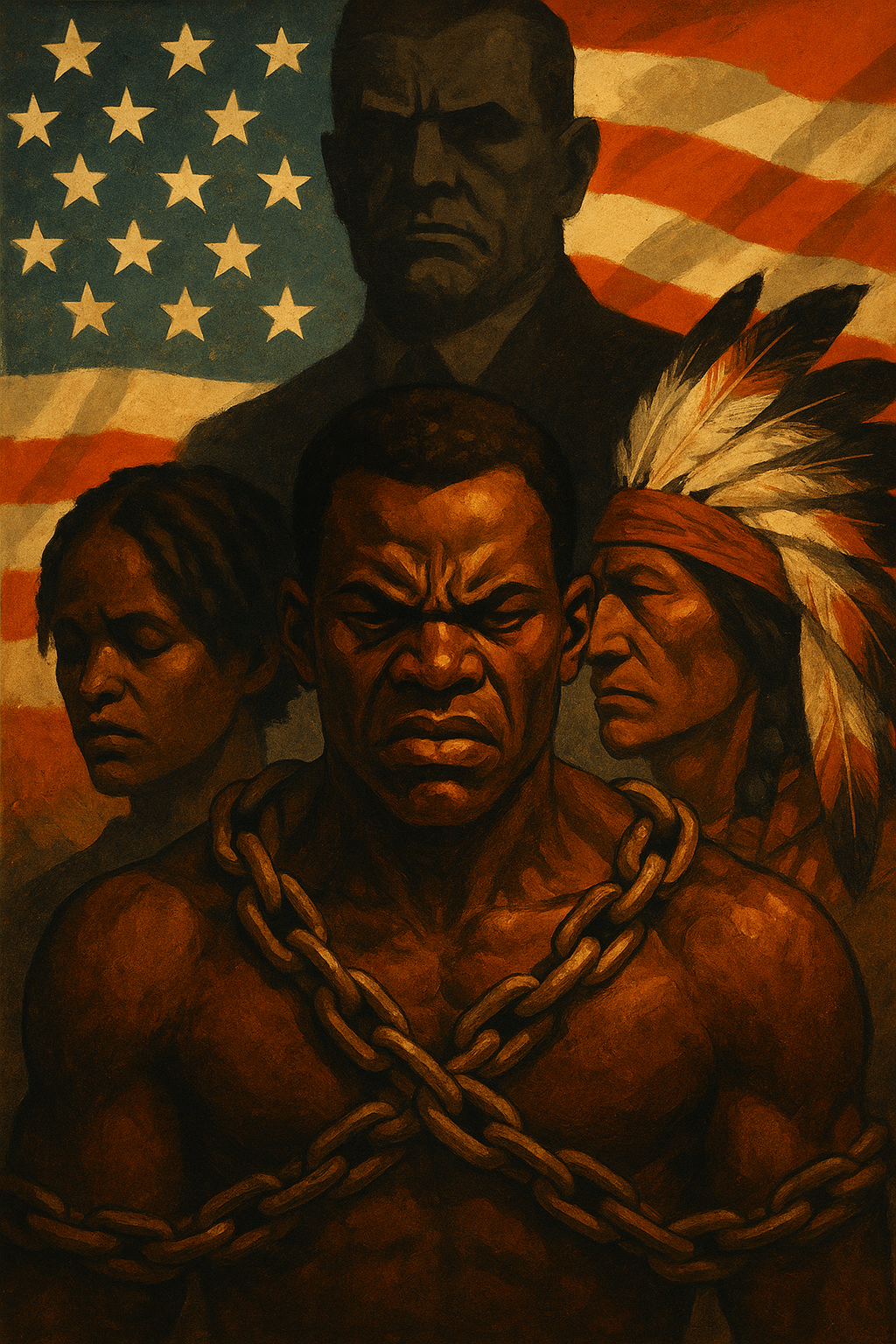
Long before propaganda and mass media, there was race—the ruling class’s first great psychological operation. It turned conquest into freedom, slavery into destiny, and a continent of nations into one empire under disguise.
By Prince Kapone | Weaponized Information
Preface: Excavating the Mask to Clarify the Terrain
This essay sits inside the Race/Class 101 project as a close-up on one load-bearing beam of the whole structure. In my earlier piece—“The Dialectics of Nation, Class Struggle and Revolutionary Rupture in the United States”—I mapped the total field: a settler empire ruled by a Euro-American nation, caging colonized nations and disciplining the working class through war, prisons, borders, and debt. Here, I isolate a single mechanism that keeps that machine humming: the concept of race itself—where it came from, why it was built, and how it still functions as the ruling class’s cover story.
We proceed historically and materially. Race did not spring from nature; it was engineered in Western Europe during the long rise of colonial capitalism, then shipped across the Atlantic and refined in the laboratories of the Americas. Pseudo-science and “reason” provided the ideology; plantations, reservations, and slave codes provided the enforcement. By the time the United States raised its flag, the architecture was complete: call nations “races,” downgrade sovereignty to “minority status,” and make domination look like biology.
This essay, then, elaborates the particular to clarify the general. By tracing how race was invented, transmitted, and transmuted into U.S. law and common sense, we make the larger dialectic legible: nation and class cannot be separated because “race” is the language that hides their unity. Pull off that mask, and the prison house of nations becomes visible; name the nations, and the path to revolutionary rupture sharpens into view.
Consider this an excavation rather than a detour: a focused strike at the ideological foundation that props up the whole edifice. If the first essay was the map, this one is the blueprint of the mask—drawn so we can tear it off, expose the wiring, and get to work on demolition.
Race: The Ruling Class’s Cover Story
From the very start, the United States has been a hustle. It calls itself a land of freedom, but it’s a prisonhouse of nations. It sells equality, but lives off chains. And the biggest trick in its book is one word—race. Race is the mask the ruling class pulls over our eyes. It takes whole peoples—Africans, Chicanos, Indigenous—and flattens them into “minorities” in a settler’s democracy. This isn’t sloppy language. It’s strategy. It’s class rule dressed up as common sense.
The myth of race did not begin in the United States but in Western Europe, during the long birth of capitalism and empire. Between the fifteenth and eighteenth centuries, Europe was bursting outward—colonizing the Americas, enslaving Africans, exterminating Indigenous nations, looting Asia. Suddenly the old religious justifications—“heathen,” “infidel,” “pagan”—were no longer enough. A new question haunted Europe’s ruling classes and its philosophers alike: were these conquered peoples fully human? The answer would decide the moral grammar of the new world system.
This question launched a furious debate. Some insisted that all humans shared a single origin—these were the monogenists—but argued that climate and geography had “degenerated” certain peoples. Others, the polygenists, claimed that races were separate species altogether. Both camps agreed on one thing: Europeans stood at the top. In 1684, the French physician François Bernier divided humanity into four “races,” aligning each with the trade zones of empire. Carl Linnaeus, in Systema Naturae (1735), went further—Europeans were “governed by laws,” Africans “by caprice.” Buffon’s Histoire Naturelle (1749) explained inequality through climate: hot lands bred laziness, temperate ones civilization. Immanuel Kant, in 1775, declared these differences hereditary and fixed; Africans, he wrote, were “by nature” incapable of progress. Johann Friedrich Blumenbach (1776) gave it the final polish—coining the term “Caucasian” and naming Europeans the most “beautiful” and original form of mankind. Together they transformed conquest into science, slavery into nature, and plunder into destiny.
The Americas became the laboratory where Europe’s theories were tested and refined. Spain’s casta system catalogued every possible racial mixture into a legal hierarchy. France’s Code Noir (1685) tied freedom to whiteness and slavery to Blackness. England’s colonies wrote race into law: Virginia’s 1662 statute made children inherit the enslaved status of their mothers, turning reproduction into property; its 1691 act outlawed “intermarriage” to preserve a color line that didn’t yet exist. In these laboratories of labor and land theft, the idea of race hardened into social fact. By the time the Euro-American republic was born, this entire apparatus of racial rule had already been perfected—it simply changed flags.
In the North American settler colonies, the European discourse on “race” did not arrive as an abstract theory—it arrived as an instrument of statecraft. The so-called Founding Fathers were steeped in the Enlightenment that had already divided humanity into biological hierarchies. Jefferson, Franklin, and their peers absorbed the works of Buffon, Linnaeus, and Kant, translating those categories into a colonial reality. Thomas Jefferson, in Notes on the State of Virginia (1785), echoed the very debates of Europe when he asked whether Africans were “originally a distinct race, or made distinct by time and circumstances,” and concluded they were “inferior to the whites in the endowments both of body and mind.” He wrote that Africans were “dull, tasteless, and anomalous,” “incapable of tracing and comprehending the investigations of Euclid,” and that emancipation would end only “in the extermination of one or the other race.” Benjamin Franklin carried the same logic into the sphere of citizenship, warning in 1751 that “the number of purely white people in the world is very small,” and insisting America remain “a land of white men,” not “increase the sons of Africa.” What the European philosophers speculated in lecture halls, the American founders implemented in law and labor: a racial order as the condition of the republic’s freedom.
For Indigenous nations, the same imported concept of race became a colonial blueprint. George Washington—remembered among the Haudenosaunee as Conotocaurius, the Town Destroyer—treated Indigenous peoples not as sovereign nations but as a racial obstacle to expansion. In 1779 he ordered the Sullivan Campaign to “lay waste all the settlements around… that the country may not be merely overrun but destroyed.” Jefferson followed the same racial logic, describing Indigenous peoples as “savages” who must be “civilized” or “driven beyond the Mississippi.” His so-called “civilization plan” mirrored the European notion that non-Europeans could ascend the racial hierarchy only through assimilation and erasure. In their hands, Enlightenment reason became an exterminating reason—the fusion of scientific racism and settler colonialism.
The U.S. Constitution crystallized this synthesis into a governing structure. Africans counted as three-fifths of a person, Indigenous nations were redefined as “domestic dependent nations,” and citizenship was reserved for the Euro-American settler population. The young republic thus codified race as both ideology and infrastructure: the political economy of whiteness became the scaffolding of American democracy. The categories that Europe invented to rationalize empire became, in the United States, the architecture of the state itself. Race was not merely a prejudice—it was the very design of the American project.
That’s why the so-called “race problem” has always been the settler’s way of hiding the real problem—colonialism. When they say “race relations,” what they mean is the permanent contradiction between the settler and the colonized, between Euro-American citizens and those denied real citizenship. It’s the dialectic that made African history in the U.S. the opposite of Euro-American history: when one expanded, the other was caged; when one accumulated, the other was robbed; when one rose to global power, the other was shackled to the plantation, the factory, the ghetto, and the prison. And yet they tell us this is just a clash of colors.
Race is no truth. It’s a ruling-class lie—an invention to cover up capitalism’s crimes. It’s how the nation-state of the bourgeoisie denies the nationhood of the colonized while protecting the spoils of the settler. Talk about race in America and you’re stuck in the vocabulary of empire. Talk about nations—African, Chicano, Indigenous—and you’re suddenly talking about the colonial foundations of the United States. And if you speak in Marxist terms, you’re exposing the nation for what it is: a bourgeois tool of class power, which only revolutionary decolonization and socialism can uproot.
So here’s where we start: tear away the veil of race and reveal the nations it hides. Don’t let the ruling class reduce us to colors when history has already made us peoples. The settler clings to race because he fears the truth of nationality. We must speak of nations—because naming the truth is the first step to ending the empire.
The Nation as a Bourgeois Weapon
The word “nation” didn’t fall out of the sky. It was built in the mud and blood of Europe as capitalism was climbing over the corpse of feudalism. The rising bourgeoisie needed more than patchwork fiefdoms and scattered dialects. They needed markets big enough to feed their factories, armies large enough to crush rebellion, and states strong enough to collect taxes and discipline workers. So they stitched together nations—not as gifts to the people, but as cages for them. The modern nation was born as a tool of class power.
Marxists tried to make sense of this new reality. Stalin, in 1913, laid out a formula: a nation is a stable community, defined by common language, territory, economic life, and culture. Useful, yes. It gave communists a way to distinguish between oppressed nations and imperial fictions. But it was also rigid, tied to Europe’s path, and blind to the messier histories of the colonized world. Nations do not always grow in tidy rows. Sometimes they’re smashed together under the lash. Sometimes they’re reborn out of ashes. Stalin’s checklist can’t capture that.
Look at the United States. The Euro-American nation was forged by exterminating Indigenous peoples, enslaving Africans, and annexing Mexican land. That’s how it became a “nation”—through conquest, dispossession, and blood. But the colonized didn’t vanish. They were forced into new unities of their own. Africans stripped of languages and tribes became a new people through the crucible of slavery and struggle. Chicanos emerged as a colonized nationality after the theft of Aztlán. Indigenous nations survived every attempt to erase them and carried their sovereignty forward. According to Stalin’s grid, their nationhood looks incomplete. But according to history, it is undeniable.
Here’s the trick: the bourgeoisie loves the concept of the nation when it cements its own power, but fears it when it belongs to the oppressed. So the Euro-American settler is called a nation, but Africans, Chicanos, and Indigenous peoples are called races. One word grants sovereignty; the other strips it away. One word justifies a state; the other justifies a cage. This is not semantics. It’s class struggle at the level of language.
To reclaim the national question, we have to rip it from the hands of the bourgeoisie. The United States is not one nation under god. It is an empire of nations under occupation. And the sooner we stop pretending otherwise, the sooner we can build a movement that doesn’t beg for a seat at the settler’s table but fights to overturn the whole damn system.
Forged in Chains: Africans in the United States
No people in this empire show the lie of “race” more clearly than Africans in the United States. Torn from dozens of nations across the continent, stripped of languages, names, and kinship, the enslavers thought they could erase everything and leave behind only bodies for sale. But history works dialectically. Out of that fire came something the colonizer did not expect: a new people, a new unity. Not a “race,” but a nation-in-the-making, forged in chains and defined by struggle.
Lerone Bennett Jr. captured this when he wrote that African history in the U.S. has been the dialectical opposite of Euro-American history. As Euro-Americans seized land, Africans were chained to it. As settlers built wealth, Africans were expropriated to create it. As Euro-Americans rose to global power, Africans were locked in plantations, mills, ghettos, and prisons. The so-called American Dream was built on the African nightmare. Two histories, bound together but moving in opposite directions.
Even Stalin’s rigid formula—language, territory, economy, culture—can’t deny this reality. Language? English was imposed, but Africans remade it into something new: a vernacular, rhythms, cadences, and music that carried memory and defiance. Territory? The Black Belt South became the historic homeland, millions of Africans rooted in semi-slavery and Jim Crow. Economy? African labor was the backbone of U.S. accumulation: from cotton to steel to today’s low-wage service sector. Culture? From spirituals and blues to hip-hop, from church pulpits to street uprisings, a distinct culture of resistance has flourished. By every measure, a people was forged.
That’s why every African uprising has terrified the republic. From Nat Turner to Reconstruction governments, from Garvey to the Panthers, from the Republic of New Afrika to the rebellions of the 1960s, the truth has been clear: this is not a question of “race relations.” It is a question of colonial domination. To admit Africans as a nation is to admit the United States is an empire—and that’s exactly what the ruling class cannot do. So they stick with “race,” keeping nationhood buried beneath a word designed to strip away sovereignty.
Marxism teaches us that the national question is always a class question. Africans in the U.S. are not just a mistreated minority; they are a colonized proletariat, the reserve army of labor whose exploitation makes possible the wages of Euro-Americans. To speak of race is to speak in the tongue of the oppressor. To speak of nation is to tell the truth: African liberation is not about inclusion in the settler nation but about decolonization and self-determination.
Aztlán: A Nation Born of Conquest
If Africans in the United States were forged into a people through chains, Chicanos were forged through conquest. In 1848, the U.S. marched its armies into Mexico and stole half the country—what we now call California, Texas, Arizona, New Mexico, Colorado, Utah, Nevada. The Treaty of Guadalupe Hidalgo promised rights and protections to the Mexicans left behind. Those promises lasted about as long as it took the ink to dry. Lands were stolen, languages banned, whole communities pushed into the bottom rungs of the economy. A nation was dismembered, renamed, and reclassified as a “Mexican race.”
But nations do not vanish so easily. Out of dispossession, a Chicano people emerged—rooted in the Southwest, bound by common experience, and rich in culture. Spanish, fused with Indigenous words and accents, survived despite every attempt to kill it. The land of Aztlán remained the anchor, even when families were pushed from farms to barrios to migrant camps. Economic life was defined by hard labor in fields, factories, and low-wage industries—super-exploitation that fed U.S. agribusiness and industry. Culture flowered in defiance: corridos, murals, literature, and the traditions that made barrios into spaces of survival and resistance.
By the 1960s, the truth came into the open. The Chicano Movement proclaimed what empire denied: Chicanos are not an ethnic group, they are a colonized nation. El Plan Espiritual de Aztlán declared Aztlán the homeland and self-determination the demand. The Brown Berets patrolled barrios like the Panthers patrolled ghettos, defending the people from police occupation. Farmworkers, led by César Chávez and Dolores Huerta, fought for dignity not just as laborers but as members of a nation under siege.
Here, again, we see how race is wielded to smother nationhood. By calling Chicanos a “Hispanic race” or a “Latino ethnic group,” the state reduces a national question to a cultural flavor or a census box. The theft of land becomes an immigration issue. Colonization gets renamed diversity. It’s ideology doing its job: burying sovereignty under the language of race. For the U.S. ruling class, this sleight of hand is necessary. If Chicanos are a nation, then the United States is an empire—and empires can fall.
For Marxists, the lesson is plain. The Chicano question is not about prejudice, assimilation, or multiculturalism. It is about colonial domination. And the class reality is just as sharp: Chicano workers are among the most exploited in the empire, their poverty underwriting the profits of capital. The struggle for Aztlán is not a cultural debate. It is a revolutionary struggle for national liberation, bound up with the fight against U.S. capitalism itself.
Indigenous Nations: Sovereignty in the Shadow of Empire
Long before the U.S. flag ever flew, hundreds of nations stretched across this continent—Haudenosaunee, Diné, Lakota, Cherokee, and many more. Each had its own language, territory, and ways of life. The arrival of the settler didn’t erase these nations—it waged total war against them. Land was stolen, treaties broken, children ripped into boarding schools, languages beaten out of mouths. Genocide was not a side effect. It was policy. And when extermination failed, the state pulled a final trick: rename nations as “tribes,” reduce sovereignty to a bureaucratic status, and call Indigenous peoples a “race.”
Yet despite everything, Indigenous nations never disappeared. They survived removals, massacres, and reservations. They held onto land wherever they could. They kept languages alive against the odds. They rebuilt economies and governance under siege. And they carried forward culture, spirituality, and resistance that refused to die. Sovereignty wasn’t a relic—it was lived every day, in every fight to defend sacred sites, every blockade against pipelines, every demand for treaty rights. AIM’s defiance in the 1970s, the Red Power movement, and struggles like Standing Rock all shouted the same truth: Indigenous peoples are nations, not races, not minorities, not museum pieces.
Stalin’s formula—language, territory, economy, culture—was shattered by conquest, but Indigenous peoples still embody them. The territory is ancestral, even if occupied. The economic life was communal before being destroyed, and today is rebuilt in struggle. The languages are many, though scarred by forced assimilation. The culture, forged through survival and defiance, remains vibrant. What is missing is not nationhood but sovereignty—stripped by empire and renamed as “race.”
This renaming serves the settler perfectly. By calling Indigenous nations “American Indians,” “minorities,” or “Native race,” the state erases their political status and makes colonialism sound like diversity. The reality is that the United States sits on occupied land, governing over nations it has never extinguished. Every Indigenous struggle is a reminder that empire rests on stolen ground.
For Marxists, the lesson is sharp. The Indigenous question is not about inclusion or representation. It is about colonization and decolonization. It is about nations denied sovereignty so that a Euro-American settler nation could exist at all. To stand with Indigenous nations is not charity. It is to stand against the foundation of empire itself.
Race as the Bourgeois Mask of Nationhood
Now the pattern comes into focus. Africans, Chicanos, Indigenous peoples—each with territory, culture, and collective life—have been denied recognition as nations. Instead, the settler state calls them “races.” Why? Because race is the ruling class’s euphemism, its ideological sleight of hand. It strips sovereignty from the colonized and keeps the United States looking like one unified nation instead of what it really is: an empire built on stolen land and captive peoples.
Race was not discovered—it was invented. It was the code that justified slavery, the grammar of genocide, the rationale for conquest. It became the language through which the bourgeois nation-state organized domination. Talk of “race relations” makes it sound like skin colors rubbing against each other. In reality, it’s the collision of nations: the Euro-American settler nation expanding, and the colonized nations resisting. Race hides this national contradiction under the fiction of biology and prejudice.
And this fiction has a class function. By calling Africans a race instead of a nation, the state keeps their oppression framed as a social problem rather than colonial domination. By calling Chicanos “Hispanics,” it erases the fact that Aztlán is occupied land. By calling Indigenous peoples a “Native race,” it buries sovereignty under bureaucracy. Race turns nations into demographics. It transforms political struggle into personal prejudice. It keeps the working class divided and the empire intact.
Euro-Americans, too, were stitched together into a nationality out of diverse European origins, unified through the practice of settler colonialism itself. Whiteness was not biology—it was a political project, a class alliance that fused immigrant workers and elites alike into a settler nation living off the land and labor of the colonized. That is why “white” is not an identity we accept. It is a mask for a settler nation. To call it Euro-American is to name it for what it is: a nationality born of conquest, not a race decreed by nature.
For Marxists, this clarity matters. The nation-state is a bourgeois form, a tool of class power. Race is its ideological camouflage, a way to deny the oppressed their true status as nations. To fight on the terrain of race is to fight on the ground chosen by the rulers. To fight on the terrain of nation is to unmask the empire and demand self-determination. That is the only way to bring class struggle to its sharpest point: by uniting the multinational working class in solidarity with colonized nations against the capitalist state that binds them all.
Revolutionary Implications: From Race to Nation
If race is the mask and nation is the truth, then the implications are explosive. It means the United States is not a single nation with a race problem—it is a settler empire built on top of colonized nations. It means Africans in the U.S. are not a racial minority, but an oppressed people whose labor underwrites the entire system. It means Chicanos are not a cultural group, but the occupied population of a stolen land. It means Indigenous peoples are not remnants of the past, but sovereign nations whose survival testifies to the unfinished business of decolonization.
This changes everything. The fight is not against “racism” in the abstract—it is against colonialism in the concrete. Racism is not the root of oppression, but its ideological smoke screen. You can’t abolish the master’s ideology while keeping his plantation. Even if every Euro-American woke up tomorrow free of racial prejudice, the material relations of domination would remain untouched. White people would still own nearly all the arable land, the banks, the corporations, the media, and the machinery of the state. Africans, Chicanos, and Indigenous peoples would still be dispossessed and policed, because the system that grants settlers privilege is not an idea—it’s an empire. Fighting racism is like shadowboxing the symptom while the disease devours the body. You cannot reason or educate your way out of colonialism. You have to overthrow it.
This is why the liberal sector of the white ruling class invests so heavily in “anti-racism” and “diversity.” They channel the colonial grievance of whole nations into manageable, symbolic reforms—workshops, hashtags, representation—while keeping the foundations of empire intact. “Race relations” are the velvet curtain that hides the iron bars. But once you tear away the curtain, the real contradiction stands naked: the colonizer and the colonized, the settler and the nation struggling to be free. The task before us is not to reform the empire’s ideology but to dismantle its power.
Class remains the anchor. The nation-state itself is a bourgeois form—a fortress built to protect private property and manage labor. The Euro-American settler nation fused workers and rulers in a shared project of conquest. Its working class, instead of uniting with the colonized, was bribed into whiteness and taught to police the empire’s color line. That bargain is the root of its betrayal. The only path forward is for Euro-American workers to break their allegiance to empire, defect from their settler nation, and align with the struggles of the colonized. That is not moral conversion—it is historical necessity.
Revolutionary internationalism must begin at home. It means fighting for the self-determination of New Afrikans, of Chicanos in Aztlán, and of Indigenous nations across this occupied land. It means exposing the United States not as a democracy, but as an empire. And it means recognizing that the liberation of the colonized nations is the precondition for any genuine socialism here. To unite the working class, we must first confront its fractures. To build democracy, we must first end colonialism. To destroy capitalism, we must destroy the empire that birthed it.
Race is the ruling class’s cover story. Nation is the people’s truth. And socialism—the abolition of empire and the restoration of sovereignty to the oppressed—is the only way that truth can be realized. The road ahead is not toward a “multiracial America,” but toward a decolonized world, where nations once buried under race rise free, equal, and sovereign. Only then will humanity itself be whole again.
 Weaponized Information
Leave a comment