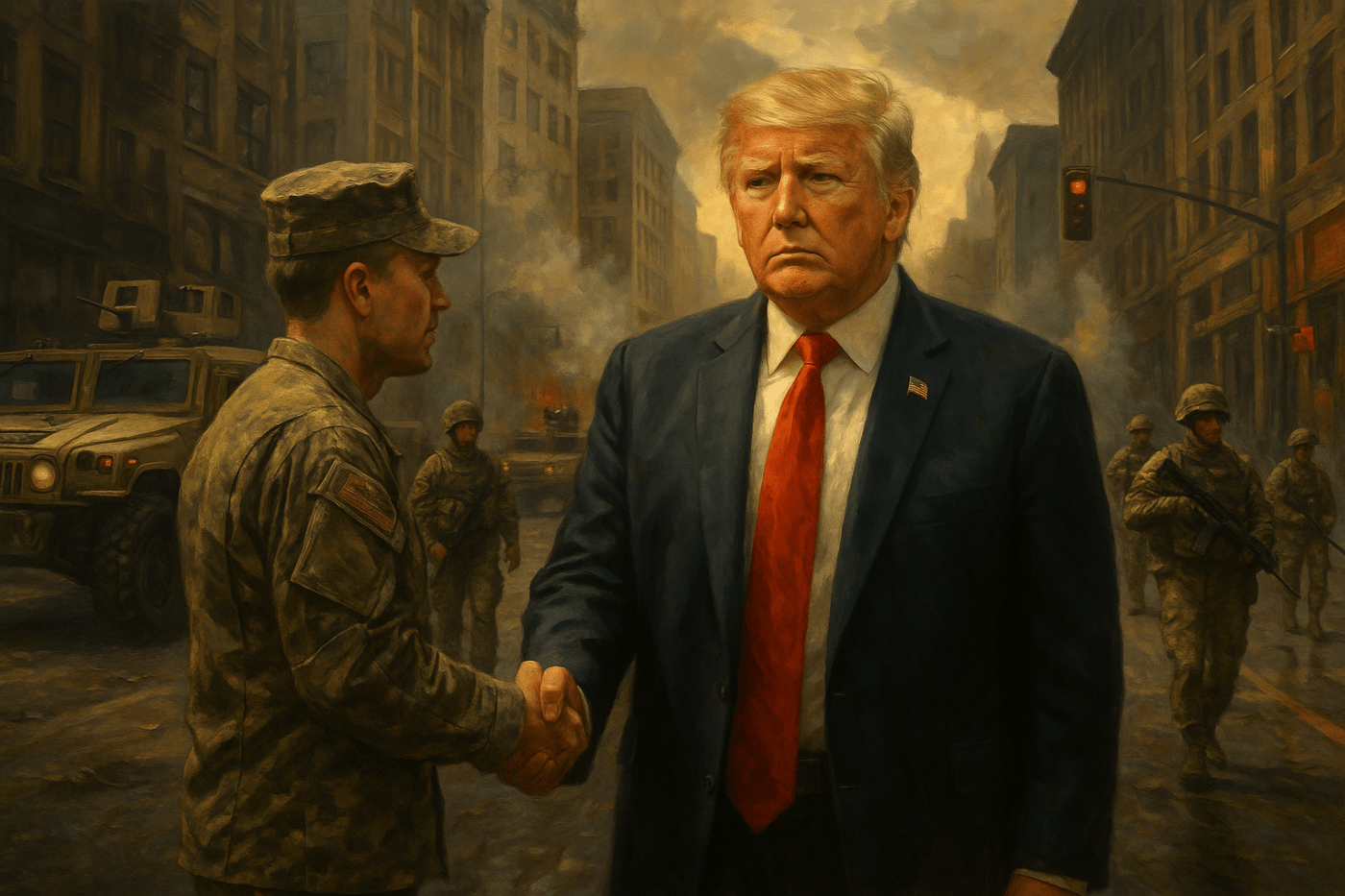
How Politico launders militarism into common sense, and how the ruling class sharpens its counterinsurgency state under crisis
By Prince Kapone | Weaponized Information | October 1, 2025
The Theater of Obedience
On September 30, 2025, Politico ran a piece by Irie Sentner and Paul McLeary under the title, “Trump, justifying domestic military action, tells Pentagon leaders to ‘handle’ the ‘enemy from within.’” At first glance it reads like sober reportage: a president delivering a “dark and winding” 72-minute speech at Quantico, peppering his tirade with insults for Biden, DEI programs, and immigrants, while proposing that American cities be turned into military “training grounds.” But look again. The text is less journalism than stenography, less analysis than the laundering of state ideology. It is the theater of obedience, performed in print.
Sentner and McLeary, both long-time defense correspondents, are not neutral scribes. Their careers rest on access to Pentagon corridors and the favor of brass in uniform. The price of that access is a steady reproduction of the worldview of the national security state: generals are sober guardians, the Pentagon is a professional machine, and “politics” only enters when a figure like Trump clumsily pushes beyond tradition. In reality, the entire edifice they cover is politics—the politics of empire, repression, and capital—but their craft requires them to pretend otherwise. They are not rogue voices, they are functionaries in the newsroom wing of the war machine.
Politico itself is no innocent platform. Owned by Axel Springer SE, a German media conglomerate openly pledged to NATO and the Atlantic alliance, it operates as an amplifier of Western state power and capital. Every “scoop” about defense is framed to reassure investors and allies that U.S. militarism is both stable and legitimate. The job of its editors is not to expose the permanent war economy but to naturalize it, to weave it seamlessly into the daily diet of news so that endless militarization feels like common sense. When Trump rants, they present it as “remarkable,” but never question the structure that allows such ranting to mobilize billions of dollars and entire armies.
The article leans on familiar amplifiers. It draws legitimacy from the Pentagon stage itself, from the presence of generals and admirals flown in at public expense, from the nodding gravity of Defense Secretary Pete Hegseth. Behind them stand the usual think-tank strategists, RAND alumni, and defense contractors whose fortunes depend on militarizing both foreign soil and domestic streets. Their voices are not quoted, but their fingerprints are everywhere in the framing: cities as “lawless zones,” soldiers as “heroes,” Trump as aberrant but still a commander to be taken seriously.
The propaganda mechanics are textbook. The framing declares Trump’s idea a “remarkable break,” which erases the long continuity of the U.S. military patrolling its own poor and racialized populations, from Reconstruction to the civil rights movement. The omissions are glaring: no mention of the Posse Comitatus Act, no acknowledgment of National Guard deployments against Black uprisings in the twentieth century, no recognition of the Pentagon’s own 1033 pipeline arming police departments with military gear. Instead of history, we are given adjectives—“dark,” “winding”—a liberal horror at Trump’s tone rather than his substance. It is emotional manipulation for readers who fear demagoguery but accept militarism as long as it wears a professional mask.
The cognitive trick is simple: contrast Trump with “tradition” so that the Pentagon appears as a reluctant actor, dragged into politics by a wayward president. This absolves the institution of its actual role as the backbone of domestic repression. False equivalence is deployed through the invocation of Washington and Lincoln, as if settler-colonial wars and civil war suspensions of rights were noble precedents. And the orientalist tropes once hurled at colonies—“lawless,” “dangerous”—are now repurposed to describe U.S. cities where the poor and oppressed dwell. The enemy is recast as internal, and the map of empire folds back onto the metropole.
Thus, the Politico article is not a neutral report but a transmission line for imperial ideology. It tells readers that Trump is uniquely outrageous, but that the system itself remains sound. It buries history under adjectives, erases structure under narrative flair, and in doing so it prepares the ground for acceptance. When the tanks roll into Baltimore or Chicago, the reader will remember not that this is the iron law of empire turned inward, but that Trump was “dark and winding.” This is how propaganda works in polite society: by narrowing vision until continuity looks like rupture and repression looks like order.
The Facts They Bury Beneath the Spectacle
Beneath the melodrama of Politico’s narrative lies a concrete scaffolding of facts that can and must be pried apart from the propaganda. Trump did indeed describe America’s inner cities as “a big part of war” and suggested that Los Angeles, Portland, Seattle, Washington, and Memphis could serve as live “training grounds” for the U.S. military. He has already ordered the National Guard into Washington, Memphis, Los Angeles, and Portland, and floated further deployments to Chicago, Atlanta, Baltimore, and New York. His newly christened Department of War, under the hand of Pete Hegseth, positions the military as an order above civilian society, reinforced by a costly spectacle in Quantico where nearly every general and admiral was flown in at public expense for a pep rally dressed up as patriotic seriousness.
These are verifiable claims, and they map onto a grim trajectory. What Politico avoids spelling out is that this militarization of U.S. urban space is not a rupture but the latest expression of a historical pattern. The U.S. state has always turned its armies inward to enforce racial and class domination: during Reconstruction when federal troops were deployed to suppress Black freedom, in the violent crushing of labor uprisings like the Pullman Strike, and again in the 1960s when the National Guard rolled tanks through Black neighborhoods during civil rights rebellions. These are not aberrations—they are precedents, rehearsals for the present moment.
Equally absent is the legal architecture that once constrained such deployments. The Posse Comitatus Act of 1878, designed to limit federal military involvement in domestic law enforcement, has been steadily undermined since the “War on Drugs” and virtually hollowed out in the post-9/11 “War on Terror”. Today, Pentagon resources flow freely into domestic policing through the infamous 1033 Program, funneling assault rifles, armored vehicles, and surveillance tech into the hands of local police departments. When Trump proposes using cities as training grounds, he is not leaping into unknown terrain—he is accelerating a process already institutionalized.
There is also the matter of political economy. The military spectacle at Quantico was not just a morale exercise; it was a billboard for the contractors whose profits depend on militarized governance. Companies like Raytheon and Lockheed Martin build the kinetic weapons, while Palantir and Axon supply the software and surveillance infrastructure. This domestic theater feeds directly into global markets where counterinsurgency and repression are exported as U.S. “expertise”. What is rehearsed in Baltimore today is sold to Bogotá, Tel Aviv, or Manila tomorrow.
The geopolitical context seals the contradiction. Trump’s rhetoric is not simply about “crime” or “urban decay.” It coincides with the erosion of U.S. hegemony in a multipolar world order. As the Tricontinental Institute notes, imperial decline sharpens the drive to consolidate control at home even as global influence wanes. When Washington cannot guarantee supremacy abroad, it tightens the grip on its internal colonies: Black communities, migrant neighborhoods, and the poor who inhabit the “dangerous cities.” This is not about public safety; it is about securing accumulation in crisis.
Politico’s omissions are therefore not incidental—they are structural. By stripping Trump’s proposals of their historical precedents, legal erosion, economic incentives, and geopolitical context, the article reduces everything to a grotesque personality show. But once excavated, the facts tell a different story: a state apparatus recalibrating, under duress, to militarize its own territory in the same way it has long militarized the periphery. What they call a “remarkable break” is in truth a convergence, where domestic repression and imperial war finally reveal themselves as two sides of the same coin.
From Crisis Rhetoric to Counterinsurgency State
Once the facts are stripped of Politico’s melodrama, the true pattern emerges. Trump’s Quantico speech was not an oddity of tone or a personal obsession with “dangerous cities.” It was a crystallization of the U.S. state’s long project of fusing external imperial violence with internal repression. What the article tried to sell as a “remarkable break” is really a sharpening of continuity: a counterinsurgency state maturing in the open. The language of “training grounds” does not signify policy drift—it signifies the official acknowledgment that American urban space, especially where the poor, migrants, and Black communities live, has been reclassified as insurgent terrain. In this framing, the line between Baghdad and Baltimore collapses.
Here the concept of Technofascism becomes indispensable. This is not fascism in the 1930s sense of jackboots alone, nor is it merely digital surveillance. It is the fusion of monopoly-finance capital with both the digital infrastructure of data capture and the kinetic machinery of war. When Trump tells generals that Los Angeles or Portland should be treated as live-fire classrooms, he is effectively proposing the integration of predictive policing algorithms, mass surveillance feeds, and military weaponry into a single, normalized apparatus. The “war on crime” becomes indistinguishable from the war on terror. The civilian is recoded as enemy combatant by software, and the bullet follows where the data points.
This trajectory reveals the U.S. as a Counterinsurgency State. From its founding it has waged war on colonized peoples, both internally and abroad, but now it names this openly. What Trump calls “enemy from within” is simply the reclassification of the surplus population—the unemployed, the racialized, the poor—into permanent insurgents. The National Guard deployments are not isolated; they are the logical extension of a state that has long governed its own colonies through terror, whether the Black Belt South, Native reservations, or the barrios of Puerto Rico. In this optic, the Department of War’s revival is not symbolic—it is structural, a recognition that repression is no longer episodic but permanent.
The deeper motor of this shift is the Crisis of Imperialism. U.S. hegemony abroad is slipping; multipolarity grows as China, Russia, and BRICS+ nations build institutions that no longer bow to Washington. Unable to secure dominance abroad as it once did, U.S. capital requires greater discipline at home. This is why Quantico’s theater cost millions to stage: it was less about speeches and more about signaling to finance, to contractors, to the ruling class that the military remains the ultimate guarantor of order in times of decline. The crisis is not only economic; it is ideological. The spectacle at Quantico sought to re-anchor the myth of military heroism precisely as its global aura falters.
From the standpoint of the global proletariat, none of this is shocking. The oppressed have long known that the U.S. empire trains its weapons first on colonized people. The novelty lies only in how naked the merger has become, how openly domestic repression is named as “training.” What the Politico article called “dark and winding” is in fact brutally clear: the U.S. ruling class, through Trump’s mouthpiece, admits it has no vision left but the gun. It can no longer promise prosperity, democracy, or peace. It can only promise order enforced by soldiers in the streets. That is not a break with American tradition—it is its culmination.
To reframe Trump’s Quantico moment is therefore to reject the liberal fantasy that institutions will restrain him. The Pentagon is not reluctant. Politico is not watchdog. Both are participants in the recalibration of repression. The crisis of imperialism dictates this course, and technofascism provides its operating system. What looks like a grotesque aberration from the outside is, from the inside, the rational unfolding of a system designed to crush resistance wherever it appears, whether in the slums of Gaza or the streets of Portland. In this sense, Trump was not rambling at Quantico—he was announcing the new normal.
From Fragments to Frontlines
If Trump’s Quantico speech revealed anything, it is that the U.S. ruling class has no solutions left but repression. The empire is unraveling abroad, profits are thinning at home, and so the boot is prepared to fall harder on the necks of the poor, the colonized, and the working class within the borders of the United States itself. The question before us is not whether repression will intensify—it already has. The question is how those who suffer under its weight will organize, not as scattered victims, but as a united force that links every struggle into one front against technofascism.
The call is first to the working class in the U.S.—the majority who labor without security, whose wages are eaten by inflation, whose children are fed into debt and despair. But it is also to those who know, perhaps more viscerally, that this empire was never meant to serve them: Black communities criminalized and occupied since slavery, Indigenous nations still resisting theft of land and water, migrants treated as disposable cogs while being scapegoated as invaders. Their struggles cannot remain parallel lines; they must converge. The colonized and the exploited within the U.S. are not separate categories—they are overlapping trenches of the same battlefield.
This front must not be inward-looking alone. The fight against technofascism here is inseparable from the uprisings and resistance abroad. When Venezuela asserts sovereignty, when Palestine refuses annihilation, when BRICS+ crafts institutions to break the dollar’s grip, they are striking at the same imperial machine that sends tanks into American streets. To stand with them is not charity—it is self-defense. Every worker in Memphis or Portland must know that their struggle for dignity is bound up with the struggles of Havana, Johannesburg, and New Delhi. This is not a metaphor; it is material fact. Empire wages one war on many fronts, and so too must our resistance.
Tactics must grow from the soil we stand on. In some places, it means deepening community defense networks against police and Guard incursions. In others, it means forging worker-tenant alliances that link housing, wages, and anti-policing struggles into a single campaign. Where possible, it means exposing and disrupting the corporations profiteering from militarization—Palantir, Lockheed, Axon—through divestment, boycotts, and blockades. It means using political education to unmask liberal illusions and arm new generations with the memory of Reconstruction, of the Panthers, of every uprising erased from textbooks but still alive in spirit. It also means building channels of solidarity with multipolar states and socialist movements abroad, not as distant sympathizers but as comrades in the same war.
The configuration of forces is uneven, but the direction is clear. The U.S. ruling class is consolidating technofascism as its domestic mode of rule, while its imperial grip weakens globally. That contradiction is our opening. We cannot afford to fight as isolated camps—workers here, colonized there, socialists abroad. We must fight as a united front: workers linking arms with the colonized, the colonized drawing strength from global anti-imperialist sovereignty, socialist and multipolar forces finding common cause with the rebellions in the belly of the beast. From fragments, we must forge frontlines. That is how we break the cycle of repression, and that is how we build the possibility of emancipation.
 Weaponized Information
Leave a comment