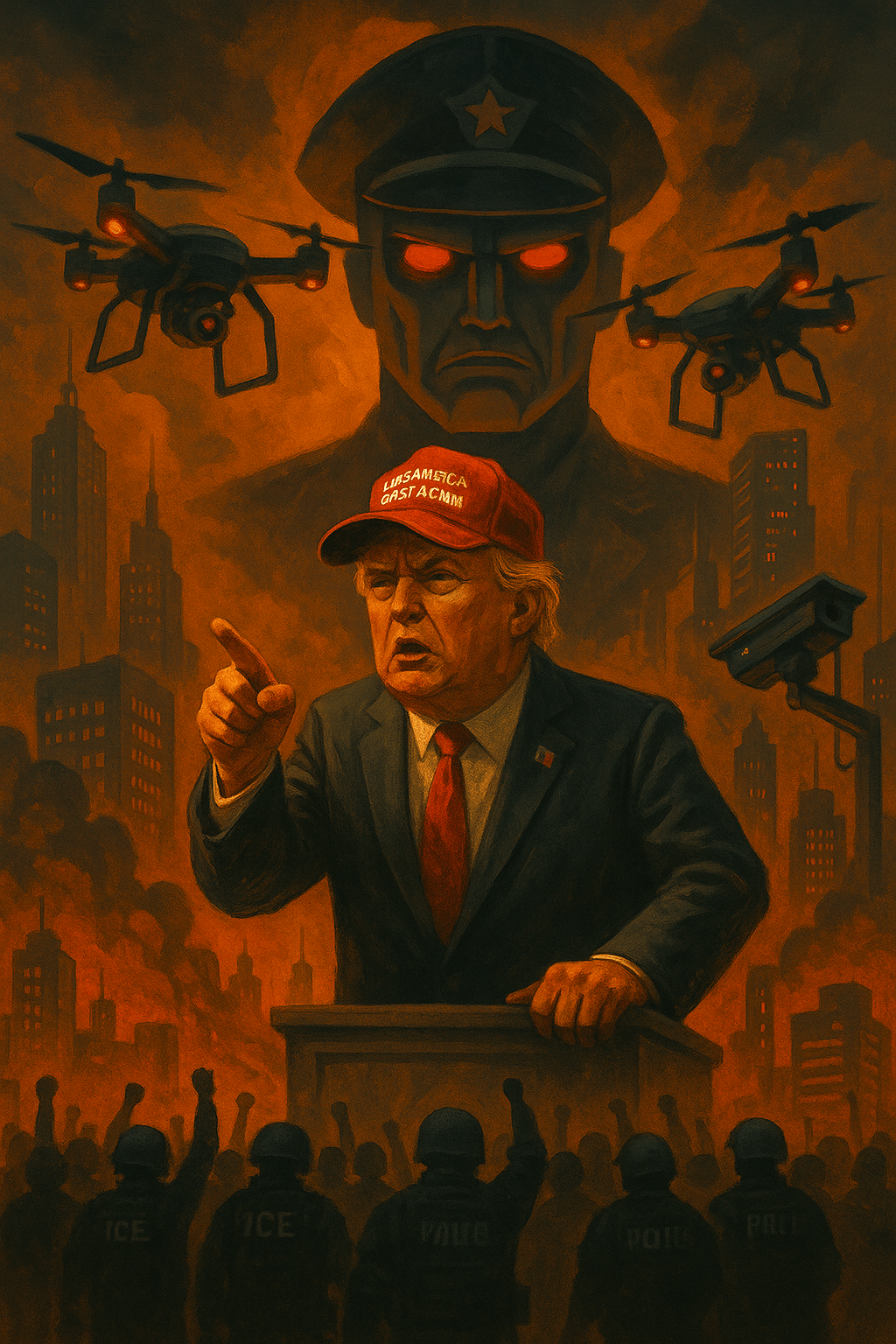
History Repeats—First as Tragedy, Second as Algorithmic Farce
By Prince Kapone | Weaponized Information | October 1, 2025
The Mask Slips: Democracy’s Reserve Clause
Democracy or Bonapartism is not a book about definitions; it’s a pry bar. Domenico Losurdo takes the shiny word “democracy,” wedges it under the lid of liberal mythology, and pops the hinges clean off. His claim is disarmingly simple and historically ruthless: when capitalism hits crisis, parliamentary ritual reaches for an emergency form—Bonapartism. Not an exception. Not a bad dream. A built-in reserve clause that preserves the rule of capital when ordinary management falters.
Losurdo works like a field medic on the battlefield of history, not a philosopher admiring clouds. He drags the term “democracy” out of textbooks and into the mud—elections held beside plantations, constitutions drafted behind colonial fortifications, rights proclaimed while shackles clink in the next room. The point is not to score hypocrisy points. It’s to name structure. “Liberty” in a slave society is the owner’s liberty; “order” in a settler colony is the ongoing dispossession of the colonized. When the oppressed force a breach—strikes, mutinies, uprisings—the ruling class doesn’t debate; it consolidates. A single figure steps forward claiming to embody “the people,” while the state quietly normalizes emergency as routine. That is the Bonapartist maneuver.
Seen through that lens, the nineteenth century stops looking like a museum of great men and starts looking like a manual of crisis management. Louis-Napoléon’s plebiscites functioned as mass consent rituals that suspended class antagonism while declaring it fulfilled. Bismarck mastered the two-hand technique: reforms as sedatives, repression as backbone—the Anti-Socialist Laws paired with social insurance, the velvet glove and the iron truncheon operating from the same wrist. In each case, the goal wasn’t to perfect democracy but to pacify insurgency and stabilize accumulation. Call it what it is: counterinsurgency in domestic dress.
Losurdo’s method matters as much as his thesis. He refuses nostalgia and moral fog. He reads “democracy” through the colonial laboratory that fed the metropole—from Algeria to India to the Caribbean—where pass systems, collective punishment, and states of siege were refined before being imported back home as “public order.” The colony is not democracy’s shadow; it is its workshop. Once you see that, the headline reverses: democracy did not occasionally fall from grace; it was born with a standing doctrine of exception. The mask and the truncheon were manufactured on the same line.
What does this arm us to see in our present? Not a fairy tale of decline from a golden age, but a continuity that mutates its tools. The names change, the hardware updates, the logic persists: when class struggle and colonial contradiction sharpen, the ruling bloc fuses around a leader, routinizes emergency, and sells pacification as national salvation. We do not need another sermon about “defending democracy.” We need a clear view of the machine and the courage to jam it. Losurdo hands us both: a history that refuses amnesia and a concept—Bonapartism—that strips the varnish from bourgeois rule. From here, we can track how the old script kept its plot while learning new lines. The mask has slipped; let’s study the face.
History as a Weapon Against Myth
Losurdo’s strength is that he does not let “democracy” float in the air like a holy word. He drags it through the archives, where the smell of blood and gunpowder cannot be ignored. In his hands, history becomes a weapon against liberal amnesia. He reminds us that the French Revolution thundered about the “rights of man” while tightening the chains on Saint-Domingue, where enslaved Africans were already preparing the revolt that would topple France’s empire. He shows how Jefferson drafted paeans to liberty while keeping meticulous records of births, sales, and deaths in his human inventory. He pulls Tocqueville from the pedestal of “democratic philosopher” and puts him back in Algeria, where he defended scorched-earth tactics as necessary to civilize the colony. These are not moral lapses in an otherwise noble tradition; they are the grammar of bourgeois democracy itself: freedom for the few, domination for the many.
This is why Losurdo insists that the state of siege is not a temporary deviation from democratic norms but a built-in function of capitalist rule. Emergency decrees, military tribunals, and pass systems were pioneered in the colonies and then recycled at home. What was tested in the dust of Algeria reappeared in the streets of Paris; what was honed in India became law in London. The colonial world was never outside democracy—it was its crucible. To speak honestly of democracy is to admit it has always carried dictatorship in its bloodstream. Liberalism sells the story of steady progress, but Losurdo forces us to see a cycle instead: emancipation provokes repression, revolt is followed by counterrevolution, rights gained are clawed back until the oppressed fight again.
And here the mirror turns toward us. What the state of siege was to Algeria, Guantánamo and Gaza are to our present. What the pass laws were to South Africa, ICE checkpoints and biometric borders are to the United States. The so-called “homeland” is governed with technologies first tested against the colonized abroad, just as it always has been. Losurdo’s archive is a warning label: there is no clean separation between democracy at home and dictatorship overseas. The two feed each other, justify each other, and mutate together. The empire’s laboratory never closes; its experiments come home in uniform, in law, in code. To believe otherwise is not naiveté—it is collaboration with the ruling class’s ideology. Against that collaboration, Losurdo arms us with a sharper truth: democracy and dictatorship are not rivals but siblings, bound together in the very history of capital. And once you see the blood on the mask, you cannot unsee it.
The Colonial Skeleton of Democracy
Losurdo pushes us to confront what polite historians call “contradictions” but what the oppressed have always known as truth: democracy was never meant for all. Its very foundations were laid on slavery, settler conquest, and racial dictatorship. The parchment rights drafted in Philadelphia were signed with one hand while the other inked treaties of extermination against Indigenous nations. The French Declaration of the Rights of Man rang out in Paris while Haiti was shackled and bled for French profit. For Losurdo, this is not hypocrisy to be corrected but the essence of bourgeois democracy itself—universal only for the settler, the property-holder, the colonizer. Democracy was born with a skeleton already inside it: the bones of the enslaved and the colonized, holding up the body politic that proclaimed itself free.
This skeleton did not disappear with abolition or independence struggles; it mutated. The pass systems tested in the colonies reemerged as Jim Crow laws. The plantation ledger that tracked enslaved bodies became the prison registry and, later, the digital database. The frontier war against Native peoples became the permanent militarization of the border, with drones in the sky and agents in armored trucks. As Du Bois reminded us, Reconstruction’s fleeting experiment in multiracial democracy was drowned in blood because it threatened to expose this skeleton for what it was. The suppression of Black self-determination in the United States was not a deviation from democracy but its precondition. Settler democracy required the dictatorship of race to survive.
And it still does. ICE patrols are the overseer’s whip updated; biometric scans at airports are the new pass laws; predictive policing is the same colonial logic wired into code. What liberals mourn as “democratic backsliding” under Trump is nothing new—it is settler democracy stripped of its cosmetics. The skeleton is no longer hiding; it’s wired into the cloud, humming in Palantir’s servers, encoded in facial recognition algorithms, tracked across borders by satellites. Losurdo helps us to see that the colonial contradiction is not an external stain on democracy but its marrow. To imagine a U.S. “restored” as a multiracial democracy is to misunderstand the beast entirely. What we face today—Trump’s Bonapartism digitized into technofascism—is not the breaking of democracy’s promise, but the perfection of its colonial truth.
Bonapartism as Counterinsurgency
Losurdo refuses the fairy tale of the strongman as accident or aberration. Bonapartism, in his telling, is not the collapse of democracy but its reserve formation—the spare weapon kept polished in the arsenal of the ruling class. When parliaments wobble and the streets grow restless, when workers build barricades or the colonized rise in revolt, capital calls forth its savior. He arrives crowned not by divine right but by plebiscite, promising to embody “the people” while in fact breaking their spine. This is counterinsurgency in a political mask, not unlike the baton dressed up as public order.
Bismarck is Losurdo’s most cutting example: the “revolution from above” that delivered crumbs of social insurance with one hand while unleashing the Anti-Socialist Laws with the other. These were not benevolent reforms but sedatives, carefully measured doses to dull the pain of exploitation while neutralizing organization. Bonapartism integrates reform as weapon; every concession becomes a leash, every right a chain that keeps the oppressed tethered to the state. The bourgeoisie learns to pacify without surrendering command, to concede without ever losing power. That is the genius of counterinsurgency: it lets the oppressed breathe just enough to keep them from breaking free.
The architecture is always the same: normalize emergency, routinize exception, build the permanent state of siege. Napoleon III ruled by referendum, Mussolini by decree, Hitler by suspension of law. Each case is a variation on the same theme: crisis managed through authoritarian unity, dissent dissolved into the spectacle of popular consent. The language changes, the costumes vary, but the script is constant. Bonapartism does not abolish class antagonism; it smothers it under a blanket of plebiscitary acclamation and nationalist fervor. It is order purchased at the price of truth, a dictatorship wearing the mask of democracy’s savior.
This rhythm has never stopped. The tools migrate from sabers to statutes, from emergency decrees to data feeds, but the logic persists. What was martial law in the colony becomes standard governance in the metropole. What was once a provisional measure hardens into routine. Losurdo teaches us to see this not as betrayal but as blueprint. And when we glance at our present—at terror lists, indefinite detention, predictive policing—we recognize the pattern: Bonapartism automated, counterinsurgency coded into the operating system of the state. The question is no longer whether the strongman will return; it is how his return will be managed, mediated, and digitized for the age of monopoly capital.
Monopoly Capital and the Mutation to Technofascism
Losurdo’s genealogy of Bonapartism gives us the framework; the task now is to track its mutation under monopoly capital. In the nineteenth century, Bonapartism was ballots and bayonets. In the twentieth, it fused with mass parties, fascist rallies, and imperial wars. Today, under Trump 2.0, it has slipped into a new skin: technofascism. The logic hasn’t changed—crisis governance, counterinsurgency, spectacle—but the instruments are different. Where Napoleon III staged plebiscites with paper ballots, today loyalty is measured in real time through likes, shares, and algorithmic feeds. Where Bismarck pacified with pensions and crushed with police, today the same dialectic runs on servers: Amazon hosting CIA data, Palantir flagging protestors, predictive policing criminalizing entire neighborhoods before they act. The state of siege has been automated; the plebiscite has been digitized.
This fusion did not appear out of thin air. It was the product of monopoly-finance capital’s long march into the digital frontier. The railroads of the nineteenth century became the fiber-optic cables of the twenty-first; the war industries that built tanks became the platforms that build drones. Big Tech is not a rogue sector but the newest branch of the same tree: monopoly power, cultivated by the state, married to finance, weaponized through empire. Losurdo’s categories let us see this clearly. Bonapartism always adapts to the material base of accumulation. Today that base is the cloud, the algorithm, the predictive model. Crisis management has been recoded into software.
Trump sits atop this mutation not as a genius but as a salesman. He poses as an enemy of the elites while binding Wall Street financiers, Silicon Valley moguls, and oil barons into a single ruling bloc. He howls about censorship while leaning on the very data infrastructure that makes repression frictionless. He markets sovereignty while digitizing surveillance and militarizing borders. His rallies are plebiscites in flesh, but his real acclamation happens on the feed, where algorithms manufacture consent faster than ballots can be counted. Trump is not the death of democracy; he is its continuity under monopoly capital, its Bonapartist mask rewritten in silicon code.
This is what we name technofascism: the dictatorship of capital in crisis, armored with digital skin. It is Bonapartism reborn in the age of platform monopolies and predictive policing, a regime where repression is constant, invisible, and normalized as efficiency. The danger is not simply authoritarianism with a populist face—it is a totalizing system that fuses finance, fossil capital, and tech into a seamless machine of extraction and control. Losurdo equips us to recognize the pattern; our task is to see its mutation. The plebiscite has become the push notification, the decree has become the algorithmic flag, the overseer’s whip has become the biometric scan. This is the new mask of democracy, and it is tightening around our throats.
The Dialectic of Emancipation
Losurdo does not let us linger on the strongman alone. To understand democracy, he insists, you must look not only at the rulers but at the ruled—the insurgent masses who have always forced the issue. There is no linear progress of democracy handed down by enlightened elites. Every advance—abolition, suffrage, decolonization—was pried loose by the hands of the oppressed. Haiti’s revolutionaries shattered the lie that liberty and slavery could coexist. Enslaved Africans in the U.S. South liberated themselves by running, rebelling, joining the Union armies. Workers from Paris to Petrograd won suffrage and organization only through barricades and strikes. Colonized peoples from Vietnam to Angola forged freedom through guerrilla war. Democracy, for Losurdo, is not the gift of the bourgeoisie—it is the battlefield where the oppressed make history by seizing space denied to them.
But here comes the dialectic that haunts every victory: emancipation is always met with counterinsurgency. The abolition of slavery was followed by the lynch rope and Jim Crow. Reconstruction was drowned by the Klan and the Compromise of 1877. Decolonization was checked by coups, blockades, and IMF structural adjustment. Each step forward was shadowed by a ruling-class backlash that sought to claw back what had been won. Losurdo forces us to see democracy not as a steady incline but as a rhythm of rupture and rollback, advance and counterrevolution. The oppressed press forward, the ruling class summons its Bonaparte, and the struggle begins again. The cycle is merciless, but it is also the heartbeat of history.
This rhythm matters now more than ever. What passes today for “democracy promotion”—NGOs, soft-power liberalism, electoral reforms—is the velvet glove of counterinsurgency. Diversity slogans and token reforms serve the same purpose as Bismarck’s insurance laws: containment, not liberation. They pacify revolt, channel energy back into safe institutions, and keep the structure of exploitation intact. Meanwhile, the real engine of democracy today beats in the uprisings of those who refuse to be pacified: Palestinians resisting siege, Cubans defying blockade, migrants walking north in caravans, Black communities rising against police terror. These struggles are not side stories—they are the front lines of democracy in our time.
Under Trump 2.0, the stakes of this dialectic sharpen to a razor’s edge. The choice is not between democracy and its erosion, as liberals moan, but between two incompatible paths: the consolidation of technofascism, or the insurgent recomposition of democracy from below. Either algorithms, drones, and austerity tighten into a permanent digital dictatorship, or the oppressed seize democracy as their weapon and redefine it on their own terms—socialist, anti-colonial, multipolar. Losurdo does not spell this future out for us. But by showing us the pattern—emancipation followed by counterinsurgency, revolt answered by repression—he makes the stakes plain. There is no neutral ground. The dialectic insists: freedom is seized or it is lost, and each seizure only sets the stage for the next battle. The question is not whether democracy will be defended, but who will wield it and for what world.
The Bankruptcy of Western Marxism and the White Left
Losurdo is merciless in his verdict: the betrayal does not come only from liberals but from the so-called Marxists of the imperial core. Too many of them, he shows, abandoned the colonial contradiction and sanitized democracy into a polite abstraction. From the Frankfurt School to today’s NGO-socialists, they wring their hands about “authoritarian populism” while leaving the skeleton of empire intact. They treat Trump as a monster who broke into the house of democracy, instead of admitting that the house itself was built on genocide and slavery. This is not an intellectual mistake. It is ideological counterinsurgency—an alibi for imperialism, written in the language of radical critique.
In the U.S., this betrayal is grotesque. The white left mourns “democratic backsliding” while ICE expands its gulag. They canvas for Biden while Black proletarian neighborhoods are stalked by militarized police. They publish think pieces about “saving democracy” while Gaza is starved and Yemen is bombed with U.S. weapons. Their Marxism stops at the water’s edge, and at the color line. What Losurdo helps us see is that this is not new. Western Marxism has long made peace with colonial plunder, preferring to theorize alienation in the seminar room rather than revolution in the streets. In its worst forms it becomes the left-wing auxiliary of liberalism: defending institutions that were never designed for the oppressed, and dismissing the colonized when they refuse to wait for history’s permission slip.
This is not just hypocrisy—it is structural. A Marxism that severs itself from the colonial contradiction will always end up siding with the settler state when crisis comes. That is why today’s white left so often sounds indistinguishable from liberal pundits: condemning Trump as a threat to democracy, but never condemning the democracy that gave birth to Trump. They defend the mask while ignoring the bones beneath. They cling to “universal values” that were never universal, and in doing so, they make themselves useful to power. They become the chorus for counterinsurgency, the ideological police who scold the oppressed for demanding too much, too soon, too militantly.
For revolutionaries, the lesson is blunt. We cannot outsource Marxism to the seminar room or the NGO. We cannot look to the white left for salvation, because its material function is to domesticate revolt. The real bearers of Marxism are the colonized and the insurgent proletariat, those who have bled to win every inch of freedom history has known. To reclaim Marxism is to wrench it out of the hands of its Western custodians and return it to the struggles that forged it in the first place. Losurdo gives us the clarity to see through the fog. The bankruptcy of Western Marxism is not a tragedy to be mourned—it is a mask torn away. What matters is the living Marxism of Haiti, of Reconstruction, of Bandung, of the Panthers. That is the tradition that arms us for the fight ahead, and that is the only Marxism worth the name.
Democracy or Technofascism
Losurdo framed the nineteenth-century dilemma as democracy or Bonapartism. In our conjuncture the terms have mutated, but the contradiction remains: democracy or technofascism. And by democracy, we cannot mean the ballot rituals of the settler republic or the parliamentary stagecraft of capital. We mean democracy as the power of the oppressed to govern their own lives, to dismantle exploitation and empire, to build socialism and sovereignty. Everything else—every congressional hearing, every “get out the vote” drive, every liberal panic about backsliding—is theater for keeping the people out of power while capital keeps its boot on the throat of the world.
Technofascism is not the end of democracy. It is its latest mask. The reserve clause Losurdo traced through Napoleon III and Bismarck, Mussolini and Hitler, has been automated, digitized, and globalized. The plebiscite that once required ballots now runs on cloud servers and data feeds. Consent is measured not once every four years but by every click and swipe. The state of siege that once meant martial law is now permanent: drones at the border, biometric databases, predictive policing, national emergencies coded into law and never lifted. The Bonapartist figure who claims to embody the people is no longer just the tribune on the balcony; he is the avatar on your screen, amplified by algorithms that sell acclamation as participation. Trump is not the death of democracy—he is its perfection under monopoly capital, the Bonaparte of Silicon Valley and Wall Street combined.
The ruling bloc is clear. Finance capital enforces austerity; Big Tech harvests data and polices attention; fossil capital fuels empire and ecological collapse; the Pentagon welds them together into a global war machine. Trump is not their enemy but their salesman, the mask they wear to keep workers pacified while the plunder continues. His “forgotten American” is just Napoleon III’s “universal suffrage” with a red cap and a Twitter feed—manufactured acclamation hiding the dictatorship of capital. To call this a threat to democracy is a cruel joke. It is democracy as it has always been practiced in the settler empire: freedom for the rulers, repression for the colonized, pacification for workers.
So the choice is not restoration. There is nothing to restore. The parchment mask of Jefferson, the ballot mask of Lincoln, the plebiscite mask of Napoleon III—they have all been replaced by the biometric mask of the digital empire. Either the oppressed seize democracy as their weapon, building power that is socialist, anti-colonial, and multipolar, or technofascism will consolidate into a permanent regime of surveillance and austerity. There is no neutral ground, no safe middle. The farce Marx warned of has returned, but now it wears silicon armor and speaks in code. The lesson Losurdo forces on us is merciless: Bonapartism repeats itself, but each repetition escalates. Either we break the cycle, or it will break us.
Weaponizing Losurdo
Losurdo does not leave us with comfortable conclusions. He strips away illusions until the ground beneath us is bare. Democracy, as practiced under capitalism, has always been a class dictatorship. Bonapartism, far from being democracy’s failure, is its continuity under crisis. To read Losurdo today is to see Trump 2.0 not as an accident, not as a “threat” to a healthy system, but as the most recent mask worn by that same dictatorship—digitized, militarized, automated. The parchment of constitutions, the ballot of plebiscites, the truncheon of emergency decrees: all have been updated into satellites, biometric scans, predictive algorithms, drones. The continuity is undeniable. The mutation is deadly.
But Losurdo also gives us something more than diagnosis—he gives us method. He shows us how to read history against myth, how to see the skeletons that polite ideology hides, how to connect the colony to the metropole, the emergency decree to the “ordinary” law, the reform to the repression that shadows it. To weaponize Losurdo is to wield history like a machete, hacking through the fairy tales of liberalism and Western Marxism alike. It is to refuse the empty call to “defend democracy” and to instead ask: democracy for whom, against whom, on whose graves? It is to shift the subject of democracy from the ballot box to the insurgent—from Haiti to Reconstruction, from Bandung to Black Power, from Palestine to Ferguson.
This is the lesson we must take into our conjuncture. Trump 2.0 signals that U.S. capitalism has entered its Bonapartist-technofascist phase, where counterinsurgency is not just foreign policy but the daily grammar of domestic life. Drones do not just stalk Yemen; they hover over the border. Data mining does not just target “terrorists”; it monitors workers and protestors. The prison is not just punishment; it is political strategy. Democracy here is not slipping—it is consolidating as a permanent siege against the oppressed. Either we see this, or we are lost in the fog of liberal nostalgia.
And so the choice Losurdo sharpened—democracy or Bonapartism—returns to us as democracy or technofascism. Not the hollow democracy of settler institutions, but the living democracy of the oppressed: socialism, anti-colonialism, multipolar sovereignty. To build it we must break with the illusions of the white left, the NGO-industrial complex, the sentimental socialists who defend the mask. We must return democracy to its true authors: the colonized, the worker, the insurgent. Truth, as Malcolm X said, is always on the side of the oppressed. Losurdo gives us the scalpel to cut away the mask. Our task is to strike with it, to name what stands beneath, and to organize the new power that can finally bury it.
Against technofascism. Against settler Bonapartism. For the living democracy of the oppressed. That is the only future worth fighting for.
 Weaponized Information
Leave a comment