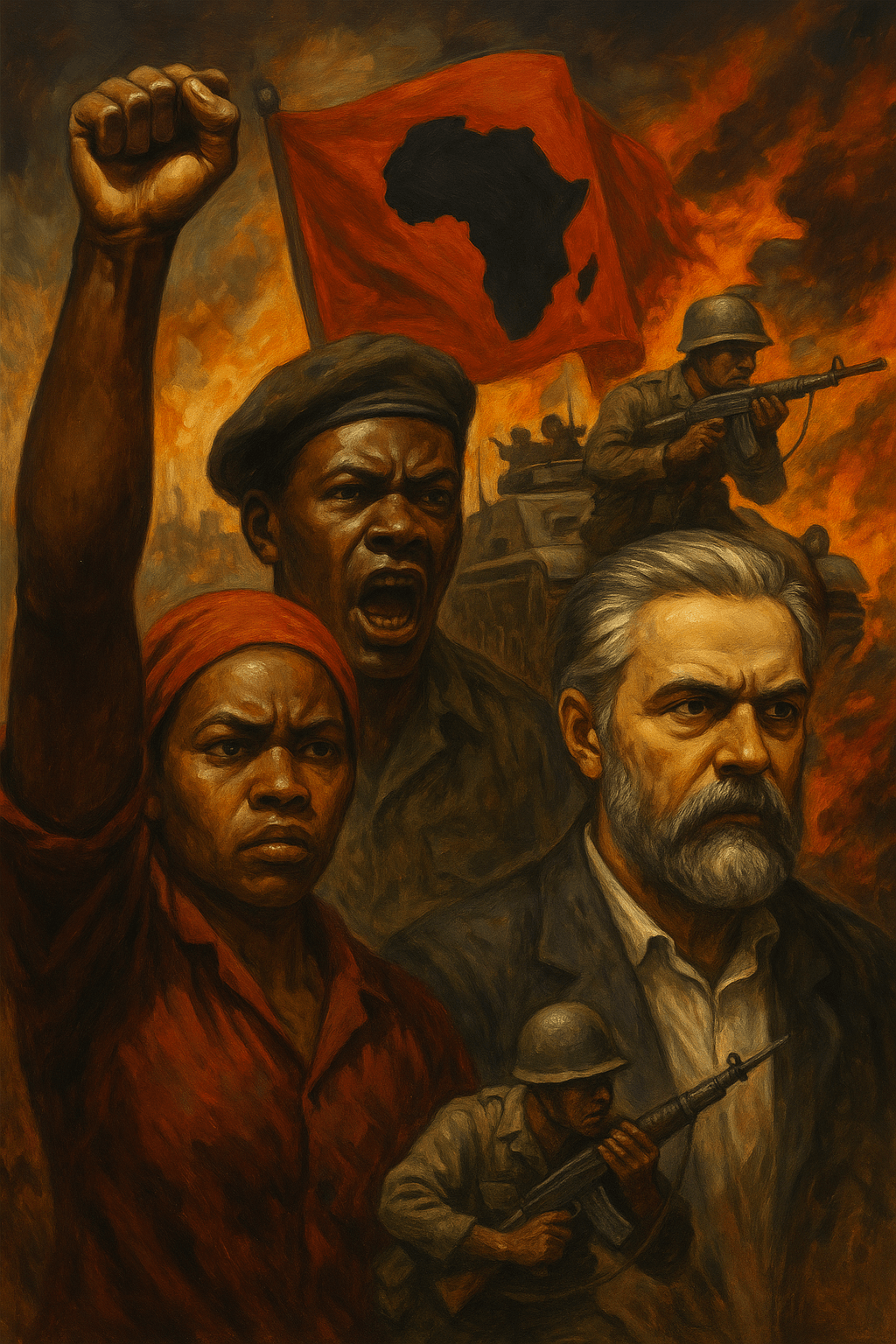
Weaponized Intellects Review of Overturning the Culture of Violence
By Prince Kapone | Weaponized Information | September 21, 2025
Turning the World Right Side Up
Penny Hess’s Overturning the Culture of Violence does not mince words—it announces from the opening lines that neutrality is treason. Hess follows the leadership of Omali Yeshitela and the African People’s Socialist Party, situating the book explicitly as a weapon against the great lie of Western history: that Europe’s wealth and U.S. democracy are products of genius, not genocide. She begins where most Western Marxists refuse to tread—naming the simple, brutal truth that white prosperity rests on African slavery, Indigenous genocide, colonial plunder, and ongoing counterinsurgency against the oppressed majority of humanity.
This is not the voice of the liberal academic, weighing crimes and virtues on the scales of “objectivity.” Nor is it the impotent posturing of Western Marxism, which treats colonialism as a backdrop rather than the motor of capitalism itself. Hess makes it plain: the history of Europe and the U.S. is written in blood, and white people—even those who call themselves “radical”—have reaped the dividends. Where Western Marxism chokes on the colonial question, Hess—under the discipline of African Internationalism—puts it at the center, showing how the culture of violence was not a deviation but the very structure of the modern world.
The book’s introduction hammers this point: the “tree-lined streets” and “vacations” of white life are dialectically tied to the “poverty, misery and political terror” imposed on colonized peoples. That is the material foundation of America’s vaunted democracy. It is also why Western Marxists, from the Frankfurt School to today’s tenured radicals, cannot speak honestly about empire—they too are its beneficiaries. Hess turns the gaze back on her own community, demanding reparations as the concrete measure of solidarity, not rhetoric or moral anguish.
In the framework of Weaponized Intellects, this book is more than testimony—it is a call to arms for white defectors to abandon the parasitic relationship with empire and join the struggle to destroy it. Where Western Marxism offers critique without consequence, Hess offers betrayal of the settler order. This is what makes Overturning the Culture of Violence such a dangerous and necessary text: it not only unmasks the lie of white innocence, it prescribes the cure—reparations and solidarity under the leadership of the colonized. That is how we begin, as Yeshitela says, to turn the world right side up.
The Parasitic Core of Capitalism
In the first substantive section of Overturning the Culture of Violence, Penny Hess takes the scalpel to capitalism itself—not as the textbooks in Boston or Berlin describe it, but as it has always actually functioned: a parasitic system born from conquest. She does not begin with industrial machinery, clever bourgeois invention, or the sanctified myths of “free markets.” She begins with chains, whips, and stolen land. Under Yeshitela’s theoretical guidance, Hess makes the colonial contradiction the pivot of history: Europe’s rise is Africa’s rape, America’s “freedom” is Indigenous genocide, and the wealth of the white world is nothing more than fossilized violence pressed into coin and concrete.
Here Hess strikes directly at the heart of Western Marxism’s evasion. For decades, the Eurocentric left has told its story of capitalism as if it were the natural outgrowth of Europe’s “internal contradictions.” They speak of class struggle in the mills of Manchester while silencing the blood running through the cane fields of the Caribbean. They dissect surplus value while ignoring the surplus humanity packed into ships and sold as cattle. Hess reminds us that this erasure is not an oversight—it is ideology. By severing capitalism from colonialism, Western Marxism reproduces the very lies of the ruling class it claims to oppose. It turns Marx into a European moral philosopher, not a revolutionary weapon wielded by the colonized.
The “parasitic core” thesis, as Hess develops it, is not simply a moral condemnation; it is a scientific law of motion. There can be no white affluence without Black poverty, no European democracy without African enslavement, no settler suburb without a Native graveyard underneath it. Every police bullet, every prison cell, every IMF loan is a continuation of the same system. This is why Hess refuses to speak of “violence” as an aberration—it is the culture itself, the oxygen of empire. To overturn that culture is not to beg for kinder rulers; it is to strike at the roots of the parasite and sever white wealth from colonial blood.
In this light, Western Marxism’s cult of “nonviolence” and endless critique without power appear not merely timid but counterrevolutionary. They offer a Europe-centered story of capitalism’s birth and a Europe-centered program for its reform, all while colonized nations fight for their lives. Hess, by contrast, plants her flag on the side of the oppressed: reparations as the measure of solidarity, African Internationalism as the method, and the recognition that socialism cannot be born from the womb of settler privilege. It must be midwifed by the struggles of those the West has tried to bury. This is the starting point for any real communist politics today, and it is precisely where Western Marxism chokes and retreats.
Black Power and the White Man’s Game
When Hess reaches the era of Black Power, she pulls no punches: the 1960s were not simply a season of protest, they were a declaration of war from the colonized against the settler state. The rebellions in Watts, Detroit, Newark—these were not “riots” or spontaneous breakdowns, but political uprisings against an occupying army. Out of this fire emerged the Black Panther Party, the League of Revolutionary Black Workers, and a host of other revolutionary nationalist forces that exposed the U.S. not as a “democracy with flaws,” but as a colonial dictatorship on stolen land.
Hess makes it clear that in this moment, the fault line of world revolution ran directly through the African colony inside the U.S. This is precisely why the state unleashed COINTELPRO, assassinations, mass imprisonment, and every manner of counterinsurgency it could devise. And it is here that Western Marxism reveals itself as not just inadequate, but treacherous. Rather than stand shoulder to shoulder with Black Power, most of the white left treated it as an appendage to their own projects, a “radical color” to paint their economism. Others dismissed it outright as “petty bourgeois nationalism.” The result was predictable: white radicals won tenure, while Black radicals were buried in unmarked graves or locked away for life.
Hess refuses to let white readers off the hook. She demonstrates how every layer of white society—liberal, conservative, even “revolutionary”—benefited materially from the crushing of Black Power. White workers took the union gains secured through the exclusion of Black labor. White students got their affirmative action while Panthers got FBI bullets. Even the cultural revolution of the 60s, from rock music to fashion, commodified and profited from the very communities under siege. This is what it means to live inside a culture of violence: even rebellion becomes a business opportunity for the settler class.
The lesson Hess drives home is one Western Marxists still cannot swallow: there is no proletarian unity on the basis of abstract class struggle when one class lives as a parasite on the backs of another. “Solidarity” without reparations is theft dressed up in red slogans. To play the white man’s game—parliamentary creampuffs, campus debates, moralistic street theater—while the colonized are fighting for their very survival is to serve the counterinsurgency. The Panthers understood this; so too did the League, Garveyites before them, and every insurgent formation that named the colonial question as the motor of U.S. capitalism. That is why they were targeted for destruction. Hess’s account reminds us: Black Power was not defeated by its own limits, but by the full weight of empire and the complicity of the white left.
Counterinsurgency: War Without Terms
Hess does not let us imagine that the repression of Black Power was a temporary overreaction, some Cold War fever dream. She insists that it was, and remains, the operating system of the United States: counterinsurgency as permanent governance. From COINTELPRO to militarized policing, from CIA coups abroad to FBI frame-ups at home, the same doctrine guides every move: deny the colonized the capacity to breathe, to organize, to fight back. She calls it what it is—war without terms, a campaign waged against African, Indigenous, and oppressed peoples as a matter of state policy.
Here the mask of “democracy” fully slips. What kind of democracy builds prisons faster than schools, floods communities with drugs and guns, and then declares war on the very crises it manufactured? What kind of democracy executes Fred Hampton in his bed while preaching liberty abroad? For Hess, the answer is simple: not democracy at all, but colonial dictatorship dressed in red, white, and blue. And this is where the Western Marxist romance with civil liberties and procedural reforms shows itself as farce. They imagine rights as neutral ground, available to all who demand them. But in the colony, rights are suspended at will, and the law is just another weapon in the counterinsurgency arsenal.
Hess threads the domestic and the international seamlessly. The same state that burned Black Panther offices to the ground was napalming villages in Vietnam. The same generals who perfected population control in the Mekong Delta advised police chiefs in Detroit. The same corporations that profiteered from prisons at home fattened themselves on coups in Chile, Angola, and the Congo. This is the global culture of violence, where empire’s frontier runs through every ghetto, barrio, and reservation. The war is continuous, only the terrain shifts.
For the white left, this section is an indictment. How many radicals denounced Vietnam but stayed silent about COINTELPRO? How many still fetishize tactics and slogans while ignoring the prisons that hold political prisoners decades after the 60s? Hess refuses to let “progressives” off the hook. To look away is complicity. To wring hands about “excesses on both sides” is to echo the FBI’s script. Counterinsurgency does not negotiate; it destroys. The only possible response is organization under the leadership of the colonized, the building of institutions strong enough to survive the siege.
This is where Hess’s analysis cuts deepest: the war without terms is not an exception but the baseline. Empire cannot coexist with African freedom, so it treats every act of survival as insurgency and every insurgent as a target. Western Marxism calls this paranoia; Hess calls it policy. And she is right. Until we confront the reality that the U.S. is not malfunctioning but operating exactly as designed, we will continue to mistake the colonizer’s counterinsurgency for democracy. To overturn the culture of violence, we must first admit we are living inside a war.
Genocide as Modern Policy
Hess refuses to leave genocide in the past tense. For her, it is not simply the crime of Columbus, or the atrocity of slavery, but the ongoing strategy of empire. She traces the through-line from the forced marches of Indigenous nations to the mass incarceration of Black people today, from the auction block to the prison-industrial complex, from lynch mobs to police chokeholds. This is not historical coincidence—it is the logic of a system that requires the continual destruction of colonized life to maintain white prosperity. Genocide is not an episode but a policy, written into the DNA of the United States.
In this frame, every war abroad and every policy at home converges. Vietnam, Iraq, and Libya are not “mistakes” or “overreach.” They are extensions of the same genocidal culture that treats African neighborhoods as occupied zones and Indigenous land as expendable territory. The denial of healthcare, the stripping of resources, the environmental poisoning of Black and brown communities—these are not policy failures. They are deliberate acts of slow-motion genocide, designed to cull populations deemed surplus to profit. Hess calls this what liberal politicians and Western Marxists dare not: a strategy of death for the colonized and a strategy of life for the settlers.
Western Marxism recoils from such clarity. It prefers the safe terrain of economic abstraction, where exploitation can be modeled without ever naming the bodies that are disappeared, the children who never grow old, the nations that vanish from maps. By treating genocide as an unfortunate excess rather than the structure itself, Western Marxism launders empire’s crimes into mere “contradictions.” Hess, by contrast, wields the term as a weapon. She insists that genocide is the operating system of capitalism-in-decline, the permanent state of emergency that keeps colonized peoples under siege. To deny this is not just cowardice—it is collaboration.
For organizers, this section of the book is crucial. It gives us the language to connect the dots between prisons, police killings, wars, and economic sanctions. It shows how the genocide of African people inside the U.S. is bound to the genocide of Palestinians, Congolese, Haitians, Iraqis. It arms us to expose liberal hand-wringing and Western Marxist hedging as what they are: evasions in service of empire. Hess leaves us no room to dodge. To stand with life is to call the system by its true name. And that name is genocide.
St. Petersburg as a Battlefield
Hess brings the analysis down from the global to the local, showing that the colonial contradiction is not abstract—it is lived on the streets of St. Petersburg, Florida. In the 1990s, the African community there rose up after yet another police murder, turning a small city into a frontline of resistance. For the Uhuru Movement, this was not simply a “local disturbance,” as the media framed it, but a clear expression of the war without terms waged against African people. Hess details how the rebellion exposed the hypocrisy of white liberal governance, revealing that even in a supposedly “progressive” city, the state would rather unleash tanks than concede Black political power.
This focus on St. Petersburg is not provincial—it is strategic. By highlighting a specific city, Hess makes the colonial contradiction concrete and undeniable. Here were African families living in poverty beside white neighborhoods flush with development money. Here were police armed like soldiers patrolling Black streets while downtown boomed with white capital. Here was a city whose future was literally bought with Black dispossession. The rebellion of 1996 shattered the myth that such contradictions could be managed with reforms. It proved that colonial oppression generates colonial resistance, even in the heart of small-town America.
Hess also points to the organizational response: the building of African-led institutions of power in St. Petersburg, with the Uhuru Movement at the center. Rather than appealing for inclusion in the very system that brutalized them, the Movement sought to construct dual power—to carve out space for African self-determination in the teeth of white opposition. For white readers, the lesson is unavoidable: the only meaningful solidarity is to get behind these struggles materially, with resources and reparations, not sympathy or slogans. Western Marxists, with their fetish for the national stage and theoretical abstraction, ignored such local battles. Hess insists they are where the war is fought and where solidarity must be proven.
St. Petersburg becomes, in this telling, a microcosm of the entire U.S. order. The lines of class, nation, and race converge in one city block. Every police checkpoint, every zoning law, every act of resistance is part of the same global struggle. Hess uses this case to drive home her central argument: overturning the culture of violence means siding with the African community wherever they rise, because their fight is not just local, it is universal. To ignore St. Petersburg is to side with empire. To engage is to take a side in the world revolution.
Reparations or Nothing
By the time Hess reaches the question of reparations, the argument has been sharpened to a razor’s edge. She is not pleading for sympathy, nor is she proposing symbolic gestures. She declares that reparations are the concrete measure of solidarity, the dividing line between complicity and rupture. White people live on stolen land and stolen labor; until those resources are returned, no talk of justice carries weight. For Hess, reparations are not charity but class struggle in its truest form: the transfer of wealth from the oppressor to the oppressed, under the leadership of the colonized themselves.
Here the Western Marxist tradition is exposed in all its cowardice. European theorists can map the falling rate of profit in exquisite detail, yet when confronted with the question of returning stolen resources, they hide behind abstractions of “redistribution” and “equality.” They debate the finer points of exploitation while ignoring the parasitic foundation that makes their own societies possible. Even when they speak of “solidarity,” it is imagined as joint struggle on the factory floor, not as the painful process of giving up what has been stolen over centuries. Hess calls their bluff: without reparations, solidarity is theft draped in red flags.
The culture of violence, she argues, is maintained precisely because white society has never had to pay the bill for its crimes. Every generation inherits the spoils and the cover stories, from the slave plantation to the New Deal suburb to the gentrified city block. Reparations are not a favor; they are the return of what was taken at gunpoint. To deny them is to endorse genocide. To delay them is to extend the war. There is no reform that can substitute, no policy that can obscure this fact. Until resources move, history repeats.
Hess is blunt about what this means for white people who claim to oppose empire. It is not enough to denounce racism in theory or posture at protests. Real solidarity means organizing to funnel wealth, skills, and infrastructure into the hands of African liberation movements. It means confronting the everyday privileges of white life not with guilt but with action. Reparations are the price of peace, the proof of commitment, the only way to overturn the parasitic relationship at the heart of the system. Anything less is, in her words, playing the white man’s game.
 Weaponized Information
Leave a comment