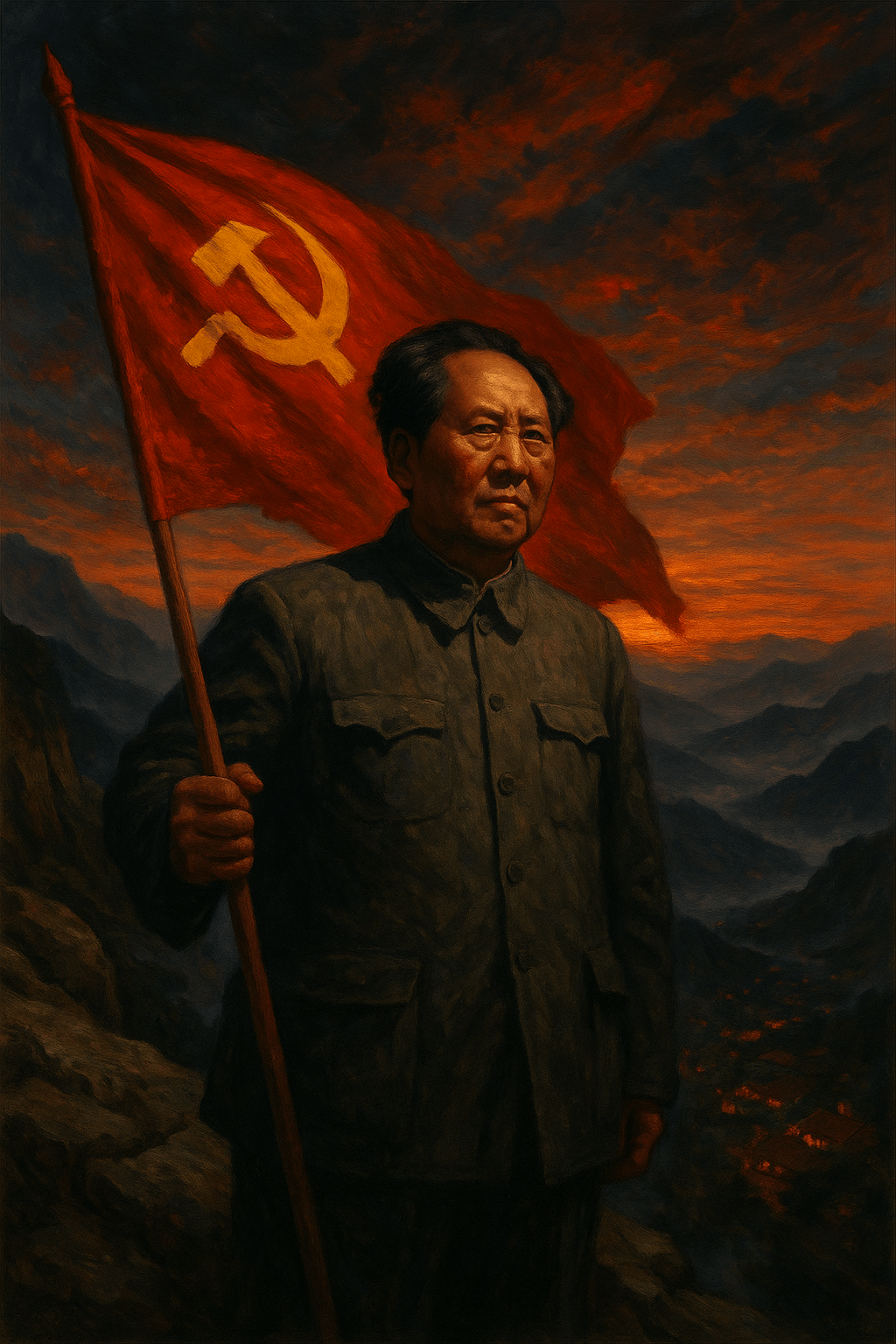
Weaponized Statecraft Series | Mao at Lushan, 1959
In the storm of the Great Leap’s setbacks, Mao did not fold—he listened. At Lushan he turned mistakes into lessons, errors into curriculum, and criticism into a method of survival. He named two illnesses—touchiness and wavering—and prescribed two remedies: endurance and rectification. He defended the communes, corrected the “communist wind,” and shouldered responsibility without surrendering the revolution. His lesson: unity, mass initiative, and red flags everywhere, or collapse.
By Prince Kapone | Weaponized Information | Septbemeber 17, 2025
Lushan at Night — Learning to Hear Bad News
The summer of 1959 found the Party leadership perched on the misty ridges of Lushan. The Great Leap Forward had unleashed mass initiative and equally mass contradictions. Reports piled high, rumors spread of shortages and discontent, and Mao spent twenty days listening in silence. He joked about taking sleeping pills but still lying awake—insomnia not from weakness, but from carrying the weight of a revolution at a turning point. At last, he rose to speak. This was not theatre; it was the old guerrilla method: watch, listen, absorb, and then strike with clarity.
Mao diagnosed two illnesses afflicting the Party. First was touchiness—the habit of comrades who jumped at the slightest criticism, who could not bear to hear a bad word. To them, politics was a mirror, not a battlefield: if it did not flatter, they rejected it. The second illness was wavering—those who proclaimed loyalty to the General Line yet drifted into doubt and pessimism when conditions grew rough. In Mao’s eyes, both were fatal if unchecked. A revolutionary cannot afford thin skin or weak legs.
To treat these diseases, Mao prescribed a method as simple as it was hard: listen first. He broke speech into “three kinds of words”—correct, basically correct, and incorrect. All three, he insisted, must be heard before any judgment. To wall off unpleasant truths is to blind oneself. To demand only praise is to prepare the ground for rightist victory. The order of operations was not flattery first, struggle later—it was listening first, sorting with method, and responding in kind. At Lushan’s opening, Mao made the line clear: toughen your scalp, steady your nerves, and let reality—however bitter—be spoken.
The Right to Bad News — “Toughen Your Scalp and Bear It”
Mao refused to separate criticism from politics. At Lushan he insisted that the combined pressure from outside and inside the Party was not a calamity but a stress test. Rightists mocked the Leap as chaos, wavering comrades whispered the same within Party schools, and Mao welcomed both currents. Let them speak, he said, because only under that pressure could the real situation surface. To silence criticism would be to seal the Party in a vacuum, unable to breathe or fight. A revolutionary party has to take the blows in order to sharpen its edge.
Why endure the bad news? Mao’s answer was confidence. China would not collapse because soap was short or vegetables scarce. The backbone of the revolution was not comfort but practice—decades of guerrilla war, land reform, and peasant alliances that no temporary shortage could erase. Listening to criticism did not mean bowing to it. It meant knowing the difference between a passing difficulty and a mortal wound, between a tactical problem and a strategic defeat. That clarity gave the Party strength to stand upright while enemies shouted collapse.
Mao mapped endurance in time: one month, three months, a year, or even longer. Strain must not be confused with collapse. Revolutions are not smooth roads but protracted wars, full of repetition and reversal. The task of the Party was to cultivate nerves steady enough to bear the pressure, to cool panic without extinguishing vigilance. “Protracted war” was not only a military doctrine; it was a psychological discipline for cadres who needed to learn that history moves in waves, not in straight lines.
To hear wrong ideas without panic was, for Mao, a form of political hygiene. If comrades lacked the ability to sort speech into correct, half-correct, and incorrect, they would lurch from enthusiasm to despair with every rumor. A clean revolutionary method meant listening to all words, holding them up against practice, and discarding what was rotten. This discipline—toughening the scalp and bearing the sting—was not stoicism for its own sake but the price of leadership. Without it, the Party would confuse gossip with reality and hand victory to its enemies.
Mass Enthusiasm vs. “Communist Wind” — How to Cool a Fever Without Killing the Patient
By the summer of 1958, the communes had become magnets of hope. Mao described how hundreds of thousands of cadres and peasants trekked to places like Cha-ya-shan in Henan, Hsu-shui in Hebei, and Ch’i-li-ying, treating them almost as sacred sites. Three hundred thousand in three months at one commune alone—it was pilgrimage politics, proof that the Leap had ignited a hunger for a new social order. Mao refused to dismiss this energy as delusion; he saw it as a resource to be harnessed. When millions stream to see with their own eyes, that is not illusion but living faith in revolution.
Yet Mao drew a sharp distinction between the masses’ initiative and the distortions of petit-bourgeois fanaticism. The former was rooted in poor and lower-middle peasants, proletarians, and semi-proletarians who wanted to build canteens, communes, and large enterprises because they sought a better life. The latter erupted primarily at the commune and hsien cadre level, where overeager leaders blew the “communist wind,” seizing pigs, grain, and cabbages from production teams as if they were ill-gotten spoils. For Mao, it was critical to separate these strata: the masses were moving toward socialism, while a thin layer of cadres acted like bandits cloaked in red.
The cure for this fever was not punishment but correction. Mao insisted that what had been improperly seized must be returned, and the principles of value, equal exchange, and remuneration by work reestablished. To rob peasants of their property, he warned, was no different in spirit from the gangs of Shanghai who took whatever they pleased. Socialism could not be built on theft; it had to be built on conscious organization and persuasion. By restoring balance, the Party saved the body of the revolution while cooling the fever of excess.
The line of rectification was persuasion, not terror. Cadres were to explain patiently why egalitarian “first equalize, second adjust, third withdraw” schemes would not work. Education had to replace coercion, so that hundreds of millions of peasants could learn political economy not from textbooks but from lived correction. Mao argued that even illiterates could understand the laws of value if explained in plain speech. In this way, the rectification turned disaster into a classroom, converting excess into mass education.
The strategic lesson was blunt: never pour cold water on the people’s initiative. Fanaticism could be redirected, but extinguishing zeal would leave only passivity and despair. Mao’s method was to cool the fever without killing the patient—to discipline enthusiasm without humiliating those who dared to try. The commune movement remained a revolutionary treasure, but only if guided by persuasion, rectification, and practical results. Kill the “communist wind,” Mao said, but keep the red flame burning.
The Class Geometry of Initiative — 30 / 40 / 30
Mao cut through the fog with a simple arithmetic of class motion. Thirty percent of the people, he said, were active drivers—poor peasants, lower-middle peasants, proletarians, and semi-proletarians who pushed communes, canteens, and cooperative enterprises with burning energy. Another forty percent followed the stream, ready to move if momentum carried them. The remaining thirty percent resisted—landlords, rich peasants, bureaucrats, and other entrenched elements. The line was clear: socialism advanced not by waiting for unanimity but by rallying the drivers and mobilizing the middle.
The strategy was to win the forty percent through example and persuasion. Their hesitation was not rooted in permanent hostility but in uncertainty. If the activists proved communes could work—feeding more people, saving more labor, raising production—then the broad middle would fall in behind them. Mao knew that the tide of history was decided not only by vanguards but by those in the middle ranks whose weight could swing the balance. The task was not to scold them for caution, but to bring them along step by step until caution turned into confidence.
That left the hard thirty percent who refused to move. For Mao, they were not to be appeased. Isolate them, strip them of influence, and let the momentum of the majority render them irrelevant. In this way, political arithmetic became political geometry: the thirty percent of activists set the direction, the forty percent expanded the base, and the resisting thirty percent were cordoned off. The formula was not abstract mathematics but a strategy for converting enthusiasm into durable organization—channeling the uneven energies of the people into a forward march that no minority obstruction could halt.
Rectification as a People’s University
Mao turned what others would have called failure into pedagogy. The months of March through May became a crash course in political economy, where millions of cadres and hundreds of millions of peasants learned by doing. The so-called “communist wind” of seizures and excesses, once checked and reversed, became a living classroom. The Party showed its strength not only in building communes but in correcting errors swiftly, transforming chaos into curriculum. This was not a retreat from socialism but a sharpening of its edge.
Literacy was no precondition for comprehension. Mao mocked the notion that only university graduates could grasp economics. Illiterate cadres, if walked through the laws of value, exchange, and remuneration, understood the principles as well as any professor—often better, because their test was reality, not theory alone. The poor peasant knew what it meant to work a day and receive nothing in return; he did not need a textbook to recognize exploitation. Education was to be grounded in practice and explanation, not in mystified jargon.
At the same time, Mao insisted that cadres themselves must study political economy. Without a clear grasp of value and exchange, they would inevitably repeat the errors of seizure and misappropriation. It was not enough to denounce mistakes; cadres had to be trained in the science of socialist construction. If they could not read the texts, they had to learn through discussion, through patient teaching, through linking theory to their own daily work. Otherwise, the temptation to treat collective property as a grab-bag would reappear.
The Party’s ability to suppress the “communist wind” within a month was proof of its vitality. It showed that rectification was not humiliation but education. The missteps became lessons, the lessons became collective knowledge, and collective knowledge became stronger organization. In this way, the Great Leap was not just an economic campaign but a people’s university, forging cadres and masses alike into students and teachers of socialism. The revolution was not only about production—it was about cognition, about learning to see and correct errors without losing faith in the larger struggle.
Against Touchiness and Wavering: Two Illnesses, Two Remedies
Mao opened his scalpel on two recurring illnesses inside the Party. The first was touchiness—the fragile comrades who demanded applause and bristled at criticism. These were the leaders who, when faced with blunt assessments from the masses or from fellow cadres, recoiled as if struck. They wanted only good words, never bad. But Mao reminded them that there are three kinds of words: correct, partly correct, and wrong. To refuse two-thirds of this spectrum is to amputate the Party’s capacity to learn. Touchiness, in his view, was not a matter of personal temperament—it was an ideological weakness that endangered the revolution.
The second illness was wavering. These were the comrades who were “basically correct” but whose line bent under pressure, especially when the wind of criticism blew strong. They mouthed support for the Leap, the communes, and the General Line, but their words carried a rightward drift. Mao placed them thirty kilometers from the rightists—close enough to smell their perfume, far enough to claim innocence. But proximity matters in politics. To waver in a storm is to invite collapse. The wavering were not enemies, but their instability was a danger to the collective.
Mao sharpened the test: the content of one’s words mattered less than their direction. A speech could be ninety percent correct, but if its thrust landed in the camp of the bourgeoisie, it strengthened the enemy. Standpoint was the compass. The Party was not a debating society but a weapon of class struggle. To speak without considering where one’s words landed in the geometry of class forces was to practice bourgeois liberalism under a red flag. Truth had to be measured not just in accuracy but in alignment.
The remedy Mao prescribed was backbone—an iron resolve forged through investigation, practice, and results. The comrades needed to remember that strain was not collapse, that storms were not defeat. Temporary discontent, shortages, or errors were not the death of socialism but the terrain of its advance. By mistaking pressure for doom, the wavering risked surrendering the revolution at the first sign of trouble. Mao’s line was clear: tension must be endured, criticism must be welcomed, because only through that process could the Party emerge stronger.
Finally, Mao called for a Party culture that could listen, sort, and respond without hysteria. No dunce caps, no humiliation campaigns, but also no hedging. The method was unity–criticism–unity: open the ears, hear every word, distinguish the correct from the incorrect, and respond with clarity. For touchy comrades, this meant toughening their scalps. For the wavering, it meant planting their feet firmly in the soil of class struggle. Both illnesses had remedies, but only if the Party had the courage to administer them. Mao’s warning was sharp: without this discipline, the revolution would rot from the inside.
Public Opinion and State Stability: Don’t Print Yourself to Death
Mao shifted from Party discipline to the role of public opinion, issuing a blunt warning: a revolution can perish not only from famine or invasion but from drowning itself in bad news. If nine out of ten reports in the press are negative, the result is not enlightenment but demoralization. Workers lose heart, peasants lose faith, and enemies gain confidence. For Mao, the press was not a mirror held up to chaos but a tool of class struggle. Its responsibility was to report problems without letting pessimism become the dominant narrative.
This was not a call for sugarcoating. Mao did not want Pollyanna optimism that ignored errors. He had already shown that mistakes—like the “communist wind”—had to be exposed, corrected, and learned from. But he demanded proportionality. Criticism had to be embedded in a horizon of struggle and advance. If the Party had ten tasks and nine went poorly, then the one success had to be lifted up as proof of direction, as anchor for the next advance. Otherwise, the line of the revolution would collapse under its own confessionals.
The criterion Mao laid down was simple: does this line mobilize production and unity, or does it feed bourgeois despair? A Party that makes self-criticism a fetish while erasing its gains ceases to be a vanguard and becomes its own executioner. Mao’s metaphor was sharp: if the press poisons morale, he would rather take to the countryside, raise another Red Army, and begin again. It was hyperbole with teeth, a reminder that in class struggle, communication is not neutral—it is itself a battlefield. To print oneself to death is still a form of suicide, and Mao was determined the revolution would not fall into that trap.
Canteens and Communes: Voluntarism, Experiment, Unevenness
Mao turned to the people’s canteens, a flashpoint of debate and discontent. He did not abolish them, nor did he canonize them. His line was simple: canteens are a good thing if voluntary, but they must prove themselves in practice. Even if only one-third of them endured, that would still be a victory. Socialism was not about universal templates—it was about experimentation, uneven development, and learning from what worked. The canteens, born of mass initiative, deserved space to breathe rather than a hasty burial.
Mao insisted that design mattered. Kitchens had to be mechanized—running water, efficient stoves, organized labor divisions—so that women were freed, labor saved, and materials conserved. Without such improvements, canteens would collapse under their own inefficiency. The solution was not abolition but transformation, applying science and collective ingenuity to make communal dining viable. Here Mao was sharpening the dialectic: socialism succeeds not by decree, but by solving practical problems in ways that expand mass enthusiasm.
On communes, Mao was blunt: none had collapsed. If some must fail, let them fail by practice, not by proclamation. A commune that cannot sustain itself should dissolve, but the system as a whole remained sound. To demand uniformity across 700,000 brigades was folly. In Hubei, bamboo was central; in other provinces, sugar or tea. To impose a single “model commune” on all was to repeat the dogma he had spent months denouncing. Communes, like revolutions, had to grow out of their own soil.
Mao sharpened the polemic with literary allusions. He compared his critics to Teng T’u-tzu, who mocked Sung Yü by focusing on three flaws while ignoring the man’s virtues. To attack canteens or communes by obsessing over pork shortages or soap rations while ignoring their structural gains was petty. Every institution has defects, Mao argued—even Confucius, even Lenin. The task was not to eliminate contradiction but to manage it, to weigh faults against advances, and to correct through practice.
The principle that emerged was clear: voluntarism, experiment, unevenness. The communes and canteens were not frozen monuments but living laboratories. If half survived, if a third thrived, those survivors would set the model for others. Abolishing them wholesale would not be realism—it would be reaction. Mao’s wager was that through experimentation, correction, and persistence, the red flag would remain raised over the communes, while the gray flags of mediocrity and the white flags of surrender would sink into the dustbin of history.
Responsibility at the Summit: Self-Critique Without Self-Liquidation
Mao did something few leaders dare: he shouldered the heaviest responsibility for the failures of the Leap. The 10.7-million-ton steel target, the backyard furnaces, the chaos that swept through villages—he called himself “the inventor of burial puppets,” invoking an ancient curse on those who unleash diabolical inventions. Yet this confession was not an act of despair; it was a political method. Mao claimed the burden so that the Party could see clearly, correct swiftly, and continue marching forward without paralysis.
He was merciless toward the planning apparatus. The commissions and ministries, he argued, had abandoned balance—coal dug without transport to carry it, iron smelted without consideration for quality or cost. The center had failed to keep the books straight, and the result was disarray. Mao admitted his own ignorance of industrial planning, confessing that until recently he focused more on revolution than economics. But ignorance did not absolve him. He demanded that responsibility be apportioned where it belonged—on himself, on the commissions, and on every comrade who cheered targets without checking feasibility.
On the General Line and the communes, Mao was clear: he pushed them, but others signed off. The responsibility was distributed. This was not a cult leader demanding obedience; it was a Party leader demanding collective accountability. To pretend the line was flawless would be dishonest. To abandon it entirely would be cowardice. The task was to distinguish between adventurist excess and strategic direction. The communes, despite errors, were still the path forward. The General Line, despite exaggerations, was still correct in essence.
Mao modeled a new kind of critique. He named errors without dissolving the revolution. He did not perform self-liquidation, nor did he play the martyr. Instead, he reframed failure as tuition: socialism, he said, was a school, and the tuition fees were paid in mistakes. What mattered was whether the Party used those mistakes to graduate to higher levels of practice. This was Marxism as living science—not theology, not pride, but method. You make an error, you own it, you correct it, and you move on.
The deeper criterion Mao offered was material: measure by outcomes and mass support, not by rhetoric or face-saving. If a commune lifted production, if the masses supported it, it was sound—even if the newspapers groaned with criticism. If a steel furnace consumed more than it produced, it was wrong—even if Mao himself had called for it. The authority was not in Mao’s signature but in reality itself. That was the anti-cult principle, hidden inside his self-critique: the truth rules, not the Chairman’s prestige.
Humor became one of Mao’s sharpest weapons. He joked about farts and burial puppets, about comrades’ anxieties and his own mistakes. This was not frivolity—it was a tactic. By disarming comrades with laughter, he forced them to hear truths they might otherwise reject. Jokes lowered defenses so that critique could land. In this way, Mao combined severity with levity, responsibility with resilience. He refused to let errors harden into defeatism. The message was unmistakable: mistakes are inevitable, but surrender is unforgivable. The revolution learns, it does not weep.
The Combat Method: Listen, Endure, Counterattack
Mao distilled his approach to struggle into a combat method. First, let opponents speak. Record everything. Do not fear their words, however sharp or wrong. Listening is not weakness—it is reconnaissance. By allowing criticism to flow, by hearing even the most hostile voices, the Party could map the terrain of ideas and know where each comrade stood. Suppressing speech blinded the Party; listening armed it.
Second, endure. Mao called this “toughening the scalp.” Criticism, even insults, had to be borne without panic. To endure was to resist the urge to lash out prematurely. He joked that opponents might curse three generations of your ancestors, but no matter—better to withstand the sting than to silence the truth. Endurance was not passive; it was strategic patience, a way to let contradictions reveal themselves fully before striking.
Only after listening and enduring came counterattack. Not vindictive retaliation, but a methodical response grounded in analysis. Mao insisted that opposites already existed in reality; the Party’s role was to expose them, clarify them, and fight on that basis. This was the essence of unity–criticism–unity: gather the contradictions, sort them, and then act to resolve them in a way that preserved the Party’s cohesion while sharpening its line. For Mao, this was combat without blood, war fought in words and method—war necessary to keep the revolution red and disciplined.
Strategy Under Strain: Optimism of Will, Discipline of Method
At Lushan, Mao refused the narrative of collapse. Yes, the Leap had overreached, and yes, mistakes had cost dearly. But to call the line a failure was to confuse strain with defeat. Mao’s judgment was that gains outweighed losses. The communes stood, mass enthusiasm remained, and the Party had proved it could correct itself. Partial failure did not equal strategic defeat. This refusal to equate turbulence with doom was the marrow of Mao’s optimism.
Mao’s optimism, however, was not blind cheerleading—it was dialectical. He argued that disasters could be turned into accelerants, that mistakes could compress decades of lessons into months. Famine, criticism, even splits within the Party were not the end but the terrain of struggle. To treat them as terminal was to betray Marxism. To treat them as contradictions to be handled was to stay revolutionary. This was optimism not of comfort, but of will: confidence rooted in method, not wishful thinking.
The forward path, Mao stressed, was not adventurism but consolidation. The leap had to continue, but with balance, with planning, with science married to red politics. Steel production, agriculture, transport, and value exchange all had to be recalibrated. The rhythm was: rectify, consolidate, leap again. The discipline of method was as vital as the optimism of will. Together they formed the only shield strong enough to keep the revolution advancing under strain.
Finale: Raise the Banner of Unity
Mao ended Lushan not with despair but with a call to unity. The revolution could not afford to splinter into factions of despair, adventurism, or rightist retreat. The people, the nation, and the Party had to be bound together under a single red banner. To retreat into camps of self-pity or self-defense was to hand the initiative to the enemy. Unity was not an optional virtue—it was the condition for survival.
He warned against the gray flags of caution and the white flags of surrender. A unit, a commune, a brigade that hoisted anything less than red was signaling weakness, mediocrity, or capitulation. The task of the Party was to uproot these flags wherever they appeared and replace them with the red standard of revolutionary initiative. The middle—those who hesitated, those who waited—had to be won, dragged forward by the strength of the committed minority.
The crescendo of Lushan was simple, fierce, and unforgettable: listen hard, rectify fast, and stay red. Mistakes will come. Disasters will come. Criticism will rain like monsoon storms. But as long as the masses are activated, as long as the Party listens, learns, and unites under the red flag, the revolution will not fall. Unity is not a slogan—it is a method of struggle, the final guarantee that the red line will hold against every wind and every storm.
 Weaponized Information
Leave a comment