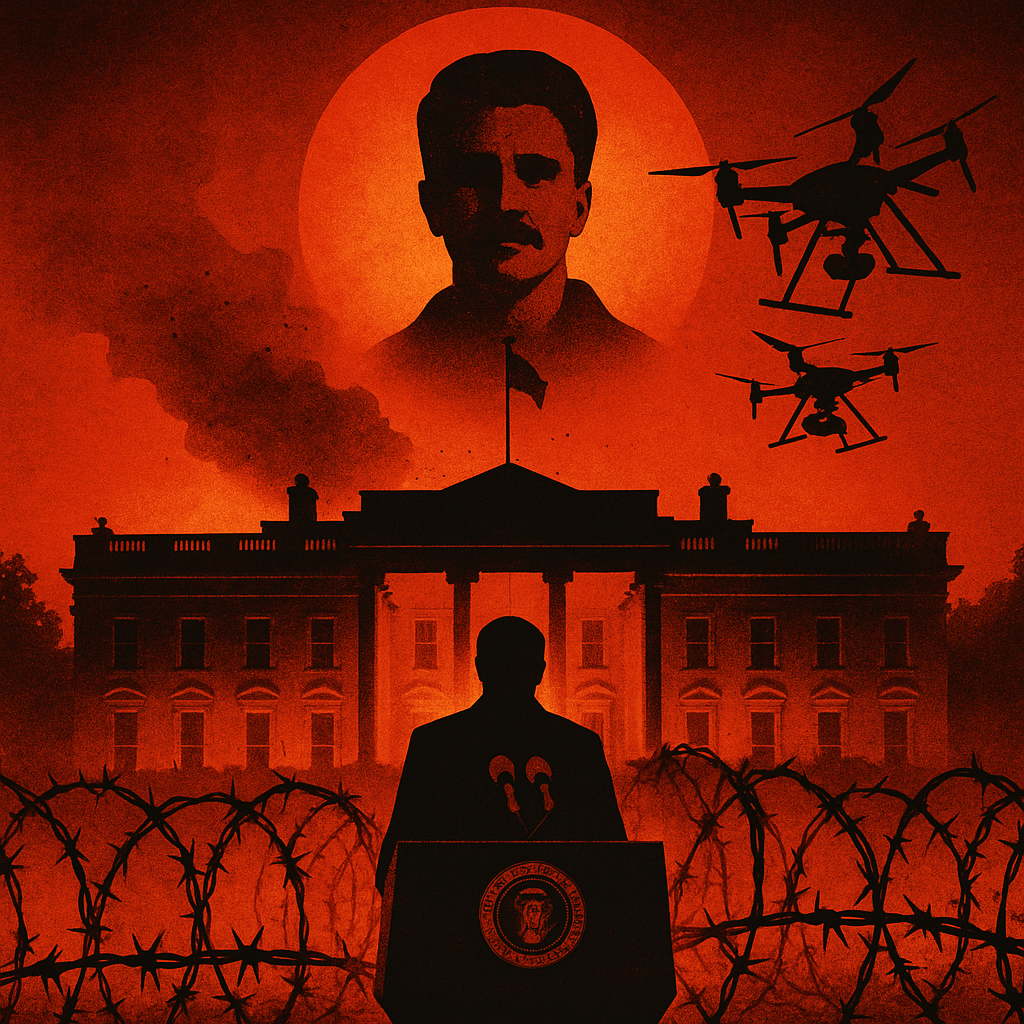
From the sanctification of Charlie Kirk to National Guard deployments in Black communities, the regime turns grief into mandate and spectacle into machinery of repression.
By Prince Kapone | Weaponized Information | September 15, 2025
The Script of Martyrdom and Vengeance
Joey Garrison’s September 15, 2025 piece in USA Today is written less as a report than as a carefully staged drama. It opens with a declaration: Trump officials, “angered in the wake of Charlie Kirk’s assassination,” are prepared to use “every resource” of government to crush left-wing groups. From the first line, outrage is harnessed to authority, grief to power. The emotional ground is tilled before a single question is asked, the reader invited to feel the same righteous fury as the men promising vengeance.
The article builds its stage around Kirk’s death, not as a fact to be explained but as a symbol to be weaponized. Stephen Miller is quoted promising to “dismantle and destroy” shadowy networks, swearing that this will be done “in Charlie’s name.” By repeating this phrase without irony or challenge, the piece transforms Kirk into a martyr whose memory demands a crusade. The effect is devotional, not investigative, turning a politician’s rhetoric into the moral spine of the story itself.
Vagueness becomes a weapon in the text. “Left-wing NGOs” are named as the villains, accused of doxxing, orchestrating riots, and fomenting violence—yet not a single group is identified. The absence of specifics allows the threat to expand without limit: any organization, any activist, any dissident could be folded into this invisible “terror network.” The article transmits this vagueness uncritically, presenting the accusation as if its mere utterance were proof.
The suspect in Kirk’s killing is mentioned—22-year-old Tyler Robinson, said to hold a “leftist ideology”—but the article immediately cushions this with official voices connecting him to a broader movement. No evidence of ties is provided, yet the leap is made smoothly: one gunman is recast as the tip of an iceberg. In this way, the piece substitutes insinuation for demonstration, encouraging readers to see an organized conspiracy where only a solitary individual is known.
A striking device is the selective memory of violence. The article briefly notes examples of right-wing attacks—an assassination in Minnesota, the assault on Paul Pelosi, an arson at Governor Shapiro’s home—but these appear only at the margins, mentioned almost in passing. By contrast, every detail of “left-wing” incidents is recited as evidence of a spreading plague. The imbalance is not subtle: one side’s crimes are the headline, the other side’s atrocities a footnote.
Finally, the cadence of the piece mirrors the cadence of the officials it covers. Miller and Vance appear not as subjects to be questioned but as narrators guiding the reader through danger and resolution. Their livestream becomes the article’s central event, their words the unquestioned structure around which the narrative turns. The article does not investigate; it echoes. And in that echo, the transformation is complete: Kirk is sanctified, dissent is criminalized, and vengeance is naturalized as the only possible response.
Assembling the Scaffolding of Fact
Strip the story down to its bones and a simple sequence emerges. The article reports that the Trump administration, shaken by Kirk’s assassination, vowed to use “every resource” of government against what it calls “left-wing terrorism.” Vice President JD Vance and Stephen Miller, speaking from the stage of “The Charlie Kirk Show,” promised to “identify, disrupt, dismantle, and destroy” organizations they accused of stoking violence. Miller claimed Kirk’s final text urged such a campaign, and he pledged to fulfill it “in Charlie’s name.” Law enforcement described the suspect, Tyler Robinson of Utah, as a 22-year-old with “leftist ideology” but no known group ties. Trump and his allies pointed to the Scalise shooting in 2017 and the 2024 killing of a corporate executive as part of a larger pattern, blaming the “radical Left” for a climate of terror.
That is the scaffold of fact the article lays out. But around it stretch wide silences. Nowhere does the piece mention that, by every major study, the overwhelming share of political violence and killings in the United States over recent decades have been carried out by far-right extremists. Nor does it tell the reader who Kirk was: not a neutral voice but the founder of Turning Point USA, a partisan organization infamous for campaigns against queer rights, racial justice, and for its fervent backing of Israel’s war in Gaza.
The article also omits reference to the administration’s pre-existing program for civil society control. The Heritage Foundation’s Project 2025 blueprint explicitly calls for defunding and dismantling nongovernmental organizations viewed as obstacles to the regime’s agenda. Garrison never names this plan, leaving readers with the impression of a spontaneous response rather than a carefully prepared program.
A further omission lies in the way the article repeats official references to “left-wing NGOs” without clarifying what that category even means. Liberal nonprofits and advocacy organizations — the institutional machinery often called the NGO industrial complex — are not the same as radical left movements that openly challenge the system. By erasing this distinction, the article leaves the reader with the impression of a single undifferentiated network, though no such network is identified by investigators.
The wider domestic militarization now underway is also absent. As reported in Weaponized Information’s investigation into the Pentagon’s “fortress turn”, National Guard units have been deployed into cities, “border missions” have expanded, and internal security exercises are now routine. The language of “support” and “resources” that runs through Miller and Vance’s remarks mirrors this technocratic vocabulary of militarization — yet the article connects no dots.
Nor does it acknowledge how this road was paved. As detailed in elsewhere, Democratic administrations steadily concentrated power in the White House, expanded surveillance, and normalized emergency powers. What Trump is seizing now rests squarely on those foundations, but the article pretends those continuities do not exist.
Finally, the assault on NGOs cannot be separated from the wider purge of dissent. In policy circles, as shown in my report on the think tank purge, critical analysts and researchers have already been sidelined or removed. The silencing of civil society and the silencing of policy dissent are two fronts of the same campaign — yet Garrison’s piece mentions neither.
Taken together, these omissions reveal the narrow corridor the article walks. It relays administration vows and law-enforcement claims, but strips away the wider record: the scale of right-wing violence, Kirk’s political role, the existence of a prewritten blueprint, the erasure of distinctions between NGOs and revolutionaries, the steady militarization of the home front, and the broader campaign to excise dissent from both civil society and policy institutions. What remains is not a full account but a partial transcript, a scaffold without the structure it supports.
Repressive Spectacle Violence and the Machinery of Consolidation
The Kirk assassination is not just a tragedy; it is an instrument. Its blood has been translated into mandate, its mourning converted into policy. This is how technofascist consolidation advances: by seizing on moments of shock and grief, then fastening them to programs of repression already drafted. The device has a name—repressive spectacle violence. A violent act becomes a spectacle, and the spectacle is weaponized to authorize the purge. The crackdown on “left-wing NGOs,” the vows to dismantle unnamed networks, the calls to deploy every resource of the state—none of these emerged from the graveyard. They were waiting, and the spectacle provided their trigger.
Through this lens, the National Guard deployments are not random shows of force but deliberate steps in the consolidation process. Washington, D.C. and Chicago today, New Orleans and Memphis tomorrow—always the cities where Black proletarians and lumpen live, organize, and resist. The colonial contradiction explains the pattern. Right-wing assassinations are minimized as aberrations, but Black communities are militarized as permanent threats. The Guard does not stand in white suburbs; it stands at the occupied frontier within the empire, where the descendants of the enslaved and dispossessed are treated as enemy populations.
The conflation of liberals and revolutionaries completes the picture. Miller and Vance’s targeting of “left-wing NGOs” is repeated without question, collapsing charities, nonprofits, and advocacy outfits into the same category as militant formations that seek to abolish the system. This is the grammar of counterinsurgency: keep the enemy vague, erase distinctions, and criminalize the entire spectrum of dissent. A lone suspect becomes a network, a protest becomes a plot, a food pantry becomes a “front.” By this sleight of hand, the regime grants itself permission to strike anywhere, against anyone, without limit.
The logic is circular but effective. Repressive spectacle violence provides the pretext, the colonial contradiction selects the targets, and counterinsurgency tactics map the terrain of repression. Together, they form the architecture of technofascist consolidation: censorship of radical voices, deportations of migrants, Guard deployments in Black neighborhoods, purges of dissenting institutions, and executive power without restraint. The Kirk assassination is not the beginning of this process—it is the excuse, the lever, the spectacle made into law. In this way, grief is conscripted, violence is weaponized, and repression is naturalized as the common sense of governance.
From Spectacle to Struggle: A Call to Global Mobilization
The ruling class tells us that Kirk’s death demands vengeance. We answer that it demands organization. What Miller, Vance, and Trump dress up as law and order is in truth a blueprint for mass repression: domestic colonialism renewed, surveillance technologies fused to police and military command, corporate media and social platforms deputized to censor radical voices, deportations on a scale not seen in generations, labor crushed, National Guard patrols in Black communities, and a sweeping political purge prepared in the name of security. This is not speculation; it is the road already being paved in full view.
Against this, the task falls to the global working class, the colonized, the multipolar and socialist revolutionary forces, and the defectors from empire to forge a united front. The struggle is not confined to Washington or to the borders of the United States. Every mass deportation raid in Los Angeles is tied to the same machinery that bombs Yemen. Every National Guard patrol in Chicago’s Black neighborhoods is linked to the same Pentagon that fortifies the first island chain against China. Every censorship algorithm throttling radical voices online is an extension of the same “ministry of truth” already wielded abroad. Empire’s repression is global; so too must be our resistance.
The blueprint is already being written from below. Grassroots campaigns defending migrants, abolitionist networks challenging police militarization, independent media that breaks the corporate stranglehold, union drives fighting against union-busting corporations, internationalist solidarity projects linking Havana to Houston, Caracas to Detroit, Johannesburg to Oakland—these are the living structures of counterpower. They exist not in theory but in practice, carrying forward the lessons of every generation that fought before.
To defect from empire is to throw our weight into these struggles, to stand shoulder to shoulder with those already resisting, to strip legitimacy from the purge Trump prepares and replace fear with solidarity. The spectacle of martyrdom and vengeance cannot be allowed to decide our future. Only the organized force of the oppressed and exploited, acting across borders and against the machinery of technofascist consolidation, can determine the outcome. The call is clear: mobilize where you are, strengthen what already lives, and link arms across all frontiers. The purge they promise can become the rupture we demand.
 Weaponized Information
Leave a comment