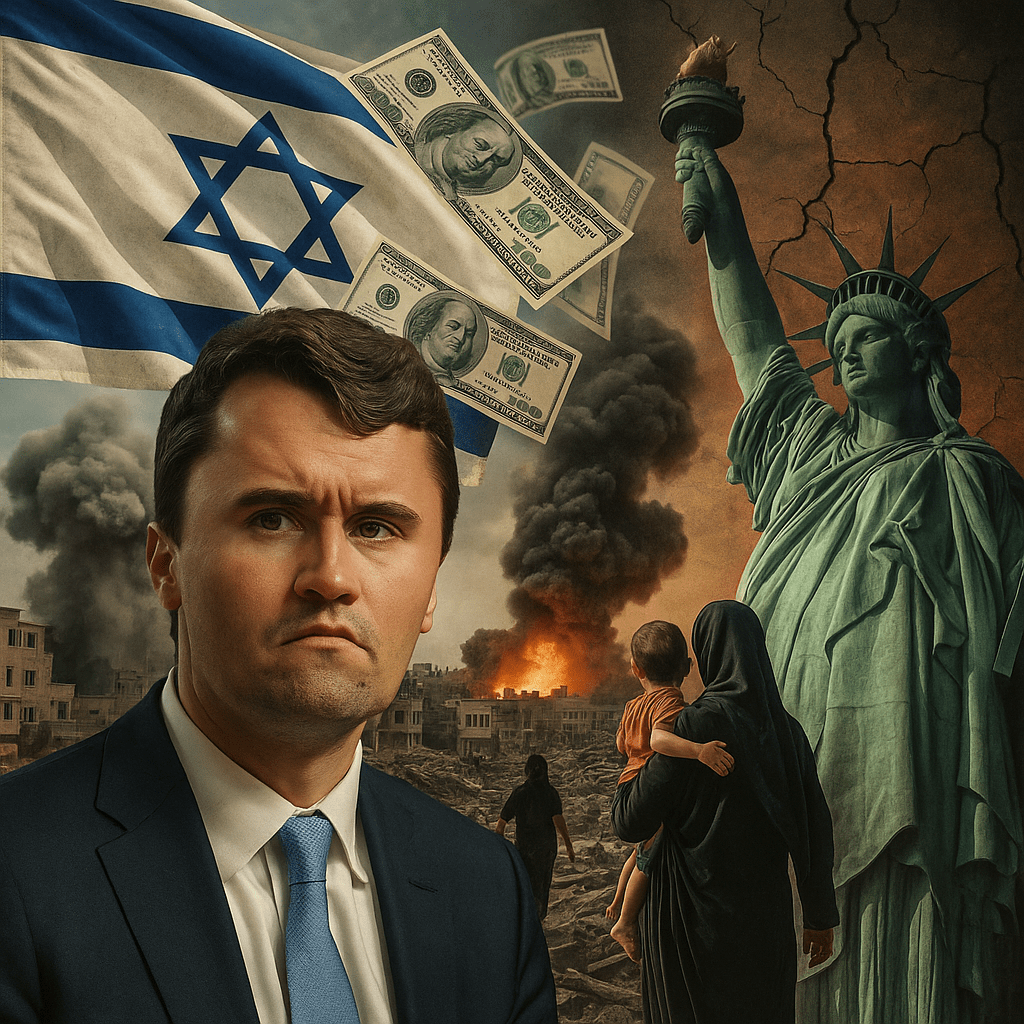
The Grayzone turns a feud between donors and their disciple into intrigue about Israel, but the deeper story is U.S. polarization, Gaza’s genocide, and empire in decay.
By Prince Kapone | Weaponized Information | September 15, 2025
The Manufacture of Martyrdom: How Propaganda Frames the Death of Charlie Kirk
On September 12, 2025, The Grayzone ran with a story that spread like kerosene on an open flame: Charlie Kirk, the golden child of MAGA youth politics, had not only turned sour on Benjamin Netanyahu but might have paid the ultimate price for it. The narrative is seductive—Kirk the loyal servant of empire, suddenly questioning his master, refusing the handouts of Zionist donors, and ending up cut down before the cameras. It is framed as a fall from grace, a morality play where the forces of Zionist intimidation and imperial manipulation hover in the shadows. And it is told in such a way that the reader is invited to speculate endlessly, to fill in the gaps with conspiracy and suspicion, while never being led to the material roots of power that underlie the entire affair.
The texture of the piece reveals itself through its storytelling devices. Kirk’s death is not presented in the dry register of cause and consequence, but as a drama of private fear. We are told he “loathed” Netanyahu, that he was “frightened” by texts, that he was “outraged” on air with Megyn Kelly. These are not stray details—they are the engine of the narrative, pulling the reader into Kirk’s subjective world. The politics of empire fade, and what remains is the image of a man cracking under pressure.
The story leans heavily on anonymous intimates: “a longtime friend,” “someone close to Charlie Kirk,” “contacts in the White House.” Their words appear as if overheard confessions, stitched together to carry the plot forward. This device is not about evidence but about mood. The reader is left unsure of what can be proven but is immersed in the atmosphere of betrayal and threat. The uncertainty itself becomes the hook.
At the same time, menace is cultivated with deliberate rhythm. The article stacks images of Netanyahu as a “bully,” of donors bombarding Kirk with calls, of surveillance gear supposedly planted by Israeli agents. Each element is presented in succession, until the reader feels the weight of encirclement. What matters is not whether each claim is grounded, but how the layering builds an impression: a crescendo of hostility tightening around Kirk in his final weeks.
The narrative then slides without pause from phone calls and text messages to the sniper’s bullet. By placing these details in the same chain of storytelling, the article leaves the suggestion that one flowed naturally into the other. The donor shouting in a boardroom and the assassin crouching on a rooftop are made to feel like stages of the same process. This blurring of categories produces suspicion while sparing the need to demonstrate causality.
And finally, the antagonist is cast in sweeping strokes. Netanyahu is drawn as a figure of almost supernatural reach—dictating Trump’s personnel, manipulating U.S. donors, intimidating allies, and inserting himself even into bathroom walls. By exaggerating his agency to this degree, the text reduces a tangled web of imperial politics into a duel between two men: the Israeli prime minister and the American youth leader. The larger system of power slips out of view.
What emerges, then, is not a clean exposé of power but a carefully curated spectacle of martyrdom. Kirk’s assassination is framed less as the outcome of imperial structures than as the punishment for his supposed moral awakening. The reader is invited to mourn him, speculate about him, and center him—while the system that bred him, elevated him, and discarded him remains safely in the background. Propaganda works not only by lying but by deciding what cannot be said. In this case, it is the silence about empire itself that is loudest of all.
What the Article Says and What It Leaves Out
To move beyond the atmosphere of menace and martyrdom, we first have to extract what The Grayzone actually places on the record. Its verifiable claims are not many, but they form the scaffolding of the narrative. Charlie Kirk, it reports, refused an offer of financial support from Netanyahu; he expressed disdain for the Israeli leader and resentment at Israel’s hold on Trump’s White House; he warned Trump against striking Iran; he received hostile communications from pro-Israel donors; he complained publicly in interviews about intimidation; he was killed on September 10 by a sniper; Netanyahu mounted a rapid public-relations campaign to frame Kirk’s memory as pro-Israel; and a 22-year-old man from Utah has been taken into custody for the killing. Around these points of fact, the rest is insinuation and embroidery.
Yet when we look at what is omitted, the picture changes dramatically. Start with the alleged shooter. The only person arrested is 22-year-old Utahn Tyler Robinson, now in custody. Reports describe him as a straight-A former student from a tight-knit Mormon family, with no history of activism or foreign connections. Instead, his “short-time” radicalization ran through gaming echo chambers and Discord chats referencing Gaza imagery. He never voted despite being registered, and even joked online about a “doppelganger” shooter after the event. What this reveals is not Mossad intrigue but the violent churn of U.S. digital culture — young men drifting into armed alienation through domestic pipelines of polarization and online spectacle.
Then there is Kirk himself. Far from being a threat to Zionism, his worldview mirrored it: defense of colonial domination, contempt for non-Europeans, and lockstep alignment with Israeli foreign policy. He proudly called himself an Evangelical Christian Zionist, boasted of his “bulletproof résumé” of defending Israel, and reiterated Israeli talking points by blaming Hamas for atrocities in Gaza. He denied that Palestinians were being starved, and consistently trafficked in Islamophobic rhetoric, railing against the Muslim call to prayer and slandering the Prophet Mohammad. By 2025, he had even begun to employ anti-Semitic tropes, blaming “Jewish donors” for cultural Marxism and “anti-whiteness” while simultaneously insisting his loyalty to Israel was unimpeachable. His quarrels with the Zionist donor class were about discipline, not principle. To frame this as anti-Zionism is dishonest: he was quarreling with patrons, not breaking with empire.
The structural integration of U.S. and Israeli power is also left unexamined. For decades, Washington has funneled billions in military aid, provided diplomatic cover at the United Nations, and built intelligence-sharing pipelines that lock the two settler states together. The role of AIPAC and pro-Israel PACs, and of billionaire donors like Paul Singer and Miriam Adelson, is not a sidebar — it is the machinery itself. Even Kirk’s own rise was fueled by donors like Bernie Marcus, who later turned on him when his rhetoric veered. To reduce this to a feud between Kirk and a handful of stakeholders is to erase the systemic fusion of empire and Zionism.
In the same way, Trump is cast as a man bullied by Netanyahu, barking at Kirk when he dared suggest restraint toward Iran. But Trump was not a victim of manipulation. He willingly recognized Israel’s annexation of the Golan Heights, withdrew from the Iran nuclear deal, and advanced the so-called “Deal of the Century” to liquidate Palestinian sovereignty. In 2025 he deepened ties further, granting Israel oversight of U.S. aid distribution in Gaza and authorizing an emergency $4 billion in new arms. These were conscious, settler-colonial choices. To portray him as cowed is to sanitize his active role in advancing Zionist aims.
Equally telling is the silence on the broader U.S. context of rising political polarization and violence. By mid-2025, the country had seen a surge of political violence, with about 150 politically-motivated attacks in the first half of 2025 — nearly double that of the same period in 2024. Threats against officials and lone-actor attacks have become commonplace, with Gaza imagery appearing in manifestos across the spectrum. Kirk’s assassination belongs to this domestic terrain, not an imported conspiracy. Analysts note that growing numbers of Americans now view violence as acceptable under certain conditions, a shift that has destabilized the whole field of politics.
Another omission is the generational revolt now reshaping the U.S. right. Sympathy for Israel among younger Republicans has collapsed, with only 23 percent of 18–29 year olds backing Israel’s Gaza assault. Polls show majorities of young Americans sympathize more with Palestinians, and even conservative influencers are splitting under this pressure. Kirk’s hedging was not a spiritual transformation but a tactical maneuver to chase relevance in a shifting base.
The global context is also missing. At the very moment Kirk was unraveling, Israel was waging genocide in Gaza, with over 64,000 Palestinians killed, UN-confirmed famine spreading, and Netanyahu threatening mass displacement to blunt an ICC genocide case. Netanyahu’s frantic PR blitz around Kirk’s death must be read in light of these crimes, not in isolation. Meanwhile, China and Russia moved humanitarian aid directly to Gaza, with BRICS as a bloc rejecting the militarized and restricted aid model dominated by the U.S. and Israel. While the scale remains limited, these actions signal growing cracks in unipolar control and affirm multipolar willingness to act outside Washington’s channels.
Finally, the disciplining power of billionaire donors is flattened into melodrama. Kirk’s rift is presented as personal persecution, when in truth arms packages now exceed $12 billion in a single year and donor enforcement mechanisms operate across the political class. He was not singled out. He was chewed up by the same machine that defines the system itself.
When placed in fuller context, the contradictions sharpen. The shooter’s background points away from Mossad intrigue; Kirk’s ideology was aligned with Zionism, even laced with its own anti-Semitic distortions; Trump was complicit, not bullied; U.S. society is gripped by polarization and violence; a generational revolt is reshaping grassroots opinion; Gaza is under genocidal assault; and billionaire donors enforce discipline system-wide. Seen this way, Kirk’s downfall is not a mystery of foreign plots but one more tremor inside the crumbling architecture of empire.
From Martyrdom Spectacle to Imperial Decay
Once the noise of speculation is stripped away, Charlie Kirk’s death does not stand as the tale of a conservative leader martyred for defying Zionism. It is the story of a loyal settler-colonial ideologue whose minor dispute with his benefactors has been inflated into a drama of resistance. The evidence is plain: the alleged shooter comes from a MAGA family, not Mossad; Kirk himself shared the Zionist worldview of racial hierarchy and colonial domination; his complaint was never about Palestinian humanity, but about the degree to which Israel dictated the tempo of U.S. politics. To mistake this for anti-Zionism is to misread a quarrel among colonizers as the birth of solidarity with the colonized.
What is revealed here is a small crack inside the broader colonial contradiction. The United States and Israel are not merely allies but twin settler projects, bound together by the logic of dispossession. Friction arises when one settler elite resents the other’s dominance, but that friction never breaks the shared foundation of stolen land and racial supremacy. Kirk’s irritation with Netanyahu was the resentment of a junior partner, not the stance of an opponent. For the working classes and colonized nations, his posturing cannot be confused with genuine dissent: it was a quarrel inside the house of empire.
Yet the handling of his assassination exposes much more than personal grievance. The rush by Netanyahu, Fox News, and the rest of the imperialist media apparatus to seize control of the narrative shows how efficiently death is absorbed into propaganda pipelines. Kirk’s collapse on stage was not only an act of violence; it was instantly a story, broadcast, interpreted, and spun into ammunition for competing factions. This is what we must call the martyrdom spectacle—the transformation of assassination into a staged event that disciplines not only through the bullet but through the flood of images and interpretations that follow.
The spectacle itself was shaped by technofascism. In a society where repression and digital circulation have fused, the assassination was live-streamed, replayed, and embedded into every device. The moment of Kirk’s death was also the moment of its commodification, as clicks, retweets, and viral memes. Here we see how the fusion of surveillance tech, corporate media, and militarized violence produces not just fear but a permanent archive of terror, weaponized against all who might question imperial authority.
Around this spectacle swirled waves of rumor and suspicion—precisely the domain of cognitive warfare. The Grayzone piece, like the online frenzy that followed, generated an atmosphere where everything felt connected yet nothing could be confirmed. This is not an accident but a feature: disorientation, not clarity. Conspiracies about Netanyahu’s hand in the killing are less important for their truth than for the way they fracture consensus, erode trust, and keep the population locked in speculation instead of organization.
The deeper meaning lies in the crisis of imperialism. The fact that so many Americans, even inside Trump’s base, instinctively suspect Israeli involvement shows how hollow the empire’s legitimacy has become. A ruling bloc that once demanded absolute loyalty now presides over a population that believes nothing it says. This is the rot of imperialist decay: the inability to maintain coherence even among its chosen sons. The bullet that struck Kirk is less significant than the collapse of belief that followed it.
For the global proletariat, colonized nations, and multipolar forces, the lesson is clear. Charlie Kirk was not an ally, not a convert to justice, but an instrument of empire caught in its own contradictions. His death does not demand mourning; it demands clarity. It reveals how imperialism disciplines its servants, how propaganda turns murder into spectacle, and how decay inside the core reflects a system unraveling under the weight of its own violence. The real battlefield is not Kirk’s stage in Utah but Gaza under siege, the Sahel breaking from France, BRICS+ building new institutions, and workers worldwide resisting technofascist control. It is there, not in the myth of Kirk the martyr, that the struggle for liberation advances.
From Spectacle to Struggle: A Call to Organize Against Empire’s Cracks
Charlie Kirk’s assassination has been spun as a tale of martyrdom, but for us it stands as something else: proof of imperial decay. A loyal settler ideologue was disciplined by the very system he served, his death turned into spectacle by the technofascist machinery of media and surveillance. For the global working class, for the colonized nations, for the multipolar forces rising against unipolar domination, and for defectors from empire’s camp — the lesson is not to mourn Kirk, but to seize the cracks his story reveals. We are called not to sympathy but to struggle.
On one front lies the fusion of Big Tech with repression. The same system that broadcast Kirk’s death in real time also powers ICE raids, battlefield surveillance, and Pentagon cloud warfare. Workers inside Amazon, Microsoft, and Palantir are already resisting these contracts; immigrant rights coalitions are demanding that Palantir be driven out of ICE; organizers are exposing Starlink’s role in militarizing war zones. These campaigns show us that technofascism is not an abstraction but a battlefield where collective action can break corporate complicity with empire.
On another front lies the Zionist occupation and genocide of Palestine. While The Grayzone lingers on whether Kirk was cowed by donors, the real story is in Gaza, where U.S. weapons and Israeli bombs wipe out entire families. The BDS movement continues to build campaigns targeting HP, Chevron, and arms manufacturers; student encampments and strikes erupt on campuses across the U.S. and Europe; dockworkers refuse to unload Israeli weapons shipments; the United Auto Workers have passed resolutions of solidarity. This is the terrain where action must escalate — boycotts, labor blockades, direct solidarity with the besieged. Every rupture in Zionist legitimacy is an opening to strengthen the Palestinian cause.
The question of donor capture cannot be ignored. Kirk’s complaints were about being disciplined by wealthy patrons, but these are the same networks — AIPAC, Miriam Adelson, Bill Ackman, Paul Singer — that bankroll genocide and buy loyalty across the political spectrum. Grassroots exposés of these billionaires, campaigns against PAC dominance in elections, and organized refusals of tainted money are vital. To break donor discipline is to weaken both domestic repression and foreign slaughter at the same time.
The media front is equally decisive. Netanyahu’s rush to Fox and NewsMax shows the speed at which the imperialist media apparatus launders repression into propaganda. The counter-force exists: Electronic Intifada, Mondoweiss, Peoples Dispatch, Tricontinental, and the new Voices of the New World alliance launched from Caracas. These outlets are already building narrative sovereignty. Our task is to amplify them, support them materially, and spread their reach to challenge the monopoly of CNN, Fox, and the New York Times.
And globally, the cracks in empire are widening. The Sahel’s AES bloc defies French neocolonialism, BRICS+ builds institutions outside dollar supremacy, and multipolar projects in Latin America, Africa, and Asia move forward despite U.S. sabotage. The spectacle of Kirk’s death cannot hide these shifts — it only reveals how desperately the imperial center clings to control even as its own children rebel.
The call is clear. Workers: resist the bosses who bind your labor to repression. Colonized nations: press forward with the liberation struggles that have always carried the future. Multipolar forces: deepen the cooperation that makes U.S. domination obsolete. Socialist revolutionaries: build organization where suspicion and conspiracy now fester, turning confusion into clarity. Defectors from empire: cut your ties with the settler project and join the camp of the oppressed. The cracks are there. The only way to honor this moment is to widen them into a break, and to build dual and contending power capable of outgrowing the spectacle machine of a dying empire.
 Weaponized Information
Leave a comment