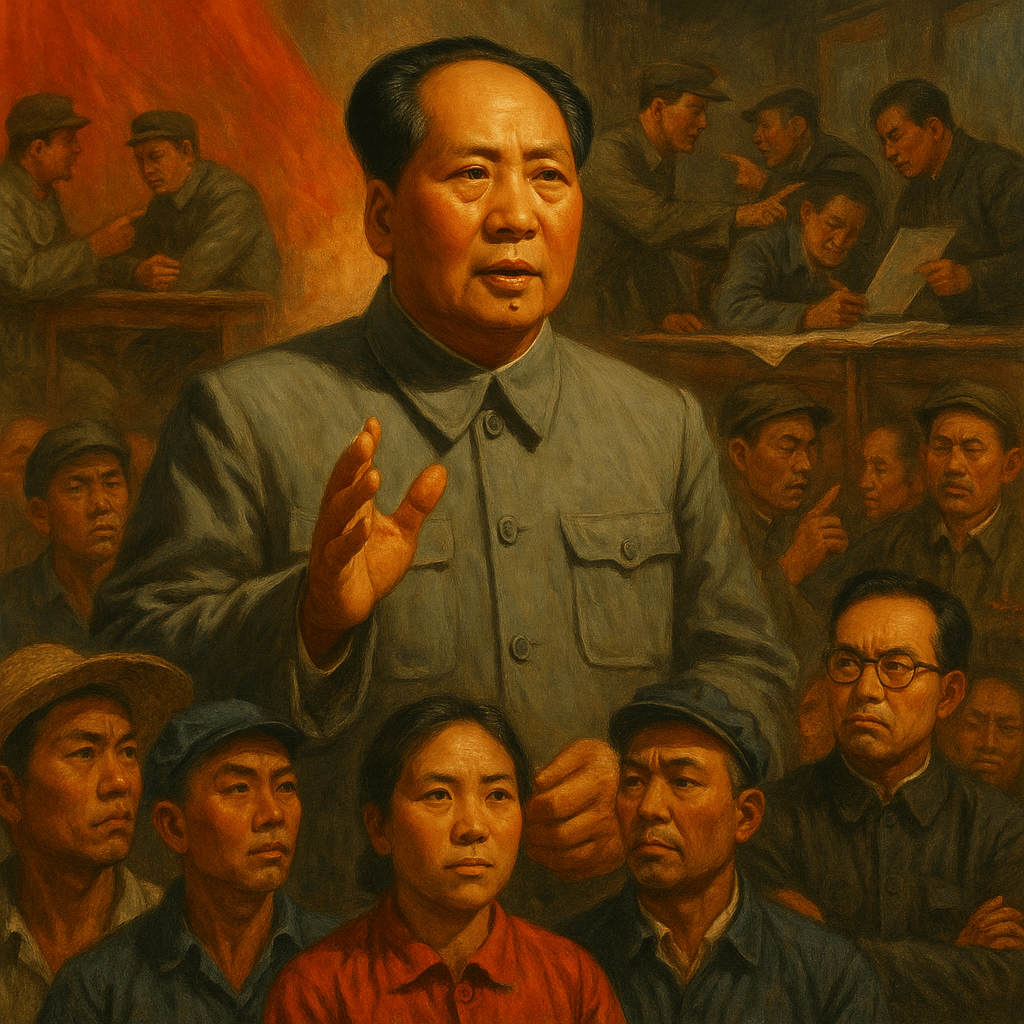
From Chengtu’s questions to Hankow’s battlefield, Mao sharpened the class line, armed the masses with democracy, and struck at the overlord style that threatened to hollow out the revolution.
Weaponized Statecraft Series | Mao in Hankow, 1958
By Prince Kapone | Weaponized Information | September 14, 2025
From Chengtu’s Questions to Hankow’s Battlefield
April 1958, Hankow. Weeks after forcing the Party to think before it leapt at Chengtu, Mao stepped into a new room with the same war in mind: keeping a young socialist state from hardening into habit. The sequence is the point. Nanning’s Sixty Points set methods of working; Chengtu disciplined methods of thinking; Hankow now takes the same knife to practice. We move from clearing the fog inside the head to mapping the ground under our feet. The atmosphere is not ceremonial. It is shop-floor serious: what must be done so the revolution doesn’t drown in its own paperwork or fall asleep at its own victory banquet.
Hankow sharpens the question that Chengtu only framed. If Chengtu answered how to think—investigate, compare, create—Hankow answers who to fight and how to fight them in the transition period. Mao lays out the terrain without metaphysics: enemies that must be isolated, vacillators that must be struggled with and rallied, workers and peasants who must be united through persuasion and rectification. He brings rhythm to the struggle—cooling off, letting loose—so class confrontation does not become a permanent siren that exhausts the people or a permanent lullaby that puts the Party to sleep. Politics commands; the numbers obey. Democracy is not a garnish; it is a weapon that keeps the line honest.
And let us kill a convenient myth before it grows legs: this is not the speech of a reckless man about to hurl a country into fantasy. It is the speech of a dialectician with a ledger—naming classes, distinguishing enemies from vacillators, insisting on persuasion among the people and coercion only for the hardened right. The so-called “Leap” in Mao’s mouth is not a drunken jump; it is a timed stride—advance, compare, rectify, advance again—taken with eyes open and ears tuned to the masses. Hankow is not bravado. It is the checklist of a revolution that intends to stay red.
Drawing the Lines of Class
Mao began at Hankow not with abstractions but with a map of living forces. First, the hardened enemy: the landlords not yet reformed, the rich peasants, the counter-revolutionaries, the bad elements, the rightists. Maybe five percent of the country—thirty million souls—but numbers mean little without politics. This bloc was the “current Chiang Kai-shek,” a reservoir of resistance that had to be isolated and struggled against. Mao’s line was sharp but not mechanical: smash their influence, reform where possible, and turn even a fraction of them into new people. If seventy percent split, that was victory. If ten percent truly changed, that was success. Nothing was permanent; all was struggle.
Second came the vacillating exploiters—the national bourgeoisie, their intellectual satellites, and the well-to-do middle peasants. Exploiters, yes, but not the same as the first. They bent with the wind, shouting support when the Party was strong, hedging when reaction threatened. Mao refused both liberal illusions and dogmatic purges. Against this class, the weapon was criticism, not annihilation. Handle them “civilized,” he said—not because they deserved kindness, but because their contradictions were not yet hostile. To treat them as sworn enemies would only drive them into the rightist camp. Better to rally the middle and isolate the hard core.
Then Mao turned to the workers. Supposedly the iron spine of socialism, they too carried contradictions. Some fought narrow battles for “five big items”—higher wages, better rations—forgetting the larger collective struggle. Others, newly made cadres, turned arrogant overnight, reproducing overlord habits in the factory. Mao did not flatter them. He demanded rectification, self-criticism, a return to the mass line inside production itself. Workers could lead, but only if they led themselves as much as they led others.
Finally, the peasants—the vast majority, and yet not a simple bloc. The cooperative movement had united millions, but suspicion lingered. Peasants still remembered cadres who had bullied them like Kuomintang tax collectors. They watched carefully whether collectivization meant equality or new layers of domination. Mao’s demand was that relations between cadres and peasants be remade through persuasion, not compulsion. Here was the Party’s greatest test: to prove that socialism was not simply a new landlord in red clothes, but a new relationship of equality. Without that, the whole alliance would crack.
In one sweep Mao named four fronts of struggle. Enemies to be fought, vacillators to be criticized, workers to be rectified, peasants to be persuaded. No fixed categories, no eternal positions—only movement, transformation, and vigilance. At Hankow, class was not a slogan; it was a compass for navigating the storm of transition.
Cooling Off, Letting Loose
Having drawn the map of classes, Mao turned to method. Struggle, he warned, cannot be treated as a permanent fever. The Party must learn rhythm: press, consolidate, press again. “We must have a strategy,” he said, “cooling off for a while and then letting loose. Without such cooling off and letting loose, it won’t flare up.” In those few words Mao buried two illusions at once: that class struggle could end with one victory, or that it could be carried on in a state of constant emergency. Both were recipes for exhaustion, either of the masses or of the Party itself.
The danger of permanent emergency was real. Exhaust the people with endless campaigns, and enthusiasm turns into fatigue, vigilance into cynicism. Mao had seen it happen. The Party could not keep the engine revved at full speed forever; the people needed air to breathe, space to digest, time to absorb gains. Cooling off was not retreat but recovery. It was the pause in the guerrilla war, the regrouping after the offensive. Without it, even the most loyal would crumble.
But the danger of permanent peace was just as lethal. Rest too long, declare victory too soon, and the class enemy reorganizes in the shadows. The people sink into complacency, cadres into bureaucracy. “Without letting loose, it won’t flare up”—without renewed struggle, contradictions do not sharpen into clarity, they rot into confusion. Mao demanded cycles: struggle to break the old, consolidation to build the new, then struggle again when new contradictions emerged. This was dialectics not as philosophy but as strategy of survival.
The transition period, Mao insisted, is repetitious and complex. One victory does not seal the revolution; one rectification does not cure bureaucracy. The same enemies resurface in new forms, the same contradictions return in sharper guise. To govern is to expect this repetition, to prepare for it, to turn it into strength rather than defeat. Mao’s formula—cooling off, letting loose—was not caution. It was tempo. It was the furnace master’s art: stoke, pause, stoke again, until the steel is tempered strong enough to hold.
Breaking the Overlord Style
Mao did not leave the disease unnamed. He told the cadres at Hankow: some of you act like the very Kuomintang we defeated. Cadres who bark orders, seize privileges, strut like petty kings—this was not socialism, it was the overlord style dressed in red. Workers and peasants could see it clearly. To them, an arrogant cadre was indistinguishable from the tax collector or the warlord. And once the people make that comparison, the Party bleeds legitimacy. That, Mao warned, is how revolutions decay from within.
The examples he offered were concrete and humiliating. A woman cadre in a Hunan hospital usurped a lavatory and forbade others to use it. Newly promoted shop workers turned on their fellow clerks as soon as they wore a Party badge. County officials strutted through cooperatives as if they owned them. Mao’s sarcasm was sharper than any statistic: socialism built on this behavior was socialism in name only. The cadres had become what they claimed to have buried.
Mao’s axiom was blunt: internal contradictions among the people cannot be solved by coercion. To beat, threaten, or silence workers and peasants is to govern with the Kuomintang’s hand. The Party must use persuasion, equality, and rectification. He reminded comrades of the Party’s guerrilla traditions: three rules of discipline, eight points of attention, the abolition of flogging and executions for deserters. Those rules had once bound the army to the masses like kin. Why abandon them now, in the name of socialism? To do so was to betray both the people and the revolution.
This was more than a moral scolding. It was a political principle. A Party that treats its people like subjects ceases to be a revolutionary party. Bureaucratism, Mao said, is counter-revolution in embryo. Every arrogant gesture, every silenced criticism, every abuse of privilege is a seed of restoration. The cure was not more paperwork or discipline from above. It was the mass line itself—cadres descending to learn from the people, contradictions resolved by debate and persuasion, equality restored in practice. Hankow made the choice plain: either purge the overlord style, or watch the revolution rot into a red bureaucracy.
Big Characters, Loud Voices
At Hankow, Mao did not merely criticize arrogance; he armed the people against it. His call was simple: let the provincial congresses publish big-character posters, and let the masses write them freely. A poster scrawled on cheap paper carried more truth than a polished report padded with lies. “Like the Yangtze River roaring down ten thousand li,” he said, mass criticism could wash away the rot clogging the Party’s arteries. It was not decoration. It was a weapon—ink turned into steel.
The posters mattered because they exposed contradictions in broad daylight. Cadres who bullied, shop managers who lorded over clerks, officials who mimicked the Kuomintang—all could be dragged before the people’s eyes. Internal contradictions among the people, Mao insisted, are not enemies to be crushed but problems to be aired, debated, and solved. Silence breeds resentment, resentment breeds alienation, and alienation becomes the soil for counter-revolution. Only by giving the people the right to speak could the Party keep its link with the masses alive.
The posters were also a school of democracy. For Mao, democracy was not the parliamentary theater of the bourgeoisie but mass participation as class struggle. To post one’s criticism publicly was to enter politics directly, without mediation. And to allow it was to bind the Party to the masses, forcing cadres to answer, correct, and change. Without such democracy, socialism suffocates; with it, socialism breathes. Hankow was Mao’s reminder that the revolution needed a living chorus, not a silent audience.
To drive home the point, Mao reached for folklore. The Monkey King, unruly and fearless, who smashed the order of heaven with his staff, became his symbol of anti-dogmatism. Big-character posters were that staff in the hands of the people—crude, disruptive, unstoppable. He contrasted it with Chu Pa-chieh, lazy and revisionist, and Monk T’ang, timid like Bernstein of the Second International. The message was sharp: without the Monkey King’s spirit of defiance, the revolution would sink into sermons and compromises. With it, even paper and ink could topple bureaucracy. Hankow’s posters were not graffiti; they were the people breaking heaven’s laws in defense of socialism.
Politics as Commander, Not Clerk
Mao reminded the cadres that numbers are not neutral. Production quotas, grain tallies, steel output—all mean nothing if stripped of politics. “Politics is the commander,” he declared, and it was not a slogan but a law of survival. If politics does not lead, then statistics rule like scripture, and cadres become accountants of decline. To treat socialist construction as bookkeeping is to mistake the revolution for a shop ledger. Mao’s warning was sharp: socialism without politics is only arithmetic waiting to be turned back into capital.
In this, Mao held fast to Lenin’s example. Lenin did not govern with abstractions; he persuaded. He walked into factories and villages, spoke plainly, argued fiercely, and trusted the masses to respond. For Mao, this was the standard of leadership—authority rooted in practice and persuasion, not in numbers scrawled on paper. Lenin’s Marxism was vivid, he said, because it was sincere, dialectical, and rooted in reality. That was the spirit Mao demanded his own Party revive.
Stalin, by contrast, carried what Mao called an “overlord flavor.” Schooled in rigid categories, he mishandled contradictions within the people, treating them like sins to be punished rather than tensions to be resolved. Mao was not erasing Stalin’s achievements, but warning against his rigidity. If China’s revolution copied this overlord style, it would divorce itself from the masses and wither. To govern without persuasion is to govern without roots, and unrooted power soon topples.
Bureaucracy, then, was not a nuisance but a mortal threat. When cadres govern like mandarins, when statistics are worshipped as ends in themselves, socialism hollows out from within. Mao’s antidote was clear: return to the mass line, resolve contradictions among the people with persuasion, reserve coercion for true enemies. China’s own guerrilla tradition—rules of discipline, abolition of flogging, persuasion over compulsion—was proof that another path existed. Hankow was a reminder: socialism is not maintained by clerks pushing paper. It lives only when politics commands, democracy breathes, and the people themselves decide the direction of the storm.
The Struggle That Repeats
At Hankow Mao struck a sober note: victory was real, but it was not final. Class struggle in the transition to socialism does not disappear—it mutates, resurfaces, and repeats. “There will be repetitions in the class struggle,” he warned. Famine, war, global shocks—any of these could turn the middle-roaders against the Party or embolden the rightists to rise again. History does not move in a straight line toward tranquility; it circles back, throws up new enemies, and forces the revolution to fight on terrain it thought already secured. To believe otherwise is to invite disaster.
Mao’s realism was rooted in the balance sheet of forces. The hostile exploiting class was only about five percent of the people, scattered and isolated, but still venomous. The vacillating national bourgeoisie bent with the wind; yesterday’s critic could become today’s ally and tomorrow’s saboteur. Even the workers and peasants, though the backbone of the revolution, carried remnants of old ideology and could be misled if cadres behaved like overlords. The battlefield was shifting and unstable. Mao refused to flatter his audience with fantasies of harmony. He told them the struggle was protracted, repetitious, complex—and that clarity, not complacency, was the weapon.
This was not pessimism. It was instruction. By admitting that reversals were possible, Mao was preparing the Party to survive them. The rightists may revolt, he said, the middle-roaders may resist, but if the Party holds the mass line, rectifies its style, and activates the people, the revolution can weather each storm. Victory is not a permanent state; it is a rhythm, a process of advance and correction. To forget this is to fall asleep at the watchtower while enemies regroup in the dark.
 Weaponized Information
Leave a comment