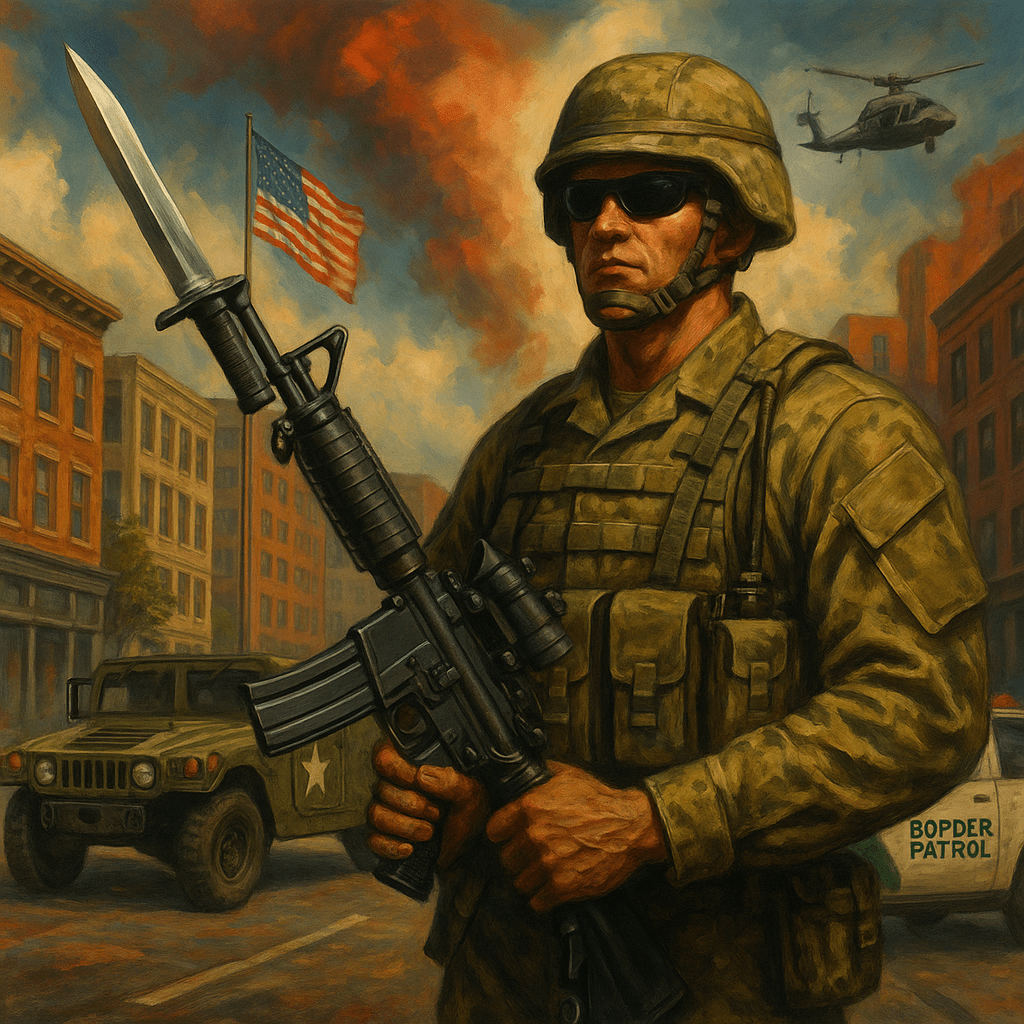
Politico reports that the Pentagon’s new National Defense Strategy shifts away from deterring Beijing and toward domestic deployments, Caribbean patrols, border militarization, and hemispheric policing — a move it calls a “striking reversal” that leaves U.S. allies uneasy.
By Prince Kapone | Weaponized Information | September 6, 2025
The Art of Dressing Bayonets in Silk
On September 5, 2025, Politico published an article titled “Pentagon plan prioritizes homeland over China threat” by Paul McLeary and Daniel Lippman. The piece reports that a draft of the new National Defense Strategy, now on Defense Secretary Pete Hegseth’s desk, shifts Pentagon priorities away from deterring China and toward securing the U.S. homeland and Western Hemisphere. It notes recent deployments of National Guard troops in American cities, warships and fighter jets in the Caribbean, a deadly strike on Venezuelans at sea, and the establishment of militarized detention zones on the southern border. The article frames this as a “striking reversal” from Trump’s first-term focus on Beijing, emphasizing allied anxiety over troop withdrawals in Europe and the uncertainty such a reorientation may create.
Politico’s article arrives dressed in the neutral garments of “exclusive reporting,” but beneath the polish lies a carefully woven tapestry of imperial common sense. The headline itself — a “plan prioritizing the homeland over China” — signals rupture, but the narrative quickly sutures that rupture by reassuring readers that the empire is still firmly in command. The supposed surprise of a “striking reversal” from Trump’s first term creates a staged drama: the generals are portrayed as pragmatic strategists, the allies as anxious dependents, and the homeland as a fortress that must be defended at all costs.
The reporters lean heavily on unnamed “officials” and “experts,” those ventriloquists of empire whose anonymity grants their words the aura of sober truth. They tell us that the old promises are “being questioned,” that allies are “worried,” that hawks are “inflamed.” These are not facts so much as moods, conjured to establish the reader’s horizon of concern: the credibility of U.S. power and the reliability of its commitments abroad. Nowhere do we hear from those who might cheer a weakening grip; the range of voices is policed to reinforce a single anxiety — that the empire’s word is its bond, and that bond is under stress.
Domestic militarization is slipped in through the side door, presented as a mundane line item of strategy rather than an extraordinary escalation. The activation of National Guard troops in Los Angeles and Washington, the dispatch of warships and F-35s to the Caribbean, the creation of detention zones on the border — each is narrated with the dry cadence of operational updates. By cloaking these deployments in the technocratic idiom of “support,” “interdiction,” and “missions,” the article normalizes what in plain speech amounts to soldiers patrolling cities, gunboats cruising regional waters, and troops empowered to detain civilians.
The language of omission works as powerfully as what is printed. The piece never troubles itself with the history of hemispheric domination, nor with the legal or moral consequences of using the military against civilians at home or abroad. Instead, it leans on emotional cues: allies “increasingly expect” troop reductions, Europeans “worry” about funding cuts, Republicans are “surprised” at the direction of strategy. Fear of abandonment is the emotional linchpin, a fear meant to bind the reader to the presumption that U.S. commitments must be upheld, whatever the cost.
The article even flirts with moral sleight of hand. A U.S. strike that killed eleven Venezuelans is mentioned in passing, sanitized with the adjective “suspected” and folded into the larger narrative of operational necessity. What might otherwise provoke outrage is instead filed away as proof of the Pentagon’s seriousness. The act of killing becomes a credential, a bullet point in a PowerPoint of deterrence. Violence is transfigured into evidence of competence.
At every turn, the prose works to disguise the true stakes. What is presented as a sober strategic debate is in fact a performance, one that masks escalation as prudence and militarization as mere adjustment. The anonymous official, the worried ally, the sober expert — these are the props that sustain the illusion. And Politico, draped in the credibility of its “exclusive,” serves not as neutral observer but as stage manager, ensuring the spotlight falls where empire prefers it to shine.
When “Strategy” Means Soldiers in the Streets
Stripped of its staging, the Politico article reveals a handful of concrete developments. A draft National Defense Strategy has landed on the Defense Secretary’s desk, and its central thrust is to shift the Pentagon’s gaze inward and closer to home. The text itself admits that thousands of National Guard troops are already deployed in major U.S. cities like Los Angeles and Washington. It reports that warships and F-35 fighter planes are patrolling the Caribbean on “drug interdiction” missions. It acknowledges that a U.S. strike killed eleven Venezuelans at sea. It concedes that troops have been stationed along the southern border with powers to detain civilians.
Each of these facts is presented as though it were a novel adjustment in grand strategy. But they stand out as evidence of something much larger: the use of the military to police civilians, patrol neighborhoods, and carry out killings far from battlefields. No matter how Politico wraps it, these are extraordinary deployments. The vocabulary of “support,” “missions,” and “interdiction” cannot conceal the reality of uniformed soldiers acting as domestic enforcers and regional police.
Beyond the borders of the United States, the draft strategy hints at retrenchment in Europe and the Middle East. Allies are described as nervous that U.S. troops will be withdrawn from their soil. The Baltic Security Initiative, which had been funneling hundreds of millions of dollars into Latvia, Lithuania, and Estonia for military infrastructure, is set to lose funding. NATO states brace themselves for reductions, while Trump personally assures Poland of continued U.S. troop presence, leaving others uncertain of their status. In this way, Politico records the anxieties of allied governments as though their unease were the natural measure of U.S. credibility.
What goes unspoken is as important as what appears. The piece does not trace these troop deployments to the long history of militarized policing at home. It does not connect Caribbean patrols or Venezuelan killings to centuries of hemispheric control. It does not register the Monroe Doctrine echoing through the corridors of the Pentagon. These absences reveal the limits of the story Politico is willing to tell. By cutting the frame so tightly, the article ensures that readers see only the present moment, never the deeper continuity of empire.
Context is necessary to grasp the weight of these developments. Since its swift passage after September 11, 2001, the PATRIOT Act catalyzed a sweeping expansion of executive surveillance and facilitated the normalization of military-grade tools in domestic policing — a trajectory rooted in the bipartisan construction of an imperial presidency, shaped by liberal and progressive compromise over decades. After decades of drug war operations in Colombia, Mexico, and Central America, U.S. warships in the Caribbean are no innovation but a continuation. The “new” detention zones at the border follow a long trajectory of transforming migrants into enemies of the state. And the fear voiced by European allies reflects not a new anxiety but the dependency built through military Keynesianism: their defense budgets propped up by American funds and American weapons.
Once set against this backdrop, the contradictions come into sharper focus. What Politico calls “homeland prioritization” is less a narrowing of commitments than a redirection of counterinsurgency toward domestic and regional targets. What allies experience as abandonment is in fact the exposure of their reliance on U.S. subsidies. And what appears as a strategy of “defense” is better read as crisis management, as the empire turns its weapons inward and southward to preserve itself in a time of decline.
Fortress Empire and the Monroe Doctrine 2.0
Read carefully, the draft National Defense Strategy is less about innovation than admission. Between the lines is a quiet concession: Washington has failed in its central mission to cripple Russia, halt China’s development, and freeze the birth of a multipolar order. The new watchword is not supremacy but survival. Faced with the collapse of the dream of unipolar dominance, the U.S. ruling class turns inward and southward, fortifying itself as a besieged fortress power.
This recalibration takes two distinct forms. At home, it manifests as technofascism — the fusion of permanent militarized policing, digital surveillance, and economic austerity into the daily fabric of social life. The National Guard in city streets, the militarized detention zones at the border, the normalization of soldiers as domestic law enforcers: these are not temporary measures but the outlines of a new internal order. The enemy is redefined as dissent, migration, and poverty; the battlefield is the American city itself.
Abroad, the pivot is toward hyper-imperial policing of the hemisphere and the seas that border it. The Caribbean becomes a permanent security theater, patrolled under the banner of “drug interdiction.” South America is treated as a military perimeter, where Venezuelan lives can be extinguished without debate. The Pacific islands are folded into the same logic, transformed into outposts of containment. What emerges is a Monroe Doctrine reborn, expanded into a Doctrine 2.0 that now extends across both the Americas and the Indo-Pacific. The message is blunt: in a world it can no longer dominate outright, Washington seeks to guarantee that its backyard remains fenced in and its sea lanes remain patrolled.
The ideological packaging disguises this retreat as strategy. Politico calls it “homeland prioritization,” as if narrowing focus were a deliberate choice rather than a concession to limits. But the reality is that empire no longer has the capacity to maintain simultaneous dominance everywhere. The NDS acknowledges this, not openly, but through its very structure. It is a doctrine of triage — the empire deciding what it can still hold, and what it must now abandon.
The class character of this shift is plain. This is not about the security of ordinary people. It is about safeguarding the wealth and power of the white ruling class in an age of crisis. The militarization of borders, the policing of migrant flows, the redirection of funds from foreign subsidies to domestic militarization — these moves protect accumulated imperial wealth from being drained abroad or redistributed at home. Allies may weep, migrants may die, workers may live under armed patrols, but the fortress remains intact for those it was built to defend.
From the standpoint of the global proletariat and the colonized, this strategy reveals weakness, not strength. The empire that once claimed to be indispensable now admits it is only one power among many, scrambling to wall off its hemisphere while multipolarity gathers momentum elsewhere. What Politico presents as a sober shift in defense priorities is, in fact, the political economy of decline: technofascism within, hyper-imperial Monroe Doctrine without, both joined in the desperate project of prolonging the life of a crumbling order.
From Fragmented Resistance to Contending Power
The scattered campaigns and organizations already fighting in the streets of this country reveal a landscape alive with struggle. Each front may seem isolated—immigrant defense here, anti-police battles there, labor fights in warehouses and coffee shops, Indigenous sovereignty uprisings, solidarity networks for Cuba and Venezuela—but when seen together they sketch the contours of a single resistance to the new fortress doctrine. What the Pentagon calls “homeland defense” looks, on the ground, like cages, checkpoints, surveillance towers, wage theft, and repression. And what the people are building against it looks, in embryonic form, like another kind of power.
Migrant defense networks have already shown the cracks in technofascist order. Detention Watch Network, United We Dream, Mijente, RAICES, Freedom for Immigrants, Never Again Action, and Grassroots Leadership have kept up constant pressure on ICE raids, exposed the machinery of deportation, and even shut down detention centers. These struggles are not just about survival; they chip away at the legitimacy of the militarized border itself. Their tactics—mass encampments, coordinated legal defense, solidarity visits, direct action blockades—model the kind of community infrastructure that refuses to let state violence operate in silence.
In Atlanta, the Stop Cop City fight has already exposed the blueprint of militarized domestic counterinsurgency. Community Movement Builders, the Atlanta Solidarity Fund, the Cop City Vote coalition, environmental defenders like the Climate Justice Alliance, and abolitionist groups such as Critical Resistance have built a broad front that links climate justice, racial justice, and anti-policing. The referendum push, the encampments in the forest, the mutual aid that has sustained jailed comrades—all of it shows how the state’s fortress plans can be contested on the very ground where they hope to build. Here, abolition is not an abstract horizon but a lived necessity: stopping the construction of the police city before it cements a new normal of armed occupation.
Labor militancy, too, cracks the surface of the fortress. The Amazon Labor Union, Starbucks Workers United, Trader Joe’s United, the UE, and Teamsters for a Democratic Union show that workers can still withhold the one commodity the system cannot automate away: labor power. These struggles, often dismissed as sectoral or “bread-and-butter,” take on a different meaning when seen in the context of technofascism. Every union drive in a warehouse or coffee shop doubles as a refusal of corporate surveillance regimes and a defiance of the austerity that guts social spending to fund militarization. The potential lies in knitting these rank-and-file struggles to the broader movement against war and empire.
On the terrain of colonized communities, the projects of dual and contending power already shine. Cooperation Jackson’s people’s assemblies, freedom farms, and community land trusts; People’s Programs’ free breakfasts, mobile clinics, and bail funds; and the LA Tenants Union’s neighborhood councils all create structures of survival that operate outside the state’s legitimacy. Most advanced is the African People’s Socialist Party and the Uhuru Movement, who have for decades insisted that Black people in the U.S. constitute an oppressed colony and built institutions—media, housing projects, solidarity networks—that embody sovereignty in practice. The Uhuru Movement’s survival programs and the Uhuru Solidarity Movement’s organizing of white defectors show what it means to contend for power under the direct leadership of the colonized.
The Indigenous struggle makes clear that the Monroe Doctrine 2.0 begins at home. NDN Collective’s LANDBACK campaigns, the Indigenous Environmental Network’s climate justice fights, and Honor the Earth’s pipeline blockades are already resisting the militarized seizure of land and resources. These movements do more than defend against extraction—they insist on sovereignty as the precondition for survival. Their tactics—land occupations, blockades, community-run monitoring, and cultural resurgence—demonstrate how Indigenous nations stand at the front lines of the same imperial logic that extends into the Caribbean and Pacific.
International solidarity campaigns refuse to let the fortress wall off the hemisphere. The National Network on Cuba, IFCO/Pastors for Peace, CODEPINK with Puentes de Amor, and the Black Alliance for Peace all link the wars abroad to the wars at home. Their work against the blockade of Cuba, and in defense of Venezuela and Nicaragua, makes visible the violence Politico erases with a single word like “interdiction.” Their caravans, brigades, and public education are not charity—they are acts of political sabotage against the empire’s narrative, building real ties between people under siege in the South and the workers and colonized inside the U.S.
The synthesis of these fronts points toward a strategy not yet fully grasped: the convergence of abolition, labor militancy, migrant defense, Indigenous sovereignty, anti-imperialist solidarity, and dual power construction. Each is fighting its own battle against the same encroaching technofascist order, and each generates tactics born from its terrain: blockades at the border, encampments in the forest, strikes in the warehouse, survival programs in the neighborhood, caravans against the blockade. When these tactics learn from and reinforce one another, the result is no longer fragmented resistance but the scaffolding of contending power. The empire builds its fortress; the people build another world in its shadow.
 Weaponized Information
Leave a comment