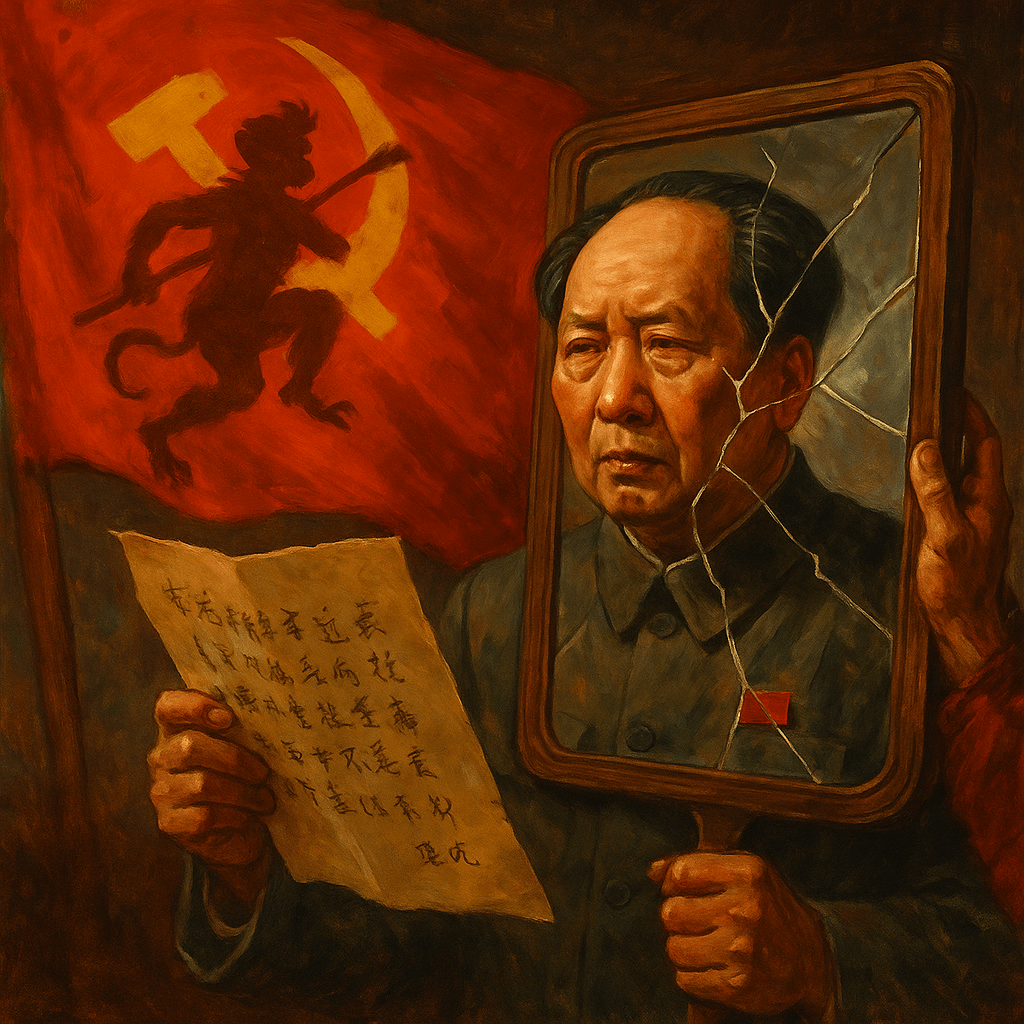
Weaponized Statecraft Series | Mao Zedong’s Letter to Jiang Qing, July 1966
By Prince Kapone | Weaponized Information
September 5, 2025
Cave, Clouds, and the Coming Storm
July 1966. Mao Zedong isn’t on some retreat to rest his bones; he’s holed up “in a cave in the West,” scribbling, reading, watching. From there he moves to the “land of white clouds and yellow cranes.” Sounds poetic, but it’s really the battlefield seen from above. Mao writes: “The world is in great turmoil, which will lead to great governance.” That’s not prophecy—it’s materialism. He’s saying what every worker knows: only when the pot boils over do you see what’s inside. Upheaval isn’t a mistake; it’s the raw material of change. Mao’s letter is less a love note than a reconnaissance report, a guerrilla’s sketch of the class terrain.
The cast is already assembled. Students, workers, peasants—the restless masses—are chafing at the old order. Inside the Party, the so-called “capitalist roaders” polish their resumes, dreaming of a socialism without struggle, a China fit for landlords in Mao suits. One “friend” writes a speech about coups, draped in revolutionary words but dripping with flattery that threatens to turn Mao into a porcelain idol. Pamphlets glow, quotations become catechism, and opportunists learn that waving a red flag can be the best cover for slipping back into power. Mao cuts through the noise with an old folk phrase: “the monsters and demons will reveal themselves.” That’s not metaphor for its own sake—it’s the simple truth that ruling-class habits don’t die; they hide and wait until the people move, then crawl back out.
This letter to Jiang Qing isn’t private musing—it’s statecraft sharpened into a blade. Mao thinks like a strategist: what to say openly, what to hold back so as not to hand the right wing fresh ammunition. He sizes up the ground: institutions that seem eternal can “collapse overnight”; universities and ministries that look solid are hollow to the core. The task isn’t to steady the scenery but to rip down the rotten props and rebuild. That’s why he calls the Cultural Revolution a “serious rehearsal.” He knows the show hasn’t yet begun—the rehearsal is where the actors, left, right, and wavering middle, reveal their true lines.
Mao places the letter inside a larger storm. Imperialist pressure presses from without, the bourgeoisie stirs within, and the Party itself is a battleground. His stance is not saintly patience but a fighter’s vigilance. “In seven or eight years, it will happen again.” That’s not mystical foresight; it’s the cold math of class struggle. Victories are never permanent; they demand to be defended, rectified, and won again. The future is bright because the people are many, but the road is tortuous because the enemy wears our colors and speaks our language.
So here is the stage on which the Cultural Revolution erupts: a leader refusing to be embalmed as a myth, a Party being forced to choose between empty ritual and living struggle, a society summoned to interrogate itself with the same harshness it shows its enemies. Mao isn’t asking us to bow before him—he’s showing us a method: study the moment, draw the class line, time the strike, and never confuse applause with power. From cave to clouds, his lesson is blunt: turmoil is not the detour, turmoil is the road. Governance isn’t the end of struggle—it’s just how struggle is organized.
The Monkey King’s Mirror
Mao looks into the cracked mirror of history and doesn’t see a saint staring back. He sees a monkey. “Without a tiger in the mountain, the monkey becomes king,” he writes, mocking the flattery that casts him as untouchable. It’s not false modesty—it’s dialectics. Mao admits he once bragged, “With confidence, one can live for 200 years, and strike three thousand miles through the waves.” But then he confesses he was never fully confident. That mix of bravado and unease, arrogance and humility, is not a personal quirk. It’s a revolutionary method. Confidence without self-doubt hardens into dogma. Doubt without confidence collapses into paralysis. The dialectic between the two is what keeps the revolutionary blade sharp.
He leans on Lu Xun’s wisdom: “When dissecting oneself, one is often harsher than when dissecting others.” Mao knew that lesson by practice. He says comrades often don’t believe his self-criticisms, but he insists anyway. Because for a revolutionary leader, self-exposure is not weakness—it’s discipline. Mao’s harshness toward himself is how he avoids the poison of flattery. He calls out his own arrogance before the enemy can weaponize it, before opportunists can turn it into myth. The monkey king metaphor is not confession but pedagogy: no one rules by divine right, not even Mao. A leader steps into power because of historical necessity and class struggle, not because he is carved from stone.
And still, Mao is not shy about his tiger stripes. He says outright that he carries some tiger qualities—primary—and monkey qualities—secondary. It’s a way of saying: yes, I lead, but leadership is situational. The tiger and the monkey live together in the same body, just as arrogance and humility live together in the same revolution. Here, Mao does not present himself as a perfect vessel of truth but as a contradictory figure, a man who must constantly interrogate his own role. That’s the opposite of how the cult tried to polish him, turning every word into scripture. Mao pushes back: the task of revolution is not to canonize individuals but to keep the contradictions alive, because it is only through contradictions that the masses can see clearly.
For us in 2025, this lesson is piercing. The rulers today sell certainty like a product—tech moguls peddle progress as if it were gravity, politicians broadcast confidence while hiding their fragility behind police and prisons. Mao reminds us that revolutionary confidence isn’t swagger; it’s forged in doubt, hammered in the recognition that the enemy lurks both outside and within. The monkey king’s mirror is not about Mao’s self-image alone. It’s about how revolutionaries everywhere must look at themselves without illusion, stripping away the masks of grandeur, keeping the tiger’s courage but never letting the monkey’s tricks blind us to reality.
Zhong Kui’s Burden
In his letter, Mao jokes with bitterness: “It’s like the old woman selling melons, boasting about her own wares. I have been forced onto the mountain by them.” The Party’s flattery had turned his slim volumes into holy scripture, plastering his words across banners and Little Red Books until even he could barely recognize himself in the carnival. Here Mao is not the adored icon of propaganda posters but a reluctant Zhong Kui, the ghost-catcher of Chinese legend. He suspects he’s been conscripted into myth, wielded to slay the demons of revisionism, while the very same flatterers build him into a god they can later topple. Mao sees the trap: the higher the pedestal, the harder the fall. And he is prepared for it—“to be shattered to pieces”—because he knows matter cannot be destroyed, only broken and remade.
This is the tightrope Mao walks in 1966. To unleash the Cultural Revolution, he must allow his image to be weaponized. The Red Guards rally around his words; the masses pour into the streets under his banner. Yet every chant of praise carries a shadow. The myth mobilizes, but it also petrifies, hardens into dogma, breeds opportunists who learn to hide their ambitions behind Mao’s face. He is wary of the very machinery that carries his name, knowing it can just as easily be hijacked by the right wing to smother the revolution in ritual. Flattery, he knows, is not love; it is a tool of power, and in the wrong hands it strangles the very struggle it pretends to serve.
The allegory of Zhong Kui is precise. In Chinese lore, Zhong Kui slays demons not out of choice but because the emperor commands it, condemned to the role by circumstance. Mao compares himself to this figure because he feels the Party has thrust the ghost-hunting burden onto him—he must fight revisionists and bureaucrats with the weight of a myth he never wanted. He recognizes the irony: the Party calls on him as the hero to cleanse it of ghosts, even as the hero’s own myth risks creating new ones. That contradiction is unbearable but unavoidable. For Mao, it is better to risk being shattered than embalmed as a golden statue.
The lesson cuts beyond 1966. In every era, the ruling class has learned to turn rebellion into iconography, to freeze living struggle into dead symbols. In our own time, corporations slap “resistance” on T-shirts while mining cobalt with child labor, NGOs wrap imperialism in the banner of “human rights,” and billionaires brand themselves as visionaries while exploiting workers as ruthlessly as any landlord. Mao’s warning is sharp: beware the myths that march under your own flag. Revolutionaries cannot escape the burden of symbols, but they must never forget that symbols have class character. A myth can rally the people, but it can also be the rope that strangles them.
The Mirror of Struggle
Mao tells Jiang Qing plainly: “In seven or eight years, it will happen again. The monsters and demons will reveal themselves; it is in their class nature, and they cannot help but emerge.” This isn’t melodrama—it’s materialism. Victories in class struggle are never final. Every triumph of the people cracks open new contradictions, and every defeated class bides its time, waiting for the chance to rise again. Mao calls the Cultural Revolution a “serious rehearsal,” a nationwide drill where left, right, and wavering middle all take their places on stage, where universities that looked like fortresses crumble overnight. The rehearsal matters because the enemy is never vanquished once and for all. They will return—inside the Party, inside institutions, even inside ourselves.
That is why Mao insists on vigilance, on self-criticism sharper than any weapon the enemy could wield. He quotes Lu Xun: “When dissecting oneself, one is often harsher than when dissecting others.” For Mao, this is not self-flagellation but survival. He warns Jiang Qing not to let success cloud her judgment, not to forget weaknesses and mistakes. These words aren’t domestic counsel—they’re a manual for revolutionaries. The greatest danger is not failure in battle but complacency in victory. It is when the banners are waving and the slogans are loudest that the rot seeps in. Bureaucrats, opportunists, careerists—they are the monsters and demons who always reappear. And if leaders do not interrogate themselves, the enemy will do it for them, with a vengeance.
Mao is clear that some of his words cannot be made public, that they would be misused by the right wing to sow confusion. This is not dishonesty; it is revolutionary discipline. Timing matters. To expose certain contradictions too early is to hand the enemy your ammunition. To speak them at the right moment is to turn them into a weapon. Here Mao reveals the difference between gossip and strategy, between “black talk” that demoralizes and dialectical criticism that prepares the next advance. He knows the right wing might one day even twist his own words against the people. But he also knows the masses will learn to wield his other words to tear the right wing down.
For us today, the lesson is cutting. The system that exploits us does not rest—it mutates. Capitalism does not collapse under its own contradictions; it recruits our victories into its arsenal, selling rebellion back to us as fashion, turning critique into career, organizing our doubt into cynicism. Mao’s rehearsal reminds us that the enemy never sleeps, and neither can revolutionaries. To keep the revolution alive, we must wield the mirror of struggle: reflect, criticize, rectify, and prepare. That is not paranoia—it is the discipline of survival. The monsters and demons will return, and when they do, the question will be whether we’ve built the clarity, the organization, and the courage to sweep them away again.
The Tortuous Road Ahead
Mao closes his letter with words that sound almost casual, but they cut like a blade: “The future is bright, but the road is tortuous. These two old sayings still hold true.” Here is the synthesis of all the contradictions he has laid bare—confidence and doubt, myth and vigilance, victory and reversal. Mao is not handing Jiang Qing a prophecy; he is handing us a map. The road is rough, full of reversals, betrayals, and broken institutions. But the brightness is real, because the power of the people is real. Ninety percent of the country, he reminds us, will never tolerate permanent reaction. Chiang Kai-shek proved it—twenty years of borrowed power, propped up by landlords and imperialists, and still he crumbled into exile. Any coup, Mao says, would be the same: short-lived, because the masses will not carry it on their backs.
This is weaponized statecraft in its purest form. Mao is not consoling, not begging for faith—he is preparing his comrades for the long march of contradictions. He knows the right wing will twist even his own words, will try to drape themselves in his banner. But he also knows that the masses can learn to distinguish myth from method, flattery from struggle, idol worship from real revolutionary practice. He demands we remember that even when a leader is shattered, the matter of revolution is not destroyed. It reorganizes, reshapes, and surges forward again.
For us in 2025, the echo is unmistakable. We live under rulers who speak of “progress” while chaining us to debt, who brand dissent as merchandise, who use the language of resistance to sell us submission. They promise straight highways to the future, while every step workers take is uphill and under fire. Mao’s verdict slices through this fraud: the future belongs to the people, but only if we are ready to walk the tortuous road. There are no shortcuts, no saviors, no smooth transitions. There is only the grind of organizing, the discipline of criticism, the courage to fight, fail, and rise again.
The letter ends with the warmth of a comrade writing at length, promising to talk more next time. But beneath the intimacy lies the clarity of a revolutionary commander: prepare for turmoil, embrace rectification, trust the people. The road is tortuous, yes—but that is what makes the future bright. The lesson Mao leaves us is not to worship his image, but to carry forward his method: read the world as it is, tear away its illusions, and turn every contradiction into a weapon for liberation. That is the inheritance of the Cultural Revolution’s rehearsal, and it is the task before us now.
 Weaponized Information
Leave a comment