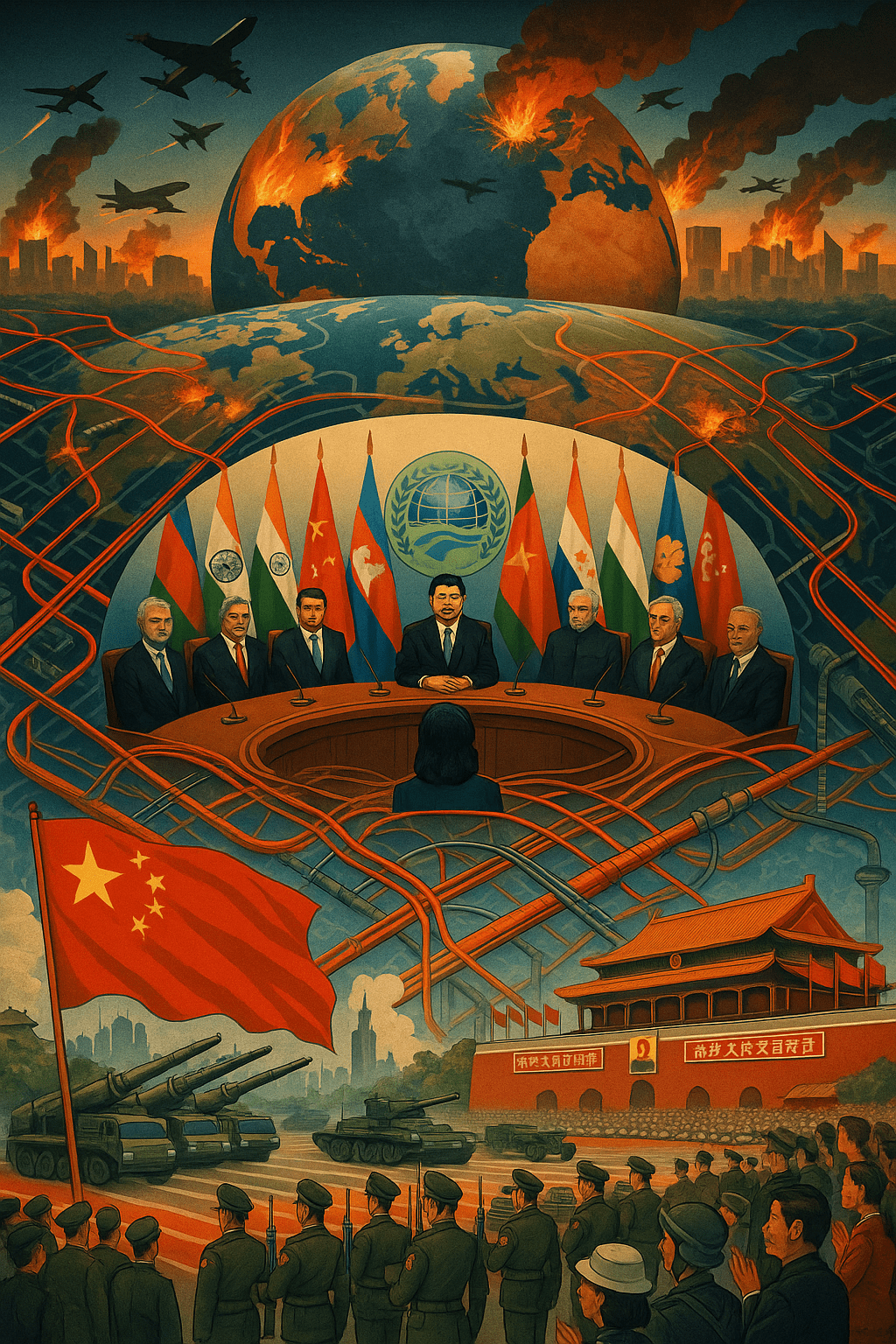
Foundations laid in steel and circuits, institutionalized in Tianjin, and proclaimed on Beijing’s avenues — multipolarity has left the page and entered history. The Global South builds, empire sabotages, and the crack in the order widens. Grammar, backbone, ritual, and governance converge into a new architecture. The task now is to make it irreversible through the sovereignty of peoples.
By Prince Kapone | Weaponized Information | September 4, 2025
At the Crossroads of History
The first week of September 2025 staged a double drama the empire could neither ignore nor spin away. In Tianjin, the Shanghai Cooperation Organization convened its largest summit in history, bringing together more than twenty countries and ten international organizations. Days later in Beijing, the 80th anniversary of the victory over fascism was marked with a parade that looked less like a commemoration of the past than a proclamation of the future. Together, these moments carried a single message: the unipolar order is cracking, and a multipolar world is no longer a rumor but a lived reality.
Xi Jinping framed it with blunt clarity: the world stands at a crossroads, between war and peace, between domination and dignity. The SCO’s Tianjin Declaration spoke the institutional language of sovereignty and parity, while the parade gave it flesh and sound, an inauguration broadcast in steel and song. This was not coincidence but choreography: first the signatures on agreements to expand trade, build banks, and coordinate security, then the massed formations of soldiers and citizens to legitimize those commitments before the eyes of the world. Paper and parade, declaration and demonstration—each leaned on the other, each amplified the other.
The empire, of course, has no tolerance for sovereignty. Its entire architecture of domination depends on vetoing independence, whether through sanctions, coups, or narrative smears. That is why these scenes from Tianjin and Beijing felt electric: they punctured the fiction that Washington’s veto is final. Here were nations saying no—and not just saying it, but building railways, signing financial accords, and marching in defiance of being forever spectators to history. For the colonized, it is a reminder that the masses themselves are the real strategic infrastructure of multipolarity. Without their labor, no corridor runs, no pipeline flows, no society stands. That is the contradiction the empire cannot resolve.
This essay reads these events as one arc: the foundations of multipolarity laid in infrastructure and finance across the Global South; the SCO summit institutionalizing this alternative order; the Victory Day parade inaugurating it before the world; and the inevitable counter-moves of empire to sabotage, co-opt, and narrate it out of existence. At every turn, we will see that multipolarity is not abstraction but practice, not dream but construction. And in that construction lies the crack in the imperial system—a crack that, if widened by struggle, can become the doorway to a new epoch.
Foundations Laid in Steel and Struggle
Multipolarity did not appear overnight, nor was it born out of academic seminars in Geneva. Its foundations were poured in the rubble left by empire’s rampages of the last two decades. The Shanghai Cooperation Organization itself was forged in the aftermath of the U.S. invasion of Afghanistan and the unilateral declaration of a “war on terror,” when Central Asian states recognized that their survival depended on coordination beyond NATO’s dictates. Every new corridor, bank, and payment system since then has been less a “grand Chinese design,” as Western analysts sneer, than a collective survival mechanism—a refusal to remain hostage to Washington’s wars and Washington’s currency.
The 2008 financial crash stripped the mask off the system. As Wall Street was bailed out and millions lost homes and jobs, the South learned a bitter lesson: no one was safe as long as the dollar held its chokehold over global trade and finance. Then came the string of imperial proxy wars—Libya reduced to chaos, Syria besieged, Ukraine turned into a NATO forward operating base. Each time, Western powers used not only bombs and mercenaries, but also the dollar as a weapon. Central banks saw sovereign reserves seized or frozen. Trade routes were blockaded or sanctioned into paralysis. The message was unmistakable: independence without alternatives was an illusion. Multipolar infrastructure had to be built, or sovereignty would remain a slogan.
Out of this crucible came the arteries of multipolarity. In finance, countries began experimenting with ways out of the dollar’s trap. Argentina now pays the IMF in yuan. Africa launched the Pan-African Payment and Settlement System to clear transactions without passing through New York. Saudi Arabia dares to speak of oil in non-dollar terms. In energy and transport, the Belt and Road Initiative laid track and pipeline across Eurasia: the Addis–Djibouti electrified railway slashing travel times, the Jakarta–Bandung bullet train linking Indonesia’s industrial belt, the Power of Siberia pipeline pumping gas eastward in defiance of sanctions. In digital space, China’s CIPS and Russia’s SPFS emerged as payment systems outside SWIFT, India’s UPI scaled into a national backbone, and BeiDou and GLONASS satellites ended the monopoly of U.S. GPS. Even renewable energy projects in Kazakhstan and Uzbekistan, once afterthoughts to imperial planners, became pillars of sovereignty through wind farms and hydropower stations tied into multipolar grids.
To empire’s pundits, these are “technical adjustments” or “debt traps.” To the people who depend on them, they are lifelines. They mean goods shipped without a Western veto, remittances that reach families without being skimmed by U.S. banks, electricity generated without dependence on Western oil giants. This is the quiet revolution: multipolarity built in boring details—rails, pipes, servers, power plants—that collectively shift the center of gravity away from the imperial core. It is no accident that the Victory Day parade in Beijing could proclaim a new world with such confidence. Ceremony only has weight because construction already exists beneath it. The foundations of multipolarity were laid in the empire’s own wreckage, and from those ruins another architecture has risen.
Institutionalizing the Multipolar Order — The SCO in Tianjin
If the past twenty years built the foundations of multipolarity in steel and circuits, the Tianjin summit of the Shanghai Cooperation Organization formalized them into architecture. Here multipolarity ceased to be scattered lifelines and became an institutional order. The Tianjin Declaration did not mince words: the international system is shifting toward a just and representative multipolarity, and the SCO intends to anchor that transition. Unlike NATO’s iron discipline, the SCO does not demand ideological conformity; it demands only sovereignty. Its principle is simple: contradictions are contained inside a common house rather than exploited into permanent fracture. That is why socialist China and sanctioned Iran can sit at the same table as capitalist India and post-Soviet republics without collapsing the structure.
The work of Tianjin was concrete. Member states signed twenty agreements that extend multipolarity from aspiration to practice. A new Comprehensive Center for Responding to Security Threats was established, along with an Anti-Drug Center to coordinate enforcement. The roadmap for expanding local-currency settlements was reaffirmed, paving the way for an SCO Development Bank and an expanded Interbank Consortium. Digital sovereignty was advanced through cooperation on e-commerce, a Future Technologies Program, and a joint roadmap on artificial intelligence. Energy security was mapped to 2030, renewable projects endorsed, and a high-level SCO–Arab League energy dialogue scheduled. Transport corridors were advanced, with China–Kyrgyzstan–Uzbekistan Railway launched and “smart customs” protocols agreed. Even food security was addressed through the SCO Food Security and agricultural technology bases. These are not abstract communiqués. They are binding instruments, each one a nail in the coffin of dollar hegemony and imperial veto.
Security was strengthened not only through new agreements but through regional architecture. Coordination with the Collective Security Treaty Organization and the Commonwealth of Independent States was endorsed, binding Eurasia’s defensive web tighter. Kyrgyzstan assumed the rotating chairmanship under the slogan “25 Years Together Towards Sustainable Peace, Development and Prosperity,” signaling continuity and institutional maturity. Behind the diplomatic phrasing was a clear signal: the SCO is not a temporary alignment of convenience, but a durable institution designed to hold under pressure.
Tianjin also became the stage for the launch of China’s Global Governance Initiative, the fourth in a series of landmark proposals following the Global Development, Security, and Civilization initiatives. If the Global Civilization Initiative provided the ideological grammar of parity, GGI offered the governance software of multipolarity. It promised to democratize global governance, to make multilateral institutions responsive to the needs of developing countries, and to align practice with the UN Charter rather than with Washington’s unilateral decrees. Support came immediately. Putin declared it a “good initiative” in a world of imperial pressure. UN Secretary-General António Guterres called it a unique step towards strenthening multilateralism. Pakistan, Belarus, Venezuela, Nicaragua, and Cuba formally joined or endorsed. In one summit, multipolar governance ceased to be a Chinese aspiration and became a multilateral project with Global South traction.
This is the difference between SCO and the alphabet soup of imperial “coalitions.” NATO, the G7, the Quad—all demand obedience. SCO coordinates sovereignty. In Tianjin the multipolar order acquired its institutional backbone: declarations turned into strategies, pledges into agreements, and initiatives into living frameworks. Multipolarity is no longer just built in rails and banks; it is codified in treaties, housed in institutions, and recognized in the open. It is, in short, a world order in formation.
Inauguration on Chang’an Avenue — Victory Day as Multipolar Theater
If Tianjin gave multipolarity its paperwork, Beijing’s Victory Day gave it its proclamation. The 80th anniversary of the antifascist victory was framed not as nostalgia but as a hinge in history. The sequencing was deliberate: the SCO summit concluded, and then the parade began. First came the signatures on declarations and agreements, then the spectacle that made those signatures visible. Beijing was staged as the symbolic capital of a new order, the place where the memory of past struggle fused with the choreography of present power.
The parade itself unfolded as multipolar theater. Military formations marched with precision, displaying technologies that silently announced the end of Western monopoly on deterrence. But it was not only a matter of missiles. Cultural performances highlighted the plurality of civilizations, woven into the day’s ritual as a reminder that multipolarity is not just a balance of forces but a coexistence of traditions. The choreography refused to reduce the day to national pride; it was staged as a planetary performance, crafted to broadcast that the future will not be unipolar.
What gave this theater its legitimacy was the audience. On the reviewing stand were not NATO generals stacked in hierarchy but SCO leaders, Global South delegates, and sanctioned states, standing as equals. The semiotics were unmistakable. Where a G7 or NATO summit arranges its participants in pecking order, Beijing presented a tableau of parity. Leaders of vastly different GDPs and political systems were positioned side by side, signaling that the principle of multipolarity is not uniformity but coexistence. That image itself was a rebuke to empire’s hierarchies.
Xi Jinping framed the scene with the language of crossroads: between peace and war, between domination and dignity. Antifascism was reframed for the present, not as memory of 1945 but as resistance to new forms of imperial aggression—sanctions, blockades, proxy wars, coups. The vocabulary of the Global Civilization Initiative was woven into his speech: respect for sovereignty, civilizational dignity, and a shared future. Victory Day thus became not only a commemoration but a declaration that multipolarity is the true inheritance of the antifascist struggle.
Every great transformation has its inaugural rituals. In 1789 it was the storming of the Bastille, in 1917 the Winter Palace, in 1949 Mao proclaiming the birth of the People’s Republic. In 2025, Beijing’s parade joined that lineage: a performative declaration that multipolarity had entered history not only in treaties but in flesh and sound. The choreography said it clearly: many states, many flags, one shared stage. What had been negotiated in Tianjin was now enacted before the eyes of the world.
This embodiment matters. The SCO provided documents; the parade provided legitimacy. Leaders, soldiers, and masses together enacted multipolarity, showing it as present fact rather than future aspiration. To empire, it was a provocation. To the South, it was a signal: the alternative order is not a dream but a reality, visible and inevitable. The ritual validated the infrastructure, the ceremony sanctified the construction. With this inauguration, multipolarity was no longer just built—it was born.
The Empire Strikes Back
Every step toward sovereignty invites retaliation. Empire cannot sit idle while the scaffolding of multipolarity rises around it. What Tianjin built in agreements and what Beijing proclaimed in ritual, Washington and its allies seek to unmake through sabotage, co-optation, and narrative war. The method is familiar: punish disobedience, lure the wavering, and smear the alternative until it looks dangerous or absurd.
Sabotage begins with finance. The U.S. Federal Reserve tightens rates, bleeding Global South currencies dry. Sanctions are deployed not only against Russia and Iran but against any country that experiments with alternative payment systems or energy partnerships. Sovereign reserves are frozen, as Libya’s and Venezuela’s were. AFRICOM stretches deeper into the Sahel under the pretext of fighting terrorism, when the real objective is to prevent African states from controlling their own minerals. In West Asia, air strikes on Iran’s civilian infrastructure are defended as “non-proliferation” but in fact aim to cripple independence. The lesson is clear: where multipolarity advances, empire turns the screws.
Co-optation is the velvet glove. Swing states are offered carrots to dilute multipolar momentum. Brazil is courted with green finance under Western terms. India is pulled into the Quad and whispered promises of technological partnership. South Africa is tempted with trade preferences to soften BRICS. The logic is old: pry open contradictions within the South and weaponize them. The SCO treats contradiction as a resource to be managed; empire treats it as a lever to fracture sovereignty. The goal is not to defeat multipolarity outright but to slow it, to muddy its institutions until they look incoherent and weak.
Narrative war completes the arsenal. Western media churns out headlines declaring the SCO a “talk shop,” BRICS an “uneven club,” the Global Civilization Initiative a “propaganda stunt,” the Belt and Road a “debt trap.” Even the Victory Day parade is dismissed as “authoritarian pageantry,” stripped of its antifascist lineage and its multipolar meaning. Think tanks flood op-eds about “Chinese coercion” while ignoring the decades of U.S. coercion that birthed these alternatives. This is counterinsurgency by vocabulary: if multipolarity cannot be stopped, it can at least be painted as illegitimate in the eyes of the casual observer.
Beneath all this lies a single contradiction: empire cannot tolerate sovereignty, yet every strike against it accelerates the very alternatives it fears. Sanctions push more countries to trade in local currencies. Military interventions deepen Eurasian security ties. Narrative attacks confirm that SCO and BRICS matter enough to target. The same logic that has driven empire for centuries—discipline through punishment and spectacle—now backfires in the face of a world no longer willing to kneel. Multipolarity grows not in spite of empire’s blows but through them, each strike forging new circuits of resistance. That is the paradox at the heart of our time: the empire’s strength reveals its weakness, and its counterattacks mark the measure of its decline.
From Inauguration to Institution — Making Multipolarity Irreversible
The September sequence in Tianjin and Beijing was more than ceremony and communiqués. It marked the moment when multipolarity stood up, not as theory but as order. The foundations had been laid across two decades of empire’s overreach: corridors built in defiance of sanctions, payment systems forged to escape the dollar’s chokehold, satellites launched to break GPS monopoly, pipelines and power stations constructed to survive blockades. On that base, the SCO summit provided the architecture—agreements, strategies, and frameworks that made coordination durable. Then Beijing’s Victory Day parade gave the new order its inauguration, transforming paper into presence and institutions into embodied legitimacy.
Taken together, these moves form a living triad. The Global Civilization Initiative supplies the grammar, the ideological operating system of parity and mutual respect. The SCO supplies the backbone, the institutional wiring that turns ideals into protocols and corridors. Victory Day supplied the ritual of inauguration, broadcasting multipolarity before the eyes of the world. And now the Global Governance Initiative expands the circle outward, offering governance software to democratize the international system itself. Grammar, backbone, ritual, governance: these are no longer separate gestures but an integrated structure, a framework for an alternative order.
Empire, of course, will strike back. It already has—with sanctions, co-optation, and narrative war. But its counterattacks reveal the same contradiction that has haunted every colonial project: the harder it tries to suffocate sovereignty, the more it multiplies the circuits of resistance. By freezing reserves, it convinces more states to diversify currencies. By bombing sovereign nations, it forces Eurasia to build new security architectures. By smearing the SCO and BRICS, it proves they matter. The contradiction remains the compass: empire cannot tolerate sovereignty, yet sovereignty grows through the very blows meant to crush it.
The task ahead is to widen the crack. Multipolarity will not hold if it remains the project of states alone. Its permanence depends on popular legitimacy—on delivering material dignity, on making the sovereignty of nations inseparable from the sovereignty of peoples. Corridors must mean jobs, not just cargo. Banks must mean housing and food, not only statistics. Satellites must mean connectivity for the villages, not just prestige in the skies. Only when the masses feel multipolarity in their stomachs and their lungs will it become irreversible.
In Tianjin and Beijing, multipolarity announced its arrival. It marched in steel and sang in chorus. It signed documents and raised toasts. It stood as both ceremony and construction, as both infrastructure and imagination. The empire will deny it, attack it, and seek to buy it off. But the fact remains: a new world has been inaugurated. Its grammar is written, its architecture is rising, and its presence has been declared in the open. The duty of our time is to widen this opening until it becomes a rupture, to push multipolarity beyond survival into transformation, beyond sovereignty into socialism-in-motion. That is the higher basis on which history now invites us to stand.
 Weaponized Information
Leave a comment