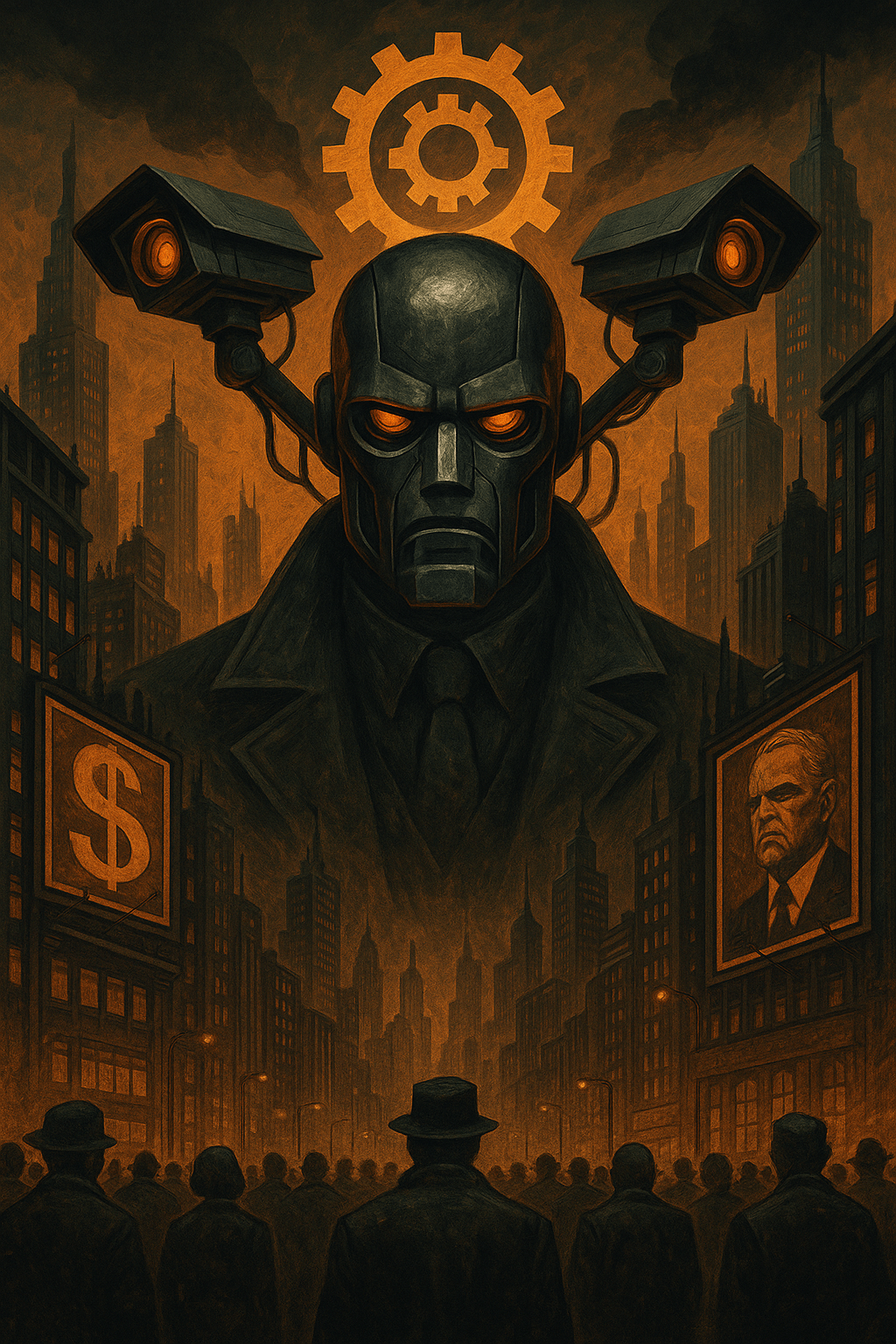
Gavin Newsom brands Trump the “leading nationalist and socialist of our time.” Democrats decry cronyism. Republicans shout America First. But behind the slogans, both parties run the same monopoly system: bailouts, subsidies, and surveillance—capitalism without its mask.
By Prince Kapone | Weaponized Information | September 3, 2025
When Capitalism Calls Itself Socialist
At the end of August 2025, Governor Gavin Newsom went on Kara Swisher’s Pivot podcast and decided to troll Donald Trump. He accused Trump of having “completely perverted capitalism,” called his economic order “crony capitalism,” and then branded him the “leading nationalist and socialist of our time” over the federal government taking a ten percent stake in Intel. The trick works only if you blur meanings: a public stake in a private firm becomes “socialism,” as if shoring up Intel were the same thing as workers’ control of production.
The point isn’t Trump. It’s the sleight of hand. Calling corporate bailouts “socialism” turns the word into a slur and teaches people that anything public—any leverage over capital—must be suspect. In reality, nothing novel happened here. This is monopoly capitalism doing what it always does in crisis: fusing state power to private capital to protect profits.
The punchline: the very crowd decrying Trump’s “socialism” runs the same playbook. Clinton’s Treasury deregulated finance and showered Wall Street with gifts. Obama and Bush shoveled trillions into bank rescues. Biden handed semiconductor monopolies billions through the CHIPS Act. Newsom presides over a state where Silicon Valley and Hollywood write rules, pocket subsidies, and steer policy. The system isn’t “perverted” by Trump; it’s functioning as designed.
So let’s be clear: Newsom’s jab fails not because it offends Trump, but because it smears socialism. What we’re seeing is neither socialism nor a deviation from capitalism—it’s capitalism’s normal crisis management. The state underwrites monopoly power, profits are socialized upward, and elites call it prudence when their side does it and “cronyism” when the other side does. Trump isn’t a socialist or a perverter; he’s capitalism without its mask.
The Fraud of “Crony Capitalism”
When politicians sling the phrase “crony capitalism,” they pretend to expose corruption. In reality, they are laundering capitalism’s crimes. The term suggests the system works fine until shady operators distort it with favors—when in truth, those “favors” are the very DNA of monopoly capital. What they call cronyism is simply capitalism in its monopoly stage. The myth of a pure, competitive market, unsullied by government, is as believable as a benevolent slave master.
Think about the logic. If capitalism rests on “free markets”, then subsidies or contracts should be an aberration. But when the state hands out tax breaks, contracts, and loopholes, liberals cry “perversion!”—as though politics poisoned economics. The truth: politics and markets were fused from the beginning. The railroads that carved across the continent were built on land theft, subsidies, and genocidal war against Indigenous nations. The banks that fueled industrial growth were propped up by federal guarantees and bailouts. The defense giants that dominate today’s economy exist entirely on the public teat, shielded by endless budgets justified as “national security.” Capitalism without cronyism is like a gun without bullets—fit only for display.
The point of “crony capitalism” isn’t critique—it’s cover. It shifts blame from the system to a few bad actors. Trump becomes the scapegoat, accused of corrupting an otherwise healthy order. Meanwhile, Democrats and Republicans alike shovel billions to their own cronies: Wall Street financiers, Silicon Valley monopolists, Hollywood producers, fossil fuel giants. Calling Trump a perverter of capitalism is not an indictment—it’s a defense of the system itself. It draws a fake line between “good” and “bad” capitalists, a line that only exists in the imagination of the ruling class.
For workers, this semantic theater changes nothing. Whether Boeing or Lockheed wins the contract, Exxon or Tesla pockets the subsidy, Citigroup or Goldman gets the bailout, the outcome is the same: layoffs, stagnant wages, higher rents, and an economy organized for the profits of a few. “Crony capitalism” is just how elites describe capitalism when the mask slips. The machinery itself is the problem—and it was built for cronies from the start.
The Revolving Door: Where Capital and State Walk Hand in Hand
Follow the people and the truth comes out. The so-called “revolving door” between government and industry is not an occasional scandal—it is the bloodstream of American capitalism. Politicians call “cronyism” a bug in the system, but the revolving door shows it is the system itself: designed to fuse corporate and state power so that the very people meant to regulate capital are those profiting from it.
The history is clear. In the 1990s, Bill Clinton’s Treasury Secretary Robert Rubin dismantled Glass–Steagall, the firewall separating investment gambling from ordinary deposits. When his work was done, Rubin landed at Citigroup—the firm that benefited most. Under Obama, Timothy Geithner and Larry Summers ran the “recovery” after the 2008 crash, bailing out Wall Street while families drowned; Geithner later cashed out at Warburg Pincus, a private equity powerhouse. Trump’s first term followed the same script: Treasury Secretary Steven Mnuchin built his fortune on foreclosures, and adviser Gary Cohn glided from Goldman Sachs to the White House to a cushy corporate landing. These aren’t “bad apples”—they are the orchard.
Under Trump 2.0, the carousel spins faster. Larry Fink of BlackRock slips from Biden’s team into Trump’s councils, proving Wall Street hedges every bet. Elon Musk briefly helmed the Department of Government Efficiency (DOGE), advising on state restructuring, AI, and deregulation. Sriram Krishnan of Andreessen Horowitz now shapes AI and industrial policy. Retired generals like Joseph Dunford shuttle between the Pentagon and boardrooms at Lockheed Martin. And the administration openly considers state stakes in Lockheed, Boeing, and Palantir, making the cabinet look like an America Inc. shareholder meeting.
This carousel exposes the fraud of “crony capitalism.” Cronyism is not the deviation—it is the blueprint. Generals become contractors, bankers become regulators, tech moguls become policymakers. The state and capital are not rival spheres occasionally corrupted by backroom deals; they are one organism, feeding off the public while posing as separate. The revolving door doesn’t squeak open by chance—it spins endlessly, greased by campaign donations, lobbying budgets, and the promise of future paydays.
When Newsom points at Trump and cries foul, he points into a mirror. California’s Democratic machine runs on the same circuitry: real estate developers, Hollywood studios, Silicon Valley venture capital. Red tie or blue, every regime survives through this door. It isn’t corruption on the margins—it is capitalism at the core, laying the groundwork for the even darker fusion of technofascism.
Monopoly Capitalism, Not Cronyism
The revolving door is not an accident—it is the natural expression of monopoly capitalism. To call it “cronyism” is to pretend capitalism could function without it, that there was once a golden age of fair competition where the best idea won. But Marxists long ago exposed this fairy tale. As capital accumulates, it concentrates into fewer and fewer hands, until a handful of trusts and banks dominate entire industries. Competition doesn’t disappear—it becomes ritualized, a shadow play masking cartel agreements, state guarantees, and imperial expansion. What liberals denounce as corruption is simply capitalism obeying its own law of motion.
Lenin made this point more than a century ago: imperialism was not a distortion of capitalism but its highest stage, where finance capital fuses with state power to dominate abroad and suppress labor at home. The state becomes the guarantor of monopoly, enforcing tariffs, sanctions, and war to secure profits. Decades later, Paul Baran and Paul Sweezy showed how surplus concentrated in giant corporations distorted the whole economy, breeding stagnation, militarism, and waste. In the twenty-first century, John Bellamy Foster and Robert McChesney extended this to “monopoly-finance capital,” mapping how financialization and digitalization deepen the power of a ruling class that sits astride the planet’s resources.
The U.S. record proves the case. Railroads were carved with subsidies and land theft. Oil monopolies were shielded by state force and foreign coups. Wall Street was bailed out repeatedly, most spectacularly in 2008 when trillions were funneled to banks while workers lost homes and pensions. Today, chipmakers, electric car firms, and AI giants gorge on subsidies, all justified as “national security” or “competitiveness.” None of this is new—it is capitalism doing what it has always done.
Which is why Newsom’s complaint collapses. Monopoly capitalism doesn’t need perversion; it is born perverted. Its essence is to concentrate wealth, capture the state, and weaponize it for profit. Whether under Roosevelt or Reagan, Clinton or Trump, Biden or Trump 2.0, the machinery remains the same. “Cronyism” is just the bedtime story elites tell when they want us to believe capitalism could be otherwise.
Receipts of Plutocracy: The Princeton Study
If theory were not enough, the numbers drive it home. In 2014, political scientists Martin Gilens of Princeton and Benjamin Page of Northwestern published one of the most sweeping studies of U.S. politics ever undertaken. Examining nearly 1,800 policy decisions between 1981 and 2002, they compared the preferences of ordinary citizens with those of wealthy elites and organized business interests. Their finding was blunt: the will of average people had “a near-zero, statistically non-significant impact” on policy outcomes. In plain terms, what the majority wants rarely matters—what elites and corporate lobbies want almost always does.
Gilens and Page did not call the United States a dictatorship of the bourgeoisie, but in the polite language of academia they said the quiet part out loud: the U.S. is best described as an oligarchy, or more precisely, a plutocracy—where public policy overwhelmingly reflects the interests of the rich and organized business. You can cast a ballot, but Goldman Sachs casts the real vote.
The study rattled the establishment because it quantified what working people already knew in their bones. Every time Congress ignores support for higher wages, universal healthcare, affordable housing, or an end to imperial wars, the receipts are in plain sight. “Democracy” under capitalism is not about the demos—the people—it is about the kratos—the power—and who controls it. In the United States, that power is welded to capital.
Newsom’s jab about Trump “perverting capitalism” dissolves under this light. The Princeton data show there was never a “pure” capitalism responsive to the masses. The system has always been wired to obey wealth. America is not a democracy gone astray under Trump’s cronies—it is a plutocracy functioning as designed. The mask of democracy may be paraded at election time, but behind it stands the permanent dictatorship of capital.
The Sick Joke of Bipartisan Hypocrisy
If “crony capitalism” were truly a Trump invention, then history would look very different. But the receipts show the opposite: every administration, Democrat and Republican alike, has fed the same beast. When the financial system collapsed in 2008, George W. Bush and Barack Obama didn’t nationalize the banks in the interest of the people—they nationalized the losses in the interest of Wall Street. The Treasury and Federal Reserve handed out trillions through TARP and emergency lending facilities, saving Citigroup and Goldman Sachs while millions of workers lost their jobs and homes. That was not an exception—it was capitalism doing what it always does when crisis hits: protect capital, sacrifice labor.
Trump’s first administration followed the same script with a fresh coat of nationalist paint. The 2020 CARES Act delivered massive public subsidies to airlines and corporations, while ordinary people got a one-time check that vanished before the rent was due. Behind the scenes, the Federal Reserve opened credit lines to corporations and hedge funds, ensuring that the portfolios of the rich remained intact even as the pandemic gutted working-class communities. This was not populism; it was plutocracy in its purest form, carried out with MAGA slogans.
Biden entered office promising to restore “normalcy,” and he did just that—normalcy for monopoly capital. His signature achievement, the CHIPS and Science Act, was sold as a visionary investment in America’s future. In reality it was a $52 billion handout to semiconductor giants like Intel, Micron, and TSMC, subsidizing their profits under the guise of “national security.” At the same time, his Pentagon budget ballooned to record levels, showering Lockheed Martin, Raytheon, and Northrop Grumman with contracts. The revolving door spun smoothly, with BlackRock alumni and defense board members writing the checks.
And now, in Trump 2.0, the farce continues. The White House is preparing to take a ten percent stake in Intel, a move cheered by markets and sold as proof of patriotic industrial policy. In reality, it is just another subsidy to a monopoly already fattened by state largesse. Meanwhile, Peter Thiel enjoys direct access to policy corridors, ensuring Palantir and his wider tech-finance network secure government contracts across the Pentagon and intelligence agencies. Venture capitalists who once bet on Democrats now swarm back to Washington, cashing in on the same subsidies for chips, batteries, and AI surveillance infrastructure. The script never changes; only the cast does.
So when Newsom scolds Trump for “perverting capitalism,” the hypocrisy is thick enough to choke on. Democrats and Republicans alike have overseen bailouts, subsidies, and state-directed capital that funnel public wealth into private hands. They accuse Trump of cronyism while practicing it daily. The difference is not in principle but in packaging: Obama wrapped the handouts in the language of “hope,” Biden dresses them up as “innovation,” and Trump slaps “America First” on the same old robbery. The joke is not on them—it is on us, if we keep mistaking this bipartisan looting for anything other than the normal functioning of monopoly capitalism.
From Plutocracy to Technofascism
Plutocracy is the baseline, but it is not the endgame. In an age of deepening crisis—climate collapse, declining profit rates, imperial overstretch—the monopoly system requires new tools to hold its grip. What emerges is not simply plutocracy but technofascism: the fusion of monopoly capital, digital surveillance, and militarized state power. If plutocracy is the rule of wealth, technofascism is the rule of wealth armed with algorithms, drones, and biometric control.
The Pentagon’s Joint Warfighting Cloud Capability program brought Amazon, Google, Microsoft, and Oracle into the heart of U.S. military planning, fusing Silicon Valley’s data empires with the permanent war machine. Google’s brief retreat from Project Maven under worker protest did not stop the project—it simply shifted the contracts to other firms willing to weaponize artificial intelligence for drone warfare. Palantir, birthed from CIA venture capital, now supplies predictive policing software to ICE and counterinsurgency platforms to the Pentagon, turning the domestic carceral state into a laboratory for global domination.
The intelligence architecture deepens this merger. Fusion centers link local police, federal agencies, and private security firms in a nationwide surveillance dragnet. Reauthorizations of programs like FISA Section 702 ensure that warrantless data collection remains a permanent feature of American life. These mechanisms are not temporary—they are the scaffolding of a new order where digital oversight substitutes for mass consent. The working class is not invited to participate in this democracy—it is monitored, profiled, and disciplined.
Trump 2.0 accelerates this trajectory. With Peter Thiel acting as consigliere of the digital empire, Palantir enjoys privileged access to Pentagon and intelligence contracts, embedding its surveillance infrastructure into U.S. geopolitical strategy. As a longtime Trump backer, Thiel’s network of protégés now shapes AI and finance policy from inside the state, ensuring venture capital and monopoly tech are treated as national champions. This is not cronyism but consolidation—the plutocrats no longer just buy the state, they become indistinguishable from it, ruling through technology as much as through law.
Technofascism is not a detour from capitalism—it is capitalism under conditions of permanent crisis. It disciplines workers at home through surveillance, debt and mass deportations, it disciplines colonized nations abroad through tariffs, sanctions and drones, and it disciplines the entire planet through the chokehold of monopoly tech infrastructure. This is the logical conclusion of the revolving door and the plutocratic system documented by Princeton. The cronies no longer just lobby the state; they are the state. And in this synthesis, the mask of democracy is not simply cracked—it is discarded entirely.
Stripping the Mask
Gavin Newsom’s soundbite about Trump “perverting capitalism” was meant as a clever jab, a way to paint his party as the guardian of a healthy order while casting Trump as the corrupter-in-chief. But when we follow the evidence—the revolving door, the bailouts, the Princeton receipts, the subsidies, the contracts—the joke is on him. There is no pure capitalism waiting to be restored, no golden age of fair markets and honest competition. What exists, and has always existed, is monopoly capitalism: concentrated wealth fused with the state, enforcing its rule through war abroad and austerity at home. Newsom is not exposing Trump. He is defending the very system that produced him.
The Princeton study showed what Marxists and anti-colonial revolutionaries have long known: the United States is not a democracy, but a plutocracy, where the preferences of ordinary people vanish into statistical noise while the demands of the wealthy are translated directly into law. Every administration—from Clinton to Obama, Bush to Biden, Trump to Trump 2.0—has managed the same order of elite domination. The slogans shift—“hope and change,” “America First,” “build back better”—but the results do not. Wealth is concentrated, labor is disciplined, empire is enforced, and the revolving door spins.
What we call technofascism is the tightening of this system through digital surveillance, algorithmic policing, and militarized technology. It is not a detour from capitalism but its most authoritarian expression under conditions of crisis. The mask of democracy has slipped too many times to be convincing. Now, in the face of ecological collapse and global rebellion, the ruling class discards the mask altogether, relying on data-driven repression and imperial violence to hold the line.
So when Newsom scolds Trump for cronyism, remember this: he is not telling us the truth, he is telling us a bedtime story. The perversion is not Trump. The perversion is capitalism itself. Our task is not to defend some imagined “good capitalism” against its bad version, but to strip away the mask and organize for its overthrow. Anything less is to keep laughing along with the cronies as they cash in on the ruin of the world.
 Weaponized Information
Leave a comment