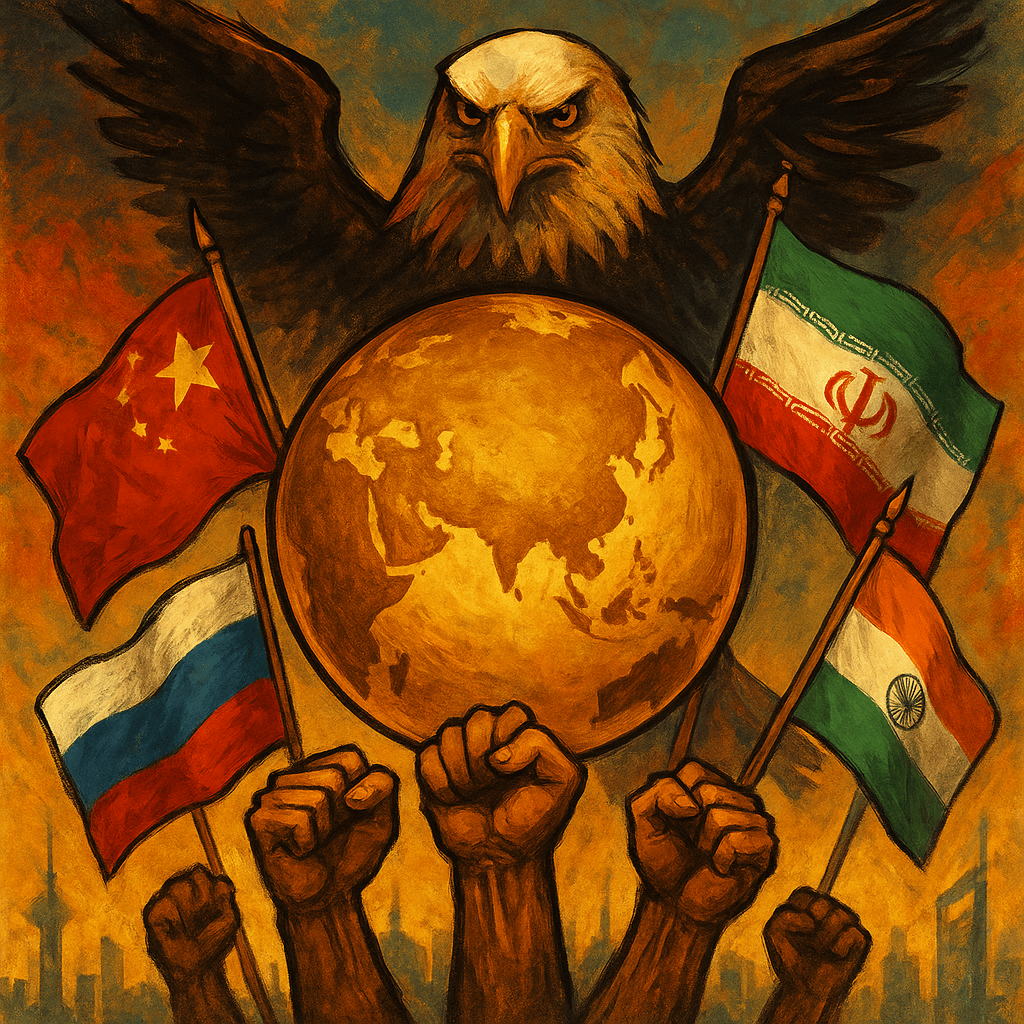
From Tianjin to Tehran, the Shanghai Cooperation Organization emerges as a counterweight to U.S. hegemony, exposing the crisis of imperialism and the birth of a multipolar world order.
By Prince Kapone | Weaponized Information | September 1, 2025
Dissecting the Wire Service of Empire
Christopher Bodeen’s piece for the Associated Press, published on September 1, 2025, is presented as straight reporting: the Shanghai Cooperation Organization has met in Tianjin, China; the leaders of Russia, China, India, and their allies have shaken hands; the world is reminded of the 80th anniversary of Japan’s surrender. But the mask of neutrality slips the moment the pen touches the page. This is not reporting—it is empire speaking through a wire service, and empire always speaks in half-truths and coded alarms. The SCO is called “murky,” its goals “uncertain,” its members “foes of the West.” The vocabulary is not descriptive but prescriptive: multipolarity must be cast as suspicious, even illegitimate, so that U.S. dominance appears natural, eternal, unquestioned.
To understand why Bodeen writes this way, one must look at the man and the machine he represents. His career is carved from years in Beijing and Taipei, the perfect perch for a professional courier of Washington’s anxieties about China. His work reproduces the default assumptions of U.S. foreign policy: that when others unite, it is posturing; when the U.S. dictates, it is leadership. The Associated Press itself—this vaunted “independent” news cooperative—has long been a pillar of the American information order. It sells the fantasy that corporate news is free of capital’s fingerprints, even as its business model depends on access to Pentagon briefings and the steady drip of State Department talking points. AP does not need to invent lies. Its job is subtler: to curate the silences, to plant the seed of suspicion, to ensure that every reader in the imperial core views alternative power as chaos, and U.S. hegemony as order.
Bodeen leans on familiar amplifiers to do his work. Scholars like Dali Yang of the University of Chicago and June Teufel Dreyer of the University of Miami appear as neutral experts, yet both are nestled in the academic-military nexus that feeds on Washington’s contracts and anxieties. Their quotes provide the sheen of authority while reinforcing the line that the SCO is all smoke, no fire. The routine is as old as colonial anthropology: gather a few “respectable” voices, dress the prejudice in scholarly garb, and feed it to the public as fact.
Look at the propaganda devices at play. The SCO is framed as a club of “clear foes,” activating fear without evidence. The absence of context is deafening: no mention that the SCO represents nearly half of humanity, no acknowledgment of its economic weight. Instead, the reader is nudged toward an emotional response—anxiety that the U.S. faces encirclement. Xi Jinping’s call for multipolarity is brushed off as personal vanity, not systemic necessity, while India’s membership is painted as a destabilizing nuisance rather than a strategic pivot. This is cognitive warfare by omission, where what is left unsaid carries more power than what is printed. Even the oldest Orientalist tropes resurface: Asian-led cooperation is portrayed as unstable, driven by rivalries and egos, unlike the supposedly rational and disciplined alliances of the West.
What Bodeen delivers is not analysis but projection. U.S. elites see their own fractures mirrored in the SCO and hope readers will mistake their paranoia for universal truth. The empire cannot admit that its own sanctions and tariffs are driving states together, or that its dollar weaponization has birthed dedollarization. So the story must be inverted: multipolarity becomes vanity, cooperation becomes instability, sovereignty becomes a threat. This is the Associated Press at work—not the bearer of neutral fact, but the stenographer of empire’s fears.
Unearthing What Was Buried Beneath the Headlines
The Associated Press article gives us a skeletal outline of the Shanghai Cooperation Organization summit: the dates, the location, the cast of leaders, the ceremonial gestures. It tells us that the SCO now has ten members—China, Russia, India, Pakistan, Iran, Belarus, Kazakhstan, Kyrgyzstan, Tajikistan, and Uzbekistan. It reminds us that India and Pakistan joined in 2017, Iran in 2023, and Belarus in 2024. It admits that the bloc has held joint military drills, discussed trade and freight links, and signed commemorative documents for the 80th anniversary of the defeat of Japanese fascism. In this stripped-down factual register, there is no lie—only a void. The power of propaganda is not what it says but what it leaves unsaid.
What is omitted is far more telling. The SCO represents around 40% of the world’s population and nearly a third of global GDP. It is not just a loose talking shop but a platform that has begun to integrate with BRICS+ and the Belt and Road corridors, creating the skeleton of a new economic architecture beyond Washington’s reach. The bloc has built security frameworks that explicitly oppose U.S. bases in Central Asia, a rebuke to the endless NATO expansion that has destabilized the region since 2001. Its member states coordinate on counterterrorism, energy infrastructure, digital infrastructure, and increasingly, currency settlement mechanisms designed to erode the tyranny of the dollar. These details vanish from the AP’s telling, as if the organization is a dinner club rather than a material challenge to U.S. domination.
India’s position is flattened into caricature. In reality, New Delhi practices hedging: it sits in the U.S.-backed Quad alliance even as it deepens trade with Russia and energy ties with Iran. Its participation in SCO is not a fluke but a deliberate strategy to preserve sovereignty by refusing to be locked into Washington’s orbit. The AP article gestures at “tensions” but avoids mentioning the shared material interests that keep India in the fold: cheap Russian oil, access to Chinese markets, and the space to maneuver outside the chokehold of Western economic coercion. The hedging posture may appear contradictory, but it is precisely this contradiction that makes India a pillar of multipolar politics.
The historical backdrop is critical. The SCO was born in 2001 as a response to U.S. militarism after 9/11, when Washington attempted to plant bases across Central Asia. Its expansion has tracked the cracks in the U.S. imperium: after the 2008 financial meltdown, it began offering loans and infrastructure support—including a $10 billion Chinese relief package—as Washington reeled. NATO’s withdrawal—widely seen as a strategic humiliation in Afghanistan—gave added impetus to regional autonomy. Today the SCO operates as a counterweight to the G7, stitching together alternative routes for trade and survival, not by imitation but by necessity.
Here lies the heart of the contradiction. Western commentators frame the SCO as unstable, yet ignore the open fractures within NATO and the EU. They sneer at Xi Jinping’s multipolar rhetoric, yet cannot explain why half the world’s governments increasingly echo it. They cast India as a destabilizer, yet fail to ask why Washington cannot secure New Delhi’s loyalty despite lavish courtship. Most of all, they bury the truth that U.S. policy itself has been the greatest accelerator of multipolarity. Trump 2.0 thunders against BRICS+, against dedollarization, against the very idea of a multipolar world order. He denounces them as existential threats to U.S. supremacy. And yet his own policies—universal tariffs slapped on “friends and foes” alike, the endless sanction regimes, the crude weaponization of the dollar—push the BRICS core tighter together. In trying to throttle alternatives, Washington is midwifing them. The empire digs its own grave and calls the sound of the shovel “leadership.”
From Crisis of Imperialism to Multipolar Recalibration
If the Associated Press paints the SCO as a foggy gathering of malcontents, our task is to reframe it through the clear lens of history and struggle. The first concept that must guide us is the Colonial Contradiction. Capitalism was born in the theft of Indigenous land, the enslavement of Africans, and the conquest of Asia and the Americas. That contradiction never disappeared—it simply evolved into new forms of exploitation and control. Every Western headline that dismisses the SCO as unstable is an echo of that same colonial arrogance, assuming that sovereignty only has meaning when blessed by Washington, Brussels, or London.
Yet this arrogance no longer rests on a secure foundation. We are living in the throes of a Crisis of Imperialism. The United States and its allies once strutted across the world stage, proclaiming a unipolar order after 1991. But decades of endless war, financial meltdowns, ecological collapse, and domestic rot have eaten away at the core. The dollar, once seen as untouchable, is weaponized through sanctions and asset seizures to such a degree that it drives states into alternative systems. The military machine, stretched across a thousand bases, is less a symbol of confidence than of panic. The empire is decaying, and its own strategies accelerate the decay.
In this moment of unraveling, the West has turned to Hyper-Imperialism. No longer able to dominate by consent, it rules by blockade, by hybrid war, by spasms of militarized brinkmanship. Sanctions are piled on dozens of nations; media systems are weaponized to delegitimize any alternative; drones and special forces operate as permanent counterinsurgency. Hyper-imperialism is not strength but desperation, the frantic attempt of a declining system to impose total control as its legitimacy collapses. Trump’s own tantrums against BRICS+ and dedollarization are a symptom of this desperation: the U.S. lashes out at the very multipolar tendencies it has birthed through its own excesses.
Against this backdrop, the SCO cannot be reduced to a talking shop. It is a concrete expression of what we call Multipolar Recalibration. China, Russia, India, Iran, and their allies are not unified in every policy or free of contradictions. But together they are building pathways that step outside the strictures of unipolar command. Freight routes that bypass Western chokepoints, energy deals settled in non-dollar currencies, military exercises that train without NATO supervision—all of these are pieces of a world in which the Global South asserts its right to determine its own course. The recalibration is not smooth, but it is real. It marks the passage from a world strangled by a single imperial center to one shaped by a plurality of sovereign voices.
This is what terrifies Washington. The SCO summit in Tianjin is not just a pageant; it is another stone laid in the foundation of a Multipolar World Order. The Associated Press would rather mock it, trivialize it, or erase its material weight. But the proletariat and peasantry of the Global South know otherwise: multipolarity is not an academic phrase but a condition of survival. It is the chance to break free of the sanctions, the debt traps, the coups, the endless theft dressed up as “rules-based order.” The crisis of imperialism is real, and so too is the emergence of multipolar sovereignty. What we are witnessing is history breaking its chains in real time, and no headline can bury it.
Make It Real: Build Dual and Contending Power at Home
A headline won’t liberate us; organization will. If the wire services of empire tell us to scoff at Tianjin and shrug at coordination among the nations outside Washington’s leash, our answer is simple: we don’t wait for permission to act. We build where we stand. The task is to turn clarity into muscle—constructing Dual and Contending Power that can survive propaganda cycles, outlast election mood swings, and make solidarity material. The point is not to cheer from the bleachers while others experiment with new trade routes and currency settlements; the point is to plug our neighborhoods, unions, tenant councils, and study circles into a living infrastructure that denies the empire its favorite weapons: isolation, financial chokeholds, and ignorance.
Start with the money. Choose one concrete target—your city’s custodian bank, a pension fund, or a university endowment—and force daylight on its role in sanction enforcement and war financing. Demand divestment from the worst offenders, insist on procurement rules that don’t launder blockades through “compliance,” and make the case in plain language: our wages and tuition will not bankroll sieges abroad or repression at home. Pair this with an on-the-ground alternative: cooperative remittance pathways, local credit unions, and community finance that refuse to treat whole nations as unbankable. That is how a slogan becomes a scaffold.
Build the megaphone next. The imperial news machine counts on your exhaustion; meet it with a disciplined media stack. Form neighborhood “headline brigades” that translate dense international shifts into worker-common sense and push rapid rebuttals when the wires recycle talking points. Equip them with a secure, shared library of explainers, maps, and short videos that others can fork and reuse. Don’t brawl for clout—coordinate for reach. Treat every platform algorithm like a factory foreman: learn its quirks, beat its quotas, and organize shifts so the story never sleeps.
Link shop floor to world floor. Pass resolutions in your union locals recognizing the right of nations to develop outside Washington’s dictates; tie that principle to immediate demands—no strikebreaking shipments for sanctions, no police exchange junkets with foreign repression forces, no tech-for-surveillance contracts in your workplace. If you’re not in a union, organize where you are: delivery hubs, food service, schools, gig networks. Make internationalism a condition of everyday life—what we buy, ship, code, insure, and teach.
Protect the flank. Set up legal-defense pods for students and workers targeted by “foreign influence” smears; train rapid-response teams for doxxing, deplatforming, and HR retaliation. Map local power—city councils, procurement offices, port authorities—and introduce model ordinances that bar municipal cooperation with extraterritorial sanctions. If they call it symbolic, smile and pass the next one. Symbols become structures when they stack.
Finally, keep the compass steady. Host standing study circles—short, regular, practical—where new comrades can grasp why summits abroad echo in grocery prices, hospital bills, and rent at home. Teach people how dollar weaponization reaches their paycheck, how tariffs boomerang through supply chains, how “security partnerships” turn into cameras on the corner. Then send them back to their blocks with a job to do this week. Victory won’t look like one big headline; it will look like a thousand small institutions that answer to working people rather than to the empire’s accountants. Build them, defend them, federate them—and the old order will find itself surrounded, not by tweets, but by a world already under construction.
 Weaponized Information
Leave a comment