How imperial propaganda turns testimony into tragedy, and why Ahn Hak-sop’s final walk demands we join living struggles for Korean sovereignty
By Prince Kapone | Weaponized Information | September 1, 2025
Framing Sovereignty as Senility: Excavating the BBC’s Narrative on Ahn Hak-sop
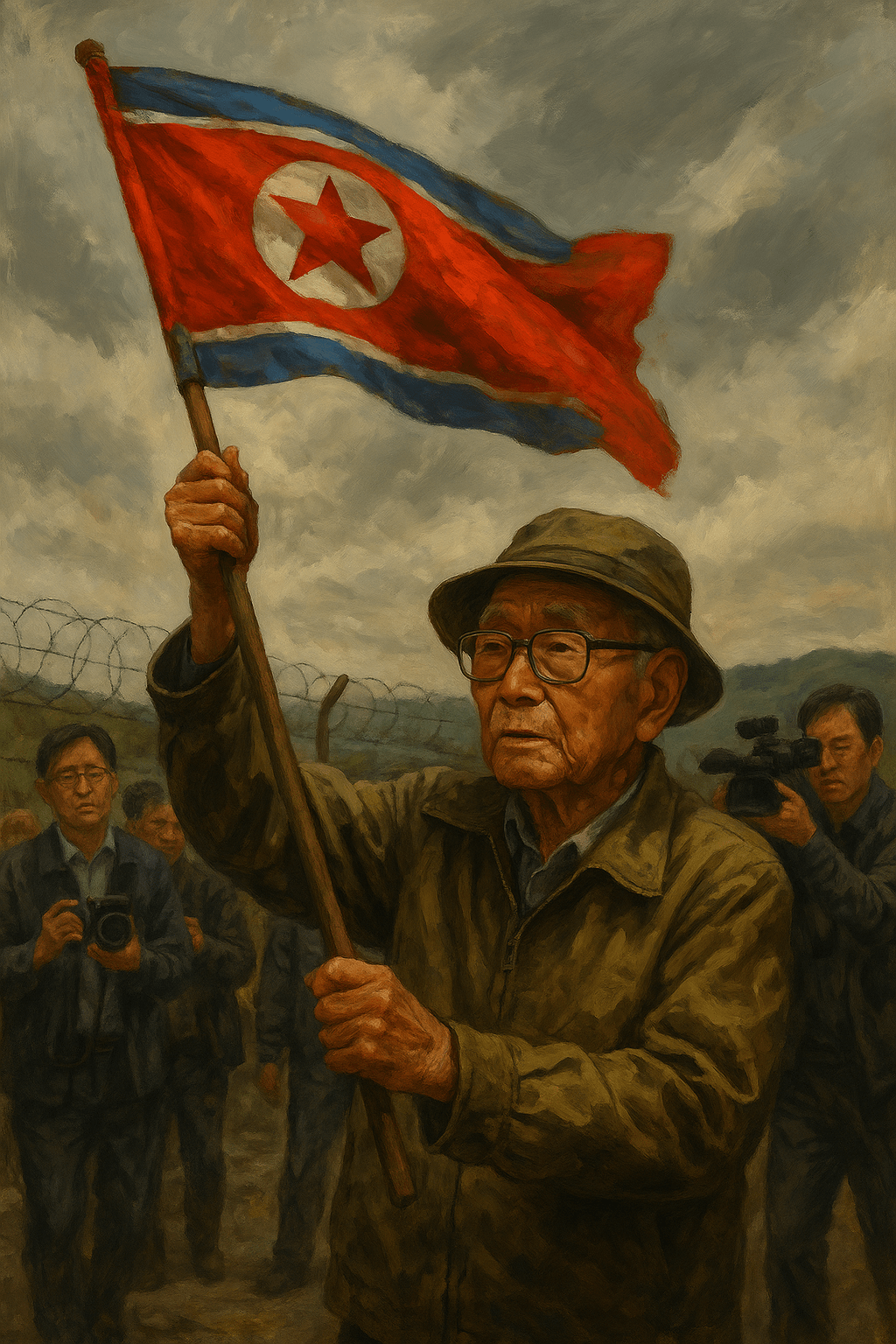
The story the British press wants us to absorb is simple: a frail old man, bewitched by communist myths, makes a quixotic attempt to cross a militarized border. In the BBC’s feature on Ahn Hak-sop, the camera lingers on age and illness—pulmonary edema, a trembling walk, the flag in his hands—until politics dissolves into pathos. Sovereignty is recast as nostalgia; conviction becomes confusion. The effect is anesthetic: we are invited to feel for the man while dismissing the meaning of his life. It’s a familiar trick of imperial storytelling—turn the colonized subject into a parable and the system that produced his ordeal disappears behind the soft focus.
Notice the frame. Ahn’s words—“a land free from imperialism”—are quoted but fenced off, treated as a kind of quaint superstition rather than a diagnosis rooted in history. His decades of refusing a “conversion” oath are presented as stubbornness, not as a refusal to surrender political personhood. The piece laces in standardized contrasts—“reclusive dictatorship” versus “wealthy, powerful democracy”—while tiptoeing around the machinery that makes such contrasts possible. The border is a stage, not a wound; the alliance is a background fact, not a structure of domination. By design, the reader is nudged toward a conclusion: this is a tragic human interest story, not an indictment of the order that caged him.
The omissions are the argument. The article nods to torture and forced “conversion,” then moves on, as if the point were merely biographical color and not evidence of an ideological carceral regime. It gestures vaguely at history—Japanese rule, war, armistice—without following the thread to the present, where the same power geometry still organizes Korean life. We are told the South “changed” into a “wealthy democracy,” but not asked what bargains, bases, and bargains-for-bases underwrite that wealth. “Change” here is a euphemism for alignment.
There’s also the choreography of emotion. The reader is made to feel pity for the man and pride for the South, while suspicion is reserved for any analysis that names the empire. When Ahn speaks of imperialism, the text quietly pathologizes his memory—“propaganda,” “unwavering belief,” “delusion”—rather than engaging his claim. That is cognitive warfare at the level of tone: treat anti-imperialist language as a symptom to be managed, not an argument to be answered. It’s how you empty a life of its politics while pretending to honor it.
And we should be clear about the mouth that speaks. The BBC operates under a Royal Charter and a public funding model that casts it as “independent,” but independence and ideology are not the same thing. In the long Cold War afterlife, the World Service is openly counted as part of Britain’s “soft power,” a civil veneer for strategic messaging abroad. You can see the architecture in the budgets and briefings; you can hear it in the cadence of the copy. None of this means every fact is false. It means the angle is faithful—to the needs of empire, not to the sovereignty of those it narrates.
Read the piece again with that in mind. Ahn Hak-sop is not a cautionary tale about gullibility; he is a witness. He is saying what the format cannot allow: that domination survives by laundering itself as common sense. He refuses the laundering. He insists on dying in a land where the word “independent” is not an insult. The article wants you to see a man out of time. What I see is a man who never surrendered the right to name his condition, even when the price for telling the truth was a lifetime behind bars. Strip away the sentimental fog and the through-line is obvious: this is not the tragedy of an old believer—it is the continuity of an unfinished liberation, narrated by a broadcaster that cannot afford to admit its part in keeping it unfinished.
Facts Buried Beneath the Frame: Extracting the Historical Record
Beneath the sentimental fog of the BBC’s narrative sits a bedrock of facts, some acknowledged in passing, others erased altogether. What the article admits is straightforward: Ahn Hak-sop was captured in 1953, spent forty-two years behind bars, endured torture for refusing to sign an oath of “conversion,” and walked with a North Korean flag in his final attempt to cross the border. These are not small details; they are the skeleton of a life shaped by war, imprisonment, and resistance. Yet when they are placed within a frame that treats them as curiosities rather than indictments, the truth is gutted of its teeth.
Consider first what is withheld. The BBC references Ahn’s refusal to sign “conversion” papers but never explains what that practice really was: a program of psychological and physical coercion designed to erase political identity, run inside South Korean prisons with U.S. oversight. The Truth and Reconciliation Commission of Korea documented beatings, torture, and fabricated oaths pressed onto prisoners’ fingers to simulate agreement. These were not isolated incidents but systemic attempts to force ideological surrender. Without that context, the reader is left with a vague sense of stubbornness instead of a clear picture of organized repression.
The timeline is another omission. After Japan’s defeat in 1945, the United States imposed a military government in the South, complete with military law and colonial administration, before handing over power to a client regime in 1948. As historian Bruce Cumings shows, this was not liberation but substitution: Japanese police were recycled under American command, and anti-colonial Koreans were sidelined or crushed. When Ahn recalls leaflets warning that “US military law” would replace Japanese rule, he is not trafficking in fantasy—he is recalling the reality of his youth. Yet the BBC reduces such memory to propaganda rather than evidence.
War crimes also vanish from view. Between 1950 and 1953, the United States dropped more bombs on Korea than in the entire Pacific theater of World War II. Entire towns were leveled with napalm; massacres such as those at No Gun Ri were carried out against civilians. Reports from the Asia-Pacific Journal document in graphic detail how American planes executed saturation bombing of North Korean towns—including elementary schools and neighborhoods—as part of a strategic campaign of terror and destruction. Declassified U.S. military files, especially the record group that includes the No Gun Ri orders, reveal that executions of villagers and firing on refugee columns were part of standard operating procedure. The No Gun Ri massacre is one key example: refugee groups were strafed and bombed under orders to treat civilians as hostile infiltrators. That Ahn and thousands of others experienced capture, torture, and forced conversion within this landscape is not an unfortunate footnote but a direct continuation of imperial policy. To omit this is to render his life unintelligible.
The economic record tells a similar story. South Korea’s prosperity, celebrated in the BBC piece as democratic triumph, is also the fruit of foreign garrisons and dependency. The U.S. still stations approximately 28,500 troops in South Korea, one of its largest overseas deployments—second only to Japan—and embedded within long-standing strategic and imperial military. This presence is not symbolic—it secures trade routes, underwrites financial flows, and disciplines politics. Meanwhile, the North’s crisis in the 1990s is presented as the inevitable collapse of misrule. Absent is the role of sanctions, trade collapse after the Soviet Union’s disintegration, and international isolation. Scholars like Hazel Smith have demonstrated that the famine in North Korea was driven as much by external blockades and sanctions as by domestic bureaucratic failures. To pretend otherwise is to shift causality from global siege to local pathology.
Seen clearly, the contradictions line up. Ahn’s refusal to “convert” was not eccentricity but fidelity to a political life denied him in captivity. His longing to be buried in the North was not senile obsession but a demand to rest in a sovereign land. His story is evidence of how Korea’s division was never a natural outcome of history but the product of an imperial settlement—one that persists in every U.S. base, every sanctions regime, and every sentimental obituary that treats anti-imperialist conviction as delusion. To extract the facts is to recover what the propaganda works to bury: that Ahn’s life is not a human-interest footnote but a living archive of empire, imprisonment, and unfinished liberation.
From Tragedy to Testimony: Reframing Ahn Hak-sop’s Life Through Revolutionary Analysis
Once the propaganda fog clears, Ahn Hak-sop’s story stops reading like a sad tale of misplaced loyalty and instead becomes something sharper: a testimony to the unfinished struggle for sovereignty on the Korean peninsula. What the BBC pathologizes as delusion is, in reality, a refusal to surrender to the empire’s script. His life carries the imprint of a larger contradiction—one that begins with colonialism, mutates into U.S. military governance, and hardens into permanent division backed by foreign troops and sanctions. This is not nostalgia; it is historical continuity. To call his wish to die in a sovereign land “irrational” is to deny the rationality of resistance itself.
This is where the vocabulary of empire must be turned inside out. What South Korea calls its “democratic prosperity” is not merely the fruit of industrious modernization but of what can be named the Colonial Continuum: the smooth handover from Japanese to American domination, legitimized through constitutions and alliances that lock sovereignty into dependency. Ahn’s life behind bars exposes another imperial tool: Psychological Operations (PSYOP). Torture and coerced conversion were not accidents of brutality; they were deliberate tactics to fracture political commitment and manufacture consent. The BBC touches this only as anecdote, but it is the centerpiece of the imperial project.
The ideological policing of “reds” in the South also reveals how repression was modernized. Surveillance, informant networks, and anti-communist witch hunts became everyday tools of governance. What began in prison cells has expanded into the digital age, where dissent is tagged, tracked, and silenced. This is the mark of Technofascism: the fusion of capitalist development, military tutelage, and technological surveillance, producing not freedom but a high-tech cage. Ahn’s refusal to convert, his decades of humiliation and torture, are precursors to the apparatus now pointed at workers, students, and dissidents across the South.
His conviction that the U.S. is the main barrier to reunification also places his life in the theater of Hyper-Imperialism. The peninsula is not merely a local dispute between two governments but a frontline in Washington’s global strategy: bases in Korea extend U.S. reach into China, Russia, and the Pacific, anchoring a system of forward deployment and sanctions warfare. The famine in the North is blamed on local failure, yet its roots lie in this global chokehold—an imperial logistics of hunger that criminalizes self-sufficiency and weaponizes scarcity. The BBC omits this because to admit it would mean acknowledging empire not as a backdrop but as the protagonist of the Korean story.
Dialectically, what is framed as instability or tragedy is better understood as counterinsurgency against resistance. The imprisonment of POWs was not a matter of security—it was ideological war. The persistence of U.S. troops is not protection—it is colonial garrison. The sanctions that strangled the North are not humanitarian safeguards—they are economic warfare. Every contradiction in Ahn’s story traces back to the crisis of imperialism itself, struggling to preserve order by criminalizing sovereignty and branding anti-colonial conviction as madness.
Seen from the standpoint of the global proletariat, Ahn Hak-sop is not a deluded elder but a comrade who never signed his humanity away. His testimony lines up with other witnesses of unfinished liberation: Palestinians who refuse displacement, Cubans who defy blockade, Venezuelans who resist economic piracy. His body, broken by prison and age, still carried the North Korean flag because he understood something the BBC cannot permit: that political life is life itself, and to die without sovereignty is to die as a captive. His demand was simple but profound: to be buried not as a colonial subject but as a free human being. In that demand, his life becomes more than biography—it becomes a mirror of the Korean nation, divided not by fate but by empire, and still awaiting its liberation.
Carrying the Flag Forward: Mobilizing Around Living Struggles
Ahn Hak-sop’s final walk toward the border is not a relic of the past but a reminder that conviction must be carried forward through collective struggle. His testimony calls us not to invent new blueprints in his name but to join the currents already flowing across the world—movements that confront the same imperial chokehold which shaped his life. The task is not to imagine resistance in the abstract, but to strengthen it where it already exists, in the streets, assemblies, and campaigns waging this fight today.
Across the Korean peninsula, groups like Korea Peace Now!, Veterans for Peace’s Korea Peace Campaign, and the Korea Peace Appeal are mobilizing to end the war formally, shut down U.S. bases, and lift sanctions. Diaspora-led formations such as Nodutdol’s US Out of Korea campaign are linking arms with anti-imperialist coalitions like the ANSWER Coalition, CODEPINK, and the Black Alliance for Peace. Feminist voices through Women Cross DMZ continue to insist that peace and reunification must be led by the people themselves, not dictated by foreign garrisons.
Beyond Korea, these struggles resonate with the global fight against sanctions and militarism. The campaigns against blockades in Cuba and Venezuela, the demands for an end to U.S. bases in Okinawa and Djibouti, the calls for Palestinian self-determination—these are not separate struggles but interwoven threads of the same fabric. The names of the organizations are different, but the enemy they confront is the same architecture of hyper-imperialism that sought to erase Ahn’s political life. To support them is to amplify a chorus already singing against empire.
Mobilization, then, is straightforward. Join local chapters of Korea Peace Now!, sign and spread the Korea Peace Appeal, support Veterans for Peace and CODEPINK in their campaigns, stand with Nodutdol and diaspora networks, and link these to the broader anti-war and anti-racist coalitions in your own cities. The work is underway; the infrastructure is built. What remains is to swell the ranks, to connect the fights, and to carry forward the flag Ahn refused to drop. His wish to rest in a sovereign land is the same demand echoed by millions across the Global South. To answer him is not to mourn, but to organize with those already on the frontlines.
 Weaponized Information
Leave a comment