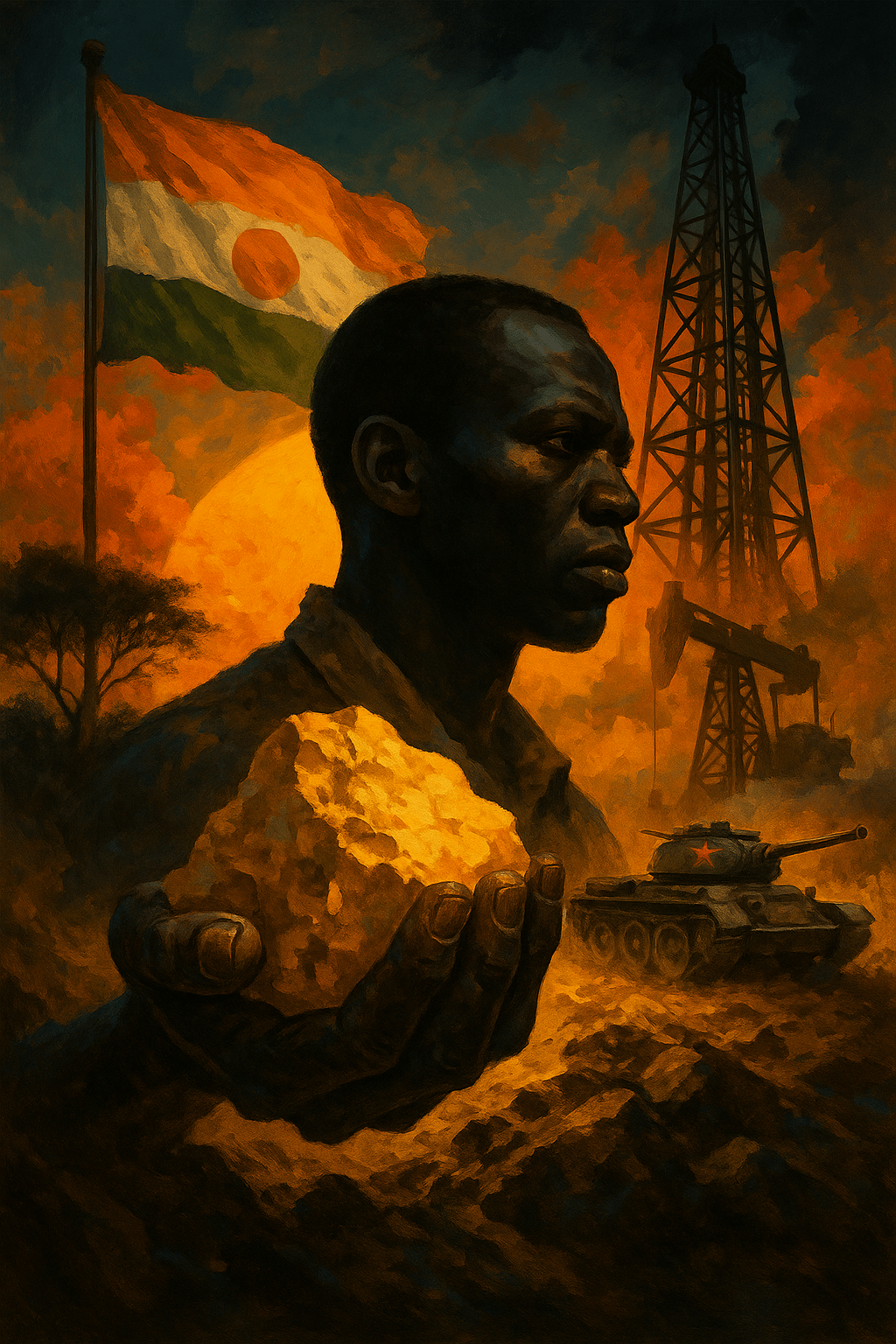
The BBC paints Niger’s sovereignty as a fantasy, erasing African agency in favor of imperial rivalry. The record shows decades of colonial plunder and neocolonial extraction that lit France while Niger stayed dark. In the crisis of imperialism, Niger turns to multipolar recalibration, opening cracks in the world system. Our task in the Global North is to join these cracks, linking their sovereignty to our struggles at home.
By Prince Kapone | Weaponized Information | August 27, 2025
The Script of Outsmarting and the Invention of Impossibility
On August 26, 2025, the BBC ran Paul Melly’s story, “Russia outsmarts France with nuclear power move in Niger”. On the surface it looks like a straight piece of news: Russia signs a cooperation deal with Niger to build a nuclear sector, France gets shoved aside, and the writer spends most of the piece wondering if the project will ever happen. But the headline gives the whole game away. It isn’t Niger that made a sovereign move. No, the drama is staged as a clever chess match between Moscow and Paris, with Niger treated like an empty square on the board. From the very first words, the African people disappear.
The author behind this script, Paul Melly, isn’t just some reporter. He’s tied to Chatham House, one of Britain’s top policy factories. These are the people who brief ministers, consult for corporations, and shape imperial strategy with a polite accent. Melly doesn’t write from Niamey’s streets or the uranium pits of Arlit—he writes from the boardrooms of empire. His job is to translate African defiance into a language that calms the nerves of European investors and foreign office bureaucrats.
And the megaphone he uses is the BBC, Britain’s state broadcaster. The BBC wears a mask of neutrality, but it’s a state institution through and through. Its Africa coverage is never really about Africa—it’s about managing the anxieties of the West. Decade after decade, it tells the same story: Africa as dependent, unstable, barren, always in need of a steady European hand. This isn’t journalism; it’s the ideological soundtrack of empire.
Look closely at the propaganda devices tucked into this text. The headline “Russia outsmarts France” erases Niger from its own story. The word “outsmarts” suggests trickery and cunning, as if Moscow pulled a rabbit from its hat while Niger sat there waiting to be acted upon. That little word does the heavy lifting of imperial framing: Africans don’t make choices, they get manipulated.
The next trick is the drumbeat of doubt. The article tells us again and again that a nuclear plant in Niger is “impractical,” that it “may never happen,” that the challenges are “huge.” This repetition is not analysis—it’s hypnosis. The reader is taught to see Niger’s ambition as naïve from the start. The aim is not to explain but to ridicule, to paint self-determination as a fantasy.
Then comes the cloud of insecurity. Phrases about “jihadist groups” and the “fragile Sahel” don’t appear to provide evidence or detail. They hang in the text like a permanent curse, as if instability is the natural condition of Africa. It’s a lazy trick: you don’t have to prove Niger can’t run a nuclear plant, you just have to remind the reader that the region is “dangerous” and let the assumption do the work.
Another sleight of hand is how people’s anger at France is described. The author calls it “resentment,” as if decades of plunder and denial of development can only produce an irrational grudge. Stripped of its political content, Nigerien resistance becomes nothing more than bitterness to be exploited by outsiders. In this way, the rational demand for sovereignty is rewritten as childish emotion.
And notice how the story closes. Russia is praised for “correctly reading the political mood,” while Niger remains voiceless, framed only as the soil where Russia and France plant their moves. Even when the piece acknowledges popular feeling, it is never Niger’s agency that matters, only Russia’s cleverness. Africans remain props in the theater of European decline.
This is the work of propaganda: erase the subject, repeat the doubt, saturate the air with insecurity, pathologize resistance, and hand agency to outsiders. It is not neutral reporting—it is narrative discipline, crafted to keep the colonial hierarchy intact. The story teaches us not to see Niger rising, but to see empire stumbling, with Russia waiting in the wings. The people themselves, as always in this script, are written out.
From Omission to Grounded Record
Let’s start from what the BBC article actually says: that Russia’s Rosatom signed an agreement with Niger for nuclear cooperation; that Niger’s junta nationalized French uranium operations run by Orano; that around 1,400 tonnes of uranium concentrate are now stalled after export blocks; that the Imouraren deposit, once held by Orano, was revoked; that foreign suitors like China and Iran briefly showed interest; that Orano’s Niger director was detained; and that Russia has “seized on Nigeriens’ sense of resentment.” These are the explicit, reportable facts within the BBC text itself.
Now let’s breathe life into the silences. For over fifty years Niger’s uranium has powered nearly a third of France’s electricity while most Nigeriens remained in darkness. Eighty percent of the population still lacks access to electricity. Contracts structured by neocolonial arrangements guaranteed cheap supply to Paris while barring Niger from industrial transformation. These are not minor details—they are the foundation of Niger’s push for nationalization.
Next, consider technical competence. Rosatom is already building nuclear plants abroad—Egypt’s El Dabaa is underway, and Turkey’s Akkuyu is being constructed under a build-own-operate model. So when the BBC frames Niger’s ambitions as fanciful, it ignores the fact that Rosatom has proven itself in so-called “challenging” zones.
Geopolitics too is skipped over. Mali, Niger, and Burkina Faso broke from ECOWAS and formed the Alliance of Sahel States, a mutual defense and development bloc. The AES explicitly rejects Western tutelage and has established a regional development bank to secure financial independence. These are organized, sovereign choices, not desperate coups.
And the global uranium market? Demand is surging as nuclear power is revived to meet climate goals. Russia currently controls around 40–46% of global uranium conversion and enrichment capacity, giving it a strategic chokehold. To tie Niger’s deposits to Rosatom is not fantasy—it is economic leverage with teeth.
Security concerns in the BBC piece are presented as natural conditions of the Sahel, but NATO’s destruction of Libya in 2011 destabilized the region. French counterinsurgency campaigns entrenched violence rather than resolved it. The insecurity is external in origin, not inherent. But the BBC’s omission transforms imperial violence into African chaos.
Put together, the record is clear: Niger’s nationalization and Russia’s overture emerge in a context of half a century of extraction without development; Rosatom has the track record to deliver; the Sahel bloc has reorganized around sovereignty; uranium demand is rising; and regional insecurity has the fingerprints of NATO and France all over it. None of this registers in the BBC’s version. The omission is not an oversight—it is the story.
From Colonial Contradiction to Multipolar Recalibration
The real story of Niger’s uranium is not about Russia “outsmarting” France, as the BBC claims. It begins with the Colonial Contradiction itself. French colonialism created an imperial division of labor: Niger supplied raw materials, while the imperial core processed, profited, and industrialized. This division locked Niger into permanent underdevelopment, dependence, and exploitation. The uranium that lit French cities condemned Niger’s miners to poverty and radiation. The contradiction was baked into the structure of the capitalist world system.
After independence, this logic did not disappear. It mutated into Neocolonial Extraction, where the French state and its corporate proxies like Orano enriched themselves under the guise of partnership. The fruits of Niger’s earth flowed outward to the metropole, fueling French prosperity while Niger itself remained among the least electrified countries in the world. Development was not denied accidentally—it was systematically stolen.
Today, however, the ground beneath this system is shifting. A prolonged Crisis of Imperialism has weakened the Western bloc. Endless wars, declining productivity, and global resistance are breaking the spine of unipolar dominance. Into this breach step Russia and China, offering an alternative model of development—however contradictory or incomplete—that challenges the monopoly of the old colonial powers. Nuclear energy cooperation, infrastructure building, and finance outside the dollar system all represent cracks in the edifice of empire.
Niger is not blind to this shift. By nationalizing Orano’s operations and turning toward Rosatom, it is engaging in what we can call Multipolar Recalibration—the dialectical opposite of Imperialist Recalibration. Where the West uses sanctions, lawfare, and narratives to tighten its grip, Niger uses alignment with emerging poles to loosen it. This recalibration does not end dependency overnight, but it creates room to maneuver and opens doors that France kept locked for decades.
Each act of recalibration widens the fractures in the capitalist-imperialist world system. The monopoly of the West is breaking down; the unipolar order cannot contain the growing centrifugal pull of Multipolarity. And within these fractures lies the potential for something more profound than pragmatic alignment: the possibility of Revolutionary Rupture. A world where nations like Niger no longer just escape French exploitation, but overturn the entire hierarchy that made such exploitation possible.
From this vantage, the BBC’s story unravels. What it calls “resentment” is in fact the rational politics of sovereignty. What it calls “impractical” is the assertion of a right long denied. And what it calls “outsmarting” is actually the weakening of an imperial system whose time is running out. In the hands of Niger’s people, uranium is no longer just yellowcake for France—it is a lever prying open the future.
Mobilization: Linking the Sahel to the Belly of the Beast
Solidarity does not start from zero. Organizations are already in motion around the Sahel struggle. The Pan Africanism Today Secretariat is building international support for the Alliance of Sahel States. The US Out of Africa Network and Shut Down AFRICOM campaign connect Niger’s rejection of foreign bases to anti-imperialist fights worldwide. Climate justice collectives like Wretched of the Earth in Britain bring the question of ecological debt and anti-extraction politics into the heart of the imperial core. And groups like the International Coalition to Ban Uranium Weapons highlight the deadly legacy of uranium itself, pointing directly to the system of nuclear apartheid.
The call to revolutionaries, socialists, progressives, multipolar and anti-imperialist forces in the Global North is simple: do not build parallel campaigns from scratch—organize with and amplify these forces already on the ground. Push their demands into unions, climate networks, student organizations, anti-war movements. Use their work to pierce the walls of imperial media and turn Niger’s struggle for uranium sovereignty into a living question in the streets of Paris, London, and New York.
But solidarity is not only outward-facing. The colonial contradiction that shackled Niger to underdevelopment is the same system that delivers austerity, wage stagnation, police repression, and debt peonage to workers and the oppressed in the imperial core. When Niger is told it cannot industrialize, we are told we cannot afford healthcare. When their uranium is stolen to light Europe, our communities are told to tighten belts as utility companies hike prices. The fight for sovereignty in Niamey is bound up with the fight for dignity in Detroit, Marseille, and Manchester.
To deepen this connection is to see Niger’s multipolar recalibration as our own opportunity. Every fracture in the imperial system abroad creates space for resistance here at home. Our task is not charity but shared struggle—to bring down the same system of exploitation and hierarchy that suffocates Niger and starves us. Their sovereignty is a frontline of our emancipation.
 Weaponized Information
Leave a comment