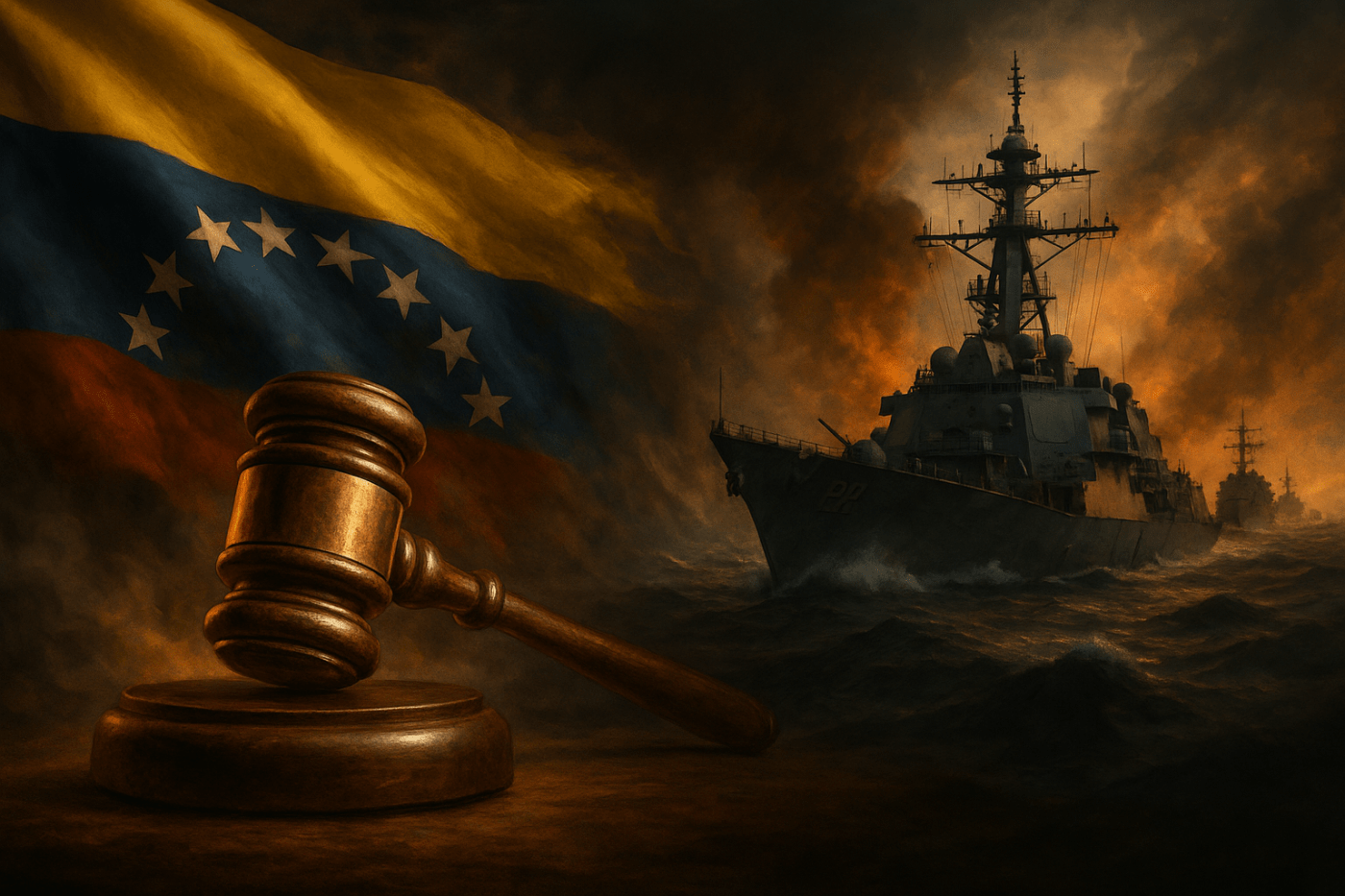
The U.S. indictment of Nicolás Maduro was never about drugs. It was the opening shot in a hybrid war—lawfare, sanctions, propaganda, and now destroyers off Venezuela’s coast. Exposing the smear means exposing the empire itself.
By Prince Kapone | Weaponized Information | August 26, 2025
From Indictments to Destroyers – How a Smear Becomes a War Plan
On March 26, 2020, the U.S. Department of Justice stepped to the podium and tried to recast an elected president as a “narco-terrorist.” They filed their charges in the Southern District of New York, as if a Manhattan courtroom had suddenly become a world tribunal. No international body — not the United Nations, not the International Criminal Court, not the UN Office on Drugs and Crime — ever signed off on this performance, as even the Congressional Research Service and the American Journal of International Law observed. The point was never law — the point was spectacle, to paint Venezuela’s leadership as cartel bosses and soften the ground for the next assault.
That smear, planted in 2020, has now sprouted into open gunboat diplomacy. In August 2025 the United States sent the USS Gravely, USS Jason Dunham, and USS Sampson into Caribbean waters brushing against Venezuela’s coast, backed by submarines, surveillance aircraft, and nearly 4,000 personnel — deployments confirmed by AP News and others. Washington’s cover story is that these are “counternarcotics operations.” But you don’t need Aegis destroyers to chase smugglers in speedboats. What we are watching is the same tired lie dressed up in naval fatigues — warships with DEA stickers slapped on the hull.
The escalation didn’t stop at the water’s edge. In August 2025, Trump’s Attorney General Pamela Bondi announced a fifty million dollar bounty on Maduro’s head, a stunt the Justice Department itself broadcast as if it were a wanted poster from the Wild West. When a prosecutor’s press conference in New York becomes the justification for a flotilla in the Caribbean, you see how lawfare and warfare fuse into one imperial instrument. First they invent jurisdiction, then they invent the evidence, and finally they send in the Navy to enforce the fiction.
The stakes are obvious. Venezuela is not being punished for cocaine — the UN’s own data proves it produces none. It is being targeted for sovereignty, for oil, for its alliances with BRICS+, for the crime of daring to chart an independent course. The “Maduro = narco” smear was never meant to be tested in court; it was meant to be tested at sea. And now, as U.S. destroyers circle Caribbean waters, the lie of yesterday has become the invasion plan of tomorrow.
The Anatomy of a Smear – Lawfare as Hybrid Warfare
Start with an indictment and call it justice: that was the template when the U.S. turned a prosecutor’s podium into a battlefield, using an extraterritorial cocktail of 21 U.S.C. § 959 and “terror” add-ons like 18 U.S.C. § 2339B to stretch Manhattan’s reach across the Caribbean. Even Washington’s own researchers admitted what this really was—policy by indictment—see the CRS Insight (IN11306) laying out the charges’ political context, and the peer-reviewed record in AJIL’s “Contemporary Practice of the United States Relating to International Law” noting the unilateral character of the move. That’s the trick: dress foreign policy in courtroom robes, claim universal jurisdiction without universal consent, and let the headline do the rest.
How do you build the case? You stack it with paid-for testimony. Flip a trafficker here, a defector there, and make “cooperation” the price of freedom. That’s standard craft in federal prosecutions and the architecture of this smear, where plea bargains and “substantial assistance” become narrative engines powered by the threat of mandatory minimums. It’s not due process—it’s a scaffold for regime change.
This isn’t new; it’s a lineage. When Bolivia refused to play prop in the “drug war,” it expelled the U.S. DEA in 2008 for political interference, and the UN later recognized Bolivia’s progress in coca control through UNODC reporting. When a U.S. client in Panama outlived his usefulness, the “narco” label became a pretext for invasion—documented in the FAS archive on Operation Just Cause. And when Washington needed a hybrid legal-military umbrella in Colombia, it fused counter-narcotics to counterinsurgency under Plan Colombia, turning rural war into a development model for corporations and contractors alike.
That is the anatomy of the smear: lawfare as the velvet glove over the mailed fist. One indictment writes the story. Then the sanction starves the target. Then the gunboat arrives to enforce the fiction. Call it what it is: hybrid war in a judge’s wig.
Cocaine Reality vs. Imperial Fantasy
The smear only works if people don’t look at the map. The UN’s own numbers place the coca plant—and therefore cocaine production—squarely in the Andes, not in Venezuela. The UNODC World Drug Report 2023 shows cultivation concentrated in Colombia, Peru, and Bolivia, with Venezuela absent from the roster of producing countries. Two years on, the picture remains the same: Colombia still leads global cultivation, confirmed in the UNODC World Drug Report 2025, which again identifies the production heartland far from Venezuelan soil. Geography, climate, and agronomy favor the coca bush in the Andean ridge; wishing it into Caracas doesn’t make it grow there.
Even Washington’s own bureaucracy concedes the basics. Its annual narcotics survey classifies Venezuela as a transit corridor rather than a producer, which is why the State Department’s 2025 International Narcotics Control Strategy Report lists the country among “major drug transit” states instead of coca-growing nations. You can argue politics all day; you can’t argue botany. The plant grows where it grows.
There is another inconvenient pattern the propaganda machine avoids. The region with the heaviest U.S. military and counternarcotics footprint over the past quarter century is also the world’s largest coca cultivator. Colombia’s long war under U.S. tutelage—funded, trained, and armed through Plan Colombia—never knocked the country from the top of UNODC’s cultivation tables, a fact reiterated in the UNODC 2025 report. Correlation isn’t causation, but it does puncture the fairy tale that U.S. militarization equals supply reduction. If anything, it shows that “war on drugs” is a slogan; the crop follows markets and land control, not press conferences and photo-ops.
So the production question is settled by the data: Venezuela is not a cocaine producer. The empire’s story needs it to be one, because the script requires a villain with a lab coat and a runway. But the numbers won’t cooperate. And when numbers won’t bend, propaganda tries to make them disappear.
Transit ≠ Narco-State
Imperial propaganda relies on a sleight of hand: if it can’t paint Venezuela as a producer, it will criminalize its geography. Every year, the U.S. State Department identifies multiple “major drug transit countries.” The 2025 International Narcotics Control Strategy Report includes Venezuela in that list—but also Honduras, Guatemala, and Panama. These U.S. allies are framed as partners in counternarcotics; Venezuela alone is condemned as a narco-state. Same category, different politics. That is the double standard laid bare.
The difference lies not in the flow of cocaine but in the flow of power. Smugglers use Venezuela’s territory for the same reason they use Honduras or Panama: it sits next to Colombia, the world’s largest coca producer, and borders are long and porous. Routes shift constantly with enforcement pressure, and traffickers exploit whatever corridor is most vulnerable. That’s not complicity—it’s geography. To equate transit with command is to confuse a highway with the driver.
Venezuela’s national anti-drug authority (now SUNAD, successor to ONA) and the Public Ministry document multi-ton annual seizures, dismantled trafficking networks, and operations against clandestine airstrips used to move cocaine out of Colombia. In 2022 authorities seized about 47.26 metric tons, rising to ~52.19 tons in 2023. The armed forces have repeatedly located and destroyed illegal runways, aircraft, and labs along border corridors like Apure and Amazonas, with commanders reporting dozens to over a hundred airstrips neutralized in 2022. On the judicial side, Venezuela has extradited traffickers to other countries and cooperated in cases that led to Venezuelan nationals being extradited to the United States. These facts don’t fit Washington’s script, so they rarely make the headlines.
Regionally, Venezuela has chosen cooperation rather than isolation. Through CELAC, ALBA, and bilateral accords with Caribbean neighbors, it has engaged in joint patrols and intelligence sharing that have disrupted flows beyond its borders. The reality is that Venezuela enforces, seizes, and cooperates. The narrative insists it conspires, directs, and profits. Between the two lies the gap between data and propaganda.
Transit is an accident of geography, not proof of sovereignty’s collapse. If the mere presence of cocaine along smuggling routes made governments into cartels, then Miami during the 1980s would have crowned the United States itself as kingpin. But empire doesn’t turn the mirror inward. The label “narco-state” is not a category of analysis; it is a weapon deployed selectively. Transit explains smuggling; politics explains the smear.
The “Cartel of the Suns” – Gossip Weaponized
Few phrases have been repeated more breathlessly by Washington’s stenographers than the “Cartel of the Suns.” Originally a whisper about corrupt officers in the Venezuelan military—“suns” referring to the insignia of generals—it was never substantiated as a unified cartel, let alone one commanded by the president. Even field investigations, such as those by regional crime observatories, acknowledge the absence of evidence for a centralized structure. But repetition turned gossip into gospel. Soon enough, every story about Venezuela came preloaded with this ghost cartel, an accusation that has never survived in court but thrives in headlines.
The selectivity is striking. While Venezuela is condemned based on rumor, U.S. foreign policy has long embraced leaders with much more substantial evidence of narco ties. The case of former Honduran President Juan Orlando Hernández is textbook: a sitting head of state who actively facilitated cocaine flows into the United States, yet was praised by Washington as a partner in security cooperation until his usefulness expired. Only then was he prosecuted. In Ecuador, narco-money launderers and compradors were elevated into high office with Washington’s tacit blessing, as documented in our own Ecuador Files investigation. There, the empire cheered on a technofascist coup while conveniently ignoring the narco-financing networks woven into its fabric.
And Colombia remains the most damning example. For decades, presidents and ruling parties in Bogotá have been dogged by credible evidence linking them to narco-trafficking networks and death squads. The paramilitary alliance between state forces, drug barons, and right-wing militias is a matter of record, yet each successive administration is hailed in Washington as a “bulwark of democracy.” Billions in U.S. aid flow annually under the banner of counternarcotics, even as Colombia remains the world’s largest coca producer and a nexus of paramilitary violence. The hypocrisy is staggering: where the U.S. finds alignment, narco evidence is erased; where it finds defiance, rumor is inflated into regime change doctrine.
The “Cartel of the Suns” label is not an investigative conclusion—it is a political weapon. It takes the messiness of a border economy, amplifies it into a conspiracy, and aims it squarely at Caracas. Meanwhile, allies with far deeper entanglements are shielded, funded, and armed. In this sense, the smear functions less as a charge of narco-crime than as an oath of loyalty: accept U.S. hegemony and your sins are forgiven, resist it and you become the cartel incarnate.
Jurisdictional Farce – U.S. Law Beyond Its Borders
This is the crux of the matter. The United States behaves not as one sovereign among equals, but as an empire claiming extraterritorial jurisdiction over the planet. By indicting Venezuelan officials in the Southern District of New York under statutes like 21 U.S.C. § 959 (narcotics offenses committed outside the U.S.) and 18 U.S.C. § 2339B (material support to “terrorism”), Washington asserts that a courtroom in Manhattan can police actions on the Orinoco River, the Andes mountains, or anywhere else it chooses. This is not law—it is imperial fiat. There is no treaty, no multilateral convention, and no international tribunal that grants the U.S. this authority. It is self-declared sovereignty over the earth.
International law cuts the other way. The UN Charter enshrines the principle of sovereign equality and the prohibition of intervention in domestic affairs. Extraterritorial enforcement without consent or Security Council mandate is a violation of Articles 2(1), 2(4), and 2(7). Likewise, the United Nations Convention on the Law of the Sea (UNCLOS) recognizes flag-state jurisdiction on the high seas and territorial sovereignty in coastal waters. U.S. naval deployments off Venezuela under the banner of “law enforcement” invert these principles: they assert a right of universal police power that international law explicitly denies.
The absurdity is laid bare when you flip the script. Imagine Caracas indicting a sitting U.S. president in a Venezuelan court for crimes committed abroad and dispatching warships to the Gulf of Mexico to enforce the warrant. The U.S. political class would treat it as an act of war, not a matter of jurisprudence. But when Washington does the same, it cloaks the aggression in the language of “justice.” This is not the application of law; it is its weaponization. It turns courts into catapults and prosecutors into quartermasters for the fleet.
This legal farce is not an accident—it is a deliberate architecture of empire. By extending domestic statutes to cover the globe, the U.S. constructs a shadow system of “universal jurisdiction” that answers only to itself. This system underpins sanctions regimes, asset seizures, indictments, and even military operations. It is how Washington seizes billions in Venezuelan oil revenue, how it claims the right to criminalize third-country trade, and how it justifies the presence of destroyers off Caracas under the banner of counternarcotics. It is imperial sovereignty disguised as the rule of law.
And that is why this point is decisive. The issue is not whether individual Venezuelan officials are innocent or guilty. The issue is whether the United States can arrogate to itself the power to be judge, jury, and global executioner. By the standards of the UN Charter and the very idea of international law, the answer is no. But by the logic of empire, the answer is always yes—because empire recognizes no higher authority than itself. That is the core contradiction: law as the shield of sovereignty for most of the world, law as a sword of domination in Washington’s hands. Call it what it is: global dictatorship without consent, colonial prerogative wrapped in legalese. This is not justice; it is empire’s farce of jurisdiction.
Historical Pattern – Narco Pretexts for Regime Change
The United States has never invented a weapon it didn’t use twice. The “narco” smear is no different: it has been field-tested across the hemisphere as a pretext for regime change and counterinsurgency. When Panama’s Manuel Noriega was a loyal CIA asset, Washington tolerated his drug connections as the cost of doing business. But the moment he began to defy U.S. orders, he was recast overnight as a cartel kingpin. The indictment became the moral alibi for Operation Just Cause in 1989, an invasion that killed thousands of Panamanians and installed a compliant regime. The narco charge didn’t come from a sudden discovery—it came from a sudden disobedience.
Bolivia offers the same lesson. President Evo Morales, himself a former coca grower, was internationally recognized for pioneering coca control policies that reduced illicit cultivation while protecting traditional uses. But Morales’ expulsion of the DEA in 2008, his role in ALBA, and his alignment with anti-imperialist blocs made him a target. By the time of the 2019 coup, Western media had spent years priming audiences with insinuations that tied his government to cocaine, despite the absence of hard evidence. The result was lawfare camouflaging a coup—narco rhetoric preparing the ideological terrain for the rupture of constitutional order.
In Colombia, the pattern fused into doctrine. Plan Colombia deliberately blurred the line between counternarcotics and counterinsurgency. Billions in U.S. aid funded a war machine that targeted not only traffickers but also peasant unions, Indigenous communities, and the FARC guerrillas—groups branded as “narco-terrorists” regardless of evidence. The narco smear provided legal cover for a scorched-earth campaign that displaced millions, opened rural territory to mining and agribusiness, and entrenched paramilitary violence. Coca production did not disappear; it shifted. What changed was ownership of the land and the political map.
This lineage matters because Venezuela is not an exception but the next chapter. The indictment of Nicolás Maduro echoes Noriega’s overnight transformation from ally to outlaw. The vilification of ALBA echoes the campaign against Morales. And the fusion of “narco” and “terror” statutes echoes Plan Colombia’s redefinition of counterinsurgency as drug war. Each case proves the same point: the narco smear is not about protecting public health or dismantling cartels. It is about disciplining sovereign states that refuse to march in lockstep with Washington. It is a weapon in the hybrid arsenal, deployed whenever the empire needs a moral fig leaf for aggression.
The Real Narco-Empire – U.S. Complicity
If “narco-state” were a label applied by evidence instead of convenience, Washington would have to pin it to its own lapel. The drug economy that devastates barrios from Tegucigalpa to the Bronx isn’t just a black market; it is a shadow revenue stream that has repeatedly intersected with U.S. covert operations, friendly regimes, and too-big-to-jail banks. That is the real architecture: intelligence, finance, and proxy politics moving product and laundering proceeds while preaching law and order to the rest of us.
Start with the Contra war. Long before Netflix discovered the scandal, the U.S. Senate put it in the record: the Kerry Committee’s report on Drugs, Law Enforcement and Foreign Policy (1989) documented that U.S.-backed Contra networks were entangled with cocaine trafficking into the United States. Years later, even the Agency had to reckon with it; the CIA Inspector General’s multi-volume review acknowledged that the CIA knew of Contra-linked narcotics allegations and failed to adequately report them, a paper trail preserved in the CIA’s own reading room archives. Journalists like Gary Webb—whose Dark Alliance series forced the country to look—did not invent the facts; they pried open what officialdom tried to bury.
Follow the money and the picture gets uglier. When the U.S. Senate’s Permanent Subcommittee on Investigations opened the HSBC books, it found the telltale flow: billions in cartel cash washed through the system, compliance stripped for profit—read the committee’s case study, U.S. Vulnerabilities to Money Laundering: HSBC Case History (2012). The Justice Department then extracted an admission and a record forfeiture; see DOJ’s own press release, HSBC Admits AML and Sanctions Violations (2012). Wachovia followed a similar path—deferred pain for systemic crime—when U.S. prosecutors detailed how the bank processed vast sums tied to Mexican casas de cambio and cartel couriers, culminating in nine-figure penalties and a quiet exit. The lesson was clear: when narco-money meets Wall Street, fines replace handcuffs and everyone gets back to business.
The double standard is even starker with U.S. allies. As previously noted, Honduras was sold in Washington as a security partner while cocaine moved through its corridors; only after his utility expired did the mask drop and the gavel fall on former president Juan Orlando Hernández for conspiring to traffic hundreds of tons of cocaine to the United States. Colombia, hailed for decades as a “bulwark of democracy,” incubated a paramilitary nexus that married state forces, death squads, and drug logistics under the umbrella of U.S. security assistance—while remaining, by the UNODC’s own accounting, the world’s largest coca cultivator. The result was not the end of cocaine; it was the reorganization of territory and power.
Put bluntly: the empire that indicts Caracas has laundered cartel cash in its banks, armed and trained “partners” who swim in the trade, and run covert projects that rode the same airstrips as cocaine flights. That’s not a conspiracy theory; it’s an official record—Senate reports, Justice Department admissions, and UN data. So when Washington shouts “narco-state” at Venezuela, understand the ventriloquism. The voice belongs to the real narco-empire speaking through a judge’s wig, a banker’s pen, and a general’s epaulettes.
Material Motives – Why the Smear, Why Now
Strip the rhetoric and you see the loot. Venezuela sits on the planet’s largest proven crude reserves, a geological bank that Wall Street can’t stop salivating over—confirmed even by Reuters. Under that soil and across the Orinoco belt sit other prizes: state-controlled expansions in gold and strategic minerals like coltan. That’s the material substrate of the smear: whoever controls extraction controls the flow of value. The Bolivarian answer has been sovereignty—public management, national priority, and limits on foreign plunder. The imperial answer is to call that sovereignty a crime.
Now look at the chessboard. Caracas orients toward multipolar partners that Washington wants to contain. Its diplomacy and trade point toward BRICS+, deepened ties with China and Russia, and long-horizon cooperation with Iran. These aren’t just flags; they’re pipelines for energy, technology, payments, and currency workarounds. Every step away from dollar dependency is a step out of Washington’s leash, and that’s precisely what the smear is designed to yank back. Senator Marco Rubio admitted as much in congressional testimony on February 28, 2019, warning that Venezuela’s real “threat” was not cocaine but its growing ties with Russia and China in what he arrogantly called the US’s “own” hemisphere. The empire has never hidden its motives; it only buries them under headlines about drugs and democracy.
The legal alchemy is straightforward. Brand officials as tied to “narco-terrorism,” then activate domestic tools like 18 U.S.C. § 2339B to criminalize cooperation, chill third-country trade, and green-light asset seizures. We’ve already seen the template: the 2019 Treasury action that froze the heart of Venezuela’s energy revenue at PDVSA, and U.S. court processes clearing the way to carve up overseas holdings like CITGO. Call it law, but it functions as siege warfare by spreadsheet—block the money, starve the state, then blame the victim for the hunger.
Enter Trump 2.0’s recalibration: move from “maximum pressure” to pressure with a naval escort. The “Maduro = narco” story isn’t a headline—it’s a bridge. On one end: sanctions, lawfare, and asset grabs. On the other: destroyers off the coast, meant to enforce the fiction with steel. The target is bigger than one presidency. It’s the very idea that a nation can defend its resources, trade outside Washington’s system, and still breathe. That’s why the smear resurfaces now—because sovereignty is rising with the multipolar tide, and empire is trying to dam the river at its source.
Propaganda Function – Fusing the War on Drugs and the War on Terror
The genius of empire’s smear is not in its originality but in its recycling. By stitching together the “War on Drugs” and the “War on Terror,” Washington gives itself a master key to any lock. Label an adversary a “narco-terrorist,” and suddenly the full spectrum of U.S. power—from Treasury sanctions to military strikes—can be justified under domestic law. It is a propaganda formula that turns two failed wars inward and outward at once: a domestic policing regime for the barrios of the United States, and a global counterinsurgency doctrine for the barrios of the world.
Consider the architecture. The narco statutes, like 21 U.S.C. § 959, extend U.S. drug law to the planet. The terror statutes, like 18 U.S.C. § 2339B, criminalize contact with anyone the State Department brands an “organization.” Together, they form a hybrid jurisdictional net that can be thrown over any sovereign state that resists Washington. The result is not a fair trial but a “narco-terror” designation, a label that triggers asset seizures, sanctions, travel bans, and, when convenient, the deployment of Marines. The 2019 PDVSA sanctions and the CITGO asset seizures were not just economic measures; they were military moves by other means, enabled by the “narco-terror” script.
The propaganda function is to make this look like common sense. Repeat “Maduro” and “narco-terrorist” often enough and the association calcifies in public consciousness. Media outlets obediently recycle the indictment language, think tanks produce reports with the same phrases, and cable news chyrons hammer it home until it seems like truth. This is psychological warfare at scale: if you can’t convince the world that Venezuela is a threat, you can at least convince your own citizens that bombing a sovereign country is “drug enforcement.”
By fusing the two wars, Washington also cloaks its aggression in moralism. Drugs destroy communities, terrorism kills innocents—who could oppose a war against both? But this sleight of hand hides the reality: the U.S. state oversaw cocaine flights in the 1980s to fund its Contra proxies, and it armed jihadists in the 1980s to fight its Cold War. The very empire that midwifed the cartels and the terror networks now indicts others for their existence. It is the old colonial trick of creating the monster, then playing the monster slayer.
This is why propaganda is not a side note but the central battlefield. The smear doesn’t just justify sanctions or naval deployments; it fuses them into a single ideological machine. It tells Americans they are fighting crime and terror, while telling the rest of the world that resistance is illegitimate. It is the psywar glue of hybrid warfare—lawfare in the courts, sanctions in the banks, gunboats at sea, and headlines at home. The war on Venezuela is not fought only with missiles; it is fought with words that turn sovereignty into criminality and resistance into terrorism. That is how empire makes aggression look like law enforcement and colonial plunder look like global security.
Analytical Terrain – Context and Counter-Narrative
The “Maduro = narco-terrorist” smear only makes sense if you amputate it from the living body of Venezuelan politics. But when we put it back in context, the entire edifice collapses. In The Commune Must Not Be Televised, we documented the participatory structure of the Bolivarian Revolution: tens of thousands of communal councils allocating resources, planning infrastructure, and exercising popular oversight. This is not a failed state. It is a working-class democracy whose very existence exposes the poverty of liberal democracy at home in the imperial core. That is why it must be silenced under the noise of “cartel” and “terror.”
In Empire Armed the Cartels, we traced how narco-capitalism itself is not an aberration but a systemic feature of empire. The cartels function as subcontractors of global capital, laundering billions through HSBC and Wachovia, arming paramilitaries with U.S. weapons, and providing cover for counterinsurgency projects. To then accuse Venezuela—the country intercepting, seizing, and extraditing traffickers—of being the “cartel” is pure inversion. The empire accuses others of the crimes that sustain its own machinery of repression.
And in Seven Fronts of Liberation, we highlighted what really frightens Washington: the articulation of sovereignty with socialism on a global stage. Venezuela’s “7T” transformations, its leadership in CELAC, its solidarity with Cuba, Nicaragua, and Bolivia, and its partnerships with BRICS+ and Iran—all these gestures point toward a world beyond unilateral domination. That is the actual threat Rubio blurted out in 2019: Venezuela’s deepening ties with Russia and China in what he arrogantly considers America’s “backyard.” The crime is not cocaine; the crime is multipolar sovereignty in defiance of U.S. hegemony.
Placed on this analytical terrain, the “narco” smear is not an isolated falsehood but a cog in a machine: lawfare, sanctions, psywar, and gunboats rotating around the same axis of imperial control. Every repetition of “narco-state” is not just a lie about Venezuela; it is a rehearsal for how to criminalize any project of socialist sovereignty, from Tehran to Harare to Gaza. It is an ideological weapon honed on Caracas and aimed at the Global South writ large. Our counter-narrative must therefore do more than refute—it must expose the machinery, link the struggles, and build the solidarity that makes the smear powerless.
Conclusion – From Propaganda to War, From War to Solidarity
The “Maduro = narco-terrorist” smear was never about law. It was never about drugs. It was a weapon forged in the arsenal of hybrid warfare, sharpened by lawfare and polished by media repetition, then strapped to the hull of U.S. destroyers now prowling the Caribbean. We have followed its trajectory: from a courtroom stunt in Manhattan to a naval deployment in Venezuela’s waters. That journey tells us everything. Propaganda is not decoration; it is preparation. The indictment is the alibi, sanctions are the siege, the destroyers are the enforcement. This is how empire turns rumor into regime change, gossip into gunboats.
The real narco-empire sits in Washington and Wall Street, laundering cartel cash through HSBC, arming Colombian death squads, and prosecuting leaders only after their usefulness expires. Its hypocrisy is so flagrant it barely bothers with disguise. Honduras under Hernández, Colombia under presidents tied to paramilitaries, Ecuador under narco-financed comprador elites—these were all treated as bulwarks of “freedom.” Venezuela alone is smeared as the cartel, not because of evidence, but because of disobedience. That is the truth the smear is meant to hide: sovereignty is the crime, socialism the unforgivable offense.
The answer to this propaganda is not polite correction but militant solidarity. We must refuse the categories empire imposes—“failed state,” “narco-state,” “dictatorship”—and insist on naming the real structures: colonial domination, economic siege, and military encirclement. We must connect Venezuela’s struggle to those of Oak Flat, Palestine, Yemen, Cuba, the Sahel AES, and the wider BRICS+ alliance. Each faces the same arsenal of lies, each confronts the same empire, and each shows the same lesson: solidarity is not charity, it is survival.
For those of us in the belly of the beast, the task is clear. To dismantle the smear is to dismantle one gear in the machinery of war. To defend Venezuela’s sovereignty is to defend our own future against the same imperial dictatorship that loots our labor and wages endless war abroad. The slogans of empire must be met with clarity, the gunboats with resistance, the sanctions with defiance. Solidarity with Venezuela is solidarity with every people struggling to breathe under the boot of empire. And solidarity, as we have said before, is not a gesture—it is a weapon.
 Weaponized Information
Leave a comment