Weaponized Statecraft Series | In Commemoration of Fidel Castro’s Birthday
By Prince Kapone | Weaponized Information | August 13, 2025
Part I. Revolutionary Presence in the Midst of Crisis
“If rocks were being thrown and shots were being fired, I wanted to receive my share.”
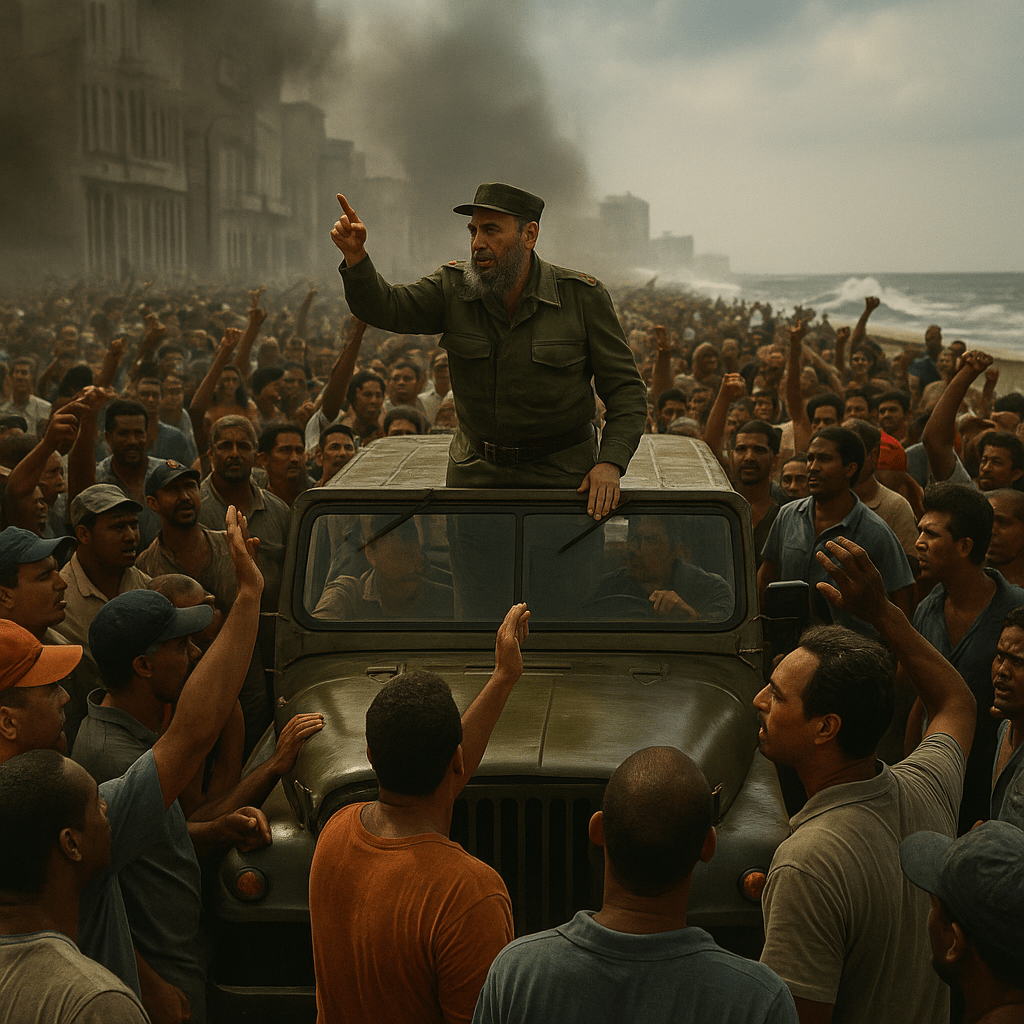
In the summer of 1994, as the so-called “Maleconazo” protests swept through Havana amid the worst economic crisis in post-revolutionary Cuba, Fidel Castro did not retreat into a bunker or broadcast pre-recorded platitudes from a distant perch. He walked into the storm—physically, symbolically, and historically. His presence was not a spectacle; it was strategy. It was pedagogy in motion.
He confronted the contradictions head-on: spontaneous rebellion versus organized struggle, lumpen desperation versus revolutionary discipline, imperial sabotage versus socialist survival. In his televised remarks following the event, Fidel described the turmoil in Centro Havana and Old Havana as “obviously organized disorders.” And then he offered a statement that encapsulates the essence of revolutionary leadership: “If rocks were being thrown and shots were being fired, I wanted to receive my share.” This wasn’t romantic bravado—it was dialectical materialism in action. Leadership does not command from afar. It marches into contradiction.
Fidel immediately named the enemy: imperialism. He explained that the goal of these disturbances was to produce “bloody scenes,” to exploit dissatisfaction, and to “divide the population.” This was not merely spontaneous outrage—it was social engineering, destabilization warfare, the manufacturing of counter-revolution. In the vacuum left by material scarcity, Washington’s propaganda machine sought to impose chaos.
Yet Fidel rejected reactionary panic. He didn’t demand repression for repression’s sake. Instead, he reasserted the primacy of political guidance: “The people must be led so they act in the most intelligent possible way.” That is, the revolutionary masses must be organized—not pacified. Their energy must be harnessed and sharpened—not defused or moralized.
In this way, Fidel modeled a revolutionary approach to crisis management. He did not deny hunger, pain, or confusion. He contextualized them as outcomes of imperialist blockade and post-Soviet economic strangulation. And he called for clarity, unity, and discipline—not cynicism, not capitulation. His posture was not managerial. It was militant. He walked into a potential insurrection not to suppress it but to redirect its force—to transform a moment of despair into an opportunity for revolutionary re-clarification.
This was not “damage control” in the liberal technocratic sense. It was revolutionary re-grounding in the midst of imperial siege. As such, it remains a model for all socialist and anti-colonial movements struggling to survive sabotage while preserving their revolutionary soul.
Part II. The Imperial Strategy of Destabilization
“They want bloody scenes… to divide the population.”
In Fidel’s analysis, the events of August 5, 1994 were not merely internal disturbances born of economic frustration. They were the calculated outcome of a long-term imperialist strategy aimed at destabilizing the Cuban Revolution through sabotage, starvation, and media manipulation. Washington’s goal was not simply regime change, but regime collapse—from within. This required more than bombs or invasions. It required demoralization, disorientation, and provocation.
By the early 1990s, the collapse of the Soviet Union had triggered a cascading economic catastrophe in Cuba. Oil shipments disappeared, trade plummeted, and factories stalled. The United States saw this as an opportunity to tighten the noose. The Torricelli Act of 1992 and the looming Helms-Burton Act intensified the blockade, cutting off food, medicine, and remittances—just as Cuba’s economic lifelines dried up.
But the blockade alone wasn’t enough. Washington needed to manufacture internal conflict. Fidel explained this clearly: “They want bloody scenes. They want to create a particular situation with maximum dissatisfaction.” U.S.-funded media and exile networks spread rumors and incited unrest. Human traffickers, sometimes with direct or indirect ties to U.S. intelligence networks, encouraged mass emigration crises. Discontent wasn’t just amplified—it was engineered.
The aim was simple: transform hunger into rebellion, transform confusion into chaos, and then present the Revolution as failed and irredeemable. Every act of unrest would be broadcast internationally—not as evidence of imperial sabotage, but as proof of socialism’s supposed failure. The goal was not to engage Cuba in debate, but to destabilize it into surrender.
Fidel recognized this tactic for what it was: not a spontaneous uprising, but a psychological operation. It was part of a broader strategy of hybrid warfare—economic, informational, and social. And just as importantly, he saw through the enemy’s illusion: “They want to divide the population.” In other words, imperialism does not conquer by invasion alone—it conquers by disarticulation. By breaking the bonds between the leadership and the masses. By turning the people into a fragmented, reactive crowd rather than a conscious revolutionary force.
Fidel’s intervention that day was not just physical. It was ideological. It was an act of defiance, but also one of unmasking. He revealed the enemy’s playbook, and in doing so, prevented a reactionary spiral. Where the empire sought blood, he offered clarity. Where it sought collapse, he demanded organization.
The lesson is clear for every revolutionary movement under siege: chaos is the preferred weapon of empire. Disorientation is the precondition for recolonization. The antidote is revolutionary presence, political consciousness, and collective discipline. These are not luxuries in times of crisis—they are the very conditions of survival.
Part III. Revolutionary Discipline vs. Lumpen Provocation
“Revolution is not simply a protest. It is a process of organized power.”
One of the most decisive elements of Fidel’s message on August 5 was his refusal to romanticize spontaneity. He recognized the desperation of the people—but refused to conflate lumpen disarray with revolutionary struggle. The protests, he clarified, were not expressions of class consciousness, but signs of exhaustion weaponized by counterrevolutionaries. The role of leadership in such moments is not to cheerlead rebellion for its own sake, but to harness mass energy toward revolutionary ends.
“The people must be led,” he said, “so they act in the most intelligent possible way.” This is not elitism—it is Leninism. The masses are not automatons; they are a political force, but their strength lies in organization, not mere emotion. Without political clarity, hunger becomes rage, and rage becomes reaction. The class enemy thrives in chaos and confusion. Fidel knew that to survive the special period, Cuba would need not only courage, but clarity, unity, and ideological sharpness.
Here, we must draw a sharp line between the revolutionary proletariat and the lumpen elements that imperialism often weaponizes. The revolutionary proletariat builds power; the lumpen element—detached from production and often from political consciousness—is vulnerable to manipulation, driven by survivalist instincts rather than strategy. In many colonized and semi-colonized societies, imperialism exploits this sector to sow instability, offering bribes, escape routes, or platforms in exchange for sabotage.
Fidel’s clarity on this point was never rooted in moralism—it was grounded in revolutionary necessity. He did not condemn the poor for being poor. He condemned imperialism for turning poverty into a counterrevolutionary weapon. And he called on the revolutionaries to organize, educate, and lead—not to shame or abandon the disoriented.
Thus, revolutionary discipline becomes more than obedience—it becomes a form of political consciousness. It is the act of refusing imperialist bait. It is the choice to stand with the revolution even in hunger, even in crisis, because the alternative is national death. In Fidel’s words and deeds, we see an affirmation that the revolution must not mirror the chaos imposed by the empire. It must rise above it, reshape it, and transform it into a renewed commitment to socialism and sovereignty.
The lesson resonates today as the forces of destabilization—from sanctions to social media psy-ops—target every independent project across the Global South. Revolution must not collapse into protest. It must develop the internal coherence and leadership necessary to endure, adjust, and advance. That is the heart of revolutionary discipline—not repression, but organized self-defense.
Part IV. Lessons for Today’s Revolutionary Movements
“We will resist, we will fight, and we will win—because we have no alternative but to be free.”
Fidel Castro’s intervention on August 5, 1994 is more than an anecdote from the Special Period—it is a manual for revolutionary leadership under siege. In a moment of maximum vulnerability, he demonstrated how to face the storm without abandoning principles, how to lead without fear, and how to respond to imperialist destabilization with unity rather than disintegration.
In our current era of hybrid warfare—when coups come cloaked in NGOs, when food and fuel are weaponized, when algorithms suppress revolutionary speech—the clarity and courage displayed by Fidel offer concrete direction. Socialist and anti-colonial movements across Latin America, Africa, Asia, and the Caribbean continue to confront the same imperialist playbook: blockade, provoke, distort, divide, and then present the resulting chaos as failure of socialism.
The response must be what Cuba modeled in 1994: revolutionary presence. Not withdrawal. Not technocratic evasion. But presence—on the street, in the community, at the point of contradiction. It is not enough to declare loyalty to the people; one must demonstrate it with political clarity and physical proximity. The masses know when their leaders walk beside them—and when they don’t.
But presence must be paired with ideological sharpness. Today’s counterinsurgency campaigns are waged not only with bullets, but with narratives. They frame shortages as socialism’s failure, revolts as spontaneous uprisings, and every disorder as an argument for neoliberal restoration. What Fidel demonstrated is that narrative warfare must be met with revolutionary truth: that the crisis was not born in Havana but in Washington; that dissatisfaction is not an indictment of socialism but of imperialism’s cruelty; and that rebellion must serve liberation, not recolonization.
For those building revolutionary alternatives today—whether in Venezuela, Burkina Faso, Nicaragua, or any nation resisting the imperial core—the 1994 moment offers timeless instruction. Survival requires not only resilience, but political education. Organization is not a luxury—it is the only path through the fog of sabotage.
Fidel taught that there is no shortcut around the hard work of building revolutionary consciousness, defending gains, and correcting course without abandoning the cause. When the empire imposes hunger, the answer is not to abandon socialism, but to deepen it. When the enemy provokes division, the answer is not suspicion, but organization. When the people falter, the answer is not condemnation—but leadership.
That is the legacy of August 5. Not simply a defensive act, but a revolutionary reaffirmation: to walk among the people, fight alongside the people, and if necessary, die with the people—not for power, but for liberation.
 Weaponized Information
Leave a comment