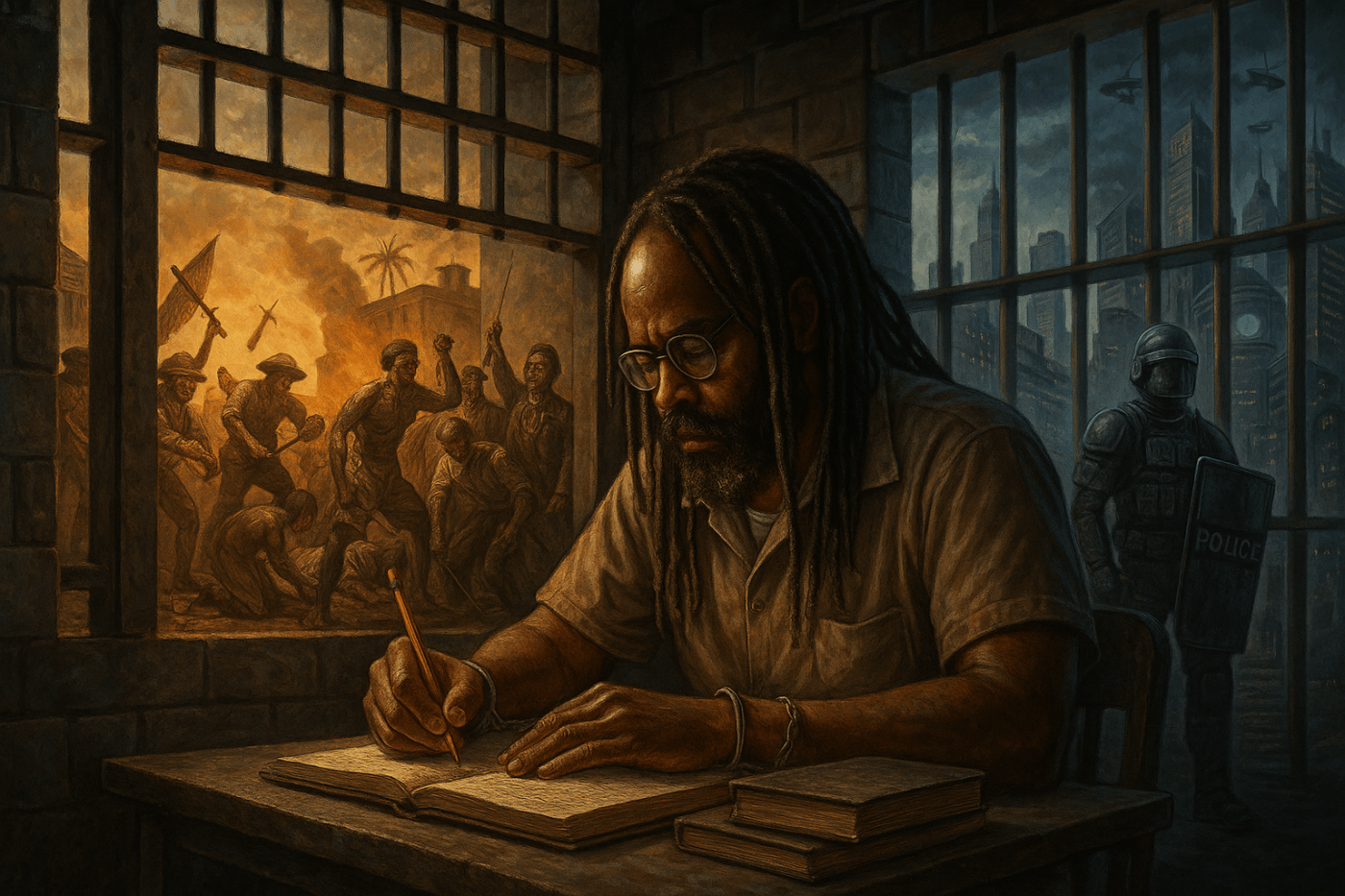
Mumia Abu-Jamal and Stephen Vittoria’s trilogy is a five-century autopsy of the United States — a counter-history that dissects the settler-colonial birth, imperialist adolescence, and technofascist present of the American project, demanding that readers turn knowledge into revolutionary weaponry.
By Prince Kapone | Weaponized Information | August 11, 2025
Framing a 500-Year Indictment
With Murder Incorporated, Mumia Abu-Jamal and Stephen Vittoria deliver a three-volume counter-history that tears the mask off the American project, revealing it for what it has always been: a 500-year criminal enterprise. This is not the polite revisionism of liberal historians looking to “complicate the narrative.” It is the work of outlaw historians in the tradition of Howard Zinn, Ivan Van Sertima, and W.E.B. Du Bois — truth-tellers who refuse to sand down the edges of atrocity. Abu-Jamal and Vittoria write like men with nothing to lose but their chains, and everything to gain from telling the truth that power has worked centuries to bury.
The trilogy’s voice is a razor’s edge — part investigative history, part poetic indictment, dripping with irony and righteous anger. It reads like a court transcript from the trial of empire, where the defendant is the United States and the charges range from grand larceny to genocide. The authors don’t merely catalogue crimes; they narrate them with the detail of witnesses who have walked through the smoke and rubble. This is history stripped of the euphemisms that make it digestible in high school textbooks, restored to its original, unbearable clarity.
For Weaponized Information, our review is both tribute and continuation. We stand in the same trench, aiming our fire at the same enemy. The trilogy’s analysis plugs directly into our framework on technofascism, settler colonialism, hyper-imperialism, and the colonial contradiction. It confirms our position that the United States was not “corrupted” over time but engineered from birth as an imperialist project — a blueprint of conquest and control that has been updated, digitized, and globalized in our own era. Reading these volumes is not an academic exercise; it’s a call to recognize the enemy’s operating manual, from its bloody first draft to the present-day code running in the heart of the technofascist machine.
Dreaming of Empire – The Blueprint of Conquest
In Dreaming of Empire, the first volume of the trilogy, Abu-Jamal and Vittoria walk us through the foundational crimes of the United States with the precision of forensic investigators. This is the origin story stripped of its nationalist mythology — no powdered wigs and liberty bells, just the smell of blood and gunpowder. The book moves from the first waves of settler-colonial genocide to the Monroe Doctrine and the U.S. theft of half of Mexico, laying bare the white supremacist logic that stitched the entire project together. The so-called “American Revolution” is recast here not as the birth of freedom, but as a transfer of colonial management from one set of white elites to another, with the same program of land theft, slavery, and extermination intact.
The authors remind us that the Republic’s capital accumulation was never a product of “hard work” or “frontier spirit.” It was built on the twin pillars of Indigenous genocide and African enslavement — a system so efficient that it industrialized human misery into a commodity. “Manifest Destiny” wasn’t just a slogan; it was an operating doctrine, codified early in instruments like the Monroe Doctrine, which granted Washington the divine right to dominate an entire hemisphere. This wasn’t expansion in the name of liberty, but expansion as a corporate merger — hostile takeovers of entire nations justified by racial supremacy and the profit motive.
Here, the historical method is unapologetically insurgent. Abu-Jamal and Vittoria integrate suppressed histories, radical historiography, and the testimony of those written out of the national myth. Slave rebellions, tenant farmer uprisings, and Indigenous resistance movements are restored to their rightful place at the center of the American story. The revolutionary tradition they highlight is multiracial, anti-colonial, and always under siege — not the sanitized “Founding Father” version peddled by the state.
WI reads Dreaming of Empire as more than a correction to the record; it is a weapon for understanding how the blueprint of conquest drawn in the 18th and 19th centuries continues to shape the technofascist present. The Monroe Doctrine lives on in U.S. coups against elected governments in Latin America. The scorched-earth campaigns against Indigenous nations echo in drone strikes in Yemen. The slave patrols have been upgraded to predictive policing and militarized SWAT raids. Volume One shows that the through-line from past to present is not incidental — it is structural. Recognizing that continuity is the first step toward breaking it.
From Birth in Blood to Technofascist Maturity
The political lesson of Dreaming of Empire is as sharp as a bayonet: the United States did not “become” an imperialist power — it was born one. Abu-Jamal and Vittoria demolish the myth of a republic that somehow lost its way, replacing it with the unbroken reality of a colonial settler state whose DNA encodes conquest, racial hierarchy, and class domination. To understand this truth is to see the present not as a “fall” from democratic grace but as the logical maturation of a system designed for plunder.
In this reframing, the revolutionary tradition in the United States is not embodied by the architects of the Constitution but by those they sought to crush: the Africans who seized freedom in insurrections from Stono to Nat Turner, the Indigenous nations who resisted annihilation, the poor white tenant farmers and debtors who defied the planter class, the multiracial uprisings that shook the colonial order. These were not footnotes to the American story — they were the only genuinely democratic chapters, written in blood and hope against overwhelming force.
What makes this volume vital for the present moment is how clearly it shows the continuity between early settler violence and today’s imperial warfare. The border wall is just the latest palisade; economic sanctions are siege warfare by another name; “humanitarian intervention” is the modern missionary’s Bible, concealing the sword. The patterns repeat because the blueprint has not changed — only the tools have been upgraded, refined, digitized.
For Weaponized Information, this continuity is the bridge to our analysis of technofascism. The domestic face of empire is now dressed in the language of national security, counterterrorism, and law-and-order, but the architecture remains the same as it was in 1492 and 1776: domination enforced by violence, justified by lies, and lubricated by profit. Volume One arms us with the knowledge that this is not accidental — it is systemic. And systems do not collapse under the weight of their own contradictions without organized force pushing them over. The stakes could not be higher: understand the empire’s birth, or live under its perfected tyranny.
America’s Favorite Pastime – The Industrialization of Mass Murder
If Dreaming of Empire exposes the blueprint, then America’s Favorite Pastime shows the machine in full operation. Abu-Jamal and Vittoria drag the reader through the killing fields of the 20th century, a century in which the United States perfected the art of industrialized slaughter. The title is no accident — war is not a last resort in this narrative, it is the national sport. The opening pitch was thrown in the Philippines at the dawn of the century, where U.S. troops massacred civilians under the Stars and Stripes, and the innings piled up in Korea, Vietnam, Latin America, and beyond.
This volume makes clear that the United States doesn’t wage war merely to defend its borders or “spread democracy.” It wages war to open markets, to secure resource flows, to plant its corporate flag in foreign soil. Each campaign is a business plan with a casualty count. The military-industrial complex isn’t a hidden conspiracy — it’s an open industry, a sprawling profit machine whose shareholders include the banks, the weapons manufacturers, and the politicians they keep in their pockets.
From the jungle villages of Southeast Asia to the barrios of Central America, the pattern is relentless: annihilation of resistance, installation of client regimes, and resource extraction at gunpoint. Abu-Jamal and Vittoria detail how the U.S. learned to fight “Low Intensity Conflicts” — a euphemism for slow-motion genocide — designed to drain the lifeblood from movements without triggering the political cost of large-scale invasions. These were not “mistakes” of foreign policy; they were deliberate calibrations of violence to achieve imperial objectives.
The historical method here is forensic and global. Eyewitness accounts from veterans and victims, declassified files, and the testimonies of the dispossessed converge to show that every so-called humanitarian mission is a cover story. The “troops” we are told to support are the enforcers of an empire whose favorite pastime is the calculated destruction of any society that dares to stand outside its economic and political dominion.
For WI, this is the century where the architecture of settler-colonial violence scaled up into a planetary system — the moment where the U.S. stopped pretending it was anything other than the headquarters of a global protection racket. If Volume One was the smoking gun, Volume Two is the bullet in motion.
War Without End – The DNA of Empire
The political takeaway from America’s Favorite Pastime is merciless in its clarity: war is not an aberration for the United States — it is the operating system. Abu-Jamal and Vittoria strip away the polite euphemisms and expose the truth: every administration, red or blue, governs in the service of a permanent war economy. The Pentagon’s budget is not a policy choice; it’s a structural necessity, feeding a capitalist engine that cannot run without fresh targets, new markets to pillage, and the steady drip of body counts to keep the contractors flush.
The “support the troops” mantra, endlessly repeated by politicians and media, is revealed here for what it is — an ideological muzzle. It turns legitimate dissent into heresy, protects the war machine from scrutiny, and transforms the people who enforce imperial plunder into sacred symbols. This is not about honoring sacrifice; it is about manufacturing consent for endless killing.
Low Intensity Conflict — a phrase that should curdle the blood — emerges as the connective tissue between foreign and domestic counterinsurgency. The same doctrines refined in the jungles of Vietnam and the hills of El Salvador are imported to the streets of Los Angeles, Ferguson, and Standing Rock. The empire fights insurgents abroad and polices its internal colonies at home using the same playbook: surveillance, infiltration, disruption, and, when necessary, outright assassination.
For Weaponized Information, this is where the trilogy’s historical excavation fuses directly with our analysis of hyper-imperialism and the colonial contradiction. The global South is bled to feed Wall Street’s quarterly profits, while the internal colonies within U.S. borders are disciplined into submission by militarized police and economic siege. The war never ends because it cannot end without collapsing the system that depends on it. The task for the revolutionary is to make that collapse not only possible, but inevitable — to turn the tools of counterinsurgency back on the system that created them.
Perfecting Tyranny – The Corporate State Comes Home
By the time we arrive at Perfecting Tyranny, the American empire has stopped pretending. Abu-Jamal and Vittoria walk us through the late 20th and early 21st centuries, where the machinery of global conquest turns inward, tightening its grip on the domestic population. The transition is seamless: the same doctrines used to topple governments abroad are repurposed to manage dissent at home. The Cold War’s covert assassinations give way to targeted drone strikes; the CIA’s destabilization playbooks find their way into predictive policing algorithms.
This volume is a ledger of continuities. COINTELPRO doesn’t die; it mutates into mass surveillance, facial recognition, and the criminalization of dissent. The prison-industrial complex swallows millions, disproportionately from the internal colonies, functioning as both labor camp and political containment zone. The U.S.–Mexico border becomes a militarized frontier patrolled by drones and mercenaries, while austerity programs starve the working class in the name of fiscal discipline. All of it wrapped in the bipartisan language of “security,” “reform,” and “efficiency.”
Abu-Jamal and Vittoria make it plain that Obama’s smooth liberal rhetoric and Trump’s frothing nationalism are two masks on the same imperial face. Both preside over the expansion of state surveillance, the militarization of police, and the corporate capture of every public institution. This is not drift — it is design. The neoliberal order doesn’t just tolerate authoritarianism; it requires it to manage the crises it creates.
Climate catastrophe looms as the next pretext for control. The authors warn of eco-fascism — a future where resource scarcity is used to justify martial law, border crackdowns, and the abandonment of entire populations. This is the “perfection” of tyranny: a state so entrenched in its power that repression becomes mundane, and resistance is rendered nearly invisible by the opacity of its methods.
For WI, Volume Three is the present tense of empire — the live feed of technofascism in motion. The tools honed over centuries of conquest are now embedded in the everyday: in the camera on the traffic pole, in the algorithm that decides who gets a mortgage, in the data broker that knows your politics better than you do. This is not just history; it is a battlefield we are standing on.
The Last Warning – Organizing Against Technofascism
In Perfecting Tyranny, the political and revolutionary implications are not just implicit — they are screaming. Abu-Jamal and Vittoria leave no doubt that we are living in the endgame of the imperial project. The surveillance state, the militarized police, the fusion of corporate data empires with state intelligence — these are not tools being sharpened for some future crisis. They are already here, already aimed at us. The United States has spent five centuries refining its instruments of domination; now, in the technofascist era, it wields them with algorithmic precision.
The authors place the youth at the center of the solution, not out of romanticism, but because they are both the prime targets and the last untamed force in the imperial core. The task is not to “raise awareness” in the abstract; it is to arm people — politically, intellectually, and organizationally — to resist. This means understanding the historical continuity between the slave patrol and the SWAT raid, between the Pinkertons and the predictive policing database, between the Indian Wars and the militarized border.
From WI’s standpoint, this is the volume where the trilogy’s historical excavation fuses completely with our analysis of technofascism and hyper-imperialism. What Abu-Jamal and Vittoria call tyranny perfected, we identify as the domestic face of the same imperial apparatus that bombs wedding parties in Yemen and blockades medicine to Venezuela. There is no reforming this machine; there is only dismantling it. The authors don’t indulge in illusions — they know the ruling class is prepared to burn the planet rather than cede power.
The final implication is urgent and direct: organization is not optional. Without disciplined, revolutionary structures rooted in the most oppressed sectors — the internal colonies and the global proletariat — resistance will be sporadic, isolated, and ultimately crushed. The trilogy’s closing challenge is WI’s call to action: take the knowledge, take the history, and turn it into a weapon before the perfected tyranny becomes irreversible.
From History to Battlefield – A Call to Arms
The Murder Incorporated trilogy is more than a history — it is a war manual written by survivors and witnesses of empire. Across three volumes, Mumia Abu-Jamal and Stephen Vittoria strip away the mythic skin of the United States to reveal the muscle, bone, and rot beneath. From the first massacres on stolen land to the digitized repression of today, the through-line is unbroken: conquest, plunder, domination. The genius of the work lies not just in its encyclopedic excavation of crimes, but in its refusal to let those crimes be sealed away as “past tense.” Every atrocity echoes in the present.
For Weaponized Information, this trilogy is a diagnostic tool and a bullhorn. It confirms our central thesis: the American project has never been a democracy in any meaningful sense, but a settler-colonial and imperial machine whose lifeblood is exploitation — of land, labor, and life itself. The empire’s “freedoms” are rationed privileges, granted to stabilize the home front while the plunder continues abroad. When crises threaten that balance, the mask slips, and the repression turns inward. We are living in such a moment now.
Mumia and Vittoria’s achievement is to fuse the scale of a historical epic with the intimacy of a political intervention. Their prose is both indictment and eulogy, rich with irony and sharpened with moral clarity. They are not neutral narrators; they are combatants, urging the reader to choose a side. This is history written not for the classroom, but for the barricade.
The task they leave us is not one of mere remembrance. It is one of transformation. To read these books and do nothing is to become an accomplice to the crimes they document. The proper tribute to Murder Incorporated is to treat it as a field guide for dismantling the imperial state — to build organizations capable of withstanding repression, to forge solidarity across borders and walls, to weaponize history against the ruling class’s lies.
In the face of a perfected tyranny, half-measures are suicide. The authors are clear, and so are we: the only way to stop the machine is to break it. And the only way to break it is together, organized, disciplined, and relentless. History has already given us the proof; now it demands the fight.
 Weaponized Information
Leave a comment