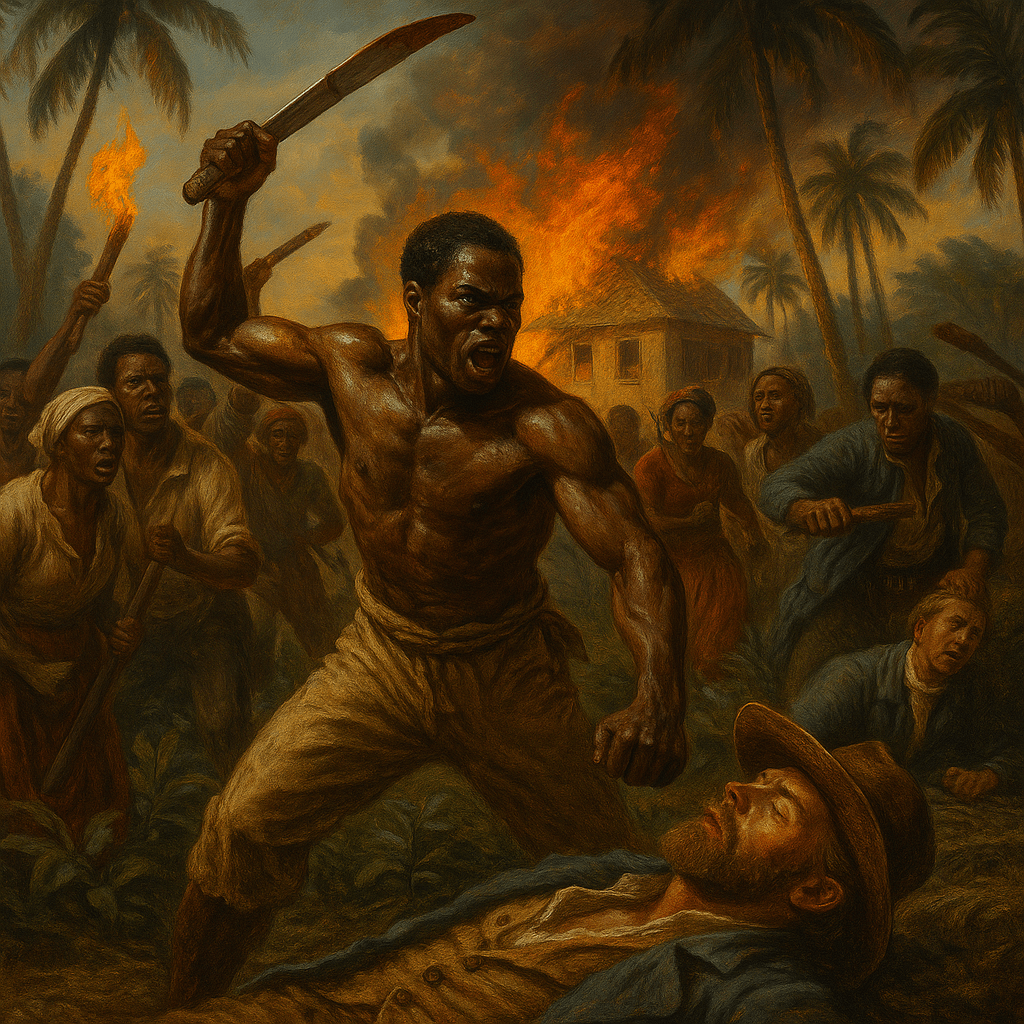
From the cane fields of São Tomé to the swamps of Virginia, the enslaved struck the first world-historic blows against capitalist-imperialism — long before the factory whistle summoned Europe’s “free” workers.
By Pablo Katari | Weaponized Information | August 10, 2025
I. The Plantation as the Foundry of Modern Capitalism
Political economy, that hired prizefighter of capital, delights in tracing the origin of the modern worker to the “free” wage-laborer of Europe, sprung, like Minerva, fully armed from the brow of the factory system. In its idyllic prefaces to industry, it speaks of sturdy peasants transformed, by the magic wand of enterprise, into proud and independent producers, exchanging labour for wages as one commodity for another, in the very Eden of “freedom, equality, property, and Bentham.” Yet the ledgers of history show a different balance. Long before the spindle turned in Manchester or the piston throbbed in Birmingham, the capitalist mode of production had already seized its first fully-formed prey: not the wage-laborer of the workshop, but the slave of the plantation.
On the volcanic slopes of São Tomé, Madeira, and the Canaries, capital rehearsed its future dominion. These islands, torn from their native inhabitants and parcelled out like so many estates of a feudal lord, became laboratories in which the ruling classes of Europe conducted their earliest great experiment: how to organise labour on a scale vast enough to feed the appetite of distant markets, and to do so without the inconvenient limits imposed by the labourer’s own life, will, or body. The African, kidnapped and uprooted from the communal soil of his homeland, was cast as the first truly globalised proletarian — free, in the double sense, from any means of production, and free to be consumed, utterly, by the production process itself.
The plantation was no feudal remnant, no patriarchal household economy. It was the capitalist workshop stripped of all pretence: here the instruments of labour walked on two legs, the overseer’s whip served as both clock and law, and the “turnover” of fixed capital was measured by the years it took to wear a man’s body into the earth. Ships, chains, sugar-boilers, and ledgers formed the circulating arteries of this system; the lifeblood was human sweat, and the profit, crystallised in sacks of sugar, flowed not to the labourer but to the counting-houses of Lisbon, Seville, Amsterdam, and London.
In these fields the economic laws of motion peculiar to the capitalist mode operated in their purest and most unvarnished form. The enslaved worker, reduced to the status of a machine part, was yet the source of all value; the planter, that petty sovereign of the cane, was but the local agent of a world market whose demands knew neither mercy nor restraint; the imperial state, draped in the robes of Christian civilisation, acted as armed bailiff and executioner for the creditor class. Here, with no veil of contract or citizenship to hide it, the essence of capital was laid bare: the compulsion to extend labour beyond its natural limits, to convert human life into an expendable input, and to reproduce this cycle on an ever-widening scale.
Thus, in the cane fields of the Atlantic islands, before the factory system had even entered upon its mechanical childhood, the proletariat was already in existence — only it was held fast by iron fetters instead of the paper bonds of wage-labour. And if, from these same fields, there arose a cry of insurrection, it was because the contradictions of capital had already reached that point where they could only be “resolved” — in the bourgeois sense — by annihilating the labourer, or, in the proletarian sense, by annihilating the system itself.
II. Primitive Accumulation and the Birth of the Slave Proletariat
The so-called “primitive accumulation” with which the capitalist era opens is not, as the professors of political economy would have it, the tale of industrious virtues rewarded and idle vices punished. It is, rather, the pre-history of capital written in the annals of conquest, enslavement, and robbery. The enclosure of the commons in Europe — that expropriation of the peasant from his means of subsistence — is but one side of the ledger. On the other stands the simultaneous and colossal expropriation of entire continents: the plunder of the Americas, the genocide of their peoples, the transformation of Africa into a human hunting-ground. If the first act expelled the producer from the soil, the second act expelled the soil itself from the producer, casting him across oceans to toil on lands stolen twice over.
In the Atlantic world, capital perfected the unity of these processes. The Portuguese fort at Elmina, with its vaulted dungeons for gold and for men, was no mere trading post but a combined treasury and warehouse of human labour-power. From here the double stream of primitive accumulation flowed: bullion to finance the European state, and bodies to animate the new machinery of plantation production. In the sugar islands of São Tomé and Madeira, in the coffee slopes of Brazil, in the tobacco fields of Virginia, the African captive was inserted into the circuit of capital as the most valuable — and most perishable — of its instruments.
Unlike the serf, whose surplus labour was bounded by custom and season, the enslaved labourer was subjected to a regime in which the only measure of the working day was the planter’s appetite for profit. Labour-time was wrung from the body until the body itself collapsed; the replacement cost was met not by wages, pensions, or “human resources” management, but by the next shipload from the African coast. This incessant demand for new labour-power bound the slave-trade and the plantation into a single system, in which the mortality of the worker was a necessary condition of the vitality of capital.
Thus arose the first modern proletariat: torn from every tie of kinship and commons, stripped of all property, compelled to labour in a foreign land for a commodity market thousands of miles away. The free wage-labourer of Europe was still in the cradle; the slave proletarian was already turning the wheels of the world economy. And here, in this stark form, we perceive the true secret of “freedom” under capital: whether bound by contract or by chain, the worker’s relation to the means of production is one of complete dispossession, and his life’s activity is appropriated for the enrichment of another.
The political economists, confronted with this history, avert their eyes, as though the primitive accumulation of capital were an unfortunate but long-forgotten accident, like a regrettable youthful indiscretion of an otherwise respectable gentleman. But the plantation is no juvenile folly of capital — it is its first mature work, its original work of art in the medium of human misery. And the class it forged in iron and fire would, in time, return the compliment by creating in turn the first great insurrections of the capitalist age.
III. Class Formation under the Plantation Regime
If in the factory the antagonists stand as wage-labourer and industrial capitalist, bound together by the fictitious contract of “free” exchange, on the plantation they confront each other in their naked and undisguised forms: human labour-power held as private property, and its owner as sovereign master over life and death. Here, no veil of juridical equality softens the glare of exploitation; the class relation appears in its absolute state, as an armed dictatorship of capital over the body of the worker.
Within this regime, the class structure was as rigid as it was international. At the base stood the enslaved proletariat, propertyless and wholly alienated from the instruments and products of their labour. Their activity — whether planting cane, cutting stalks, feeding the rollers, stoking the boiling house, or hauling sugar to port — was organised with all the regimentation of a modern factory, but intensified by the lash into a tempo unknown even to the later mills of Lancashire. Above them, the overseer: that petty-bourgeois functionary, himself often a degraded offshoot of the settler class, who served as the living embodiment of capital’s command, measuring out the working day with whip and tally-sheet. And over both, the planter: the colonial capitalist, whose ledgers linked the sweat of the field directly to the credit books of European merchants, insurers, and financiers.
It was no accident that the plantation became the prototype of the modern capitalist enterprise. In it we find all the essential forms: production for an anonymous market, the subordination of labour to the valorisation of capital, the strict separation between direct producers and owners of the means of production, and the organisation of the labour process according to the dictates of profitability alone. Even the most advanced techniques of industrial discipline — the segmentation of tasks, the measurement of output, the use of threats and incentives — were prefigured here, albeit in the brutal register of colonial slavery.
But the plantation did more than merely anticipate the industrial factory: it fused the capitalist relation of production with the colonial relation of domination. The enslaved worker was not only exploited as a producer of value, but was subjugated as a member of a conquered and racialised population. Race here did not precede class; it was the specific form in which class domination was enforced in the colonies, a form which intensified exploitation by naturalising it. Thus the social reproduction of the plantation proletariat was inseparable from the reproduction of a colonial order backed by armed force, legal codes, and the ideological machinery of empire.
And as in all mature class systems, the conditions of exploitation contained their own negation. The daily organisation of labour in gangs, the enforced cooperation in field and boiling house, the collective suffering under the same overseer’s lash — these gave the enslaved workers both the discipline and the solidarity necessary for revolt. The very same class relation that extracted their surplus labour also produced the means by which they could, and would, attempt to abolish it.
The plantation did not spring from the soil like some tropical weed; it was planted, watered, and fertilised by the long arm of sovereign and merchant capital. The first sugar mills of São Tomé, the early tobacco fields of the Chesapeake, the cane breaks of Barbados — all were the bastard offspring of the royal treasury and the merchant ledger. States funded conquest, granted monopolies, and armed expeditions; chartered companies like the Dutch West India Company, the Royal African Company, and the Compagnie des Indes supplied ships, slaves, and credit. The planter class, so often romanticised as rugged pioneers, were in truth the middle managers of empire — subcontractors in the business of primitive accumulation.
Sovereign capital provided the muscle: warships to seize territory, garrisons to hold it, and treaties to sanctify theft with the ink of diplomacy. Merchant capital provided the sinew: a web of financiers, insurers, and brokers who transformed human beings into ledger entries, movable at the stroke of a pen. The planter’s role was to fuse land, labour, and violence into commodities for the world market — to transmute African lives and stolen soil into sugar, cotton, tobacco, and indigo. From the outset, the plantation’s output was earmarked not merely for consumption, but as raw material and liquid capital for the industrialising metropole.
As the centuries turned, these forms of capital did not so much disappear as change costume. The profits of the sugar islands were sunk into textile mills in Lancashire, ironworks in Birmingham, shipyards in Nantes. The same capital that had purchased a coffle of captives in West Africa now purchased steam engines, mechanised looms, and railway bonds. The merchant adventurer’s tall ship was replaced by the industrialist’s smoke-belching factory; but the blood in the balance sheets was the same. Sovereign capital, merchant capital, planter capital, industrial capital — these were not discrete stages in a polite succession, but interlocking gears in a single machine of exploitation.
To revolt against the plantation, then, was to strike not merely at a local tyrant, but at the converged power of king, company, and manufacturer — a power that spanned oceans and transcended the particular form it wore in any given age. The enslaved may have seen only the whip in the overseer’s hand, but the hand itself was moved by the invisible armature of the entire capitalist world-system.
IV. Contradictions in Motion: Why Revolt Was Inevitable
The political economists, with their talent for moral arithmetic, are fond of explaining away revolt as the irrational tantrum of the ignorant, the savage, or the criminal. But under the plantation regime, revolt was neither accidental nor irrational — it was the inevitable expression of the system’s own laws of motion. When the extraction of surplus labour proceeds without any limit save the exhaustion or death of the labourer; when the replenishment of that labour-power depends upon the ceaseless violence of a transoceanic slave trade; when the life expectancy of the worker is measured in single digits, and the only relief from toil is the grave — then rebellion is not a possibility to be explained, but the absence of it is what requires explanation.
The economic logic of the plantation was founded on a calculus of destruction. In the Caribbean sugar colonies, the average life-span of a newly imported African rarely exceeded seven years. It was more profitable to consume a human body quickly and replace it from the African coast than to preserve it with rations, rest, or medical care. Thus the very rhythm of production depended upon a steady influx of fresh captives — a rhythm that bound together the ports of West Africa, the Atlantic crossing, and the cane fields into a single, infernal circuit of capital.
But this same rhythm was also the drumbeat of insurrection. The continual importation of new captives meant the continual importation of new memories — of villages defended, of battles fought, of kinship ties sundered by European guns. The barracoons of the Middle Passage were not vessels of oblivion, but of transmission: every ship that landed on the sugar quay carried with it the cultural, military, and organisational resources of entire societies. The labour gangs of the plantation became schools of mutual recognition; the boiling house and the cane row, meeting places where a common enemy was named and a common cause rehearsed.
Nor could the planters’ desperate measures — the division of workers by language, the prohibition of drums, the surveillance of night gatherings — extinguish the embers of revolt. For the very structure of the plantation ensured that solidarity could never be eradicated. The synchronisation of labour, the dependence of each worker’s task upon the next, and the shared exposure to the overseer’s whip produced a unity of condition which neither racial codes nor colonial bayonets could finally dissolve.
In this way, the contradictions of the plantation were self-generating: the more ruthlessly capital extracted labour, the more it multiplied the conditions for its own overthrow. Each tightening of discipline was also a tightening of bonds between the exploited; each escalation of violence was a reminder that nothing short of the system’s destruction could bring relief. Revolt was not an intrusion into the “natural” order of the plantation — it was the plantation’s most logical and necessary product.
V. The First Modern Proletarian Uprisings
To speak of these revolts as “primitive” is to confess one’s ignorance of the world market in whose shadow they unfolded. The uprisings of the enslaved were not eruptions from some pre-capitalist darkness, but conscious assaults on the most advanced productive apparatus of their age. Long before the barricades of 1848, the cane fields, coffee slopes, and tobacco rows had already seen the modern proletariat in open, organised insurrection against the global rule of capital.
In the late sixteenth century, on the island of São Tomé — a linchpin in the Portuguese sugar trade — African labourers, imported and disciplined under the lash, rose up in a coordinated campaign that seized control of the countryside and paralysed production. This was no mere peasant jacquerie; it was the calculated seizure of the colony’s productive base, the disruption of its export flows, and the direct challenge to the imperial state’s armed authority. Similar risings on the Canaries — another node in the same Atlantic network — testify to the geographic breadth and strategic awareness of these early proletarian struggles.
As the plantation frontier shifted to the Americas, so too did the geography of revolt. In Brazil, the quilombo of Palmares emerged as a permanent maroon polity, sustained over decades by fugitive workers who refused reintegration into the capitalist order. In Jamaica, the Maroon wars waged by escaped slaves and their allies forced the British Empire into treaties that conceded territory and autonomy — a recognition of military stalemate rare in colonial history. In the swamps and forests of Suriname, African-descended communities defended themselves with the organisation and discipline of standing armies, financed not by taxes but by raids on the very plantations from which they had fled.
The highest development of this cycle was the revolution in Saint-Domingue. Beginning in 1791, the enslaved workers of the world’s richest colony destroyed the armies of France, Spain, and Britain in turn, abolished slavery, and declared the independent republic of Haiti. Here the modern proletariat did not simply strike for better conditions; it expropriated the expropriators, seized the land, and reorganised production on new social foundations. In doing so, it accomplished what no European working-class movement of the time had yet dared: the creation of a workers’ state in direct defiance of the global capitalist order.
Each of these revolts, whether suppressed or victorious, bore the marks of a class conscious of its position in a world system. They were international in their origins, drawing together captives from dozens of societies; international in their targets, striking at commodities and trade routes that fed the industries of Europe; and international in their consequences, shaking the confidence of capitalists and statesmen across the Atlantic world. In this sense they were not only the first modern proletarian uprisings — they were the first to reveal that the proletariat’s struggle, from its birth, was a world-historical one.
If the geography of revolt stretched across the Atlantic world, the map was incomplete without the slaveholding republic that would one day style itself the guardian of liberty. From its colonial infancy, the North American mainland was no stranger to insurrection. In 1712 and again in 1741, New York — then a port city whose docks and warehouses pulsed with Atlantic trade — saw uprisings by enslaved Africans who put the heart of the colonial economy to the torch. These were not “isolated incidents” but skirmishes in the same global war waged on São Tomé and in Saint-Domingue, adapted to the urban topography of the North.
Further south, in the Carolina lowcountry and Georgia’s rice swamps, revolt assumed a more rural form. The Stono Rebellion of 1739 was a disciplined march of armed enslaved workers toward Spanish Florida, where freedom was promised. Along the way, they burned plantations, destroyed crops, and struck at their overseers — a campaign that exposed the vulnerability of an economy built on dispersed yet interdependent units of production. The ruling class responded with the Negro Act of 1740, a legislative fortress that outlawed literacy, restricted movement, and tightened the surveillance net over the enslaved.
In the early 19th century, the contradictions sharpened. Gabriel Prosser’s 1800 conspiracy in Virginia aimed to seize Richmond, take the governor hostage, and bargain from a position of armed strength. Denmark Vesey’s 1822 plan in Charleston mobilised church networks, maritime labourers, and plantation hands in a plot that, had it succeeded, might have detonated the slave economy of the entire South Carolina coast. Nat Turner’s 1831 revolt in Southampton County, Virginia, sent shockwaves across the United States and provoked a frenzy of repression: mass executions, the shuttering of Black religious gatherings, and an expansion of militia power.
Beyond these headline uprisings lay the stubborn persistence of maroon communities in places like the Great Dismal Swamp — fugitive strongholds that endured for decades, conducting raids on nearby plantations and offering a living alternative to bondage. Their existence was a constant reminder that the slave system’s grasp was never total, and that the geography of the United States itself harboured the infrastructure for resistance.
These revolts on U.S. soil were neither aberrations nor provincial echoes of Caribbean and South American struggles. They were integral fronts in the same world-historical process: the proletariat, in its earliest global incarnation, striking directly at the material base of capitalist-imperialism. They made clear that the North American mainland was not insulated from the hurricane of insurrection sweeping the Atlantic world, but stood directly in its path.
VI. The Political Economy of Revolt
In the polite salons of Europe, where sugar dissolved invisibly into tea and coffee, revolt was regarded as a disruption of “order,” an unfortunate impediment to commerce. But to the planters and merchants whose fortunes depended on the regular rotation of the cane harvest, revolt was something more concrete: a rupture in the circuit of capital. Each uprising was a strike at the delicate mechanism that turned human bondage into bullion, disrupting not only the labour process but the entire chain of production, transport, and exchange.
The immediate effect was the paralysis of the plantation’s productive apparatus. Fields went uncut, mills went cold, ships departed half-empty or not at all. The seasonal rhythm of planting, harvesting, and shipping — the heartbeat of colonial accumulation — was thrown into arrhythmia. Idle land meant idle capital; idle capital meant bills unpaid to creditors in Amsterdam, insurance premiums spiking in London, and merchants in Nantes or Bristol scrambling to cover shortages on the commodity exchange.
Beyond the immediate loss of output, revolts imposed new and permanent costs on the system. Garrison troops had to be stationed year-round, not merely during harvest; fortifications were built around estates; naval patrols were expanded; and insurance companies raised their rates to account for the “risk” of human resistance. Each of these measures ate into the surplus value extracted from the enslaved, forcing planters to choose between profitability and security — a choice that revealed the fragility of their entire enterprise.
Even suppression carried its own contradictions. The execution of ringleaders and the deportation of suspected conspirators could not erase the memory of collective defiance; indeed, such spectacles often clarified, rather than obscured, the antagonism between master and slave. In some cases, as in the Maroon wars or the Haitian Revolution, suppression failed outright, forcing colonial authorities to concede territory, autonomy, or outright independence — a geopolitical humiliation that reverberated through the entire imperial system.
From the standpoint of the world market, the most dangerous aspect of these revolts was their tendency to spread. A rumour of rebellion in Saint-Domingue could stir unrest in Jamaica; news of Palmares might embolden captives in Suriname; the mere whisper of Haitian independence sent tremors through Cuba, Brazil, and the American South. In this sense, the revolts functioned as both a political and economic contagion, undermining the confidence that capital requires to reproduce itself on a global scale.
Thus, the political economy of revolt was not an external threat to the plantation system, but one of its intrinsic features. The same mechanisms that generated immense wealth for European capitals — the concentration of labour, the integration of production into global markets, the unrelenting drive for surplus extraction — also generated the very conditions for their negation. Revolt was not an interruption of capitalist accumulation in the colonies; it was its most profound critique, delivered in the only language capital truly understands: the cessation of profit.
VII. From Colonial Revolt to World-Historical Consciousness
If the bourgeois historian insists on treating these uprisings as local disturbances — the tragic byproducts of “mismanagement” or “overzealous” overseers — it is because to recognise their true nature would be to admit a heresy: that the first class to challenge capitalist-imperialism on a world scale did so not from within the metropole, but from its farthest and most despised peripheries. The enslaved of the plantations, chained at the base of the world market, were also the first to grasp, in practice if not in print, that their liberation could not be won in isolation from the collapse of the system itself.
Every revolt that severed a link in the chain of imperial accumulation cast its effects far beyond the island, valley, or coastal plain where it began. The Haitian Revolution redrew the strategic map of the Americas, shattered the colonial revenue streams of France, and struck terror into the slaveholding classes of every European and American colony. The Maroon wars in Jamaica forced Britain to treat armed African communities as diplomatic actors. The quilombos of Brazil demonstrated that alternative modes of social reproduction could survive for generations outside the reach of capital. These were not merely “slave uprisings”; they were the embryos of a world-historical proletarian consciousness, gestating under the tropical sun.
This consciousness did not take the form of parliamentary manifestos or economic treatises; it was expressed in the seizure of land, the burning of cane, the redistribution of tools and arms, the destruction of plantation records — all acts that directly confronted the twin pillars of capitalist domination: property and profit. In burning the cane fields, the revolting slaves were not simply destroying the master’s crop; they were severing the arteries through which the lifeblood of European accumulation flowed. In seizing the land, they were negating the entire colonial property regime, in which human beings and hectares were alike reduced to entries in a ledger.
The world-historical significance of these struggles lies precisely in their position at the heart of capital’s formative stage. In confronting the plantation, the revolting slave was confronting the concentrated essence of the capitalist mode of production: commodity production for the world market, enforced through the naked violence of the state and its armed auxiliaries. Unlike the European artisan resisting mechanisation, the enslaved worker had no illusions about reforming the system from within; his very existence in bondage was proof that the system’s foundation was theft, and its superstructure, murder.
It is in this sense that the revolts of São Tomé, Palmares, Jamaica, Suriname, and above all Haiti must be counted among the first modern proletarian uprisings. They emerged not at the periphery of history, but at its cutting edge — in the crucible where capitalism was being forged out of gold, blood, and sugar. They were not the distant cousins of the European working-class movement, but its elder siblings, seasoned in battle before the factory whistle ever blew in Manchester. And they leave us with an unambiguous lesson: the modern proletariat was born in chains, but it did not wait for theory to tell it that those chains must be broken.
VIII. Counter-Revolution and the Global Colour Line
No ruling class in history has ever failed to learn from its defeats, and the bourgeoisie of the plantation world proved no exception. The Haitian Revolution, like a thunderclap over the sugar islands, illuminated for the masters the true scope of the danger they faced: that the very labouring class on which their wealth depended might one day abolish not only their fortunes, but their entire social order. From this revelation emerged the global counter-revolution — a coordinated project to bind the modern proletariat in new chains, forged not merely of iron but of law, ideology, and race.
The first task was military. Across the Americas, colonial garrisons were reinforced, militias expanded, and naval patrols increased. Plantation colonies became armed camps, their production schedules subordinated to the logistics of surveillance and suppression. Fortifications rose alongside boiling houses; rifles were as indispensable to the planter as the cane knife. The cost was borne, as always, by the enslaved: higher mortality from harsher discipline, longer hours to recoup the planter’s “security investments,” and the ever-present shadow of the gallows as a tool of labour management.
But bayonets alone could not guarantee stability. The second task was juridical: the codification of a racial order so rigid that any solidarity between the enslaved and other labouring classes would appear unnatural, even unthinkable. Slave codes were rewritten with an obsessive precision, mapping out every conceivable channel through which insurrectionary currents might flow. “Free” people of colour were stripped of rights or driven into petty overseer roles; poor whites were flattered with legal privileges and economic crumbs, binding them to the defence of a system that exploited them differently but no less surely. Race, in this order, was not a mere prejudice — it was the cement that sealed the fissures of class antagonism among the oppressed.
The third task was ideological. Pulpits thundered with sermons on obedience; newspapers in Europe and the Americas teemed with tales of “savage” cruelty whenever enslaved people struck for freedom, as though the barbarity of centuries of forced labour paled before the burning of a planter’s mansion. The myth of white supremacy became a political economy in itself, a system of belief as necessary to the circulation of capital as the bills of exchange that crossed the Atlantic. In the metropolis, this ideology served to convince the emerging industrial working class that its lot, however meagre, was preferable to the imagined horrors of “African barbarism.”
Thus was drawn the global colour line: a fortified boundary within the proletariat, patrolled by both musket and myth, designed to ensure that the revolts of São Tomé, Jamaica, Suriname, and Haiti would never find ready allies in the workshops of Europe or the farms of North America. This was not the incidental racism of individual planters, but a structural counter-insurgency strategy — the world-spanning corollary to the local whip. By dividing the working class along lines of skin and origin, the bourgeoisie sought to immunise itself against the most contagious lesson of the plantation: that the oppressed, once united, can tear down empires.
While the cane fields and swamps of the colonial world were aflame with uprisings, the emerging labour movements of the metropole confronted their own battles: strikes for shorter hours, food riots, protests against wage cuts. Yet between these two theatres of struggle yawned a gulf, dug deep by the racial order that the bourgeoisie had so carefully built after Haiti. The revolts of the enslaved — the most militant and uncompromising blows yet struck against capital — were met not with universal acclaim from the “free” workers of Europe and North America, but with a mixture of indifference, anxiety, and, too often, open hostility.
In the United States, white artisans and wage-workers of the antebellum North were quick to denounce Southern planters as aristocratic parasites, yet slow to welcome the abolition of slavery on terms set by the enslaved themselves. The spectre of competition from a newly freed Black labour force — a fear actively stoked by the ruling class — blunted solidarity. The uprising led by Nat Turner in 1831 drew condemnation in Northern newspapers that otherwise professed sympathy for “freedom”; even among abolitionists, there was a distinct preference for emancipation as a moral gift from the benevolent, rather than as the spoils of a slave army’s victory.
Across the Atlantic, British textile workers, whose livelihoods depended on the steady flow of slave-grown cotton, reacted to slave revolts with a caution that bordered on complicity. During the American Civil War, Lancashire millhands famously endured the “cotton famine” and in some cases expressed solidarity with the Union cause — but this was decades after Haiti had been shunned and maroon wars ignored. The French working class, in the revolutionary ferment of 1848, applauded the formal abolition of slavery in its colonies but largely refrained from treating the enslaved insurgent as a comrade in the same class war.
There were, it must be said, glimmers of a different path. The English radical William Cobbett denounced slavery as a capitalist crime. In the U.S., a handful of white abolitionists — from the interracial utopian experiments of the Owenites to militant allies of John Brown — sought genuine alliance with Black insurgency. Yet these were the exceptions that proved the rule: metropolitan labour’s general posture toward slave revolts was one of distance, its solidarity withheld or conditional, its political imagination hemmed in by the colour line.
This failure was not merely moral; it was strategic. By ignoring or rejecting the most advanced struggles against capital, the metropolitan working class narrowed its own horizon, allowing the bourgeoisie to maintain the colonial division of the proletariat. While the enslaved were storming the strongholds of capital with fire and steel, the “free” worker too often fought for a larger share of the spoils wrung from those same plantations. Thus the colour line did not only divide the cane field from the factory; it divided the class against itself, postponing the day when the world’s workers might rise as one.
IX. Lessons for the Proletariat of the Factory Age
When the steam engine’s whistle began to summon Europe’s new industrial armies, the bourgeoisie congratulated itself on having entered a more “civilised” stage of production. The wage contract, it was said, had replaced the whip; the factory clock had supplanted the overseer’s pistol. Yet in the DNA of the industrial system lay the plantation’s entire genome — refined, repackaged, and exported back to the metropole. The extraction of surplus value still reigned supreme; only the legal form of compulsion had changed.
For the wage-worker in Manchester or Rouen, the history of São Tomé or Saint-Domingue was not an exotic curiosity but a forewarning. The factory’s division of labour, its regimentation of time, its reduction of the worker to a replaceable part — all had been perfected under tropical suns long before the first textile mill spun a thread. The iron discipline of the overseer found its mechanical twin in the supervisor and the timekeeper; the economic dependence of the enslaved, who could not live without the master’s rations, found its analogue in the wage-worker whose subsistence hinged on the next payday. The difference was that the latter could be thrown into the street, while the former was thrown into the grave.
The lesson for the factory proletariat was twofold. First: that capital’s “progress” in methods of labour control did not abolish coercion but universalised it, shrouding it in the garb of contractual freedom. Second: that the experience of the plantation proved the possibility — and necessity — of organised, collective rupture. The enslaved had not waited for abstract theories of surplus value to discover their exploitation, nor for parliamentary debates to legitimise their liberation. They had seized arms, land, and time, and in doing so had disrupted the world market itself.
Yet the colour line, drawn so carefully in the wake of Haiti, blunted this lesson’s edge. The industrial proletariat of the metropole, itself battered by the degradations of factory life, often failed to recognise in the revolts of the colonies its own reflection — and worse, was taught to see in colonial liberation a threat to its own precarious privileges. Thus, the solidarity that might have been forged in the shared condition of dispossession was fractured, and the bourgeoisie was spared the nightmare of a truly global working-class front.
For the workers of the factory age, then, the history of the plantation proletariat was both a suppressed memory and an unclaimed inheritance. To recover it was to grasp that the struggle against capital is not confined to the workshop or the ballot box, but must extend to every corner of the world where value is extracted and lives are spent — whether under the name of wage-labour or slavery, “free” trade or forced migration. In the age of the steam engine as in the age of the cane knife, emancipation begins with the recognition that the chains binding one section of the proletariat bind them all.
X. Conclusion: The Birthmark of Chains
Capitalism, like the mythical gods of antiquity, devours its own children — but it was born devouring children of a darker hue. The blood-soaked cradle of the modern world was not the cobblestone street of the European market town, but the cane field, the coffee slope, the indigo vat. The enslaved African, torn from their homeland, forced into the regimental discipline of the plantation, was not a “primitive” precursor to the proletariat; they were the proletariat in its first global form — commodified, dispossessed, and compelled to labour for the enrichment of a class whose reach spanned oceans.
The revolts that erupted from São Tomé to Suriname, from Palmares to Haiti, were not local curiosities in the margins of “world history” — they were world history. In them, the fundamental antagonism between capital and labour emerged in its purest form, stripped of the legal fictions and parliamentary illusions that would later mask it in the metropole. These uprisings targeted not just the whip-wielding overseer, but the very circuits of the world market, severing the arteries through which Europe’s wealth flowed. Their victories and defeats alike reshaped the strategies of empire, forcing the bourgeoisie to invent the global colour line as a bulwark against universal emancipation.
To remember this is not a matter of moral sentiment, but of strategic necessity. The modern proletariat cannot understand itself without reckoning with the fact that its first organised offensives against capitalism were waged in chains. The so-called “labour movement” of the industrial age did not spring fully formed from the looms of Manchester or the docks of Liverpool; it inherited, often without acknowledgment, the tactics, courage, and revolutionary clarity forged in the cane fields and maroon camps of the colonial world.
Marx once wrote that the “birthmark of the old society from whose womb it emerges” clings to the new for as long as it lives. For the proletariat, that birthmark is the shackle. The task before us is not merely to recall that origin, but to complete its unfinished work: to make common cause across the colour line, to recognise that the emancipation of any fraction of the working class is inseparable from the emancipation of all, and to abolish — root and branch — the system that was born in the holds of slave ships and matured in the shadow of the gallows.
The revolts of the plantation age stand as a permanent reminder that the path to freedom is neither granted nor negotiated, but taken — sometimes with the same cane knives that once harvested profit for our oppressors. They prove, against every slander of the ruling class, that the modern proletariat’s first instinct, when confronted with the naked reality of capital, was to rise.
References
- Marx, Karl. Capital: Volume I. Translated by Ben Fowkes. London: Penguin Classics, 1990.
- Williams, Eric. Capitalism and Slavery. Chapel Hill: University of North Carolina Press, 1944.
- Clarke, John Henrik. Christopher Columbus and the Afrikan Holocaust. Baltimore: Black Classic Press, 1993.
- French, Howard W. Born in Blackness: Africa, Africans, and the Making of the Modern World, 1471 to the Second World War. New York: Liveright, 2021.
- Diop, Cheikh Anta. Precolonial Black Africa: A Comparative Study of the Political and Social Systems of Europe and Black Africa. Brooklyn: Lawrence Hill Books, 1987.
- Magubane, Bernard, and Nzongola-Ntalaja, Georges, eds. Proletarianization and Class Struggle in Africa. Synthesis Publications, 1983.
- Disney, A. R. A History of Portugal and the Portuguese Empire, Volume I: Portugal. Cambridge: Cambridge University Press, 2009.
- Rönnbäck, Klas, and Broberg, Oskar. Capital and Colonialism: The Return on British Investments in Africa, 1869–1969. London: Palgrave Macmillan, 2019.
- Stern, Philip J. Empire, Incorporated: The Corporations That Built British Colonialism. Cambridge: Harvard University Press, 2023.
- Mariátegui, José Carlos. Selected Works of José Carlos Mariátegui. Edited by Christian Noakes. Iskra Books, 2021.
- Genovese, Eugene D. From Rebellion to Revolution: Afro-American Slave Revolts in the Making of the Modern World. Baton Rouge: Louisiana State University Press, 1979.
- Blackburn, Robin. The Making of New World Slavery: From the Baroque to the Modern, 1492–1800. London: Verso, 1997.
- Beckles, Hilary McD. Black Rebellion in Barbados: The Struggle Against Slavery, 1627–1838. Bridgetown: University of the West Indies Press, 1984.
- Fick, Carolyn. The Making of Haiti: The Saint Domingue Revolution from Below. Knoxville: University of Tennessee Press, 1990.
- Morgan, Philip D. Slave Counterpoint: Black Culture in the Eighteenth-Century Chesapeake and Lowcountry. Chapel Hill: University of North Carolina Press, 1998.
 Weaponized Information
Leave a comment