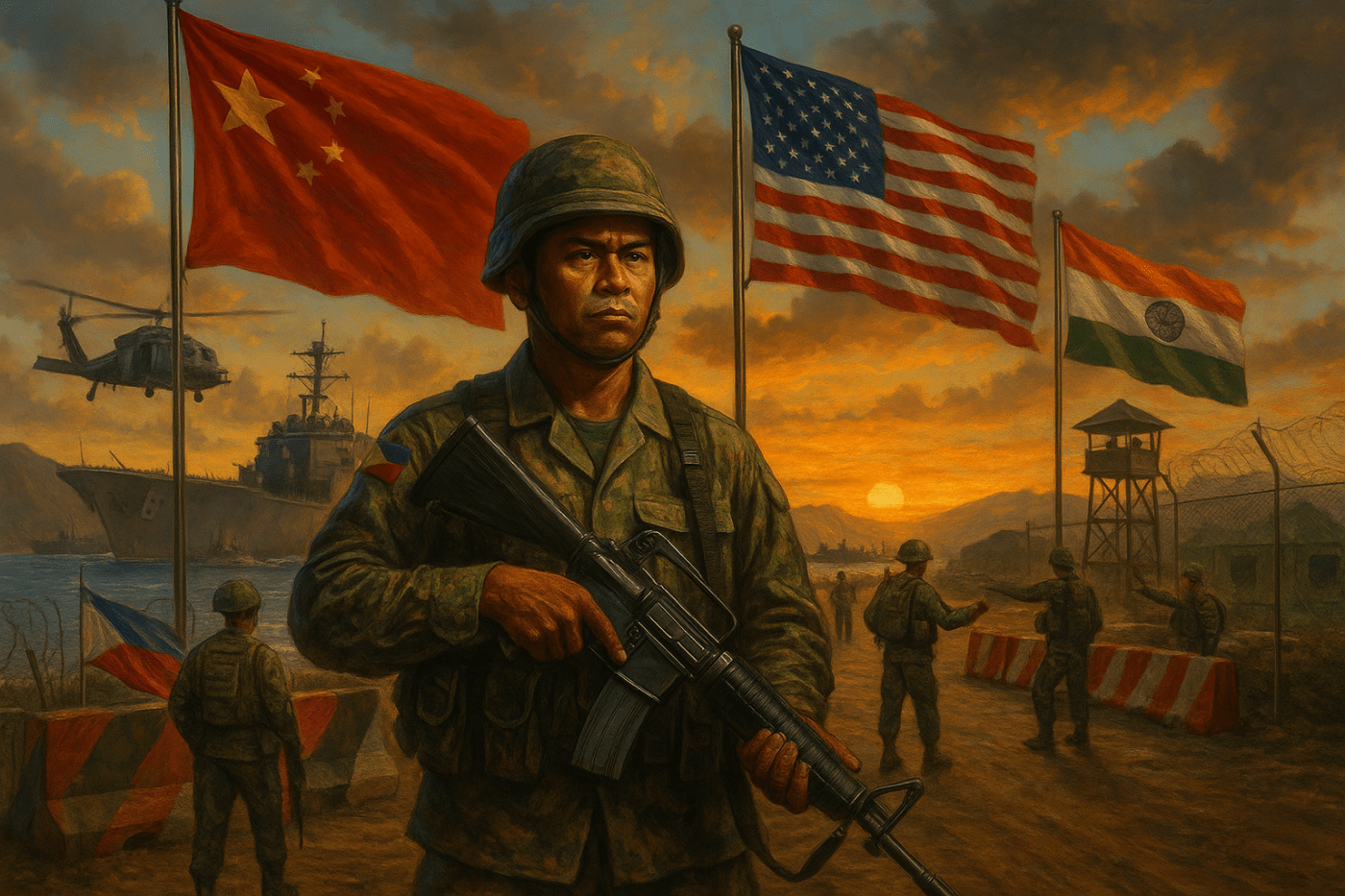
Zee News performs propaganda, not journalism, staging war drills as patriotic spectacle. India and the Philippines are not asserting sovereignty—they are rehearsing U.S. war plans. This is not strategy—it is Sovereignty Theater managed by compradors under hyperimperial command. We must sabotage the logistics of empire and organize rupture, not reform.
By Prince Kapone | Weaponized Information | August 6, 2025
Signal Flares and Soundbites: How Propaganda Dresses Itself in Uniform
On August 6, 2025, Zee News declared with theatrical testosterone: “India Hits China Where It Hurts Most.” The headline is less a report than a performance—tabloid spectacle dressed in state colors. It recounts a joint India–Philippines naval drill in the South China Sea, presenting the maneuver as an act of righteous defiance against China’s so-called “aggression.” Prime Minister Modi is hailed for embracing Philippine President Ferdinand Marcos Jr., their warships portrayed as symbols of “strategic clarity” sailing through contested waters. In this retelling, India is the principled sentinel, the Philippines the willing junior partner, and China the specter in the wings—summoned not to be quoted, but to be feared.
Penned by Tarique Anwar—a journalist whose byline appears frequently across state-aligned platforms like Zee News and The Mooknayak—the piece reads like a transcription of foreign ministry dictation. There are no opposing quotes, no analysis, no friction—just a seamless stream of military choreography and diplomatic applause. This absence is not accidental. Zee News, owned by the BJP-linked Essel Group, has long operated as a mouthpiece for India’s ruling class, particularly when the interests of finance capital, arms contractors, and Washington’s think tank chorus harmonize. One such amplifier, the Observer Research Foundation (ORF)—historically funded by Reliance Industries and partnered with U.S. war lobbies like the Hoover Institution—supplies ideological reinforcement for this scripted convergence, framing confrontation as cooperation.
From its opening salvo, the article substitutes incitement for investigation. “Hits China where it hurts most”—but where, exactly? No evidence is offered. No consequences explored. The reader is asked to accept the fantasy that a brief naval pass-through in the Philippine Exclusive Economic Zone delivers a wound to the world’s second-largest economy. This is not journalism—it is cognitive warfare. It instructs the public to view military drills as virtue and escalation as equilibrium. It flattens geopolitics into a binary: China aggressive, India assertive, the West observant, and the seas open—but only to the “right” navies.
The language is engineered with propagandistic precision. Words like “historic,” “robust,” and “strategic” are thrown around like diplomatic glitter—meant to dazzle, not define. “Freedom of navigation” is wielded as a sacred incantation—never explained, always sanctified. The article avoids hard data and instead leans on orientalist tropes: China is “monitoring” the drills, not through evidence or quotes, but through spectral suggestion. It is not reporting—it’s mood management. The goal is to stir unease, suppress critique, and attach feeling to policy.
What emerges is a carefully balanced false equivalence. The drill is offered as a counterweight to China’s territorial claims, as if symbolic gestures in open water carry the same gravity as actual infrastructure, economic leverage, or doctrine. This isn’t strategy—it’s Sovereignty Theater. A stage-managed performance of autonomy, executed with borrowed ships, press release choreography, and Pentagon-approved coordinates. The message is said to be loud—but who is listening, and what are they meant to hear? The article doesn’t say. Because it’s not there to clarify—it’s there to condition.
Material questions vanish in the fog: What capabilities were tested? What risks calculated? What budget expended—and for whose benefit? There is no mention. No voices from China. No critics from the region. Not even the token nod to “dissenting views.” It glides forward frictionlessly, because friction is the enemy of illusion. It’s not coverage—it’s choreography. A performance meant not to reveal, but to conceal.
And just when the jingoism begins to overextend, the article soothes itself with a lullaby: the drills were “peaceful,” “no untoward incidents” occurred, and “diplomacy remains key.” This is the velvet glove atop the iron gauntlet. Militarism becomes pacifism. Escalation is rebranded as dialogue. And empire, once again, is recast as stability. It is a lullaby meant to tranquilize the masses, to dull the instinct to question, and to allow the machinery of imperial provocation to proceed uninterrupted.
In the end, the article is not a report of events—it is a delivery mechanism for manufactured consent. It doesn’t report—it rehearses. It doesn’t analyze—it aligns. And it doesn’t ask the reader to think—it trains them to obey. It functions precisely as intended: not to document the world, but to weaponize it.
Occupation by Another Name: The Philippines as Forward Operating Zone
The Zee News article offers several claims, presented without scrutiny, that can be verified:
- India and the Philippines conducted a joint naval sail in the South China Sea.
- The maneuver took place within the Philippine Exclusive Economic Zone and included warships from both nations.
- President Marcos Jr. made a state visit to India during which a Joint Declaration on Strategic Partnership was signed.
- India reaffirmed its position on maritime freedom and the South China Sea as global commons under UNCLOS.
- China’s objections to foreign military presence were alluded to but not quoted directly.
The attempt to frame the India–Philippines joint naval drill as a sovereign assertion obscures its deeper strategic purpose: to integrate semi-colonial states like the Philippines into a U.S.-led infrastructure of hyperimperial containment. These are not defensive exercises born of mutual interest—they are rehearsals for regional war, calibrated to the Indo-Pacific architecture mapped by U.S. military planners. The Philippines is not a co-equal partner; it is a militarized node. The ships may fly Indian flags, but the coordinates were drawn in Pentagon war rooms.
This node did not appear overnight. It was engineered through a sequence of U.S. footholds—most notably the Enhanced Defense Cooperation Agreement (EDCA), signed in 2014, which permits the U.S. military to construct and operate facilities on Philippine bases under the pretense of “rotational access.” According to the U.S. State Department, EDCA allows U.S. forces access to “agreed locations” for training, prepositioning of equipment, and base development in coordination with the Armed Forces of the Philippines. The Asia Maritime Transparency Initiative shows that these sites—including bases in Pampanga, Palawan, and Nueva Ecija—are upgraded with U.S. funds, maintained with U.S. logistics, and accessed freely by U.S. military personnel despite formal Philippine ownership. EDCA is not a partnership; it is a colonial lease cloaked in diplomatic euphemism. And as Weaponized Information has documented, these bases now house Tomahawk-capable launchers, expeditionary HIMARS units, 3D-printed FPV drone assembly points, and U.S.-led joint air-sea-ground redeployment rehearsals—all within reach of the Taiwan Strait.
India’s participation in the drills—heralded as “strategic clarity” by Zee News—is not an isolated gesture. It signals alignment with a broader strategy in which Philippine sovereignty is auctioned to the highest bidder. The handshake between Modi and Marcos cannot disguise the material contradiction: the Philippines’ largest trading partner is China, yet its territory is now militarized against Beijing. This is not strategy—it is structural schizophrenia, governed by a comprador elite that trades national autonomy for weapons systems and press conferences.
The article’s invocation of “freedom of navigation” further reveals the imperial assumptions at work. There is no record of China obstructing commercial shipping in the South China Sea. As the Center for a New American Security admits, the real contest is over military access: the U.S. and its allies demand the right to deploy near China’s periphery, while rejecting any reciprocal Chinese activity near their own. “Freedom,” in this case, is not a shared principle—it is a one-way entitlement.
These “joint exercises” are framed as training in cooperation, but they are better understood as dry runs for joint operations under U.S. command. The Philippine military, increasingly integrated into U.S. doctrine and logistics, is being fused into the operational code of an imperial war machine. As Reuters reports, U.S. and Philippine troops conducted live-fire drills in Zambales—including shooting down drones using U.S.-provided systems—as part of the Balikatan exercises. These actions illustrate the militarization of Philippine territory and the operational fusion of local forces into imperial war logistics—not symbolic cooperation.
India’s role in this configuration reflects its own class contradictions. The Modi government postures as a leader of the Global South while doubling down on defense ties with Washington. It attends BRICS summits while importing Lockheed weapons systems. It trumpets self-reliance under Atmanirbhar Bharat while contracting U.S.-Israeli surveillance firms. This is not multipolarity—it is sub-imperial brokerage. India’s ruling class is not navigating sovereignty—it is managing subcontracted empire. As Weaponized Information’s analysis of India’s role in BRICS+ makes clear, this contradiction is not strategic—it is structural.
In the final analysis, the India–Philippines naval drill is less a signal to China than a performance for Washington. India affirms its role in the Indo-Pacific pivot. The Philippines, meanwhile, sacrifices land, autonomy, and future generations in exchange for “strategic partnership.” This is not regional solidarity—it is the choreography of containment, executed in borrowed uniforms and on occupied soil.
When the Curtain Falls: Sovereignty Theater in the Age of Hyperimperialism
Every empire stages illusions before collapse. The naval drills between India and the Philippines—wrapped in the rhetoric of “strategic clarity”—are no exception. Behind the press releases and photo ops lies not sovereign statecraft, but a carefully directed performance. What we confront here is a textbook case of Sovereignty Theater: a script in which nominally independent states play the role of empowered actors, while their movements, weapons systems, and alignments are choreographed by an empire in decline. The setting may be Manila or New Delhi, but the command center remains Washington.
This performance is not an isolated act. It is the structural symptom of Imperial Decline: a unipolar system unraveling under its own contradictions. Decline, in this case, does not mean retreat—it means outsourcing. The U.S. is shedding the optics of occupation, replacing boots on the ground with basing agreements, joint exercises, and logistics corridors managed by client states. The missile systems may wear foreign flags, but the launch codes serve imperial command.
This is the infrastructure of Hyperimperialism: a modular, digitally networked system of domination that no longer requires formal colonization to maintain global control. It operates through interoperability, surveillance grids, forward staging zones, and compliant regional brokers. The India–Philippines drills were not evidence of regional strength—they were dry runs for regional war, embedding submission protocols into war logistics and supplying spectacle to the imperial center.
To sustain this system, empire depends on its brokers. This is the logic of Comprador Capitalism: a class formation whose function is to extract surplus for foreign patrons while pacifying the local population with symbolic performances of autonomy. That both the Indian and Philippine ruling classes mirror each other—signing defense pacts, parroting Indo-Pacific talking points, and inviting foreign militaries onto sovereign soil—is not coincidence. It is the behavior of managers, not leaders. Their job is not to protect sovereignty, but to perform it while leasing it out in the back room.
This is why the language of “authoritarianism” functions as imperial sleight of hand. The article accuses China of “aggression” without evidence—but the real authoritarianism is structural. It is not China who is building missile bases across Luzon or launching BrahMos from Palawan. It is not China whose war doctrine dictates the logistics of EDCA or the choreography of Indo-Pacific drills. The accusation of authoritarianism deflects from the imperialism that enforces subservience with budgets, battalions, and base-building disguised as security cooperation.
What emerges from this is not a sovereign coalition, but a subordinate fusion into empire. The EDCA sites and India’s maneuvers are not expressions of autonomy—they are compliance mechanisms. The armed forces involved are no longer defenders of national territory—they are custodians of imperial sea lanes. Land is not governed—it is leveraged. Consent is not earned—it is presumed. And when the fire comes, it will not land in Virginia or San Diego. It will land in Isabela and Visakhapatnam.
For the global working class and peasantry, the script reads in reverse. These drills are not about defense—they are about deployment. These partnerships are not about peace—they are rehearsals for war. Stability is a marketing term for occupation. Its function is not to safeguard sovereignty—it is to prevent it. The endgame of hyperimperialism is not just domination—it is the preemption of any future where domination is no longer viable.
The response must not be reformist. As Weaponized Information has documented, this means targeting the systems of embedded warfare before they become active war zones. These drills are not just maneuvers—they are warnings. The declarations are not just empty symbolism—they are structural betrayals.
What unfolded in the South China Sea is not proof of strength. It is proof of how deep the imperial hand has penetrated the postcolonial state. But for those organizing in the shadows of the war machine, the curtain has lifted. The theater is exposed. And the next act belongs to us.
The Field Is Ours: From Resistance to Revolution
The theater of war may be scripted by empire, but the stage belongs to us. As joint naval drills and diplomatic posturing escalate, so too does the crisis of consent within each state that participates. In the Philippines, student activists blockade weapons shipments near Subic Bay. In India, farmers erect highway occupations against military land grabs in Odisha. These are not symbolic gestures—they are rupture points. And every war rehearsal, every logistics corridor, every surveillance base can become a frontline of disobedience.
We propose a four-part strategy of Global North solidarity with emerging resistance in semi-colonial nations:
- Disinvest from Militarism: No more investments in war profiteers. Trade unions, pension boards, and university endowments in the imperial core must pressure financial institutions to divest from weapons contractors complicit in the Indo-Pacific buildup. This includes those profiting from India’s BrahMos production and the EDCA expansion in the Philippines, documented by BAYAN USA’s 2024 fact-finding report.
- Disrupt the Supply Chain: Use open-source intelligence (OSINT) to map the empire’s logistics—radar installations, drone factories, port visits. Build shared visualization tools, support local land defenders with actionable data, and expose war infrastructure as a publicly trackable system. This disruption strategy contributes to the construction of Dual and Contending Power, rooted in people’s sovereignty over imperial logistics.
- Amplify Resistance Voices: Translate and circulate dispatches from Filipino mass organizations like BAYAN, GABRIELA, and ICHRP, and from Indian peasant rights coalitions resisting displacement and corporate land grabs. Fund translation projects. Host teach-ins. Build digital channels that link frontline organizing to international networks of solidarity.
- Coordinate Transnational Disruption: Model cyber solidarity on precedent campaigns such as #BDS and #StopCopCity. Launch targeted hashtags like #StopEDCA and #NoQuadWar, support digital walkouts from weapons expos, and organize coordinated teach-ins that link militarized dispossession in Mindoro to evictions in Mumbai. Draw inspiration from historical BRICS+ protest mobilizations and re-center anti-imperialist unity from below.
This is not global governance—it is global counter-governance, in the sense theorized by Samir Amin and echoed by the Tricontinental Institute. Our objective is not to reform the imperial architecture, but to destroy it. Not to ask for inclusion, but to build a world where comprador elites cannot sell sovereignty, because it belongs to the organized masses.
Empires cannot function when their logistics are visible, when their secrecy is shattered, and when their forward bases are confronted by mass refusal. We are not here to interpret their choreography—we are here to interrupt it. The Indo-Pacific war map is drawn. Our task is to redraw it. From Manila to Mumbai, Luzon to Ladakh, the most revolutionary act is to say: we see it, we name it, and we will not let it pass.
When they rehearse war, we must rehearse rupture. Let every press release be a detonator of exposure. Let every logistics hub face organized refusal. This is how we reclaim sovereignty—not in ceremony, but in struggle.
 Weaponized Information
Leave a comment