As the U.S. government reinstalls a Confederate war criminal in the capital, it reveals not a flaw in its democracy—but the very foundation of its rule.
By Prince Kapone | Weaponized Information | August 5, 2025
The Statue Falls, the Empire Rebuilds It
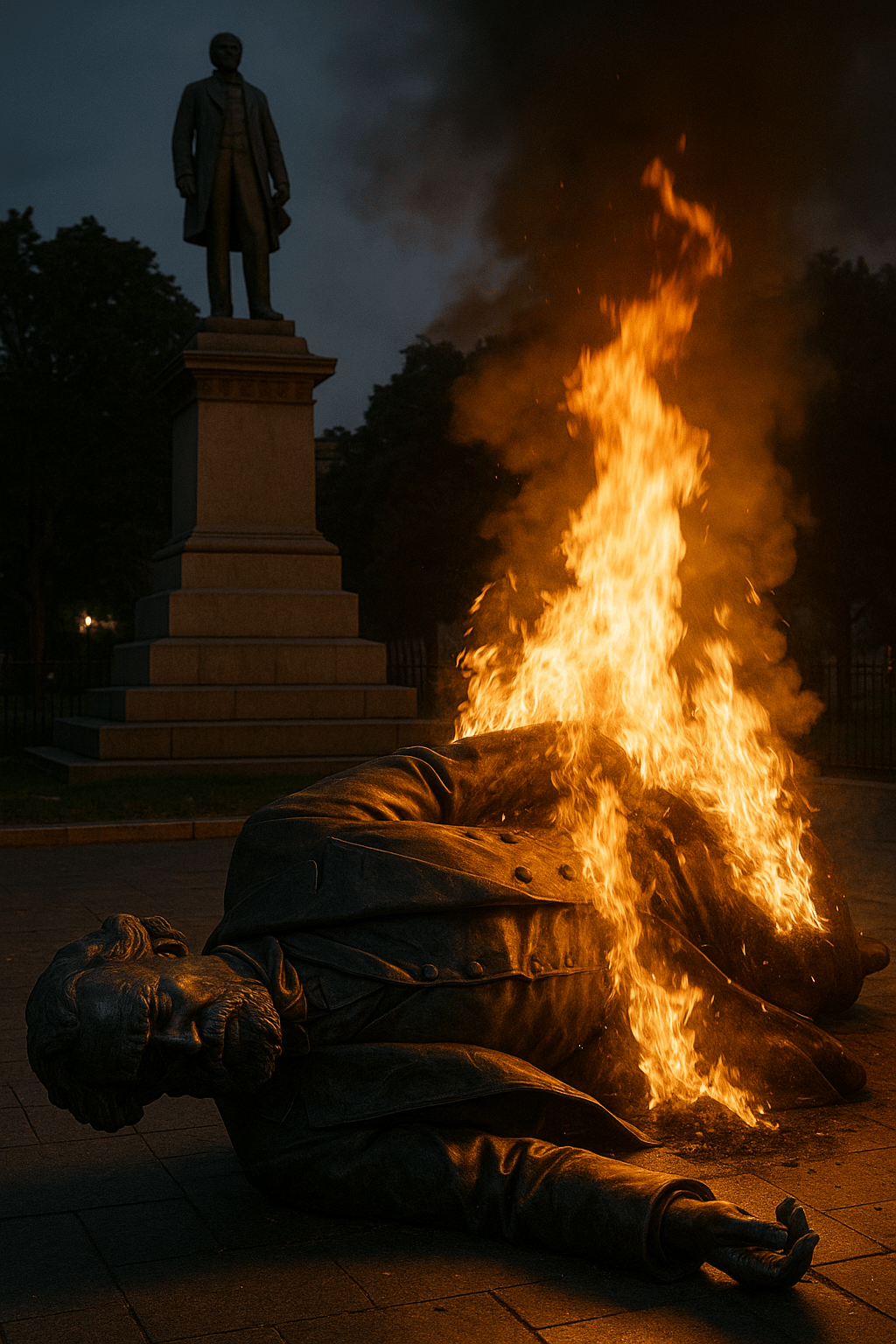
They dragged it down on Juneteenth. Ropes wrapped around the bronze neck of a man who fought to keep others in chains. Protesters, not vandals, brought the statue of Albert Pike crashing into the concrete of Judiciary Square in the summer of 2020—a righteous act of memory, not erasure. They set it ablaze not out of hatred for history, but out of love for the truth it had buried beneath granite and state-sanctioned lies. That was during the George Floyd uprising, when the streets smelled of tear gas and liberation, and even the dead began to rise to speak.
But now, in 2025, the U.S. government is putting him back. Not in a museum. Not in a textbook footnote where disgraced Confederates belong. Back on his pedestal. Back above the heads of the living. The National Park Service has announced that Pike’s statue will be restored and reinstalled by October, just blocks from the National Mall. The justification? “Historic preservation.” A campaign to “beautify the capital.” And, more ominously, executive orders issued by President Trump under titles that sound like psychiatric reports for a collapsing empire: “Restoring Truth and Sanity to American History.” You can’t make this up. You don’t have to.
Every ruling class lies. But when they start pouring public funds into bronzing those lies and bolting them into the center of the capital, it’s not just historical revisionism—it’s a declaration of war on memory itself. Pike wasn’t toppled because he wrote bad poetry. He was toppled because he represented a tradition of genocidal arrogance and slaveholding brutality that never really ended—it just put on a suit, joined the board of Raytheon, and wrote executive orders in cursive.
This isn’t about a statue. It never was. It’s about who gets to define what counts as beauty, what counts as truth, what counts as sanity. And in a settler-colonial regime like the United States, beauty is always white, truth is always property, and sanity is the uninterrupted functioning of racial capitalism. Which is why a slave-owning, pro-slavery, pro-genocide Confederate general is deemed worthy of federal protection and historical reverence, while the people who toppled him—risking arrest and police violence—are treated like criminals or, worse, forgotten.
Let’s not forget that this statue wasn’t torn down in secret. It was pulled down in broad daylight, in the shadow of federal buildings, as a public act of historical correction. The people did what the state would not: they stripped away the mythology, the marble, and the state-funded delusion that Pike was anything more than a glorified war criminal in civilian clothes. They burned the statue not out of nihilism, but as a cleansing ritual. They did not destroy history. They exposed it.
So when the Park Service puts it back up this October, they won’t just be hoisting bronze. They’ll be hoisting the worldview of a dying empire gasping for legitimacy. They’ll be reasserting who owns public space, who defines memory, and who is authorized to speak for the dead. But some dead don’t need bronze to be remembered. Their legacy lives in fire, not in plaques. And history, no matter how tightly fastened to its pedestal, has a way of coming down again.
Sanitizing Slavery with Titles and Stone
Albert Pike is not some misunderstood intellectual whose legacy has been unfairly tarnished by modern “wokeness.” He was a slaveholder, a Confederate general, and a political reactionary who aligned himself with white supremacist causes before, during, and after the Civil War. He joined the Know-Nothing Party—an anti-Catholic, anti-immigrant hate group—but stormed out when they wouldn’t explicitly endorse slavery. In 1861, he was given a Confederate commission to “manage” Native American alliances, and according to wartime records, his troops committed war crimes so grotesque he was forced to resign. And yet, here he is again—being glorified as a “Philosopher,” “Philanthropist,” and “Scholar” on a monument paid for and erected in 1901 by the Southern Masonic elite.
The statue’s inscriptions tell you everything you need to know about how the U.S. ruling class manufactures historical memory. Not a word about his Confederate service. Not a mention of the bodies left behind. Just a sanitized list of liberal honorifics, as if the blood on his hands could be washed off with Latin. A man who fought to preserve the plantation economy is memorialized in the nation’s capital not as a soldier of white supremacy, but as a kindly old man in civilian clothes, surrounded by allegory and marble. It’s historical alchemy—the transmutation of reaction into reverence.
And what’s most grotesque is that the Freemasons, who commissioned and protected the statue, knew what they were doing. They weren’t celebrating Pike’s poetry or his so-called “esoteric writings.” They were honoring him for being a pillar of their class: white, landed, male, and unrepentantly committed to the racial order that undergirded American capitalism. The statue was a reward. A signal. A reminder to those passing by that this city—this empire—remains in the hands of the same forces that built it atop the backs of the enslaved.
This is how empires lie: not just with words, but with marble. Not just in textbooks, but in traffic circles. They put up statues not to remember the past but to impose it on the present. And in the U.S., they use the language of “heritage” and “history” as camouflage for the most cowardly kind of nostalgia—a longing for the time when the subjugation of others was openly celebrated, not hidden behind think tank white papers and bipartisan committee reports.
So the next time someone tells you that toppling statues is erasing history, ask them whose history they mean. Because no child has ever learned about Gabriel Prosser, Denmark Vesey, or Charles Deslondes by walking through Judiciary Square. No monument commemorates the hands that built Washington, D.C.—Black, bound, and brutalized. But a man like Pike? He gets polished, preserved, and paraded back into public view like some great-grandfather of “civilization.” Because in America, slavery is not just a chapter in a textbook—it’s a credential carved into stone.
The Freedom Fighters They Fear to Name
There are no statues of Nat Turner on the National Mall. No marble columns honor Gabriel Prosser or Denmark Vesey in the plazas of power. Charles Deslondes—who led the largest slave rebellion in U.S. history, marching downriver to take New Orleans in 1811—isn’t immortalized in bronze beside the Capitol. These men were not passive victims of slavery. They were strategists, insurrectionists, and visionaries who fought to burn the entire system of racial terror to the ground. They didn’t beg for inclusion. They picked up blades, rallied the enslaved, and attempted to build a new world from the ashes of the old. And for that, they’ve been disappeared from public memory.
The U.S. does not forget its history. It selectively curates it. It elevates those who defended the plantation and buries those who torched it. That’s why Confederate generals stand tall in public squares, while Black revolutionaries rot in the footnotes. That’s why Pike is reinstalled with federal ceremony, while Vesey is lucky to get a modest monument tucked away in a Charleston park. Turner’s name is invoked only to pathologize Black rage. Deslondes is barely mentioned in high school curricula. And Gabriel—who plotted the liberation of thousands and was executed for it—is reduced to a trivia question at best.
But this is not an accident. It is the psychological arm of counterinsurgency. A war on memory, disguised as commemoration. A program of ideological containment, where the enemy is not only rebellion but the idea of rebellion. Because to memorialize Nat Turner is to admit that slavery was not simply an unfortunate chapter—it was a violent system that bred violent resistance. To build monuments to Gabriel and Vesey is to confess that American freedom was not granted—it was seized. And that is what the state cannot allow.
They say history is written by the victors, but that’s only half true. In the United States, history is written by those who own the printing press, the land, and the police. And in their version of history, Albert Pike is a philosopher, while Nat Turner is a terrorist. Confederate generals are men of honor, while Charles Deslondes is unfit for a school name. It is not just injustice—it is narrative warfare. A campaign to erase the moral clarity of the enslaved who chose freedom by any means necessary, and replace it with the polished lies of men who fought to deny it.
So let us name them. Not just once, not just here—but again and again, until their names drown out the marble hymns of settler nostalgia. Nat Turner. Gabriel Prosser. Denmark Vesey. Charles Deslondes. These were not criminals. They were abolitionist warriors, fighting the purest form of tyranny this country has ever known. And if the U.S. cannot find it in itself to build statues in their honor, then we should build memory into the movements we lead and the struggles we wage. Because the truth is this: the only people who have ever fought for actual freedom in this country are the ones America buried—without monuments, without mercy, and without apology.
The Cult of the Confederacy and the Architecture of Amnesia
Albert Pike’s return is not an isolated incident. It’s part of a broader counteroffensive—a cultural restoration campaign orchestrated by the very forces whose power is threatened by the truth. Since Trump’s return to office in 2025, his administration has aggressively revived Confederate and colonial iconography under the pretext of “restoring sanity” to American history. This isn’t just rhetorical nostalgia. It’s policy. It’s statecraft. It’s the weaponization of memory to cement a racial, imperial, and class hierarchy whose legitimacy is slipping by the day.
This is why Fort Bragg is once again Fort Bragg. Why books are being pulled from school libraries and replaced with sanitized civics lessons that equate slave revolts with terrorism and equate the Confederacy with regional pride. It’s why “heritage” groups have re-emerged with new funding streams and new branding, laundering old white supremacy through slick logos and patriotic veneers. It’s why monuments once removed are now being reinstalled—under federal protection, at taxpayer expense, in cities filled with the descendants of the people those men enslaved.
The ruling class knows the empire is cracking. It knows the mythologies that held it together—the rugged individualism, the benevolent founding fathers, the “land of the free”—are wearing thin. So it doubles down. Not with truth, but with bronze. Not with reconciliation, but with restoration. It builds statues to the past not to remember it, but to recruit the present into defending it. These aren’t just cultural artifacts. They’re ideological instruments. Recruitment posters for a dying order that needs new foot soldiers.
Every time a Confederate statue goes back up, it sends a signal. To police. To white vigilantes. To militia groups. To disillusioned white workers clinging to identity as capital dries up. It tells them: this is your country. This is your history. These are your heroes. And anyone who says otherwise is the enemy. That is the political function of the cult of the Confederacy. It is not about history. It is about power. It is about who gets to belong, and who must be surveilled, silenced, or expelled.
Pike’s reinstallation is not the past returning—it’s the present revealing itself. The United States never left the plantation. It digitized it. It globalized it. And now, with its legitimacy in crisis, it looks backward not to reflect, but to reload. That’s what this statue is. A weapon. An altar. A warning. And if we are not prepared to confront it—physically, ideologically, and organizationally—we will find ourselves once again bowing to marble gods erected by the same hands that once held the whip.
Cognitive Warfare by Other Means
When the state restores a statue like Albert Pike’s, it is not just engaging in historical revisionism—it is executing psychological operations. This is cognitive warfare waged through granite and bronze. A campaign not merely to preserve a narrative but to discipline a population. Every monument is a thesis statement. Every pedestal is a claim to moral authority. And when that pedestal is occupied by a man who fought to enslave, it tells the world exactly whose freedom the state exists to protect—and whose freedom it exists to crush.
This is not speculation. It is strategy. Trump’s executive order, “Building and Rebuilding Monuments to American Heroes”, explicitly mandates the construction and protection of statues that “reflect the greatness of our country.” But in practice, “greatness” is a code word. It does not mean abolitionist rebellion. It does not mean liberation. It means hierarchy. It means whiteness. It means empire. And it is enforced by the full machinery of the state—from the Park Service to Homeland Security to the coordinated propaganda of educational reform and culture war hysterics.
This is how counterinsurgency functions in the imperial core. Not just through drones or curfews, but through symbols and silences. It is not enough to beat back a protest; the memory of that protest must also be erased, its meaning inverted, its legacy vilified. That’s why statues come down in fire and rage—and return in bureaucratic press releases. It is a battle between collective memory and official myth, between the unfinished freedom struggles of the oppressed and the ideological demands of a settler state in decline.
In this context, Pike’s statue is less a relic and more a re-education tool. It tells the colonized that their rebellions will be forgotten, their heroes unhonored, their stories unworthy of stone. It tells poor white people that the past belongs to them, that their ancestors fought “nobly,” that they too can reclaim pride through patriotic submission. It tells us all that history is settled, written, and no longer up for debate. And it is this performance—this simulation of stability in the midst of unraveling—that defines the current phase of imperial ideology: brittle, aggressive, and desperate.
But no amount of bronze can stabilize a collapsing order. You can’t reinstall legitimacy with a crane. You can’t restore the aura of empire by polishing its pedestals. These monuments are not signs of confidence. They are symptoms of fear. The ruling class is terrified—not of the past—but of what the past might inspire in the present. Terrified of the memory of resistance. Terrified that statues might fall again—and this time, that something better might be built in their place.
The Memory of the Oppressed Will Outlive the Marble of the Masters
The question is not why Albert Pike is being reinstalled. The question is why the empire needs him back up there so badly. Why now, in this moment of escalating crisis, mass political disillusionment, and deepening social fragmentation, must a Confederate war criminal be paraded as a “philosopher”? Why does the state demand that we remember him, and not the ones who resisted him? Because empire, when it teeters, returns to its origin story. It wraps itself in old myths. It raises its dead. It calls its ghosts back to discipline the living.
And yet, despite their best efforts, there are no statues that can bury the truth. Not permanently. Every bronze general standing tall is surrounded by the silence of those the system fears to name—those whose lives and sacrifices, though unchiseled, remain etched in the minds of those who carry history not in textbooks but in blood. Nat Turner doesn’t need a statue to be remembered. Gabriel Prosser doesn’t need a grant to be honored. Denmark Vesey lives in every act of rebellion. Charles Deslondes rides with every march on power. The state can erase their names from its curriculum, but it cannot delete the desire they ignite.
Because that’s what terrifies the ruling class most: not that people will topple statues, but that they will remember why. That they will see in Pike’s polished face not a hero, but a tyrant. That they will begin to question the stone foundation of this republic and ask themselves what else has been built on lies. And once that question is asked, the rest unravels. The myth of American democracy. The sanctity of the Constitution. The innocence of capitalism. The whole rotted scaffolding begins to creak.
This is why the struggle over memory is not symbolic—it is strategic. Because the side that defines the past controls the future. And if we allow the empire to keep elevating slavers while erasing revolutionaries, we resign ourselves to more of the same: more repression, more surveillance, more ideological warfare masquerading as heritage. But if we fight to remember—if we teach our children the names of those who truly fought for freedom, if we honor them not with stone but with struggle—then we reclaim history not as trauma, but as a weapon.
Let them put Pike back on his pedestal. Let them crown him with laurel and lies. The oppressed have always known that no statue stands forever. They fall—sometimes with ropes, sometimes with revolutions. And when they do, the ground remembers. The memory of the oppressed is heavier than stone, sharper than inscriptions, and more enduring than any empire’s monuments. Let them build. We will rise.
 Weaponized Information
Leave a comment