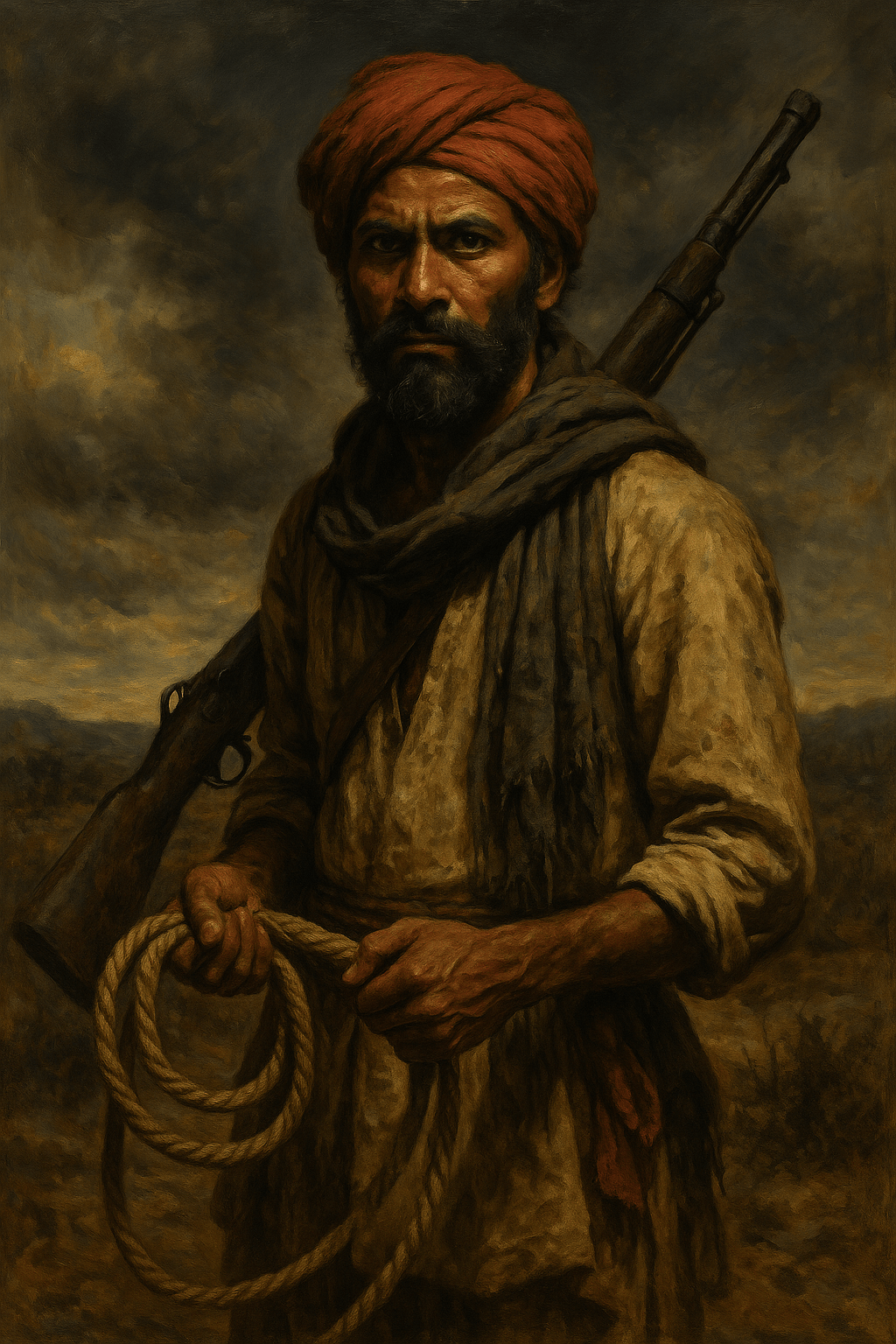
When labor is outlawed and life is disposable, strangulation becomes political economy
By Pablo Katari | Weaponized Information | August 1, 2025
I. Of Beggars and Bandits: The Specter Beneath Civilization
History, when written by the victorious pickpockets of the world-market, is quick to condemn those who steal outside its formal registers. And so we are told that India, land of spices and famines, suffered a peculiar scourge: the thuggee, a secret cult of ritual stranglers who murdered for Kali, godless fanatics devoted to death for death’s sake. Such is the fable spun by the colonial chroniclers—who, in their zeal to moralize the rope, conveniently strangle the truth.
But let us set aside the pious fictions of British bureaucrats and their German parrots. Let us instead begin where all serious inquiry must—with the material reproduction of life. For the so-called thug was not born from some congenital bloodlust, nor from the womb of superstition, but from the entrails of a society ripped open by imperial plunder. He was not a remnant of an archaic world, but the offspring of its annihilation.
The thug was, in essence, a political economist—of a peculiar sort. He did not trade in cotton, but in corpses; did not levy taxes, but tolls of terror. And like every good merchant under capitalism, he specialized in alienation: of breath from body, of body from kin, and of kin from history. If his profession shocks the delicate conscience of the European bourgeoisie, it is only because he practiced, at the level of the roadside, what they perfected in the counting house: accumulation through annihilation.
What, after all, distinguishes the thug from the East India Company functionary who starved whole provinces to swell London’s grain markets? Only the scale of operation and the sacramental honesty of the act. The Company killed by spreadsheet, the thug by scarf. Both served Kali, though only one dared speak her name.
We must then ask not what pathology produced the thug, but what mode of production necessitated him. Who cut the peasant from his land and made the strangler from his shadow? Who broke the village economy into fragments and cast its refuse into the forests, there to feed on the ruins of a world that no longer wanted them? The answer, as always, is the same: the British Empire, midwife of misery, executioner of economies, evangelist of extermination—who now condemns the very monsters it fashioned from famine and dispossession.
In the thug, we glimpse not the return of barbarism, but its inversion. He is no more savage than the system that expelled him, no more violent than the empire that starved his kin. He is the ghost of subsistence past, returned with a noose, to remind capital that what it cannot absorb, it will ultimately confront.
II. From Grain to Garrote: The Dispossession of India and the Birth of the Thug
It was not Kali who tore the plough from the peasant’s hands—it was the Permanent Settlement of 1793. Nor was it any ritual compulsion that sent entire castes fleeing the village—it was the cash nexus, driven like a bayonet into the spine of Indian agrarian life. Where once land yielded subsistence and kinship governed tenure, now taxes flowed in coin, rent mounted like corpse-heaps in a famine, and the cultivator was recast as a debtor, a vagrant, or worse—an outlaw.
The so-called thug was born not in the shadows, but in the full light of colonial “reform.” The Company’s scribes, ever eager to quantify their conquest, measured out the village in acres and rupees, converted subsistence into surplus, and called it civilization. What they could not commodify, they criminalized. What they could not tax, they annihilated. The forests into which the disinherited fled became breeding grounds not for demons, but for men without futures.
This was the alchemy of empire: the conversion of famine into labor surplus, and of surplus labor into menace. The thug was nothing if not adaptive—he scavenged the refuse of a shattered economy and repurposed it into his own. The kinship networks of the peasant became the blood-compacts of the band. The pilgrimage routes, once sacred veins of exchange, became the arteries of ambush. And the strangling scarf—rumāl—stood in for the landlord’s writ: both extracted life from the subaltern, though one did it with ceremony and the other with legality.
Let bourgeois historians wax lyrical about the “mysteries” of thuggee. Let them catalogue skulls and simulate rituals. We, however, ask the prior question: what material conditions made death a profession? For when the peasant is torn from his land, the artisan from his guild, the pastoralist from his route—what remains is not a labor force, but a residue. And in the residue, empire finds its most ungovernable contradiction.
The thug did not signify a return to feudalism, nor a deviation from progress, but a symptom of its genocidal core. He was a by-product of primitive accumulation—the refuse expelled from the belly of the machine. And if he resorted to strangulation, it was only because he had already been economically suffocated.
III. Kali’s Currency: The Political Economy of Strangulation
Let the Enlightenment gasp: how could a cult of killers persist for centuries across the breadth of a subcontinent? The answer, dear reader, is not to be found in theology, but in economy. The thuggee system was not a disorder in Indian society, but a rational response to a world made irrational by conquest. It was not chaos, but counter-order—precisely calibrated to extract, reproduce, and survive in the interstices of colonial rule.
At the base: loot. Not plunder in the feudal sense, nor speculation in the capitalist sense, but redistribution via death. The thug band functioned as a mobile enterprise, an extralegal syndicate, a traveling commune of surplus extraction—only their surplus was not profit, but plundered possessions, parceled out along lines of labor performed. One observed here, with dark precision, the division of labor: the jemadar as captain and administrator; the scouts as intelligence-gatherers; the stranglers as executioners; the diggers as custodians of disappearance. If the factory had its overseer, the thug band had its jemadar; if the bourgeoisie had its bookkeeper, the thugs had their tally of corpses.
Even reproduction was managed with proto-industrial regularity. Women, excluded from the act of killing, maintained domestic units in peripheral villages—organizing safehouses, laundering garments, managing goods, transmitting rituals. The thuggee was not a disorderly gang, but a disciplined collective—a traveling war machine of the lumpen.
And what of Kali? She was not a pretext, nor a hallucination. She was the deity of inversion, the feminine force of time and annihilation, but above all, she was the ideological armature that made sense of a world drowned in blood. The strangler did not kill because of superstition, but because he had been structurally severed from the means of life. Kali gave death a name, a pattern, a logic—precisely because capital had made life meaningless.
In this inverted world, where the peasant became a corpse-finder, and the road a ledger of unmarked debts, the thuggee stood as a grotesque mirror to the British civil servant. One taxed the living, the other the dead. One operated in the daylight of legality, the other in the dusk of banishment. Both served empire—though one from above, the other from below. In this, the thug was not an enemy of capital, but its bastard son, cast out and returned with rope in hand.
IV. Thuggee and the Colonial State: From Enemy to Allegory
The British state, whose own hands dripped with the blood of Bengal’s famines, now posed as the patron saint of the sanctity of life. It condemned the thug not for murder, but for unsanctioned murder. The real crime, after all, was not that the thug strangled travelers—but that he failed to remit a share of the loot to Whitehall. In the theater of imperial morality, the rope was only legitimate when tied by state decree.
Thus entered one William Sleeman, grand inquisitor of the Thuggee and Dacoity Department. A petty clerk in the grand machinery of empire, he was elevated to sainthood for having exterminated the cult of the garrote. In truth, he pioneered the very methods later perfected by the counterinsurgency states of the 20th century: surveillance, informant networks, ethnographic intelligence, legal exceptionalism. The thug was not arrested; he was classified. Not convicted, but categorized.
Sleeman’s genius was not merely to apprehend the thug, but to reinvent him. He transformed a decentralized network of survival into a centralized mythology of evil—an allegory for everything the British state claimed to civilize. The thug became a mirror in which empire could view itself in negative: where it imposed order, the thug sowed chaos; where it taxed, the thug extorted; where it governed, the thug conspired. That the empire itself had birthed the thug was a detail best left to the footnotes of moral philosophy.
With the Criminal Tribes Act of 1871, the state declared entire castes, clans, and itinerant communities to be hereditary criminals—criminal not by act, but by birth. Here the full horror of bourgeois reason is laid bare: it criminalized bloodlines, not behavior; made race the measure of guilt; and turned ethnology into an instrument of incarceration. Sleeman’s rope gave way to prison colonies, reformatory labor camps, and administrative genocide. The thug was gone—but his children were placed under perpetual surveillance.
And so the colonial state, while waging war against the thug, absorbed his methods: espionage, preemption, ideological warfare. The difference was that the state wrapped its rope in parchment, its violence in procedure. The thug rendered bodies lifeless; the state rendered entire populations invisible. The rope became red tape, and red tape—the most efficient garrote of all.
V. The Lumpenproletariat of Empire: A Reassessment
In the pious catechism of bourgeois historiography, the lumpenproletariat is forever cast as criminal detritus—those who, “unwilling to work,” live by theft, vice, or violence. The factory system, they say, was built by the honest worker; the lumpen merely loiters in its shadow. Yet in the colonial world, where factory and field were torn from the native altogether, where no labor market absorbed the dispossessed but instead cast them out like surplus carrion—who, then, becomes the lumpen? And who the lumpifier?
The thug is not an exception but a key. He reveals the fundamental condition of colonial modernity: that vast swaths of humanity, rendered economically redundant by imperial conquest, are maintained as a criminalized surplus—outside production, outside rights, outside life. The lumpen of the colonies are not idlers; they are amputated limbs of a violently restructured body politic.
In this context, the thug emerges not as a premodern relic but as an adaptive organism. Denied entry into legal exchange, he retools exchange itself. He does not oppose capitalism from outside but reflects its inverted logic—profit without production, accumulation without labor, discipline without wage. His methods are criminal only because the crime of capital leaves no legal form of survival.
Consider the broader lumpen of empire: the runaway slave turned maroon, the smuggler evading tariff and famine, the informal hawker on the street corner, the armed bandit in the highlands of Chiapas or the creeks of the Niger Delta. Are these figures evidence of moral collapse—or of history’s refusal to die quietly? Is the lumpen to be scorned for failing to integrate into capitalist discipline—or recognized as living fossils of another path, another potentiality, unearthed by violence?
Yes, the lumpenproletariat bears contradiction. It is fragmented, volatile, often ideologically pliable. It can be turned by reaction, by fascism, by religion, by bourgeois dreams of escape. But under certain conditions—when led by a revolutionary class, when fused with the broader struggle of the dispossessed—it can become insurgent. For in every gang lies a ghost of the commune; in every fugitive, a refusal; in every thug, the raw material of rebellion.
VI. From Thuggee to Trap House: The Afterlife of Lumpen Rebellion
The thug is dead. But his lineage lives—in the alleys of Lagos, the favelas of Rio, the council flats of London, the project stairwells of Baltimore. He no longer strangles pilgrims for loot—he sells fentanyl in plastic baggies, carjacks Teslas for bitcoin, livestreams shootouts on state-censored platforms. The forms have changed. The function remains. He is still surplus to the economy, central to its fear, and scapegoat for its crises.
In the imperial core, the modern lumpen is both target and byproduct of state violence. Deindustrialized, digitally policed, algorithmically contained—he is shaped by systems that simultaneously require and expel him. The “war on drugs” is merely the counterinsurgency logic of Sleeman in new dress: a justification for the preemptive suppression of entire surplus populations whose only crime is refusing to die in silence.
Like his ancestor in the ravines of Bundelkhand, today’s lumpen is condemned not because he kills, but because he survives without permission. The neoliberal city, privatized and policed to the bone, offers him no legal means of reproduction. In this terrain, the gang becomes a makeshift commune; the set, a surrogate kin network; the hustle, a form of non-waged labor. In place of Kali, there is capitalism itself—demanding sacrifice, rewarding ruthlessness, exalting accumulation.
And yet, bourgeois reformers wring their hands: Why do they kill each other? Why do they not simply get jobs? Why do they glorify violence? The same class that decimated public housing, gutted schools, offshored industry, and militarized the ghetto dares to ask why the children of the void worship the gun. The thug has returned, but not as a ghost—he walks now in Nike Airs and designer belts, not to haunt empire, but to survive it.
If the thuggee strangled travelers to redistribute their goods, the trapper slings poison to recoup rent. If one ambushed in forest clearings, the other posts up on Wi-Fi corners. Both inhabit the underside of a world where legality is monopoly and morality is a function of payroll. Both, too, are hated—not because they threaten order, but because they expose it for what it is: organized theft, systematized death, moralized barbarism in a three-piece suit.
VII. Revolutionary Resurrection: The Lumpen, the Commune, and the Question of Organization
It is not enough to indict the system that produces the thug. One must ask: can the rope be untied? Can the garrotter become the builder? Can the lumpen become the vanguard—not by moral reform, but through historical transformation?
The lumpenproletariat, as severed as it is from the direct processes of production, remains embedded in the relations of survival. It lives in the fissures of empire—its streets, prisons, refugee camps, favela alleys, and borderlands. There, it reproduces itself—illegally, informally, creatively—often in ways hostile to the prevailing order. This hostility is its virtue. But left unorganized, it turns inward. It strangles its own.
The bourgeoisie fears the lumpen not because it is criminal, but because it is unpredictable. It cannot be counted on for revolution—but neither can it be trusted with reform. Hence the obsession with surveillance, incarceration, and elimination. The thug, the gangbanger, the dealer, the pirate, the looter—each is cast as contagion, so that the system may justify preemptive repression.
And yet, history testifies: the lumpen can be organized. Maroon societies in the Americas, the mountain rebels of Haiti, the armed outcasts of the Chinese Red Base areas, the street soldiers of the Black Panther Party—all show that lumpen formations, when politicized by the revolutionary class, can become daggers pointed at the throat of empire. Not despite their exclusion, but because of it.
But this transformation is not spontaneous. The lumpen must be fused with the conscious proletariat, drawn into political struggle not as charity but as necessity. Revolutionary organization must penetrate the slums, the jails, the encampments—not to moralize, but to materialize a shared horizon. Not every hustler is a comrade. But every hustler lives at the mercy of capital. And from that fact, a program must be built.
To dismiss the lumpen is to hand them over to the fascists, the death cults, the narco-state, the police. To organize them is to reincorporate the exiled into the revolutionary totality. The thug, like the rope he wielded, can be repurposed—not as a tool of death, but as a ligament of the insurgent body politic.
VIII. Epilogue: Kali’s Revenge
The thug is gone. His scarf hangs in museums. His name, a slur in textbooks. His rituals, dissected by anthropologists like insects pinned under glass. But the world that made him—that dismembered his village, starved his kin, criminalized his existence—lives on, draped in liberalism, buttressed by satellite, lubricated by algorithm and drone strike.
Kali has not forgotten.
The empire that declared war on the thuggee declared war on the very idea of survival outside capital. It built railroads not to connect peoples, but to accelerate extraction; it burned forests to flush out rebels; it mapped tribes to imprison them; it replaced gods with stock exchanges and called it enlightenment. And yet, for all its power, it trembles still—before the bandit, the prisoner, the looter, the hustler. Because in each, it sees the return of the rope.
The lumpen of the twenty-first century is not romantic. He is violent, self-destructive, incoherent. But so was the first spark of fire, so was the slave who broke his chains. Revolution does not emerge from virtue. It erupts from contradiction. And in the lumpen—scattered, abandoned, reviled—history has deposited one of its most volatile contradictions.
The task, then, is not to revive the thuggee, but to transform the conditions that necessitate him. To build a world where one need not kill to live. To organize those who have been criminalized not because they are evil, but because they are excess to a system that sanctifies profit and strangles life.
Until then, Kali waits. Not as deity, but as dialectic. Not as goddess of death, but of rebirth—waiting, patient, in the slums and camps and prison yards, in the shadows where empire fears to tread. Her revenge will not be ritual—it will be revolutionary.
 Weaponized Information
Leave a comment